Tag Archives: Faith

On Religious Affections and Saving Faith

A few weeks ago, I was sitting in a Sunday school class, and we were discussing James 1.12, which says, “Blessed is the one who endures trials, because when he has stood the test he will receive the crown of life that God has promised to those who love him.” This verse raises an important question about the relationship between our affections for God and saving faith. In other words, if we are justified by faith alone in Christ alone, then what role do our affections play in saving faith. On the one hand, we do not want to reduce saving faith to mere intellectual agreement, i.e. “I believe that Christianity is true.” On the other hand, we do not want to reduce faith to sheer emotional experience, i.e. “I know I am saved simply because I feel close to God.” The Scriptures reject both of these reductions. Instead, the Scriptures present saving faith as the wholehearted response of a person to God’s self-revelation in Christ—a response that engages the mind, the will, and the affections. However, before we consider the relationship between saving faith and the affections, we must first ask a more basic question: What is saving faith?
Throughout the history of the church, theologians have commonly described saving faith as consisting of three essential elements: notitia (knowledge), assensus (assent), and fiducia (trust). Together, these categories help explain what it means to believe in Christ for salvation. First, a person must possess notitia, that is, a basic knowledge of the gospel and the identity of Jesus Christ. Second, that knowledge must be accompanied by assensus, an acknowledgment that the gospel is true. Yet Scripture makes it clear that knowledge and assent alone are not enough. James reminds us, “You believe that God is one. Good! Even the demons believe—and they shudder” (James 2:19). The demons possess both knowledge of God and an orthodox understanding of who he is, yet they remain in rebellion because they lack fiducia—a wholehearted trust that rests in God alone for salvation. Saving faith, therefore, is more than simply knowing the truth or agreeing that it is true; it is entrusting oneself to God in Christ. This naturally raises another question: What does that trust actually look like, and what role do our affections play in its expression?
The point, then, is that saving faith is never merely cognitive. As Paul writes in Romans 10:9, “If you confess with your mouth, ‘Jesus is Lord,’ and believe in your heart that God raised him from the dead, you will be saved.” In Scripture, the heart is far more than the seat of our emotions. It represents the very center of our personhood—the source of our thinking, willing, loving, and desiring. This is why, when Jesus is asked about the greatest commandment, he cites the Shema: “Love the Lord your God with all your heart, with all your soul, and with all your mind” (Matt. 22:37). Saving faith, therefore, is not merely the acceptance of certain propositions about Christ; it is the wholehearted entrusting of ourselves to him. Such faith redirects the deepest loves and loyalties of the heart toward the One who gave himself for us. At this point, however, an important distinction must be made. The affections are not the same thing as our passing emotions. Emotions often fluctuate with our circumstances, but the affections are the settled inclinations, desires, and loves of the soul. Consequently, when we trust in Christ for salvation, we do more than experience a passing feeling—we come to treasure him as the supreme object of our love and devotion.
Perhaps no theologian has reflected more deeply on this subject than Jonathan Edwards in his classic work Religious Affections. Writing during the First Great Awakening of the 1730s and 1740s, Edwards ministered in a period marked by extraordinary religious enthusiasm. As revival spread throughout the American colonies, many professed faith in Christ and displayed intense emotional experiences. Yet these developments raised an important question: How can we distinguish genuine saving faith from merely temporary or emotional religious excitement? It was this question that prompted Edwards to write Religious Affections. His central argument is that true religion “in great part consists in holy affections” because regeneration does more than inform the mind—it transforms the heart. Saving faith not only convinces us that Christ is worthy of our trust; it also reorients our deepest loves toward him. Edwards was therefore not measuring the authenticity of faith by the intensity of a person’s emotions. Rather, he sought to identify the enduring dispositions of the heart that inevitably accompany the new birth. In doing so, he helped clarify an important biblical truth: genuine saving faith transforms not only what we believe but also what we love.
The transformation of our affections begins with the regenerating work of God. Scripture does not describe salvation as the mere addition of new information to an otherwise unchanged heart. Rather, God promises, “I will give you a new heart and put a new spirit within you” (Ezek. 36:26). This is the new birth of which Jesus speaks in John 3 and the new creation Paul describes in 2 Corinthians 5:17. Regeneration changes the deepest orientation of the person, enabling us to see Christ as beautiful, trust him as sufficient, and love him as Lord. These new affections arise because, through faith, we are united to Christ by the Holy Spirit and begin to share in the life of the One to whom we belong. However, they do not earn our justification, nor do they become an additional ground of acceptance before God. We are justified by faith alone on the basis of Christ alone. Yet the faith through which we are justified is never left barren or unchanged. It becomes fruitful in sanctification because the Spirit who grants faith also renews the heart from which faith arises. The order, therefore, must be preserved: God regenerates, the sinner believes, God justifies, and the justified believer begins to grow in holiness. Our love for God, delight in Christ, and desire for obedience are not the merit of our salvation; they are the evidence that God has made us new.
This is the important distinction: our affections for Christ are evidence of our salvation and therefore contribute to our assurance, but they are never the ground of it. The foundation of our assurance rests entirely upon the finished work of Christ and the promises of God confirmed by the indwelling Holy Spirit. At the same time, the Spirit who assures us of our adoption also transforms our hearts, producing new desires and holy affections that testify to his ongoing work within us. Many believers ask the wrong questions when examining themselves. They wonder, “Do I feel enough?” or “Do I know enough?” Yet Scripture directs our attention elsewhere. The better question is, “Has Christ begun changing what I love?” Am I growing in my hatred of sin and my love for Christ? Do I desire to read and meditate upon God’s Word? Do I increasingly delight in holiness and long to obey him? Do I love God’s people and desire fellowship with them? None of these things earns God’s favor, but together they provide evidence that he has given us a new heart. The Christian’s assurance, therefore, rests on Christ alone, while the transformed affections of the heart bear witness that his saving work is truly taking root within us.
Saving faith, then, is far richer than either mere intellectual agreement or passing emotional experience. It knows the truth of the gospel, believes that truth to be certain, entrusts itself wholly to Christ, and, through the regenerating work of the Holy Spirit, comes to love the One in whom it has believed. In other words, saving faith engages the whole person—mind, will, and affections—in response to God’s gracious self-revelation in Jesus Christ. This is why the Christian life is not marked by perfect emotions or flawless devotion but by a heart that is being steadily transformed by the grace of God. None of us possesses perfect affections in this life. Our love for Christ is often weak, inconsistent, and mixed with the remnants of sin. Yet the Spirit who gave us a new heart does not abandon his work. Day by day, he continues to redirect our loves, deepen our trust, and conform us to the image of Christ. The mark of genuine saving faith, therefore, is not the perfection of our love but the presence of a new love—a heart that increasingly treasures Christ above all else. These affections do not save us, nor do they merit God’s favor. Rather, they testify that the One who does save us has already begun his transforming work within us. May we therefore fix our eyes on Christ, for as we behold his glory in the Scriptures, our faith is strengthened, our assurance deepened, and our hearts are increasingly taught to love the One who first loved us.
Share this:


On Psalm 119.145-152 (Qoph)
145 I call with all my heart; answer me, Lord.
I will obey your statutes.
146 I call to you; save me,
and I will keep your decrees.
147 I rise before dawn and cry out for help;
I put my hope in your word.
148 I am awake through each watch of the night
to meditate on your promise.
149 In keeping with your faithful love, hear my voice.
Lord, give me life in keeping with your justice.
150 Those who pursue evil plans come near;
they are far from your instruction.
151 You are near, Lord,
and all your commands are true.
152 Long ago I learned from your decrees
that you have established them forever.

It has been a while since I have continued my work through Psalm 119, but we now come to the nineteenth stanza (ק/Qoph). Immediately in the opening verses, we are met with the heartfelt cry of the psalmist. He rises before the dawn and cries out; he watches through the night and longs for deliverance. There is a desperation and urgency in his prayers that is all too familiar to the people of God. And yet, what grounds the psalmist in the midst of his anxieties is a profound confidence in God and in his Word. In other words, even amid the uncertainties of his circumstances, there remains a quiet confidence, a sure and certain foundation upon which he can stand, namely the faithfulness of God to his promises. Even as he waits for God to intervene in his particular situation, he does so with the expectation that God will do what he has said he will do. He will keep his promises; he will remain true to his Word.
This is perhaps why the psalmist’s prayers are so heartfelt and sincere. He cries out “with all my heart.” This is not empty emotionalism or emotion for emotion’s sake; rather, it is the full orientation of the whole self toward God in utter dependence upon him and his promises. It is only from this posture of dependence that we are truly able to express our deepest fears, longings, and vulnerabilities before God. This is one of the great comforts of covenant relationship with him, namely that we can entrust even our most personal anxieties and desperations into his hands because he hears the cries of his people. At the same time, the psalmist balances his cries for deliverance with his own commitment to walk in obedience and faithfulness. This is not a kind of tit-for-tat arrangement in which obedience earns God’s favor. Rather, it is the logic of covenant itself. God has promised to remain faithful to his word, and the psalmist responds with trust expressed through obedience. In other words, true dependence upon God does not produce passivity, but faithful perseverance. It is a radical dependence that issues forth in both trust and obedience.
It is this covenant relationship that also strengthens the psalmist’s perseverance; he rises before the dawn and watches through the night. These actions express hopeful expectation even in the midst of waiting. The fact of the matter is that we simply do not know how long the psalmist has been observing these rhythms of prayer and longing. Perhaps he has been crying out for deliverance for a very long time. And yet he persists in the offering because he remains confident that God will one day answer his prayers. Of course, waiting is a common season in the Christian life. We have all experienced moments in which we long for God’s intervention and yet it does not seem to be forthcoming. It is precisely this kind of hopeful expectation that provides the strength necessary to persevere through such seasons. Indeed, this is how waiting itself can be transformed into worship, namely when it is sustained by confidence in the promises of God. The dawn has not yet come, but hope keeps the people of God awake in the darkness.
Because, let’s face it, we do live in the midst of pervasive darkness. The psalmist puts it this way in verse 150: “Those who pursue evil plans come near; they are far from your instruction.” And yet, in the very next line, he says, “You are near, Lord.” This is one of the great comforts of covenant relationship with God, namely that the nearness of affliction does not negate the nearness of God himself. The psalmist appears to be experiencing real oppression. He is pursued by those who would do him harm and likely lives under the constant threat of suffering and hostility. And yet, his confidence does not rest in the immediate resolution of his circumstances, but in the character and presence of God. This is an incredibly important insight because we are often tempted to interpret suffering as evidence of divine distance or absence. But Scripture repeatedly teaches us otherwise. Indeed, it is often in our deepest pains and afflictions that the nearness of God becomes most precious to his people. The psalmist knows this because his confidence is grounded not in changing circumstances, but in the sure and steadfast promises of God. The darkness may draw near, but the Lord is nearer still.
The psalmist knows this truth because, as he says in verse 152, “Long ago I learned from your decrees that you have established them forever.” This is an important statement because, in the midst of a stanza filled with emotional weight and longing, the psalmist ultimately grounds his confidence in the objective certainty of God’s Word. He is not led by his emotions, nor is he controlled by the instability of his circumstances. Rather, he is anchored in the enduring faithfulness of God and his promises. This is because God’s Word is not only true, but eternally true. In the midst of the shifting seasons of life, the highs and lows of our emotions, and the ever-changing nature of our trials and afflictions, the promises of God remain fixed and unchanging. The Lord himself is the same yesterday, today, and forever, and therefore his faithfulness does not fluctuate with the changing tides of human experience. This is why the people of God are able to persevere with expectant hope, because our confidence ultimately rests not in ourselves or our circumstances, but in the unchanging certainty of the Word of God.
In the end, then, the Qoph stanza of Psalm 119 teaches us what it means to persevere in hopeful dependence upon God. The psalmist cries out, waits, watches, suffers, and longs for deliverance, and yet the dominant note throughout the stanza is not despair, but confidence. Though darkness surrounds him and affliction draws near, he remains convinced that the Lord is nearer still. This is often the shape of the Christian life as well. We pray before the dawn; we wait through long nights of uncertainty; we trust God before deliverance finally comes. And yet, in all of these seasons, the people of God continue to hope because our confidence rests not in ourselves or in the stability of our circumstances, but in the unchanging faithfulness of God and his Word. The darkness may linger through the night, but the people of God continue to hope because the God who speaks remains near, and his word remains forever true.
For further study:
Introduction
Psalm 119.1-8
Psalm 119.9-16
Psalm 119.17-24
Psalm 119.25-32
Psalm 119.33-40
Psalm 119.41-48
Psalm 119.49-56
Psalm 119.57-64
Psalm 119.65-72
Psalm 119.73-80
Psalm 119.81-88
Psalm 119.89-96
Psalm 119.97-104
Psalm 119.105-112
Psalm 119.113-120
Psalm 119.121-128
Psalm 119.129-136
Psalm 119.137-144
Share this:


On the Unfinished Finished Work of Christ
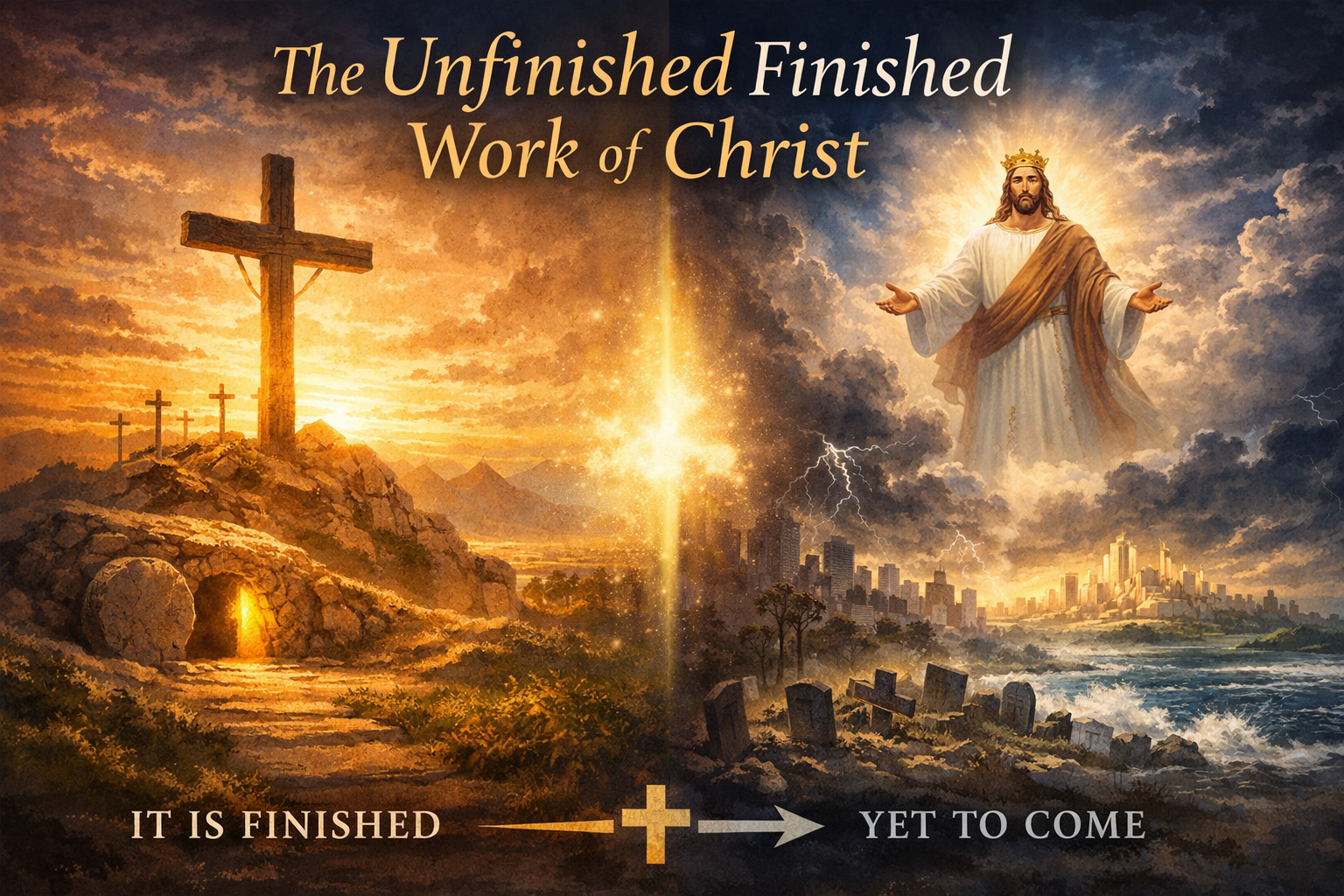
In light of this being the week of our Lord’s passion, it is interesting to note that one of the last things that he said before he gave up his Spirit on the cross was, “It is finished.” (τετέλεσται, John 19.30). With this powerful word, Jesus declared that his work on the cross in making full atonement for sin was completed, and “bowing his head, he gave up his spirit.” It must have been a powerful scene, and no more pregnant words have perhaps ever been spoken. However, the problem is that even though Christ finished his work, sin still seems to run rampant in this world. If it is finished, why, we might ask, is the world still broken, still full of pain and suffering and sin and death? Because of this, we might be tempted to suggest that his work is unfinished. Many Christians struggle to hold together what has already been accomplished and what still remains. However, what we must realize is that Christ’s work is finished; it is fully accomplished in its foundation, but not yet fully realized in its effects. In this post, I would like to consider this tension by offering just a few thoughts on what Christ accomplished in his first coming and what waits to be realized at his second coming.
In one sense, then, it is completely accurate to say that the work of Christ has been fully accomplished, and there are at least three aspects of his work that are completely finished. First, atonement has been accomplished. When Christ died on the cross, he made the full and final payment for our sin. In systematic theology, this is called penal substitutionary atonement. In other words, this means that Christ paid the penalty (penal) that we deserve (substitutionary) for our sin. (On the fact that this was Christ’s view of his death, see here.) He died the death that we deserve by dying in our place. But he did not stay dead; he rose again on the third day. This is the second aspect of Christ’s finished work, namely that victory over death has been secured. When Jesus walked out of the grave on the third day, he defeated death and disarmed Satan of his power. Death no longer has hold over those who are in Christ. We need not fear, we can have hope, even in the face of death. (On hope in the face of death, see here.) And lastly, by dying on the cross, Christ finished his work of establishing righteousness. In other words, his finished work on the cross is now the ground upon which God grants our justification, when we place our faith in Jesus. He lived a perfect life, he died an innocent death. And his righteousness is imputed to us by faith. We are made right, declared innocent, because of Christ’s finished work. This is the gospel. Nothing needs to be added to what Christ accomplished; his work is complete, sufficient, and final. It is not partial, not provisional. It is finished!
Moreover, his finished work on the cross inaugurated several important realities in which we now live. For one, the Kingdom of God has been inaugurated. Forty days after his resurrection, Jesus ascended into heaven to be seated at the right hand of the Father, and he is now reigning with all authority on earth as it is in heaven. (Matt. 28.18) He is not waiting to become King; he is already reigning as King. And he does this by his Spirit. This is the second reality in which we now live, namely that Christ has sent his Spirit to indwell his people. The Spirit mediates Christ’s real presence in and among his people. He is the down payment, the seal, and the guarantee of our faith. And he is actively working in us to make us more like Jesus. And lastly, but certainly not leastly, new life has begun. When we place our faith in Christ, the Spirit regenerates us. He brings to life what was once spiritually dead, and we are born again. In this way we are new creatures in Christ. The old has passed away, and behold the new has come. (2 Cor. 5.17) New creation realities are already at work in us through the Spirit. In these ways, the future has already broken into the present through the risen Christ, and we live in these future realities even now.
And yet, in spite of all of this, several aspects of Christ’s work remain unfinished. Perhaps most clearly, sin still remains in the world. We have been saved from the penalty of sin, but we have not yet been saved from the presence of sin. Our world is saturated and polluted with sin at every turn. People are burdened down with sin and its consequences. Our relationships suffer, bodies are diseased, conflict and turmoil abound at every level of our society. Sin continues its reign of terror nearly unchecked. In addition to this, death still operates in this world. This world reeks with the stench of death; it fills our nostrils everywhere we turn. Our loved ones get sick and die. Accidents and tragedy take lives too soon. Christ has been raised, and death has been defeated. But death still reigns in our mortal bodies, and we ache and groan for that day when death will be no more. Thirdly, the created order groans under the weight of humanity’s sin. When our first parents fell, the creation itself was subjected to futility and decay. The idyllic paradise of Eden was lost to the corruption of sin. And lastly, justice and restoration are yet to be realized. Injustice abounds in our society. From all appearances, the weak get weaker and the strong get stronger. There is no real justice; there is no real peace. Wickedness and evil seem to grow day by day. What is wrong is celebrated as right, and what is right is condemned as wrong. The world is turned upside down, and we long for the day when justice will flow like rivers and when peace will rest upon the earth. And we cry out with the Scriptures, “How long, O Lord? How long?”
In theological parlance, this tension between the finished and the unfinished work of Christ is often referred to by the shorthand phrase “already/not yet”. It simply means that God’s plan of redemption for the world has already begun, has already been inaugurated, but has not yet been fully consummated. The work of Christ’s first coming is finished. He died on the cross, he rose again the third day, he sent his life-giving Spirit. But we are still waiting for the work of his second coming, namely the resurrection of the dead, the final judgment, and the new creation. This is the tension in which we now live, and in this tension, we must avoid two extremes. First, we must avoid living as if nothing has been finished. We must learn to rest in the finished work of Christ. We have been forgiven; we have been indwelled by His Spirit. We can have peace. On the other hand, however, we must not live as if everything is already complete. We do live under the burdens of sin and death; we do long for justice and peace. And we can have hope. The work of Christ is finished in its accomplishment, but it is unfinished in its application to the whole of creation. And so, we wait faithfully as Christ has instructed us.
And this is the point, namely that this tension is not ultimately about stages of fulfillment, though that is certainly the best framework for understanding it. Ultimately, this tension is about Christ. His work is unfinished because his story is not over. (On my argument for the centrality of Christ in our eschatological reflection, see here.) In other words, the same Jesus who said, “It is finished” is the same Jesus who is coming again to make all things new. The same Jesus who died on the cross is the same Jesus who is coming again in glory. Or to put it another way, the second coming of Jesus is not a different work; no, it is the completion of the same work that he began 2000 years ago. The second coming completes what the first coming began, because Christ himself is the fulfillment of all our hopes. Our hope is not just about what Christ has done and will do; it is about Christ himself. It is about his presence. In John 14.3, Jesus promised that he would come again and receive us unto himself, that where he is there we may be also. And so, the unfinished nature of Christ’s work is not a failure of the first coming, but the promise of the second. He is our blessed hope.
And so, yes, we live in the middle of this tension; we live in between the already and the not yet. We are already forgiven, but we are still struggling. We are already alive, yet we are still dying. We are already redeemed, yet we are still waiting. We are waiting to be set free from the presence and the corruption of sin once and for all. This is the lived reality of the Christian life—caught between what has been accomplished and what has not yet been revealed. And I suggest that we must embrace this tension with open arms, because it is only when we embrace this tension that we will be able to hope without denying the pain of our sufferings, that we can be confident without giving into naive triumphalism, and that we can have patience without being paralyzed by despair. If we collapse this tension in either direction, we lose something essential. Either we deny the reality of our present struggle, or we forget the certainty of our future hope. This is the ground that we must stand on, the already and the not yet. We do not live as those waiting for Christ to begin his work, but as those waiting for him to complete it.
When Jesus said, “It is finished.”, he surely meant it. Christ’s work is finished, and yet, it is not yet finished completely. It is finished in its foundation, but it is unfinished in its consummation. We are waiting for the full glory of Christ and his work to be finally revealed on earth. And even in acknowledging the unfinished aspects of Christ work, we must affirm that the work of the cross is not undone; it is unfolding. The resurrection is not isolated; it is expanding. And one day, we will all be raised to meet him in the air, and from that point on, we will always be with the Lord. This is our hope, namely that the Christ who finished his work on the cross is coming again to bring it to final completion. Even so, come quickly, Lord Jesus! Maranatha!


