Tag Archives: Christian Life

On Psalm 119.145-152 (Qoph)

145 I call with all my heart; answer me, Lord.
I will obey your statutes.
146 I call to you; save me,
and I will keep your decrees.
147 I rise before dawn and cry out for help;
I put my hope in your word.
148 I am awake through each watch of the night
to meditate on your promise.
149 In keeping with your faithful love, hear my voice.
Lord, give me life in keeping with your justice.
150 Those who pursue evil plans come near;
they are far from your instruction.
151 You are near, Lord,
and all your commands are true.
152 Long ago I learned from your decrees
that you have established them forever.

It has been a while since I have continued my work through Psalm 119, but we now come to the nineteenth stanza (ק/Qoph). Immediately in the opening verses, we are met with the heartfelt cry of the psalmist. He rises before the dawn and cries out; he watches through the night and longs for deliverance. There is a desperation and urgency in his prayers that is all too familiar to the people of God. And yet, what grounds the psalmist in the midst of his anxieties is a profound confidence in God and in his Word. In other words, even amid the uncertainties of his circumstances, there remains a quiet confidence, a sure and certain foundation upon which he can stand, namely the faithfulness of God to his promises. Even as he waits for God to intervene in his particular situation, he does so with the expectation that God will do what he has said he will do. He will keep his promises; he will remain true to his Word.

This is perhaps why the psalmist’s prayers are so heartfelt and sincere. He cries out “with all my heart.” This is not empty emotionalism or emotion for emotion’s sake; rather, it is the full orientation of the whole self toward God in utter dependence upon him and his promises. It is only from this posture of dependence that we are truly able to express our deepest fears, longings, and vulnerabilities before God. This is one of the great comforts of covenant relationship with him, namely that we can entrust even our most personal anxieties and desperations into his hands because he hears the cries of his people. At the same time, the psalmist balances his cries for deliverance with his own commitment to walk in obedience and faithfulness. This is not a kind of tit-for-tat arrangement in which obedience earns God’s favor. Rather, it is the logic of covenant itself. God has promised to remain faithful to his word, and the psalmist responds with trust expressed through obedience. In other words, true dependence upon God does not produce passivity, but faithful perseverance. It is a radical dependence that issues forth in both trust and obedience.

It is this covenant relationship that also strengthens the psalmist’s perseverance; he rises before the dawn and watches through the night. These actions express hopeful expectation even in the midst of waiting. The fact of the matter is that we simply do not know how long the psalmist has been observing these rhythms of prayer and longing. Perhaps he has been crying out for deliverance for a very long time. And yet he persists in the offering because he remains confident that God will one day answer his prayers. Of course, waiting is a common season in the Christian life. We have all experienced moments in which we long for God’s intervention and yet it does not seem to be forthcoming. It is precisely this kind of hopeful expectation that provides the strength necessary to persevere through such seasons. Indeed, this is how waiting itself can be transformed into worship, namely when it is sustained by confidence in the promises of God. The dawn has not yet come, but hope keeps the people of God awake in the darkness.

Because, let’s face it, we do live in the midst of pervasive darkness. The psalmist puts it this way in verse 150: “Those who pursue evil plans come near; they are far from your instruction.” And yet, in the very next line, he says, “You are near, Lord.” This is one of the great comforts of covenant relationship with God, namely that the nearness of affliction does not negate the nearness of God himself. The psalmist appears to be experiencing real oppression. He is pursued by those who would do him harm and likely lives under the constant threat of suffering and hostility. And yet, his confidence does not rest in the immediate resolution of his circumstances, but in the character and presence of God. This is an incredibly important insight because we are often tempted to interpret suffering as evidence of divine distance or absence. But Scripture repeatedly teaches us otherwise. Indeed, it is often in our deepest pains and afflictions that the nearness of God becomes most precious to his people. The psalmist knows this because his confidence is grounded not in changing circumstances, but in the sure and steadfast promises of God. The darkness may draw near, but the Lord is nearer still.

The psalmist knows this truth because, as he says in verse 152, “Long ago I learned from your decrees that you have established them forever.” This is an important statement because, in the midst of a stanza filled with emotional weight and longing, the psalmist ultimately grounds his confidence in the objective certainty of God’s Word. He is not led by his emotions, nor is he controlled by the instability of his circumstances. Rather, he is anchored in the enduring faithfulness of God and his promises. This is because God’s Word is not only true, but eternally true. In the midst of the shifting seasons of life, the highs and lows of our emotions, and the ever-changing nature of our trials and afflictions, the promises of God remain fixed and unchanging. The Lord himself is the same yesterday, today, and forever, and therefore his faithfulness does not fluctuate with the changing tides of human experience. This is why the people of God are able to persevere with expectant hope, because our confidence ultimately rests not in ourselves or our circumstances, but in the unchanging certainty of the Word of God.

In the end, then, the Qoph stanza of Psalm 119 teaches us what it means to persevere in hopeful dependence upon God. The psalmist cries out, waits, watches, suffers, and longs for deliverance, and yet the dominant note throughout the stanza is not despair, but confidence. Though darkness surrounds him and affliction draws near, he remains convinced that the Lord is nearer still. This is often the shape of the Christian life as well. We pray before the dawn; we wait through long nights of uncertainty; we trust God before deliverance finally comes. And yet, in all of these seasons, the people of God continue to hope because our confidence rests not in ourselves or in the stability of our circumstances, but in the unchanging faithfulness of God and his Word. The darkness may linger through the night, but the people of God continue to hope because the God who speaks remains near, and his word remains forever true.

For further study:
Introduction
Psalm 119.1-8
Psalm 119.9-16
Psalm 119.17-24
Psalm 119.25-32
Psalm 119.33-40
Psalm 119.41-48
Psalm 119.49-56
Psalm 119.57-64
Psalm 119.65-72
Psalm 119.73-80
Psalm 119.81-88
Psalm 119.89-96
Psalm 119.97-104
Psalm 119.105-112
Psalm 119.113-120
Psalm 119.121-128
Psalm 119.129-136
Psalm 119.137-144


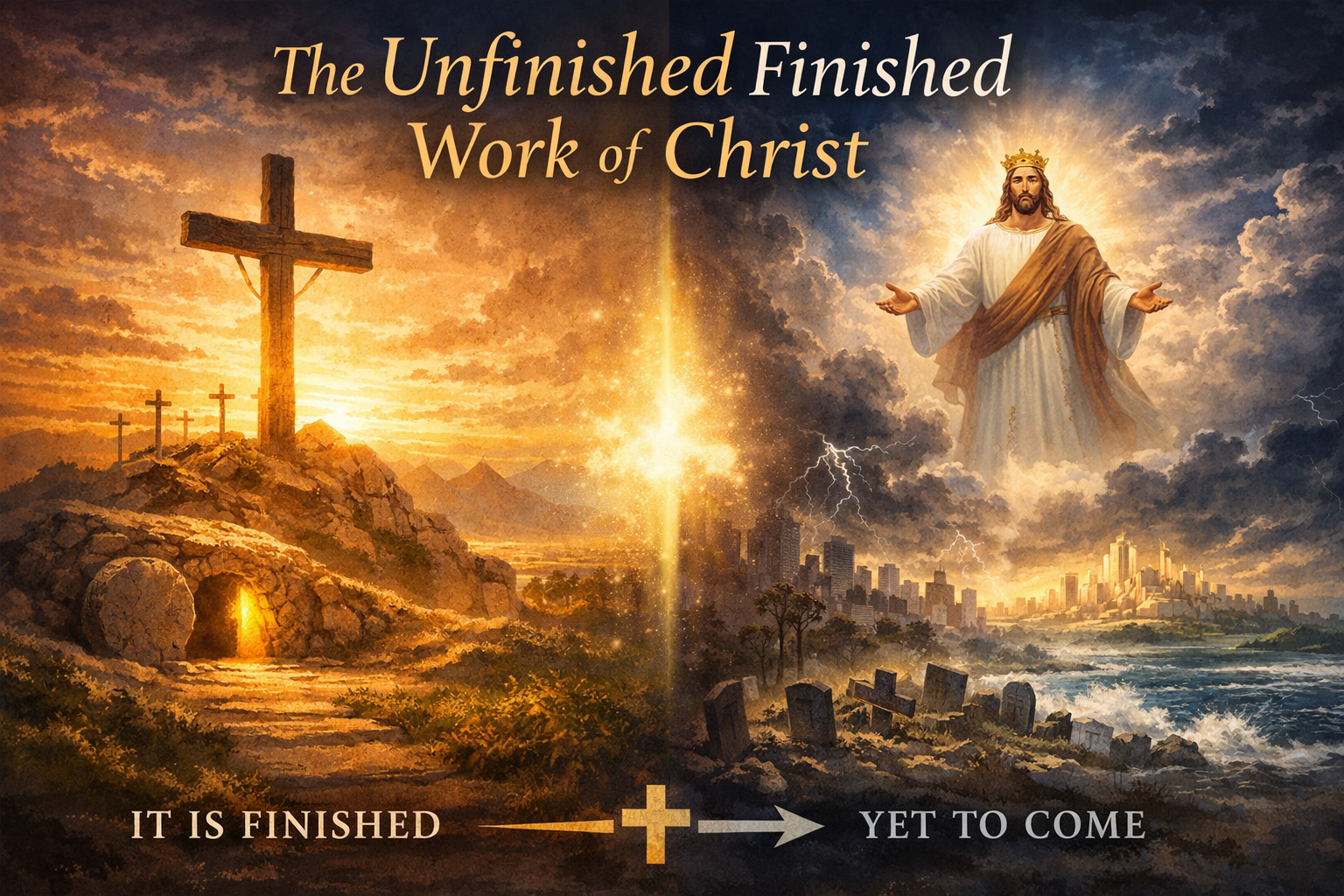
On the Unfinished Finished Work of Christ

In light of this being the week of our Lord’s passion, it is interesting to note that one of the last things that he said before he gave up his Spirit on the cross was, “It is finished.” (τετέλεσται, John 19.30). With this powerful word, Jesus declared that his work on the cross in making full atonement for sin was completed, and “bowing his head, he gave up his spirit.” It must have been a powerful scene, and no more pregnant words have perhaps ever been spoken. However, the problem is that even though Christ finished his work, sin still seems to run rampant in this world. If it is finished, why, we might ask, is the world still broken, still full of pain and suffering and sin and death? Because of this, we might be tempted to suggest that his work is unfinished. Many Christians struggle to hold together what has already been accomplished and what still remains. However, what we must realize is that Christ’s work is finished; it is fully accomplished in its foundation, but not yet fully realized in its effects. In this post, I would like to consider this tension by offering just a few thoughts on what Christ accomplished in his first coming and what waits to be realized at his second coming.

In one sense, then, it is completely accurate to say that the work of Christ has been fully accomplished, and there are at least three aspects of his work that are completely finished. First, atonement has been accomplished. When Christ died on the cross, he made the full and final payment for our sin. In systematic theology, this is called penal substitutionary atonement. In other words, this means that Christ paid the penalty (penal) that we deserve (substitutionary) for our sin. (On the fact that this was Christ’s view of his death, see here.) He died the death that we deserve by dying in our place. But he did not stay dead; he rose again on the third day. This is the second aspect of Christ’s finished work, namely that victory over death has been secured. When Jesus walked out of the grave on the third day, he defeated death and disarmed Satan of his power. Death no longer has hold over those who are in Christ. We need not fear, we can have hope, even in the face of death. (On hope in the face of death, see here.) And lastly, by dying on the cross, Christ finished his work of establishing righteousness. In other words, his finished work on the cross is now the ground upon which God grants our justification, when we place our faith in Jesus. He lived a perfect life, he died an innocent death. And his righteousness is imputed to us by faith. We are made right, declared innocent, because of Christ’s finished work. This is the gospel. Nothing needs to be added to what Christ accomplished; his work is complete, sufficient, and final. It is not partial, not provisional. It is finished!

Moreover, his finished work on the cross inaugurated several important realities in which we now live. For one, the Kingdom of God has been inaugurated. Forty days after his resurrection, Jesus ascended into heaven to be seated at the right hand of the Father, and he is now reigning with all authority on earth as it is in heaven. (Matt. 28.18) He is not waiting to become King; he is already reigning as King. And he does this by his Spirit. This is the second reality in which we now live, namely that Christ has sent his Spirit to indwell his people. The Spirit mediates Christ’s real presence in and among his people. He is the down payment, the seal, and the guarantee of our faith. And he is actively working in us to make us more like Jesus. And lastly, but certainly not leastly, new life has begun. When we place our faith in Christ, the Spirit regenerates us. He brings to life what was once spiritually dead, and we are born again. In this way we are new creatures in Christ. The old has passed away, and behold the new has come. (2 Cor. 5.17) New creation realities are already at work in us through the Spirit. In these ways, the future has already broken into the present through the risen Christ, and we live in these future realities even now.

And yet, in spite of all of this, several aspects of Christ’s work remain unfinished. Perhaps most clearly, sin still remains in the world. We have been saved from the penalty of sin, but we have not yet been saved from the presence of sin. Our world is saturated and polluted with sin at every turn. People are burdened down with sin and its consequences. Our relationships suffer, bodies are diseased, conflict and turmoil abound at every level of our society. Sin continues its reign of terror nearly unchecked. In addition to this, death still operates in this world. This world reeks with the stench of death; it fills our nostrils everywhere we turn. Our loved ones get sick and die. Accidents and tragedy take lives too soon. Christ has been raised, and death has been defeated. But death still reigns in our mortal bodies, and we ache and groan for that day when death will be no more. Thirdly, the created order groans under the weight of humanity’s sin. When our first parents fell, the creation itself was subjected to futility and decay. The idyllic paradise of Eden was lost to the corruption of sin. And lastly, justice and restoration are yet to be realized. Injustice abounds in our society. From all appearances, the weak get weaker and the strong get stronger. There is no real justice; there is no real peace. Wickedness and evil seem to grow day by day. What is wrong is celebrated as right, and what is right is condemned as wrong. The world is turned upside down, and we long for the day when justice will flow like rivers and when peace will rest upon the earth. And we cry out with the Scriptures, “How long, O Lord? How long?”

In theological parlance, this tension between the finished and the unfinished work of Christ is often referred to by the shorthand phrase “already/not yet”. It simply means that God’s plan of redemption for the world has already begun, has already been inaugurated, but has not yet been fully consummated. The work of Christ’s first coming is finished. He died on the cross, he rose again the third day, he sent his life-giving Spirit. But we are still waiting for the work of his second coming, namely the resurrection of the dead, the final judgment, and the new creation. This is the tension in which we now live, and in this tension, we must avoid two extremes. First, we must avoid living as if nothing has been finished. We must learn to rest in the finished work of Christ. We have been forgiven; we have been indwelled by His Spirit. We can have peace. On the other hand, however, we must not live as if everything is already complete. We do live under the burdens of sin and death; we do long for justice and peace. And we can have hope. The work of Christ is finished in its accomplishment, but it is unfinished in its application to the whole of creation. And so, we wait faithfully as Christ has instructed us.

And this is the point, namely that this tension is not ultimately about stages of fulfillment, though that is certainly the best framework for understanding it. Ultimately, this tension is about Christ. His work is unfinished because his story is not over. (On my argument for the centrality of Christ in our eschatological reflection, see here.) In other words, the same Jesus who said, “It is finished” is the same Jesus who is coming again to make all things new. The same Jesus who died on the cross is the same Jesus who is coming again in glory. Or to put it another way, the second coming of Jesus is not a different work; no, it is the completion of the same work that he began 2000 years ago. The second coming completes what the first coming began, because Christ himself is the fulfillment of all our hopes. Our hope is not just about what Christ has done and will do; it is about Christ himself. It is about his presence. In John 14.3, Jesus promised that he would come again and receive us unto himself, that where he is there we may be also. And so, the unfinished nature of Christ’s work is not a failure of the first coming, but the promise of the second. He is our blessed hope.

And so, yes, we live in the middle of this tension; we live in between the already and the not yet. We are already forgiven, but we are still struggling. We are already alive, yet we are still dying. We are already redeemed, yet we are still waiting. We are waiting to be set free from the presence and the corruption of sin once and for all. This is the lived reality of the Christian life—caught between what has been accomplished and what has not yet been revealed. And I suggest that we must embrace this tension with open arms, because it is only when we embrace this tension that we will be able to hope without denying the pain of our sufferings, that we can be confident without giving into naive triumphalism, and that we can have patience without being paralyzed by despair. If we collapse this tension in either direction, we lose something essential. Either we deny the reality of our present struggle, or we forget the certainty of our future hope. This is the ground that we must stand on, the already and the not yet. We do not live as those waiting for Christ to begin his work, but as those waiting for him to complete it.

When Jesus said, “It is finished.”, he surely meant it. Christ’s work is finished, and yet, it is not yet finished completely. It is finished in its foundation, but it is unfinished in its consummation. We are waiting for the full glory of Christ and his work to be finally revealed on earth. And even in acknowledging the unfinished aspects of Christ work, we must affirm that the work of the cross is not undone; it is unfolding. The resurrection is not isolated; it is expanding. And one day, we will all be raised to meet him in the air, and from that point on, we will always be with the Lord. This is our hope, namely that the Christ who finished his work on the cross is coming again to bring it to final completion. Even so, come quickly, Lord Jesus! Maranatha!


On Resurrection and the Path of Glory

TEXT
10 My goal is to know him and the power of his resurrection and the fellowship of his sufferings, being conformed to his death, 11 assuming that I will somehow reach the resurrection from among the dead.

~Philippians 3.10-11

Title: On Resurrection and the Path of Glory
Text: Philippians 3.10-11
Church: Redeemer Baptist Church, Jonesboro, AR
Date: March 31, 2024

On Sanctification and the Christian Life

TEXT

1. Those who are united to Christ and effectually called and regenerated have a new heart and a new spirit created in them through the power of Christ’s death and resurrection. They are also further sanctified, really and personally, through the same power, by his Word and Spirit dwelling in them. The dominion of the whole body of sin is destroyed, and the various evil desires that arise from it are more and more weakened and put to death.  At the same time, those called and regenerated are more and more enlivened and strengthened in all saving graces so that they practice true holiness, without which no one will see the Lord.

2. This sanctification extends throughout the whole person, though it is never completed in this life. Some corruption remains in every part.  From this arises a continual and irreconcilable war, with the desires of the flesh against the Spirit and the Spirit against the flesh.

3. In this war, the remaining corruption may greatly prevail for a time.  Yet through the continual supply of strength from the sanctifying Spirit of Christ, the regenerate part overcomes.  So the saints grow in grace, perfecting holiness in the fear of God. They pursue a heavenly life, in gospel obedience to all the commands that Christ as Head and King has given them in his Word.

Series: The 1689 Baptist Confession of Faith
Church: Redeemer Baptist Church, Jonesboro, AR
Date: February 28, 2024


On the Fatherhood of God and Our Adoption

TEXT

1. God has granted that all those who are justified would receive the grace of adoption, in and for the sake of his only Son Jesus Christ. By this they are counted among the children of God and enjoy the freedom and privileges of that relationship. They inherit his name, receive the spirit of adoption, have access to the throne of grace with boldness, and are enabled to cry “Abba, Father!” They are given compassion, protected, provided for, and chastened by him as a father. Yet they are never cast off but are sealed for the day of redemption and inherit the promises as heirs of everlasting salvation.

~Second London Baptist Confession (1689), 12.1

Series: The 1689 Baptist Confession of Faith
Church: Redeemer Baptist Church, Jonesboro, AR
Date: February 21, 2024


On Why Christians Still Need the Gospel

TEXT

11 For the grace of God has appeared, bringing salvation for all people, 12 instructing us to deny godlessness and worldly lusts and to live in a sensible, righteous, and godly way in the present age, 13 while we wait for the blessed hope, the appearing of the glory of our great God and Savior, Jesus Christ. 14 He gave himself for us to redeem us from all lawlessness and to cleanse for himself a people for his own possession, eager to do good works.

Text: Titus 2.11-14
Series: Revival
Church: First Baptist Church, Mammoth Spring, AR
Date: August 31, 2022


On Common Objections to the Observation of Lent

Well, as they say, it is that time of year again. No, I am not talking about tax season; I am talking about the season in the traditional Christian calendar which is set aside for the purpose of self-reflection, examination, confession, and repentance. I am talking about that time of the year when we are asked to set aside the creature comforts that we are so dependent on and to cultivate that pure and singular dependence upon Christ through His Spirit. It is that time of year when Christians from all around the world from many varied theological and cultural backgrounds are invited to set their gaze on the cross of our Lord Jesus and the price that He paid for our sin, even as they begin to anticipate that victorious day when we will celebrate His resurrection from the dead. I am talking about the season of Lent. (For more on this season and its usefulness in the Christian life, see my post here.)

However, in most non-liturgical, low-church traditions, especially down here in the good ole’ Bible belt, the idea of observing the season of Lent is most often met with hostility and a host of objections as to why Christians should not observe this ancient practice. In this post, I would like to consider just a few of these, so that we may perhaps have a clearer understanding as to the benefits and the dangers of observing the season of Lent.

One of the primary objections that is most often given against the practice of Lent, as well as any other practice that might remotely be considered liturgical, is that it comes to us from the traditions of the Roman Catholic Church. There is a deep seated antipathy, an unstated but ever present aversion to any and all things Roman Catholic, that lives just under the surface in many Protestant denominations, and this is much to our shame. (This may be a symptom of a wider problem, i.e. the hubris of denominational tribalism that treats all those outside of our own tradition with skepticism and disdain.) Now, I will be the first to admit that there are many facets of Roman Catholic theology that I find troublesome and concerning, many aspects of their belief and practice that are hard to square with the teaching of the Bible, but we do ourselves a great disservice when we dismiss their contributions to the Christian faith altogether.

After all, the Roman Catholic Church was the only church for the first 1500 years of Christian history, and though they might have gone astray along the way, they actually got many things right. From their centuries long faithfulness comes classic formulations of doctrines like the trinity, the hypostatic union, etc., and for these we must be ever grateful. But not only in matters of doctrinal orthodoxy, but in the details of faithful orthopraxy, their contributions must be considered, and not merely dismissed. They have given us a rich and beautiful liturgical tradition which we would do well to consider in our own attempts to be faithful worshippers of Christ. Practices like the lectionary and the calendar are just some of the contributions that come to us from that tradition. I believe the season of Lent to be one of these contributions from which our faith and practice could benefit deeply. In other words, we don’t have to throw the baby out with the bathwater, so to speak.

A second objection that is somewhat connected with the first has do with the purpose of the season of Lent. In some traditions, Lent is presented as a way of “earning” God’s forgiveness, as a meritorious act by which we might deserve God’s grace, even as a kind of penance. In this light, the observance of Lent is made to be a mandatory practice for all of those who call themselves Christians. Clearly, this flies in the face of the clear teaching of the Bible. Our sins were once and for all completely forgiven when we placed our faith in Christ. This is what it means to be justified. There are no actions that we can take to earn or deserve more grace from God, because He has already poured out grace upon grace to us through the person and work of Jesus Christ. We are not required to do any works of penance for our sins, because the once and for all punishment for our sins fell on the shoulders of Jesus Christ as He was nailed to the cross to die. The payment for sin has been made in full; nothing more is necessary.

However, the repentance that God requires is more than a one time event; on the contrary, it is the lifelong discipline of a follower of Christ as we turn from our sin daily. This is the first of Martin Luther’s 95 Theses, that “When our Lord and Master Jesus Christ said, “Repent” (Mt 4:17), he willed the entire life of believers to be one of repentance.” Repentance is a habit, and setting aside a season for intentional reflection and cultivation of that habit can be quite beneficial in the life of the Christian. Especially as we prepare ourselves for the festivities of Holy Week, which culminate in the events of Good Friday and Easter Sunday, this season can aid us in our sanctification by exposing our sin and then reminding us anew of the wonder of the atoning work of our Savior and the victory that we have over sin through His resurrection. So, while the season of Lent should not be observed as a means to earning God’s grace, it can help us to understand and appreciate the grace that we have already received in new and fresh ways.

A final objection that is often raised in this conversation is that the practice of Lent is nowhere explicitly commanded in Holy Scripture. And if I am being honest, this is the strongest objection to be considered, because we all want to be biblical in the practice and expression of our faith. This is often expressed as a formulation of the regulative principle for worship (RPW), which states, “The acceptable way of worshiping the true God, is instituted by himself, and so limited by his own revealed will, that he may not be worshiped according to the imagination and devices of men, nor the suggestions of Satan, under any visible representations, or any other way not prescribed in the Holy Scriptures.” (2nd London Baptist Confession, 1689) Anyone who believes that the Bible is the inspired inerrant Word of the one true and living God must affirm this as being true. And so, if lent is nowhere commanded in Holy Scripture, then why would we concern ourselves with observing it. Aren’t the Scriptures sufficient for all matters of faith and practice?

We are required to answer this question in the affirmative. (2 Timothy 3.16-17) YES, the Scriptures are sufficient. But just because something is not expressly commanded in Scripture does not mean that it is not beneficial for our faith and practice. There are many things we do in the practice of our faith, both personally and corporately, that are not directly commanded in Scripture. For example, the Scriptures do not command us to have Vacation Bible Schools during the summer, but almost every church I know and have been a part of has a VBS. The point is simply that no one follows the RPW absolutely; in fact, to do so would be impossible. The Scriptures give us general guidelines, and we are called to use our Holy Spirit guided Biblically informed wisdom in the specific applications of those guidelines. (cf. Romans 12.1-2) In the case of Lent, the Bible clearly emphasizes the importance and priority of repentance, and it is up to us, with the help of Scripture and tradition, to cultivate repentance in our lives.

In the final analysis, we must conclude that the decision to observe the season of Lent, whether that observance is personal or corporate, it must remain at the level of Christian freedom. For those who have come out of liturgically rigorous traditions bordering on the legalistic, where observing Lent was a matter of obligation, then I would advise against it. Instead, I would encourage you to relish in the finished work of Christ. However, for others, and I would surmise that this is most of my readers, observing Lent can be an opportunity to cultivate the spiritual discipline of repentance, to intentionally reflect on the condition of our souls, to identify those unacknowledged and unadmitted sins, and to turn again toward Christ in faithful obedience. We are hardly in danger of taking our repentance too seriously, and the season of Lent can help us appreciate anew the reality and significance of sin and its ongoing power in our lives, even as we anticipate the day when we will finally be set free from its very presence. And oh, how we long for that day! Even so, Lord Jesus, come quickly!


On Psalm 119.17-24 (Gimel)

340px-Gimel_Hebrew.svg17 Deal generously with your servant
so that I might live;
then I will keep your word.
18 Open my eyes so that I may contemplate
wondrous things from your instruction.
19 I am a resident alien on earth;
do not hide your commands from me.
20 I am continually overcome
with longing for your judgments.
21 You rebuke the arrogant,
the ones under a curse,
who wander from your commands.
22 Take insult and contempt away from me,
for I have kept your decrees.
23 Though princes sit together speaking against me,
your servant will think about your statutes;
24 your decrees are my delight
and my counselors.

In the third stanza, ג (gimel), our psalmist begins with what seems to be a condition to his obedience. Verse 17 reads, “Deal generously with your servant so that I might live; then I will keep your word.” However, we must not read this is a quid pro quo request. Our psalmist is not basing his obedience on the condition of God’s grace. He is not saying, “if you do this for me, then I’ll do this for you.” The footnotes in the NET Bible state that the cohortative verbal forms in this line indicate purpose or result. In other words, our psalmist is requesting the empowerment of God’s grace so that he will be able to keep God’s Word. This understanding is confirmed in verse 18, where we read, “Open my eyes so that I may contemplate wondrous things from your instruction.”

This is a much needed corrective in the contemporary understanding of the role of obedience in the Christian life, that the empowerment of God’s grace precedes all our effort to obey. Grace results in obedience, and not the other way around, because that would be legalism. In other words, what our psalmist is requesting is exactly what we have been given in the New Covenant. In Ezekiel’s description of the New Covenant (36.24-30), we read, “I will put my place my Spirit within you and cause you to follow my statues and carefully observe my ordinances” (verse 27).  And the Apostle Peter confirms, “His divine power has given us everything required for life and godliness through the knowledge of Him who called us by His own glory and goodness” (2 Peter 1.3).

And why is this gracious empowerment necessary? Well, our psalmist gives us the answer in verse 19, “I am a resident alien on earth.” The word is variously rendered as “foreigner”, “sojourner”, “stranger.” In other words, our psalmist understands that this world is not his native home, that his values, convictions, and principles are of another reality altogether. As he says, “I am continually overcome with longing for your judgments.” However, he also understands that while we live “on earth”, it is so easy to become distracted, confused, and misdirected in our lives, which is why we need the constant favor of God’s empowering grace to regularly reorient our perspectives. As our psalmist understands, “you rebuke the arrogant, the ones under a curse, who wander from your commands” (verse 21).

Of course, our psalmist knows that walking to the beat of God’s drum will necessarily result in misunderstandings, in ridicule, scorn, and contempt. One person’s obedience must necessarily expose someone else’s disobedience, and when that happens, we can automatically expect to face opposition. But our psalmist knows the source of his strength, “Your decrees are my delight and my counselors” (verse 24), and so he prays, “Take insult and contempt away from me, for I have kept your decrees” (verse 22). The psalmist understands that the one who has so graciously empowered his obedience will also graciously protect and sustain him through any circumstance.

This should be the perspective of every follower of Jesus. We are strangers living in a foreign land; we do believe, speak, feel, and behave according to another reality. We are  “continually overcome with longing for [His] judgments.” And as long as we live in this already/not yet season, we can trust that our God will empower us for obedience by His grace, even while He sustains us to perfection in glory.

For further study:
Introduction/Overview
Psalm 119.1-8
Psalm 119.9-16


Slow To Write

"let every person be quick to hear, slow to speak, slow to anger."

lovegavehope

Just another WordPress.com site

Jared Cornutt

Pastor | Speaker | Writer

Denny Burk

A commentary on theology, politics, and culture

G3 Ministries

Events + Resources for the Local Church

Biblical Reasoning

Biblical and Systematic Theology According to the Scriptures

RetroChristianity

Reclaiming the Forgotten Faith

SBC Voices

Southern Baptist News & Opinion

Lucid Theology

Thoughts on words, books, theology, and life.

Baptist21

A pastor-led voice for Baptists in the 21st century

Center For Baptist Renewal

The Personal and Professional Blog of Phillip Powers

The Pastor's Well - Pastor Well

The Personal and Professional Blog of Phillip Powers

Articles - AlbertMohler.com

The Personal and Professional Blog of Phillip Powers

The Gospel Coalition

The Personal and Professional Blog of Phillip Powers