Tag Archives: Suffering


On Psalm 119.161-168 (Sin/Shin)
161 Princes have persecuted me without cause,
but my heart fears only your word.
162 I rejoice over your promise
like one who finds vast treasure.
163 I hate and abhor falsehood,
but I love your instruction.
164 I praise you seven times a day
for your righteous judgments.
165 Abundant peace belongs to those
who love your instruction;
nothing makes them stumble.
166 Lord, I hope for your salvation
and carry out your commands.
167 I obey your decrees
and love them greatly.
168 I obey your precepts and decrees,
for all my ways are before you.

The twenty-first stanza (ש/sin or shin, depending on the placement of the dot) continues the theme of suffering that we have encountered throughout the last several stanzas. Our psalmist opens with the observation, “Princes have persecuted me without cause.” Once again, we are not given all the details of his circumstances, but it is clear that his troubles originate from those who possess power and authority. It is often the case that the righteous suffer not because they have done anything wrong, but simply because they belong to God. Our psalmist finds himself opposed by the powers that be without just cause. Of course, this pattern runs throughout the history of God’s people and finds its fullest expression in the suffering of Jesus Christ, who “left you an example, that you should follow in his steps” (1 Pet. 2.21). As Jesus himself warned, “A servant is not greater than his master. If they persecuted me, they will also persecute you” (John 15.20). Yet in the face of this persecution, our psalmist does not surrender to fear, bitterness, or despair. Rather, he declares, “My heart fears only your word.” The princes may possess earthly authority, but God’s Word possesses ultimate authority. The defining feature of this stanza, therefore, is not the persecution itself, but the psalmist’s response to it. Instead of allowing his circumstances to govern his heart, he finds comfort, stability, and confidence in the promises of God.
This is perhaps why he says, “I rejoice over your promise like one who finds vast treasure.” The image is striking. Imagine the excitement of stumbling upon a fortune beyond anything you could have imagined. That is how our psalmist views the Word of God. He recognizes that true and lasting value is found not in possessions, accomplishments, status, or worldly comforts, but in the promises of God. Indeed, no earthly treasure can compare with the life-giving riches that are found in God’s Word. And this is cause for great joy, because no matter what difficulties may arise, we always have God’s promises to uphold and sustain us. This is an important lesson for us as well, namely that the value we assign to God’s Word reveals much about the orientation of our hearts. Are our hearts consumed by anxiety, fear, and uncertainty about the future, or are they resting in the promises of the one true and living God? Do we rejoice in God’s Word even when circumstances are difficult and answers seem far away? Our psalmist’s joy is not rooted in changing circumstances but in the unchanging faithfulness of God revealed through his Word.
And it is this treasuring of God’s Word that leads our psalmist to say in verse 163, “I hate and abhor falsehood, but I love your instruction.” This is strong language, but compared to the surpassing value of God’s truth, all falsehood must appear by contrast as hateful and abhorrent. Of course, this is not the language of emotional volatility or personal animosity. Rather, it is the language of covenant loyalty and moral commitment. Our psalmist’s love for God and his Word has shaped his affections in such a way that he delights in what is true and rejects what is false. Covenant love for God necessarily produces opposition to anything that contradicts his character and his revelation. Yet modern notions of love often seek to separate love from truth. Many assume that to love someone means affirming whatever they believe or shielding them from difficult truths. But the Scriptures know nothing of such a separation. Genuine love rejoices in the truth because truth ultimately leads us to God himself. For this reason, our psalmist refuses to separate love from truthfulness. To love God is to love what is true, right, good, and beautiful, and to reject whatever stands opposed to it.
Of course, this kind of love should stand at the very center of our worship, as our psalmist writes, “I praise you seven times a day for your righteous judgments.” In other words, our psalmist’s heart is so filled with covenant love and loyalty that he cannot help but burst forth in praise. The reference to “seven times a day” likely signifies more than a literal number. Throughout Scripture, the number seven often conveys the idea of fullness or completeness. The point, then, is that praise has become the regular habit of his soul. Worship is not an occasional activity reserved for certain moments or certain days of the week. Rather, it permeates the very fabric of his life. And we might be tempted to ask how such continual praise is possible in the face of unjust persecution and suffering. The answer is simple: God’s righteous judgments are continually before him. His mind is saturated with the truth of God’s Word, and his heart responds with worship. The more deeply Scripture shapes our thinking and affections, the more naturally praise emerges from our lives. This is because the ultimate goal of Scripture is not merely information but worship, not merely knowledge about God but joyful devotion to the God who has revealed himself in his Word.
Now, the result of this life of covenant loyalty, delight in God’s Word, and continual worship is what our psalmist describes in verse 165: “Abundant peace belongs to those who love your instruction; nothing makes them stumble.” This is perhaps the central affirmation of the entire stanza. However, we must be careful to understand what kind of peace the psalmist has in mind. He is not speaking of ease, comfort, or the absence of hardship. After all, he has already told us that he is being persecuted by princes without cause. His circumstances have not changed. The opposition remains. The suffering continues. Yet he possesses peace. This is because biblical peace is not primarily the absence of conflict but the presence of stability, wholeness, and confidence in God. It is the settled assurance that God remains faithful to his promises regardless of what may be happening around us. This is why peace belongs specifically to those who love God’s instruction. The Word of God anchors the believer amid the storms of life. It provides a sure foundation when everything else seems uncertain and unstable. As we have seen in the previous stanzas, our circumstances may remain difficult, our prayers may seem unanswered, and our suffering may continue for a season. Yet the foundation remains secure because God’s Word remains true. Peace, therefore, does not flow from our ability to control our circumstances but from our confidence in the God who governs them. The more deeply we trust his Word, the more firmly our hearts are established in peace.
Our psalmist concludes the stanza by reminding us why all of this is possible: “I obey your precepts and decrees, for all my ways are before you.” Though he is persecuted, pressured, and opposed by powerful enemies, he continues to rejoice in God’s Word, to praise God continually, and to walk in faithful obedience. More remarkably still, he enjoys a peace that transcends his circumstances. The reason for this confidence is that he lives Coram Deo, that is to say, before the face of God. His life is not hidden from the Lord. His sufferings are known. His prayers are heard. His obedience is seen. The God who gave these promises is the same God who remains present with his people and faithful to his covenant. This is why the stability of the believer is ultimately grounded not in favorable circumstances but in the enduring truth of God’s Word. Though the people of God may face opposition from every side, they possess a peace the world cannot give because their lives are anchored in the truth, presence, and faithfulness of the God who speaks.
For further study:
Introduction
Psalm 119.1-8
Psalm 119.9-16
Psalm 119.17-24
Psalm 119.25-32
Psalm 119.33-40
Psalm 119.41-48
Psalm 119.49-56
Psalm 119.57-64
Psalm 119.65-72
Psalm 119.73-80
Psalm 119.81-88
Psalm 119.89-96
Psalm 119.97-104
Psalm 119.105-112
Psalm 119.113-120
Psalm 119.121-128
Psalm 119.129-136
Psalm 119.137-144
Psalm 119.145-152
Psalm 119.153-160
Share this:

On Psalm 119. 153-160 (Resh)
153 Consider my affliction and rescue me,
for I have not forgotten your instruction.
154 Champion my cause and redeem me;
give me life as you promised.
155 Salvation is far from the wicked
because they do not study your statutes.
156 Your compassions are many, Lord;
give me life according to your judgments.
157 My persecutors and foes are many.
I have not turned from your decrees.
158 I have seen the disloyal and feel disgust
because they do not keep your word.
159 Consider how I love your precepts;
Lord, give me life according to your faithful love.
160 The entirety of your word is truth,
each of your righteous judgments endures forever.

We now come to the twentieth stanza of Psalm 119 (ר/resh, pronounced raysh), and many of the thoughts and themes are a continuation from the previous stanza (qoph). Our psalmist begins by asking God to “consider my affliction and rescue me.“ Clearly, our psalmist is experiencing some measure of personal suffering and sorrow. And we must affirm that suffering and difficulty are a regular part of the life of faith. The Christian life is not lived apart from suffering, but through it. The question is not whether we will suffer and face difficulties, but how we will suffer and face difficulties. Our psalmist’s suffering drives him toward God, not away from him, as he says, “for I have not forgotten your instruction.” In other words, in the midst of his suffering and troubles, our psalmist clings to God’s Word, because he believes that God is fundamentally faithful to his promises. His suffering may be real, but so too is the steadfast faithfulness of the God who speaks.
This is why he goes on to pray in verse 154, “Champion my cause and redeem me; give me life as your promised.” Notice that the psalmist appeals not to his own personal merits, but to God’s covenant mercy. He understands that he cannot ultimately save himself and that he depends entirely upon God’s intervention. And this is exactly the point, namely that our affliction and difficulties are meant to expose our weaknesses and our inabilities to sustain ourselves apart from God. Yet the psalmist does not collapse into despair or hopelessness. Rather, he cultivates a posture of active dependence upon the Lord. His suffering does not destroy his faith; it drives him more deeply into dependence upon God and his promises. He prays, he cries out, he seeks the Lord, and he clings to the certainty of God’s covenant faithfulness. This is what true dependence looks like. It is not passive resignation, but persevering trust that continues to hold firmly to the faithfulness of God even in the face of suffering and uncertainty.
Of course, this is not true for those who stand outside of covenant relationship with God. Verse 155 reads, “Salvation is far from the wicked because they do not study your statutes.” This is not merely a rejection of moral instruction in an abstract sense; rather, it is a wholesale covenant repudiation. The wicked are described as those whose lives are fundamentally oriented away from God and his Word. By contrast, the righteous cling to God’s promises and seek refuge in his instruction. This distinction is incredibly important because the psalmist understands that salvation and deliverance cannot be separated from relationship with God himself. Life, truth, obedience, and salvation all belong together. This stands in direct contrast to the instincts of our fallen nature. So often, we desire comfort, peace, and deliverance while resisting submission to God and his Word. We want the blessings of covenant without the God of the covenant. But the psalmist refuses to separate these realities. To reject the Word of God is ultimately to reject the God who gives life, because his Word is the very means through which he reveals himself, sustains his people, and leads them into salvation and truth.
The God of the Bible is the only one who can truly give life, as our psalmist prays, “Your compassions are many, Lord; give me life according to your judgments.” Of course, our psalmist is not merely praying for physical preservation, though that is certainly included within his request. The “life” he prays for is spiritual, covenantal, and relational; it is grounded in the Lord’s many compassions. This is why he repeatedly prays for God to revive him according to his steadfast love, his judgments, and his Word. True and abundant life, a life that is full and flourishing, flows from the character of God as he reveals himself through his Word and remains faithful to his covenant promises. In other words, the Word of God is not abstract information, bare command, or mere doctrine; it is life-giving revelation. And this notion stands in direct contrast to the instincts of our modern world. We often seek life and renewal through changing circumstances, distractions, self-help strategies, or emotional experiences, but none of these things can truly sustain the soul. The psalmist understands that real life can only be found in God and in his Word. Scripture does not merely inform the people of God; it sustains, revives, and gives them life.
And so, our psalmist concludes in verse 160, “The entirety of your word is truth, each of your righteous judgments endures forever.” In many ways, this is the theological climax of the stanza. The psalmist’s confidence ultimately rests not in changing circumstances, nor even in the immediate easing of his affliction, but in the enduring truthfulness of God’s Word. As we saw in the previous stanza, the details and circumstances of human experience change constantly, sometimes day by day, even moment by moment. Our emotions fluctuate, our trials intensify, and the uncertainties of life often leave us feeling unstable and weary. But the truthfulness of God does not change. His Word remains fixed, enduring, and eternally true. This is why the stability of the Christian life ultimately depends upon the stability of divine revelation rather than the instability of human experience. Like the psalmist, then, we are able to persevere through every season of suffering and uncertainty because the God who speaks remains faithful and true, and his Word endures forever.
In the end, then, the Resh stanza of Psalm 119 teaches us what it means to seek life through the Word of God in the midst of suffering and affliction. The psalmist cries out, waits, longs for deliverance, and pleads for God to revive him, and yet throughout the stanza he continually turns back to the certainty of God’s promises and covenant faithfulness. Affliction does not sever his relationship with God; rather, suffering becomes the very context in which his dependence upon God deepens. And the same is true for the people of God today. We continue to seek life not in changing circumstances or fleeting comforts, but in the enduring faithfulness of the God who speaks. Though affliction surrounds the people of God, true life is found in the God who speaks, whose Word remains forever true and whose covenant faithfulness never fails.
For further study:
Introduction
Psalm 119.1-8
Psalm 119.9-16
Psalm 119.17-24
Psalm 119.25-32
Psalm 119.33-40
Psalm 119.41-48
Psalm 119.49-56
Psalm 119.57-64
Psalm 119.65-72
Psalm 119.73-80
Psalm 119.81-88
Psalm 119.89-96
Psalm 119.97-104
Psalm 119.105-112
Psalm 119.113-120
Psalm 119.121-128
Psalm 119.129-136
Psalm 119.137-144
Psalm 119.145-152
Share this:


On Psalm 119.145-152 (Qoph)
145 I call with all my heart; answer me, Lord.
I will obey your statutes.
146 I call to you; save me,
and I will keep your decrees.
147 I rise before dawn and cry out for help;
I put my hope in your word.
148 I am awake through each watch of the night
to meditate on your promise.
149 In keeping with your faithful love, hear my voice.
Lord, give me life in keeping with your justice.
150 Those who pursue evil plans come near;
they are far from your instruction.
151 You are near, Lord,
and all your commands are true.
152 Long ago I learned from your decrees
that you have established them forever.

It has been a while since I have continued my work through Psalm 119, but we now come to the nineteenth stanza (ק/Qoph). Immediately in the opening verses, we are met with the heartfelt cry of the psalmist. He rises before the dawn and cries out; he watches through the night and longs for deliverance. There is a desperation and urgency in his prayers that is all too familiar to the people of God. And yet, what grounds the psalmist in the midst of his anxieties is a profound confidence in God and in his Word. In other words, even amid the uncertainties of his circumstances, there remains a quiet confidence, a sure and certain foundation upon which he can stand, namely the faithfulness of God to his promises. Even as he waits for God to intervene in his particular situation, he does so with the expectation that God will do what he has said he will do. He will keep his promises; he will remain true to his Word.
This is perhaps why the psalmist’s prayers are so heartfelt and sincere. He cries out “with all my heart.” This is not empty emotionalism or emotion for emotion’s sake; rather, it is the full orientation of the whole self toward God in utter dependence upon him and his promises. It is only from this posture of dependence that we are truly able to express our deepest fears, longings, and vulnerabilities before God. This is one of the great comforts of covenant relationship with him, namely that we can entrust even our most personal anxieties and desperations into his hands because he hears the cries of his people. At the same time, the psalmist balances his cries for deliverance with his own commitment to walk in obedience and faithfulness. This is not a kind of tit-for-tat arrangement in which obedience earns God’s favor. Rather, it is the logic of covenant itself. God has promised to remain faithful to his word, and the psalmist responds with trust expressed through obedience. In other words, true dependence upon God does not produce passivity, but faithful perseverance. It is a radical dependence that issues forth in both trust and obedience.
It is this covenant relationship that also strengthens the psalmist’s perseverance; he rises before the dawn and watches through the night. These actions express hopeful expectation even in the midst of waiting. The fact of the matter is that we simply do not know how long the psalmist has been observing these rhythms of prayer and longing. Perhaps he has been crying out for deliverance for a very long time. And yet he persists in the offering because he remains confident that God will one day answer his prayers. Of course, waiting is a common season in the Christian life. We have all experienced moments in which we long for God’s intervention and yet it does not seem to be forthcoming. It is precisely this kind of hopeful expectation that provides the strength necessary to persevere through such seasons. Indeed, this is how waiting itself can be transformed into worship, namely when it is sustained by confidence in the promises of God. The dawn has not yet come, but hope keeps the people of God awake in the darkness.
Because, let’s face it, we do live in the midst of pervasive darkness. The psalmist puts it this way in verse 150: “Those who pursue evil plans come near; they are far from your instruction.” And yet, in the very next line, he says, “You are near, Lord.” This is one of the great comforts of covenant relationship with God, namely that the nearness of affliction does not negate the nearness of God himself. The psalmist appears to be experiencing real oppression. He is pursued by those who would do him harm and likely lives under the constant threat of suffering and hostility. And yet, his confidence does not rest in the immediate resolution of his circumstances, but in the character and presence of God. This is an incredibly important insight because we are often tempted to interpret suffering as evidence of divine distance or absence. But Scripture repeatedly teaches us otherwise. Indeed, it is often in our deepest pains and afflictions that the nearness of God becomes most precious to his people. The psalmist knows this because his confidence is grounded not in changing circumstances, but in the sure and steadfast promises of God. The darkness may draw near, but the Lord is nearer still.
The psalmist knows this truth because, as he says in verse 152, “Long ago I learned from your decrees that you have established them forever.” This is an important statement because, in the midst of a stanza filled with emotional weight and longing, the psalmist ultimately grounds his confidence in the objective certainty of God’s Word. He is not led by his emotions, nor is he controlled by the instability of his circumstances. Rather, he is anchored in the enduring faithfulness of God and his promises. This is because God’s Word is not only true, but eternally true. In the midst of the shifting seasons of life, the highs and lows of our emotions, and the ever-changing nature of our trials and afflictions, the promises of God remain fixed and unchanging. The Lord himself is the same yesterday, today, and forever, and therefore his faithfulness does not fluctuate with the changing tides of human experience. This is why the people of God are able to persevere with expectant hope, because our confidence ultimately rests not in ourselves or our circumstances, but in the unchanging certainty of the Word of God.
In the end, then, the Qoph stanza of Psalm 119 teaches us what it means to persevere in hopeful dependence upon God. The psalmist cries out, waits, watches, suffers, and longs for deliverance, and yet the dominant note throughout the stanza is not despair, but confidence. Though darkness surrounds him and affliction draws near, he remains convinced that the Lord is nearer still. This is often the shape of the Christian life as well. We pray before the dawn; we wait through long nights of uncertainty; we trust God before deliverance finally comes. And yet, in all of these seasons, the people of God continue to hope because our confidence rests not in ourselves or in the stability of our circumstances, but in the unchanging faithfulness of God and his Word. The darkness may linger through the night, but the people of God continue to hope because the God who speaks remains near, and his word remains forever true.
For further study:
Introduction
Psalm 119.1-8
Psalm 119.9-16
Psalm 119.17-24
Psalm 119.25-32
Psalm 119.33-40
Psalm 119.41-48
Psalm 119.49-56
Psalm 119.57-64
Psalm 119.65-72
Psalm 119.73-80
Psalm 119.81-88
Psalm 119.89-96
Psalm 119.97-104
Psalm 119.105-112
Psalm 119.113-120
Psalm 119.121-128
Psalm 119.129-136
Psalm 119.137-144
Share this:

On Christ as the Fulfillment of the Psalms
One of the richest books in the Old Testament, in my opinion, is the Book of Psalms. It is a collection filled with the prayers and songs of Israel throughout her history, and it holds immense value for the devotional life of the church today. When we read the Psalms, we are drawn into the devotional, emotional, and personal experience of faith in ways that touch every part of our lives. And this is good and right. But the Psalms are not only expressions of faith, whether Israel’s or our own. They are also filled with expectations that reach beyond themselves. The Book of Psalms gives voice to Israel’s experience, to her covenant relationship with God, and to the life of faith more broadly, but it also creates categories that are not fully resolved within Israel’s history. In other words, the Psalms cry out for fulfillment, and it is my thesis that that fulfillment is ultimately found in and through the person and work of Jesus Christ.
In terms of the Old Testament canon, the Book of Psalms consists of prayers and songs that reflect the people, events, and experiences of Israel’s history. They provide a kind of covenantal reflection and royal theology that flows directly out of that historical context. However, the Psalms consistently reach beyond their immediate setting to realities that are eschatological in nature and central to God’s redemptive purposes. For example, in Psalm 22, we encounter the figure of the righteous sufferer—one who endures deep emotional and physical suffering through no fault of his own. While the superscript attributes the psalm to David, the experience described surpasses anything we can clearly identify in his life. Similarly, Psalms 2 and 110 present a vision of Israel’s ideal king: one who is anointed by God, victorious over his enemies, and who reigns with perfect righteousness and justice. Yet no king in Israel’s history, David included, fully embodies this portrait. Likewise, Psalm 1 sets forth a picture of perfect obedience that distinguishes the righteous from the wicked—an ideal never fully realized in Israel or in our own experience. The point is that the realities these psalms describe extend far beyond any one historical figure. They are not exhausted by the past; they point forward. This is why we can say that they cry out for fulfillment.
What I am saying is that the Psalms present us with a kind of tension; they describe ideals that are a far cry from the lived experience of the faithful, both then and now. The righteous sufferer suffers, but he is ultimately vindicated. The ideal king reigns, yet the nations still rage against his authority. The faithful worshiper trusts in God’s covenant promises, but the world remains broken and filled with sin. In other words, these themes are not fully resolved within the Psalter itself; they point beyond its pages and look forward to the decisive intervention of God. Or to put it differently, the Psalms do not simply describe reality as it is; they long for its restoration. There is a deep and persistent yearning throughout the Psalms for God to act on behalf of his people, to fulfill his promises, to judge the wicked, and to vindicate the righteous. This has been the cry of God’s people from the time of the fall until today. We know that something is wrong with the world as it is, and we long for the day when God will set things right and restore creation to what it was always meant to be. This is the heart of the Psalms.
Of course, it is clear in the Gospels that Jesus knew the Psalms well; no doubt he had read, heard, and memorized many of them throughout his life. But Jesus does not merely quote from the Psalms; he inhabits the realities that they describe. For example, when he is hanging on the cross, he cries out in quotation of Psalm 22.1, even as he bears the weight of his work in making atonement for sin. (On the cry of dereliction, see here.) This is not simply a cry of anguish, but an identification with the righteous sufferer whose vindication is anticipated in that psalm. Or again, in his debates with the religious leaders, he quotes Psalm 110.1 in reference to the identity of the Messiah (Matt. 22.41–46). But this is not merely an abstract theological question; it cuts to the very heart of Jesus’s identity as David’s Lord and the one who shares in the authority of God himself. Likewise, after telling the parable of the vineyard owner, Jesus quotes Psalm 118.22–23 about the stone the builders rejected, applying it directly to his own rejection by the religious leaders (Matt. 21.42–46). Many commentators suggest that these quotations function in a way similar to the Jewish practice of remez, where a single verse evokes the broader context of the entire psalm. The point is that Jesus read the Psalms as speaking about himself and his mission. He is not merely borrowing their language; he is revealing their fulfillment, embodying in his own life, death, and resurrection the realities toward which they ultimately point.
This is most clearly seen in the accounts of Jesus’s passion. I have already mentioned his quotation of Psalm 22, but he also alludes to Psalm 31.5, “Into your hands I entrust my spirit.” In addition to this, the Gospel writers present Jesus as inhabiting the experience of the righteous sufferer described in Psalm 69—one who is mocked, rejected, and consumed with zeal for the house of God. Even in the details of his crucifixion, we see the Psalms shaping the narrative, as John notes that not one of his bones was broken, in keeping with Psalm 34.20. These are not random correspondences; they are theological claims. The cross is the place where the unresolved tensions of the Psalms converge. The suffering of the righteous one, the apparent triumph of the wicked, and the trust of the faithful all meet in this moment. And yet, even here, lament is not the final word. In the midst of suffering, there is trust; in the midst of humiliation, there is the promise of vindication. In other words, what the Psalms anticipated, the cross of Jesus embodies. The cries of the Psalter are not silenced at Calvary; they are fulfilled there, as Jesus bears the full weight of suffering while entrusting himself completely to the Father.
And these kinds of connections between the person and work of Jesus and the Psalms are not unique to the Gospels; they are found throughout the New Testament. The apostles consistently interpret the Psalms in light of Christ. For example, in Acts 2, Peter quotes Psalm 16 in defense of Jesus’s resurrection, arguing that David’s words, “You will not abandon my soul to Hades or allow your Holy One to see decay,” cannot ultimately refer to David himself, since his tomb remained among them. Rather, the psalm finds its true fulfillment in the resurrection of Jesus. Likewise, in Acts 4, when the early church faces opposition, they quote Psalm 2 to interpret the raging of the nations against Jesus as the outworking of God’s sovereign plan. And again, in Acts 4:11, Peter cites Psalm 118.22 about the stone the builders rejected and applies it directly to Christ, a move he likely learned from Jesus himself. The author of Hebrews goes even further, repeatedly drawing from the Psalms to establish the superiority of the Son over angels, priests, and kings (e.g., Psalms 2, 8, and 110 among others). These examples could be multiplied, but the point is clear: the New Testament does not treat the Psalms merely as background; it treats them as prophetic and forward-looking. This fulfillment is not always a matter of direct prediction, but often of pattern and typology. The apostles read the Psalms as finding their true meaning in Christ, a hermeneutic grounded in Jesus’s own words that “everything written about me in the Law of Moses, the Prophets, and the Psalms must be fulfilled” (Luke 24:44).
In other words, Christ is the true singer of the Psalms. He is the true righteous one of Psalm 1; he is the true king of Psalm 2. He is the true suffering servant of Psalm 22, and on and on we could go through all 150 psalms. What the Psalter describes in part and in shadow, Christ embodies in fullness and in reality. He fulfills the Psalms both perfectly, in himself, and representatively, for us. That is to say, he is not only the one who perfectly lives out the life of trust, obedience, and righteousness described in the Psalms, but he is also the one who does so on behalf of his people. He stands in our place as the faithful worshiper, the obedient son, and the righteous sufferer who entrusts himself fully to the Father. This means that the Psalms ultimately belong to Christ before they belong to us. We do not begin with our own experience and read ourselves into the Psalms; rather, we begin with Christ and understand the Psalms through him. Only then, as those united to him by faith, do we find our place within their words.
This means that we must read the Psalms as Christians. Yes, we should still read them devotionally; yes, we should still make them our own in the discipline of prayer as we pray through the Scriptures. But we pray them as those who are united to Christ by faith; we pray them in him and through him. This means that our laments are joined to his laments; our cries of suffering are not isolated expressions, but echoes of the righteous sufferer who has gone before us. Likewise, our hope for vindication and deliverance is not grounded in uncertain circumstances, but in the sure reality of his resurrection. When we pray the Psalms, we are not merely expressing our own emotions; we are participating in the life of Christ himself. He gives shape to our prayers, depth to our suffering, and certainty to our hope. This is why we do not outgrow the Psalms; rather, we grow into them. We learn to read them more deeply in, with, and through Christ, finding that what once seemed distant or unresolved now finds clarity and fulfillment in him.
So, yes, the Psalms cry out for fulfillment, and Christ is the answer to their call. They give voice to the longings, tensions, and expectations of God’s people—longings for justice, for deliverance, for a righteous king, for the vindication of the faithful. Yet these cries are not left unresolved. They are not left hanging in the pages of the Old Testament. Rather, they find their resolution in Jesus. In his life, death, resurrection, and exaltation, the realities anticipated in the Psalms come to their fullness. The righteous sufferer is vindicated, the true king is enthroned, and the faithful worshiper is perfected. What the Psalms express in hope, Christ accomplishes in reality. To read the Psalms rightly, then, is not only to hear the voice of Israel, but to hear the voice of Christ—and to see that what they longed for, he has fulfilled.
For further study:
Ash, Christopher. The Psalms: A Christ-Centered Commentary. Four Volumes. Wheaton, IL: Crossway, 2024.
Share this:

On the Unfinished Finished Work of Christ
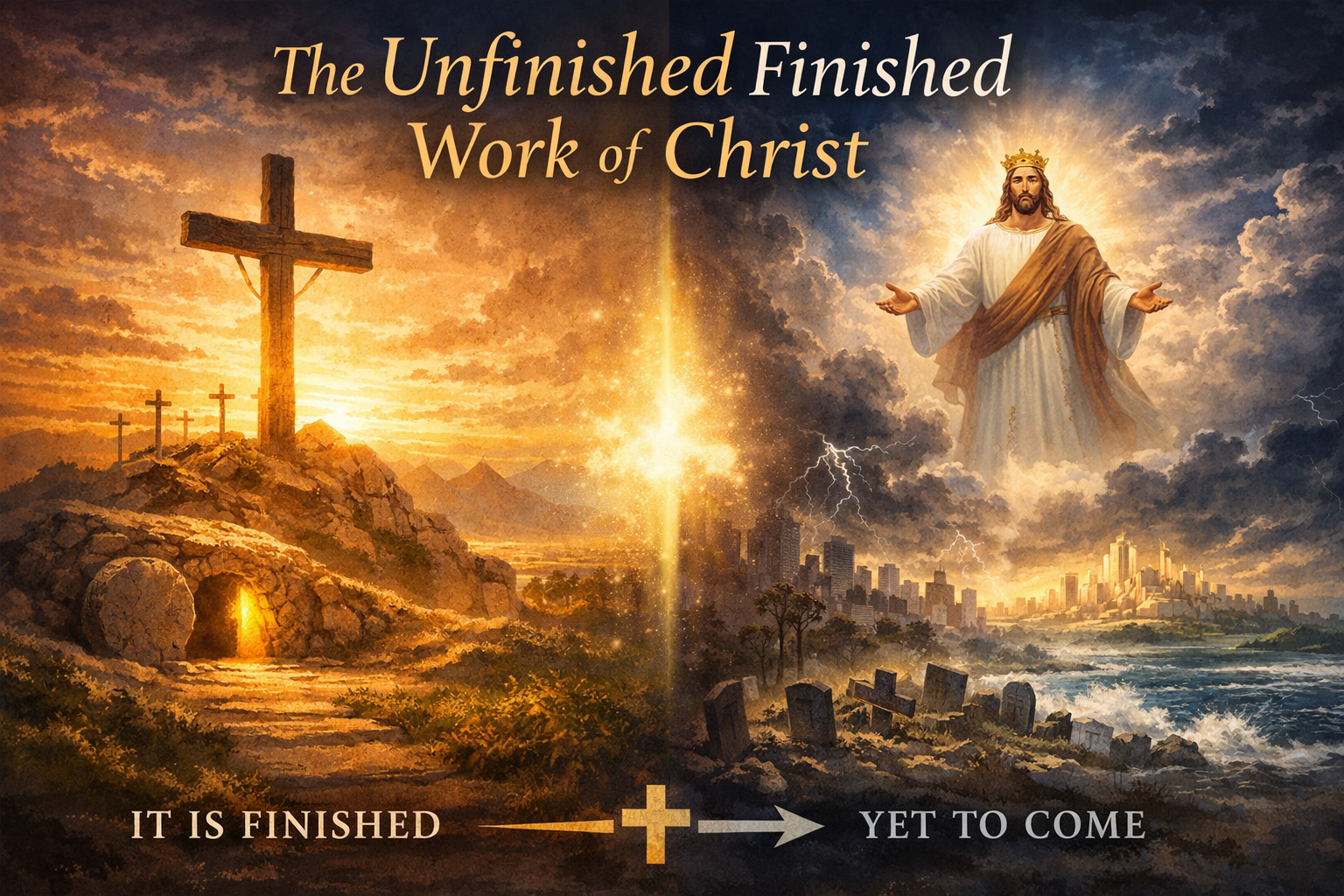
In light of this being the week of our Lord’s passion, it is interesting to note that one of the last things that he said before he gave up his Spirit on the cross was, “It is finished.” (τετέλεσται, John 19.30). With this powerful word, Jesus declared that his work on the cross in making full atonement for sin was completed, and “bowing his head, he gave up his spirit.” It must have been a powerful scene, and no more pregnant words have perhaps ever been spoken. However, the problem is that even though Christ finished his work, sin still seems to run rampant in this world. If it is finished, why, we might ask, is the world still broken, still full of pain and suffering and sin and death? Because of this, we might be tempted to suggest that his work is unfinished. Many Christians struggle to hold together what has already been accomplished and what still remains. However, what we must realize is that Christ’s work is finished; it is fully accomplished in its foundation, but not yet fully realized in its effects. In this post, I would like to consider this tension by offering just a few thoughts on what Christ accomplished in his first coming and what waits to be realized at his second coming.
In one sense, then, it is completely accurate to say that the work of Christ has been fully accomplished, and there are at least three aspects of his work that are completely finished. First, atonement has been accomplished. When Christ died on the cross, he made the full and final payment for our sin. In systematic theology, this is called penal substitutionary atonement. In other words, this means that Christ paid the penalty (penal) that we deserve (substitutionary) for our sin. (On the fact that this was Christ’s view of his death, see here.) He died the death that we deserve by dying in our place. But he did not stay dead; he rose again on the third day. This is the second aspect of Christ’s finished work, namely that victory over death has been secured. When Jesus walked out of the grave on the third day, he defeated death and disarmed Satan of his power. Death no longer has hold over those who are in Christ. We need not fear, we can have hope, even in the face of death. (On hope in the face of death, see here.) And lastly, by dying on the cross, Christ finished his work of establishing righteousness. In other words, his finished work on the cross is now the ground upon which God grants our justification, when we place our faith in Jesus. He lived a perfect life, he died an innocent death. And his righteousness is imputed to us by faith. We are made right, declared innocent, because of Christ’s finished work. This is the gospel. Nothing needs to be added to what Christ accomplished; his work is complete, sufficient, and final. It is not partial, not provisional. It is finished!
Moreover, his finished work on the cross inaugurated several important realities in which we now live. For one, the Kingdom of God has been inaugurated. Forty days after his resurrection, Jesus ascended into heaven to be seated at the right hand of the Father, and he is now reigning with all authority on earth as it is in heaven. (Matt. 28.18) He is not waiting to become King; he is already reigning as King. And he does this by his Spirit. This is the second reality in which we now live, namely that Christ has sent his Spirit to indwell his people. The Spirit mediates Christ’s real presence in and among his people. He is the down payment, the seal, and the guarantee of our faith. And he is actively working in us to make us more like Jesus. And lastly, but certainly not leastly, new life has begun. When we place our faith in Christ, the Spirit regenerates us. He brings to life what was once spiritually dead, and we are born again. In this way we are new creatures in Christ. The old has passed away, and behold the new has come. (2 Cor. 5.17) New creation realities are already at work in us through the Spirit. In these ways, the future has already broken into the present through the risen Christ, and we live in these future realities even now.
And yet, in spite of all of this, several aspects of Christ’s work remain unfinished. Perhaps most clearly, sin still remains in the world. We have been saved from the penalty of sin, but we have not yet been saved from the presence of sin. Our world is saturated and polluted with sin at every turn. People are burdened down with sin and its consequences. Our relationships suffer, bodies are diseased, conflict and turmoil abound at every level of our society. Sin continues its reign of terror nearly unchecked. In addition to this, death still operates in this world. This world reeks with the stench of death; it fills our nostrils everywhere we turn. Our loved ones get sick and die. Accidents and tragedy take lives too soon. Christ has been raised, and death has been defeated. But death still reigns in our mortal bodies, and we ache and groan for that day when death will be no more. Thirdly, the created order groans under the weight of humanity’s sin. When our first parents fell, the creation itself was subjected to futility and decay. The idyllic paradise of Eden was lost to the corruption of sin. And lastly, justice and restoration are yet to be realized. Injustice abounds in our society. From all appearances, the weak get weaker and the strong get stronger. There is no real justice; there is no real peace. Wickedness and evil seem to grow day by day. What is wrong is celebrated as right, and what is right is condemned as wrong. The world is turned upside down, and we long for the day when justice will flow like rivers and when peace will rest upon the earth. And we cry out with the Scriptures, “How long, O Lord? How long?”
In theological parlance, this tension between the finished and the unfinished work of Christ is often referred to by the shorthand phrase “already/not yet”. It simply means that God’s plan of redemption for the world has already begun, has already been inaugurated, but has not yet been fully consummated. The work of Christ’s first coming is finished. He died on the cross, he rose again the third day, he sent his life-giving Spirit. But we are still waiting for the work of his second coming, namely the resurrection of the dead, the final judgment, and the new creation. This is the tension in which we now live, and in this tension, we must avoid two extremes. First, we must avoid living as if nothing has been finished. We must learn to rest in the finished work of Christ. We have been forgiven; we have been indwelled by His Spirit. We can have peace. On the other hand, however, we must not live as if everything is already complete. We do live under the burdens of sin and death; we do long for justice and peace. And we can have hope. The work of Christ is finished in its accomplishment, but it is unfinished in its application to the whole of creation. And so, we wait faithfully as Christ has instructed us.
And this is the point, namely that this tension is not ultimately about stages of fulfillment, though that is certainly the best framework for understanding it. Ultimately, this tension is about Christ. His work is unfinished because his story is not over. (On my argument for the centrality of Christ in our eschatological reflection, see here.) In other words, the same Jesus who said, “It is finished” is the same Jesus who is coming again to make all things new. The same Jesus who died on the cross is the same Jesus who is coming again in glory. Or to put it another way, the second coming of Jesus is not a different work; no, it is the completion of the same work that he began 2000 years ago. The second coming completes what the first coming began, because Christ himself is the fulfillment of all our hopes. Our hope is not just about what Christ has done and will do; it is about Christ himself. It is about his presence. In John 14.3, Jesus promised that he would come again and receive us unto himself, that where he is there we may be also. And so, the unfinished nature of Christ’s work is not a failure of the first coming, but the promise of the second. He is our blessed hope.
And so, yes, we live in the middle of this tension; we live in between the already and the not yet. We are already forgiven, but we are still struggling. We are already alive, yet we are still dying. We are already redeemed, yet we are still waiting. We are waiting to be set free from the presence and the corruption of sin once and for all. This is the lived reality of the Christian life—caught between what has been accomplished and what has not yet been revealed. And I suggest that we must embrace this tension with open arms, because it is only when we embrace this tension that we will be able to hope without denying the pain of our sufferings, that we can be confident without giving into naive triumphalism, and that we can have patience without being paralyzed by despair. If we collapse this tension in either direction, we lose something essential. Either we deny the reality of our present struggle, or we forget the certainty of our future hope. This is the ground that we must stand on, the already and the not yet. We do not live as those waiting for Christ to begin his work, but as those waiting for him to complete it.
When Jesus said, “It is finished.”, he surely meant it. Christ’s work is finished, and yet, it is not yet finished completely. It is finished in its foundation, but it is unfinished in its consummation. We are waiting for the full glory of Christ and his work to be finally revealed on earth. And even in acknowledging the unfinished aspects of Christ work, we must affirm that the work of the cross is not undone; it is unfolding. The resurrection is not isolated; it is expanding. And one day, we will all be raised to meet him in the air, and from that point on, we will always be with the Lord. This is our hope, namely that the Christ who finished his work on the cross is coming again to bring it to final completion. Even so, come quickly, Lord Jesus! Maranatha!
Share this:

On Resurrection and the Path of Glory
10 My goal is to know him and the power of his resurrection and the fellowship of his sufferings, being conformed to his death, 11 assuming that I will somehow reach the resurrection from among the dead.
~Philippians 3.10-11
Title: On Resurrection and the Path of Glory
Text: Philippians 3.10-11
Church: Redeemer Baptist Church, Jonesboro, AR
Date: March 31, 2024
Share this:

On the Crucifixion and Why It Matters at Christmas
TEXT
32 Two others—criminals—were also led away to be executed with him. 33 When they arrived at the place called The Skull, they crucified him there, along with the criminals, one on the right and one on the left. 34 Then Jesus said, “Father, forgive them, because they do not know what they are doing.” And they divided his clothes and cast lots.
35 The people stood watching, and even the leaders were scoffing: “He saved others; let him save himself if this is God’s Messiah, the Chosen One!” 36 The soldiers also mocked him. They came offering him sour wine 37 and said, “If you are the king of the Jews, save yourself!”
38 An inscription was above him: This Is the King of the Jews.
~Luke 23.32-38
Title: On the Crucifixion and Why It Matters at Christmas
Text: Luke 23.32-38
Series: Who is Jesus? A Study of the Gospel of Luke
Church: South Caraway Baptist Church, Jonesboro, AR
Date: December 18, 2022


