Tag Archives: Faithfulness of God


On Psalm 119.145-152 (Qoph)
145 I call with all my heart; answer me, Lord.
I will obey your statutes.
146 I call to you; save me,
and I will keep your decrees.
147 I rise before dawn and cry out for help;
I put my hope in your word.
148 I am awake through each watch of the night
to meditate on your promise.
149 In keeping with your faithful love, hear my voice.
Lord, give me life in keeping with your justice.
150 Those who pursue evil plans come near;
they are far from your instruction.
151 You are near, Lord,
and all your commands are true.
152 Long ago I learned from your decrees
that you have established them forever.

It has been a while since I have continued my work through Psalm 119, but we now come to the nineteenth stanza (ק/Qoph). Immediately in the opening verses, we are met with the heartfelt cry of the psalmist. He rises before the dawn and cries out; he watches through the night and longs for deliverance. There is a desperation and urgency in his prayers that is all too familiar to the people of God. And yet, what grounds the psalmist in the midst of his anxieties is a profound confidence in God and in his Word. In other words, even amid the uncertainties of his circumstances, there remains a quiet confidence, a sure and certain foundation upon which he can stand, namely the faithfulness of God to his promises. Even as he waits for God to intervene in his particular situation, he does so with the expectation that God will do what he has said he will do. He will keep his promises; he will remain true to his Word.
This is perhaps why the psalmist’s prayers are so heartfelt and sincere. He cries out “with all my heart.” This is not empty emotionalism or emotion for emotion’s sake; rather, it is the full orientation of the whole self toward God in utter dependence upon him and his promises. It is only from this posture of dependence that we are truly able to express our deepest fears, longings, and vulnerabilities before God. This is one of the great comforts of covenant relationship with him, namely that we can entrust even our most personal anxieties and desperations into his hands because he hears the cries of his people. At the same time, the psalmist balances his cries for deliverance with his own commitment to walk in obedience and faithfulness. This is not a kind of tit-for-tat arrangement in which obedience earns God’s favor. Rather, it is the logic of covenant itself. God has promised to remain faithful to his word, and the psalmist responds with trust expressed through obedience. In other words, true dependence upon God does not produce passivity, but faithful perseverance. It is a radical dependence that issues forth in both trust and obedience.
It is this covenant relationship that also strengthens the psalmist’s perseverance; he rises before the dawn and watches through the night. These actions express hopeful expectation even in the midst of waiting. The fact of the matter is that we simply do not know how long the psalmist has been observing these rhythms of prayer and longing. Perhaps he has been crying out for deliverance for a very long time. And yet he persists in the offering because he remains confident that God will one day answer his prayers. Of course, waiting is a common season in the Christian life. We have all experienced moments in which we long for God’s intervention and yet it does not seem to be forthcoming. It is precisely this kind of hopeful expectation that provides the strength necessary to persevere through such seasons. Indeed, this is how waiting itself can be transformed into worship, namely when it is sustained by confidence in the promises of God. The dawn has not yet come, but hope keeps the people of God awake in the darkness.
Because, let’s face it, we do live in the midst of pervasive darkness. The psalmist puts it this way in verse 150: “Those who pursue evil plans come near; they are far from your instruction.” And yet, in the very next line, he says, “You are near, Lord.” This is one of the great comforts of covenant relationship with God, namely that the nearness of affliction does not negate the nearness of God himself. The psalmist appears to be experiencing real oppression. He is pursued by those who would do him harm and likely lives under the constant threat of suffering and hostility. And yet, his confidence does not rest in the immediate resolution of his circumstances, but in the character and presence of God. This is an incredibly important insight because we are often tempted to interpret suffering as evidence of divine distance or absence. But Scripture repeatedly teaches us otherwise. Indeed, it is often in our deepest pains and afflictions that the nearness of God becomes most precious to his people. The psalmist knows this because his confidence is grounded not in changing circumstances, but in the sure and steadfast promises of God. The darkness may draw near, but the Lord is nearer still.
The psalmist knows this truth because, as he says in verse 152, “Long ago I learned from your decrees that you have established them forever.” This is an important statement because, in the midst of a stanza filled with emotional weight and longing, the psalmist ultimately grounds his confidence in the objective certainty of God’s Word. He is not led by his emotions, nor is he controlled by the instability of his circumstances. Rather, he is anchored in the enduring faithfulness of God and his promises. This is because God’s Word is not only true, but eternally true. In the midst of the shifting seasons of life, the highs and lows of our emotions, and the ever-changing nature of our trials and afflictions, the promises of God remain fixed and unchanging. The Lord himself is the same yesterday, today, and forever, and therefore his faithfulness does not fluctuate with the changing tides of human experience. This is why the people of God are able to persevere with expectant hope, because our confidence ultimately rests not in ourselves or our circumstances, but in the unchanging certainty of the Word of God.
In the end, then, the Qoph stanza of Psalm 119 teaches us what it means to persevere in hopeful dependence upon God. The psalmist cries out, waits, watches, suffers, and longs for deliverance, and yet the dominant note throughout the stanza is not despair, but confidence. Though darkness surrounds him and affliction draws near, he remains convinced that the Lord is nearer still. This is often the shape of the Christian life as well. We pray before the dawn; we wait through long nights of uncertainty; we trust God before deliverance finally comes. And yet, in all of these seasons, the people of God continue to hope because our confidence rests not in ourselves or in the stability of our circumstances, but in the unchanging faithfulness of God and his Word. The darkness may linger through the night, but the people of God continue to hope because the God who speaks remains near, and his word remains forever true.
For further study:
Introduction
Psalm 119.1-8
Psalm 119.9-16
Psalm 119.17-24
Psalm 119.25-32
Psalm 119.33-40
Psalm 119.41-48
Psalm 119.49-56
Psalm 119.57-64
Psalm 119.65-72
Psalm 119.73-80
Psalm 119.81-88
Psalm 119.89-96
Psalm 119.97-104
Psalm 119.105-112
Psalm 119.113-120
Psalm 119.121-128
Psalm 119.129-136
Psalm 119.137-144
Share this:

On Deborah, Barak, and the “Failure of Men” Hypothesis
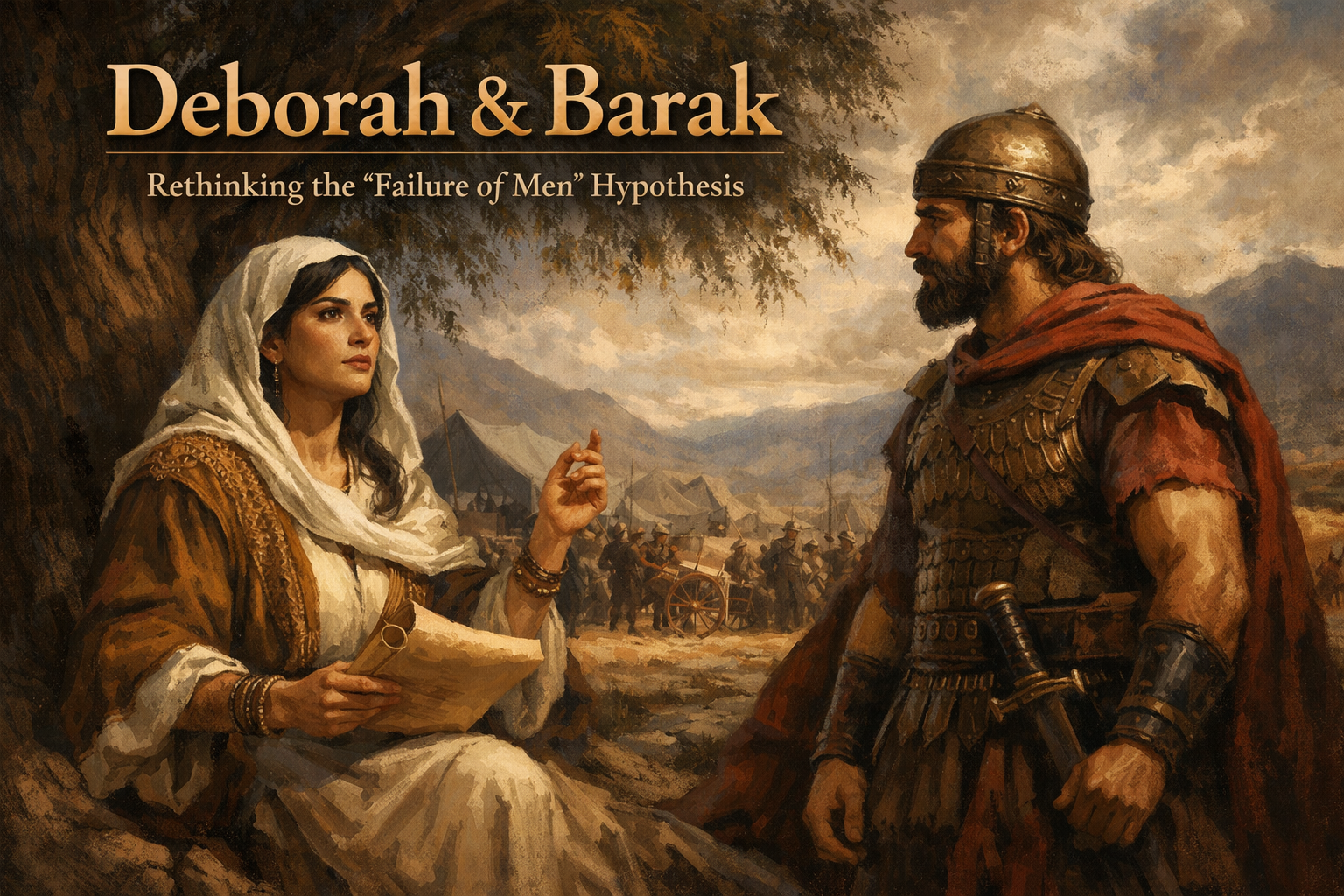
I was recently reading through the Book of Judges as part of my Bible reading plan, and I had the opportunity to revisit the story of Deborah and Barak (Judges 4–5). It is a remarkable account of how God delivered his people from Canaanite oppression and remained faithful to his covenant promises even when Israel was not faithful to him. At the same time, this passage often becomes a flashpoint in debates concerning gender roles in the home and in the church, particularly regarding the role of women. On the one hand, egalitarians point to Deborah as a paradigm for female leadership that should be emulated in the church today. On the other hand, complementarians often explain her leadership as the result of male failure, i.e. that God raised Deborah because no man was willing to step forward. It is this latter claim that I would like to examine in this post. While the “failure of men” hypothesis may resonate with certain instincts and seems to account for Barak’s initial hesitation, it ultimately goes beyond what the text itself supports. Deborah’s role is not presented as a corrective to male absence, nor as a structural shift in leadership patterns. Rather, Judges 4–5 presents a more complex picture of divine deliverance, prophetic authority, and covenant faithfulness.
Textually, the “failure of men” hypothesis is built on Barak’s apparent hesitation. In Judges 4.8, when Deborah instructs Barak to gather the tribes in preparation for battle, he responds, “If you will go with me, I will go. But if you will not go with me, I will not go.” Deborah agrees to accompany him, but she also declares that the honor of the victory will not go to Barak. From this, the argument is often made that Barak’s hesitation reveals a lack of courage or leadership, and that Deborah steps in to fill the resulting gap. The conclusion, then, is that God raises up women to lead when men fail. While it is certainly true that Barak hesitates and that Deborah plays a central leadership role, this conclusion goes beyond what the text itself actually supports. It does not arise from the narrative so much as it is imposed upon it. The issue is not whether Deborah leads—the text clearly affirms that she does—but whether her leadership is presented as a response to male absence or failure.
A close and careful reading of the text reveals that Deborah is introduced first, and she is already functioning in a leadership role before Barak even appears in the narrative. In Judges 4:4–5, we are told that “Deborah, a prophetess and the wife of Lappidoth, was judging Israel at that time,” and that the people of Israel came to her for judgment. This indicates that Deborah was already established as both a prophetess and a judge. She is not raised up in response to Barak; she is already exercising leadership within Israel. Moreover, it is Deborah who summons Barak and speaks with divine authority as she relays the Lord’s command (4:6–7). In other words, the initiative in the narrative belongs to God through Deborah, not to a vacuum created by men. As for Barak, as noted above, he does appear to hesitate in response to the Lord’s command. However, this is not an outright refusal to lead, but a form of conditional obedience. He expresses a desire for the Lord’s prophet to accompany him in the task. Importantly, Deborah does not rebuke or condemn him for this response. Instead, she simply declares that the honor of the victory will go to a woman. This is a prophetic statement of outcome, not a moral indictment. Deborah supports Barak in his role; she does not portray him as a failed leader.
The key to understanding this narrative comes in chapter 5. Judges 5 is a poetic retelling of the events of chapter 4, and as such, it functions as the inspired interpretation of those events. In the song, Deborah is praised as “a mother in Israel” (5:7), but just as importantly, Barak is also commended. He is included among the military leaders who participated in the Lord’s deliverance, and nowhere in the song is he criticized or portrayed as a failed or reluctant figure. The narrative simply does not frame Barak as a man who failed to lead. In fact, the only explicit condemnation in the song appears in verse 23, which reads “Curse Meroz,” says the angel of the Lord, “bitterly curse her inhabitants, for they did not come to help the Lord, to help the Lord with the warriors.” Meroz, likely a nearby town expected to join the battle, is condemned precisely because it failed to respond. This is significant. If the narrator intended to highlight male failure in Barak, he had the language and categories to do so—and he uses them elsewhere in the text. But Barak is never cursed, rebuked, or condemned. Instead, he is remembered as one who participated in the Lord’s victory. The silence of the text where we might expect condemnation is itself interpretively significant.
Stepping back from the story of Deborah and Barak, the broader pattern of the Book of Judges is that Israel’s history follows a predictable cycle. The people fall into sin, God punishes them with oppression, they cry out for deliverance, and the Lord raises up a judge to rescue them. Yet this cycle does not simply repeat—it spirals downward. As the narrative progresses, the judges themselves become increasingly flawed, and the moral and spiritual condition of Israel deteriorates. We need only consider figures like Gideon, Jephthah, and Samson to see that the author of Judges knows how to highlight the failures of male leadership when he intends to do so. Their weaknesses are not subtle; they are central to their stories. But Deborah’s narrative does not function in this way. She is presented as a faithful and effective leader, and Barak is not portrayed as a cautionary figure. In other words, the text does not present Deborah as a divine workaround for male incompetence, but as a legitimate agent of God’s deliverance within a broader pattern of imperfect yet usable leaders.
So, what do we do with Deborah? The fact of the matter is that Deborah does lead. She is a prophetess and a judge, and she is used powerfully by God in the deliverance of his people. However, her role must be understood within its narrative and redemptive context, not abstracted into a universal principle. On the one hand, we should not use Deborah to overturn broader biblical patterns of leadership and authority. This is the well-known distinction between what is descriptive and what is prescriptive. In this narrative, Deborah is described as a faithful and effective leader through whom God works; she is not explicitly presented as a paradigm for leadership structures in the home or the church. On the other hand, we must also resist the impulse to minimize or dismiss her role. Deborah is not an anomaly to be explained away. She is a genuine agent of God’s deliverance, and her story is preserved in Scripture as part of God’s inspired revelation. Her leadership is real, authoritative, and significant. Yet the text itself does not frame her role as establishing a normative pattern for ecclesial or domestic leadership. Rather, it highlights the sovereignty of God, who works through whom he wills to accomplish his purposes.
The point of all this is to say that the story of Deborah and Barak is not about gender polemics. This is a concern that is external to the text and often imposed upon it by modern debates. This does not mean that those debates are unimportant; they are all the more pressing in this current cultural moment. But, the question is not what Deborah means for our debates, but what this text reveals about how God works in the history of his people. The narrative of Deborah and Barak directs our attention elsewhere. This story is about God’s faithfulness to his promises, his sovereignty over his people and their circumstances, and his willingness to use unexpected agents to accomplish his purposes in the world. Throughout the Book of Judges, Israel repeatedly proves unfaithful, yet God remains steadfast. He raises up deliverers, not because of their inherent greatness, but because of his covenant commitment. Deborah and Barak are no exception. Their story highlights the fact that God is not limited by human expectations, conventions, or categories. He works through whom he wills and accomplishes his purposes in ways that often surprise us. The emphasis of Judges 4–5 is not that men failed, but that God delivers his people often in ways that subvert human expectations and call us to trust in his sovereign power rather than our own assumptions.
In the end, this discussion brings us back to a matter of method. We must let the text speak for itself rather than imposing our own categories and concerns upon it. The “failure of men” hypothesis ultimately reads more into the narrative than it draws out of it, importing assumptions that the text itself does not explicitly support. Deborah is neither an anomaly to be explained away nor a weapon to be deployed in broader ideological debates. She is a faithful servant of the Lord, raised up within a particular moment in Israel’s history to accomplish God’s purposes for his people. Her story reminds us that God is both sovereign and free in the instruments he chooses to use. At the same time, it calls us to read Scripture carefully, attentively, and humbly. Faithful interpretation requires that we resist the urge to make the text serve our frameworks, and instead allow it to shape them, even when it refuses to fit neatly into our categories.
Share this:

On the Future of Israel
TEXT
25 I don’t want you to be ignorant of this mystery, brothers and sisters, so that you will not be conceited: A partial hardening has come upon Israel until the fullness of the Gentiles has come in. 26 And in this way all Israel will be saved, as it is written,
The Deliverer will come from Zion;
he will turn godlessness away from Jacob.
27 And this will be my covenant with them
when I take away their sins.
28 Regarding the gospel, they are enemies for your advantage, but regarding election, they are loved because of the patriarchs, 29 since God’s gracious gifts and calling are irrevocable. 30 As you once disobeyed God but now have received mercy through their disobedience, 31 so they too have now disobeyed, resulting in mercy to you, so that they also may now receive mercy. 32 For God has imprisoned all in disobedience so that he may have mercy on all.
~Romans 11.25-32
Text: Romans 9-11, et al.
Series: Eschatology: A Study of the End Times
Church: South Caraway Baptist Church, Jonesboro, AR
Date: October 12, 2022


