Tag Archives: Peace

On Psalm 119.161-168 (Sin/Shin)
161 Princes have persecuted me without cause,
but my heart fears only your word.
162 I rejoice over your promise
like one who finds vast treasure.
163 I hate and abhor falsehood,
but I love your instruction.
164 I praise you seven times a day
for your righteous judgments.
165 Abundant peace belongs to those
who love your instruction;
nothing makes them stumble.
166 Lord, I hope for your salvation
and carry out your commands.
167 I obey your decrees
and love them greatly.
168 I obey your precepts and decrees,
for all my ways are before you.

The twenty-first stanza (ש/sin or shin, depending on the placement of the dot) continues the theme of suffering that we have encountered throughout the last several stanzas. Our psalmist opens with the observation, “Princes have persecuted me without cause.” Once again, we are not given all the details of his circumstances, but it is clear that his troubles originate from those who possess power and authority. It is often the case that the righteous suffer not because they have done anything wrong, but simply because they belong to God. Our psalmist finds himself opposed by the powers that be without just cause. Of course, this pattern runs throughout the history of God’s people and finds its fullest expression in the suffering of Jesus Christ, who “left you an example, that you should follow in his steps” (1 Pet. 2.21). As Jesus himself warned, “A servant is not greater than his master. If they persecuted me, they will also persecute you” (John 15.20). Yet in the face of this persecution, our psalmist does not surrender to fear, bitterness, or despair. Rather, he declares, “My heart fears only your word.” The princes may possess earthly authority, but God’s Word possesses ultimate authority. The defining feature of this stanza, therefore, is not the persecution itself, but the psalmist’s response to it. Instead of allowing his circumstances to govern his heart, he finds comfort, stability, and confidence in the promises of God.
This is perhaps why he says, “I rejoice over your promise like one who finds vast treasure.” The image is striking. Imagine the excitement of stumbling upon a fortune beyond anything you could have imagined. That is how our psalmist views the Word of God. He recognizes that true and lasting value is found not in possessions, accomplishments, status, or worldly comforts, but in the promises of God. Indeed, no earthly treasure can compare with the life-giving riches that are found in God’s Word. And this is cause for great joy, because no matter what difficulties may arise, we always have God’s promises to uphold and sustain us. This is an important lesson for us as well, namely that the value we assign to God’s Word reveals much about the orientation of our hearts. Are our hearts consumed by anxiety, fear, and uncertainty about the future, or are they resting in the promises of the one true and living God? Do we rejoice in God’s Word even when circumstances are difficult and answers seem far away? Our psalmist’s joy is not rooted in changing circumstances but in the unchanging faithfulness of God revealed through his Word.
And it is this treasuring of God’s Word that leads our psalmist to say in verse 163, “I hate and abhor falsehood, but I love your instruction.” This is strong language, but compared to the surpassing value of God’s truth, all falsehood must appear by contrast as hateful and abhorrent. Of course, this is not the language of emotional volatility or personal animosity. Rather, it is the language of covenant loyalty and moral commitment. Our psalmist’s love for God and his Word has shaped his affections in such a way that he delights in what is true and rejects what is false. Covenant love for God necessarily produces opposition to anything that contradicts his character and his revelation. Yet modern notions of love often seek to separate love from truth. Many assume that to love someone means affirming whatever they believe or shielding them from difficult truths. But the Scriptures know nothing of such a separation. Genuine love rejoices in the truth because truth ultimately leads us to God himself. For this reason, our psalmist refuses to separate love from truthfulness. To love God is to love what is true, right, good, and beautiful, and to reject whatever stands opposed to it.
Of course, this kind of love should stand at the very center of our worship, as our psalmist writes, “I praise you seven times a day for your righteous judgments.” In other words, our psalmist’s heart is so filled with covenant love and loyalty that he cannot help but burst forth in praise. The reference to “seven times a day” likely signifies more than a literal number. Throughout Scripture, the number seven often conveys the idea of fullness or completeness. The point, then, is that praise has become the regular habit of his soul. Worship is not an occasional activity reserved for certain moments or certain days of the week. Rather, it permeates the very fabric of his life. And we might be tempted to ask how such continual praise is possible in the face of unjust persecution and suffering. The answer is simple: God’s righteous judgments are continually before him. His mind is saturated with the truth of God’s Word, and his heart responds with worship. The more deeply Scripture shapes our thinking and affections, the more naturally praise emerges from our lives. This is because the ultimate goal of Scripture is not merely information but worship, not merely knowledge about God but joyful devotion to the God who has revealed himself in his Word.
Now, the result of this life of covenant loyalty, delight in God’s Word, and continual worship is what our psalmist describes in verse 165: “Abundant peace belongs to those who love your instruction; nothing makes them stumble.” This is perhaps the central affirmation of the entire stanza. However, we must be careful to understand what kind of peace the psalmist has in mind. He is not speaking of ease, comfort, or the absence of hardship. After all, he has already told us that he is being persecuted by princes without cause. His circumstances have not changed. The opposition remains. The suffering continues. Yet he possesses peace. This is because biblical peace is not primarily the absence of conflict but the presence of stability, wholeness, and confidence in God. It is the settled assurance that God remains faithful to his promises regardless of what may be happening around us. This is why peace belongs specifically to those who love God’s instruction. The Word of God anchors the believer amid the storms of life. It provides a sure foundation when everything else seems uncertain and unstable. As we have seen in the previous stanzas, our circumstances may remain difficult, our prayers may seem unanswered, and our suffering may continue for a season. Yet the foundation remains secure because God’s Word remains true. Peace, therefore, does not flow from our ability to control our circumstances but from our confidence in the God who governs them. The more deeply we trust his Word, the more firmly our hearts are established in peace.
Our psalmist concludes the stanza by reminding us why all of this is possible: “I obey your precepts and decrees, for all my ways are before you.” Though he is persecuted, pressured, and opposed by powerful enemies, he continues to rejoice in God’s Word, to praise God continually, and to walk in faithful obedience. More remarkably still, he enjoys a peace that transcends his circumstances. The reason for this confidence is that he lives Coram Deo, that is to say, before the face of God. His life is not hidden from the Lord. His sufferings are known. His prayers are heard. His obedience is seen. The God who gave these promises is the same God who remains present with his people and faithful to his covenant. This is why the stability of the believer is ultimately grounded not in favorable circumstances but in the enduring truth of God’s Word. Though the people of God may face opposition from every side, they possess a peace the world cannot give because their lives are anchored in the truth, presence, and faithfulness of the God who speaks.
For further study:
Introduction
Psalm 119.1-8
Psalm 119.9-16
Psalm 119.17-24
Psalm 119.25-32
Psalm 119.33-40
Psalm 119.41-48
Psalm 119.49-56
Psalm 119.57-64
Psalm 119.65-72
Psalm 119.73-80
Psalm 119.81-88
Psalm 119.89-96
Psalm 119.97-104
Psalm 119.105-112
Psalm 119.113-120
Psalm 119.121-128
Psalm 119.129-136
Psalm 119.137-144
Psalm 119.145-152
Psalm 119.153-160
Share this:


On the Unfinished Finished Work of Christ
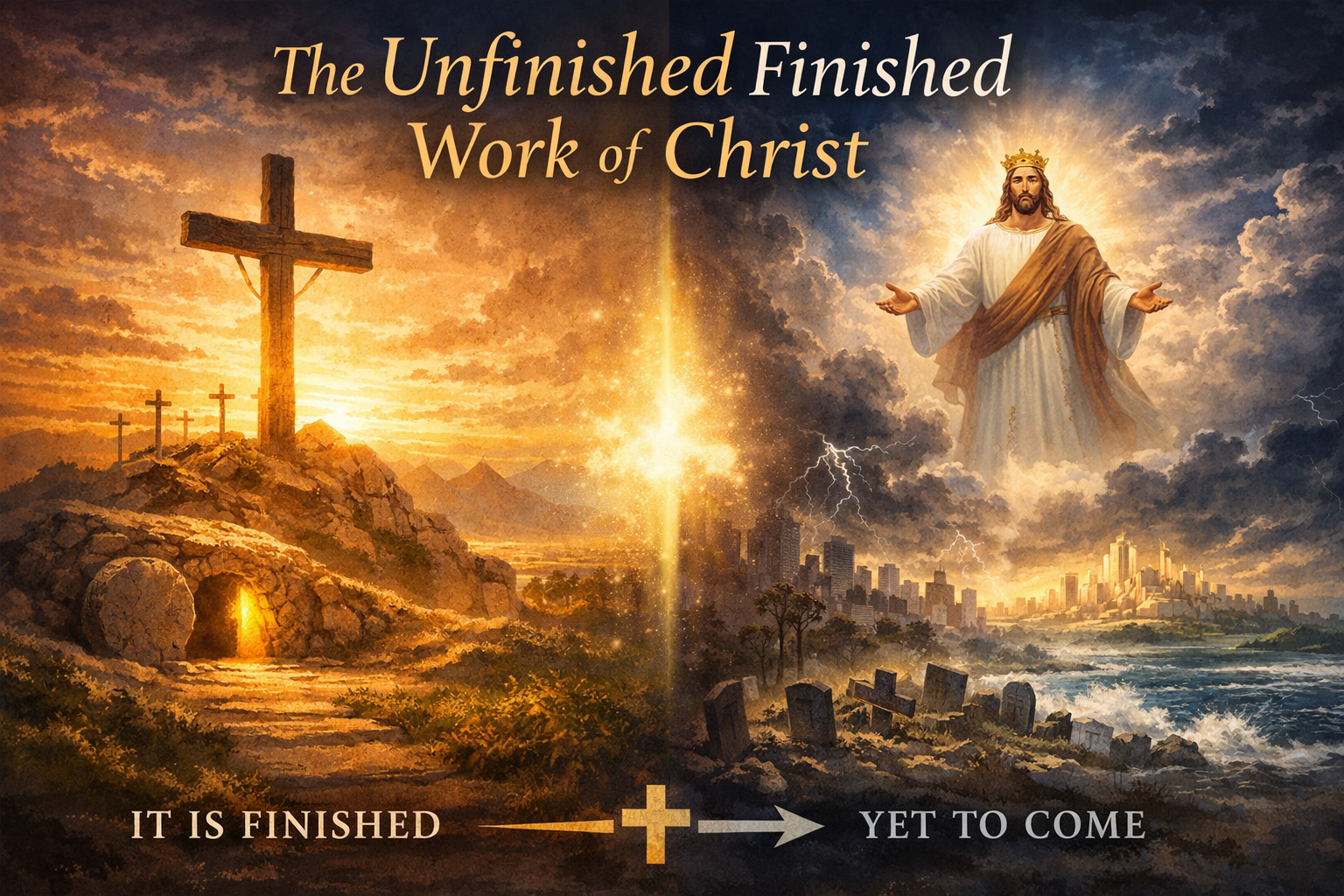
In light of this being the week of our Lord’s passion, it is interesting to note that one of the last things that he said before he gave up his Spirit on the cross was, “It is finished.” (τετέλεσται, John 19.30). With this powerful word, Jesus declared that his work on the cross in making full atonement for sin was completed, and “bowing his head, he gave up his spirit.” It must have been a powerful scene, and no more pregnant words have perhaps ever been spoken. However, the problem is that even though Christ finished his work, sin still seems to run rampant in this world. If it is finished, why, we might ask, is the world still broken, still full of pain and suffering and sin and death? Because of this, we might be tempted to suggest that his work is unfinished. Many Christians struggle to hold together what has already been accomplished and what still remains. However, what we must realize is that Christ’s work is finished; it is fully accomplished in its foundation, but not yet fully realized in its effects. In this post, I would like to consider this tension by offering just a few thoughts on what Christ accomplished in his first coming and what waits to be realized at his second coming.
In one sense, then, it is completely accurate to say that the work of Christ has been fully accomplished, and there are at least three aspects of his work that are completely finished. First, atonement has been accomplished. When Christ died on the cross, he made the full and final payment for our sin. In systematic theology, this is called penal substitutionary atonement. In other words, this means that Christ paid the penalty (penal) that we deserve (substitutionary) for our sin. (On the fact that this was Christ’s view of his death, see here.) He died the death that we deserve by dying in our place. But he did not stay dead; he rose again on the third day. This is the second aspect of Christ’s finished work, namely that victory over death has been secured. When Jesus walked out of the grave on the third day, he defeated death and disarmed Satan of his power. Death no longer has hold over those who are in Christ. We need not fear, we can have hope, even in the face of death. (On hope in the face of death, see here.) And lastly, by dying on the cross, Christ finished his work of establishing righteousness. In other words, his finished work on the cross is now the ground upon which God grants our justification, when we place our faith in Jesus. He lived a perfect life, he died an innocent death. And his righteousness is imputed to us by faith. We are made right, declared innocent, because of Christ’s finished work. This is the gospel. Nothing needs to be added to what Christ accomplished; his work is complete, sufficient, and final. It is not partial, not provisional. It is finished!
Moreover, his finished work on the cross inaugurated several important realities in which we now live. For one, the Kingdom of God has been inaugurated. Forty days after his resurrection, Jesus ascended into heaven to be seated at the right hand of the Father, and he is now reigning with all authority on earth as it is in heaven. (Matt. 28.18) He is not waiting to become King; he is already reigning as King. And he does this by his Spirit. This is the second reality in which we now live, namely that Christ has sent his Spirit to indwell his people. The Spirit mediates Christ’s real presence in and among his people. He is the down payment, the seal, and the guarantee of our faith. And he is actively working in us to make us more like Jesus. And lastly, but certainly not leastly, new life has begun. When we place our faith in Christ, the Spirit regenerates us. He brings to life what was once spiritually dead, and we are born again. In this way we are new creatures in Christ. The old has passed away, and behold the new has come. (2 Cor. 5.17) New creation realities are already at work in us through the Spirit. In these ways, the future has already broken into the present through the risen Christ, and we live in these future realities even now.
And yet, in spite of all of this, several aspects of Christ’s work remain unfinished. Perhaps most clearly, sin still remains in the world. We have been saved from the penalty of sin, but we have not yet been saved from the presence of sin. Our world is saturated and polluted with sin at every turn. People are burdened down with sin and its consequences. Our relationships suffer, bodies are diseased, conflict and turmoil abound at every level of our society. Sin continues its reign of terror nearly unchecked. In addition to this, death still operates in this world. This world reeks with the stench of death; it fills our nostrils everywhere we turn. Our loved ones get sick and die. Accidents and tragedy take lives too soon. Christ has been raised, and death has been defeated. But death still reigns in our mortal bodies, and we ache and groan for that day when death will be no more. Thirdly, the created order groans under the weight of humanity’s sin. When our first parents fell, the creation itself was subjected to futility and decay. The idyllic paradise of Eden was lost to the corruption of sin. And lastly, justice and restoration are yet to be realized. Injustice abounds in our society. From all appearances, the weak get weaker and the strong get stronger. There is no real justice; there is no real peace. Wickedness and evil seem to grow day by day. What is wrong is celebrated as right, and what is right is condemned as wrong. The world is turned upside down, and we long for the day when justice will flow like rivers and when peace will rest upon the earth. And we cry out with the Scriptures, “How long, O Lord? How long?”
In theological parlance, this tension between the finished and the unfinished work of Christ is often referred to by the shorthand phrase “already/not yet”. It simply means that God’s plan of redemption for the world has already begun, has already been inaugurated, but has not yet been fully consummated. The work of Christ’s first coming is finished. He died on the cross, he rose again the third day, he sent his life-giving Spirit. But we are still waiting for the work of his second coming, namely the resurrection of the dead, the final judgment, and the new creation. This is the tension in which we now live, and in this tension, we must avoid two extremes. First, we must avoid living as if nothing has been finished. We must learn to rest in the finished work of Christ. We have been forgiven; we have been indwelled by His Spirit. We can have peace. On the other hand, however, we must not live as if everything is already complete. We do live under the burdens of sin and death; we do long for justice and peace. And we can have hope. The work of Christ is finished in its accomplishment, but it is unfinished in its application to the whole of creation. And so, we wait faithfully as Christ has instructed us.
And this is the point, namely that this tension is not ultimately about stages of fulfillment, though that is certainly the best framework for understanding it. Ultimately, this tension is about Christ. His work is unfinished because his story is not over. (On my argument for the centrality of Christ in our eschatological reflection, see here.) In other words, the same Jesus who said, “It is finished” is the same Jesus who is coming again to make all things new. The same Jesus who died on the cross is the same Jesus who is coming again in glory. Or to put it another way, the second coming of Jesus is not a different work; no, it is the completion of the same work that he began 2000 years ago. The second coming completes what the first coming began, because Christ himself is the fulfillment of all our hopes. Our hope is not just about what Christ has done and will do; it is about Christ himself. It is about his presence. In John 14.3, Jesus promised that he would come again and receive us unto himself, that where he is there we may be also. And so, the unfinished nature of Christ’s work is not a failure of the first coming, but the promise of the second. He is our blessed hope.
And so, yes, we live in the middle of this tension; we live in between the already and the not yet. We are already forgiven, but we are still struggling. We are already alive, yet we are still dying. We are already redeemed, yet we are still waiting. We are waiting to be set free from the presence and the corruption of sin once and for all. This is the lived reality of the Christian life—caught between what has been accomplished and what has not yet been revealed. And I suggest that we must embrace this tension with open arms, because it is only when we embrace this tension that we will be able to hope without denying the pain of our sufferings, that we can be confident without giving into naive triumphalism, and that we can have patience without being paralyzed by despair. If we collapse this tension in either direction, we lose something essential. Either we deny the reality of our present struggle, or we forget the certainty of our future hope. This is the ground that we must stand on, the already and the not yet. We do not live as those waiting for Christ to begin his work, but as those waiting for him to complete it.
When Jesus said, “It is finished.”, he surely meant it. Christ’s work is finished, and yet, it is not yet finished completely. It is finished in its foundation, but it is unfinished in its consummation. We are waiting for the full glory of Christ and his work to be finally revealed on earth. And even in acknowledging the unfinished aspects of Christ work, we must affirm that the work of the cross is not undone; it is unfolding. The resurrection is not isolated; it is expanding. And one day, we will all be raised to meet him in the air, and from that point on, we will always be with the Lord. This is our hope, namely that the Christ who finished his work on the cross is coming again to bring it to final completion. Even so, come quickly, Lord Jesus! Maranatha!
Share this:

On the Priorities of the Gospel
TEXT
21 After these events, Paul resolved by the Spirit to pass through Macedonia and Achaia and go to Jerusalem. “After I’ve been there,” he said, “It is necessary for me to see Rome as well.” 22 After sending to Macedonia two of those who assisted him, Timothy and Erastus, he himself stayed in Asia for a while.
23 About that time there was a major disturbance about the Way. 24 For a person named Demetrius, a silversmith who made silver shrines of Artemis, provided a great deal of business for the craftsmen. 25 When he had assembled them, as well as the workers engaged in this type of business, he said, “Men, you know that our prosperity is derived from this business. 26 You see and hear that not only in Ephesus, but in almost all of Asia, this man Paul has persuaded and misled a considerable number of people by saying that gods made by hand are not gods. 27 Not only do we run a risk that our business may be discredited, but also that the temple of the great goddess Artemis may be despised and her magnificence come to the verge of ruin—the very one all of Asia and the world worship.”
28 When they had heard this, they were filled with rage and began to cry out, “Great is Artemis of the Ephesians!” 29 So the city was filled with confusion, and they rushed all together into the amphitheater, dragging along Gaius and Aristarchus, Macedonians who were Paul’s traveling companions. 30 Although Paul wanted to go in before the people, the disciples did not let him. 31 Even some of the provincial officials of Asia, who were his friends, sent word to him, pleading with him not to venture into the amphitheater. 32 Some were shouting one thing and some another, because the assembly was in confusion, and most of them did not know why they had come together. 33 Some Jews in the crowd gave instructions to Alexander after they pushed him to the front. Motioning with his hand, Alexander wanted to make his defense to the people. 34 But when they recognized that he was a Jew, they all shouted in unison for about two hours, “Great is Artemis of the Ephesians!”
35 When the city clerk had calmed the crowd down, he said, “People of Ephesus! What person is there who doesn’t know that the city of the Ephesians is the temple guardian of the great Artemis, and of the image that fell from heaven? 36 Therefore, since these things are undeniable, you must keep calm and not do anything rash. 37 For you have brought these men here who are not temple robbers or blasphemers of our goddess. 38 So if Demetrius and the craftsmen who are with him have a case against anyone, the courts are in session, and there are proconsuls. Let them bring charges against one another. 39 But if you seek anything further, it must be decided in a legal assembly. 40 In fact, we run a risk of being charged with rioting for what happened today, since there is no justification that we can give as a reason for this disturbance.” 41 After saying this, he dismissed the assembly.
~Acts 19.21-41
Title: On the Priorities of the Gospel
Text: Acts 19.21-41
Series: The Book of Acts
Church: Redeemer Baptist Church, Jonesboro, AR
Date: October 20, 2024
Share this:

On Psalm 119.105-112 (Nun)
105 Your word is a lamp for my feet
and a light on my path.
106 I have solemnly sworn
to keep your righteous judgments.
107 I am severely afflicted;
Lord, give me life according to your word.
108 Lord, please accept my freewill offerings of praise,
and teach me your judgments.
109 My life is constantly in danger,
yet I do not forget your instruction.
110 The wicked have set a trap for me,
but I have not wandered from your precepts.
111 I have your decrees as a heritage forever;
indeed, they are the joy of my heart.
112 I am resolved to obey your statutes
to the very end.

The fourteenth stanza of Psalm 119 starts with the letter נ (nun/pronounced like noon). Yes, that is right; the fourteenth stanza out of twenty-two. Remember, Psalm 119 is an acrostic psalm in which every stanza starts with the next letter of the Hebrew alphabet. It truly is a wonder of our psalmist could write 22 stanzas, 186 verses, extolling the perfections of God’s Word. There is no repetition, no redundancies; no, every stanza addresses some new or different aspect of God’s Law than the one before. His heart was clearly enamored – no, that’s not right – it was consumed with love, affection, devotion for the precepts of God. They were his very life, the only nourishment that could satisfy the pangs of his soul. This attitude should challenge and convict us. Modern Christians struggle to devote 15 minutes of their day to reading the bible; I know, because I am one of them. Why do our souls not hunger and thirst for the nourishment, the soul satisfying pleasures of the Word of God? This is the question that Psalm 119 is asking us.
In this stanza, our psalmist begins with those famous words, “Thy word is a lamp unto my feet, and a light unto my path” (verse 105, KJV). If you were raised in church like I was, then you probably just sang the lyrics to yourself. The fact that someone set these words to music captures the right sentiment, I think. The Psalms were originally prayers and songs that were meant for Israel’s corporate worship, so in singing them, we are no doubt emulating the practice of our psalmist. However, the connection between song and lyric and the affections of the heart is one that is often so underappreciated in modern worship services. Music has a way of touching us, of forming us, in the most vulnerable recesses of our hearts. What we sing, what we shout, these are the things that are planted in the memory of our hearts. This is why we should sing songs that are biblically faithful. As our psalmist goes on to write here, “I have solemnly sworn to keep your righteous judgments.” (verse 106). He is clear in these verses that his greatest affection, his first and foremost guiding principle for life, is the revelation of God in his Word.
And it would appear that he is in particular need of this guidance, as he goes on to write, “I am severely afflicted” (verses 107), and again, “My life is constantly in danger” (verse 109). And in the next verse, “The wicked have set a trap for me” (verse 110). Of course, we do not know the nature of this particular psalmists troubles; we have no narrative of his life to appeal to for background information. But it would appear that he is deeply troubled; he is facing some kind of opposition, some kind of persecution or threat, possibly even up to and including his very life. There are several occasions in the Book of Psalms where David faces similar circumstances, so we may reasonably infer that this was no light or temporary concern for our psalmist. And yet, in the midst of this trail, he continues to affirm his allegiance to the commands and ordinances of God. “I do not forget your instruction” (verse 109); “I have not wandered from your precepts” (verse 110). In fact, he goes on to say in the last verse of the stanza, “I am resolved to obey your statutes to the very end” (verse 112). Here again, we don’t know if the persecution he was facing was directly caused by his commitment to the God and His Word, but we do know that he was resolved, committed, and steadfast in keeping that Word until the very end, no matter what opposition he may face.
Where does a person find this kind of strength, this kind of steadfast loyalty to keeping the Word of God? I think we have our psalmists answer in verse 111, “I have your decrees as a heritage forever; indeed, they are the joy of my heart.” The word “heritage,” or perhaps “possession,” implies the idea of an inheritance; it is a surety of future prosperity. It is the reward that awaits the firstborn. And for our psalmist, the inheritance that he is anticipating is nothing less than the promises of the Word of God. It is the words of Lord Jesus, when he says, “Well done good and faithful servant, enter into the joy of your master.” It is a certainty, a sure and firm hope, of future glories, even in the midst of present difficulties and hardships. The Word of God is our hope, and it is the joy of our hearts. Hope and joy; two out of three of the great triad of Christian virtues. These are the defining characteristics of those who trust in God’s word – unshakable hope, indomitable joy. Clearly, our psalmist had these in his heart, and no matter what troubles or heartaches may come, he was able to persevere because of he found his hope and his joy in the abiding Words of the living God.
This stanza, nay this entire psalm for that matter, is a wonder to me. It challenges and convicts my soul in ways that I am still trying to define even after writing on these first fourteen stanzas. I wonder why God would put a psalm like this one in the Bible; it seems somewhat self-congratulatory – 186 verses on the soul satisfying perfections of His own Word. But perhaps, he put it here because he know that in it he has provided the salve for every every need of the human heart. So often, we look for our comfort, our peace, our security, our hop, our joy in all the wrong places. This is sin. But if we could learn to emulate the attitude and affections of our psalmist, if we would truly begin to hide his Word in our hearts, then we might be able say with the psalmist, “I have not wandered from your precepts.” In His goodness, God has provided the solution to every problem, the cure for every heartache, the peace and comfort for every trial. It is Him, God himself; He is the only one who can answer the deepest longings of our souls. And he has done this in His Word. May we learn to emulate the conviction of our psalmist and find our peace, our hope, and our comfort in His Word.
For further study:
Introduction
Psalm 119.1-8
Psalm 119.9-16
Psalm 119.17-24
Psalm 119.25-32
Psalm 119.33-40
Psalm 119.41-48
Psalm 119.49-56
Psalm 119.57-64
Psalm 119.65-72
Psalm 119.73-80
Psalm 119.81-88
Psalm 119.89-96
Psalm 119.97-104
Share this:

On Christ Our Blessing
TEXT
3 Blessed is the God and Father of our Lord Jesus Christ, who has blessed us with every spiritual blessing in the heavens in Christ. 4 For he chose us in him, before the foundation of the world, to be holy and blameless in love before him. 5 He predestined us to be adopted as sons through Jesus Christ for himself, according to the good pleasure of his will, 6 to the praise of his glorious grace that he lavished on us in the Beloved One.
~Ephesians 1.3-6
Title: On the Blessings of Election and Predestination in Christ
Text: Ephesians 1.3-6
Series: The Letter to the Ephesians
Church: South Caraway Baptist Church, Jonesboro, AR
Date: May 8, 2023
Share this:

On How Christ Makes all the Difference
TEXT
1 Paul, an apostle of Christ Jesus by God’s will:
To the faithful saints in Christ Jesus at Ephesus.
2 Grace to you and peace from God our Father and the Lord Jesus Christ.
~Ephesians 1.1-2
Title: On a Historical, Literary, and Theological Overview of Ephesians
Text: Ephesians 1.1-2
Series: The Letter to the Ephesians
Church: South Caraway Baptist Church, Jonesboro, AR
Date: April 30, 2023
Share this:

On Praying through Psalm 3
TEXT
A psalm of David when he fled from his son Absalom.
1 Lord, how my foes increase!
There are many who attack me.
2 Many say about me,
“There is no help for him in God.” Selah
3 But you, Lord, are a shield around me,
my glory, and the one who lifts up my head.
4 I cry aloud to the Lord,
and he answers me from his holy mountain. Selah
5 I lie down and sleep;
I wake again because the Lord sustains me.
6 I will not be afraid of thousands of people
who have taken their stand against me on every side.
7 Rise up, Lord!
Save me, my God!
You strike all my enemies on the cheek;
you break the teeth of the wicked.
8 Salvation belongs to the Lord;
may your blessing be on your people. Selah
~Psalm 3
Series: Praying through the Psalms
Text: Psalm 3.1-8
Church: South Caraway Baptist Church, Jonesboro, AR
Date: April 12, 2023
Share this:

On the Second Sunday of Advent

In the second week of Advent, we focus on peace, that the Christ-child came into the world to offer us peace. Peace, meaning the absence of conflict, of animosity, of antagonism. In the words of the angels on the night of His birth, “Glory to God in the highest heaven, and peace on earth to people he favors.” (Luke 2.14) And when the Prince of Peace returns one day, He will establish His kingdom of perpetual peace once and for all. However, the good news pf Advent is that this is a peace that we, as His people, already experience in the here and now. And so, the lectionary readings for the Second Sunday of Advent invite us into the peace that His coming offers us and that we desperately look forward to at His coming.
Old Testament: Isaiah 11.1-10
Of course, the prophecies of Isaiah are replete with messianic overtones, and this week’s Old Testament reading is no different. In verse 1, we read, “Then a shoot will grow from the stump of Jesse,” which is Isaiah’s way of describing the Messiah according to His biological lineage descended from David, Son of Jesse. But the important thing about Him is what He will do, specifically how He will rule. Verse 2 of the passage tells us that, “The Spirit of the Lord will rest on him.” In other words, Messiah will be anointed with the Spirit of God for the purpose of ruling in justice. And what we must understand is that a just rule, established in righteousness and faithfulness (verse 5), is a prerequisite for peace, because, “He will judge the poor righteously and execute justice for the oppressed of the land.” (verse 4)
And it is His just rule that establishes the idyllic serenity that Isaiah goes on to describe in verses 6-9. “The wolf (traditionally read as lion) will dwell with lamb, and the leopard will lie down with the goat,” etc. And notice in verse 9, “They will not harm or destroy each other on my entire holy mountain, for the land will be full of the knowledge of the Lord as the sea is filled with water.” This is Isaiah’s vision for the reign of Messiah, that violence will be no more, that bloodshed and conflict will be no more. Oh, how we long for that day, because, “On that day the root of Jesse will stand as a banner for the peoples. The nations will look to him for guidance, and his resting place will be glorious.” In other words, the reign of Messiah will be characterized by perfect peace.
Psalm: Psalm 72.1-7, 18-19
According to the traditional heading, this psalm appears to be a prayer that was written by King David (see verse 20) for his son and successor Solomon. David is praying for Solomon as he prepares to ascend to the throne. And so, in verse 1, we read, “God, give your justice to the king and your righteousness to the king’s son.” However, given the messianic implications of the term “son of David”, we must see this as a prayer for the perfect and peaceful rule of Messiah. “He will judge your people with righteousness and your afflicted ones with justice.” (verse 2) And again, “May he vindicate the afflicted among the people, help the poor, and crush the oppressor.” (verse 4) In other words, this psalm is an expression of longing for peace that is written on every human soul, and it reminds us that our longings for peace on earth will never be fully satisified by any human ruler or government. No, “Blessed be the Lord God, the God of Israel, who alone does wonders. Blessed be his glorious name forever; the whole earth is filled with his glory. Amen and amen.” (verse 18-19). There is a deep and severe longing in every human soul for the peace, and in this prayer, we affirm that it will only be realized with the coming of Messiah.
Gospel: Matthew 3.1-12
In the Gospel reading, then, we read of a familiar character in the Gospel accounts, namely John the Baptizer. And though we may not think of him in conjunction with the Christmas story, he is, nevertheless, important because of His role as herald. “For he is the one spoke of through the prophet Isaiah, who said: A voice of one crying out in the wilderness: Prepare the way for the Lord; make his paths straight.” (verse 3) And so, as we think about our Lord’s Advent, we must recognize that John was the appointed herald to announce His initial arrival. And he did so my preaching, “Repent, because the kingdom of heaven has come near.” (verse 2) This, by the way, is the same message that Jesus preached at the beginning of His ministry in Galilee.
But what makes this passage appropriate for Advent is what John says to the Pharisees and Sadducees who came out to be baptized. In verse 7, we read, “Brood of vipers! Who warned you to flee from the coming wrath?” Admittedly, it is somewhat awkward to read about wrath when we are supposed to be focusing on peace; however, John has hit on something that is important to understand about our Lord’s coming, namely that before there can be peace, there must be wrath. Evil must be dealt with, and the wicked must be removed so that peace can rise. And so, John proclaims that one who comes after him has “His winnowing shovel is in his hand, and he will clear his threshing floor and gather his wheat into the barn. But the chaff he will burn with the fire that never goes out.” When our Lord Christ returns to in glory, He will bring with Him two things, peace for those who repent of their sins and wrath for those that do not. And so John tells us, “Therefore produce fruit consistent with repentance.”
New Testament: Romans 15.4-13
And finally, in the New Testament reading, we can see exactly what kind of fruit that is, namely that we who have repented of our sins, trusted in Christ, and received His peace should show forth that peace toward others. As Paul puts it in verse 7, “Therefore accept one another, just as Christ also accepted you, to the glory of God.” In other words, we are called to be Christ’s agents of peace in the world; we give to others what we ourselves have already received. This is in keeping with Paul’s prayer in verse 13, where he prays, “Now may the God of hope fill you with all joy and peace as you believe so that you may overflow with hope by the power of the Holy Spirit.” The point is that the foundation for peaceful human relationships is grounded in the finished work of the Christ-child.
And the proof of Paul’s point in this passage is the full and equal inclusion of the Gentiles in the people of God. In the first century, there was no more antagonistic vitriolic relationship as that between the Jews and the Gentiles, but Paul strings together a handful of Old Testament quotes in this passage to show that it was always God’s plan to bring the Gentiles into the kingdom of Messiah. So, all of a sudden, Jewish followers of Jesus were faced with a dilemma, namely how could they accept Gentile followers of Jesus into their communities as brothers and sisters in Christ. And Paul’s answer is that they can because they have received the peace of Christ. So, he prays, “Now may the God who gives endurance and encouragement grant you to live in harmony with one another, according to Christ Jesus, so that you may glorify the God and Father of our Lord Jesus Christ with one mind and one voice.” This is the crucial point: He gives peace, we embrace peace, and He gets the glory.
May this Advent season bring you and yours all the peace of Christ that passes all understanding, and may we all show forth His peace to a world that is in so desperate need of it!
For Further Study:
On the Season of Advent
On the First Sunday of Advent


