Tag Archives: Acts

On the Gospel of the Kingdom and the Gospel of Jesus Christ

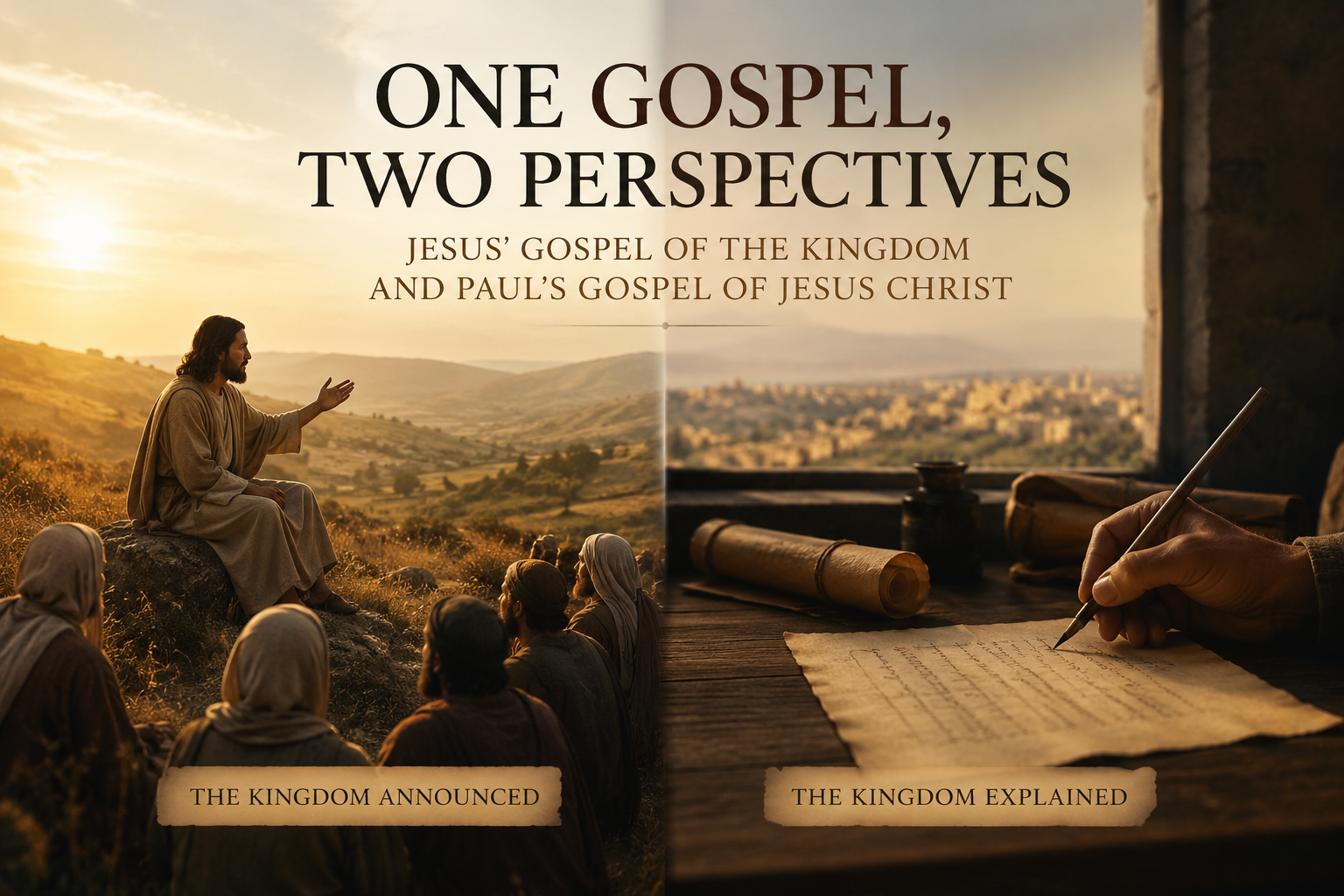
When Jesus stepped onto the scene in Galilee following the arrest of John the Baptist, he began preaching, “The time is fulfilled, and the kingdom of God has come near. Repent and believe the good news!” (Mark 1.15). His message focused on the arrival of the kingdom of God, the fulfillment of Israel’s prophetic hopes, and the call to repentance in light of God’s decisive action in history. Throughout the book of Acts and his epistles, however, the Apostle Paul repeatedly preached the gospel of Jesus Christ. His message emphasized the death and resurrection of Jesus, justification by faith, the forgiveness of sins, and the hope of resurrection. At first glance, these emphases can appear quite different. Jesus seems to proclaim the kingdom, while Paul proclaims Christ. Indeed, some scholars have argued that Paul transformed the original message of Jesus into something fundamentally different, shifting the focus from the kingdom of God to the person of Jesus himself. But are these really two different gospels? Must we choose between the message of Jesus and the message of Paul? It is my contention that the apparent tension disappears when both are understood within the broader framework of biblical eschatology. Far from proclaiming competing messages, Jesus and Paul announce the same good news from different vantage points within the unfolding drama of God’s redemptive plan.

Scholars of the historical Jesus are virtually unanimous in recognizing that the kingdom of God stood at the very center of Jesus’s preaching ministry. For example, in Matthew 4.23, we read, “Now Jesus began to go all over Galilee, teaching in their synagogues, preaching the good news of the kingdom, and healing every disease and sickness among the people.” Or again, in Matthew 24.14, Jesus declares that “this good news of the kingdom will be proclaimed in all the world as a testimony to all nations, and then the end will come.” For Jesus, the kingdom is nothing less than the reign of God breaking into history to accomplish his redemptive purposes. It is the fulfillment of Old Testament prophetic hopes such as those found in Isaiah and Daniel. Isaiah envisioned a time when God would restore his people, forgive their sins, defeat their enemies, and bring salvation to the nations. Daniel likewise anticipated the coming of the Son of Man, to whom would be given an everlasting kingdom that would never pass away. These hopes converge in the preaching of Jesus. The kingdom involves the liberation and vindication of God’s people, the defeat of evil, the forgiveness of sins, and the establishment of God’s righteous rule over all creation. In other words, Jesus did not merely announce a message of individual personal salvation; he announced the arrival of God’s long-promised reign and the fulfillment of Israel’s eschatological hope.

However, it is important to remember that Jesus never separates the kingdom from himself. He is the one true and rightful king, God’s anointed Messiah, and wherever the king is, there the kingdom stands. This is why Jesus could say to the Pharisees, when they asked him about the coming of the kingdom, “For you see, the kingdom of God is in your midst” (Luke 17.21). The kingdom was in their midst because the King himself stood among them. In other words, the kingdom is inseparable from the identity and mission of Jesus. This reality is evident throughout the Gospels. In the Son of Man sayings, Jesus identifies himself as the one who will receive dominion and an everlasting kingdom in fulfillment of Daniel 7. Likewise, in the kingdom parables, the growth and consummation of the kingdom are tied directly to his own ministry and mission. The same connection appears in the triumphal entry, where Jesus deliberately presents himself as Israel’s promised king, and again at the Last Supper, where he speaks of the coming kingdom in the context of his impending death. Far from being an unfortunate interruption of the kingdom program, the cross stands at its very center. Jesus understood that God’s reign would be established through his suffering, resurrection, and exaltation. The kingdom does not arrive apart from the King; it comes precisely through the saving work of the King himself.

This is precisely where the Apostle Paul enters into the discussion. Throughout his missionary ministry and epistles, Paul repeatedly proclaimed the good news of Christ’s saving work. In 1 Corinthians 15, he summarizes the gospel in its most basic form: Christ died for our sins, Christ was buried, Christ was raised on the third day, and Christ appeared to many witnesses (1 Cor. 15.1–8). At first glance, this emphasis on the death and resurrection of Jesus may appear quite different from Jesus’s proclamation of the kingdom of God. However, such a conclusion overlooks the fundamentally royal character of Paul’s gospel. Paul is not merely interested in what Christ accomplished; he is equally concerned with who Christ is. Again and again, he identifies Jesus as the promised Son of David, the Messiah, and the exalted Lord. For example, in Romans 1, Paul describes the gospel as being “concerning his Son, Jesus Christ our Lord, who was a descendant of David according to the flesh and was appointed to be the powerful Son of God according to the Spirit of holiness by the resurrection of the dead” (Rom. 1.3–4). Notice the royal language. Jesus is the Davidic king promised in the Old Testament, and his resurrection is the moment of his public vindication and enthronement. The point, then, is that Paul’s gospel is not less concerned with the kingdom than Jesus’s gospel. Rather, Paul focuses on the King through whom God’s kingdom has been established and through whom its blessings are now extended to the nations.

But the question remains: why the difference in emphasis? Why do Jesus and Paul sound so different in their proclamation of the gospel? The answer is that they stand at different points within the unfolding drama of redemptive history. The earthly ministry of Jesus occurs before the cross, before the resurrection, and before the ascension. He ministered primarily among Jews in Galilee and Judea, and therefore proclaimed a message that resonated deeply with Israel’s scriptural hopes and expectations. His preaching announced that the kingdom of God was at hand and that the promises spoken by the prophets were beginning to find their fulfillment. In other words, Jesus proclaimed what God was about to accomplish through his own person and work. Paul, by contrast, preached after these events had already occurred. He knew the crucified and risen Christ not merely as a future hope, but as a historical reality. Having encountered the exalted Lord on the road to Damascus, Paul devoted his ministry to explaining the significance of Christ’s death, resurrection, and exaltation for both Jews and Gentiles. Thus, Jesus announces the arrival of the kingdom, while Paul explains how that kingdom was established through the saving work of its King. The difference, then, is not one of substance but of historical perspective. Jesus proclaims the fulfillment that is coming; Paul proclaims the fulfillment that has come.

Of course, Paul is fully aware of the reality and significance of the kingdom of God. In fact, kingdom language appears throughout both his preaching and his letters. For example, in Colossians 1.13, he writes that God “has rescued us from the domain of darkness and transferred us into the kingdom of the Son he loves.” Notice that for Paul the kingdom is not merely a future hope; it is a present reality into which believers have already been brought through their union with Christ. Likewise, when Paul arrives in Rome at the end of Acts, Luke tells us that “from dawn to dusk he expounded and testified about the kingdom of God” (Acts 28.23), and concludes the book by describing Paul as “proclaiming the kingdom of God and teaching about the Lord Jesus Christ” (Acts 28.31). Significantly, Luke treats these two subjects as complementary rather than contradictory. The same pattern appears in 1 Corinthians 15.24–28, where Paul describes the consummation of history as the moment when Christ delivers the kingdom to the Father so that God may be all in all. The point is that Paul never abandoned kingdom theology; rather, he interpreted the kingdom through the death, resurrection, exaltation, and future return of Jesus. For Paul, the kingdom remains central because the King remains central.

In the final analysis, then, we can say that Jesus announced the kingdom, while Paul explained how that kingdom was established through the person and work of Christ. Jesus proclaimed its arrival; Paul proclaimed its accomplishment. Yet beneath these differing emphases lies a profound theological unity. Both Jesus and Paul understood God’s saving work as the fulfillment of Israel’s long-awaited hopes. Both proclaimed the reign of God breaking into history to accomplish redemption. Both understood forgiveness of sins, salvation for the nations, and the resurrection of the dead as essential features of God’s eschatological plan. The difference is not that Jesus preached one gospel and Paul another, but that each proclaimed the same gospel from a different vantage point within the unfolding drama of redemption. Jesus announced that the kingdom had drawn near because the King had arrived. Paul proclaimed that the kingdom had been inaugurated because the King had died, risen, and been exalted to the right hand of God. Thus, the gospel of the kingdom and the gospel of Jesus Christ are not rival messages but complementary perspectives on the same redemptive reality. To separate the kingdom from the King is to misunderstand Jesus, and to separate the King from the kingdom is to misunderstand Paul. Both stand together in proclaiming the fulfillment of God’s promises in Christ.

Ultimately, this discussion reminds us of the profound unity of the New Testament witness. Too often, Jesus and Paul are set against one another, as though they were proclaiming different messages or pursuing different theological agendas. Yet the testimony of the New Testament is remarkably consistent. The God who promised to establish his reign through Israel’s Messiah has done exactly that in the person of Jesus Christ. The kingdom that Jesus announced is the same kingdom that Paul proclaimed, and the salvation that Paul explained is the same salvation that Jesus came to accomplish. Rather than forcing a choice between the message of Jesus and the message of Paul, we should allow each to illuminate the other. When we do, we discover a single gospel centered on a single Savior, through whom God is fulfilling his promises and reconciling the world to himself.


On the Priorities of the Gospel

TEXT

21 After these events, Paul resolved by the Spirit to pass through Macedonia and Achaia and go to Jerusalem. “After I’ve been there,” he said, “It is necessary for me to see Rome as well.” 22 After sending to Macedonia two of those who assisted him, Timothy and Erastus, he himself stayed in Asia for a while.

23 About that time there was a major disturbance about the Way. 24 For a person named Demetrius, a silversmith who made silver shrines of Artemis, provided a great deal of business for the craftsmen. 25 When he had assembled them, as well as the workers engaged in this type of business, he said, “Men, you know that our prosperity is derived from this business. 26 You see and hear that not only in Ephesus, but in almost all of Asia, this man Paul has persuaded and misled a considerable number of people by saying that gods made by hand are not gods. 27 Not only do we run a risk that our business may be discredited, but also that the temple of the great goddess Artemis may be despised and her magnificence come to the verge of ruin—the very one all of Asia and the world worship.”

28 When they had heard this, they were filled with rage and began to cry out, “Great is Artemis of the Ephesians!” 29 So the city was filled with confusion, and they rushed all together into the amphitheater, dragging along Gaius and Aristarchus, Macedonians who were Paul’s traveling companions. 30 Although Paul wanted to go in before the people, the disciples did not let him. 31 Even some of the provincial officials of Asia, who were his friends, sent word to him, pleading with him not to venture into the amphitheater. 32 Some were shouting one thing and some another, because the assembly was in confusion, and most of them did not know why they had come together. 33 Some Jews in the crowd gave instructions to Alexander after they pushed him to the front. Motioning with his hand, Alexander wanted to make his defense to the people. 34 But when they recognized that he was a Jew, they all shouted in unison for about two hours, “Great is Artemis of the Ephesians!”

35 When the city clerk had calmed the crowd down, he said, “People of Ephesus! What person is there who doesn’t know that the city of the Ephesians is the temple guardian of the great Artemis, and of the image that fell from heaven? 36 Therefore, since these things are undeniable, you must keep calm and not do anything rash. 37 For you have brought these men here who are not temple robbers or blasphemers of our goddess. 38 So if Demetrius and the craftsmen who are with him have a case against anyone, the courts are in session, and there are proconsuls. Let them bring charges against one another. 39 But if you seek anything further, it must be decided in a legal assembly. 40 In fact, we run a risk of being charged with rioting for what happened today, since there is no justification that we can give as a reason for this disturbance.” 41 After saying this, he dismissed the assembly.

~Acts 19.21-41

Title: On the Priorities of the Gospel
Text: Acts 19.21-41
Series: The Book of Acts
Church: Redeemer Baptist Church, Jonesboro, AR
Date: October 20, 2024


On the Rejection of the Gospel at Thessalonica

TEXT

17 After they passed through Amphipolis and Apollonia, they came to Thessalonica, where there was a Jewish synagogue. As usual, Paul went into the synagogue, and on three Sabbath days reasoned with them from the Scriptures, explaining and proving that it was necessary for the Messiah to suffer and rise from the dead: “This Jesus I am proclaiming to you is the Messiah.” Some of them were persuaded and joined Paul and Silas, including a large number of God-fearing Greeks, as well as a number of the leading women.

But the Jews became jealous, and they brought together some wicked men from the marketplace, formed a mob, and started a riot in the city. Attacking Jason’s house, they searched for them to bring them out to the public assembly. When they did not find them, they dragged Jason and some of the brothers before the city officials, shouting, “These men who have turned the world upside down have come here too, and Jason has welcomed them. They are all acting contrary to Caesar’s decrees, saying that there is another king—Jesus.” The crowd and city officials who heard these things were upset. After taking a security bond from Jason and the others, they released them.

~ Acts 17.1-9

Title: On the Rejection of the Gospel at Thessalonica
Text: Acts 17.1-9
Series: The Book of Acts
Church: Redeemer Baptist Church, Jonesboro, AR
Date: September 8, 2024


On Resurrection and De-dustification

It is common in Biblical studies to suggest that the doctrine of the resurrection is a late development in Old Testament theology. Of course, the clearest Old Testament affirmation of this belief is found in Daniel 12.2, where we read, “Many who sleep in the dust of the earth will awake, some to eternal life, and some to disgrace and eternal contempt.” While the dating of Daniel is a much debated question, this verse certainly stands as a clear affirmation of the doctrine of a general resurrection possibly from as early as the exilic period. But is it possible that the doctrine of resurrection has a much longer presence in the Old Testament. I would suggest that it does, and I would base this suggestion, at least in part, on the words of David in Psalm 16, verse 10, where we read, “For you will not abandon me to Sheol; you will not allow your faithful one to see decay.” In this psalm, David is  seeking divine protection because he has remained loyal to God, and he is praising God for his rich blessings with full confidence God will vindicate him and deliver him from death.

Now, this particular verse is quoted twice in the in the Book of Acts in defense of the resurrection of Jesus, once by Peter in Acts 2.27, and once again by Paul in Acts 13.35. Of course, their appeal to this verse raises all kinds of questions regarding the interpretive methods of Luke and the other apostles, but suffice it to say here that there is no need to suggest that they have misinterpreted it. They haven’t read something into it that wasn’t actually there in the first place. No, they have rightly understood the implications of David’s words, and by way of typological prediction, they have applied these words to the Messianic Son of David, Jesus the Christ. David genuinely believed that that God could and would deliver him even from death, so while the doctrine of resurrection is not spelled out explicitly, we have ample reason to believe that David held some conception of physical life after death. This is why he says, “you will not allow your faithful one to see decay.”

However, Peter’s explanation here deserves our attention. In Acts 2.29, he says, “Brothers and sisters, I can confidently speak to you about the patriarch David: He is both dead and buried, and his tomb is with us to this day.” Likewise, Paul explains similarly in Acts 13.36-37, “For David, after serving God’s purpose in his own generation, fell asleep, was buried with his fathers, and decayed, but the one God raised up did not decay.” Jesus was only in the grave for three days; there simply wasn’t enough time for his physical body to see decay. But David’s bones turned to dust a long time ago, as it is written, “All are going to the same place; all come from dust, and all return to dust.” (Ecclesiastes 3.20) This dusty fate is part of God’s curse on human sin, as we read in Genesis 3.19, “For you are dust, and you will return to dust.” It is a fate that awaits us all. So, we must ask the question: was David wrong in his expectation that his body would not see decay? Was he wrong in his hope for a bodily resurrection?

The answer to these questions must be a resounding, “May it never be.” David was not wrong to believe that God could and would deliver him even from the depths of death itself, and even though his physical body has long returned to the dust from whence it came, one day, his body will be raised new, perfectly whole and completely glorified. This is the hope of resurrection; it is the hope of de-dustification. As the Apostle Paul writes in Romans 8.11, “And if the Spirit of him who raised Jesus from the dead lives in you, then he who raised Christ from the dead will also bring your mortal bodies to life through his Spirit who lives in you.” Or again, in Philippians 3.21, “He will transform the body of our humble condition into the likeness of his glorious body, by the power that enables him to subject everything to himself.” If God can create man from the dust and breath the breath (the Hebrew word is the same word sometimes translated Spirit) of life into him so that he becomes a living soul, then he can certainly raise our bodies from the dust and give them eternal physical life by His Spirit.

In other words, far from being some late postulate in Old Testament theology, the idea of resurrection has a long standing place in Old Testament thought. It goes back at least to the time of David and the monarchy, some 1000 years before the time of Daniel and the exile, and it possibly goes back farther than that (but that is a topic for another time.) The point here is simply the Christian hope, nay, the biblical hope, is for nothing less than the perfected glory of bodily resurrection. As Jesus himself says, “a time is coming when all who are in the graves will hear his voice and come out—those who have done good things, to the resurrection of life, but those who have done wicked things, to the resurrection of condemnation.” (John 5.28-29) Maranatha!

For further study, see:
On the Logic of the Resurrection
On Christian Hope: Heaven or Resurrection
On Resurrection and the Path of Glory

See also,
Chase, Mitchell L. Resurrection Hope and the Death of Death. Short Studies in Biblical Theology. Wheaton, IL: Crossway, 2022.


On Historical Context in Galatians

It has been said on more than one occasion that “A text without a context is a pretext for a prooftext.” The point is that faithful bible reading must take the historical and literary context of the text into consideration. God spoke through real people living real lives with real questions, and in order to understand His Word, we must read it on its own terms, that is to say we must seek to understand it as it would have been understood by its intended audience. We must put ourselves into their shoes, so to speak, and look at things through their eyes. Then, and only then, will we be able to draw the parallel applications that transform our own lives. However, in the academic study of the New Testament, historical reconstructions of the life and times of the biblical audience can sometimes feel overly speculative and somewhat disconnected from the actual text. This is why, no matter how sophisticated our historical reconstruction may be, we must ask the question, “How does this help me to understand the text better?,” because at the end of the day, biblical studies is an irreducibly textual endeavor.

I recently had this point reiterated to me by a brother who is preparing to teach Paul’s Letter to the Galatians in our adult Sunday school class. Of course, the basic situation in Galatians is pretty straightforward. The newly converted Gentile Christians in Galatia are facing social and theological pressure from a group of Jewish “Christians” to be circumcised, so that they can truly be part of God’s (Jewish) people. This is a position that the Apostle Paul simply will not countenance under any circumstances; in fact, he condemns it outright in some of the harshest language in all of the New Testament. “As we have said before, I now say again: If anyone is preaching to you a gospel contrary to what you received, a curse be on him!” (1.9) Of course, Paul goes on in the letter to give historical and theological arguments against the position in question in chapters 3-4, and then he uses chapters 5-6 to emphasize those virtues and habits of character that truly distinguish someone as belonging to the people of God. In other words, the message of the letter is pretty clear.

However, we must ask whether or not this is all way can say about the situation in Galatians, particularly as this relates to chapters 1-2 and their relationship with the events in Acts 9-15. In these first two chapters, Paul gives a brief history of his own salvation and his relationship with the Jerusalem church; his point is that his gospel is not based on the traditions of men, but on the supernatural revelation of God himself in the person of Christ on the Damascus road. But the correspondence between Paul’s testimony and the events in Acts is less than clear to say the least. Of course, there are some that would say that the two are inherently incompatible, and to attempt any kind of combined reconstruction is hopeless and probably not even necessary. But for those of us who hold convictions regarding the inerrancy of the Scriptures, this is simply not an option. We must ask questions regarding the text’s larger coherence with the New Testament witness, especially when that text addresses events that are recorded by another author. For example, is the Jerusalem visit that Paul mentions in 2.1-10 to be understood as corresponding his visit at the Jerusalem council as it is recorded in Acts 15, or is it the famine visit that is mentioned in Acts 11? Who are these “men from James” (2.12), and what is the purpose of their visit in Antioch? Are they part of the circumcision party? Why would Peter withdraw from table fellowship from the Gentile Christians after his transformative experience with Cornelius (Acts 10)? And the list could go on.

I don’t have the answers to all of these questions, but in the space that follows, I would like to suggest a brief timeline that attempts to reconcile Galatians 1-2 with the events of Acts 9-15. In academic scholarship, this position is known as the Southern Galatia Theory, and it is associated with names such as F.F. Bruce and Richard Longenecker, to name but a few. In general, this theory posits that the Letter to the Galatians was written around 47-48 AD to the churches that Paul started during his first missionary journey (Acts 13-14) in the southern region of the Roman province of Galatia. The alternative view, known as the Northern Galatia Theory, argues that the Letter to the Galatians was written around 56-57 AD from Ephesus to ethnic Galatians in the north, the former kingdom of Galatia. Due to space considerations, I will not lay out this opposing theory in detail.

The timeline for the Southern Galatia Theory flows as follows: AD 34 – Conversion of Paul (Galatians 1.13-16, Acts 9.1-19), AD 34-37 – Paul in Arabia and Damascus (Galatians 1.17, Acts 9.19-22, 27), AD 37 – Paul visits Jerusalem after three years (Galatians 1.18-20, Acts 9.26-29), AD 37-47 – Paul in Syria and Cilicia (Galatians 1.21-24, Acts 9:30-31), AD 47 – Paul visits Jerusalem after 14 years (Famine Visit) (Galatians 2:1-10, Acts 11.27-30), AD 47-48 – Paul’s first missionary journey (Acts 13:1-14:28), AD 48 – Peter visits Antioch and confronts Peter (Galatians 2:11-14), AD 48 – Paul writes the Letter to the Galatians, AD 49 – Paul speaks at the Jerusalem Council (Acts 15.1-29), AD 49-51 – Paul visits the Galatian churches on his second missionary journey (Acts 16-18), AD 52-57 – Paul’s visits the Galatian churches on his third missionary journey (Acts 19-21).

This theory seems to be the most widely accepted in New Testament scholarship today, but we must return to the initial question of this post, namely, “how does this help me to understand the text better?” Again, this is the fundamental question; no matter how insightful and innovative our reconstruction may be, if it does not shed greater light on the meaning of the text, then it is nothing more than pointless speculation. In particular, I think the early date offered by this theory helps explain the actions of James and Peter in chapter 2. At this point in the history of the early church, the inclusion of the Gentiles was still a relatively new phenomenon. The details were still being worked out in the lives of real people on the frontlines of the church’s ministry. So, yes, even after Peter’s incredible experience with Cornelius, it is still possible for him to waiver under the social pressures of the circumcision party. Perhaps he thought his actions in Antioch would somehow hinder the evangelistic effort among the Jews in Jerusalem.

Moreover, it explains the apparent hesitancy of James and his representatives. Of course, James will go on to give the final argument against the requirement of circumcision at the Jerusalem Council, and he will write the apostolic letter detailing the council’s decision (Acts 15.23-29). But, perhaps at this moment, before the council, he was still considering the question. We don’t know, and we may never know. But for any theory to be considered probable, it must explain the evidence better than all the other possible explanations, and I believe that the Southern Galatia Theory does just that. Moreover, it shows us that the authors of Scripture were real fallible human beings. James, Peter, Paul – they were just ordinary men who God chose to use in extraordinary ways. They didn’t get everything right all the time, but they were “men [who] spoke from God as they were carried along by the Holy Spirit” (2 Peter 1.21), and in so doing, the produced the inerrant words of Holy Scripture. Thanks be to God for His incredible grace!


On How Christ Makes all the Difference

TEXT

Paul, an apostle of Christ Jesus by God’s will:
To the faithful saints in Christ Jesus at Ephesus.
Grace to you and peace from God our Father and the Lord Jesus Christ.

~Ephesians 1.1-2

Title: On a Historical, Literary, and Theological Overview of Ephesians
Text: Ephesians 1.1-2
Series: The Letter to the Ephesians
Church: South Caraway Baptist Church, Jonesboro, AR
Date: April 30, 2023


Slow To Write

"let every person be quick to hear, slow to speak, slow to anger."

lovegavehope

Just another WordPress.com site

Jared Cornutt

Pastor | Speaker | Writer

Denny Burk

A commentary on theology, politics, and culture

G3 Ministries

Events + Resources for the Local Church

Biblical Reasoning

Biblical and Systematic Theology According to the Scriptures

RetroChristianity

Reclaiming the Forgotten Faith

SBC Voices

Southern Baptist News & Opinion

Lucid Theology

Thoughts on words, books, theology, and life.

Baptist21

A pastor-led voice for Baptists in the 21st century

Center For Baptist Renewal

The Personal and Professional Blog of Phillip Powers

The Pastor's Well - Pastor Well

The Personal and Professional Blog of Phillip Powers

Articles - AlbertMohler.com

The Personal and Professional Blog of Phillip Powers

The Gospel Coalition

The Personal and Professional Blog of Phillip Powers