When Jesus stepped onto the scene in Galilee following the arrest of John the Baptist, he began preaching, “The time is fulfilled, and the kingdom of God has come near. Repent and believe the good news!” (Mark 1.15). His message focused on the arrival of the kingdom of God, the fulfillment of Israel’s prophetic hopes, and the call to repentance in light of God’s decisive action in history. Throughout the book of Acts and his epistles, however, the Apostle Paul repeatedly preached the gospel of Jesus Christ. His message emphasized the death and resurrection of Jesus, justification by faith, the forgiveness of sins, and the hope of resurrection. At first glance, these emphases can appear quite different. Jesus seems to proclaim the kingdom, while Paul proclaims Christ. Indeed, some scholars have argued that Paul transformed the original message of Jesus into something fundamentally different, shifting the focus from the kingdom of God to the person of Jesus himself. But are these really two different gospels? Must we choose between the message of Jesus and the message of Paul? It is my contention that the apparent tension disappears when both are understood within the broader framework of biblical eschatology. Far from proclaiming competing messages, Jesus and Paul announce the same good news from different vantage points within the unfolding drama of God’s redemptive plan.
Scholars of the historical Jesus are virtually unanimous in recognizing that the kingdom of God stood at the very center of Jesus’s preaching ministry. For example, in Matthew 4.23, we read, “Now Jesus began to go all over Galilee, teaching in their synagogues, preaching the good news of the kingdom, and healing every disease and sickness among the people.” Or again, in Matthew 24.14, Jesus declares that “this good news of the kingdom will be proclaimed in all the world as a testimony to all nations, and then the end will come.” For Jesus, the kingdom is nothing less than the reign of God breaking into history to accomplish his redemptive purposes. It is the fulfillment of Old Testament prophetic hopes such as those found in Isaiah and Daniel. Isaiah envisioned a time when God would restore his people, forgive their sins, defeat their enemies, and bring salvation to the nations. Daniel likewise anticipated the coming of the Son of Man, to whom would be given an everlasting kingdom that would never pass away. These hopes converge in the preaching of Jesus. The kingdom involves the liberation and vindication of God’s people, the defeat of evil, the forgiveness of sins, and the establishment of God’s righteous rule over all creation. In other words, Jesus did not merely announce a message of individual personal salvation; he announced the arrival of God’s long-promised reign and the fulfillment of Israel’s eschatological hope.
However, it is important to remember that Jesus never separates the kingdom from himself. He is the one true and rightful king, God’s anointed Messiah, and wherever the king is, there the kingdom stands. This is why Jesus could say to the Pharisees, when they asked him about the coming of the kingdom, “For you see, the kingdom of God is in your midst” (Luke 17.21). The kingdom was in their midst because the King himself stood among them. In other words, the kingdom is inseparable from the identity and mission of Jesus. This reality is evident throughout the Gospels. In the Son of Man sayings, Jesus identifies himself as the one who will receive dominion and an everlasting kingdom in fulfillment of Daniel 7. Likewise, in the kingdom parables, the growth and consummation of the kingdom are tied directly to his own ministry and mission. The same connection appears in the triumphal entry, where Jesus deliberately presents himself as Israel’s promised king, and again at the Last Supper, where he speaks of the coming kingdom in the context of his impending death. Far from being an unfortunate interruption of the kingdom program, the cross stands at its very center. Jesus understood that God’s reign would be established through his suffering, resurrection, and exaltation. The kingdom does not arrive apart from the King; it comes precisely through the saving work of the King himself.
This is precisely where the Apostle Paul enters into the discussion. Throughout his missionary ministry and epistles, Paul repeatedly proclaimed the good news of Christ’s saving work. In 1 Corinthians 15, he summarizes the gospel in its most basic form: Christ died for our sins, Christ was buried, Christ was raised on the third day, and Christ appeared to many witnesses (1 Cor. 15.1–8). At first glance, this emphasis on the death and resurrection of Jesus may appear quite different from Jesus’s proclamation of the kingdom of God. However, such a conclusion overlooks the fundamentally royal character of Paul’s gospel. Paul is not merely interested in what Christ accomplished; he is equally concerned with who Christ is. Again and again, he identifies Jesus as the promised Son of David, the Messiah, and the exalted Lord. For example, in Romans 1, Paul describes the gospel as being “concerning his Son, Jesus Christ our Lord, who was a descendant of David according to the flesh and was appointed to be the powerful Son of God according to the Spirit of holiness by the resurrection of the dead” (Rom. 1.3–4). Notice the royal language. Jesus is the Davidic king promised in the Old Testament, and his resurrection is the moment of his public vindication and enthronement. The point, then, is that Paul’s gospel is not less concerned with the kingdom than Jesus’s gospel. Rather, Paul focuses on the King through whom God’s kingdom has been established and through whom its blessings are now extended to the nations.
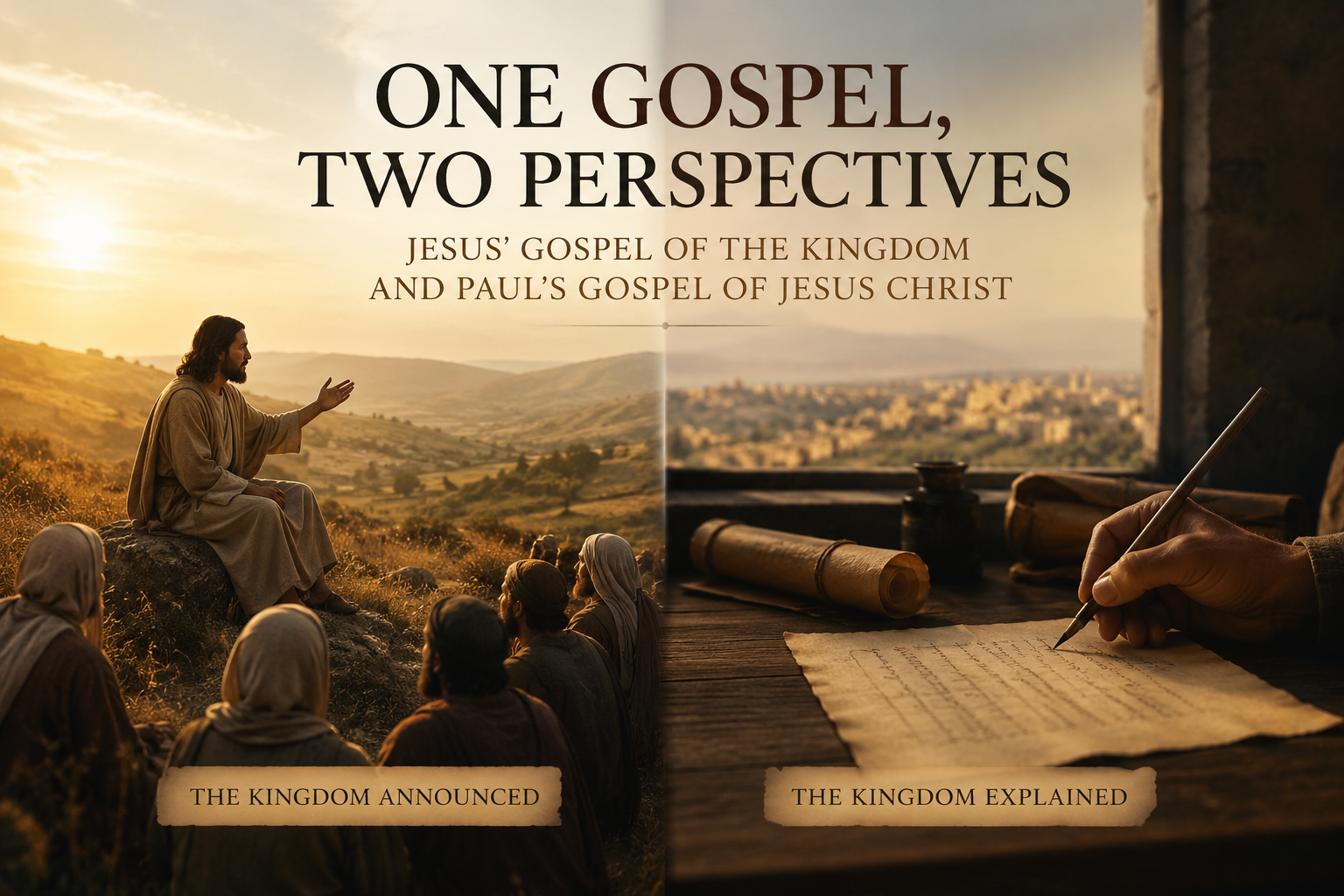
But the question remains: why the difference in emphasis? Why do Jesus and Paul sound so different in their proclamation of the gospel? The answer is that they stand at different points within the unfolding drama of redemptive history. The earthly ministry of Jesus occurs before the cross, before the resurrection, and before the ascension. He ministered primarily among Jews in Galilee and Judea, and therefore proclaimed a message that resonated deeply with Israel’s scriptural hopes and expectations. His preaching announced that the kingdom of God was at hand and that the promises spoken by the prophets were beginning to find their fulfillment. In other words, Jesus proclaimed what God was about to accomplish through his own person and work. Paul, by contrast, preached after these events had already occurred. He knew the crucified and risen Christ not merely as a future hope, but as a historical reality. Having encountered the exalted Lord on the road to Damascus, Paul devoted his ministry to explaining the significance of Christ’s death, resurrection, and exaltation for both Jews and Gentiles. Thus, Jesus announces the arrival of the kingdom, while Paul explains how that kingdom was established through the saving work of its King. The difference, then, is not one of substance but of historical perspective. Jesus proclaims the fulfillment that is coming; Paul proclaims the fulfillment that has come.
Of course, Paul is fully aware of the reality and significance of the kingdom of God. In fact, kingdom language appears throughout both his preaching and his letters. For example, in Colossians 1.13, he writes that God “has rescued us from the domain of darkness and transferred us into the kingdom of the Son he loves.” Notice that for Paul the kingdom is not merely a future hope; it is a present reality into which believers have already been brought through their union with Christ. Likewise, when Paul arrives in Rome at the end of Acts, Luke tells us that “from dawn to dusk he expounded and testified about the kingdom of God” (Acts 28.23), and concludes the book by describing Paul as “proclaiming the kingdom of God and teaching about the Lord Jesus Christ” (Acts 28.31). Significantly, Luke treats these two subjects as complementary rather than contradictory. The same pattern appears in 1 Corinthians 15.24–28, where Paul describes the consummation of history as the moment when Christ delivers the kingdom to the Father so that God may be all in all. The point is that Paul never abandoned kingdom theology; rather, he interpreted the kingdom through the death, resurrection, exaltation, and future return of Jesus. For Paul, the kingdom remains central because the King remains central.
In the final analysis, then, we can say that Jesus announced the kingdom, while Paul explained how that kingdom was established through the person and work of Christ. Jesus proclaimed its arrival; Paul proclaimed its accomplishment. Yet beneath these differing emphases lies a profound theological unity. Both Jesus and Paul understood God’s saving work as the fulfillment of Israel’s long-awaited hopes. Both proclaimed the reign of God breaking into history to accomplish redemption. Both understood forgiveness of sins, salvation for the nations, and the resurrection of the dead as essential features of God’s eschatological plan. The difference is not that Jesus preached one gospel and Paul another, but that each proclaimed the same gospel from a different vantage point within the unfolding drama of redemption. Jesus announced that the kingdom had drawn near because the King had arrived. Paul proclaimed that the kingdom had been inaugurated because the King had died, risen, and been exalted to the right hand of God. Thus, the gospel of the kingdom and the gospel of Jesus Christ are not rival messages but complementary perspectives on the same redemptive reality. To separate the kingdom from the King is to misunderstand Jesus, and to separate the King from the kingdom is to misunderstand Paul. Both stand together in proclaiming the fulfillment of God’s promises in Christ.
Ultimately, this discussion reminds us of the profound unity of the New Testament witness. Too often, Jesus and Paul are set against one another, as though they were proclaiming different messages or pursuing different theological agendas. Yet the testimony of the New Testament is remarkably consistent. The God who promised to establish his reign through Israel’s Messiah has done exactly that in the person of Jesus Christ. The kingdom that Jesus announced is the same kingdom that Paul proclaimed, and the salvation that Paul explained is the same salvation that Jesus came to accomplish. Rather than forcing a choice between the message of Jesus and the message of Paul, we should allow each to illuminate the other. When we do, we discover a single gospel centered on a single Savior, through whom God is fulfilling his promises and reconciling the world to himself.