Tag Archives: Pauline Theology

On Thinking Theologically (Weekend Vlog)


On Justification and the Roman Catholic Church

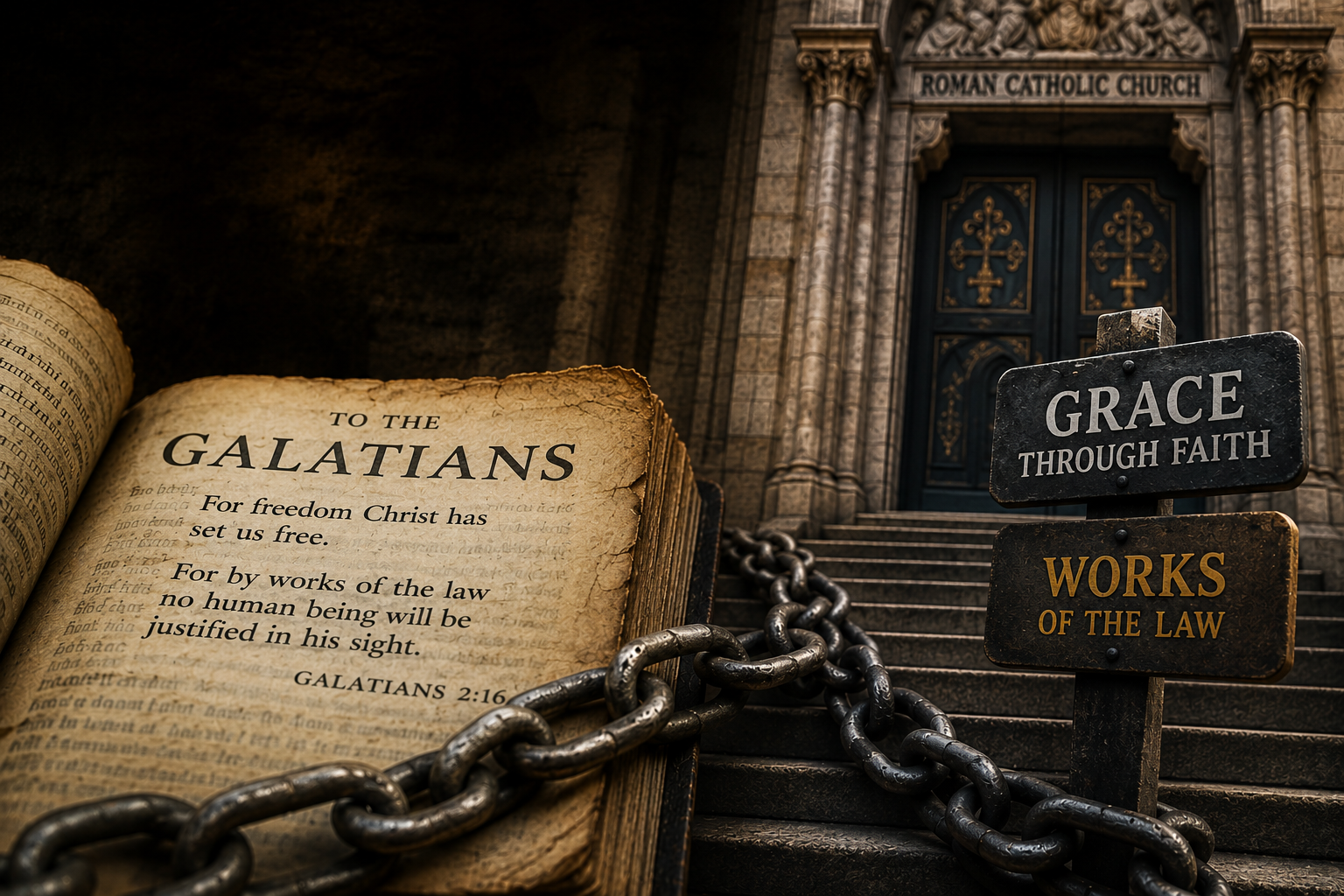
Some time ago, I reviewed a debate between Allen S. Nelson IV, pastor of Providence Baptist Church, and Father Stephen Hart of Sacred Heart Church on the question of whether the Roman Catholic Church is a gospel-denying church. (See my review here.) This debate centered on the doctrine of justification and exposed the fundamental differences between Protestant and Roman Catholic understandings of how a person is made right before God. Of course, justification stands at the very center of the gospel itself; it is not merely a secondary disagreement between theological traditions. A distorted understanding of justification necessarily distorts the good news because it touches the question of how sinners are reconciled to God through Christ. And this is precisely the issue that the Apostle Paul takes up in the Epistle to the Galatians. In Galatians, Paul argues with remarkable force that justification is by faith apart from works of the law and warns that any alteration of the gospel strikes at the heart of Christian truth. In this post, then, I would like to consider how Paul’s argument in Galatians relates to the Roman Catholic understanding of justification, because if the message of Galatians is taken seriously, it forces us to ask whether justification can, in any sense, be grounded in works without compromising the gospel itself.

The situation addressed in the Epistle to the Galatians is relatively well known, but it is worth reviewing briefly for the sake of clarity. Sometime after Paul’s first missionary journey, it appears that a group of Jewish Christians came into the churches of Galatia and began teaching that Gentile believers needed to be circumcised and adopt the Torah in order to be fully included among the people of God. (On the timeline of events in Galatia, see here.) These teachers are often described as “Judaizers,” though the issue at stake is frequently misunderstood. They were not simply advocating for moral effort or “legalism” in the modern sense of the term. Rather, they were challenging the basis upon which Gentiles could belong to the covenant community. Was faith in Christ sufficient, or did covenant membership require obedience to the Mosaic law as well? In other words, the issue was not whether obedience mattered in the Christian life. Paul himself repeatedly affirms the necessity of holiness and faithful living. The question, rather, was whether obedience to the law contributed in any sense to justification and covenant inclusion. And it is precisely at this point that Paul responds with extraordinary urgency, because for him the integrity of the gospel itself was at stake.

Against this backdrop, Paul’s central claim is that “no one is justified before God by the law, because the righteous will live by faith” (3.11). The question, of course, revolves around what Paul means by the term “justified.” However, the qualifying phrase “before God” is especially revealing. Paul is not speaking primarily about inward moral transformation or spiritual renewal, important as those realities are elsewhere in his theology. Rather, he is speaking about a person’s standing before the divine judge. Justification, then, is fundamentally forensic in nature. It is a legal declaration in which the believer is counted righteous before God on the basis of faith rather than works of the law. This is why Paul consistently contrasts justification with human obedience throughout Galatians. If righteousness could be obtained through the law, then there would be no need for Christ’s death (2.21). The issue is not whether good works follow genuine faith; Paul clearly believes that they do. The issue is whether those works contribute in any sense to the believer’s right standing before God. Paul’s answer is emphatic and uncompromising: sinners are justified by faith in Christ apart from the works of the law. Their acceptance before God rests not in their own obedience, but in the saving work of Christ received through faith.

However, the question must still be asked: what exactly does Paul mean by “works of the law”? In recent decades, the so-called “New Perspective on Paul,” especially in the work of James D. G. Dunn, has argued that these “works” refer primarily to Jewish socio-religious boundary markers such as circumcision, Sabbath observance, and food laws. On this reading, Paul’s concern is chiefly horizontal. The issue is how Jews and Gentiles can exist together within the same covenant community without the Torah functioning as a barrier between them. There is certainly truth in this observation, especially given the prominence of circumcision in Galatians itself. However, this understanding is ultimately too narrow because it does not fully account for Paul’s repeated emphasis on justification “before God.” Paul’s concern is not merely social fellowship, but a person’s standing before the divine judge. Therefore, “works of the law” cannot be reduced simply to ceremonial observances or ethnic boundary markers. Rather, the phrase must encompass any attempt to establish righteousness before God through obedience to the law. This is precisely why Paul contrasts law and promise, works and faith, curse and blessing. For Paul, the law cannot justify because fallen humanity cannot keep it perfectly. Faith, by contrast, receives what God promises in Christ rather than attempting to achieve righteousness through human obedience.

This is made clear by the way that Paul builds his argument in Galatians, namely on a series of theological contrasts that structure his understanding of the gospel itself. Central to his reasoning is the example of Abraham. Long before the giving of the law, Abraham “believed God, and it was credited to him for righteousness” (3.6). This point is crucial because it demonstrates that justification by faith precedes the Mosaic covenant altogether. The promise given to Abraham was received through faith, not through obedience to the law. The law, therefore, cannot function as the basis of justification because it was never the foundation of God’s covenant promises to begin with. Rather, Paul argues that the law was temporary, added “because of transgressions” until the coming of Christ (3.19). This is why Paul consistently contrasts promise and law, Spirit and flesh, faith and works throughout the letter. These are not complementary paths to justification, but fundamentally different principles. The law demands obedience and pronounces a curse upon those who fail to keep it perfectly, whereas faith receives the promise of God fulfilled in Christ. This is why Paul reacts so strongly to the Galatian error. The law does not complete what faith begins—it belongs to a different order altogether. To return to the law as the ground of justification is not spiritual maturity; it is, in Paul’s view, a departure from the very logic of the gospel itself.

This is perhaps why Paul speaks with such force in the opening of the Epistle to the Galatians. In 1:9, he writes, “As we have said before, I now say again: If anyone is preaching to you a gospel contrary to what you received, a curse be on him!” For Paul, this is not rhetorical exaggeration or emotional overstatement; it is covenantal seriousness. The gospel is not infinitely flexible or open to revision. It is the announcement of what God has accomplished in Christ for the salvation of sinners, and therefore to alter the basis of justification is to alter the gospel itself. This is precisely why Paul reacts so strongly to the teaching of the Judaizers. In his view, adding obedience to the law as a condition of justification does not merely supplement the gospel—it fundamentally changes its character. The issue is not whether circumcision or obedience have value in themselves; the issue is whether they contribute to a person’s right standing before God. Once works are introduced as part of the ground of justification, faith in Christ alone is no longer sufficient. And for Paul, that is not a small theological mistake, but a corruption of the gospel itself.

At this point, it is worth bringing Paul’s argument into conversation with the Roman Catholic understanding of justification, especially as articulated at the Council of Trent. To be clear, the Roman Catholic position is not identical to the error confronted in Galatia. The Judaizers were specifically requiring circumcision and Torah observance for covenant inclusion, whereas Roman Catholic theology affirms the necessity of grace and the centrality of Christ’s work. Nevertheless, there are important structural similarities that raise serious theological concerns. According to Trent, justification is not merely the forgiveness of sins, but also “the sanctification and renewal of the inward man” (Session 6, Chapter 7). Likewise, Trent teaches that the justified “through the observance of the commandments of God and of the Church, faith cooperating with good works, increase in that justice received through the grace of Christ” (Session 6, Chapter 10). In other words, justification in Roman Catholic theology includes transformative righteousness and can increase through obedience. But this is precisely where the tension with Galatians emerges. Paul consistently treats justification as a forensic declaration received through faith apart from works of the law. The question, then, is unavoidable: if justification is maintained or increased through works, even grace-enabled works, does this not reintroduce the very dynamic Paul rejects? Put differently, does the Roman Catholic system preserve the sufficiency of faith in Christ alone, or does it ultimately ground final justification, at least in part, in human obedience? At the very least, Trent’s understanding of justification is horribly confused and differs significantly from Paul’s argument in Galatians.

Now, in the interest of completeness, it is equally important to consider how the message of the Epistle to the Galatians might speak to those of us on the Protestant side of the aisle as well. As I noted in my original review, Protestants often have a tendency to underemphasize the importance—indeed, even the necessity—of good works in the Christian life. In some circles, the gospel is reduced to little more than a kind of “get out of hell free” card: simply believe in Jesus and secure your eternal destiny. But this reductionistic understanding of salvation severely minimizes the transforming power of grace and the necessity of Spirit-empowered obedience. Paul himself never makes this mistake. While he fiercely rejects works as the basis of justification, he equally insists that genuine faith necessarily produces obedience. This is why he can say in Galatians 5.6 that “what matters is faith working through love.” For Paul, obedience is not opposed to faith; rather, obedience is the fruit of true faith. The problem, then, is not works in themselves, but works placed in the wrong category. Works cannot justify the sinner before God, but they are the inevitable result of union with Christ and the indwelling work of the Spirit. Grace does not merely forgive; it transforms.

In theological categories, this process is known as sanctification, that is, the lifelong work of growing in conformity to the character of Christ through the power of the Holy Spirit. In the language of the Epistle to the Galatians, this is described as “walking by the Spirit” and cultivating the “fruit of the Spirit,” namely “love, joy, peace, patience, kindness, goodness, faithfulness, gentleness, and self-control” (5.22–23). The point is that while sanctification is logically distinct from justification, it is not altogether separate from it. The faith that justifies is never barren or inactive. We are justified by faith alone, but the person who is truly justified by faith will necessarily grow in holiness and produce the good works of Christlike character. This is why Paul can reject works as the basis of justification while simultaneously insisting upon obedience as the necessary fruit of life in the Spirit. Indeed, this is essentially the same point made by the Epistle of James in its discussion of faith and works, a point Paul himself would affirm wholeheartedly. Works do not secure our standing before God; rather, they demonstrate that our faith is living and genuine. Grace not only pardons the sinner, it transforms him.

What emerges from Galatians, then, is a clear theological order that must not be confused or reversed. First comes faith, and through faith comes justification, that once-for-all declaration in which the sinner is counted righteous before God on the basis of Christ alone. Then comes the gift of the Spirit, through whom the believer is progressively transformed into the image of Christ. Finally, obedience follows as the fruit of this new life in the Spirit. In other words, the imperatives of the Christian life flow out of the indicatives of the gospel. We obey because we have been accepted in Christ, not in order to be accepted by him. This is precisely why Paul can simultaneously reject justification by works while insisting upon the necessity of holiness. The Christian life is not opposed to obedience; it is grounded in grace-enabled obedience that flows from faith. But the order matters immensely. To place works before justification, or to make obedience part of the ground of our acceptance before God, is to reverse Paul’s entire theological structure and, in doing so, distort the very nature of the gospel itself.

In conclusion, then, we must affirm that the question of justification as it relates to faith and works is a foundational question when it comes to the clarity of the gospel itself. As Paul warns in the Epistle to the Galatians, to distort the gospel is to come under the curse of God. And while I do not think that the Roman Catholic Church falls under this curse in a simplistic or one-to-one sense, I do believe that the formulations of the Council of Trent are deeply confused on the question of justification and, in important ways, structurally parallel the very concerns Paul raises in Galatians. At the same time, Protestants must also resist the temptation to reduce the gospel to mere intellectual assent divorced from holiness and obedience. Paul rejects both legalism and moral indifference. The gospel he proclaims is one in which sinners are justified by faith alone and then transformed by the power of the Spirit into lives of joyful obedience. Faithful theology, then, requires more than loyalty to tradition or theological systems. It requires that we let Paul define the gospel on his own terms—and then have the courage to examine our systems in light of that definition.


On the Logic of the Resurrection

The New Testament is clear that the Christian Gospel rises and falls on the historical factuality of this truth, that Jesus Christ truly lived, truly died, and truly rose again. There simply is no way around it; as the Apostle Paul writes, “If there is no resurrection of the dead, then not even Christ has been raised; and if Christ has not been raised, then our proclamation is in vain, and so is your faith. … And if Christ has not been raised, your faith is worthless; you are still in your sins.” (1 Cor 15.13-14, 17) Jesus had to truly die in our place to satisfy the wrath of God toward sin, and he had to truly be raised from the dead in victory over sin and death. The work of Christ in His death and resurrection is the means by which he secures our salvation; His death achieves for us our forgiveness, and His resurrections assures us of our life eternal.

However, the crucifixion and resurrection of Jesus is more than simply a historical event; it is more than merely a transaction between the Father and the Son. No, the logic of the Gospel is that the work of Christ in his crucifixion is the pattern for our life as well. By faith, we are united with Christ; we have died with him to sin and we have been raised with him in newness of life. (Romans 6.4-5) This is the logic of the Gospel, namely that His death becomes our death and his resurrection becomes our resurrection. In the space that follows, I would like to spend just a few brief moments reflecting on the implications of this essential principle of the Christian Gospel.

On the one hand, we participate in his death and resurrection spiritually, which means we experience it through the indwelling of His Holy Spirit. This happens at the point of conversion; when someone trusts in Christ, they die with Him to the tyranny and slavery of sin, they die with Him to the old self and its fleshly desires. “For we know that our old self was crucified with him so that the body ruled by sin might be rendered powerless so that we may no longer be enslaved to sin.” (Romans 6.6) Consequently, they are, then, indwelt by the Holy Spirit who gives life. As Paul goes on to write, “Now if Christ is in you, the body is dead because of sin, but the Spirit gives life because of righteousness.” (Romans 8.10) We are renewed and transformed by the Spirit that we might walk in righteousness and holiness before God and others in this life. This is what it means to be resurrected with Him spiritually; as Paul says elsewhere, “Therefore, if anyone is in Christ, he is a new creation; the old has passed away, and see, the new has come!” (2 Cor 5.17) This is the good news of the Gospel.

However, we must also affirm that we will participate in his death and resurrection physically. This is also essential to the logic of the Gospel. Death is the consequence of sin and its corruption in a fallen creation. As the author of Hebrews writes, “it is appointed for people to die once—and after this, judgment.” Every human being, saved and unsaved, will die physically, but those who die in Christ will also be resurrected physically.  The Apostle Paul writes, “the dead in Christ will rise,” (1 Thess. 4.16) or again, “the dead will be raised incorruptible, and we will be changed.” (1 Cor 15.52) In the same way that he was raised in a glorified and perfected physical body, so also we will be raised in a glorified and perfected body. “We know that when he appears, we will be like him because we will see him as he is.” (1 John 3.2) This is the hope; this is the promise. This is the logic of the Gospel. “Just as we have borne the image of the man of dust, we will also bear the image of the man of heaven.” (1 Cor 15.49)

Of course, we may be tempted to conclude that the position that I have sketched out here is hopelessly illogical. How can it be possible that we must die and be raised both spiritually and physically? This seems like a contradiction in terms. How can Paul claim that we have been raised with Christ but then claim that we will one day be raised with Christ. I believe the answer to this apparent contradiction lies in the New Testament reality of the already and the not yet. In fact, I believe that this hermeneutical principle is fundamental for understanding the New Testament in general. In Christ, the last days have already been inaugurated. The fulfillment of God’s work of salvation has begun in the person and work of Christ. Christ has been raised from the dead as the “firstfruits”, and he has given us the eschatological indwelling of the Spirit. We already live the life of the age to come, aka eternal life, and we stand redeemed under the promise of the New Covenant.

And yet, we understand that the full consequences of the redeeming work of Christ have not yet been completely realized. We await the day when he will come again in power and glory to do away with sin once and for all, and it is then that we will be raised in glorified bodies. This is how the Apostle Paul describes the order of the resurrection, “Christ, the firstfruits; afterward, at his coming, those who belong to Christ.” (1 Cor 15.23) Yes, those who are in Christ by faith have already been made new; we are already regenerated by the indwelling Spirit,. But we await the day when our faith will be made sight. “We ourselves have the Spirit as the firstfruits, [yet] we also groan within ourselves, eagerly waiting for adoption, the redemption of our bodies.” (Romans 8.23) Christ is risen; he came up out of the grave – physically, bodily, gloriously, and one day we too will be raised from the dead physically, bodily, and gloriously.

The point of all this is to say that the inherent logic of Christ’s resurrection requires the physical bodily resurrection of believers. To deny this truth is to deny the gospel itself. We cannot have a gospel, we cannot have a salvation, we cannot have a redemption, that does not find its completion in the physical bodily resurrection of those who have been united with Christ by faith. One article I recently read sums up this truth by saying, “The end of the work of God, as regards man, is the glorification of his restored and sanctified nature—body and soul—in eternity. Without this, salvation and restitution would be incomplete. The adoption cannot be consummated without the redemption of the body.” Or to put it more sharply, a gospel that denies the physical resurrection of believers at the physical second coming of Christ is a false gospel, as the Apostle Paul would say, “If anyone is preaching to you a gospel contrary to what you received, a curse be on him!” (Galatians 1.9)

For further study, see:
On Christian Hope: Heaven or Resurrection
On the Ground of Christian Hope
On Eschatology and the Gospel
On Grief and Hope


Slow To Write

"let every person be quick to hear, slow to speak, slow to anger."

lovegavehope

Just another WordPress.com site

Jared Cornutt

Pastor | Speaker | Writer

Denny Burk

A commentary on theology, politics, and culture

G3 Ministries

Events + Resources for the Local Church

Biblical Reasoning

Biblical and Systematic Theology According to the Scriptures

RetroChristianity

Reclaiming the Forgotten Faith

SBC Voices

Southern Baptist News & Opinion

Lucid Theology

Thoughts on words, books, theology, and life.

Baptist21

A pastor-led voice for Baptists in the 21st century

Center For Baptist Renewal

The Personal and Professional Blog of Phillip Powers

The Pastor's Well - Pastor Well

The Personal and Professional Blog of Phillip Powers

Articles - AlbertMohler.com

The Personal and Professional Blog of Phillip Powers

The Gospel Coalition

The Personal and Professional Blog of Phillip Powers