Tag Archives: Holiness

On Justification and the Roman Catholic Church
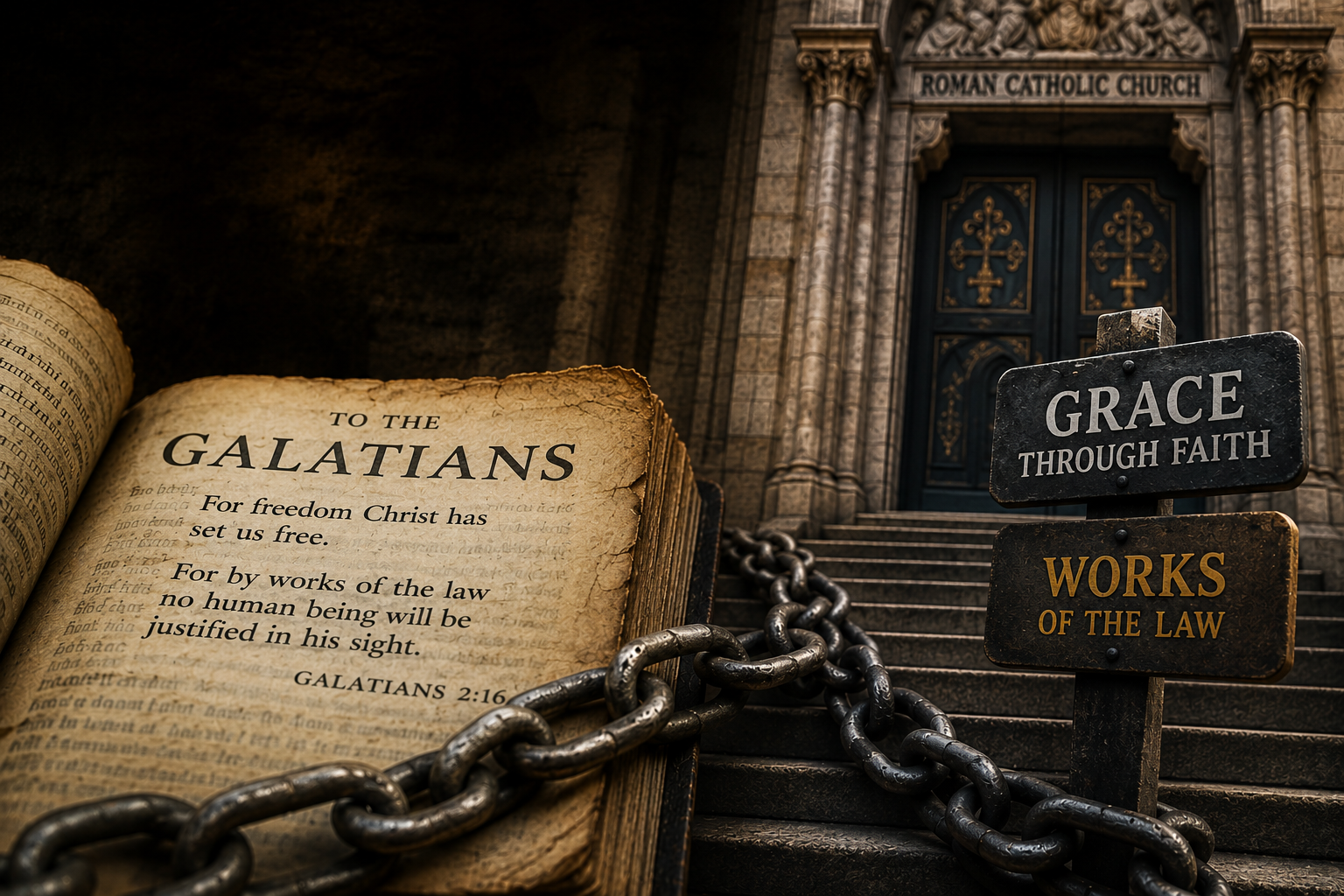
Some time ago, I reviewed a debate between Allen S. Nelson IV, pastor of Providence Baptist Church, and Father Stephen Hart of Sacred Heart Church on the question of whether the Roman Catholic Church is a gospel-denying church. (See my review here.) This debate centered on the doctrine of justification and exposed the fundamental differences between Protestant and Roman Catholic understandings of how a person is made right before God. Of course, justification stands at the very center of the gospel itself; it is not merely a secondary disagreement between theological traditions. A distorted understanding of justification necessarily distorts the good news because it touches the question of how sinners are reconciled to God through Christ. And this is precisely the issue that the Apostle Paul takes up in the Epistle to the Galatians. In Galatians, Paul argues with remarkable force that justification is by faith apart from works of the law and warns that any alteration of the gospel strikes at the heart of Christian truth. In this post, then, I would like to consider how Paul’s argument in Galatians relates to the Roman Catholic understanding of justification, because if the message of Galatians is taken seriously, it forces us to ask whether justification can, in any sense, be grounded in works without compromising the gospel itself.
The situation addressed in the Epistle to the Galatians is relatively well known, but it is worth reviewing briefly for the sake of clarity. Sometime after Paul’s first missionary journey, it appears that a group of Jewish Christians came into the churches of Galatia and began teaching that Gentile believers needed to be circumcised and adopt the Torah in order to be fully included among the people of God. (On the timeline of events in Galatia, see here.) These teachers are often described as “Judaizers,” though the issue at stake is frequently misunderstood. They were not simply advocating for moral effort or “legalism” in the modern sense of the term. Rather, they were challenging the basis upon which Gentiles could belong to the covenant community. Was faith in Christ sufficient, or did covenant membership require obedience to the Mosaic law as well? In other words, the issue was not whether obedience mattered in the Christian life. Paul himself repeatedly affirms the necessity of holiness and faithful living. The question, rather, was whether obedience to the law contributed in any sense to justification and covenant inclusion. And it is precisely at this point that Paul responds with extraordinary urgency, because for him the integrity of the gospel itself was at stake.
Against this backdrop, Paul’s central claim is that “no one is justified before God by the law, because the righteous will live by faith” (3.11). The question, of course, revolves around what Paul means by the term “justified.” However, the qualifying phrase “before God” is especially revealing. Paul is not speaking primarily about inward moral transformation or spiritual renewal, important as those realities are elsewhere in his theology. Rather, he is speaking about a person’s standing before the divine judge. Justification, then, is fundamentally forensic in nature. It is a legal declaration in which the believer is counted righteous before God on the basis of faith rather than works of the law. This is why Paul consistently contrasts justification with human obedience throughout Galatians. If righteousness could be obtained through the law, then there would be no need for Christ’s death (2.21). The issue is not whether good works follow genuine faith; Paul clearly believes that they do. The issue is whether those works contribute in any sense to the believer’s right standing before God. Paul’s answer is emphatic and uncompromising: sinners are justified by faith in Christ apart from the works of the law. Their acceptance before God rests not in their own obedience, but in the saving work of Christ received through faith.
However, the question must still be asked: what exactly does Paul mean by “works of the law”? In recent decades, the so-called “New Perspective on Paul,” especially in the work of James D. G. Dunn, has argued that these “works” refer primarily to Jewish socio-religious boundary markers such as circumcision, Sabbath observance, and food laws. On this reading, Paul’s concern is chiefly horizontal. The issue is how Jews and Gentiles can exist together within the same covenant community without the Torah functioning as a barrier between them. There is certainly truth in this observation, especially given the prominence of circumcision in Galatians itself. However, this understanding is ultimately too narrow because it does not fully account for Paul’s repeated emphasis on justification “before God.” Paul’s concern is not merely social fellowship, but a person’s standing before the divine judge. Therefore, “works of the law” cannot be reduced simply to ceremonial observances or ethnic boundary markers. Rather, the phrase must encompass any attempt to establish righteousness before God through obedience to the law. This is precisely why Paul contrasts law and promise, works and faith, curse and blessing. For Paul, the law cannot justify because fallen humanity cannot keep it perfectly. Faith, by contrast, receives what God promises in Christ rather than attempting to achieve righteousness through human obedience.
This is made clear by the way that Paul builds his argument in Galatians, namely on a series of theological contrasts that structure his understanding of the gospel itself. Central to his reasoning is the example of Abraham. Long before the giving of the law, Abraham “believed God, and it was credited to him for righteousness” (3.6). This point is crucial because it demonstrates that justification by faith precedes the Mosaic covenant altogether. The promise given to Abraham was received through faith, not through obedience to the law. The law, therefore, cannot function as the basis of justification because it was never the foundation of God’s covenant promises to begin with. Rather, Paul argues that the law was temporary, added “because of transgressions” until the coming of Christ (3.19). This is why Paul consistently contrasts promise and law, Spirit and flesh, faith and works throughout the letter. These are not complementary paths to justification, but fundamentally different principles. The law demands obedience and pronounces a curse upon those who fail to keep it perfectly, whereas faith receives the promise of God fulfilled in Christ. This is why Paul reacts so strongly to the Galatian error. The law does not complete what faith begins—it belongs to a different order altogether. To return to the law as the ground of justification is not spiritual maturity; it is, in Paul’s view, a departure from the very logic of the gospel itself.
This is perhaps why Paul speaks with such force in the opening of the Epistle to the Galatians. In 1:9, he writes, “As we have said before, I now say again: If anyone is preaching to you a gospel contrary to what you received, a curse be on him!” For Paul, this is not rhetorical exaggeration or emotional overstatement; it is covenantal seriousness. The gospel is not infinitely flexible or open to revision. It is the announcement of what God has accomplished in Christ for the salvation of sinners, and therefore to alter the basis of justification is to alter the gospel itself. This is precisely why Paul reacts so strongly to the teaching of the Judaizers. In his view, adding obedience to the law as a condition of justification does not merely supplement the gospel—it fundamentally changes its character. The issue is not whether circumcision or obedience have value in themselves; the issue is whether they contribute to a person’s right standing before God. Once works are introduced as part of the ground of justification, faith in Christ alone is no longer sufficient. And for Paul, that is not a small theological mistake, but a corruption of the gospel itself.
At this point, it is worth bringing Paul’s argument into conversation with the Roman Catholic understanding of justification, especially as articulated at the Council of Trent. To be clear, the Roman Catholic position is not identical to the error confronted in Galatia. The Judaizers were specifically requiring circumcision and Torah observance for covenant inclusion, whereas Roman Catholic theology affirms the necessity of grace and the centrality of Christ’s work. Nevertheless, there are important structural similarities that raise serious theological concerns. According to Trent, justification is not merely the forgiveness of sins, but also “the sanctification and renewal of the inward man” (Session 6, Chapter 7). Likewise, Trent teaches that the justified “through the observance of the commandments of God and of the Church, faith cooperating with good works, increase in that justice received through the grace of Christ” (Session 6, Chapter 10). In other words, justification in Roman Catholic theology includes transformative righteousness and can increase through obedience. But this is precisely where the tension with Galatians emerges. Paul consistently treats justification as a forensic declaration received through faith apart from works of the law. The question, then, is unavoidable: if justification is maintained or increased through works, even grace-enabled works, does this not reintroduce the very dynamic Paul rejects? Put differently, does the Roman Catholic system preserve the sufficiency of faith in Christ alone, or does it ultimately ground final justification, at least in part, in human obedience? At the very least, Trent’s understanding of justification is horribly confused and differs significantly from Paul’s argument in Galatians.
Now, in the interest of completeness, it is equally important to consider how the message of the Epistle to the Galatians might speak to those of us on the Protestant side of the aisle as well. As I noted in my original review, Protestants often have a tendency to underemphasize the importance—indeed, even the necessity—of good works in the Christian life. In some circles, the gospel is reduced to little more than a kind of “get out of hell free” card: simply believe in Jesus and secure your eternal destiny. But this reductionistic understanding of salvation severely minimizes the transforming power of grace and the necessity of Spirit-empowered obedience. Paul himself never makes this mistake. While he fiercely rejects works as the basis of justification, he equally insists that genuine faith necessarily produces obedience. This is why he can say in Galatians 5.6 that “what matters is faith working through love.” For Paul, obedience is not opposed to faith; rather, obedience is the fruit of true faith. The problem, then, is not works in themselves, but works placed in the wrong category. Works cannot justify the sinner before God, but they are the inevitable result of union with Christ and the indwelling work of the Spirit. Grace does not merely forgive; it transforms.
In theological categories, this process is known as sanctification, that is, the lifelong work of growing in conformity to the character of Christ through the power of the Holy Spirit. In the language of the Epistle to the Galatians, this is described as “walking by the Spirit” and cultivating the “fruit of the Spirit,” namely “love, joy, peace, patience, kindness, goodness, faithfulness, gentleness, and self-control” (5.22–23). The point is that while sanctification is logically distinct from justification, it is not altogether separate from it. The faith that justifies is never barren or inactive. We are justified by faith alone, but the person who is truly justified by faith will necessarily grow in holiness and produce the good works of Christlike character. This is why Paul can reject works as the basis of justification while simultaneously insisting upon obedience as the necessary fruit of life in the Spirit. Indeed, this is essentially the same point made by the Epistle of James in its discussion of faith and works, a point Paul himself would affirm wholeheartedly. Works do not secure our standing before God; rather, they demonstrate that our faith is living and genuine. Grace not only pardons the sinner, it transforms him.
What emerges from Galatians, then, is a clear theological order that must not be confused or reversed. First comes faith, and through faith comes justification, that once-for-all declaration in which the sinner is counted righteous before God on the basis of Christ alone. Then comes the gift of the Spirit, through whom the believer is progressively transformed into the image of Christ. Finally, obedience follows as the fruit of this new life in the Spirit. In other words, the imperatives of the Christian life flow out of the indicatives of the gospel. We obey because we have been accepted in Christ, not in order to be accepted by him. This is precisely why Paul can simultaneously reject justification by works while insisting upon the necessity of holiness. The Christian life is not opposed to obedience; it is grounded in grace-enabled obedience that flows from faith. But the order matters immensely. To place works before justification, or to make obedience part of the ground of our acceptance before God, is to reverse Paul’s entire theological structure and, in doing so, distort the very nature of the gospel itself.
In conclusion, then, we must affirm that the question of justification as it relates to faith and works is a foundational question when it comes to the clarity of the gospel itself. As Paul warns in the Epistle to the Galatians, to distort the gospel is to come under the curse of God. And while I do not think that the Roman Catholic Church falls under this curse in a simplistic or one-to-one sense, I do believe that the formulations of the Council of Trent are deeply confused on the question of justification and, in important ways, structurally parallel the very concerns Paul raises in Galatians. At the same time, Protestants must also resist the temptation to reduce the gospel to mere intellectual assent divorced from holiness and obedience. Paul rejects both legalism and moral indifference. The gospel he proclaims is one in which sinners are justified by faith alone and then transformed by the power of the Spirit into lives of joyful obedience. Faithful theology, then, requires more than loyalty to tradition or theological systems. It requires that we let Paul define the gospel on his own terms—and then have the courage to examine our systems in light of that definition.
Share this:

On Training in Godliness
TEXT
6 If you point these things out to the brothers and sisters, you will be a good servant of Christ Jesus, nourished by the words of the faith and the good teaching that you have followed. 7 But have nothing to do with pointless and silly myths. Rather, train yourself in godliness. 8 For the training of the body has limited benefit, but godliness is beneficial in every way, since it holds promise for the present life and also for the life to come. 9 This saying is trustworthy and deserves full acceptance. 10 For this reason we labor and strive, because we have put our hope in the living God, who is the Savior of all people, especially of those who believe.
~1 Timothy 3.14-16
Title: On Our Training for Godliness
Text: 1 Timothy 4.6-10
Series: 1 Timothy: God’s Design for a Healthy Church
Church: Redeemer Baptist Church, Jonesboro, AR
Date: October 19, 2025
Share this:

On the Roman Catholic Church and the Nature of the Gospel
Is the Roman Catholic Church a Gospel-denying church? This question was the theme of a recent debate between Allen S. Nelson IV, pastor of Providence Baptist Church in Perryville, AR, and Father Stephen Hart, pastor/priest at Sacred Heart Church in Morrilton, AR. (A video of the debate can be found on the YouTube page of Providence Baptist Church, here.) While it is true that both participants had strong moments in the two hour event, it is not my purpose to evaluate their performances or to name a winner. I think that Pastor Nelson was at his best when he was pushing the details of the official teachings of the Roman Catholic Church as stated in their published documents, and Father Hart was at his best when he was giving the Catholic understanding of relevant New Testament texts. In the final analysis, though, I suspect that most people went away from the event feeling confirmed in the positions they held coming in and believing that their preferred candidate had won the evening. In the space that follows, I would simply like to suggest four important takeaways that were clarified for me.
First, the debate made it clear that the Roman Catholic Church generally misunderstands the New Testament concept of justification. Lexically, the δικαι- word group (words that are usually translated in the NT as righteousness and/or justified) refers to a forensic or legal status of innocence or guiltlessness. In his commentary on Romans in the NICNT series, Douglas Moo writes, “To justify signifies, according to forensic usage, to acquit a guilty one and declare him or her righteous.” (86) As we read in Romans 5.19, “For just as through one man’s disobedience the many were made sinners, so also through the one man’s obedience the many will be made righteous (δικαίωμα).” In other words, it is a once-for-all gavel dropping declaration that a person is not guilty of their sin before God because of their faith in the atoning work of Christ. And what is important is that this status cannot be changed because of our sin, nor can it be augmented by good works. From beginning to end, it is a gift that is given by faith alone and that is preserved, maintained, and completed by God through His Spirit. As the Apostle Paul writes, “I am sure of this, that he who started a good work in you will carry it on to completion until the day of Christ Jesus.” (Phil. 1.6) Or again, in Romans 8.29-30, we read, “For those he foreknew he also predestined to be conformed to the image of his Son, so that he would be the firstborn among many brothers and sisters. And those he predestined, he also called; and those he called, he also justified; and those he justified, he also glorified.”
However, the RCC insists that this declaration of righteousness, being God’s powerful word, must be effectual, and include thereby moral transformation. For example, the Council of Trent defines justification as that “which is not remission of sins merely, but also the sanctification and renewal of the inward man.” (Chapter 7) Trent goes on to argue that “by mortifying the members of their own flesh, and by presenting them as instruments of justice unto sanctification, they, through the observance of the commandments of God and of the Church, faith co-operating with good works, increase in that justice which they have received through the grace of Christ, and are still further justified.” (Chapter 10) And so, it logically follows when Trent resolves that, “If any one saith, that the justice received is not preserved and also increased before God through good works; but that the said works are merely the fruits and signs of Justification obtained, but not a cause of the increase thereof; let him be anathema.” (Canon 24) Of course, the Council of Trent, first convened in 1545, was the Church’s response to the Protestant Reformation, and so one can’t help but wonder if there isn’t some amount of reactionism that has influenced their positions on these matters. Nevertheless, it seems clear from these statements that Trent’s understanding of justification goes well beyond the New Testament understanding of the term.
Secondly, and the statements above demonstrates this, but the debate made it clear that the Roman Catholic Church confuses the doctrine of justification with the doctrines of regeneration and sanctification. Regeneration (aka new birth or “being born again”) refers to that work of the Spirit in which a person is given spiritual life. In other words, the Spirit transforms an individual from a state of spiritual death to a state of new creation in Christ, thus, enabling them to repent, believe, and live in accordance with God’s will. By the same token, sanctification is simply the lifelong process by which a person is gradually transformed more and more into the image of Christ, becomes more holy, and learns to walk in obedience to the law of Christ. As we read in Hebrews 10.14, “For by one offering he has perfected forever those who are being sanctified.” (ESV/LSB) Note especially in this verse that we are perfected forever, and yet we are being sanctified. The point is that these are logically distinct aspects of the salvation process (ordo salutis), even if in actual experience they are sometimes indistinguishable.
But in the teaching of the RCC, all of this inheres within the doctrine of justification. As we saw above, the Catholic church defines justification as that “which is not remission of sins merely, but also the sanctification and renewal of the inward man.” Whatever the reason for this lack of theological precision may be, this indiscriminate intermingling of categories leads inevitably to the conclusion that a person’s justification is dependent upon their sanctification. Or to put it another way, the Roman Catholic view seems that imply that while justification is begun by faith, it is continued, maintained, and eventually confirmed by good works. This is perhaps why Trent envisages the possibility that a person’s initial justification can be lost. In Chapter 14, Trent reads, “As regards those who, by sin, have fallen from the received grace of Justification, they may be again justified, when, God exciting them, through the sacrament of Penance they shall have attained to the recovery, by the merit of Christ, of the grace lost.” If a person’s justification can be lost by their disobedience, then it necessarily follows that it must be maintained (or should I say earned) by their obedience. Whatever the case, it is clear that in the Catholic understanding, the determining factor in a person’s justification is their obedience, i.e. their good “works”, and not their faith.
Now, I would be remiss if I did not also submit the opposing position to equal scrutiny, and so, before I conclude this article, I would like to offer two areas of weakness in our position that I believe were exposed in the aforementioned debate. And let me hasten to add that these points should not be received as any kind of criticism of Pastor Nelson; based on the limited interaction I have had with him, I find him to be a biblically faithful, theologically astute individual. But, as it regards the way that our views are typically represented in these discussions, I think there are two important takeaways for us to consider.
The first takeaway for those holding our perspective might be stated thus, namely that Protestants have a tendency to underemphasize the importance, nay even the necessity, of good works. In our zeal to proclaim and defend that time honored Reformation principle sola fide, or justification by faith alone, we inadvertently imply that living a life of obedience that issues forth in good works is some kind of optional add-on. We suggest, though perhaps unintentionally, that the Gospel’s call to live a life of ongoing discipleship to Jesus is something that is reserved for the religious elite, those who are really serious about their faith, those who are truly devout, so-called ‘super Christians’. But the Apostle James is clear on this point when he writes, “You see that a person is justified by works and not by faith alone.” (James 2.24) Of course, this is not a contradiction of the Apostle Paul, nor is it inconsistent with the Reformation’s emphasis on faith alone rightly understood (contra Luther). Rather, it is a reminder that the kind of faith that justifies is a faith that works. In other words, the principle of sola fide does not mean that a person can believe in Jesus and then live in whatever manner they so choose. This kind of “easy-believism’ is in truth no faith at all. In fact, it is demonic (James 2.19), and it does not and cannot save. A faith that saves, a faith that justifies, is a faith that works, and on this point, James and Paul are in complete agreement.
There is a sense in which our works will play a role at the final judgment. Jesus himself says in Matthew 16.27, “For the Son of Man is going to come with his angels in the glory of his Father, and then he will reward each according to what he has done. ” And in Second Corinthians 5.10, we read, “For we must all appear before the judgment seat of Christ, so that each may be repaid for what he has done in the body, whether good or evil.” Or again, in Romans 2.6-8, Paul writes (quoting Proverbs 24.12 et al.), “He will repay each one according to his works: eternal life to those who by persistence in doing good seek glory, honor, and immortality; but wrath and anger to those who are self-seeking and disobey the truth while obeying unrighteousness.” And finally, in Hebrews 12.14, we are told to “Pursue … holiness [because] without it no one will see the Lord.” This does not mean that we are “saved” by or because of our works, but it does mean that living a life of obedience to God validates or proves that our faith is indeed a saving faith. The message of the Gospel is built on both the indicatives of what Jesus has done for us and imperatives that we are called to obey for Him. We receive the indicatives by faith, and we obey the imperatives because of what we have received by faith. The order matters here. If we put the imperatives of the Gospel before the indicatives of the Gospel, then we distort the Gospel into a salvation by works. In the logic of the Gospel, the indicatives precede and enable the imperatives. But the point is that they are both necessary parts of the gospel.
And this brings me to the second weakness of the Protestant position that I believe was exposed in the debate, namely that Protestants have a tendency to reduce the Gospel to its lowest common denominator. There can be no doubt that justification by faith is an important, even essential, foundation for our salvation, but the Gospel is so much more than justification by faith. The Gospel is the good news that in the person and work of Jesus Christ God has entered into his creation to redeem his people by dying for their sin as an atonement and by defeating death through His resurrection and to renew his creation by establishing his rule on earth, so that through the Spirit they can walk in perfect conformity to His ways and experience the blessings of His ongoing presence in and among them. It is this vision of a renewed humanity living in a renewed world in which God is eternally present to bless that is the goal of the biblical narrative (Revelation 21-22). This is why we must constantly remind ourselves that even though we have already been saved (justification), we are still being saved (sanctification), and yet one day we will be saved (glorification). And all of this is received and experienced by and through faith, but this faith must be a faith by which we walk in conformity to the way and will of Christ.
So, is the Roman Catholic Church a Gospel-denying church? I don’t know, but it does seem to me that their official teachings, whether explicitly or implicitly, confuse important concepts and components of the Gospel, and in doing so, it has the potential to lead even the most sincere and devout parishioner to believe that they are saved by living a morally upright and generally good and charitable life. Can a person be genuinely saved in the Roman Catholic Church? I think yes, but I would suspect that this is in spite of its official dogmas and teachings. And beyond their doctrine of salvation, there are many other tenets and teachings of the Roman Catholic tradition that I consider to be in clear contradiction to the teaching of Scripture. However, that is a question for another time. I will simply close this post with the words of the Apostle Paul, because I think they sum up the issues discussed in this article particularly well. “For you are saved by grace through faith, and this is not from yourselves; it is God’s gift— not from works, so that no one can boast. For we are his workmanship, created in Christ Jesus for good works, which God prepared ahead of time for us to do.” (Ephesians 2.8-10)
Share this:

On Sanctification and the Christian Life
1. Those who are united to Christ and effectually called and regenerated have a new heart and a new spirit created in them through the power of Christ’s death and resurrection. They are also further sanctified, really and personally, through the same power, by his Word and Spirit dwelling in them. The dominion of the whole body of sin is destroyed, and the various evil desires that arise from it are more and more weakened and put to death. At the same time, those called and regenerated are more and more enlivened and strengthened in all saving graces so that they practice true holiness, without which no one will see the Lord.
2. This sanctification extends throughout the whole person, though it is never completed in this life. Some corruption remains in every part. From this arises a continual and irreconcilable war, with the desires of the flesh against the Spirit and the Spirit against the flesh.
3. In this war, the remaining corruption may greatly prevail for a time. Yet through the continual supply of strength from the sanctifying Spirit of Christ, the regenerate part overcomes. So the saints grow in grace, perfecting holiness in the fear of God. They pursue a heavenly life, in gospel obedience to all the commands that Christ as Head and King has given them in his Word.
Series: The 1689 Baptist Confession of Faith
Church: Redeemer Baptist Church, Jonesboro, AR
Date: February 28, 2024
Share this:

On Psalm 119.89-96 (Lamed)

89 Lord, your word is forever;
it is firmly fixed in heaven.
90 Your faithfulness is for all generations;
you established the earth, and it stands firm.
91 Your judgments stand firm today,
for all things are your servants.
92 If your instruction had not been my delight,
I would have died in my affliction.
93 I will never forget your precepts,
for you have given me life through them.
94 I am yours; save me,
for I have studied your precepts.
95 The wicked hope to destroy me,
but I contemplate your decrees.
96 I have seen a limit to all perfection,
but your command is without limit.
The twelfth stanza of Psalm 119 (ל/Lamed) begins with a beautiful affirmation of the permanence and timelessness of God’s Word. “Lord, your Word is forever; it is firmly fixed in heaven.” (verse 89) It is not just another curiosity that has been passed down to us from antiquity; no, it is the living and abiding Word of the one true and living God. In theology, this is called the doctrine of inspiration, namely that God speaks through the human authors of the Biblical documents, such that their words are His very words. This is why the Bible has lasting relevance and authority even beyond the audiences to whom it was originally written. As our psalmist puts it, “Your judgments stand firm today. for all things are your servants.” (verse 91) Contrary to the opinions of modern culture, the Word of God is still the right and true prescription for human flourishing; the virtues it sanctions and the vices it prohibits are not outdated holdovers from people and places now long past. No, the Bible is special revelation from God in which He reveals the problem of humanity’s sin and the way of salvation that comes by grace through faith in the person and work of Jesus Christ.
Now, in verse 90, we read “Your faithfulness is for all generations; you established the earth, and it stands firm.” As we have noted in previous posts, most of the verses in Psalm 119 contain some synonym for God’s Word, e.g. laws, commands, instructions, precepts, etc., and so here we have “your faithfulness” (אֱמֽוּנָתֶךָ). It seems clear that this word is meant to stand in parallel relationship with “your word” (verse 89) and “your judgments” (verse 91); interestingly, the Septuagint (LXX) translates this word as “your truth” (ἡ ἀλήθειά σου). The point of all of this is to say that the abiding authority of God’s Word is grounded in who He is, i.e. in His unchanging character. He is faithful; He keeps His promises. Whatever He says, He will most certainly do. His Word is a reflection of who He is: His holiness, His grace, His power, His love, and even His incomprehensibility. This is why our psalmist writes in verse 96, “I have seen a limit to all perfection, but your command is without limit,” or as it reads in the NET Bible, “your commands are beyond full comprehension.” The God of the Bible is infinite; He is a mystery whose depths can never fully be exhausted. So also is His Word.
However, this does not mean that we should not read or study the Word of God. Yes, the depths of the Bible’s riches are inexhaustible, but they are also perspicuous and clear. I have previously written on this topic, here. But suffice it to say that in the act of inspiration, the infinite God condescended to our finite capacities for understanding. He is infinite in power, wisdom, and goodness, and we are His creatures, finite in our ability to comprehend His perfections. But He chose to reveal Himself in and through the Word so that we might know Him and be reconciled to Him. So yes, the Bible is so clear that any human being, regardless of their intellectual aptitude or educational achievement, can read it and understand their sin and their need for a savior; it is also, at the same time, a limitless source of mystery and wonder, such that even the finest minds throughout human history have been unable to fully explain all of its secrets.
For our psalmist, this means that the Word of God must be continuously read, studied, and contemplated. As he says in verse 93, “I will never forget your precepts, for you have given me life through them.” Here again, not only do we see that abiding authority of God’s Word, but we also see its all encompassing sufficiency. Our psalmist understands that every need of the human soul is provided for in the inspired Word of God. In verse 92, we read, “If your instruction had not been my delight, I would have died in my affliction.” The word “delight” conveys the idea of contentment, satisfaction, or pleasure. In other words, our psalmist understands that even in the midst of turmoil, adversity, and heartache, there is a joy, a “peace that passes all understanding” that is available when we rest in the promises of God’s Word. The spiritual disciplines of the Word (study, meditation, memorization) are the God prescribed antidote for our anxiety, our fear, our depression, our despair. Again, our psalmist writes in verse 95, “The wicked hope to destroy me, but I contemplate your decrees.”
This devotion, this diligence in the discipline of the Word, this affection for the perfections of God’s Law, is a distinguishing characteristic of those who belong to Him. As our psalmist writes in verse 94. “I am yours; save me, for I have studied your precepts.” We are a people of the Book. Our faith is not based on a human philosophy or mere reflections on the divine; no, it is based on the inspired, inerrant, authoritative, sufficient revelation of God Himself. In His Word, He has clearly and finally revealed the one and only path unto salvation, and He has called His people to walk upon it until we reach glory. So, when our psalmist prays “save me”, he is not simply expressing his desire to be saved from the penalty of sin. Rather, he is praying for the ongoing work of salvation to be applied in his life through sanctification, that God would save him from the power of sin through His sufficient Word. In the same breath, he is also expressing that most fundamental of Christian hopes, namely that one day he would be saved from the very presence of sin entirely, a hope that is grounded in the promises of God’s Word. In other words, our psalmist understands that the full experience of our salvation comes to us through the Word by the Spirit. Therefore, we should never cease to be amazed at the riches of His word, and we should constantly devote ourselves to its discipline.
For further study:
Introduction
Psalm 119.1-8
Psalm 119.9-16
Psalm 119.17-24
Psalm 119.25-32
Psalm 119.33-40
Psalm 119.41-48
Psalm 119.49-56
Psalm 119.57-64
Psalm 119.65-72
Psalm 119.73-80
Psalm 119.81-88
Share this:

On the Spiritual Disciplines: An Introduction
TEXT
For this very reason, make every effort to supplement your faith with goodness, goodness with knowledge, knowledge with self-control, self-control with endurance, endurance with godliness, godliness with brotherly affection, and brotherly affection with love. For if you possess these qualities in increasing measure, they will keep you from being useless or unfruitful in the knowledge of our Lord Jesus Christ.
~2 Peter 1.5-8
Topic: Introduction and Overview
Series: Spiritual Disciplines of the Christian Life
Church: South Caraway Baptist Church, Jonesboro, AR
Date: January 11, 2023
Share this:

On Why Christians Still Need the Gospel
TEXT
11 For the grace of God has appeared, bringing salvation for all people, 12 instructing us to deny godlessness and worldly lusts and to live in a sensible, righteous, and godly way in the present age, 13 while we wait for the blessed hope, the appearing of the glory of our great God and Savior, Jesus Christ. 14 He gave himself for us to redeem us from all lawlessness and to cleanse for himself a people for his own possession, eager to do good works.
Text: Titus 2.11-14
Series: Revival
Church: First Baptist Church, Mammoth Spring, AR
Date: August 31, 2022
Share this:

On Something Old, Something New (Part 3)
Question: What parts of the law do we follow today?
Series: Wednesday Night Bible Study – Q & A
Church: South Caraway Baptist Church, Jonesboro, AR
Date: July 27, 2022
Share this:

On the Practice of Holiness (1 Timothy 3.14-4.10)
Text
14 I write these things to you, hoping to come to you soon. 15 But if I should be delayed, I have written so that you will know how people ought to conduct themselves in God’s household, which is the church of the living God, the pillar and foundation of the truth. 16 And most certainly, the mystery of godliness is great:
He was manifested in the flesh,
vindicated in the Spirit,
seen by angels,
preached among the nations,
believed on in the world,
taken up in glory.
4 Now the Spirit explicitly says that in later times some will depart from the faith, paying attention to deceitful spirits and the teachings of demons, 2 through the hypocrisy of liars whose consciences are seared. 3 They forbid marriage and demand abstinence from foods that God created to be received with gratitude by those who believe and know the truth. 4 For everything created by God is good, and nothing is to be rejected if it is received with thanksgiving, 5 since it is sanctified by the word of God and by prayer.
6 If you point these things out to the brothers and sisters, you will be a good servant of Christ Jesus, nourished by the words of the faith and the good teaching that you have followed. 7 But have nothing to do with pointless and silly myths. Rather, train yourself in godliness. 8 For the training of the body has limited benefit, but godliness is beneficial in every way, since it holds promise for the present life and also for the life to come. 9 This saying is trustworthy and deserves full acceptance. 10 For this reason we labor and strive, because we have put our hope in the living God, who is the Savior of all people, especially of those who believe.
Title: On the Practice of Holiness
Series: All I Want for Christmas
Church: South Caraway Baptist Church, Jonesboro, AR
Date: December 27, 2020


