Category Archives: Gospels Studies

On Messianic Sonship in the Gospel of John

In my previous post, I argued that in the New Testament the title “Son of God” should be understood primarily as royal and messianic before it is understood in fully developed theological terms. However, because of its clear emphasis on the divinity of Jesus, many assume that the Gospel of John moves away from this historical and messianic framework. In this post, I want to suggest that John does not abandon these categories; on the contrary, he deepens them in order to reveal what it truly means for Jesus to be the Messiah. Or to put it another way, John presents Jesus in continuity with Jewish messianic expectations, while also showing that this messianic sonship entails a uniquely intimate and divine relationship with the Father that exceeds what was previously anticipated. The question, then, is not whether John’s understanding of Jesus is messianic, but what kind of messianism he presents.

In his purpose statement, John writes that “these are written so that you may believe that Jesus is the Messiah, the Son of God.” Here again, the grammatical construction is significant. The term “Christ” (or “Messiah”) stands in apposition to the phrase “Son of God,” meaning that the two expressions are placed side by side, with one defining or clarifying the other. In this context, to confess Jesus as the Messiah is to confess him as the Son of God. This same connection appears at the beginning of the Gospel of John. In John 1:49, Nathanael declares, “You are the Son of God; you are the King of Israel.” The parallelism in these lines again equates divine sonship with messianic kingship, but more importantly, these two statements function as bookends to the Gospel, framing John’s presentation of Jesus from beginning to end. The point, then, is that John does not abandon the messianic meaning of “Son of God.” Rather, he affirms it at the structural level of his narrative. To believe in Jesus as the Messiah is to believe in him as the Son, and this understanding stands in direct continuity with the Synoptic presentation explored in the previous post.

This same connection appears at the midpoint of the Gospel of John. In the account of Lazarus in John 11, after Jesus declares that he is “the resurrection and the life,” he turns to Martha and asks, “Do you believe this?” She responds, “Yes, Lord; I believe that you are the Messiah, the Son of God, who is coming into the world.” This confession is loaded with Christological significance. Not only does it once again place “Messiah” and “Son of God” in apposition, reinforcing the connection we have already seen, but it also adds a further layer by describing Jesus as “the one who is coming into the world.” This language resonates with broader biblical expectations of a coming deliverer—one who is sent by God and arrives to accomplish his purposes. It echoes themes associated with the coming figure of Daniel 7 and the one who comes in the name of the Lord in Psalm 118. Taken together with John 1:49 and 20:31, this confession strengthens the pattern: to be the Son of God is to be the Messiah, the King of Israel, the one sent into the world. In other words, John clearly preserves and reinforces the traditional messianic categories that were already in circulation.

Of course, conceptions of the Messiah in the literature of Second Temple Judaism were far from uniform. Expectations were diverse and often overlapping rather than monolithic. Some traditions emphasized a royal figure in continuity with the promises to David, drawing on texts like 2 Samuel 7 and Psalm 2, where the Messiah is understood as the anointed king who would rule on God’s behalf. Others envisioned a more prophetic figure, in keeping with the promise of a prophet like Moses in Deuteronomy 18, one who would speak God’s word with unique authority. Still others anticipated a more exalted or even heavenly figure, shaped by texts like Daniel 7, where the “Son of Man” is portrayed as receiving dominion and glory from God himself. The point is not that these expectations were clearly defined or neatly separated, but that Jewish messianism already contained a range of categories capable of accommodating a figure of significant authority and even transcendent status. This is important for reading the Gospel of John. When John presents Jesus in elevated terms, he is not abandoning messianic categories or importing something foreign into the tradition. Rather, he is drawing on a rich and developing matrix of expectation already present within Second Temple Judaism and showing how these strands converge in the person of Jesus.

Now, as I argued in my previous post, in the Synoptic Gospels the idea of sonship is primarily representative. As the Messiah, Jesus stands as God’s appointed ruler on earth, the true king who embodies and fulfills the role that Israel and her kings failed to carry out. But in the Gospel of John, the concept of sonship is taken further. The relationship between the Father and the Son is not merely one of representation, but of participation. That is, the Son does not simply act on God’s behalf; he acts in a way that is inseparably bound up with the Father’s own activity. This is made clear in passages like John 5:19, where Jesus says, “Truly I tell you, the Son is not able to do anything on his own, but only what he sees the Father doing. For whatever the Father does, the Son likewise does these things.” The claim here is remarkable. It is not merely that the Son imitates the Father, but that his actions are perfectly coordinated with and reflective of the Father’s own work. The same idea appears in John 10:30: “I and the Father are one.” In other words, the Son does not merely represent the Father as his agent; he shares in his work in a unique and unparalleled way. This is not a departure from messianic sonship, but a deepening of it—one that begins to press beyond simple representation into a more profound unity between the Father and the Son.

At this point, it is helpful to introduce a category that has received significant attention in recent scholarship, namely the Jewish concept of agency. In the ancient Jewish world, an agent functioned as a representative of the one who sent him. The basic idea was that “the one sent is as the sender,” meaning that the agent could speak and act with the authority of the one who commissioned him. This framework helps explain much of the language in the Gospel of John, especially the repeated emphasis that Jesus is the one “sent” by the Father. He speaks the Father’s words, performs the Father’s works, and carries out the Father’s will. In this sense, Jesus clearly fits within recognizable Jewish categories of agency. And yet, as the Gospel unfolds, it becomes evident that his sonship cannot be fully contained within that framework. Jesus does not merely speak for God; he speaks as one who uniquely knows the Father. He does not simply carry out God’s works; he does what the Father himself does. The point, then, is that while the category of agency is helpful, it is ultimately insufficient. The Son does not merely act on God’s behalf—he acts with God’s authority in a way that is inseparably bound up with the Father himself. In other words, John presents a form of agency that is intensified to the point of revealing something more about the identity of the Son.

According to John, this is precisely why opposition to Jesus intensifies. In John 5:18, we read, “This is why the Jews began trying all the more to kill him: not only was he breaking the Sabbath, but he was even calling God his own Father, making himself equal to God.” This observation is significant because it shows that the implications of Jesus’s claims are drawn from within the narrative itself. John does not import the idea of divine sonship from some external philosophical framework; rather, it emerges organically from the way Jesus speaks about his relationship to the Father. What is particularly striking is that Jesus does not correct this interpretation. Instead, in the verses that follow, he deepens it. He speaks of doing whatever the Father does, of giving life as the Father gives life, and of exercising judgment as the Father does. In other words, the claim to sonship entails participation in divine prerogatives that belong to God alone. The response of his opponents, then, is not a misunderstanding but a recognition of the implications of his words. They perceive that Jesus is not merely claiming to be God’s representative, but is placing himself in a unique relationship of shared authority with God. The point, then, is that in John’s Gospel, messianic sonship presses beyond representation into a form of equality that raises unavoidable questions about the identity of the Son.

And this is why Jesus is uniquely able to reveal the Father. In John 1:18 we read, “No one has ever seen God. The one and only Son, who is himself God and is at the Father’s side—he has revealed him.” There is a well-known textual question here as to whether the verse should read “the only begotten God” or “the only begotten Son.” While the evidence favors the reading “the only begotten God”, what is most striking is that both readings point in the same direction: John is describing a relationship between the Father and the Son that is without parallel. The Son stands in the closest possible relation to the Father—“at his side”—and precisely for that reason he is able to make him known. This is not simply the language of a prophet who speaks on God’s behalf; it is the language of one who knows God from within that relationship. Jesus makes this point explicit in John 14. When Philip asks, “Lord, show us the Father,” Jesus responds, “The one who has seen me has seen the Father.” In other words, the Son does not merely communicate information about God—he reveals him. The Son is uniquely qualified to make the Father known because his identity is inseparably bound up with the Father himself.

As in the Synoptic Gospels, the identity of Jesus as the Son reaches its fullest expression in his death, but in the Gospel of John this moment is framed in a striking way. The crucifixion is not merely suffering; it is glorification. In John 12:32, Jesus says, “As for me, if I am lifted up from the earth I will draw all people to myself.” The language of being “lifted up” carries a deliberate double meaning. On the one hand, it refers to the physical lifting up of Jesus on the cross. On the other, it points to exaltation, to being lifted up in glory. For John, these are not separate events but one and the same reality viewed from different angles. This is confirmed in John 13:31, where, immediately after predicting his betrayal, Jesus declares, “Now the Son of Man is glorified, and God is glorified in him.” In other words, the cross is not a contradiction of Jesus’s identity as the Son—it is its revelation. The glory of his sonship is displayed precisely in his obedience, his self-giving, and his willingness to suffer. The Son is most fully revealed not in avoiding the cross, but in embracing it.

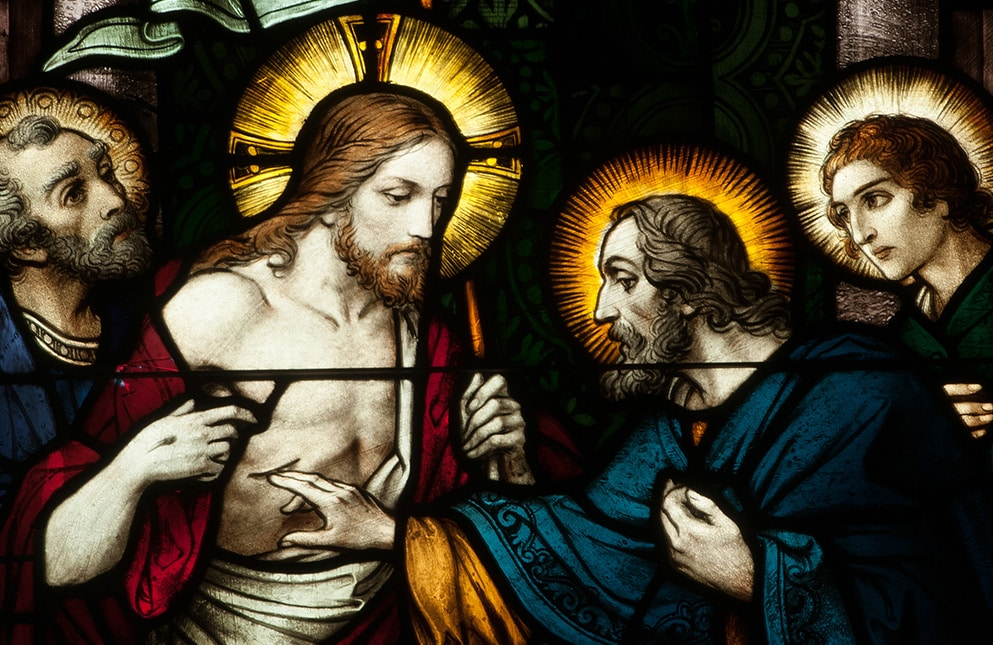
And the resurrection brings this trajectory to its proper conclusion. After seeing the risen Jesus and placing his hands in his wounds, Thomas responds with the climactic confession, “My Lord and my God!” (John 20.28). This is not merely an emotional outburst; it is the narrative’s decisive answer to the question that has been building throughout the Gospel of John: Who is this Jesus who claims to be the Son of God? Thomas’s confession brings together the strands that John has been developing from the beginning. The one who is the Messiah, the Son of God, is also rightly confessed as Lord and God. In this moment, the identity of Jesus is not revised but fully recognized. The resurrection does not introduce something new; it confirms and unveils what has been true all along. As such, the arc of the Gospel reaches its climax in the full acknowledgment of Jesus’s identity, echoing the claims of the opening prologue. The Son who was sent into the world is revealed to be none other than God himself, now seen, known, and confessed in the risen Christ.

So, to bring all of this together, we can now see the full trajectory of the title “Son of God” across the canon. In the Old Testament, sonship is grounded in covenant and kingship. Israel is called God’s son, and the Davidic king is identified as God’s son, functioning as his appointed ruler and representative. In the Synoptic Gospels, this category is sharpened and focused in the person of Jesus, who is confessed as the Messiah, the Son of God—the one who fulfills the role that Israel and her kings failed to carry out. But in the Gospel of John, this messianic sonship is not abandoned; it is brought to its fullest expression. John shows that the Messiah is the Son in a deeper sense than previously expected. The Son does not merely represent God’s rule; he participates in the Father’s work, shares in his authority, and uniquely reveals his identity. In other words, John does not move beyond messianism into something else entirely. Rather, he reveals what messianism was ultimately pointing toward all along. The royal Son of the Old Testament and the messianic Son of the Synoptics find their fullest meaning in the one who is not only God’s appointed king, but the Son who stands in a unique and unparalleled relationship with the Father.

What all of this means, then, is that the confession that Jesus is the Son of God is not merely a doctrinal statement to be affirmed, but a reality to be believed and lived. In the Gospel of John, belief in the Son is consistently tied to life. To believe in him is to receive life, to enter into a relationship with the Father, and to know God as he truly is. This is because the Son is the one who uniquely reveals the Father. He is not simply a messenger who brings information about God; he is the one in whom God is made known. And so to come to the Son is to come to the Father. At the same time, this confession is grounded in the unfolding story of Scripture. The title “Son of God” begins in the Old Testament as a royal and covenantal designation, is sharpened in the Synoptic Gospels as a messianic identity, and is brought to its fullest expression in John, where the Son is revealed in a uniquely intimate and participatory relationship with the Father. To confess Jesus as the Son of God, then, is not only to affirm his role as Messiah, but to recognize him as the one who stands at the very center of God’s redemptive purposes, the one who makes the Father known, and the one in whom we find life.

For further study:
Reynolds, Benjamin E., and Gabriele Boccaccini, eds. Reading the Gospel of John’s Christology as Jewish Messianism: Royal, Prophetic, and Divine Messiahs. Ancient Judaism and Early Christianity. Leiden: Brill, 2018.


On Son of God as a Messianic Title

When Christians confess that Jesus is the Son of God, we are usually affirming something of his divinity. In other words, the title “Son of God” is typically understood in doctrinal terms as an affirmation that Jesus is the second person of the Trinity come incarnate. This understanding reaches back to the formulation of the First Council of Nicaea in AD 325. In that creed, we confess that Jesus is “the only begotten Son of God, born of the Father before all ages, God from God, Light from Light, true God from true God, begotten, not made, consubstantial with the Father.” These are beautiful words that faithfully express the truth of Christ’s divinity. However, they also risk skipping the story. In Scripture, the term “Son of God” first emerges as a royal, messianic title before it is developed into a fuller theological claim about his divine identity. Its meaning is shaped by covenant, kingship, and expectation, and only later expanded in light of who Jesus truly is.

The idea of sonship appears early in the Old Testament. As early as Exodus 4.22, God declares that “Israel is my firstborn son,” identifying the nation as his covenant people, set apart to represent him among the nations. Later, in the Davidic covenant, God speaks of the king in similar terms: “I will be his father, and he will be my son” (2 Sam. 7.14). Here, sonship is tied directly to kingship and divine appointment. The king stands as God’s representative, ruling on his behalf and under his authority. This same idea is expressed in Psalm 2, where, in the context of royal coronation, the king declares, “He said to me, ‘You are my Son; today I have begotten you.'” The language is not biological or metaphysical, but covenantal and functional. It marks the king as the one chosen and installed by God to exercise his rule. The point, then, is that in these texts divine sonship refers to representative, covenantal identity. It speaks of relational authority, divine election, and royal vocation rather than transcendent metaphysical realities. To be called ‘Son of God’ in this context is to be appointed as God’s king, entrusted with the responsibility of embodying his rule among his people.

The problem, however, is that these “sons of God” consistently fail to live up to the height of their calling. As God’s son, Israel was called to be a kingdom of priests, a light to the nations, and a visible reflection of God’s character in the world. Yet instead of faithfulness, they fell into sin and idolatry, broke the terms of the covenant, and were ultimately sent into exile under its curses. The same pattern emerges in the Davidic line. The kings of Israel and Judah, who were called to mediate God’s rule over his people, likewise failed through disobedience and compromise. This tension is reflected within the Psalms themselves. In Psalm 2, the authority of the Lord’s anointed king is met with resistance as the nations rage against him. In Psalm 89, the psalmist recalls God’s covenant promises to David, only to lament that those promises appear to stand in contradiction to present reality. The result is that the category of “son of God” begins to carry forward-looking weight. It no longer simply describes a present reality; it generates expectation. There emerges a longing for a faithful son, a greater son, who will succeed where Israel and her kings have failed, a hope captured in texts like Isaiah 9.6–7, where the promised son will finally bear the government in righteousness and peace. In other words, the Scriptures create space for a future Son who will succeed where others failed.

This hope for a greater Son of God becomes more clearly defined in the Second Temple period. Of course, these texts are not inspired Scripture, but they do provide important insight into the expectations and categories that were alive at the time of Jesus. What we see is a growing anticipation of deliverance increasingly framed in royal and messianic terms. While these expectations are diverse, there remains a significant continuity with Old Testament categories, especially the idea of the “Son of God.” For example, among the Dead Sea Scrolls, texts like 4Q174 (the Florilegium) link the Davidic covenant and the language of sonship in 2 Samuel 7.14 with the expectation of a coming royal Messiah. Likewise, 4Q246 explicitly uses the titles “Son of God” and “Son of the Most High” in reference to a future ruler. Another text, 1QSa (often cited as 1Q28a), appears to echo Psalm 2.7 with language of divine begetting applied to the Messiah. These examples could be multiplied, but the point is clear: in the Second Temple period, the concept of divine sonship is not abandoned or redefined, but carried forward and intensified. It remains closely tied to the Davidic king, even as it takes on heightened expectation in anticipation of the one who will finally fulfill that role. Or to put it another way, the term “Son of God” was already a loaded, expectation-filled term before Jesus appeared.

In the Synoptic Gospels, “Son of God” language appears at key moments in the life and ministry of Jesus. Most notably, at his baptism and again at his transfiguration, a voice from heaven declares, “This is my beloved Son,” marking him out as the one uniquely appointed and affirmed by God. The demons, too, recognize Jesus as the Son of God, a recognition that underscores his authority and signals his messianic identity, even when others fail to perceive it clearly. This comes into sharper focus at Caesarea Philippi. When Jesus asks his disciples, “Who do you say that I am?”, Peter responds, “You are the Messiah, the Son of the living God.” The grammar of this confession is particularly significant. The predicate nominative “Messiah” and the phrase “Son of the living God” stand in apposition, meaning that the second expression defines and clarifies the first. In other words, to confess Jesus as the Messiah is to confess him as the Son of God. In this context, divine sonship is directly tied to his mission, obedience, and kingship. At the same time, Jesus redefines contemporary messianic expectations. He rejects the political and nationalistic ambitions often associated with the Messiah and instead frames his identity around suffering, obedience, and ultimately his death. The point, then, is that throughout the Synoptic Gospels, the title “Son of God” functions primarily as a messianic designation, identifying who Jesus is and what he has come to do.

Even at his crucifixion, the language of sonship is front and center. The religious leaders mock him, saying, “If you are the Son of God, come down from the cross” (Matt. 27.40), and again, “He is the King of Israel! Let him come down now from the cross, and we will believe in him” (Matt. 27.42). The parallelism in these statements is striking. “Son of God” and “King of Israel” function as equivalent titles, reinforcing the connection between divine sonship and messianic kingship. And yet, this is the tension: the one who claims to be the Son of God appears to be defeated. He does not come down from the cross; he remains and suffers. But this apparent contradiction is precisely the point. Jesus does not abandon his identity as the Son; he fulfills it through obedience and suffering. His sonship is not negated at the cross; it is revealed there. The resurrection then serves as the divine vindication of his claims. As Paul writes in Romans 1.4, he was “appointed Son of God in power… by the resurrection from the dead.” That is, the resurrection publicly confirms what was already true of him, now revealed in power. The cross is not the denial of his kingship, but the path to it. As even the Roman centurion confesses at his death, “Truly this man was the Son of God.”

The early apostolic witness continues this same pattern by interpreting Jesus’s sonship in light of his resurrection and exaltation. In the book of Acts, the apostles repeatedly draw from the Psalms to explain what God has accomplished in Christ. For example, in Acts 13, Paul cites Psalm 2.7—“You are my Son; today I have begotten you”—and applies it to the resurrection of Jesus. In this context, the language of “begetting” is not about origin, but about installation. The resurrection marks the public declaration and vindication of Jesus as the Son of God, the one who now reigns in power. Similarly, Psalm 110 is used throughout the New Testament to describe Christ’s exaltation to the right hand of God, a position of authority, kingship, and rule over all things. The point is that the apostles read the Psalms as speaking directly to the identity and mission of Jesus, particularly as they relate to his enthronement. His sonship is not merely a title attached to his earthly ministry; it is confirmed and displayed in his exaltation. In other words, Jesus is revealed to be the Son of God in power as the risen and reigning king, fulfilling the royal and covenantal expectations embedded in the Psalter. (On Christ as the fulfillment of the Psalms, see here.)

Bringing all of this together, the title “Son of God” in Scripture carries a rich and layered meaning that is rooted in covenant, kingship, and ultimately fulfillment in Christ. It is a title that begins with Israel as God’s son, is focused and intensified in the Davidic king, and then expands into a forward-looking expectation for a faithful Son who will succeed where all others have failed. In Jesus, that expectation is finally realized. He is the true Son who embodies what Israel was called to be, the true King who fulfills the promises made to David, and the obedient Son who accomplishes the will of the Father. His sonship is not defined by abstract speculation, but by his mission—his life of perfect obedience, his suffering on the cross, his resurrection from the dead, and his exaltation to the right hand of God. To confess Jesus as the Son of God, then, is to confess him as the promised Messiah, the one in whom God’s purposes for his people and his world are brought to completion. And yet, as full and glorious as this picture is, the story does not end here. The New Testament, particularly in the Gospel of John, will press even further, showing that Jesus’s sonship is not only messianic, but also reveals something deeper about his identity. But that is a discussion for another time.


On the Narrative Logic of John 21

The twentieth chapter of John’s Gospel is full of climactic moments. Not only does it record the resurrection of Jesus and his interaction with Mary in the garden, but it also tells the story of Jesus’s appearance to his disciples in the upper room (On the Johannine Pentecost) and the climactic confession of Thomas a week later. The chapter ends with a clear purpose statement when John writes, “Jesus performed many other signs in the presence of his disciples that are not written in this book. But these are written so that you may believe that Jesus is the Messiah, the Son of God, and that by believing you may have life in his name.” (20.30-31) To many, these verses sound like an appropriate conclusion to John’s Gospel; for this reason, many scholars (and some readers) treat John 21 as a kind of appendix or addendum or afterthought. Although there is no manuscript evidence to support this claim, it is often argued that if chapter 20 brings the Gospel to its climactic conclusion, then why would John write chapter 21? It seems unnecessary. From a narrative perspective, John 21 is not an awkward appendix but the necessary completion of the Gospel’s story. It resolves tensions left intentionally open in chapter 20 and brings the Gospel’s themes — discipleship, love, witness, and mission — to their proper conclusion.

As I noted above, John 20 is the clear climax of John’s Gospel. Jesus is resurrected, the disciples are commissioned, and Thomas confesses Jesus as “My Lord and my God.” (20.28) This confession serves as a kind of bookend in the book that points the reader back to John’s opening where he affirms that Jesus is the Word that was with God and was God and was made flesh and dwelt among us. (1.1, 14) Following these climactic moments, it only makes sense that John’s purpose statement in verses 30-31 would bring the Gospel to its logical conclusion. This chapter proves that Jesus is the Christ of God, and that faith in Him as the resurrected one results in eternal life. The end. Or so one would think. Not only is there no manuscript evidence that John’s Gospel should end in chapter 20 (as there is with Mark’s ending, on which see here), but if John were to end his gospel with chapter 20, then there would be many narrative threads that would remain unresolved. What becomes of Peter after his denial? What becomes of the beloved disciple? What becomes of the disciples’ mission? Yes, chapter 20 concludes the narrative arc of Jesus’s identity, but chapter 21 goes on to explain what that revelation now means for the followers of Jesus.

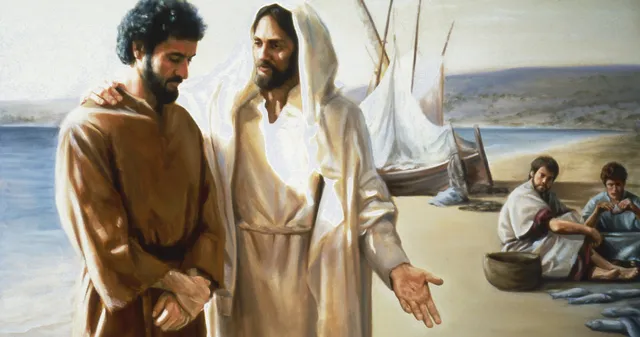
John 21 returns the reader to the Sea of Tiberias, aka the Sea of Galilee. Narratively, this is a return to where it all began. Not only did Jesus begin his public ministry in Galilee, but he also called the first four disciples after a night of fishing on the Sea of Galilee. The scene intentionally echoes the earlier calling narrative familiar from Luke 5. After a night of fruitless labor, Jesus shows up and tells them to cast their nets on the other side of the boat. They haul in a catch that is nearly too large, and Jesus commissions them to discipleship and mission. Many interpret this scene as a regression for the disciples, a return to the life and vocation before Christ. However, in light of this parallel, this scene should be understood not as a regression, but as narrative symmetry. John intentionally returns his readers to the beginning to show that the resurrection does not erase vocation — it redefines it. Vocation that is engaged apart from radical dependence on the risen Christ is utterly futile, but when vocation is entered into from a position of dependence and obedience to the risen Christ, then it is abundantly fruitful. When we submit our vocation to the mission of Jesus, then we will reap abundant fruit and reward. Even so, the real center of John 21 is not fish, it is Peter.

Of course, all four Gospels record Peter’s three denials of Jesus on the night of Jesus’s arrest, but John is the only one who records Peter’s restoration. (Luke hints at the idea when Jesus tells him that after returning, he will encourage his brothers.) John deliberately connects the scene in John 21 back to the denial scene by noting that Jesus prepared a “charcoal fire” and the threefold repetition of the question “Peter, do you love me?” matching Peter’s three denials. Some tend to make a big deal out of the various words that are used for love in Peter’s answers, but this is overplayed. Not only were the words basically synonymous in the first century, but the idea that Peter’s love did not rise to some divine standard is wholly alien to the logic of the text. This is a threefold public restoration that corresponds to Peter’s threefold public failure. Moreover, it reveals the pastoral tenderness of Jesus. Jesus does not scold Peter; he does not call him out over his failures. He doesn’t berate or condemn him. He graciously restores Peter to ecclesial service. “Feed my lambs. Shepherd my sheep. Feed my sheep.” This commission is not merely personal therapy for Peter; it is an ecclesial necessity. John cannot end his Gospel with Peter in unresolved failure. The shepherd of the disciple group must be restored if the flock is to endure. But Peter is not the only disciple in view here either.

After his restoration, Peter noticed the disciple whom Jesus loved and he asks Jesus, “Lord, what about him?”, and Jesus responds, “What is that to you? As for you, follow me.” (21.20-22) Jesus’s point is that he has different callings for each of his followers, and that following Christ is more important than comparing callings. Peter’s calling was to shepherding and martyrdom; the beloved disciple’s calling was to abiding ministry and public/written testimony. As he writes in 21.24, “This is the disciple who testifies to these things and who wrote them down. We know that his testimony is true.” Not only is this important for establishing the credibility and reliability of John’s Gospel, but it is also a fundamental component of John’s understanding of what it means to be a disciple of Jesus. To put it another way, John 21 grounds the authority of the Gospel in eyewitness testimony while clarifying that discipleship does not look identical for all. We all serve the risen Christ, but we all serve him in different and varied ways. These verses are not just random narrative details added on to the end of the story; they are essential for completing John’s theology of discipleship.

In other words, for John, discipleship is a life that is characterized by following Jesus, loving Jesus, abiding in Jesus, and witnessing to the truth about Jesus. When we confess Christ (chapter 20), he commissions us to a life of embodied mission (chapter 21). If we truly believe that Jesus is the risen Christ (and he is), then we will follow him in whatever calling he has placed on our lives. Put differently, discipleship is the vocation of following Jesus. The risen Christ is not merely to be believed in — he is to be followed. If we say we love Christ, we will commit ourselves to and give ourselves for the care of his people. Moreover, John hints at the fact that discipleship can involve suffering. In 21.18, Jesus tells Peter, “when you grow old, you will stretch out your hands and someone else will tie you and carry you where you don’t want to go.”, and John explains that “He said this to indicate by what kind of death Peter would glorify God.” (21.19) This is part of the vocation of discipleship, too. We must be willing to follow Jesus wherever he leads; this is the kind of discipleship that Jesus is calling us all too.

However, returning to my thesis, without John 21, Peter’s denial remains unresolved, the beloved disciple’s authority is unexplained, and the future of the community of Jesus followers is unclear. In terms of John’s narrative, John ends his gospel not with spectacle but with discipleship as vocation. Chapter 20 concludes the revelation of Jesus’s identity, and chapter 21 concludes the formation of Jesus’s community. Or to put it another way, John 20 answers the question “Who is Jesus?”, and John 21 answers the question “What now?” Without this pastoral and ecclesial resolution, John’s Gospel would be incomplete. John does not end his Gospel in private mystical belief. He ends it with shepherding, witness, martyrdom, and mission. And he leaves the end of the story open when he writes, “And there are also many other things that Jesus did, which, if every one of them were written down, I suppose not even the world itself could contain the books that would be written.” In other words, the story is ongoing, and all the things that the risen Jesus will do have not yet been completed even two thousand years later. John 21 is not a loose epilogue. It brings the Gospel to its proper end — not merely with a confession of Christ, but with the commissioning of those who will testify to him. The risen Lord restores the fallen, distinguishes callings, anchors testimony, and sends his followers into a future shaped by love and sacrifice. That is not an afterthought. That is narrative completion. And it poses the question to the reader, “Will you follow Jesus?”


On the (Un)Importance of the Gospel of Thomas

In my last post, I argued that the apocryphal Gospel of Thomas has little to no value when it comes to the study of the historical Jesus. However, ever since the Jesus Seminar published their book, The Five Gospels, it has become somewhat common among Jesus scholars to include Thomas as another source for Jesus studies. The Gospel of Thomas is a collection of 114 logia, or sayings, that are attributed to Jesus, most of which are enigmatic and/or aphoristic in style. For example, saying 7 reads, “Blessed is the lion which becomes man when consumed by man; and cursed is the man whom the lion consumes, and the lion becomes man.” Thomas was discovered in 1945 at Nag Hammadi among some 52 other documents, most of which are from the 4th century CE. While Thomas contains intriguing sayings, its late date, its wholesale dependence on the Synoptic tradition, and its Gnostic coloring render it of very little importance for reconstructing the historical Jesus. Its primary value lies in understanding early Christian Gnostic interpretation and theological creativity, not the life and teaching of Jesus of Nazareth.

As noted above, the Gospel of Thomas, sometimes referred to as the Secret Gospel of Thomas, contains some 114 independent sayings attributed to Jesus without any kind of narrative structure or frame. Although the complete text found at Nag Hammadi in 1945 is in Coptic and dates to the 4th century CE, it also exists in three Greek fragments previously found at Oxyrhynchus around the turn of the twentieth century that date to the mid-second century CE. Some scholars argue that the oral traditions behind these Greek texts may be earlier, but this is speculation that is not supported by any physical textual evidence. The biggest difference between Thomas and the canonical Gospels is that it is completely lacking in narrative details; it contains no geographic markers, no passion narrative, and no account of the resurrection. More often than not, it simply reworks material from the Synoptic tradition. In spite of these differences, its non-narrative, aphoristic style is perhaps part of its appeal, but it is also the reason for its interpretive challenges.

This is perhaps why many, both scholars and popular readers alike, find Thomas so intriguing. It is cryptic, wisdom-oriented, less overtly theological, and resembles Synoptic style. For many, especially those who are skeptical of the canonical accounts of Jesus, Thomas reflects a non-apocalyptic, secretive, purely ethical Jesus, which is more in keeping with modern sensibilities. For example, saying 98 reads, “The kingdom of the father is like a certain man who wanted to kill a powerful man. In his own house he drew his sword and stuck it into the wall in order to find out whether his hand could carry through. Then he slew the powerful man.” Or again, saying 77 reads, “It is I who am the light which is above them all. It is I who am the all. From me did the all come forth, and unto me did the all extend. Split a piece of wood, and I am there. Lift up the stone, and you will find me there.” According to the scholars of the Jesus Seminar, these sayings represent independent (read secret) traditions not found in the canonical Gospels. However, these claims often overlook Thomas‘s dependence on earlier Synoptic material and its interpretive framing.

Estimates vary, but roughly half of Thomas‘s 114 sayings have parallel, often more primitive, versions in the Synoptics. For example, saying 54 reads, “Blessed are the poor, for yours is the kingdom of heaven.” This is clearly a restatement of the beatitude found in Matthew 5.3 and its parallel in Luke 6.20. Saying 55 reads, “Whoever does not hate his father and his mother cannot become a disciple to me. And whoever does not hate his brothers and sisters and take up his cross in my way will not be worthy of me.” This is taken from Matthew 10.37-38 and its parallel in Luke14.26-27. Saying 65 is simply a retelling of the parable of the vineyard owner found in Matthew 21, Mark 12, and Luke 20; saying 57 is simply a retelling of the parable of the wheat and tares found in Matthew 13. Other examples could be cited, but the point is clear, namely that the author(s) of Thomas have simply reworked Synoptic material, typically drawn from the Sermon on the Mount or the Kingdom sayings/parables of Jesus. Moreover, the ordering and grouping of these sayings typically mimics that which is found in Matthew, Mark, and Luke. This evidence clearly demonstrates the secondary literary dependence of Thomas and mitigates against arguments that it preserves independent oral traditions. To put it another way, if Thomas is so clearly dependent, then it cannot be used as an independent historical source in the study of the historical Jesus.

Beyond its late date and its dependence on the Synoptic traditions, another reason Thomas holds no value for the study of Jesus is its clear Gnostic leanings. Gnosticism is a second century syncretistic heresy that combined elements of Christianity with Jewish mysticism and Greco-Roman philosophy. It is primarily characterized by its dualistic worldview, its emphasis on hidden knowledge (gnosis) and spiritual ascent, and its devaluation of material reality. The Gospel of Thomas, as well as most of the other documents found at Nag Hammadi, clearly fall into this stream of thought. For example, saying 62 reads, “It is to those who are worthy of my mysteries that I tell my mysteries.” Saying 24 reads, “There is light within a man of light, and he lights up the whole world. If he does not shine, he is darkness.” Or again, saying 108 reads, “He who will drink from my mouth will become like me. I myself shall become he, and the things that are hidden will be revealed to him.” Clearly, sayings from the canonical Gospels have been filtered through Thomas’s Gnostic framework. This theological overlay makes Thomas more a reflection of early heretical Christian thoughts than of Jesus’ own teaching. While Gnostic themes are historically interesting for understanding the history of the early church, they further limit Thomas’s usefulness for reconstructing the historical Jesus.

Methodologically speaking, for a source to contribute meaningfully to historical reconstruction, it must be anchored in some kind of narrative frame, some cultural or geographic context, some chronological markers by which its historical veracity can be evaluated. The Gospel of Thomas is clearly lacking in this regard. It does not contain any of the details of Jesus’s life, his public ministry in Galilee, his conflicts with the Jewish authorities, or his passion, death, and resurrection. Without any anchoring in actual historical events like these, a collection of sayings cannot be attributed to Jesus with any real confidence. Therefore, using Thomas as a primary source in the study of the historical Jesus risks reconstructing him as an abstract, decontextualized, disconnected figure. Or to put it another way, a Jesus disconnected from historical realities can become anything and everything, except who he truly was. The Gospel of Thomas is simply too late, too dependent, and too Gnostic to be of any value in the study of the historical Jesus. Of course, this does not mean that Thomas has no value at all. After all, the Gospel of Thomas gives us an open window into early Christian theological creativity within heretical movements. It highlights the role of wisdom and of spiritual and mystical orientations in the beliefs of the early church. And it gives us insight into how the teachings of the historical Jesus were received and interpreted by one particularly Gnostic tradition. However, whereas canonical sources like the Synoptics and Paul ground their theological reflections in the reality of historical events, Thomas abstracts wisdom and secret knowledge from reality. In this regard, then, Thomas illuminates early Christian imagination and hermeneutics rather than the life of Jesus of Nazareth.

In light of the above evidence, I can only conclude that because Thomas is derivative and shaped by Gnostic and Synoptic traditions, it cannot be used as an independent source to reconstruct the historical Jesus. Sound theological reflection must be grounded in the historical realities of the person and work of Jesus. Or to put it another way, history grounds theology, and theology interprets history. The two must remain interconnected in the theological task. To neglect one or the other would necessarily lead us into either hardened skepticism or wild theological speculation. While Thomas is a great source for understanding early Christian diversity, it simply should not be conflated with the life of Jesus of Nazareth. Thomas may open a window onto early Christian imagination, but the historical Jesus stands firmly in the Synoptic Gospels and the apostolic testimony of the New Testament.


On the Jesus of History and the Christ of Faith

One of my favorite topics in the study of the New Testament is the historical Jesus; it is an area of study that attempts to understand Jesus as he was within the context of first century Judaism. However, many who study the historical Jesus argue that the Jesus of history (the first century Jewish teacher) is not the Christ of faith (the exalted Lord proclaimed by the church). In other words, the early church’s understanding of Jesus has been embellished and augmented by influences that go well beyond who Jesus actually was and what he taught. This presupposition is one of the the primary factors that originally inspired the now century old quest(s) for the historical Jesus. Of course, we must affirm that historical investigation is indispensable for understanding the person and work of Jesus, but the hard distinction between the Jesus of history and the Christ of faith collapses under the weight of the earliest evidence. The church’s confession of Christ emerges not as a departure from Jesus, but as the historically grounded interpretation of his life, death, and resurrection. In the space that follows, I would like to defend this thesis by examining why history matters, where the split came from, and why the evidence actually favors continuity and not discontinuity.

It would seem to be readily evident that the historical study of the New Testament is essential for understanding the Christian faith. This is because Christianity makes several direct and specific claims about real events that took place in historical space and time. So understanding these events and their historical and theological significance is a matter of first importance when it comes to understanding our faith. As a case in point, when the eternal Son came incarnate in the person of Jesus Christ, he stepped into a particular place at a particular time, the fullness of time according to Galatians 4.4. In other words, the doctrine of the incarnation requires some historical understanding of the place and time when Jesus was born. In fact, the Gospels themselves are anchored in the geography, personalities, and events of the first century Palestine. The point is that if Jesus is severed from the places and times in which he lived, then we run the risk of distorting the significance of his life and teaching. More than this, we run the risk of reshaping Jesus into a man of our making, as a some kind of modern therapist or social reform mascot. The bottom line is that the hard work of history disciplines our theology and grounds it in the life of our savior as he lived it. Or to put it more simply, to confess that the Word became flesh is to confess that history matters.

The point of this is to say that historical inquiry is not the enemy of faith. The problem comes when we presume to dictate what history is allowed to contain. During the Enlightenment of the 18th Century, philosophers and historians began to doubt the details of the New Testament’s depictions of Jesus. Because of their presuppositions about the supremacy of human reason in the pursuit of truth, they were highly skeptical of the Gospels’ accounts of Jesus’s miracles, particularly his resurrection. Their skepticism resulted in an approach to history that might be called methodological naturalism, or the idea that anything that even remotely smells like it might be supernatural must be ruled out as a theological fabrication. Ultimately, their dismissal of the miracles of Jesus, particularly his resurrection, led them to conclude that the church’s high Christology, or its understanding of Jesus as the divine Lord of heaven, must be a late addition to the New Testament that has nothing to do with who Jesus was and what he did and taught during his lifetime, a conclusion which had more to do with their own presuppositions than with any actual analysis of the evidence. The real question, however, is not whether the theology of the early church developed over time (it clearly did), but the question is whether that development moved away from Jesus or unfolded from within the impact of his life and resurrection. An examination of the earliest documents clearly demonstrates that this is in fact what happened.

Now, the earliest Christian documents are the 13 letters of Paul, which were likely written between the years 49 CE and 68 CE. (The earliest of these is most likely 1 Thessalonians, and the latest is 2 Timothy.) Important for this post is the fact that several of these letters include embedded hymns and creedal material that clearly exalt Jesus as the divine Lord. For example, in Philippians 2.6, he “existed in the form of God,” and in Colossians 1.15, “He is the image of the invisible God.” In 1 Corinthians 8.6, the Apostle writes, “for us there is one God, the Father. All things are from him, and we exist for him. And there is one Lord, Jesus Christ. All things are through him, and we exist through him.” This is clearly a reworking of the Shema (Deut 6.4) which equates Jesus with the God of Israel. Even outside of Paul, in Hebrews 1.3, Jesus is “the radiance of God’s glory and the exact expression of his nature, sustaining all things by his powerful word.” And in James 5.9 (possibly the earliest document in the New Testament), he is “the judge [who] stands at the door!” The point of all this is to show that the church’s so called “high Christology” developed very early in the life of the church, and that within the context of strict Jewish monotheism. And so the question must be asked, “How did first century Jews come to worship Jesus as God so quickly?” The only possible answer is that the seeds of this belief were already present in the life and ministry of Jesus.

Of course, Jesus never articulated his identity in the language of the Nicaean Creed, but he clearly acted with divine authority. When the Pharisees ask, “Who can forgive sins but God alone?” Jesus says to the paralytic, “Son, your sins are forgiven. Get up, take your mat, and go home.” (Mark 2.1-12) When his disciples were rebuked for picking heads of grain on the sabbath, he responded, “For the Son of Man is Lord of the Sabbath.” (Matthew 12.1-8) He calmed the storms, he healed the sick, he cast out demons, he raised the dead. He equated his body with the temple, and he proclaimed a Kingdom of God that centered on his own person and work. And when the High Priest asked him if he was indeed the Christ, he responded, ““I am, and you will see the Son of Man seated at the right hand of Power and coming with the clouds of heaven,” to which the High Priest responded by accusing him of blasphemy. (Mark 14.61-64) As a side note, the title Son of Man is most likely taken from Daniel 7, where Daniel sees “one like a son of Man” approaching the Ancient of Days to be vindicated and enthroned as king. The identity of this “one like a Son of Man” is debated, but it is highly likely that Daniel understood him as (quasi) divine figure. The point is that Jesus made several extraordinarily “high” claims about himself, claims that clearly threatened the Jerusalem religious establishment and eventually got him killed.

Moreover, the church did not invent these categories out of thin air; rather, it interpreted the shock of Jesus’ life and resurrection within the context and storyline of Israel’s Scriptures. And for them, the resurrection was the decisive interpretive key. The historical plausibility of the resurrection is practically certain given the cumulative effect of the evidence. The earliest confessions assume the truth of the resurrection (1 Cor 15.3-8). The earliest disciples went from fearing for their lives in the upper room to boldly proclaiming the truth of the resurrection in the temple square. The first witnesses of the resurrection were a couple of women whose testimony would have been viewed as untrustworthy in their day. All eleven of the disciples went to their deaths preaching Christ as risen from the dead, and the apostle Paul went from hateful persecutor of Christians to the most effective preacher and missionary in the early church. In other words, the resurrection was a central component of the early church’s belief, and its exalted understanding of Jesus flows naturally from this belief. If Christ was truly raised from the dead, then he truly was who he said he was, i.e. “the Christ, the Son of the living God.” The point is that the Christ of the church’s faith is what the Jesus of history looks like after Easter. Without the resurrection, a hard divide makes sense, but with the resurrection, the continuity between the two becomes inherently plausible. Or to put it another way, the resurrection is not some theological embroidery added to the story of the historical Jesus. No, it is the primary engine of the early church’s “high” Christology.

The bottom of line is simply this, namely that the hard division between historical events and their theological significance is a false dichotomy. There simply is no such thing as uninterpreted history; all historical events are immediately interpreted. The moment something happens, it is interpreted. The question, then, is not whether theology exists, but whether it faithfully corresponds to what actually occurred. In other words, theology is not the corruption of history; it is reflection upon it. And when it comes the person and work of Jesus, the Gospel accounts are just historical testimony that has been shaped by conviction. The faith of the early church was an organic and continuous development that grew out of the life and teaching of the historical Jesus, and the earliest confessions of Christ are best understood as historically grounded worship. If we separate the Jesus of history from the Christ of faith, the our faith becomes mere myth layered on memory. Jesus came incarnate at a particular time in a concrete place, and he was resurrected and he ascended to be seated at the right hand of the Father. And this is why both the history of Jesus and the faith of the early church matter. The one worshiped in the church is not a theological invention layered upon a forgotten Galilean. He is the crucified and risen Jesus of Nazareth. There is theological development, yes. There is interpretation, certainly. But there is no canyon between the Jesus who walked the hills of Galilee and the Christ that the church confesses as Lord. There is continuity — deep, historical, and theologically unavoidable continuity between the Jesus of history and the Christ of faith.


On the Johannine Pentecost

In John 20.19-23, Jesus appears in the upper room on the eve of his resurrection, and he breathes on the disciples saying, “Receive the Holy Spirit.” This is the so-called Johannine Pentecost, and at a glance, it would seem to contradict the very clear teaching of the book of Acts that the Spirit was given on the Day of Pentecost some 50 days after Jesus’s resurrection. If the events of that first Pentecost are understood as the climactic coming of the Spirit to indwell the followers of Christ, then Jesus’ giving of the Spirit in John 20.22 would seem to indicate that John (who was present at Pentecost) was hopelessly confused about the timeline. In the space the follows, I would like to suggest that John is not confused; rather, I think that John 20 presents Jesus’ giving of the Spirit as the breath of the new creation in fulfillment of Ezekiel’s restoration promises and in turn, it grounds the church’s corporate authority to forgive in the life of the risen Christ.

Of course, scholars and pastors have tried to resolve this tension in a variety of ways throughout the history of the church, and here I will identify just four. First, some suggest that the giving of the Spirit in John 20 is a kind of proleptic gift, a partial filling, that was meant to steel the disciples until the climactic coming of the Spirit 50 days later. Others suggest that John has theologized the giving of the Spirit by temporally relocating the event to the resurrection and directly connecting it with the risen Christ in light of his own “realized eschatology”. Still others suggest that John 20 functions as a kind of apostolic commission for the disciples which establishes their role as authoritative leaders in the early church. Finally, and this is my view, but the giving of the Spirit in John 20 should be understood as the inauguration of the age of the New Covenant/New Creation. This is not in contradiction to the Book of Acts and its descriptions of the Day of Pentecost. Rather, John has compressed these events theologically by linking the resurrection of Jesus with the concept of new creation, the giving of the Spirit, and the inauguration of eschatological life. He does this by alluding to the creation account in Genesis 1-2 and the New Covenant/Resurrection account in Ezekiel 36-37.

In John 20, the scene opens “On the first day of the week” (20.1), and this temporal note is repeated in our passage in 20.19, “when it was evening on the first day of the week.” This is a clear allusion to the first day of creation in Genesis 1. In other words, with the resurrection of Jesus comes a new first day, a new creation. This allusion is further confirmed by the fact that the scene takes place in a garden (19.31), and Mary mistakes the risen Christ for the “gardener” (20. 15). This is most likely a typological allusion to Christ as the second Adam. More significantly, we are told that Jesus “breathed on them.” The Greek word here (ἐνεφύσησεν ) is a verb that only occurs here in the New Testament. In the Greek translation of the Old Testament (LXX), in Genesis 2.7, we read that “The the Lord God formed the man out of the dust from the ground and breathed the breath of life into his nostrils, and the man became a living being.” In the same way (and with same word) that God breathed life into Adam, so also the risen Christ breathes life into his disciples. This is not just incidental language; the Evangelist has utilized this rare word intentionally, because he wants to connect the resurrection of Jesus with the new creation. When Jesus breathes the Holy Spirit on the disciples, they become participants in a new humanity.

However, there is another important Old Testament allusion that stands in the background of John 20, and that is the description of the New Covenant and the story of the Dry Bones in Ezekiel 36-37. In Ezekiel 36.26-27 (also 37.14), we read,

I will give you a new heart and put a new spirit within you; I will remove your heart of stone and give you a heart of flesh. I will place my Spirit within you and cause you to follow my statutes and carefully observe my ordinances. 

And in Ezekiel 37.1-14, we read where Ezekiel is commanded to prophesy to the breath to “come from the four winds and breath (ἐμφύσησον) into these slain so that they may live.” In the same way that Ezekiel stood in the midst of the valley of dry bones and the dead came to life by the “breath/Spirit” of God, so also the risen Christ stands in the midst of his disciples who are “dead/paralyzed” in fear, and breathes into them the Spirit of life. Now, in the book of Ezekiel, these chapters drip with corporate overtones, particularly in regard to the restoration of the people of Israel. The dry bones coming to life is a symbol of national (and individual) resurrection and restoration, and the Johannine Pentecost symbolizes the eschatological restoration of the people of God, such that the 12 (or 11) disciples function as the nucleus of that people as a renewed Israel. The point is that John portrays the resurrection of Jesus as the moment when the promised Spirit of restoration becomes reality.

Now, it is important here that we stop and recall what John has already said back in John 7. 39, where we read, “Those who believed in Jesus were going to receive the Spirit, for the Spirit had not yet been given because Jesus had not yet been glorified.” This is the heart of John’s theology, namely that the glorification/exaltation of Christ comes in the crucifixion/resurrection of Jesus. We know this because, Jesus said in John 12:32, “As for me, if I am lifted up from the earth I will draw all people to myself.” He said this to indicate what kind of death he was about to die.” The verbal idea of being “lifted up” refers both to the kind of death he would die but also to the idea of exaltation. Point being that in John 20, Jesus has now been glorified and so the Spirit can now be given as a sign of eschatological life.

However, there is one more problem in this passage. In verse 23, we read where Jesus tells the disciples, “If you forgive the sins of any, they are forgiven them; if you retain the sins of any, they are retained.” Of course, this language also occurs in the Gospel of Matthew, in Matthew 16:19 in Jesus words to Peter and then again in 18:18 in the context of the Community Discourse. Clearly, this is the language of commissioning and authority, but exactly what kind of authority is in view here is debated. Some (particularly in the Roman Catholic and Eastern Orthodox traditions) understand these words to signify Apostolic/priestly authority to absolve sins. Others understand them to describe the authority of the church to announce the promise of forgiveness on the basis of the gospel. In my view, in the context of John 20, these words demonstrate that the Spirit-empowered community participates in the eschatological sorting of humanity. Forgiveness is determined by a person’s acceptance or rejection of the person and work of the Son (cf. John 3:18-21), but the church’s authority to forgive is part of its new-creation governance. In other words, just as the first humans were given dominion in the Garden of Eden (Genesis 1:28), so also the church as a new humanity is given Spirit-authorized responsibility as an agent of new-creation reconciliation. And John is clear that this authority is derivative, not autonomous; it flows from the risen Christ’s life and breath (i.e. Spirit).

In conclusion, then we must conclude that the Johannine Pentecost is not simply the relocation of the events of Acts 2; these are distinct narrative events serving distinct theological purposes. Whereas Acts emphasizes the public outpouring of the Spirit, the gift of tongues, and the church’s mission to the nations, John emphasizes the new creation, the restoration of the people of God, and ecclesial authority and identity. To put it more simply, John narrates the ontological beginning of the New Covenant age, and Luke narrates the Spirit-empowered expansion of the church’s mission. There is no contradiction; these are simply two theological angles on one redemptive reality. By tying his narrative to Genesis and Ezekiel, John gives us a theologically robust understanding of the significance of Christ’s resurrection. More importantly though, John 20.19-23 clearly demonstrates that the church exists because the risen Christ breathes his life into it. Its life is cruciform and Spirit-dependent, and its mission is one of reconciliation in the power of the new creation.


On the Red Letters and the Authentic Words of Jesus

Most English versions of the Bible print the words of Jesus in the Gospels in red letters. It is a tradition that goes back nearly a century. The first red-letter New Testament was published in 1899; the full Bible with a red-letter New Testament was printed two years later in 1901. The reason for this practice is relatively clear, namely to highlight the words of Jesus over against the surrounding narrative and commentary. As noble as this aim is, it can lead to some unhealthy conclusions and applications. Readers might be tempted to conclude that the red letters are more important, more valuable, and more primary than the rest of the New Testament. For example, some so-called “red letter Christians” pit the words of Jesus against the rest of the New Testament and purport to follow the social ethic of Jesus which is characterized by love and compassion rather than the more conservative theology and ethics of the Apostle Paul et al. However, if Jesus is fully God, and there is only one God, and if God inspired the whole Bible, then in a sense all of the words of the Bible, whether black or red, are the words of Jesus.

Of course, this does not mean that the actual content of Jesus’s teaching ministry is unimportant. When it comes to the quest of the historical Jesus, the details of what Jesus said and did are essential for understanding who Jesus was and what he came to do. This is why scholars of the historical Jesus developed criteria of authenticity to determine which sayings in the canonical gospels authentically come from Jesus and which ones do not. Criteria like multiple attestation, dissimilarity, coherence, embarrassment and others like these are used to decide the authenticity of each individual saying or pericope. However, more often than not, these criteria have been used to dismiss more sayings than they have proven. This is most evident in work of the Jesus Seminar and their book The Five Gospels: What did Jesus Really Say? The Search for the Authentic Words of Jesus. Instead of establishing the authentic words of Jesus, they dismissed some 82 % of the sayings attributed to Jesus in the canonical Gospels either as things he definitely did not say (black bead) or as things he did not say but that might be close to his ideas (grey bead). Even sayings that met the established criteria were dismissed as inauthentic. This proves that there was probably another criteria at play in their judgment, that being if a saying evinced a relatively high Christology, then it was not authentic in their view.

More to the point, in my recent book review of Jesus and His Promised Second Coming by Tucker S. Ferda (see here), I suggested that the search for the “authentic” sayings of the historical Jesus in the gospels is a fundamentally flawed endeavor from the outset. This is because the Gospel writers did not set out to record the words of Jesus verbatim (ipsissima verba). They did, however, attempt to convey the words of Jesus by way of summary, thematic arrangement, implication, and interpretation. In other words, they were conveying the essential substance of the words of Jesus as well as it theological significance (ipsissima vox or substantia verba). This is partly because the Gospels are based on traditions that were passed down orally from the time of Jesus until the time the Gospels were composed. Even if the composition of the Gospels is dated early, i.e. in the 40s or 50s CE, then we are talking about 10+ years that have passed from the time Jesus to the time when the sayings of Jesus were written down. The point is that if “authentic” is understood to mean the actual words that Jesus spoke verbatim as he spoke to them, then we are searching for something that will never be found.

On the other hand, we must affirm that the Gospel writers were not simply making things up as they went along, putting words into the mouth of Jesus that he never said or thought. This is sometimes compared to the children’s game of “telephone”, where the first child hears a sentence, and then passes it along to the next child by whispering in their ear, and on to the next and so on. More often than not, when the final child reports the sentence, the final version is a far cry from the original, and usually so horribly garbled as to be beyond recognition. This analogy is a caricature of the actual nature of oral transmission. Not only was the culture at the time of Jesus thoroughly oral, but the Jews in particular took the transmission of oral tradition highly seriously. The Old Testament scriptures commanded them to pass on their faith orally from generation to generation, and Jewish children were trained in this from an early age in the temple and synagogues. The faithful transmission of oral tradition was practically sacrosanct in Jewish culture, and given the recognized authority of Jesus as a rabbi, the gospels writers would never have thought to put their own thoughts and agendas into his mouth. The same could be said for so-called prophetic utterances given by the risen Jesus; these would never have been treated as on par with actual Jesus tradition. As Luke himself indicates in the opening of his Gospel (1:1-4), the Gospel writers were faithfully writing down that which they had also remembered and received.

Now, someone might object, “What about the doctrine of inspiration? Weren’t the Gospel writers inspired by the Holy Spirit and so kept from error?” And I would answer, “Yes! Of course they were!” (2 Tim 3:16-17). But inspiration is not dictation. The Gospel writers were not mindless automatons simply transcribing by rote. Here again, Luke’s introduction indicates that he had done his research, had talked to eyewitnesses, had done the hard work “to write carefully and in order.” In other words, inspiration does not negate the normal processes of research and writing. In inspiration, the Holy Spirit works in, with, and through the human author in such a way that their words are his words. Moreover, the method of inspiration varies according to the genre of the literature being inspired. Clearly, prophetic texts, “thus saith the Lord” were directly inspired speech, but historical narrative, epistles, et al. allow for the creative engagement of the human author with the work of the Holy Spirit. B. B. Warfield puts it this way in The Inspiration and Authority of the Bible,

The Scriptures, in other words, are conceived by the writers of the New Testament as through and through God’s book, in every part expressive of His mind, given through men after a fashion which does no violence to their nature as men, and constitutes the book also men’s book as well as God’s, in every part expressive of the mind of its human authors.

The point of all this is to say that the Gospel writers have faithfully conveyed to us the real and true words of Jesus even if they have not conveyed to us his exact words. So, we should not take individual sayings (or even whole pericopes) out of their narrative context and then dismiss them as wholly inauthentic. This is a fundamentally flawed method of historical and exegetical inquiry. Rather we should attempt to understand how the words and actions of Jesus fit within the context of first century Judaism and how they gave rise to the theology and practice of the early church. As to whether we should continue to print the words of Jesus is red letters, I am of mixed opinion. Further, I suspect that my views on the question will do nothing to unseat standard publishing practice. Nevertheless, we must understand that there is no portion of Holy Scripture that is more authoritative, more valuable, more transformative than any other. Whether we are dealing with the letters of Paul or with the words of Jesus in the Gospels, we are dealing with the Word of God, and it is He who is speaking to us when we read. And so we should ask the Lord to give us the ears to hear and the hearts to receive what the Spirit is saying to us.


On Jesus and His Promised Second Coming: A Book Review

Ferda, Tucker S. Jesus and His Promised Second Coming: Jewish Eschatology and Christian Origins. Grand Rapids: Eerdmans, 2024.

One of the convictions that has Christians now for 2000 years is the expectation that Jesus will come again at the end of history to judge the living and the dead and to establish his kingdom on earth. This “blessed hope” (Titus 2:13) has been the confession of followers of Jesus from the very beginning of Christian history, as evidenced in the Apostle’s Creed. The problem is that this belief has somewhat of an embarrassment in the study of the historical Jesus. In other words, if Jesus truly believed that he would come again in the lifetime of “this generation” (Matthew 16:28, et al.), then either he made a simple mistake in his calculations or he was horribly deluded as to his understanding of himself and his role in the final consummation of all things. Scholars have typically followed two approaches in order to alleviate this embarrassment. On the one hand, there is a widespread consensus among critical scholars that the second coming is a belief that was created by the first followers of Jesus, and it does not go back to the historical Jesus. On the other, a large number of “evangelical” scholars have reinterpreted the coming of Jesus metaphorically/symbolically as a coming in judgment and have applied it to the destruction of Jerusalem in 70 AD.

In his most recent book, Jesus and His Promised Second Coming: Jewish Eschatology and Christian Origins, Tucker S. Ferda (Errett M. Grable Associate Professor of New Testament Exegesis and Early Christianity at Pittsburgh Theological Seminary) challenges both of these approaches by arguing that the second coming hope goes back to the historical Jesus. He advances this argument in four parts. In the first section, he considers questions related to historical and interpretive method, and he critiques certain “atomistic” approaches that attempt to sift through the Gospels in order to find the authentic sayings of Jesus and then then from them try to construct the beliefs of Jesus. In Ferda’s view, this methodological approach has it completely backward. Instead, he suggests that we should start with the beliefs of the early church as they are presented in the New Testament documents and then attempt to construct a plausible scenario that how these beliefs came to be. In the second section, Ferda considers the history of scholarship on the question of the Second Coming, and he identifies certain presuppositions and biases that have contributed to the current state of affairs. Particularly, he suggests that certain elitist and antisemitic tendences among scholars have caused them to want to distance Jesus from “outlandish” apocalyptic beliefs of Second Temple Judaism. In the third section, in keeping with the method that he outlined in section one, Ferda surveys the Gospels and and writings of Paul to demonstrate the widespread and ubiquitous belief in the Second Coming that characterized the early church, and finally, in section four, he offers a historical reconstruction of the Sitz im Leben Jesu (the life and ministry context of Jesus) which he believes explains the Second Coming beliefs of the early church and how they arose from the teaching and beliefs of the historical Jesus.

In the space that remains, I would simply like to identify two strengths and two weaknesses that stand out in Ferda’s work. First, Ferda’s critique of certain “atomistic” approaches to the study of the historical Jesus is spot on. So many reconstructions of the historical Jesus have relied on application of the so-called criterion of (in)authenticity to the saying of Jesus. In this approach, scholars utilize criteria like dissimilarity, multiple attestation, embarrassment, et al., to identify which sayings of Jesus in the Gospels are authentic . However, in practice, these criteria have led to the dismissal of more sayings of Jesus than they have authenticated. Moreover, this approach simply does not appreciate the what the Gospels actually are. They are not verbatim recordings of the teaching of Jesus; the Gospel writers were not attempting to record and convey the ipsissima verba (the very words) of Jesus. Given the literary and historical nature of Gospels, it is much more likely that they convey the ipsissima vox (the very voice) or the substantia verba (the substance of the words) of Jesus. So, the search for “authentic” sayings of the historical Jesus is a fundamentally flawed endeavor to begin with; it is not possible. Ferda’s alternative approach accounts for this by treating the Gospels as theological/interpretive history, and moving backward from how the church understood and interpreted Jesus to what Jesus likely understood and believed. In other words, it attempts to explain how the beliefs and expectations of the historical Jesus fit both within the context of Second Temple Judaism and how they give rise to the beliefs and hopes of the early church.

The second strength in Ferda’s argument has to do with his thorough and nuanced handling of messianic expectations in the Second Temple period. It is widely recognized that expectations for who the Messiah would be and what he would do were quite diverse during the time of Jesus. Of course, the liberation and restoration of Israel was foundational for these hopes, but expectations for how this would be accomplished were far from uniform. However, it seems relatively clear that book of Daniel played a primary role in the formulation of these expectations, and especially so for Jesus and his understanding of himself as the Son of Man. In his analysis of these expectations, Ferda clearly demonstrates the plausibility of Jesus’ belief in his own Second Coming. Moreover, he clarifies how notions of imminence and delay fit together in these scenarios. He writes, “It is also important to note that messianic hopes, varied though they were, frequently envisioned some kind of process of inauguration, whereby the coming of a messianic figure is climactic but does not necessarily change history instantaneously.” (390) The point is that the idea of imminence need not be equated with immediacy, and it need not preclude the idea Jesus expected an interim period between his death/resurrection and his coming in glory and power. Not only is this tension between imminence and interim present in the expectations of Second Temple Judaism, it is highly likely that it was a characteristic component of the eschatological expectations of the historical Jesus.

Overall, I think Ferda has made a strong and persuasive case for the idea that the Second Coming hope goes back to Jesus himself. Of course, this does not mean that I agree with every detail of his argument, and here I will identify two that stand out. First. while he is right to reject approaches that attempt to sift the Gospels for authentic sayings of Jesus, from time to time he still dismisses sayings that he considers clearly inauthentic. For example, he writes, “The threefold passion and resurrection predictions are highly suspect as they conveniently predict what exactly took place in Jerusalem (Mark 8.31, 9.30-32, 10.32-34, and parr.).” (327) In other words, because Jesus predicts the exact events that will unfold as to his death/resurrection, these predictions cannot be authentic sayings of the historical Jesus. This is a dismissive statement that reads more like a bias than an evidence based conclusion. Moreover, he goes on to argue that it is entirely plausible that Jesus had considered the possibility of his own death and that he likely expected to die in Jerusalem. Setting aside the question of Jesus’s understanding of his resurrection, it is not clear why Jesus could expect to die but not predict that he would be killed. Moreover, as noted above, the decision on whether a saying is authentic or inauthentic is at best not helpful and at worst irrelevant.

Secondly, as I noted above, Ferda makes a convincing case that Jesus’s understanding of imminence need not entail that the kingdom would come and that the would return within his own lifetime, especially since it is clear that he expected that he would die (rise again, and ascend). It is a truism to say that the proclamation of Jesus was characterized by the notion of imminence. However, how the notion of imminence should be understood is widely debated. Even though Ferda acknowledges the presence of a delay in Jesus’s expectations, he attempts to salvage the idea of imminence by limiting it to “this generation”, meaning that Jesus expected that he would come back within the lifetimes of his audience or a timespan of approximately 40 years. This is based on statements like the one found in Matthew 16:28, which says, “Truly I tell you, there are some standing here who will not taste death until they see the Son of Man coming in his kingdom,” or Matthew 24.34, “Truly I tell you, this generation will certainly not pass away until all these things take place.” These verses, and their parallels, are widely debated. Moreover, if Ferda’s interpretation is correct, then it is not clear how this saves Jesus from error. If he believed that he would come back within 40 years, and he clearly did not, then he was still wrong about his understanding of his coming. This is a fundamental question. Ferda doesn’t acknowledge the implications of his statements in this regard, nor does he attempt to resolve this tension. (See how I have attempted to address this problem, here.)

In the final analysis, we need not be ashamed to confess that “He will come again in glory to judge the living and the dead and his kingdom will have no end.” (Nicene Creed). This is our blessed hope, and to deny this in any way is to countenance heresy. It simply will not do to explain it away as a creation of the early church, and it will not do to reinterpret it as a metaphor or symbol. Jesus is coming again, visibly, bodily, in glory and power, to establish his kingdom on earth, to vindicate his people, and to defeat sin once and for all. Tucker S. Ferda has effectively demonstrated the plausibility that the church’s belief goes back to Jesus himself. Of course, he has not answered every question, and there is still more work to be done in terms of understanding the eschatology of the historical Jesus and how it is presented in Gospels particularly but also in the rest of the New Testament. But even if every question cannot be answered or every detail explained, followers of Jesus can boldly proclaim, “Amen! Come, Lord Jesus!”


On the Wonder of the Incarnation and Whether Mary Knew

Christmas really is one of my most favorite times of the year. I love the decorations, the gifts, the parties, and the church Christmas programs, but most of all I love the music. The traditional Christmas carols, the sacred Christmas hymns, they just give me all the feels when it comes to Christmas; in the car, at home, at church, you will almost always find me listening to Christmas music during the month of December. And one of my most favorite Christmas songs is the song “Mary, Did You Know?”, and my most favorite arrangement of the song is performed by Mark Lowry with the acapella group Voctave singing backup (posted above). Mark Lowry wrote the lyrics in 1985 when he was asked to write a script for a church Christmas play, and the lyrics were put to music in 1991 by Buddy Greene. Of course, it has been recorded by many varied recording artists over the years, both secular and sacred, and it is sung and played regularly during Christmas programs in churches all across the United States and, no doubt, around the world.

However, every year it seems, I read some renewed or repeated criticism of the song on social media. Some attempt to dismiss the song theologically, citing the Annunciation and the Magnificat as evidence that “she knew”. I have even seen some who have attempted to go line by line through the song to give a yes or no answer to each rhetorical question. Similarly, those in the Roman Catholic tradition take issue with the suggestion that Mary needed to be “delivered” and “made new” because of their (erroneous) beliefs about the sinlessness of Mary. Others argue that the song is mawkish, sappy, and infantilizing, that it is “the most sexist Christmas song ever written,” or that it “treats her like a clueless child.” Still others dismiss the song simply because it is overplayed and/or poorly performed by well-meaning church members during the Christmas season as “special” music. And to be honest, when I read criticisms like these, I just shake my head and wonder how we have lost our wonder at the miracle of the incarnation.

Biblically, it is true that Luke presents Mary as a paragon of faith. When she is confronted by the angel Gabriel with the news that she will conceive by the Holy Spirit and give birth to the Son of God, she responds with simple faith, “See, I am the Lord’s servant. May it happen to me as you have said.” (Luke 1.38) And her Magnificat (Luke 1.46-55) clearly indicates that she understood that this was a pivotal moment in the unfolding of God’s plan of redemption for the world. However, we also know that at one point during his earthly ministry, she came with her other children to try to hide Jesus away because they thought he was an embarrassment to the family. (Mark 3:31-35, parallels Matthew 12.46-50, Luke 8.19-21) Time and again, the Gospels detail how the first followers of Jesus struggled to fully understanding the significance of who he was and what he had come to do, and we should assume that Mary would have been no different. We know that Mary treasured and pondered all these things in her heart, but the Bible is clear that the first followers of Jesus, including Mary and his brothers, grew in their understanding of the person and work of Jesus over the course of his life and ministry and that they did not understand him in full until after his resurrection and the coming of the Spirit.

The point is that we should not underestimate the richness of what it means for God to become flesh. When Jesus was born in the Bethlehem 2000 years ago, there was already plenty of theological and cultural expectations as to what he was supposed to be and do. But Jesus turned those expectations on their heads, and he demonstrated that he is a Messiah who cannot be fit into a preconceived box. And as his followers, we should never lose our wonder at this fact. Jesus will always be more than we could possibly hope to comprehend; we will never have him fully figured out. Even when we reach glory, we are told that “He had a name written that no one knows except himself.” (Revelation 19.12) This means that even then there will be more to learn and understand about him when he returns as glorious king. We must never lose our wonder at the person and work of Jesus. Even the things we think we know about him pale in comparison to the fullness of his glory.

And so, when we hear the song “Mary, Did You Know?” this Christmas season, we shouldn’t try to dissect it theologically. We shouldn’t dismiss it because of its musical style, its tone and perspective, or even its emotionality. We should allow it to spur our reflections, to feed our wonder, to drive us to worship the God who became flesh for our sakes, who suffered and died in our place, and who is coming again to receive us unto himself. The song is an artistic, poetic reflection on the miracle of Christmas and the sheer mystery of the incarnation. Mary was in a unique position to feel the weight and wonder of it all, and at Christmas, it is right for us to enter into her experience, to ponder anew what it must have been like, and to fall down in worship of the God who became flesh. This Christmas, let us rekindle our wonder. Let us stand in awe and silence, and let us rejoice in the fact that we have a savior who came to heal our brokenness, to free us from sin, and to restore in us the joy of living in his presence. He is Emmanuel; He is God with us!


On the Events of Holy Week

The events of Holy Week stand as the climax of the public ministry of Jesus in the Gospel accounts. All four of the Gospel writers devote almost half of their material to these events. Clearly, they intended for this story to stand at the center of our reflection on the person and work of Jesus. However, for most modern Christians, the events of Holy Week receive only a passing nod. Of course, we look forward to Easter and the cultural dressings that accompany it, and most churches emphasize the resurrection of Jesus on Easter Sunday, whether through song, sermon, or drama. But other than that, the final week of our Lord’s life mostly goes unacknowledged in the reflection and devotion of many people who call themselves His followers. As the Apostle James would say, “My brothers and sisters, these things should not be this way.” (James 3.10) The person and work of our Lord Jesus Christ should be the central focus of our reflection, not only during Holy Week, but every week of the year, because He is the never ending source of the sustaining grace that we need to live as His followers. So, in the space that follows, I would like to briefly sketch out the daily events of Holy week, so that we may grow in our understanding of what He accomplished on our behalf.

Palm Sunday
On Palm Sunday, Jesus made His triumphant entry into Jerusalem. This was His official presentation before the Jerusalem religious establishment as the long-awaited Messianic King. Matthew informs us that this event is the fulfillment of the prophecy of Zechariah 9.9 (Matthew 21.4-5), and we have this confirmed by the shouts of the Galilean pilgrims who sang “Hosanna” (Mark 11.9-10). However, as elated and joyous as the crowds were that day, we know that there is darkness on the horizon. Even as He was approaching the Holy City, He paused to weep over their lack of faith (Luke 19.41-44). It is likely that many of those who joined in the procession that day expected that this would be the day when Jesus would overthrow the Romans and establish Israel as an independent kingdom, and yet His disciples knew that He had already predicted three times that He would be crucified in Jerusalem. So, even as the disciples celebrated the arrival of Messiah, they waited with bated breath as His public ministry began to approach its primary purpose.

Monday
The last thing Jesus did on Sunday before retiring to Bethany for the night was to inspect the Temple (Mark 11.11), and in the subsequent scenes, the Gospel writers make it clear what He found there. On Monday, as they were heading back into the city, Jesus happened upon a fig tree that appeared to be fruitful, but finding it empty, He cursed it. It subsequently withered. In between these scenes, we have the familiar story of the temple cleansing. The implication is clear; the temple (and the Jerusalem religious establishment that it represents) was fruitless and empty. Though it had all the right external dressings, it was empty of any and all spiritual substance. And so, in what can only be described as a public act of prophetic judgment, Jesus clears the temple and begins to teach the people. This act was the final straw for the Jewish religious leaders, and from that point on, they began to look intently for a way to kill Him.

Tuesday, the “Day of Controversy”
On Tuesday of His passion, Jesus returned to the “scene of the crime”, so to speak, and as He was walking through the Temple, various factions representing the leadership of the Jewish religious establishment began to question him. The first question that they ask is the most telling and sets the tone for the rest of the day. “By what authority are you doing these things? Who gave you this authority to do these things?” they asked, in what was clearly an accusatory manor. It is obvious that their questions were not in earnest, and each successive interaction reveals their scheme with more clarity. But as the “Day of Controversy” unfolds, Jesus ably avoids their traps, and in the process, He exposes the true nature of their problem. Time and again, He brings the discussion back to the Scriptures, exposing the stubborn refusal of His opponents to submit to their authority. In other words, their problem is not with Him per se; rather, it is with the authority of God which He represents as Messiah. His is an authority that they all but refuse to submit to, and it is this refusal that ultimately provokes Jesus to condemn of the Temple and all that it represents in the Olivet Discourse. In this discourse, Jesus turns the attention of His disciples away from the religious, political, and nationalistic hopes of the Jewish religious establishment to a hope that culminates in His return in glory to establish the Kingdom of God once and for all.

“Silent” Wednesday
Wednesday of Holy Week is known as “Silent Wednesday”, because the Gospels are practically silent as to the activity of Jesus and the Disciples on that day. It is most likely that they spent the day in Bethany with Mary, Martha, and Lazarus enjoying the limited time that they had left to be together. It is also likely that it was on this Wednesday, as they were sharing a meal together in the home of Simon the Leper, that the woman with the alabaster jar came to anoint Jesus (Mark 14.3-10). Immediately, Judas raised the alarm that this valuable commodity had been wasted when it could have been sold and the profits given to the poor. But, when his concerns were seemingly dismissed by Jesus, it was the final straw.  Apparently, this event was the breaking point for Judas, and immediately, he went out to plot with the Jewish religious leaders to betray Jesus for 30 pieces of silver.  This is why this day is also known as “Spy” Wednesday.

Maundy Thursday (See also “On Maundy Thursday”)
On Thursday morning, Jesus instructed His disciples on where they could prepare to celebrate the Passover, and later that evening, Jesus arrived at the location where He would celebrate His Last Supper with them. The evening began with Jesus donning the apparel of a servant and washing the disciples feet. Using this action as an object lesson, Jesus went on to teach them in the Upper Room Discourse (John 13-17) about a New Commandment, “that you should love one another.” This is why we call it “Maundy” Thursday; the name comes from the Latin mandatum which means command, “a new commandment.” During the course of the evening, Jesus predicted that the disciples would betray Him (even Peter would do so three times before the rooster crowed), and Judas left to prepare for his act of betrayal. The evening concluded with the sharing of the bread and cup as symbols of His body that was about to be broken and His blood that was about to be shed for the forgiveness of sins as the inauguration of the New Covenant. After their meal, they adjourned to the Garden of Gethsemane, and while the disciples slept, Jesus prayed three times that “this cup” (by which He meant His passion) would pass from Him. Shortly thereafter, the mob arrived, Judas completed his betrayal with a kiss, and Jesus was arrested.

Good Friday
After His arrest, Jesus was carried away to the house of the High Priest where He was subjected to a sham trial in the darkness of night. The fix was in, as they say, as one by one witnesses were brought in to make false accusations against Him, and yet, throughout it all, He remained quiet. At first light, they brought Him before the Roman authorities, because the Jewish religious leaders lacked the authority to put anyone to death, and after being examined and found innocent by both Pontius Pilate and Herod Antipas, the religious leaders stirred up the crowd to call for His death. So, Pilate offered them a choice; he would release Barabbas the murderer or Jesus, the so-called King of the Jews. Again, the religious leaders stirred up the crowd, and they called for the release of Barabbas and for the crucifixion of Jesus. Pilate gave them what they asked for; he turned Jesus over to the Romans soldiers to be mocked and beaten, and then they led him away to be crucified. At the top of Golgotha, they nailed him to a cross and crucified him between two criminals. The soldiers cast lots for His clothes, and the Jewish religious leaders mocked him. At about three in the afternoon, He cried out  with a loud voice “It is finished” and yielded up His Spirit to His Father. The Roman soldiers pierced His side with a spear to confirm that He was dead. Joseph of Arimathea requested His body and buried it in his own personal tomb before the start of the Sabbath at sundown.

Holy Saturday
The Gospels are mostly silent as to the details of Holy Saturday. Of course, it was the Jewish sabbath, a day dedicated to rest and to the worship of God, but for the followers of Jesus, this day was probably not very restful, to say the least. After all, they had just watched in horror as their beloved Master was wrongfully accused, unjustly convicted, and tragically executed. Jesus was dead, and it appeared that all their hopes had died with Him. He was supposed to be the Messiah, the prophesied and anointed King who would establish the Kingdom of God on earth, and He had been murdered, seemingly defeated by the worldly powers that be. Sure, he had predicted His own death and resurrection, but it is clear that they had no understanding of what that might mean until after all these things had taken place. On this Saturday, they were most likely overcome with grief and despair, and on top of that, there was the fear that what happened to Him might yet happen to them as well. And so, it is most likely that they spent the day locked behind closed doors cowering in terror. It was a dark day indeed, and yet, we know looking back that His death would not be the final word, that light and hope were still on the horizon. But this is the nature of Christian discipleship; sometimes we must endure the depths of the darkness before we ever begin to see the light of hope. 

Resurrection Sunday
On the first day of the week, Sunday morning, at daybreak, Mary Magdalene, Mary the mother of James, and Salome went to the tomb to anoint His body for burial; there hadn’t been time to do so on Friday due to the haste of getting Him buried before the start of the Sabbath. As they made their way to the tomb, they began to wonder how they might roll the stone away. However, when they arrived, they found the stone had already been rolled away, and when they looked inside the tomb, they were met by an angelic being who informed them of what had taken place. “Don’t be alarmed,” he told them. “You are looking for Jesus of Nazareth, who was crucified. He has risen! He is not here.” (Mark 16.6) Immediately, and with the angel’s express instruction, they returned to the city to inform the disciples of what they had seen. Of course, Peter, along with John ran off to see it for themselves, and finding it as the women had said, they were amazed at what this could mean. But Mary Magdalene stayed behind at the tomb, crying and confused. A man approached her, and at first, she did not recognize Him, assuming Him to be the gardener. “Sir, if you’ve carried him away, tell me where you’ve put him, and I will take him away.” (John 20.15) But when He called her by name, she immediately understood that this man was none other than her Lord and Savior. Later that day, He appeared to all of them in the upper room, even though the door was still locked, comforted them with the peace of His presence, and commissioned them to proclaim all that they had seen and heard.

If you are like me, and you have been raised in church, this may seem like the same ole’ story that has been told and retold too many times to count, but we must remember that this is the greatest story that has ever been told. These events are the pendulum upon which the course and destiny of human history hangs. The story of Jesus, especially His death and resurrection, are the foundation of God’s redemptive work in the world, and it is the very soul of our salvation. As followers of Jesus, we must never tire of hearing it, telling it, reading it, and singing it; we must never cease to be amazed at the wondrous work of Jesus on our behalf. And so this Holy week, let us echo the words of that great hymn writer, who wrote,

Tell me the story of Jesus
Write on my heart every word
Tell me the story most precious
Sweetest that ever was heard

~Fanny Crosby, “Tell Me the Story of Jesus”

For further study, see
On the Annual Celebration of Christmas and Easter
On the Crucifixion and Why It Matters at Christmas
On the How the Death of Jesus Changed Everything
On Why Christians Still Need the Gospel
On Remembering the Gospel
On Jesus’ Understanding of His Death
On the Season of Easter

See also:
Cook, William F., III. Jesus’s Final Week: From Triumphal Entry to Empty Tomb. Nashville, TN: B&H Academic, 2022.


Slow To Write

"let every person be quick to hear, slow to speak, slow to anger."

lovegavehope

Just another WordPress.com site

Jared Cornutt

Pastor | Speaker | Writer

Denny Burk

A commentary on theology, politics, and culture

G3 Ministries

Events + Resources for the Local Church

Biblical Reasoning

Biblical and Systematic Theology According to the Scriptures

RetroChristianity

Reclaiming the Forgotten Faith

SBC Voices

Southern Baptist News & Opinion

Lucid Theology

Thoughts on words, books, theology, and life.

Baptist21

A pastor-led voice for Baptists in the 21st century

Center For Baptist Renewal

The Personal and Professional Blog of Phillip Powers

The Pastor's Well - Pastor Well

The Personal and Professional Blog of Phillip Powers

Articles - AlbertMohler.com

The Personal and Professional Blog of Phillip Powers

The Gospel Coalition

The Personal and Professional Blog of Phillip Powers