
Tag Archives: Quest of the Historical Jesus

On Theology and History in the Gospel of John

When it comes to the study of the historical Jesus, there has long been a noticeable bias against the Gospel of John. While the Synoptic Gospels (Matthew, Mark, and Luke) are generally regarded as the primary sources for reconstructing the life and ministry of Jesus, the Fourth Gospel has often been treated with considerably greater suspicion because of its overt theological concerns. The assumption seems to be that because John is more explicitly theological, he must therefore be less historically reliable. Indeed, this tendency has led some scholars to call for a so-called “Fourth Quest” for the historical Jesus that takes the historical value of John more seriously. Nevertheless, the assumption that a more theological Gospel must necessarily be a less historical Gospel deserves to be challenged. Such an assumption depends upon a questionable distinction between historical reporting and theological interpretation. The simple fact of the matter is that all historical writing involves selection, organization, and interpretation according to the understanding and purposes of its author, and the Gospels are no different. In the Gospels, theology frequently consists of history interpreted in light of its ultimate significance, but interpreted history is still history. In this post, therefore, I will argue that John’s theological presentation of Jesus does not undermine the historical character of his Gospel; rather, John’s theology represents his interpretation of historical events whose significance he seeks to explain. But before making that case, we must first consider why theological interpretation should be regarded as historical distortion in the first place.

Let me be clear from the outset: there simply is no such thing as completely “neutral” history. No historian simply reproduces the past in a purely objective or uninterpreted manner. Every writer of history selects events, arranges material, emphasizes particular details, interprets their significance, and writes for particular purposes, and the author of the Fourth Gospel is no different. In John 20:30–31, he writes, “Jesus performed many other signs in the presence of his disciples that are not written in this book. But these are written so that you may believe that Jesus is the Messiah, the Son of God, and that by believing you may have life in his name.” John openly acknowledges that Jesus performed many other signs, but that he has deliberately selected certain signs in order to demonstrate that Jesus is the Messiah, the Son of God. (On Messianic Sonship in the Fourth Gospel, see my post here.) In other words, John tells his readers both what happened and why he has chosen to record it. His theological purpose could hardly be more explicit, but theological selection does not equal historical fabrication. Indeed, John presents the events he selects as signs actually performed by Jesus “in the presence of his disciples.” The events are historical; their selection and presentation are theological. Or, to put it somewhat differently, selectivity is not the enemy of historicity; it is an unavoidable feature of historical writing.

More importantly, John’s theology is grounded in historical claims. Throughout his narrative, Jesus attends identifiable Jewish festivals, travels between Galilee and Jerusalem, visits particular locations, and interacts with identifiable people. In other words, John presents the life and ministry of Jesus as events occurring within the concrete realities of first-century history. This historical grounding is essential because, as John declares at the beginning of his Gospel, “the Word became flesh and dwelt among us” (John 1:14). The eternal Logos entered into human history, meaning that John’s theology is fundamentally incarnational. It reflects the historical reality of the Word made flesh and therefore cannot be reduced to a collection of timeless spiritual ideals. Indeed, John explicitly grounds his narrative in eyewitness testimony: “He who saw this has testified so that you also may believe. His testimony is true, and he knows he is telling the truth” (John 19:35; cf. 21:24). John thus presents his theology as arising from testimony concerning things that actually happened. The point of all this is that John’s theological claims depend upon his historical claims; the two cannot simply be separated. If the Word did not actually become flesh, if Jesus did not die upon the cross, and if he did not rise again, then John’s entire theology collapses. Far from diminishing the importance of history, therefore, John’s theology depends upon it.

What I am suggesting, then, is that theological interpretation does not necessarily mean historical invention. Of course, John interprets the actions and words of Jesus, but interpretation is inherent to historical writing. He does not merely give us a transcript of Jesus’s life; rather, he seeks to explain what Jesus’s actions mean. For example, when Jesus feeds the five thousand, John presents him as the Bread of Life. When Jesus heals the blind man, he reveals himself as the Light of the World. When he raises Lazarus from the dead, Jesus declares that he is the Resurrection and the Life. When Jesus washes the disciples’ feet, the event reveals the nature of Christlike service and love. Even the crucifixion is paradoxically presented as the glorification and exaltation of the Son. In each of these instances, John takes events from the life and ministry of Jesus and unfolds their deeper theological significance. John does not merely ask, “What happened?” He also asks, “What did what happened mean?” The simple fact of the matter is that two people can describe the same historical event, with one explaining its significance much more deeply than the other, without the more interpretive account thereby becoming historically false. Interpretation and invention are simply not the same thing. John’s theological interpretation of the life of Jesus therefore need not be understood as the creation of a theological Jesus; rather, it represents his attempt to explain the true significance of the historical Jesus whom he presents to his readers.

In fact, John explicitly tells us that the disciples did not fully understand the actions and words of Jesus until after his resurrection and glorification. Reflecting upon Jesus’s entry into Jerusalem, John writes, “His disciples did not understand these things at first. However, when Jesus was glorified, then they remembered that these things had been written about him and that they had done these things to him” (John 12:16; cf. 2:22). Notice the progression. The disciples first experienced the historical events, later remembered what they had seen and heard, and then came to understand their deeper significance in light of Jesus’s resurrection and glorification. Moreover, Jesus himself promises that the Holy Spirit “will teach you all things and remind you of everything I have told you” (John 14:26). Thus, the resurrection and the coming of the Spirit did not require the disciples to invent a different Jesus; rather, they enabled them to understand more fully the Jesus they had already known. John’s Gospel therefore reflects both eyewitness memory and mature theological reflection upon that memory. His theological interpretation is retrospective, but retrospective interpretation need not entail historical fabrication. John’s mature Christology represents his retrospective understanding of Jesus, not necessarily a retrospective creation of Jesus. Indeed, by John’s own account, history came first and theological understanding followed as the disciples reflected upon what they had witnessed in light of the resurrection.

Of course, part of the confusion stems from the fact that the Fourth Gospel is noticeably different from the Synoptics (Matthew, Mark, and Luke). The Synoptics primarily focus on Jesus’s Galilean ministry, his parables, his proclamation of the kingdom of God, and his shorter sayings, while John gives considerably more attention to his ministry in Judea and Jerusalem, his identity and relationship with the Father, extended discourses, and signs. However, in my view, these differences are sometimes overplayed. There are significant points of continuity between the four Gospels, including but not limited to the ministry of John the Baptist, the calling of the disciples, the feeding of the five thousand, Jesus’s conflict with the religious authorities, his entry into Jerusalem, and the basic contours of the passion and resurrection narratives. Even where their emphases differ, they remain centered upon the same fundamental story of Jesus’s ministry, death, and resurrection. Moreover, we should hardly expect four different authors, writing for different audiences and emphasizing different theological concerns, to tell that story in precisely the same way. Difference in selection and emphasis does not necessarily amount to contradiction, any more than theological distinctiveness necessarily amounts to historical unreliability. John is not telling a different story; he is telling the same story from a distinct theological perspective. The Synoptics and John need not be flattened into identical accounts in order to be historically complementary.

In the final analysis, then, the relative marginalization of the Gospel of John in the study of the historical Jesus is unwarranted. John is both historical and theological. More to the point, John is theological because he believes that certain things actually happened. The Word became flesh. Jesus performed signs. Jesus died upon the cross. The tomb was empty. Jesus appeared alive. The disciples witnessed these events, and John’s theology represents his explanation of their significance. Of course, John writes with an explicitly theological purpose, namely that his readers “may believe that Jesus is the Messiah, the Son of God, and that by believing [they] may have life in his name” (John 20:31). John does not conceal his purpose; he wants his readers to believe. But the faith he seeks to produce rests upon eyewitness testimony concerning the actions and teachings of Jesus. His theology therefore does not replace history but interprets it. The question is not whether John gives us history or theology. He gives us theological history: testimony concerning real events interpreted in light of the identity of the One who stood at their center. John’s theology does not require us to abandon the Jesus of history; it invites us to recognize who the Jesus of history truly was.

For further study, see also
On the Jesus of History and the Christ of Faith
On the Johannine Pentecost
On the Narrative Logic of John 21

On the Jesus of History and the Christ of Faith

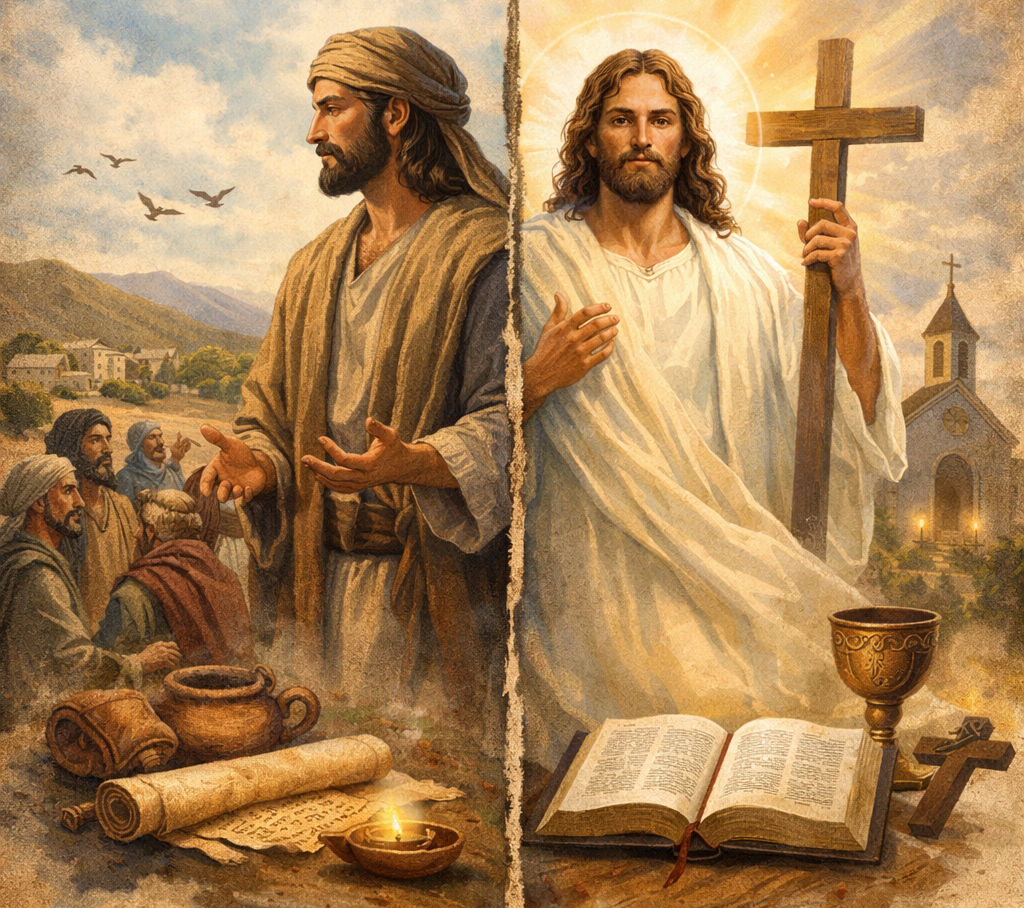
One of my favorite topics in the study of the New Testament is the historical Jesus; it is an area of study that attempts to understand Jesus as he was within the context of first century Judaism. However, many who study the historical Jesus argue that the Jesus of history (the first century Jewish teacher) is not the Christ of faith (the exalted Lord proclaimed by the church). In other words, the early church’s understanding of Jesus has been embellished and augmented by influences that go well beyond who Jesus actually was and what he taught. This presupposition is one of the the primary factors that originally inspired the now century old quest(s) for the historical Jesus. Of course, we must affirm that historical investigation is indispensable for understanding the person and work of Jesus, but the hard distinction between the Jesus of history and the Christ of faith collapses under the weight of the earliest evidence. The church’s confession of Christ emerges not as a departure from Jesus, but as the historically grounded interpretation of his life, death, and resurrection. In the space that follows, I would like to defend this thesis by examining why history matters, where the split came from, and why the evidence actually favors continuity and not discontinuity.

It would seem to be readily evident that the historical study of the New Testament is essential for understanding the Christian faith. This is because Christianity makes several direct and specific claims about real events that took place in historical space and time. So understanding these events and their historical and theological significance is a matter of first importance when it comes to understanding our faith. As a case in point, when the eternal Son came incarnate in the person of Jesus Christ, he stepped into a particular place at a particular time, the fullness of time according to Galatians 4.4. In other words, the doctrine of the incarnation requires some historical understanding of the place and time when Jesus was born. In fact, the Gospels themselves are anchored in the geography, personalities, and events of the first century Palestine. The point is that if Jesus is severed from the places and times in which he lived, then we run the risk of distorting the significance of his life and teaching. More than this, we run the risk of reshaping Jesus into a man of our making, as a some kind of modern therapist or social reform mascot. The bottom line is that the hard work of history disciplines our theology and grounds it in the life of our savior as he lived it. Or to put it more simply, to confess that the Word became flesh is to confess that history matters.

The point of this is to say that historical inquiry is not the enemy of faith. The problem comes when we presume to dictate what history is allowed to contain. During the Enlightenment of the 18th Century, philosophers and historians began to doubt the details of the New Testament’s depictions of Jesus. Because of their presuppositions about the supremacy of human reason in the pursuit of truth, they were highly skeptical of the Gospels’ accounts of Jesus’s miracles, particularly his resurrection. Their skepticism resulted in an approach to history that might be called methodological naturalism, or the idea that anything that even remotely smells like it might be supernatural must be ruled out as a theological fabrication. Ultimately, their dismissal of the miracles of Jesus, particularly his resurrection, led them to conclude that the church’s high Christology, or its understanding of Jesus as the divine Lord of heaven, must be a late addition to the New Testament that has nothing to do with who Jesus was and what he did and taught during his lifetime, a conclusion which had more to do with their own presuppositions than with any actual analysis of the evidence. The real question, however, is not whether the theology of the early church developed over time (it clearly did), but the question is whether that development moved away from Jesus or unfolded from within the impact of his life and resurrection. An examination of the earliest documents clearly demonstrates that this is in fact what happened.

Now, the earliest Christian documents are the 13 letters of Paul, which were likely written between the years 49 CE and 68 CE. (The earliest of these is most likely 1 Thessalonians, and the latest is 2 Timothy.) Important for this post is the fact that several of these letters include embedded hymns and creedal material that clearly exalt Jesus as the divine Lord. For example, in Philippians 2.6, he “existed in the form of God,” and in Colossians 1.15, “He is the image of the invisible God.” In 1 Corinthians 8.6, the Apostle writes, “for us there is one God, the Father. All things are from him, and we exist for him. And there is one Lord, Jesus Christ. All things are through him, and we exist through him.” This is clearly a reworking of the Shema (Deut 6.4) which equates Jesus with the God of Israel. Even outside of Paul, in Hebrews 1.3, Jesus is “the radiance of God’s glory and the exact expression of his nature, sustaining all things by his powerful word.” And in James 5.9 (possibly the earliest document in the New Testament), he is “the judge [who] stands at the door!” The point of all this is to show that the church’s so called “high Christology” developed very early in the life of the church, and that within the context of strict Jewish monotheism. And so the question must be asked, “How did first century Jews come to worship Jesus as God so quickly?” The only possible answer is that the seeds of this belief were already present in the life and ministry of Jesus.

Of course, Jesus never articulated his identity in the language of the Nicaean Creed, but he clearly acted with divine authority. When the Pharisees ask, “Who can forgive sins but God alone?” Jesus says to the paralytic, “Son, your sins are forgiven. Get up, take your mat, and go home.” (Mark 2.1-12) When his disciples were rebuked for picking heads of grain on the sabbath, he responded, “For the Son of Man is Lord of the Sabbath.” (Matthew 12.1-8) He calmed the storms, he healed the sick, he cast out demons, he raised the dead. He equated his body with the temple, and he proclaimed a Kingdom of God that centered on his own person and work. And when the High Priest asked him if he was indeed the Christ, he responded, ““I am, and you will see the Son of Man seated at the right hand of Power and coming with the clouds of heaven,” to which the High Priest responded by accusing him of blasphemy. (Mark 14.61-64) As a side note, the title Son of Man is most likely taken from Daniel 7, where Daniel sees “one like a son of Man” approaching the Ancient of Days to be vindicated and enthroned as king. The identity of this “one like a Son of Man” is debated, but it is highly likely that Daniel understood him as (quasi) divine figure. The point is that Jesus made several extraordinarily “high” claims about himself, claims that clearly threatened the Jerusalem religious establishment and eventually got him killed.

Moreover, the church did not invent these categories out of thin air; rather, it interpreted the shock of Jesus’ life and resurrection within the context and storyline of Israel’s Scriptures. And for them, the resurrection was the decisive interpretive key. The historical plausibility of the resurrection is practically certain given the cumulative effect of the evidence. The earliest confessions assume the truth of the resurrection (1 Cor 15.3-8). The earliest disciples went from fearing for their lives in the upper room to boldly proclaiming the truth of the resurrection in the temple square. The first witnesses of the resurrection were a couple of women whose testimony would have been viewed as untrustworthy in their day. All eleven of the disciples went to their deaths preaching Christ as risen from the dead, and the apostle Paul went from hateful persecutor of Christians to the most effective preacher and missionary in the early church. In other words, the resurrection was a central component of the early church’s belief, and its exalted understanding of Jesus flows naturally from this belief. If Christ was truly raised from the dead, then he truly was who he said he was, i.e. “the Christ, the Son of the living God.” The point is that the Christ of the church’s faith is what the Jesus of history looks like after Easter. Without the resurrection, a hard divide makes sense, but with the resurrection, the continuity between the two becomes inherently plausible. Or to put it another way, the resurrection is not some theological embroidery added to the story of the historical Jesus. No, it is the primary engine of the early church’s “high” Christology.

The bottom of line is simply this, namely that the hard division between historical events and their theological significance is a false dichotomy. There simply is no such thing as uninterpreted history; all historical events are immediately interpreted. The moment something happens, it is interpreted. The question, then, is not whether theology exists, but whether it faithfully corresponds to what actually occurred. In other words, theology is not the corruption of history; it is reflection upon it. And when it comes the person and work of Jesus, the Gospel accounts are just historical testimony that has been shaped by conviction. The faith of the early church was an organic and continuous development that grew out of the life and teaching of the historical Jesus, and the earliest confessions of Christ are best understood as historically grounded worship. If we separate the Jesus of history from the Christ of faith, the our faith becomes mere myth layered on memory. Jesus came incarnate at a particular time in a concrete place, and he was resurrected and he ascended to be seated at the right hand of the Father. And this is why both the history of Jesus and the faith of the early church matter. The one worshiped in the church is not a theological invention layered upon a forgotten Galilean. He is the crucified and risen Jesus of Nazareth. There is theological development, yes. There is interpretation, certainly. But there is no canyon between the Jesus who walked the hills of Galilee and the Christ that the church confesses as Lord. There is continuity — deep, historical, and theologically unavoidable continuity between the Jesus of history and the Christ of faith.


Slow To Write

"let every person be quick to hear, slow to speak, slow to anger."

lovegavehope

Just another WordPress.com site

Jared Cornutt

Pastor | Speaker | Writer

Denny Burk

A commentary on theology, politics, and culture

G3 Ministries

Events + Resources for the Local Church

Biblical Reasoning

Biblical and Systematic Theology According to the Scriptures

RetroChristianity

Reclaiming the Forgotten Faith

SBC Voices

Southern Baptist News & Opinion

Lucid Theology

Thoughts on words, books, theology, and life.

Baptist21

A pastor-led voice for Baptists in the 21st century

Center For Baptist Renewal

The Personal and Professional Blog of Phillip Powers

The Pastor's Well - Pastor Well

The Personal and Professional Blog of Phillip Powers

Articles - AlbertMohler.com

The Personal and Professional Blog of Phillip Powers

The Gospel Coalition

The Personal and Professional Blog of Phillip Powers