
Tag Archives: Hebrews

On Eschatology in the Book of Hebrews

One of the major themes of the Letter to the Hebrews is the theme of perseverance. But perseverance unto what? What is the destination toward which we are heading? Hebrews paints an extraordinarily “heavenly” picture. We share in a heavenly calling (3.1), we have tasted the heavenly gift (6.4), we desire a heavenly country (11.16), and we have come to the heavenly Jerusalem (12.22). All of this can create the impression that Hebrews replaces earthly and creational hope with an essentially spiritual, heavenly destiny. On the other hand, the strong fulfillment language found throughout the book can be pushed toward the opposite mistake, namely treating the eschatological horizon of Hebrews as if it were essentially exhausted by Christ’s first coming and other first-century events. But, in my opinion, neither of these extremes adequately captures the eschatological vision of the Book of Hebrews. Rather, Hebrews presents Christian existence as participation in an eschatological salvation that has genuinely begun through Christ’s death, resurrection, exaltation, and heavenly priesthood but awaits a future consummation at his return. That consummation cannot be reduced either to events surrounding the first century or to an immaterial heavenly existence, for Hebrews directs believers toward Christ’s future appearing, the resurrection and judgment of the dead, the final shaking of creation, and humanity’s inheritance of “the world to come.”

The author of Hebrews introduces this “world to come that we are talking about” in 2.5, and he immediately quotes from Psalm 8. Psalm 8 is a prayerful reflection on humanity’s God-given dominion over creation. In other words, it speaks of creational realities and of humanity’s God-intended vocation. The eschatological hope envisioned here is therefore not an abandonment of humanity’s creational vocation but its ultimate realization. And the author of Hebrews is clear that this vocation is fulfilled in the second Adam, Jesus Christ. Jesus fulfills humanity’s vocation, having been crowned with glory and honor because he suffered death (2.9). Yet Hebrews immediately acknowledges an obvious tension: “At present, we do not yet see everything in subjection to him.” The promise of Psalm 8 has not yet reached its complete realization in human experience. What we do see, however, is Jesus, who has already entered into the glory and dominion for which humanity was created. His exaltation therefore anticipates the destiny of those who belong to him. The “world to come” is the world in which humanity’s creational vocation, already realized in the exalted Christ, will finally become a reality for redeemed humanity. From the outset, then, Hebrews presents an eschatological hope that is both already realized in Christ and still awaiting its full realization in the world to come.

This is exactly why we can speak of the “already” in the phrase “already and not yet.” The “last days” began when the Son came incarnate to earth, died on the cross, and rose again (cf. 1.1–2). “He has appeared one time, at the end of the ages, for the removal of sin by the sacrifice of himself” (9.26). The turning of the ages, then, is not merely a future expectation; it has already occurred through the saving work of Jesus Christ. Indeed, believers have even “tasted the powers of the coming age” (6.5). This is possible because Jesus has already entered the heavenly sanctuary on our behalf (9.11–12, 24) and has taken his place at the right hand of God (1.3; 8.1). Consequently, the blessings associated with the world to come have broken into the present through the exalted Christ. Christians can presently draw near to the throne of grace (4.14–16), enter the presence of God through the blood of Jesus (10.19–22), and participate in realities belonging to the coming age. In this sense, the eschatology of Hebrews is genuinely inaugurated. The future has become present in Christ without thereby ceasing to be future.

And yet there is still a future hope. As the author writes in 9.28, “so also Christ, having been offered once to bear the sins of many, will appear a second time, not to bear sin, but to bring salvation to those who are waiting for him.” The Day is approaching (10.25), and “he who is coming will come and will not delay” (10.37). Likewise, there remains a promised rest for the people of God into which believers must still strive to enter (4.1–11). Nor is this future expectation limited to Christ’s return. Hebrews includes “the resurrection of the dead and eternal judgment” among the foundational realities of the Christian faith (6.2), while the faithful who have gone before us have “not received what was promised,” so that “they would not be made perfect without us” (11.39–40). In other words, whatever first-century fulfillments Hebrews may encompass, its eschatological horizon exceeds them. Christ has accomplished the decisive work of salvation and presently reigns at the right hand of God, but the salvation secured by his first appearing still awaits its consummation at his second. The “already” of Hebrews is therefore substantial, but it does not eliminate the “not yet.”

Of course, as I stated above, Hebrews paints an extraordinarily heavenly picture of salvation. However, it is important that we distinguish between the heavenly location and source of our salvation and the ultimate nature of our salvation. A heavenly sanctuary does not imply eternal disembodiment, nor does present access to heaven require an ultimate escape from creation. As we saw in Hebrews 2 and its quotation of Psalm 8, our salvific destiny concerns humanity and “the world to come.” The goal is the realization of humanity’s God-given vocation over creation, a destiny already realized in the exalted Christ but not yet realized in us. Moreover, Hebrews 6.2 explicitly retains “the resurrection of the dead” as part of its eschatological expectation. Even Abraham’s desire for a “better country—a heavenly one” (11.16) must be read within this broader eschatological horizon rather than as a Greek-style escape from embodiment. The country is heavenly because it is prepared by God and belongs to the order of his promised salvation, not because salvation requires the abandonment of created existence. Indeed, Hebrews immediately associates this heavenly country with the city that God has prepared for his people. In other words, Hebrews has a heavenly Christology without an ethereal eschatology.

This is made clear when the author quotes Haggai 2.6: “Yet once more I will shake not only the earth but also the heavens” (Heb 12.26). In other words, final judgment has cosmic dimensions. God’s eschatological purpose is not merely private souls arriving in heaven. It involves the shaking of the created order and “the removal of what can be shaken—that is, created things—so that what is not shaken might remain” (12.27). Significantly, the emphasis is not simply upon destruction, but upon what remains after the shaking. As believers, we are therefore “receiving a kingdom that cannot be shaken” (12.28). The contrast is between the present order, which remains subject to God’s eschatological shaking and judgment, and the permanent kingdom that God will establish beyond that judgment. This is the “world to come” toward which the author has been directing our attention: the promised order in which the purposes of God, already realized in the exalted Christ, reach their final and unshakable realization. The consummation envisioned by Hebrews therefore encompasses creation, judgment, kingdom, and the destiny of redeemed humanity. Its hope is not escape from the created order, but participation in the permanent order that remains when God finally shakes heaven and earth.

This already-but-not-yet tension explains why Hebrews so frequently describes the Christian life in terms of pilgrimage and perseverance. Abraham looked forward to “the city that has foundations, whose architect and builder is God” (11.10), while the patriarchs confessed that they were “strangers and temporary residents on the earth” because they desired the better and heavenly country God had prepared for them (11.13–16). Christians similarly have no enduring city here but “seek the one to come” (13.14). Yet this pilgrimage does not mean that believers are searching for a salvation they have not yet encountered. Jesus has already entered the heavenly sanctuary as our “forerunner” (6.19–20), opening the way into God’s presence for those who belong to him. Christians therefore live between promise and consummation. We already possess access to the heavenly realities secured by Christ, but we still journey toward the final inheritance of those realities in the world to come. This is precisely why perseverance matters so much in Hebrews. Christians belong to the world to come before the world to come has arrived in its fullness. We therefore press forward in faith because the destination toward which we journey has already been secured by the Christ who has gone before us.

So, we return to the opening question: perseverance unto what? Hebrews calls believers to persevere because the salvation inaugurated by Jesus Christ has not yet reached its consummation. We await his second appearing, the resurrection of the dead and final judgment, the promised rest, the city that is to come, the unshakable kingdom, and ultimately the “world to come” over which redeemed humanity will share in the destiny already realized in Jesus Christ. Hebrews therefore allows us neither to collapse its eschatological expectations into events surrounding the first century nor to transform its heavenly language into the hope of an immaterial existence removed from creation. Instead, its eschatology is grounded in what Christ has already accomplished and directed toward what God has yet promised to accomplish. Hebrews 2 captures this tension remarkably well: “At present, we do not yet see everything subjected to him,” but “we do see Jesus” already crowned with glory and honor (2.8–9). Christians therefore look upward because Jesus is already enthroned in heaven, but we also look forward because the world over which the enthroned Son reigns has not yet become what God has promised it will be. Until then, we persevere, following our forerunner and awaiting the world to come.

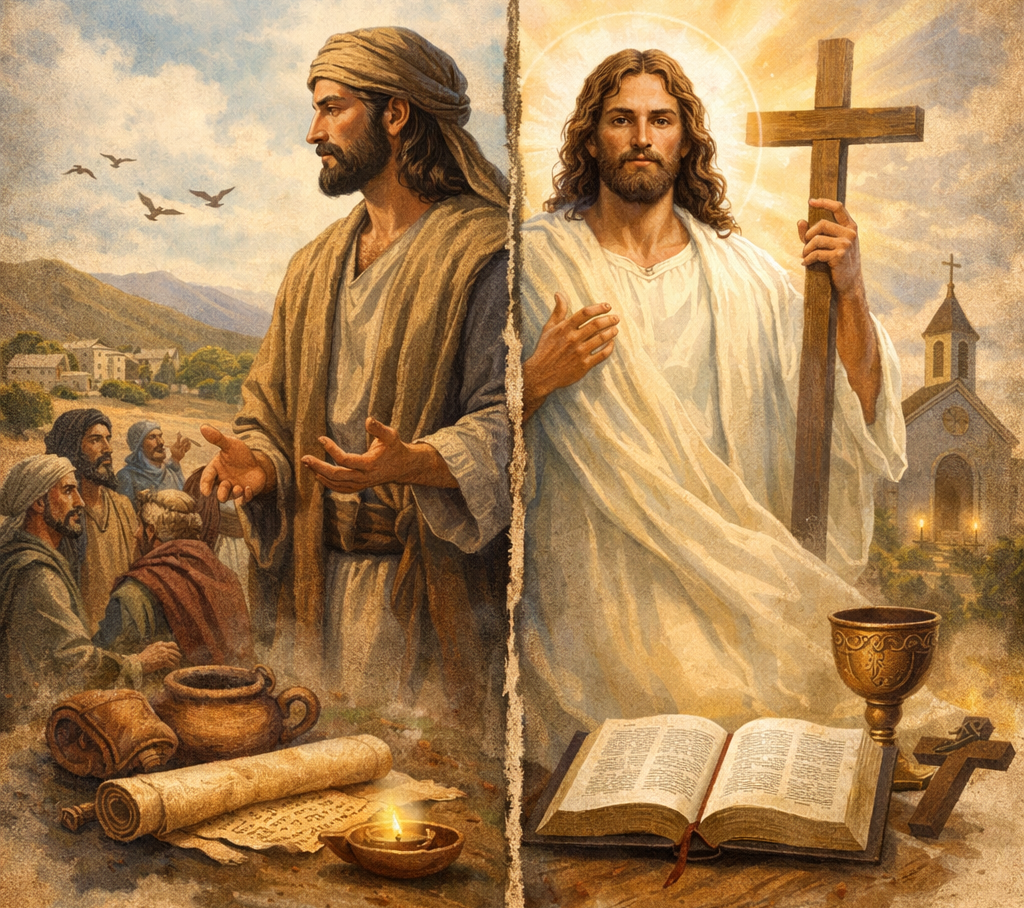
On the Jesus of History and the Christ of Faith

One of my favorite topics in the study of the New Testament is the historical Jesus; it is an area of study that attempts to understand Jesus as he was within the context of first century Judaism. However, many who study the historical Jesus argue that the Jesus of history (the first century Jewish teacher) is not the Christ of faith (the exalted Lord proclaimed by the church). In other words, the early church’s understanding of Jesus has been embellished and augmented by influences that go well beyond who Jesus actually was and what he taught. This presupposition is one of the the primary factors that originally inspired the now century old quest(s) for the historical Jesus. Of course, we must affirm that historical investigation is indispensable for understanding the person and work of Jesus, but the hard distinction between the Jesus of history and the Christ of faith collapses under the weight of the earliest evidence. The church’s confession of Christ emerges not as a departure from Jesus, but as the historically grounded interpretation of his life, death, and resurrection. In the space that follows, I would like to defend this thesis by examining why history matters, where the split came from, and why the evidence actually favors continuity and not discontinuity.

It would seem to be readily evident that the historical study of the New Testament is essential for understanding the Christian faith. This is because Christianity makes several direct and specific claims about real events that took place in historical space and time. So understanding these events and their historical and theological significance is a matter of first importance when it comes to understanding our faith. As a case in point, when the eternal Son came incarnate in the person of Jesus Christ, he stepped into a particular place at a particular time, the fullness of time according to Galatians 4.4. In other words, the doctrine of the incarnation requires some historical understanding of the place and time when Jesus was born. In fact, the Gospels themselves are anchored in the geography, personalities, and events of the first century Palestine. The point is that if Jesus is severed from the places and times in which he lived, then we run the risk of distorting the significance of his life and teaching. More than this, we run the risk of reshaping Jesus into a man of our making, as a some kind of modern therapist or social reform mascot. The bottom line is that the hard work of history disciplines our theology and grounds it in the life of our savior as he lived it. Or to put it more simply, to confess that the Word became flesh is to confess that history matters.

The point of this is to say that historical inquiry is not the enemy of faith. The problem comes when we presume to dictate what history is allowed to contain. During the Enlightenment of the 18th Century, philosophers and historians began to doubt the details of the New Testament’s depictions of Jesus. Because of their presuppositions about the supremacy of human reason in the pursuit of truth, they were highly skeptical of the Gospels’ accounts of Jesus’s miracles, particularly his resurrection. Their skepticism resulted in an approach to history that might be called methodological naturalism, or the idea that anything that even remotely smells like it might be supernatural must be ruled out as a theological fabrication. Ultimately, their dismissal of the miracles of Jesus, particularly his resurrection, led them to conclude that the church’s high Christology, or its understanding of Jesus as the divine Lord of heaven, must be a late addition to the New Testament that has nothing to do with who Jesus was and what he did and taught during his lifetime, a conclusion which had more to do with their own presuppositions than with any actual analysis of the evidence. The real question, however, is not whether the theology of the early church developed over time (it clearly did), but the question is whether that development moved away from Jesus or unfolded from within the impact of his life and resurrection. An examination of the earliest documents clearly demonstrates that this is in fact what happened.

Now, the earliest Christian documents are the 13 letters of Paul, which were likely written between the years 49 CE and 68 CE. (The earliest of these is most likely 1 Thessalonians, and the latest is 2 Timothy.) Important for this post is the fact that several of these letters include embedded hymns and creedal material that clearly exalt Jesus as the divine Lord. For example, in Philippians 2.6, he “existed in the form of God,” and in Colossians 1.15, “He is the image of the invisible God.” In 1 Corinthians 8.6, the Apostle writes, “for us there is one God, the Father. All things are from him, and we exist for him. And there is one Lord, Jesus Christ. All things are through him, and we exist through him.” This is clearly a reworking of the Shema (Deut 6.4) which equates Jesus with the God of Israel. Even outside of Paul, in Hebrews 1.3, Jesus is “the radiance of God’s glory and the exact expression of his nature, sustaining all things by his powerful word.” And in James 5.9 (possibly the earliest document in the New Testament), he is “the judge [who] stands at the door!” The point of all this is to show that the church’s so called “high Christology” developed very early in the life of the church, and that within the context of strict Jewish monotheism. And so the question must be asked, “How did first century Jews come to worship Jesus as God so quickly?” The only possible answer is that the seeds of this belief were already present in the life and ministry of Jesus.

Of course, Jesus never articulated his identity in the language of the Nicaean Creed, but he clearly acted with divine authority. When the Pharisees ask, “Who can forgive sins but God alone?” Jesus says to the paralytic, “Son, your sins are forgiven. Get up, take your mat, and go home.” (Mark 2.1-12) When his disciples were rebuked for picking heads of grain on the sabbath, he responded, “For the Son of Man is Lord of the Sabbath.” (Matthew 12.1-8) He calmed the storms, he healed the sick, he cast out demons, he raised the dead. He equated his body with the temple, and he proclaimed a Kingdom of God that centered on his own person and work. And when the High Priest asked him if he was indeed the Christ, he responded, ““I am, and you will see the Son of Man seated at the right hand of Power and coming with the clouds of heaven,” to which the High Priest responded by accusing him of blasphemy. (Mark 14.61-64) As a side note, the title Son of Man is most likely taken from Daniel 7, where Daniel sees “one like a son of Man” approaching the Ancient of Days to be vindicated and enthroned as king. The identity of this “one like a Son of Man” is debated, but it is highly likely that Daniel understood him as (quasi) divine figure. The point is that Jesus made several extraordinarily “high” claims about himself, claims that clearly threatened the Jerusalem religious establishment and eventually got him killed.

Moreover, the church did not invent these categories out of thin air; rather, it interpreted the shock of Jesus’ life and resurrection within the context and storyline of Israel’s Scriptures. And for them, the resurrection was the decisive interpretive key. The historical plausibility of the resurrection is practically certain given the cumulative effect of the evidence. The earliest confessions assume the truth of the resurrection (1 Cor 15.3-8). The earliest disciples went from fearing for their lives in the upper room to boldly proclaiming the truth of the resurrection in the temple square. The first witnesses of the resurrection were a couple of women whose testimony would have been viewed as untrustworthy in their day. All eleven of the disciples went to their deaths preaching Christ as risen from the dead, and the apostle Paul went from hateful persecutor of Christians to the most effective preacher and missionary in the early church. In other words, the resurrection was a central component of the early church’s belief, and its exalted understanding of Jesus flows naturally from this belief. If Christ was truly raised from the dead, then he truly was who he said he was, i.e. “the Christ, the Son of the living God.” The point is that the Christ of the church’s faith is what the Jesus of history looks like after Easter. Without the resurrection, a hard divide makes sense, but with the resurrection, the continuity between the two becomes inherently plausible. Or to put it another way, the resurrection is not some theological embroidery added to the story of the historical Jesus. No, it is the primary engine of the early church’s “high” Christology.

The bottom of line is simply this, namely that the hard division between historical events and their theological significance is a false dichotomy. There simply is no such thing as uninterpreted history; all historical events are immediately interpreted. The moment something happens, it is interpreted. The question, then, is not whether theology exists, but whether it faithfully corresponds to what actually occurred. In other words, theology is not the corruption of history; it is reflection upon it. And when it comes the person and work of Jesus, the Gospel accounts are just historical testimony that has been shaped by conviction. The faith of the early church was an organic and continuous development that grew out of the life and teaching of the historical Jesus, and the earliest confessions of Christ are best understood as historically grounded worship. If we separate the Jesus of history from the Christ of faith, the our faith becomes mere myth layered on memory. Jesus came incarnate at a particular time in a concrete place, and he was resurrected and he ascended to be seated at the right hand of the Father. And this is why both the history of Jesus and the faith of the early church matter. The one worshiped in the church is not a theological invention layered upon a forgotten Galilean. He is the crucified and risen Jesus of Nazareth. There is theological development, yes. There is interpretation, certainly. But there is no canyon between the Jesus who walked the hills of Galilee and the Christ that the church confesses as Lord. There is continuity — deep, historical, and theologically unavoidable continuity between the Jesus of history and the Christ of faith.


On A Healthy Church Member … Gathers

Text
24 And let us consider one another in order to provoke love and good works, 25 not neglecting to gather together, as some are in the habit of doing, but encouraging each other, and all the more as you see the day approaching.

~Hebrews 10.24-25

Title: A Healthy Church Member … Gathers
Series: A Healthy Church Member
Church: South Caraway Baptist Church, Jonesboro, AR
Date: January 31, 2021


Slow To Write

"let every person be quick to hear, slow to speak, slow to anger."

lovegavehope

Just another WordPress.com site

Jared Cornutt

Pastor | Speaker | Writer

Denny Burk

A commentary on theology, politics, and culture

G3 Ministries

Events + Resources for the Local Church

Biblical Reasoning

Biblical and Systematic Theology According to the Scriptures

RetroChristianity

Reclaiming the Forgotten Faith

SBC Voices

Southern Baptist News & Opinion

Lucid Theology

Thoughts on words, books, theology, and life.

Baptist21

A pastor-led voice for Baptists in the 21st century

Center For Baptist Renewal

The Personal and Professional Blog of Phillip Powers

The Pastor's Well - Pastor Well

The Personal and Professional Blog of Phillip Powers

Articles - AlbertMohler.com

The Personal and Professional Blog of Phillip Powers

The Gospel Coalition

The Personal and Professional Blog of Phillip Powers