Tag Archives: New Heavens and New Earth

On Eschatology and the Beatific Vision

In my last episode of Thinking Theologically (see here), I reflected on the nature of the Christian’s hope in the face of death. Do we simply go to heaven when we die, or is there something more for which we are waiting? (See also my post, “On Christian Hope: Heaven or Resurrection,” here.) The point of all this is that we must recover the priority of resurrection and new creation in contemporary evangelical eschatology. Christian hope is not simply “dying and going to heaven.” We await bodily resurrection and the renewal of creation. However, there is a danger of swinging the pendulum too far in the other direction, as it were. A beautiful renewed earth, embodied existence, culture, work, relationships, and the like are genuine eschatological goods—but are they the highest good? What are we to make of the traditional doctrine of the beatific vision, the idea that the final blessedness of redeemed humanity consists in seeing and enjoying God forever? After all, Paul can say that to depart and be with Christ is “far better” (Phil 1:23). So, which is it? I would submit that the Christian eschatological hope is neither merely resurrection and new creation nor an immaterial vision of God detached from creation. Rather, the resurrection of the body and renewal of creation provide the embodied setting for the beatific vision, in which redeemed humanity reaches its final blessedness by dwelling in the unveiled presence of the Triune God.

Of course, the Christian hope is irreducibly bodily. This cannot be denied. In Romans 8:23, Paul reminds us that “we also groan within ourselves, eagerly waiting for adoption, the redemption of our bodies.” In the same way that Christ was raised bodily from the dead, so we too, as his people, will one day be raised in glorified bodies. His resurrection is the pattern for ours. This is the logic of the resurrection. (On which, see here.) Salvation, therefore, does not culminate in the permanent separation of the soul from the body. God created human beings as embodied creatures, and his work of redemption restores the whole human person rather than liberating the soul from embodied existence. This is important for how we understand the beatific vision. To say that our final blessedness consists in seeing and enjoying God does not require us to abandon the bodily character of Christian hope. The redeemed who see God will be resurrected human beings, restored to the embodied existence for which God created them. The beatific vision is not the replacement of embodied human existence; it is the perfection of embodied human existence in the presence of God.

Neither, by the way, does embracing the beatific vision require us to abandon our concept of a renewed creation. In Romans 8, Paul deliberately connects the liberation of creation with the glorification of God’s children. Creation presently “groans” under its bondage to decay, even as we ourselves groan while awaiting the redemption of our bodies (Rom 8:21–23). The two hopes belong together. Just as God will redeem our bodies from death, so creation itself “will also be set free from the bondage to decay into the glorious freedom of God’s children” (8:21). The biblical hope, therefore, is not the abandonment of the created order but its renewal. This trajectory reaches its culmination in Revelation 21, where John sees “a new heaven and a new earth” and the New Jerusalem descending “out of heaven from God” (Rev 21:1–2). The direction is significant: redeemed humanity does not permanently escape upward from creation; rather, God’s heavenly reality comes down to transform the dwelling place of humanity. Resurrection and new creation thus belong together as essential dimensions of Christian eschatological hope. But this raises an important question: what ultimately makes this renewed creation the blessed existence for which Christians hope? A renewed creation is essential to Christian hope, but the biblical story does not reach its climax merely by telling us that everything has been made new.

What, then, constitutes the supreme glory of the new creation? John provides the answer almost immediately: “Look, God’s dwelling is with humanity, and he will live with them. They will be his peoples, and God himself will be with them and will be their God” (Rev 21:3). The great hope of the new creation is therefore not merely that death has been defeated, the curse has been removed, or creation has been restored—glorious though each of these realities will be. Its supreme glory is the presence of God himself. Indeed, this is the destination toward which the entire biblical story has been moving. Humanity begins in Eden dwelling in the presence of God. After the entrance of sin and humanity’s exile from his presence, God nevertheless dwells among his covenant people through the tabernacle and temple. In the incarnation, the Word himself “dwelt among us” (John 1:14), and through the Spirit God now dwells among his people in the church. Yet each of these anticipates the consummation, when God will dwell immediately and permanently with redeemed humanity in the new creation. The glory of the new creation is not ultimately that everything has been made new, but that the God who makes all things new dwells there with his people.

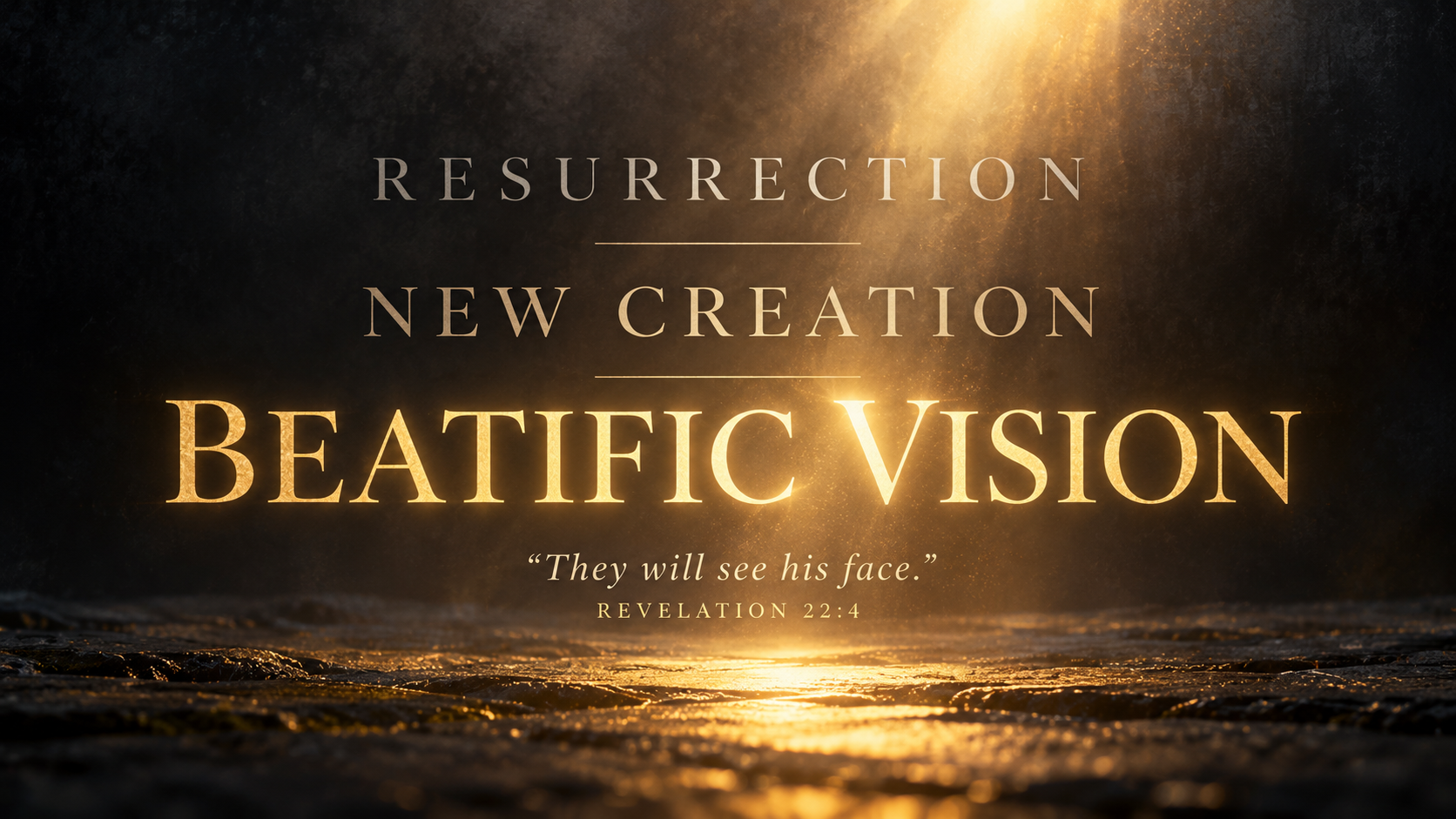
Yet Revelation goes even further. The promise is not merely that God will dwell with his people, but that “they will see his face” (Rev 22:4). Here we arrive at what Christian theology has traditionally called the beatific vision. The word “beatific” refers to blessedness, and the doctrine describes the final blessedness of redeemed humanity as consisting in the immediate knowledge and enjoyment of God himself. This hope appears throughout the New Testament. Jesus promises that the “pure in heart” will “see God” (Matt 5:8). Paul explains that although we presently see “only a reflection as in a mirror,” we will one day see “face to face” (1 Cor 13:12). Likewise, John declares that when Christ appears, “we will be like him because we will see him as he is” (1 John 3:2). Of course, none of this means that finite creatures will somehow become capable of comprehending the infinite God exhaustively. The Creator-creature distinction remains. Rather, the redeemed will know and enjoy God with an immediacy, purity, and fullness impossible in the present age. We presently know God truly, but our knowledge remains mediated and incomplete. In the new creation, faith will finally give way to sight. The highest blessing of the age to come is therefore not merely that we will live forever, but that we will live forever in the unveiled presence of God.

We should not, therefore, think that we must choose between resurrection and the beatific vision, as though one represented a properly biblical hope while the other reflected an overly spiritualized view of salvation. The New Testament holds them together. We will see God as the resurrected and glorified human beings he created and redeemed us to be. Our resurrected eyes will behold Christ, our ears will hear the worship of the redeemed, and our glorified bodies will inhabit the renewed creation in which God dwells with his people. Indeed, the closing chapters of Revelation bring all these realities together. John sees a city, a river, the tree of life, the nations, the servants of God, and the throne of God and of the Lamb (Rev 21–22). Yet at the center of this renewed creation stands the remarkable promise that God’s servants “will see his face” (22:4). New creation is not an alternative to heaven because heaven comes down. Resurrection is not an alternative to seeing God because we are raised to enjoy God as whole human beings. And the beatific vision is not an escape from creation because God’s unveiled presence is the supreme glory of the new creation.

This is why Scripture can speak of God himself as the inheritance and supreme good of his people. The psalmist declares, “LORD, you are my portion and my cup of blessing” and confesses that “in your presence is abundant joy; at your right hand are eternal pleasures” (Ps 16:5, 11). Likewise, Psalm 73 asks, “Who do I have in heaven but you? And I desire nothing on earth but you” (73:25). Such language does not diminish the goodness of God’s created gifts. Rather, it places those gifts in their proper order. We should certainly look forward to a renewed creation free from death, suffering, and the curse. We should look forward to resurrected bodies, restored relationships, and the fullness of human life as God intended it. But none of these things constitutes our highest good apart from God himself. Indeed, Revelation describes the New Jerusalem as having no temple because “the Lord God the Almighty and the Lamb are its temple,” and needing neither sun nor moon because “the glory of God illuminates it” (Rev 21:22–23). The greatest gift God gives his people in the new creation is ultimately himself. Every other eschatological good finds its proper place within that supreme and everlasting good.

What, then, is the Christian’s ultimate hope? It is not simply that our souls go to heaven when we die. Neither, however, is it merely that our bodies will be raised and we will inhabit a renewed creation forever. We await the return of Christ, the resurrection of the dead, the renewal of creation, the removal of death and the curse, and, above all, the unhindered presence of God himself. Resurrection describes the embodied form of our final salvation. New creation describes its created setting. The beatific vision describes its supreme blessedness and end. This is precisely the picture with which the biblical story concludes: “There will no longer be any curse. The throne of God and of the Lamb will be in the city, and his servants will worship him. They will see his face” (Rev 22:3–4). Christian hope is therefore gloriously earthly without being earth-centered and gloriously heavenly without being disembodied. We await resurrection and new creation because God intends redeemed humanity to live forever as the creatures he made us to be. But the supreme glory of that life will not be merely that death is gone, creation is renewed, or our bodies have been raised. It will be that we will see his face. The new creation is the world of our eschatological hope, but God himself is its object.

On Eschatology in the Book of Hebrews

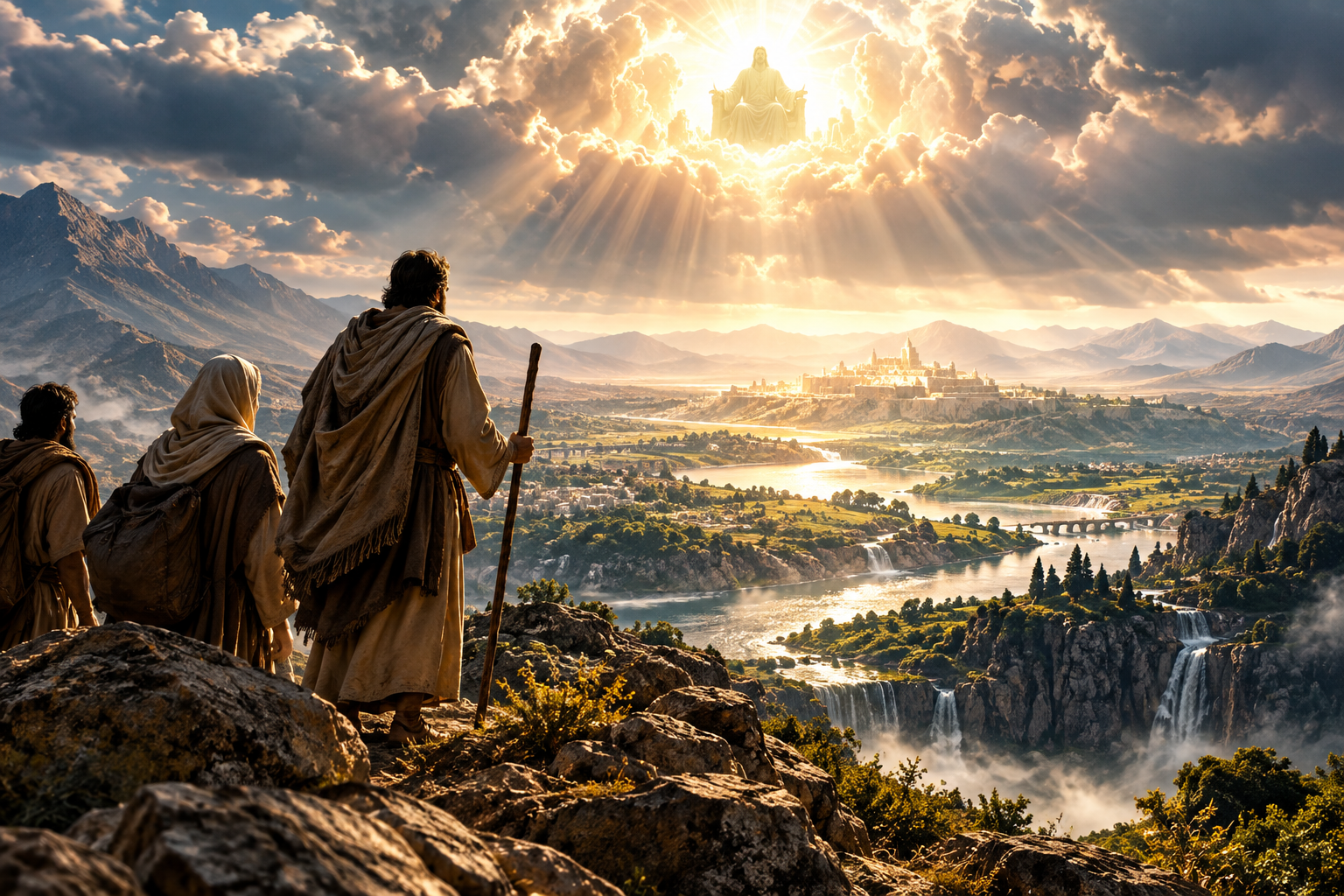
One of the major themes of the Letter to the Hebrews is the theme of perseverance. But perseverance unto what? What is the destination toward which we are heading? Hebrews paints an extraordinarily “heavenly” picture. We share in a heavenly calling (3.1), we have tasted the heavenly gift (6.4), we desire a heavenly country (11.16), and we have come to the heavenly Jerusalem (12.22). All of this can create the impression that Hebrews replaces earthly and creational hope with an essentially spiritual, heavenly destiny. On the other hand, the strong fulfillment language found throughout the book can be pushed toward the opposite mistake, namely treating the eschatological horizon of Hebrews as if it were essentially exhausted by Christ’s first coming and other first-century events. But, in my opinion, neither of these extremes adequately captures the eschatological vision of the Book of Hebrews. Rather, Hebrews presents Christian existence as participation in an eschatological salvation that has genuinely begun through Christ’s death, resurrection, exaltation, and heavenly priesthood but awaits a future consummation at his return. That consummation cannot be reduced either to events surrounding the first century or to an immaterial heavenly existence, for Hebrews directs believers toward Christ’s future appearing, the resurrection and judgment of the dead, the final shaking of creation, and humanity’s inheritance of “the world to come.”

The author of Hebrews introduces this “world to come that we are talking about” in 2.5, and he immediately quotes from Psalm 8. Psalm 8 is a prayerful reflection on humanity’s God-given dominion over creation. In other words, it speaks of creational realities and of humanity’s God-intended vocation. The eschatological hope envisioned here is therefore not an abandonment of humanity’s creational vocation but its ultimate realization. And the author of Hebrews is clear that this vocation is fulfilled in the second Adam, Jesus Christ. Jesus fulfills humanity’s vocation, having been crowned with glory and honor because he suffered death (2.9). Yet Hebrews immediately acknowledges an obvious tension: “At present, we do not yet see everything in subjection to him.” The promise of Psalm 8 has not yet reached its complete realization in human experience. What we do see, however, is Jesus, who has already entered into the glory and dominion for which humanity was created. His exaltation therefore anticipates the destiny of those who belong to him. The “world to come” is the world in which humanity’s creational vocation, already realized in the exalted Christ, will finally become a reality for redeemed humanity. From the outset, then, Hebrews presents an eschatological hope that is both already realized in Christ and still awaiting its full realization in the world to come.

This is exactly why we can speak of the “already” in the phrase “already and not yet.” The “last days” began when the Son came incarnate to earth, died on the cross, and rose again (cf. 1.1–2). “He has appeared one time, at the end of the ages, for the removal of sin by the sacrifice of himself” (9.26). The turning of the ages, then, is not merely a future expectation; it has already occurred through the saving work of Jesus Christ. Indeed, believers have even “tasted the powers of the coming age” (6.5). This is possible because Jesus has already entered the heavenly sanctuary on our behalf (9.11–12, 24) and has taken his place at the right hand of God (1.3; 8.1). Consequently, the blessings associated with the world to come have broken into the present through the exalted Christ. Christians can presently draw near to the throne of grace (4.14–16), enter the presence of God through the blood of Jesus (10.19–22), and participate in realities belonging to the coming age. In this sense, the eschatology of Hebrews is genuinely inaugurated. The future has become present in Christ without thereby ceasing to be future.

And yet there is still a future hope. As the author writes in 9.28, “so also Christ, having been offered once to bear the sins of many, will appear a second time, not to bear sin, but to bring salvation to those who are waiting for him.” The Day is approaching (10.25), and “he who is coming will come and will not delay” (10.37). Likewise, there remains a promised rest for the people of God into which believers must still strive to enter (4.1–11). Nor is this future expectation limited to Christ’s return. Hebrews includes “the resurrection of the dead and eternal judgment” among the foundational realities of the Christian faith (6.2), while the faithful who have gone before us have “not received what was promised,” so that “they would not be made perfect without us” (11.39–40). In other words, whatever first-century fulfillments Hebrews may encompass, its eschatological horizon exceeds them. Christ has accomplished the decisive work of salvation and presently reigns at the right hand of God, but the salvation secured by his first appearing still awaits its consummation at his second. The “already” of Hebrews is therefore substantial, but it does not eliminate the “not yet.”

Of course, as I stated above, Hebrews paints an extraordinarily heavenly picture of salvation. However, it is important that we distinguish between the heavenly location and source of our salvation and the ultimate nature of our salvation. A heavenly sanctuary does not imply eternal disembodiment, nor does present access to heaven require an ultimate escape from creation. As we saw in Hebrews 2 and its quotation of Psalm 8, our salvific destiny concerns humanity and “the world to come.” The goal is the realization of humanity’s God-given vocation over creation, a destiny already realized in the exalted Christ but not yet realized in us. Moreover, Hebrews 6.2 explicitly retains “the resurrection of the dead” as part of its eschatological expectation. Even Abraham’s desire for a “better country—a heavenly one” (11.16) must be read within this broader eschatological horizon rather than as a Greek-style escape from embodiment. The country is heavenly because it is prepared by God and belongs to the order of his promised salvation, not because salvation requires the abandonment of created existence. Indeed, Hebrews immediately associates this heavenly country with the city that God has prepared for his people. In other words, Hebrews has a heavenly Christology without an ethereal eschatology.

This is made clear when the author quotes Haggai 2.6: “Yet once more I will shake not only the earth but also the heavens” (Heb 12.26). In other words, final judgment has cosmic dimensions. God’s eschatological purpose is not merely private souls arriving in heaven. It involves the shaking of the created order and “the removal of what can be shaken—that is, created things—so that what is not shaken might remain” (12.27). Significantly, the emphasis is not simply upon destruction, but upon what remains after the shaking. As believers, we are therefore “receiving a kingdom that cannot be shaken” (12.28). The contrast is between the present order, which remains subject to God’s eschatological shaking and judgment, and the permanent kingdom that God will establish beyond that judgment. This is the “world to come” toward which the author has been directing our attention: the promised order in which the purposes of God, already realized in the exalted Christ, reach their final and unshakable realization. The consummation envisioned by Hebrews therefore encompasses creation, judgment, kingdom, and the destiny of redeemed humanity. Its hope is not escape from the created order, but participation in the permanent order that remains when God finally shakes heaven and earth.

This already-but-not-yet tension explains why Hebrews so frequently describes the Christian life in terms of pilgrimage and perseverance. Abraham looked forward to “the city that has foundations, whose architect and builder is God” (11.10), while the patriarchs confessed that they were “strangers and temporary residents on the earth” because they desired the better and heavenly country God had prepared for them (11.13–16). Christians similarly have no enduring city here but “seek the one to come” (13.14). Yet this pilgrimage does not mean that believers are searching for a salvation they have not yet encountered. Jesus has already entered the heavenly sanctuary as our “forerunner” (6.19–20), opening the way into God’s presence for those who belong to him. Christians therefore live between promise and consummation. We already possess access to the heavenly realities secured by Christ, but we still journey toward the final inheritance of those realities in the world to come. This is precisely why perseverance matters so much in Hebrews. Christians belong to the world to come before the world to come has arrived in its fullness. We therefore press forward in faith because the destination toward which we journey has already been secured by the Christ who has gone before us.

So, we return to the opening question: perseverance unto what? Hebrews calls believers to persevere because the salvation inaugurated by Jesus Christ has not yet reached its consummation. We await his second appearing, the resurrection of the dead and final judgment, the promised rest, the city that is to come, the unshakable kingdom, and ultimately the “world to come” over which redeemed humanity will share in the destiny already realized in Jesus Christ. Hebrews therefore allows us neither to collapse its eschatological expectations into events surrounding the first century nor to transform its heavenly language into the hope of an immaterial existence removed from creation. Instead, its eschatology is grounded in what Christ has already accomplished and directed toward what God has yet promised to accomplish. Hebrews 2 captures this tension remarkably well: “At present, we do not yet see everything subjected to him,” but “we do see Jesus” already crowned with glory and honor (2.8–9). Christians therefore look upward because Jesus is already enthroned in heaven, but we also look forward because the world over which the enthroned Son reigns has not yet become what God has promised it will be. Until then, we persevere, following our forerunner and awaiting the world to come.


On the Kingdom of God and this World

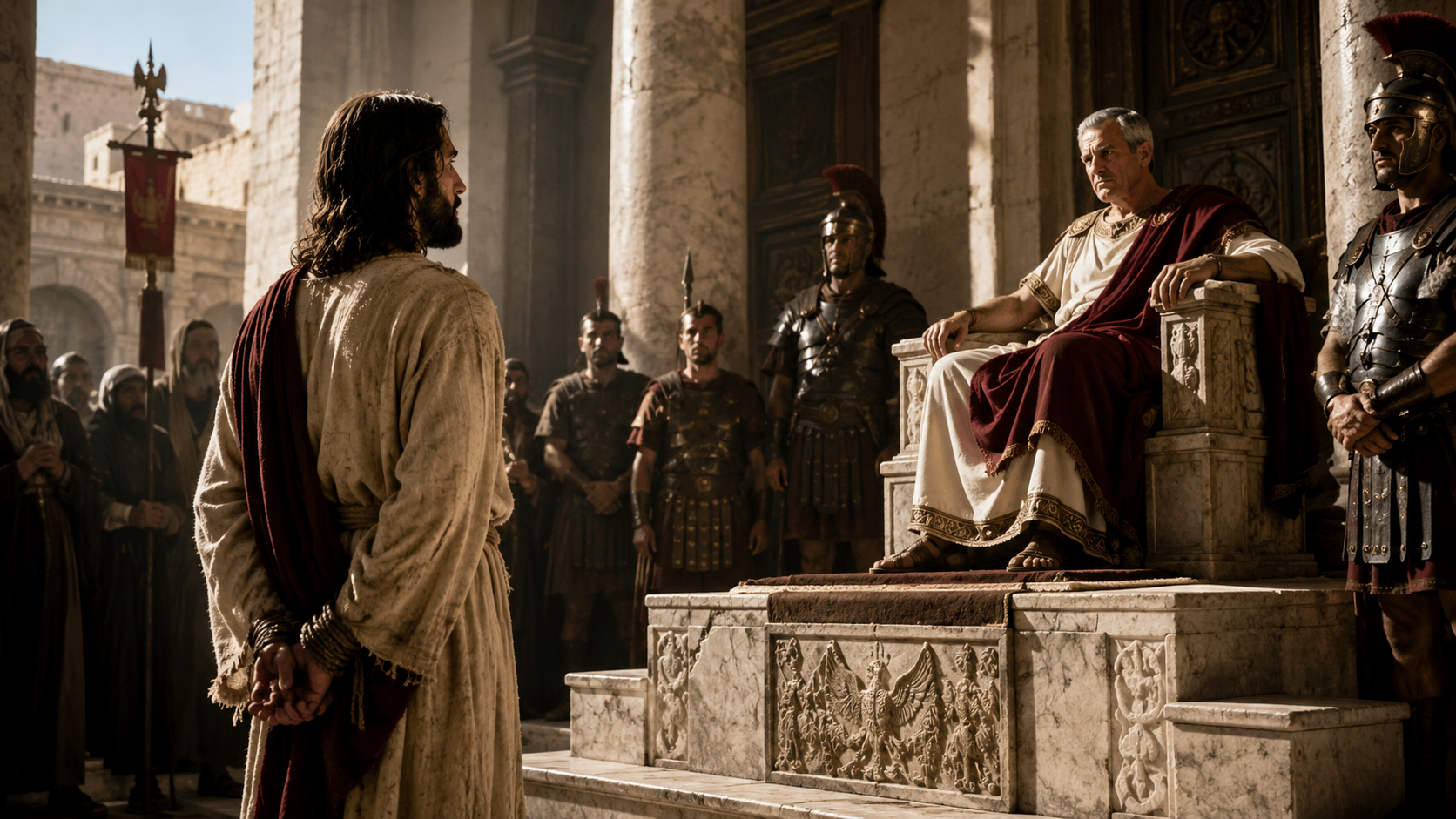
In my opinion, one of the most profound scenes of Jesus’s passion is his examination before Pilate in John 18:28–40. In the middle of this scene, Jesus makes a startling statement: “My kingdom is not of this world. If my kingdom were of this world, my servants would fight, so that I wouldn’t be handed over to the Jews. But as it is, my kingdom is not from here” (John 18.36). This statement is pregnant with significance for understanding the nature of the kingdom Jesus preached, but it is often misunderstood. When Jesus says, “My kingdom is not of this world,” many understand him to mean something like, “My kingdom has nothing to do with the earth.” This can create the misconception that the Christian hope is ultimately to escape the physical world for an immaterial heavenly existence. But is this what Jesus is really saying? To answer that question, we must distinguish between two others: Where does Jesus’s kingdom come from, and where will it ultimately be manifested? Jesus’s kingdom is not an immaterial or purely spiritual kingdom removed from the earth. Rather, its origin and authority do not derive from the present world order, and it will ultimately be manifested in its fullness when Christ reigns over a renewed creation.

However, in order to understand this, we must first consider Jesus’s statement in its immediate context. The question Jesus is answering sets the scene. Pilate asks, “Are you the King of the Jews?” (John 18:33). In response, Jesus does not deny the implication of the question, but he uses the opportunity to clarify the nature of his kingdom: “My kingdom is not [from] this world.” The preposition (ἐκ) indicates the source or origin of Jesus’s kingdom, not its geographical location or ultimate destination. In other words, Jesus does not mean that his kingdom has nothing to do with this world, that it will never exist upon the earth, or even that it is purely spiritual. Rather, Jesus is saying that his authority does not stem from the world’s powers and that his kingdom does not operate according to the world’s principles and values. This is why he goes on to say, “If my kingdom were of this world, my servants would fight, so that I wouldn’t be handed over to the Jews.” If his kingdom were a kingdom derived from this world, then his servants would advance it according to this world’s methods. But his kingdom is from above, even as he is from above. It is defined by a different set of priorities and values. Or, to put it another way, Jesus’s point concerns the origin and character of his kingdom, not the permanent exclusion of the earth from its rule.

This distinction between the kingdom’s heavenly origin and its earthly significance is consistent with a larger pattern in John’s Gospel. Earlier, Jesus tells his opponents, “You are from below; I am from above. You are of this world; I am not of this world” (John 8:23). The language closely parallels Jesus’s description of his kingdom before Pilate. Yet when Jesus says that he is not “of this world,” he obviously does not mean that his mission has nothing to do with the world. Jesus comes from above precisely in order to enter this world and accomplish God’s saving purposes within it. His heavenly origin identifies the source of his identity and authority without removing his mission from the earthly sphere. The same is true of his kingdom. Because it is not “from this world,” Christ’s kingdom does not derive its authority from earthly rulers like Pilate or advance through the coercive power by which worldly kingdoms maintain their rule. Its authority comes from God and therefore confronts the fallen world’s values rather than conforming to them. A kingdom that is not from this world, then, need not be a kingdom that has nothing to do with this world. Indeed, the larger biblical story reveals that God’s purpose is not to abandon the world he created, but ultimately to redeem and renew it.

In the beginning, God created the physical world and all it entails, and then he pronounced it to be “very good.” When sin entered the picture, however, it corrupted God’s good creation. But rather than simply abandon what he had made, God set in motion a plan to redeem the created order and restore what was lost in the garden. This is why Paul says that creation itself longs to be “set free from the bondage to decay into the glorious freedom of God’s children” (Rom. 8:21). Significantly, Paul connects the liberation of creation with the redemption of our bodies (8:23). The Christian hope, therefore, can be summed up in one word: resurrection. Jesus was raised bodily, and those who believe in him await a resurrection in which our mortal bodies will be glorified. (On Christian hope as resurrection rather than simply “going to heaven,” see here.) Our hope is not for some kind of disembodied existence, nor is it to be saved from material creation. Rather, we await the glorification of our bodies so that we might live as embodied creatures within a restored creation. The biblical story does not move from creation to the abandonment of creation, but from creation through fall and redemption to new creation.

This is ultimately how the kingdom of God will be manifested on earth, i.e., in a new creation; this is the goal of the Bible’s story. In Revelation 21:1–3, we read of a new heaven and a new earth, and a new Jerusalem coming down out of heaven to earth. John records it this way: “Then I heard a loud voice from the throne: Look, God’s dwelling is with humanity, and he will live with them. They will be his peoples, and God himself will be with them and will be their God” (Rev. 21:3). The direction of this movement is significant. God’s people do not permanently leave the earth to dwell with God somewhere else; God comes to dwell with his people in a renewed creation. This vision brings to fulfillment Isaiah’s earlier expectation of “new heavens and a new earth” (Isa. 65:17) and the declaration in Revelation that “the kingdom of the world has become the kingdom of our Lord and of his Christ, and he will reign forever and ever” (Rev. 11:15). Christ’s reign, therefore, does not culminate in the abandonment of the created world, but in God’s reign being fully manifested throughout a renewed creation. The present world order characterized by sin, rebellion, death, and corruption passes away, but God’s purposes for his creation do not. The kingdom is not from this world, but it is ultimately for this world—not the world as presently corrupted by sin, but the world judged, renewed, and brought completely under the reign of Christ.

Of course, this does not mean that Christ is not already reigning. Christ does not have to wait until the new creation to become King. He is King, and he is seated at the right hand of the Father, where he reigns over his church by his Spirit through the Word. His kingdom is already present, and his authority is already real. Through his death, resurrection, exaltation, and the giving of the Spirit, Christ presently reigns. We call this inaugurated eschatology, or the already and the not yet. (On inaugurated eschatology in the preaching of John and Jesus, see my post here.) The kingdom of Christ has already begun, but it has not yet reached its full realization. However, it is important to note that just because Christ’s kingdom is already present, this does not mean that it is a purely spiritual kingdom. It is presently manifested on earth through his church, and one day it will be consummated throughout the new creation. The difference is not between a spiritual kingdom now and an earthly kingdom later, but between a kingdom already inaugurated and a kingdom not yet consummated. The kingdom that has already broken into the present through Christ will therefore reach its appointed goal when his reign extends in all its fullness throughout a renewed creation at his return. (On the already and the not yet of the Kingdom, see Thinking Theologically here.)

So, we can now return to that profound scene with which we began. Pilate looks upon what appears to be a powerless Jewish prisoner and asks, “Are you the King of the Jews?” Jesus’s answer is that he possesses a kingdom, but that his kingdom is “not from this world” (John 18:36). Far from denying his kingship or consigning his kingdom to some immaterial spiritual realm, Jesus identifies the divine source and radically different character of his reign. His kingdom does not originate from the fallen powers of this world, nor does it advance through their methods of coercion and violence. The Christian hope, therefore, is neither the establishment of Christ’s kingdom through worldly political conquest nor an escape from the physical world into an eternal disembodied existence. Instead, we await the return of the King, the resurrection of the dead, the judgment of evil, and the renewal of creation, when the reign that already belongs to Christ will be manifested in all its fullness. Jesus’s kingdom is not from this world because its authority, power, and character come from God. But that does not mean that Christ intends to abandon the world to sin, death, and decay. The King who once stood before Pilate will return to renew creation and manifest his reign over all things. The kingdom is not from this world, but God’s purpose is ultimately to bring this world, renewed and restored, under the reign of its rightful King.


On Eschatology and the Gospel

The study of Eschatology in the church is usually met with two distinct responses. On the one hand, some become so consumed with an over fascination that it drives them to unhealthy speculations, and on the other hand, others are so filled with apathy and distaste that they would rather neglect its doctrines altogether. Recently, I heard about one church that spent eighteen months studying the Book of Revelation, and there is nothing wrong with that per se. However, to the external observer, it could appear as if this subject is more important than the Gospel itself. This is perhaps part of the reason why this area of theological reflection is so often met with such varied and disparate responses; we have failed to demonstrate clearly how these truths are connected to the saving work that God has accomplished in and through His Son, Jesus Christ. We have become so bogged down in controversial matters like tribulations, raptures, millenniums, antichrists, and the like, that we have lost the point that these events bring the promises of the Gospel to completion.

At its core, the Gospel is about how God has solved, is solving, and will solve the problem of sin. Of course, sin is first and foremost a personal individual problem; human beings are corrupted by and enslaved to sin, and because of this, they deserve to spend eternity in hell under the wrath of God. However, in the Gospel, Jesus Christ took upon himself the punishment that we deserve; He died in our place, satisfied the wrath of God, and declared, “It is finished!” Now, by grace through faith in Him, we are forgiven of our sin, clothed in His righteousness, and promised eternal life. But sin is also a cosmic problem, because all of creation has been polluted by and cursed because of sin. As the Scriptures explain,

For the creation eagerly waits with anticipation for God’s sons to be revealed. For the creation was subjected to futility—not willingly, but because of him who subjected it—in the hope that the creation itself will also be set free from the bondage to decay into the glorious freedom of God’s children. 

~Romans 8.19-21

In the beginning, when God created the world, all was very good, but with the fall of mankind, sin and its consequences have hopelessly poisoned God’s good creation. This world reeks with the stench of death and decay; where there was once life and beauty, there is now sickness and death. But in the gospel, God is making all things new; he is restoring and recreating the paradise that was lost. In the Book of Revelation, chapters 21-22, we read of a new heaven and new earth which is completely free of sickness and death, heartache and pain, tear and loss. It is a world that is completely free from the stain of sin in every way. It is not just the Garden of Eden restored, it is the Garden of Eden made better.

In other words, the Gospel is inherently and irreducibly eschatological, because not only have we been set free from the penalty of sin, not only are we being set free from the power of sin, but one day we will be set free from the very presence of sin. Until then, we live in the tension of the already but not yet, already forgiven of our sin, already free from sin’s tyranny, but not yet free from its temptations and habituations in our daily lives. We rightly long for the day when the problem of sin and its effects will be no more; this is our blessed hope. And this is why the study of Eschatology should not be viewed as a distraction from the proclamation of the Gospel. On the contrary, the doctrines of Eschatology are so intricately and intimately woven into the fabric of the Gospel, that if we neglect or ignore them, we truncate the Gospel message, empty it of its power, misconstrue the nature of its promises.

This is not to say that the study of Eschatology is always done correctly. Certainly, there are many who have engaged this subject matter in improper or unhealthy ways that have shifted the focus or missed the mark. Eschatology is one of those areas in the study of which it is possible to miss the forest for the trees. There are many details and questions that fall into this category that could become a distraction. However, this does not mean that we should omit the study of it altogether, because Eschatology is fundamentally about hope, the hope of a world free from sin. This is the wonder of our salvation, not only that we have been forgiven of our sin and have received eternal life, but that the work of Christ in salvation has put something into motion that will completely transform the world as we know it.

For the grace of God has appeared, bringing salvation for all people, instructing us to deny godlessness and worldly lusts and to live in a sensible, righteous, and godly way in the present age, while we wait for the blessed hope, the appearing of the glory of our great God and Savior, Jesus Christ.

~Titus 2.11-13

Slow To Write

"let every person be quick to hear, slow to speak, slow to anger."

lovegavehope

Just another WordPress.com site

Jared Cornutt

Pastor | Speaker | Writer

Denny Burk

A commentary on theology, politics, and culture

G3 Ministries

Events + Resources for the Local Church

Biblical Reasoning

Biblical and Systematic Theology According to the Scriptures

RetroChristianity

Reclaiming the Forgotten Faith

SBC Voices

Southern Baptist News & Opinion

Lucid Theology

Thoughts on words, books, theology, and life.

Baptist21

A pastor-led voice for Baptists in the 21st century

Center For Baptist Renewal

The Personal and Professional Blog of Phillip Powers

The Pastor's Well - Pastor Well

The Personal and Professional Blog of Phillip Powers

Articles - AlbertMohler.com

The Personal and Professional Blog of Phillip Powers

The Gospel Coalition

The Personal and Professional Blog of Phillip Powers