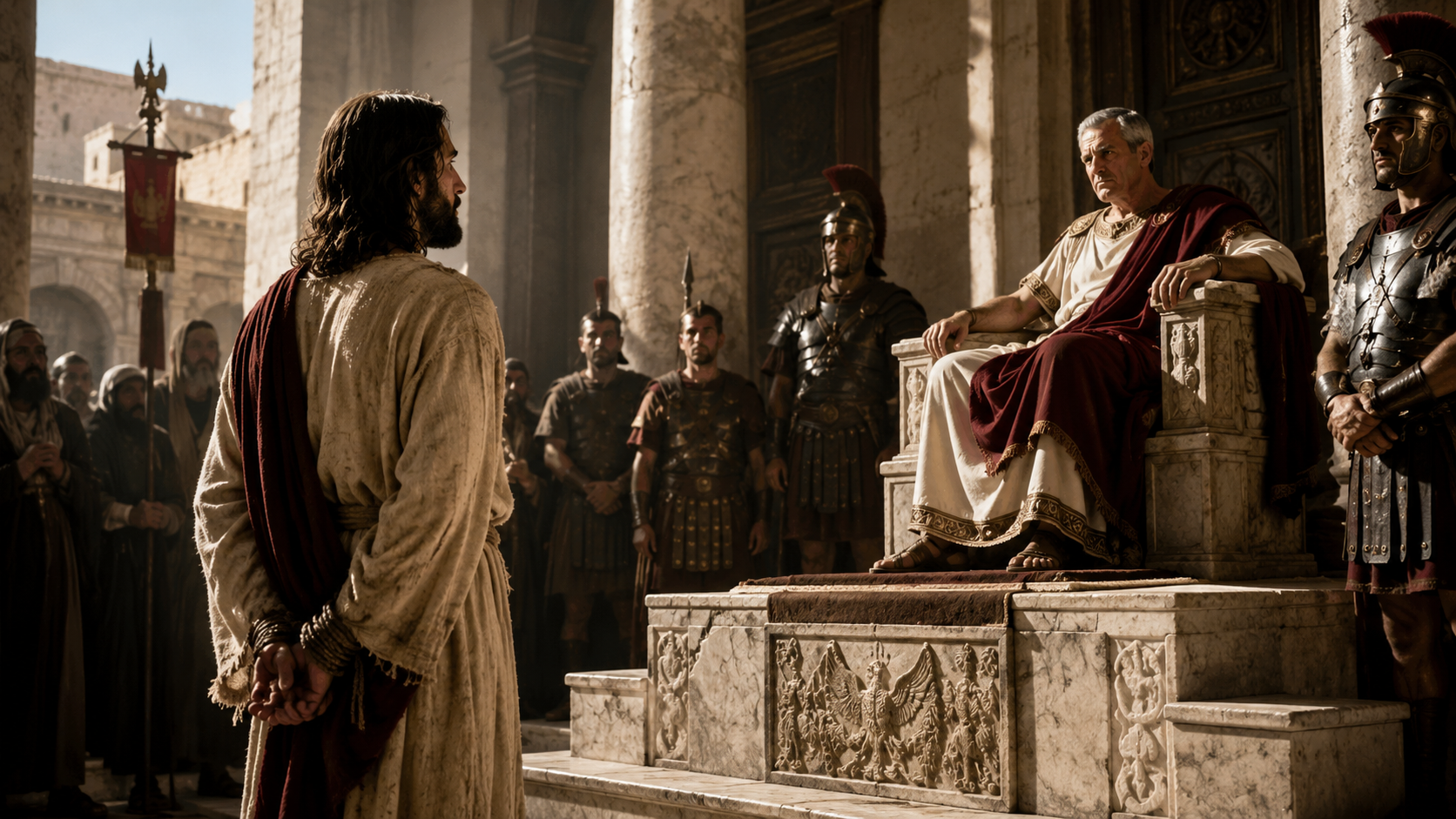
In my opinion, one of the most profound scenes of Jesus’s passion is his examination before Pilate in John 18:28–40. In the middle of this scene, Jesus makes a startling statement: “My kingdom is not of this world. If my kingdom were of this world, my servants would fight, so that I wouldn’t be handed over to the Jews. But as it is, my kingdom is not from here” (John 18.36). This statement is pregnant with significance for understanding the nature of the kingdom Jesus preached, but it is often misunderstood. When Jesus says, “My kingdom is not of this world,” many understand him to mean something like, “My kingdom has nothing to do with the earth.” This can create the misconception that the Christian hope is ultimately to escape the physical world for an immaterial heavenly existence. But is this what Jesus is really saying? To answer that question, we must distinguish between two others: Where does Jesus’s kingdom come from, and where will it ultimately be manifested? Jesus’s kingdom is not an immaterial or purely spiritual kingdom removed from the earth. Rather, its origin and authority do not derive from the present world order, and it will ultimately be manifested in its fullness when Christ reigns over a renewed creation.
However, in order to understand this, we must first consider Jesus’s statement in its immediate context. The question Jesus is answering sets the scene. Pilate asks, “Are you the King of the Jews?” (John 18:33). In response, Jesus does not deny the implication of the question, but he uses the opportunity to clarify the nature of his kingdom: “My kingdom is not [from] this world.” The preposition (ἐκ) indicates the source or origin of Jesus’s kingdom, not its geographical location or ultimate destination. In other words, Jesus does not mean that his kingdom has nothing to do with this world, that it will never exist upon the earth, or even that it is purely spiritual. Rather, Jesus is saying that his authority does not stem from the world’s powers and that his kingdom does not operate according to the world’s principles and values. This is why he goes on to say, “If my kingdom were of this world, my servants would fight, so that I wouldn’t be handed over to the Jews.” If his kingdom were a kingdom derived from this world, then his servants would advance it according to this world’s methods. But his kingdom is from above, even as he is from above. It is defined by a different set of priorities and values. Or, to put it another way, Jesus’s point concerns the origin and character of his kingdom, not the permanent exclusion of the earth from its rule.
This distinction between the kingdom’s heavenly origin and its earthly significance is consistent with a larger pattern in John’s Gospel. Earlier, Jesus tells his opponents, “You are from below; I am from above. You are of this world; I am not of this world” (John 8:23). The language closely parallels Jesus’s description of his kingdom before Pilate. Yet when Jesus says that he is not “of this world,” he obviously does not mean that his mission has nothing to do with the world. Jesus comes from above precisely in order to enter this world and accomplish God’s saving purposes within it. His heavenly origin identifies the source of his identity and authority without removing his mission from the earthly sphere. The same is true of his kingdom. Because it is not “from this world,” Christ’s kingdom does not derive its authority from earthly rulers like Pilate or advance through the coercive power by which worldly kingdoms maintain their rule. Its authority comes from God and therefore confronts the fallen world’s values rather than conforming to them. A kingdom that is not from this world, then, need not be a kingdom that has nothing to do with this world. Indeed, the larger biblical story reveals that God’s purpose is not to abandon the world he created, but ultimately to redeem and renew it.
In the beginning, God created the physical world and all it entails, and then he pronounced it to be “very good.” When sin entered the picture, however, it corrupted God’s good creation. But rather than simply abandon what he had made, God set in motion a plan to redeem the created order and restore what was lost in the garden. This is why Paul says that creation itself longs to be “set free from the bondage to decay into the glorious freedom of God’s children” (Rom. 8:21). Significantly, Paul connects the liberation of creation with the redemption of our bodies (8:23). The Christian hope, therefore, can be summed up in one word: resurrection. Jesus was raised bodily, and those who believe in him await a resurrection in which our mortal bodies will be glorified. (On Christian hope as resurrection rather than simply “going to heaven,” see here.) Our hope is not for some kind of disembodied existence, nor is it to be saved from material creation. Rather, we await the glorification of our bodies so that we might live as embodied creatures within a restored creation. The biblical story does not move from creation to the abandonment of creation, but from creation through fall and redemption to new creation.
This is ultimately how the kingdom of God will be manifested on earth, i.e., in a new creation; this is the goal of the Bible’s story. In Revelation 21:1–3, we read of a new heaven and a new earth, and a new Jerusalem coming down out of heaven to earth. John records it this way: “Then I heard a loud voice from the throne: Look, God’s dwelling is with humanity, and he will live with them. They will be his peoples, and God himself will be with them and will be their God” (Rev. 21:3). The direction of this movement is significant. God’s people do not permanently leave the earth to dwell with God somewhere else; God comes to dwell with his people in a renewed creation. This vision brings to fulfillment Isaiah’s earlier expectation of “new heavens and a new earth” (Isa. 65:17) and the declaration in Revelation that “the kingdom of the world has become the kingdom of our Lord and of his Christ, and he will reign forever and ever” (Rev. 11:15). Christ’s reign, therefore, does not culminate in the abandonment of the created world, but in God’s reign being fully manifested throughout a renewed creation. The present world order characterized by sin, rebellion, death, and corruption passes away, but God’s purposes for his creation do not. The kingdom is not from this world, but it is ultimately for this world—not the world as presently corrupted by sin, but the world judged, renewed, and brought completely under the reign of Christ.
Of course, this does not mean that Christ is not already reigning. Christ does not have to wait until the new creation to become King. He is King, and he is seated at the right hand of the Father, where he reigns over his church by his Spirit through the Word. His kingdom is already present, and his authority is already real. Through his death, resurrection, exaltation, and the giving of the Spirit, Christ presently reigns. We call this inaugurated eschatology, or the already and the not yet. (On inaugurated eschatology in the preaching of John and Jesus, see my post here.) The kingdom of Christ has already begun, but it has not yet reached its full realization. However, it is important to note that just because Christ’s kingdom is already present, this does not mean that it is a purely spiritual kingdom. It is presently manifested on earth through his church, and one day it will be consummated throughout the new creation. The difference is not between a spiritual kingdom now and an earthly kingdom later, but between a kingdom already inaugurated and a kingdom not yet consummated. The kingdom that has already broken into the present through Christ will therefore reach its appointed goal when his reign extends in all its fullness throughout a renewed creation at his return. (On the already and the not yet of the Kingdom, see Thinking Theologically here.)
So, we can now return to that profound scene with which we began. Pilate looks upon what appears to be a powerless Jewish prisoner and asks, “Are you the King of the Jews?” Jesus’s answer is that he possesses a kingdom, but that his kingdom is “not from this world” (John 18:36). Far from denying his kingship or consigning his kingdom to some immaterial spiritual realm, Jesus identifies the divine source and radically different character of his reign. His kingdom does not originate from the fallen powers of this world, nor does it advance through their methods of coercion and violence. The Christian hope, therefore, is neither the establishment of Christ’s kingdom through worldly political conquest nor an escape from the physical world into an eternal disembodied existence. Instead, we await the return of the King, the resurrection of the dead, the judgment of evil, and the renewal of creation, when the reign that already belongs to Christ will be manifested in all its fullness. Jesus’s kingdom is not from this world because its authority, power, and character come from God. But that does not mean that Christ intends to abandon the world to sin, death, and decay. The King who once stood before Pilate will return to renew creation and manifest his reign over all things. The kingdom is not from this world, but God’s purpose is ultimately to bring this world, renewed and restored, under the reign of its rightful King.

 Faith Seeking Understanding