Category Archives: Bible Exposition

On Justification and the Roman Catholic Church

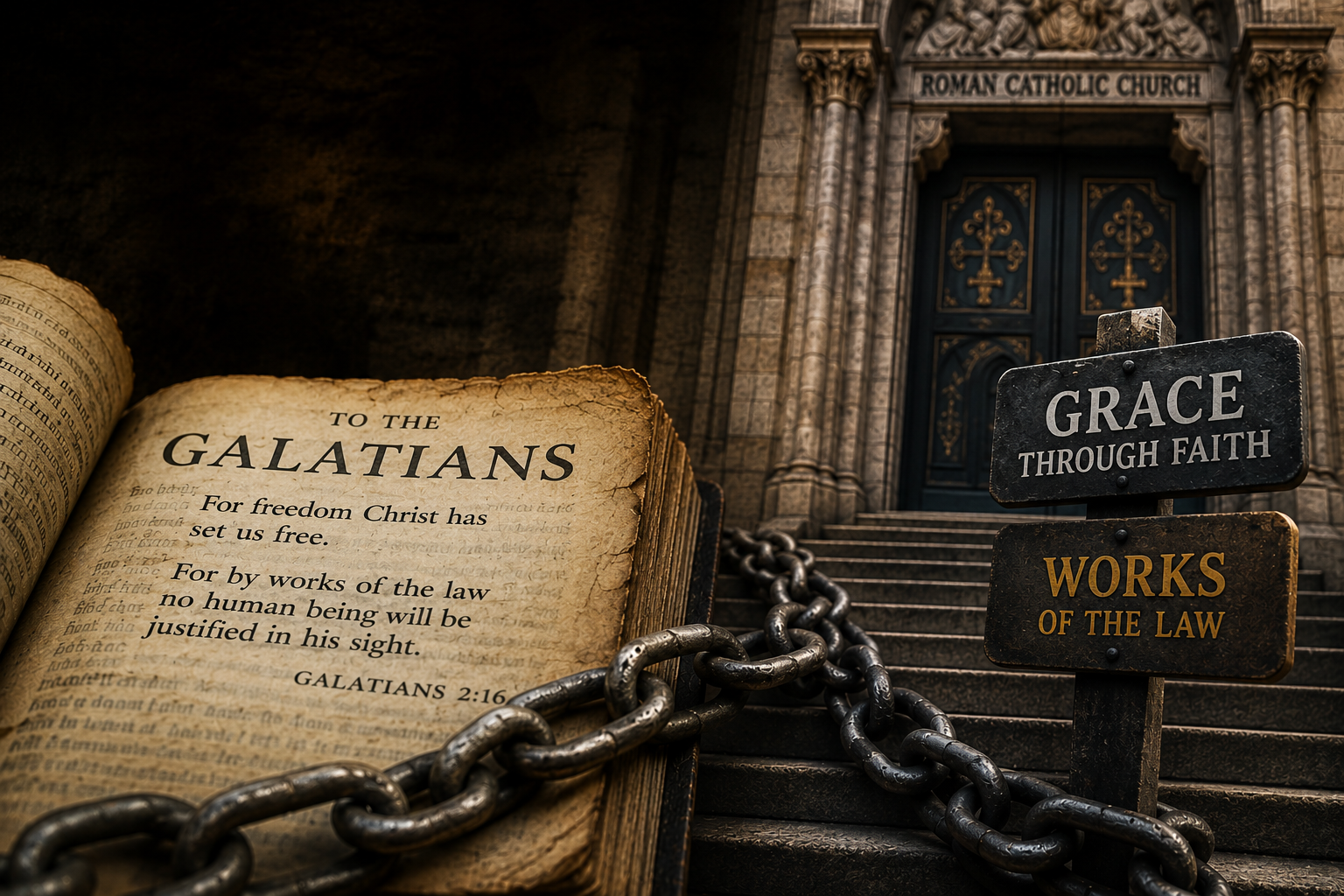
Some time ago, I reviewed a debate between Allen S. Nelson IV, pastor of Providence Baptist Church, and Father Stephen Hart of Sacred Heart Church on the question of whether the Roman Catholic Church is a gospel-denying church. (See my review here.) This debate centered on the doctrine of justification and exposed the fundamental differences between Protestant and Roman Catholic understandings of how a person is made right before God. Of course, justification stands at the very center of the gospel itself; it is not merely a secondary disagreement between theological traditions. A distorted understanding of justification necessarily distorts the good news because it touches the question of how sinners are reconciled to God through Christ. And this is precisely the issue that the Apostle Paul takes up in the Epistle to the Galatians. In Galatians, Paul argues with remarkable force that justification is by faith apart from works of the law and warns that any alteration of the gospel strikes at the heart of Christian truth. In this post, then, I would like to consider how Paul’s argument in Galatians relates to the Roman Catholic understanding of justification, because if the message of Galatians is taken seriously, it forces us to ask whether justification can, in any sense, be grounded in works without compromising the gospel itself.

The situation addressed in the Epistle to the Galatians is relatively well known, but it is worth reviewing briefly for the sake of clarity. Sometime after Paul’s first missionary journey, it appears that a group of Jewish Christians came into the churches of Galatia and began teaching that Gentile believers needed to be circumcised and adopt the Torah in order to be fully included among the people of God. (On the timeline of events in Galatia, see here.) These teachers are often described as “Judaizers,” though the issue at stake is frequently misunderstood. They were not simply advocating for moral effort or “legalism” in the modern sense of the term. Rather, they were challenging the basis upon which Gentiles could belong to the covenant community. Was faith in Christ sufficient, or did covenant membership require obedience to the Mosaic law as well? In other words, the issue was not whether obedience mattered in the Christian life. Paul himself repeatedly affirms the necessity of holiness and faithful living. The question, rather, was whether obedience to the law contributed in any sense to justification and covenant inclusion. And it is precisely at this point that Paul responds with extraordinary urgency, because for him the integrity of the gospel itself was at stake.

Against this backdrop, Paul’s central claim is that “no one is justified before God by the law, because the righteous will live by faith” (3.11). The question, of course, revolves around what Paul means by the term “justified.” However, the qualifying phrase “before God” is especially revealing. Paul is not speaking primarily about inward moral transformation or spiritual renewal, important as those realities are elsewhere in his theology. Rather, he is speaking about a person’s standing before the divine judge. Justification, then, is fundamentally forensic in nature. It is a legal declaration in which the believer is counted righteous before God on the basis of faith rather than works of the law. This is why Paul consistently contrasts justification with human obedience throughout Galatians. If righteousness could be obtained through the law, then there would be no need for Christ’s death (2.21). The issue is not whether good works follow genuine faith; Paul clearly believes that they do. The issue is whether those works contribute in any sense to the believer’s right standing before God. Paul’s answer is emphatic and uncompromising: sinners are justified by faith in Christ apart from the works of the law. Their acceptance before God rests not in their own obedience, but in the saving work of Christ received through faith.

However, the question must still be asked: what exactly does Paul mean by “works of the law”? In recent decades, the so-called “New Perspective on Paul,” especially in the work of James D. G. Dunn, has argued that these “works” refer primarily to Jewish socio-religious boundary markers such as circumcision, Sabbath observance, and food laws. On this reading, Paul’s concern is chiefly horizontal. The issue is how Jews and Gentiles can exist together within the same covenant community without the Torah functioning as a barrier between them. There is certainly truth in this observation, especially given the prominence of circumcision in Galatians itself. However, this understanding is ultimately too narrow because it does not fully account for Paul’s repeated emphasis on justification “before God.” Paul’s concern is not merely social fellowship, but a person’s standing before the divine judge. Therefore, “works of the law” cannot be reduced simply to ceremonial observances or ethnic boundary markers. Rather, the phrase must encompass any attempt to establish righteousness before God through obedience to the law. This is precisely why Paul contrasts law and promise, works and faith, curse and blessing. For Paul, the law cannot justify because fallen humanity cannot keep it perfectly. Faith, by contrast, receives what God promises in Christ rather than attempting to achieve righteousness through human obedience.

This is made clear by the way that Paul builds his argument in Galatians, namely on a series of theological contrasts that structure his understanding of the gospel itself. Central to his reasoning is the example of Abraham. Long before the giving of the law, Abraham “believed God, and it was credited to him for righteousness” (3.6). This point is crucial because it demonstrates that justification by faith precedes the Mosaic covenant altogether. The promise given to Abraham was received through faith, not through obedience to the law. The law, therefore, cannot function as the basis of justification because it was never the foundation of God’s covenant promises to begin with. Rather, Paul argues that the law was temporary, added “because of transgressions” until the coming of Christ (3.19). This is why Paul consistently contrasts promise and law, Spirit and flesh, faith and works throughout the letter. These are not complementary paths to justification, but fundamentally different principles. The law demands obedience and pronounces a curse upon those who fail to keep it perfectly, whereas faith receives the promise of God fulfilled in Christ. This is why Paul reacts so strongly to the Galatian error. The law does not complete what faith begins—it belongs to a different order altogether. To return to the law as the ground of justification is not spiritual maturity; it is, in Paul’s view, a departure from the very logic of the gospel itself.

This is perhaps why Paul speaks with such force in the opening of the Epistle to the Galatians. In 1:9, he writes, “As we have said before, I now say again: If anyone is preaching to you a gospel contrary to what you received, a curse be on him!” For Paul, this is not rhetorical exaggeration or emotional overstatement; it is covenantal seriousness. The gospel is not infinitely flexible or open to revision. It is the announcement of what God has accomplished in Christ for the salvation of sinners, and therefore to alter the basis of justification is to alter the gospel itself. This is precisely why Paul reacts so strongly to the teaching of the Judaizers. In his view, adding obedience to the law as a condition of justification does not merely supplement the gospel—it fundamentally changes its character. The issue is not whether circumcision or obedience have value in themselves; the issue is whether they contribute to a person’s right standing before God. Once works are introduced as part of the ground of justification, faith in Christ alone is no longer sufficient. And for Paul, that is not a small theological mistake, but a corruption of the gospel itself.

At this point, it is worth bringing Paul’s argument into conversation with the Roman Catholic understanding of justification, especially as articulated at the Council of Trent. To be clear, the Roman Catholic position is not identical to the error confronted in Galatia. The Judaizers were specifically requiring circumcision and Torah observance for covenant inclusion, whereas Roman Catholic theology affirms the necessity of grace and the centrality of Christ’s work. Nevertheless, there are important structural similarities that raise serious theological concerns. According to Trent, justification is not merely the forgiveness of sins, but also “the sanctification and renewal of the inward man” (Session 6, Chapter 7). Likewise, Trent teaches that the justified “through the observance of the commandments of God and of the Church, faith cooperating with good works, increase in that justice received through the grace of Christ” (Session 6, Chapter 10). In other words, justification in Roman Catholic theology includes transformative righteousness and can increase through obedience. But this is precisely where the tension with Galatians emerges. Paul consistently treats justification as a forensic declaration received through faith apart from works of the law. The question, then, is unavoidable: if justification is maintained or increased through works, even grace-enabled works, does this not reintroduce the very dynamic Paul rejects? Put differently, does the Roman Catholic system preserve the sufficiency of faith in Christ alone, or does it ultimately ground final justification, at least in part, in human obedience? At the very least, Trent’s understanding of justification is horribly confused and differs significantly from Paul’s argument in Galatians.

Now, in the interest of completeness, it is equally important to consider how the message of the Epistle to the Galatians might speak to those of us on the Protestant side of the aisle as well. As I noted in my original review, Protestants often have a tendency to underemphasize the importance—indeed, even the necessity—of good works in the Christian life. In some circles, the gospel is reduced to little more than a kind of “get out of hell free” card: simply believe in Jesus and secure your eternal destiny. But this reductionistic understanding of salvation severely minimizes the transforming power of grace and the necessity of Spirit-empowered obedience. Paul himself never makes this mistake. While he fiercely rejects works as the basis of justification, he equally insists that genuine faith necessarily produces obedience. This is why he can say in Galatians 5.6 that “what matters is faith working through love.” For Paul, obedience is not opposed to faith; rather, obedience is the fruit of true faith. The problem, then, is not works in themselves, but works placed in the wrong category. Works cannot justify the sinner before God, but they are the inevitable result of union with Christ and the indwelling work of the Spirit. Grace does not merely forgive; it transforms.

In theological categories, this process is known as sanctification, that is, the lifelong work of growing in conformity to the character of Christ through the power of the Holy Spirit. In the language of the Epistle to the Galatians, this is described as “walking by the Spirit” and cultivating the “fruit of the Spirit,” namely “love, joy, peace, patience, kindness, goodness, faithfulness, gentleness, and self-control” (5.22–23). The point is that while sanctification is logically distinct from justification, it is not altogether separate from it. The faith that justifies is never barren or inactive. We are justified by faith alone, but the person who is truly justified by faith will necessarily grow in holiness and produce the good works of Christlike character. This is why Paul can reject works as the basis of justification while simultaneously insisting upon obedience as the necessary fruit of life in the Spirit. Indeed, this is essentially the same point made by the Epistle of James in its discussion of faith and works, a point Paul himself would affirm wholeheartedly. Works do not secure our standing before God; rather, they demonstrate that our faith is living and genuine. Grace not only pardons the sinner, it transforms him.

What emerges from Galatians, then, is a clear theological order that must not be confused or reversed. First comes faith, and through faith comes justification, that once-for-all declaration in which the sinner is counted righteous before God on the basis of Christ alone. Then comes the gift of the Spirit, through whom the believer is progressively transformed into the image of Christ. Finally, obedience follows as the fruit of this new life in the Spirit. In other words, the imperatives of the Christian life flow out of the indicatives of the gospel. We obey because we have been accepted in Christ, not in order to be accepted by him. This is precisely why Paul can simultaneously reject justification by works while insisting upon the necessity of holiness. The Christian life is not opposed to obedience; it is grounded in grace-enabled obedience that flows from faith. But the order matters immensely. To place works before justification, or to make obedience part of the ground of our acceptance before God, is to reverse Paul’s entire theological structure and, in doing so, distort the very nature of the gospel itself.

In conclusion, then, we must affirm that the question of justification as it relates to faith and works is a foundational question when it comes to the clarity of the gospel itself. As Paul warns in the Epistle to the Galatians, to distort the gospel is to come under the curse of God. And while I do not think that the Roman Catholic Church falls under this curse in a simplistic or one-to-one sense, I do believe that the formulations of the Council of Trent are deeply confused on the question of justification and, in important ways, structurally parallel the very concerns Paul raises in Galatians. At the same time, Protestants must also resist the temptation to reduce the gospel to mere intellectual assent divorced from holiness and obedience. Paul rejects both legalism and moral indifference. The gospel he proclaims is one in which sinners are justified by faith alone and then transformed by the power of the Spirit into lives of joyful obedience. Faithful theology, then, requires more than loyalty to tradition or theological systems. It requires that we let Paul define the gospel on his own terms—and then have the courage to examine our systems in light of that definition.

On Deborah, Barak, and the “Failure of Men” Hypothesis

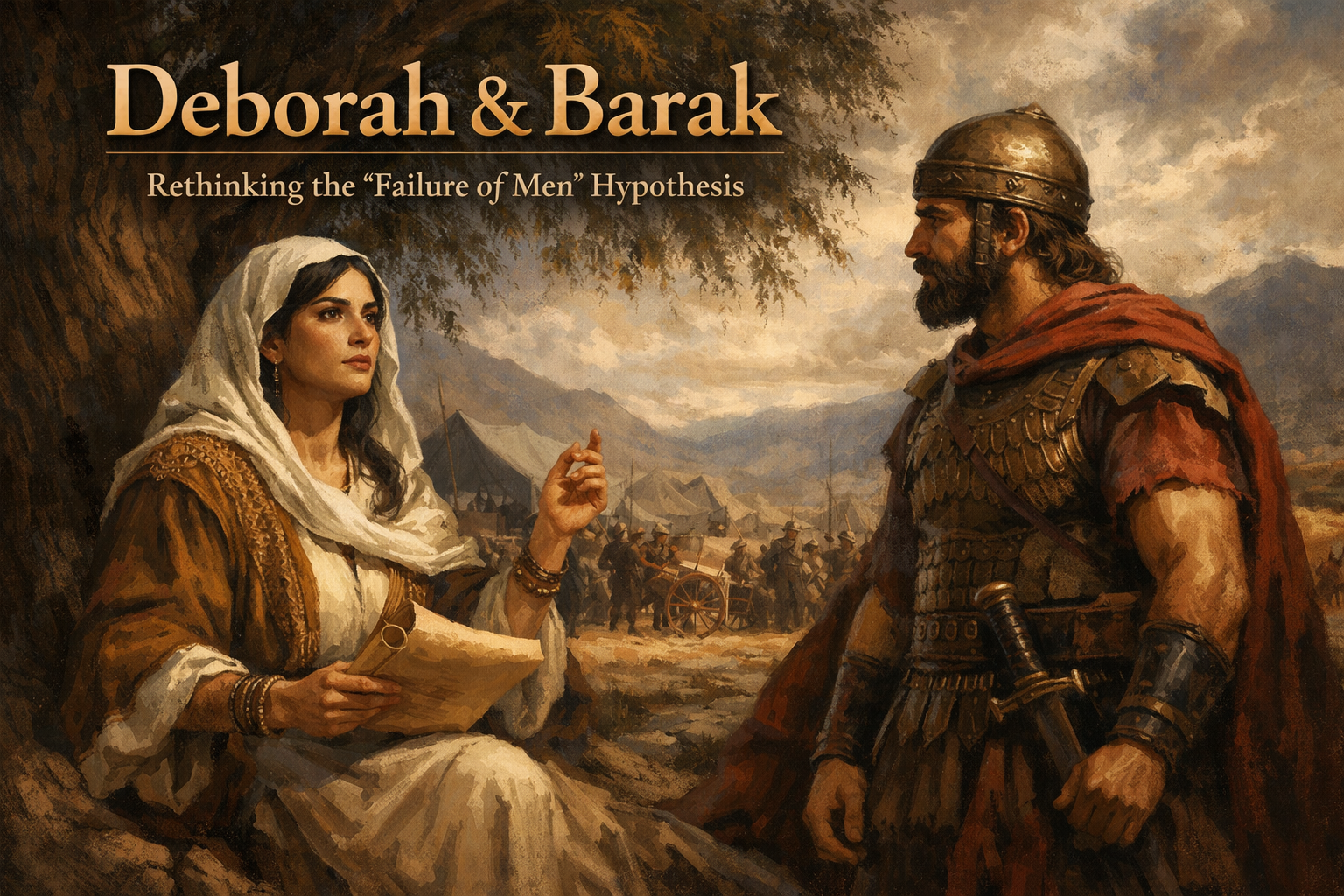
I was recently reading through the Book of Judges as part of my Bible reading plan, and I had the opportunity to revisit the story of Deborah and Barak (Judges 4–5). It is a remarkable account of how God delivered his people from Canaanite oppression and remained faithful to his covenant promises even when Israel was not faithful to him. At the same time, this passage often becomes a flashpoint in debates concerning gender roles in the home and in the church, particularly regarding the role of women. On the one hand, egalitarians point to Deborah as a paradigm for female leadership that should be emulated in the church today. On the other hand, complementarians often explain her leadership as the result of male failure, i.e. that God raised Deborah because no man was willing to step forward. It is this latter claim that I would like to examine in this post. While the “failure of men” hypothesis may resonate with certain instincts and seems to account for Barak’s initial hesitation, it ultimately goes beyond what the text itself supports. Deborah’s role is not presented as a corrective to male absence, nor as a structural shift in leadership patterns. Rather, Judges 4–5 presents a more complex picture of divine deliverance, prophetic authority, and covenant faithfulness.

Textually, the “failure of men” hypothesis is built on Barak’s apparent hesitation. In Judges 4.8, when Deborah instructs Barak to gather the tribes in preparation for battle, he responds, “If you will go with me, I will go. But if you will not go with me, I will not go.” Deborah agrees to accompany him, but she also declares that the honor of the victory will not go to Barak. From this, the argument is often made that Barak’s hesitation reveals a lack of courage or leadership, and that Deborah steps in to fill the resulting gap. The conclusion, then, is that God raises up women to lead when men fail. While it is certainly true that Barak hesitates and that Deborah plays a central leadership role, this conclusion goes beyond what the text itself actually supports. It does not arise from the narrative so much as it is imposed upon it. The issue is not whether Deborah leads—the text clearly affirms that she does—but whether her leadership is presented as a response to male absence or failure.

A close and careful reading of the text reveals that Deborah is introduced first, and she is already functioning in a leadership role before Barak even appears in the narrative. In Judges 4:4–5, we are told that “Deborah, a prophetess and the wife of Lappidoth, was judging Israel at that time,” and that the people of Israel came to her for judgment. This indicates that Deborah was already established as both a prophetess and a judge. She is not raised up in response to Barak; she is already exercising leadership within Israel. Moreover, it is Deborah who summons Barak and speaks with divine authority as she relays the Lord’s command (4:6–7). In other words, the initiative in the narrative belongs to God through Deborah, not to a vacuum created by men. As for Barak, as noted above, he does appear to hesitate in response to the Lord’s command. However, this is not an outright refusal to lead, but a form of conditional obedience. He expresses a desire for the Lord’s prophet to accompany him in the task. Importantly, Deborah does not rebuke or condemn him for this response. Instead, she simply declares that the honor of the victory will go to a woman. This is a prophetic statement of outcome, not a moral indictment. Deborah supports Barak in his role; she does not portray him as a failed leader.

The key to understanding this narrative comes in chapter 5. Judges 5 is a poetic retelling of the events of chapter 4, and as such, it functions as the inspired interpretation of those events. In the song, Deborah is praised as “a mother in Israel” (5:7), but just as importantly, Barak is also commended. He is included among the military leaders who participated in the Lord’s deliverance, and nowhere in the song is he criticized or portrayed as a failed or reluctant figure. The narrative simply does not frame Barak as a man who failed to lead. In fact, the only explicit condemnation in the song appears in verse 23, which reads “Curse Meroz,” says the angel of the Lord, “bitterly curse her inhabitants, for they did not come to help the Lord, to help the Lord with the warriors.” Meroz, likely a nearby town expected to join the battle, is condemned precisely because it failed to respond. This is significant. If the narrator intended to highlight male failure in Barak, he had the language and categories to do so—and he uses them elsewhere in the text. But Barak is never cursed, rebuked, or condemned. Instead, he is remembered as one who participated in the Lord’s victory. The silence of the text where we might expect condemnation is itself interpretively significant.

Stepping back from the story of Deborah and Barak, the broader pattern of the Book of Judges is that Israel’s history follows a predictable cycle. The people fall into sin, God punishes them with oppression, they cry out for deliverance, and the Lord raises up a judge to rescue them. Yet this cycle does not simply repeat—it spirals downward. As the narrative progresses, the judges themselves become increasingly flawed, and the moral and spiritual condition of Israel deteriorates. We need only consider figures like Gideon, Jephthah, and Samson to see that the author of Judges knows how to highlight the failures of male leadership when he intends to do so. Their weaknesses are not subtle; they are central to their stories. But Deborah’s narrative does not function in this way. She is presented as a faithful and effective leader, and Barak is not portrayed as a cautionary figure. In other words, the text does not present Deborah as a divine workaround for male incompetence, but as a legitimate agent of God’s deliverance within a broader pattern of imperfect yet usable leaders.

So, what do we do with Deborah? The fact of the matter is that Deborah does lead. She is a prophetess and a judge, and she is used powerfully by God in the deliverance of his people. However, her role must be understood within its narrative and redemptive context, not abstracted into a universal principle. On the one hand, we should not use Deborah to overturn broader biblical patterns of leadership and authority. This is the well-known distinction between what is descriptive and what is prescriptive. In this narrative, Deborah is described as a faithful and effective leader through whom God works; she is not explicitly presented as a paradigm for leadership structures in the home or the church. On the other hand, we must also resist the impulse to minimize or dismiss her role. Deborah is not an anomaly to be explained away. She is a genuine agent of God’s deliverance, and her story is preserved in Scripture as part of God’s inspired revelation. Her leadership is real, authoritative, and significant. Yet the text itself does not frame her role as establishing a normative pattern for ecclesial or domestic leadership. Rather, it highlights the sovereignty of God, who works through whom he wills to accomplish his purposes.

The point of all this is to say that the story of Deborah and Barak is not about gender polemics. This is a concern that is external to the text and often imposed upon it by modern debates. This does not mean that those debates are unimportant; they are all the more pressing in this current cultural moment. But, the question is not what Deborah means for our debates, but what this text reveals about how God works in the history of his people. The narrative of Deborah and Barak directs our attention elsewhere. This story is about God’s faithfulness to his promises, his sovereignty over his people and their circumstances, and his willingness to use unexpected agents to accomplish his purposes in the world. Throughout the Book of Judges, Israel repeatedly proves unfaithful, yet God remains steadfast. He raises up deliverers, not because of their inherent greatness, but because of his covenant commitment. Deborah and Barak are no exception. Their story highlights the fact that God is not limited by human expectations, conventions, or categories. He works through whom he wills and accomplishes his purposes in ways that often surprise us. The emphasis of Judges 4–5 is not that men failed, but that God delivers his people often in ways that subvert human expectations and call us to trust in his sovereign power rather than our own assumptions.

In the end, this discussion brings us back to a matter of method. We must let the text speak for itself rather than imposing our own categories and concerns upon it. The “failure of men” hypothesis ultimately reads more into the narrative than it draws out of it, importing assumptions that the text itself does not explicitly support. Deborah is neither an anomaly to be explained away nor a weapon to be deployed in broader ideological debates. She is a faithful servant of the Lord, raised up within a particular moment in Israel’s history to accomplish God’s purposes for his people. Her story reminds us that God is both sovereign and free in the instruments he chooses to use. At the same time, it calls us to read Scripture carefully, attentively, and humbly. Faithful interpretation requires that we resist the urge to make the text serve our frameworks, and instead allow it to shape them, even when it refuses to fit neatly into our categories.


On the Narrative Logic of John 21

The twentieth chapter of John’s Gospel is full of climactic moments. Not only does it record the resurrection of Jesus and his interaction with Mary in the garden, but it also tells the story of Jesus’s appearance to his disciples in the upper room (On the Johannine Pentecost) and the climactic confession of Thomas a week later. The chapter ends with a clear purpose statement when John writes, “Jesus performed many other signs in the presence of his disciples that are not written in this book. But these are written so that you may believe that Jesus is the Messiah, the Son of God, and that by believing you may have life in his name.” (20.30-31) To many, these verses sound like an appropriate conclusion to John’s Gospel; for this reason, many scholars (and some readers) treat John 21 as a kind of appendix or addendum or afterthought. Although there is no manuscript evidence to support this claim, it is often argued that if chapter 20 brings the Gospel to its climactic conclusion, then why would John write chapter 21? It seems unnecessary. From a narrative perspective, John 21 is not an awkward appendix but the necessary completion of the Gospel’s story. It resolves tensions left intentionally open in chapter 20 and brings the Gospel’s themes — discipleship, love, witness, and mission — to their proper conclusion.

As I noted above, John 20 is the clear climax of John’s Gospel. Jesus is resurrected, the disciples are commissioned, and Thomas confesses Jesus as “My Lord and my God.” (20.28) This confession serves as a kind of bookend in the book that points the reader back to John’s opening where he affirms that Jesus is the Word that was with God and was God and was made flesh and dwelt among us. (1.1, 14) Following these climactic moments, it only makes sense that John’s purpose statement in verses 30-31 would bring the Gospel to its logical conclusion. This chapter proves that Jesus is the Christ of God, and that faith in Him as the resurrected one results in eternal life. The end. Or so one would think. Not only is there no manuscript evidence that John’s Gospel should end in chapter 20 (as there is with Mark’s ending, on which see here), but if John were to end his gospel with chapter 20, then there would be many narrative threads that would remain unresolved. What becomes of Peter after his denial? What becomes of the beloved disciple? What becomes of the disciples’ mission? Yes, chapter 20 concludes the narrative arc of Jesus’s identity, but chapter 21 goes on to explain what that revelation now means for the followers of Jesus.

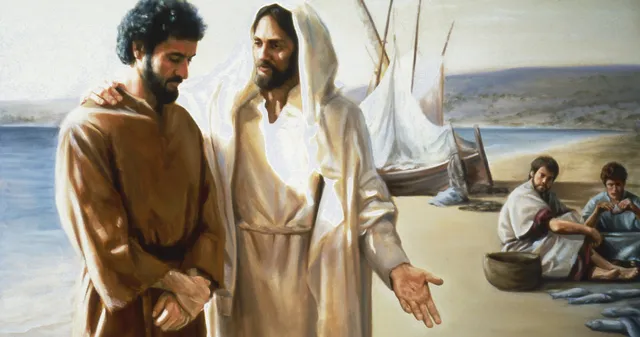
John 21 returns the reader to the Sea of Tiberias, aka the Sea of Galilee. Narratively, this is a return to where it all began. Not only did Jesus begin his public ministry in Galilee, but he also called the first four disciples after a night of fishing on the Sea of Galilee. The scene intentionally echoes the earlier calling narrative familiar from Luke 5. After a night of fruitless labor, Jesus shows up and tells them to cast their nets on the other side of the boat. They haul in a catch that is nearly too large, and Jesus commissions them to discipleship and mission. Many interpret this scene as a regression for the disciples, a return to the life and vocation before Christ. However, in light of this parallel, this scene should be understood not as a regression, but as narrative symmetry. John intentionally returns his readers to the beginning to show that the resurrection does not erase vocation — it redefines it. Vocation that is engaged apart from radical dependence on the risen Christ is utterly futile, but when vocation is entered into from a position of dependence and obedience to the risen Christ, then it is abundantly fruitful. When we submit our vocation to the mission of Jesus, then we will reap abundant fruit and reward. Even so, the real center of John 21 is not fish, it is Peter.

Of course, all four Gospels record Peter’s three denials of Jesus on the night of Jesus’s arrest, but John is the only one who records Peter’s restoration. (Luke hints at the idea when Jesus tells him that after returning, he will encourage his brothers.) John deliberately connects the scene in John 21 back to the denial scene by noting that Jesus prepared a “charcoal fire” and the threefold repetition of the question “Peter, do you love me?” matching Peter’s three denials. Some tend to make a big deal out of the various words that are used for love in Peter’s answers, but this is overplayed. Not only were the words basically synonymous in the first century, but the idea that Peter’s love did not rise to some divine standard is wholly alien to the logic of the text. This is a threefold public restoration that corresponds to Peter’s threefold public failure. Moreover, it reveals the pastoral tenderness of Jesus. Jesus does not scold Peter; he does not call him out over his failures. He doesn’t berate or condemn him. He graciously restores Peter to ecclesial service. “Feed my lambs. Shepherd my sheep. Feed my sheep.” This commission is not merely personal therapy for Peter; it is an ecclesial necessity. John cannot end his Gospel with Peter in unresolved failure. The shepherd of the disciple group must be restored if the flock is to endure. But Peter is not the only disciple in view here either.

After his restoration, Peter noticed the disciple whom Jesus loved and he asks Jesus, “Lord, what about him?”, and Jesus responds, “What is that to you? As for you, follow me.” (21.20-22) Jesus’s point is that he has different callings for each of his followers, and that following Christ is more important than comparing callings. Peter’s calling was to shepherding and martyrdom; the beloved disciple’s calling was to abiding ministry and public/written testimony. As he writes in 21.24, “This is the disciple who testifies to these things and who wrote them down. We know that his testimony is true.” Not only is this important for establishing the credibility and reliability of John’s Gospel, but it is also a fundamental component of John’s understanding of what it means to be a disciple of Jesus. To put it another way, John 21 grounds the authority of the Gospel in eyewitness testimony while clarifying that discipleship does not look identical for all. We all serve the risen Christ, but we all serve him in different and varied ways. These verses are not just random narrative details added on to the end of the story; they are essential for completing John’s theology of discipleship.

In other words, for John, discipleship is a life that is characterized by following Jesus, loving Jesus, abiding in Jesus, and witnessing to the truth about Jesus. When we confess Christ (chapter 20), he commissions us to a life of embodied mission (chapter 21). If we truly believe that Jesus is the risen Christ (and he is), then we will follow him in whatever calling he has placed on our lives. Put differently, discipleship is the vocation of following Jesus. The risen Christ is not merely to be believed in — he is to be followed. If we say we love Christ, we will commit ourselves to and give ourselves for the care of his people. Moreover, John hints at the fact that discipleship can involve suffering. In 21.18, Jesus tells Peter, “when you grow old, you will stretch out your hands and someone else will tie you and carry you where you don’t want to go.”, and John explains that “He said this to indicate by what kind of death Peter would glorify God.” (21.19) This is part of the vocation of discipleship, too. We must be willing to follow Jesus wherever he leads; this is the kind of discipleship that Jesus is calling us all too.

However, returning to my thesis, without John 21, Peter’s denial remains unresolved, the beloved disciple’s authority is unexplained, and the future of the community of Jesus followers is unclear. In terms of John’s narrative, John ends his gospel not with spectacle but with discipleship as vocation. Chapter 20 concludes the revelation of Jesus’s identity, and chapter 21 concludes the formation of Jesus’s community. Or to put it another way, John 20 answers the question “Who is Jesus?”, and John 21 answers the question “What now?” Without this pastoral and ecclesial resolution, John’s Gospel would be incomplete. John does not end his Gospel in private mystical belief. He ends it with shepherding, witness, martyrdom, and mission. And he leaves the end of the story open when he writes, “And there are also many other things that Jesus did, which, if every one of them were written down, I suppose not even the world itself could contain the books that would be written.” In other words, the story is ongoing, and all the things that the risen Jesus will do have not yet been completed even two thousand years later. John 21 is not a loose epilogue. It brings the Gospel to its proper end — not merely with a confession of Christ, but with the commissioning of those who will testify to him. The risen Lord restores the fallen, distinguishes callings, anchors testimony, and sends his followers into a future shaped by love and sacrifice. That is not an afterthought. That is narrative completion. And it poses the question to the reader, “Will you follow Jesus?”


On the Johannine Pentecost

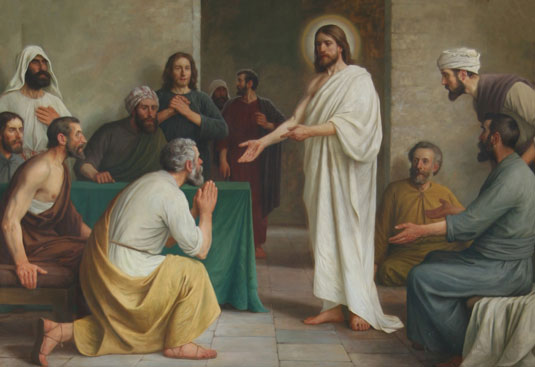
In John 20.19-23, Jesus appears in the upper room on the eve of his resurrection, and he breathes on the disciples saying, “Receive the Holy Spirit.” This is the so-called Johannine Pentecost, and at a glance, it would seem to contradict the very clear teaching of the book of Acts that the Spirit was given on the Day of Pentecost some 50 days after Jesus’s resurrection. If the events of that first Pentecost are understood as the climactic coming of the Spirit to indwell the followers of Christ, then Jesus’ giving of the Spirit in John 20.22 would seem to indicate that John (who was present at Pentecost) was hopelessly confused about the timeline. In the space the follows, I would like to suggest that John is not confused; rather, I think that John 20 presents Jesus’ giving of the Spirit as the breath of the new creation in fulfillment of Ezekiel’s restoration promises and in turn, it grounds the church’s corporate authority to forgive in the life of the risen Christ.

Of course, scholars and pastors have tried to resolve this tension in a variety of ways throughout the history of the church, and here I will identify just four. First, some suggest that the giving of the Spirit in John 20 is a kind of proleptic gift, a partial filling, that was meant to steel the disciples until the climactic coming of the Spirit 50 days later. Others suggest that John has theologized the giving of the Spirit by temporally relocating the event to the resurrection and directly connecting it with the risen Christ in light of his own “realized eschatology”. Still others suggest that John 20 functions as a kind of apostolic commission for the disciples which establishes their role as authoritative leaders in the early church. Finally, and this is my view, but the giving of the Spirit in John 20 should be understood as the inauguration of the age of the New Covenant/New Creation. This is not in contradiction to the Book of Acts and its descriptions of the Day of Pentecost. Rather, John has compressed these events theologically by linking the resurrection of Jesus with the concept of new creation, the giving of the Spirit, and the inauguration of eschatological life. He does this by alluding to the creation account in Genesis 1-2 and the New Covenant/Resurrection account in Ezekiel 36-37.

In John 20, the scene opens “On the first day of the week” (20.1), and this temporal note is repeated in our passage in 20.19, “when it was evening on the first day of the week.” This is a clear allusion to the first day of creation in Genesis 1. In other words, with the resurrection of Jesus comes a new first day, a new creation. This allusion is further confirmed by the fact that the scene takes place in a garden (19.31), and Mary mistakes the risen Christ for the “gardener” (20. 15). This is most likely a typological allusion to Christ as the second Adam. More significantly, we are told that Jesus “breathed on them.” The Greek word here (ἐνεφύσησεν ) is a verb that only occurs here in the New Testament. In the Greek translation of the Old Testament (LXX), in Genesis 2.7, we read that “The the Lord God formed the man out of the dust from the ground and breathed the breath of life into his nostrils, and the man became a living being.” In the same way (and with same word) that God breathed life into Adam, so also the risen Christ breathes life into his disciples. This is not just incidental language; the Evangelist has utilized this rare word intentionally, because he wants to connect the resurrection of Jesus with the new creation. When Jesus breathes the Holy Spirit on the disciples, they become participants in a new humanity.

However, there is another important Old Testament allusion that stands in the background of John 20, and that is the description of the New Covenant and the story of the Dry Bones in Ezekiel 36-37. In Ezekiel 36.26-27 (also 37.14), we read,

I will give you a new heart and put a new spirit within you; I will remove your heart of stone and give you a heart of flesh. I will place my Spirit within you and cause you to follow my statutes and carefully observe my ordinances. 

And in Ezekiel 37.1-14, we read where Ezekiel is commanded to prophesy to the breath to “come from the four winds and breath (ἐμφύσησον) into these slain so that they may live.” In the same way that Ezekiel stood in the midst of the valley of dry bones and the dead came to life by the “breath/Spirit” of God, so also the risen Christ stands in the midst of his disciples who are “dead/paralyzed” in fear, and breathes into them the Spirit of life. Now, in the book of Ezekiel, these chapters drip with corporate overtones, particularly in regard to the restoration of the people of Israel. The dry bones coming to life is a symbol of national (and individual) resurrection and restoration, and the Johannine Pentecost symbolizes the eschatological restoration of the people of God, such that the 12 (or 11) disciples function as the nucleus of that people as a renewed Israel. The point is that John portrays the resurrection of Jesus as the moment when the promised Spirit of restoration becomes reality.

Now, it is important here that we stop and recall what John has already said back in John 7. 39, where we read, “Those who believed in Jesus were going to receive the Spirit, for the Spirit had not yet been given because Jesus had not yet been glorified.” This is the heart of John’s theology, namely that the glorification/exaltation of Christ comes in the crucifixion/resurrection of Jesus. We know this because, Jesus said in John 12:32, “As for me, if I am lifted up from the earth I will draw all people to myself.” He said this to indicate what kind of death he was about to die.” The verbal idea of being “lifted up” refers both to the kind of death he would die but also to the idea of exaltation. Point being that in John 20, Jesus has now been glorified and so the Spirit can now be given as a sign of eschatological life.

However, there is one more problem in this passage. In verse 23, we read where Jesus tells the disciples, “If you forgive the sins of any, they are forgiven them; if you retain the sins of any, they are retained.” Of course, this language also occurs in the Gospel of Matthew, in Matthew 16:19 in Jesus words to Peter and then again in 18:18 in the context of the Community Discourse. Clearly, this is the language of commissioning and authority, but exactly what kind of authority is in view here is debated. Some (particularly in the Roman Catholic and Eastern Orthodox traditions) understand these words to signify Apostolic/priestly authority to absolve sins. Others understand them to describe the authority of the church to announce the promise of forgiveness on the basis of the gospel. In my view, in the context of John 20, these words demonstrate that the Spirit-empowered community participates in the eschatological sorting of humanity. Forgiveness is determined by a person’s acceptance or rejection of the person and work of the Son (cf. John 3:18-21), but the church’s authority to forgive is part of its new-creation governance. In other words, just as the first humans were given dominion in the Garden of Eden (Genesis 1:28), so also the church as a new humanity is given Spirit-authorized responsibility as an agent of new-creation reconciliation. And John is clear that this authority is derivative, not autonomous; it flows from the risen Christ’s life and breath (i.e. Spirit).

In conclusion, then we must conclude that the Johannine Pentecost is not simply the relocation of the events of Acts 2; these are distinct narrative events serving distinct theological purposes. Whereas Acts emphasizes the public outpouring of the Spirit, the gift of tongues, and the church’s mission to the nations, John emphasizes the new creation, the restoration of the people of God, and ecclesial authority and identity. To put it more simply, John narrates the ontological beginning of the New Covenant age, and Luke narrates the Spirit-empowered expansion of the church’s mission. There is no contradiction; these are simply two theological angles on one redemptive reality. By tying his narrative to Genesis and Ezekiel, John gives us a theologically robust understanding of the significance of Christ’s resurrection. More importantly though, John 20.19-23 clearly demonstrates that the church exists because the risen Christ breathes his life into it. Its life is cruciform and Spirit-dependent, and its mission is one of reconciliation in the power of the new creation.


On Fuel for the Fires of Revival

TEXT

The high priest Hilkiah told the court secretary Shaphan, “I have found the book of the law in the Lord’s temple,” and he gave the book to Shaphan, who read it. Then the court secretary Shaphan went to the king and reported, “Your servants have emptied out the silver that was found in the temple and have given it to those doing the work—those who oversee the Lord’s temple.” 10 Then the court secretary Shaphan told the king, “The priest Hilkiah has given me a book,” and Shaphan read it in the presence of the king.

11 When the king heard the words of the book of the law, he tore his clothes. 12 Then he commanded the priest Hilkiah, Ahikam son of Shaphan, Achbor son of Micaiah, the court secretary Shaphan, and the king’s servant Asaiah, 13 “Go and inquire of the Lord for me, for the people, and for all Judah about the words in this book that has been found. For great is the Lord’s wrath that is kindled against us because our ancestors have not obeyed the words of this book in order to do everything written about us.”

14 So the priest Hilkiah, Ahikam, Achbor, Shaphan, and Asaiah went to the prophetess Huldah, wife of Shallum son of Tikvah, son of Harhas, keeper of the wardrobe. She lived in Jerusalem in the Second District. They spoke with her. 15 She said to them, “This is what the Lord God of Israel says: Say to the man who sent you to me, 16 ‘This is what the Lord says: I am about to bring disaster on this place and on its inhabitants, fulfilling all the words of the book that the king of Judah has read, 17 because they have abandoned me and burned incense to other gods in order to anger me with all the work of their hands. My wrath will be kindled against this place, and it will not be quenched.’ 

18 Say this to the king of Judah who sent you to inquire of the Lord: ‘This is what the Lord God of Israel says: As for the words that you heard, 19 because your heart was tender and you humbled yourself before the Lord when you heard what I spoke against this place and against its inhabitants, that they would become a desolation and a curse, and because you have torn your clothes and wept before me, I myself have heard’—this is the Lord’s declaration. 20 ‘Therefore, I will indeed gather you to your ancestors, and you will be gathered to your grave in peace. Your eyes will not see all the disaster that I am bringing on this place.’” Then they reported to the king.

~2 Kings 22.8-20

Title: On Fuel for the Fires of Revival
Text: 2 Kings 22-23
Series: Revival Us Again!
Church: Redeemer Baptist Church, Jonesboro, AR
Date: December 28, 2025


On How Death is Gain when Our Life is Christ

TEXT

21 For me, to live is Christ and to die is gain. 22 Now if I live on in the flesh, this means fruitful work for me; and I don’t know which one I should choose. 23 I am torn between the two. I long to depart and be with Christ—which is far better— 24 but to remain in the flesh is more necessary for your sake. 25 Since I am persuaded of this, I know that I will remain and continue with all of you for your progress and joy in the faith, 26 so that, because of my coming to you again, your boasting in Christ Jesus may abound.

~Philippians 1.21-26

Title: On Death as Gain when Life is Christ
Text: Philippians 1.21-26
Occasion: Celebration of Life for Mr. Bobby Garrison
Church: Redeemer Baptist Church, Jonesboro, AR
Date: November 15, 2025


On Training in Godliness

TEXT

If you point these things out to the brothers and sisters, you will be a good servant of Christ Jesus, nourished by the words of the faith and the good teaching that you have followed. But have nothing to do with pointless and silly myths. Rather, train yourself in godliness. For the training of the body has limited benefit, but godliness is beneficial in every way, since it holds promise for the present life and also for the life to come. This saying is trustworthy and deserves full acceptance. 10 For this reason we labor and strive, because we have put our hope in the living God, who is the Savior of all people, especially of those who believe.

~1 Timothy 3.14-16

Title: On Our Training for Godliness
Text: 1 Timothy 4.6-10
Series: 1 Timothy: God’s Design for a Healthy Church
Church: Redeemer Baptist Church, Jonesboro, AR
Date: October 19, 2025


On Our Conduct as Members of the Local Church

TEXT

14 I write these things to you, hoping to come to you soon. 15 But if I should be delayed, I have written so that you will know how people ought to conduct themselves in God’s household, which is the church of the living God, the pillar and foundation of the truth. 16 And most certainly, the mystery of godliness is great:

He was manifested in the flesh,
vindicated in the Spirit,
seen by angels,
preached among the nations,
believed on in the world,
taken up in glory.

~1 Timothy 3.14-16

Title: On Our Conduct in the Local Church
Text: 1 Timothy 3.14-16
Series: 1 Timothy: God’s Design for a Healthy Church
Church: Redeemer Baptist Church, Jonesboro, AR
Date: October 5, 2025


On the Curse of Death and the Hope of Resurrection

TEXT

12 The iniquity of Ephraim is bound up;
His sin is stored up.
13 The pains of childbirth come upon him;
He is not a wise son,
For it is not the time that he should delay at the opening of the womb.
14 Shall I ransom them from the power of Sheol?
Shall I redeem them from death?
O Death, where are your thorns?
O Sheol, where is your sting?
Compassion will be hidden from My sight.

15 Though he flourishes among the reeds,
An east wind will come,
The wind of the Lord coming up from the wilderness;
And his fountain will become dry
And his spring will be dried up;
It will plunder his treasury of every precious article.
16 Samaria will be held guilty,
For she has rebelled against her God.
They will fall by the sword,
Their little ones will be dashed in pieces,
And their pregnant women will be ripped open.

~Hosea 13.12-16 (NASB95)

Title: On the Curse of Death and the Hope of Resurrection
Text: Hosea 13.12-16
Series: Hosea: A Love Story Like No Other
Church: Redeemer Baptist Church, Jonesboro, AR
Date: July 13, 2025


On the Danger of Mixing Religion with Politics

TEXT

Put the ram’s horn to your mouth!
One like an eagle comes
against the house of the Lord,
because they transgress my covenant
and rebel against my law.
Israel cries out to me,
“My God, we know you!”
Israel has rejected what is good;
an enemy will pursue him.

They have installed kings,
but not through me.
They have appointed leaders,
but without my approval.
They make their silver and gold
into idols for themselves
for their own destruction.
Your calf-idol is rejected, Samaria.
My anger burns against them.
How long will they be incapable of innocence?
For this thing is from Israel—
a craftsman made it, and it is not God.
The calf of Samaria will be smashed to bits!

Indeed, they sow the wind
and reap the whirlwind.
There is no standing grain;
what sprouts fails to yield flour.
Even if they did,
foreigners would swallow it up.
Israel is swallowed up!
Now they are among the nations
like discarded pottery.
For they have gone up to Assyria
like a wild donkey going off on its own.
Ephraim has paid for love.
10 Even though they hire lovers among the nations,
I will now round them up,
and they will begin to decrease in number
under the burden of the king and leaders.
11 When Ephraim multiplied his altars for sin,
they became his altars for sinning.
12 Though I were to write out for him
ten thousand points of my instruction,
they would be regarded as something strange.
13 Though they offer sacrificial gifts
and eat the flesh,
the Lord does not accept them.
Now he will remember their guilt
and punish their sins;
they will return to Egypt.
14 Israel has forgotten his Maker and built palaces;
Judah has also multiplied fortified cities.
I will send fire on their cities,
and it will consume their citadels.

Title: On the Danger of Mixing Religion with Politics
Text: Hosea 8.1-14
Series: Hosea: A Love Story Like No Other
Church: Redeemer Baptist Church, Jonesboro, AR
Date: May 11, 2025


Slow To Write

"let every person be quick to hear, slow to speak, slow to anger."

lovegavehope

Just another WordPress.com site

Jared Cornutt

Pastor | Speaker | Writer

Denny Burk

A commentary on theology, politics, and culture

G3 Ministries

Events + Resources for the Local Church

Biblical Reasoning

Biblical and Systematic Theology According to the Scriptures

RetroChristianity

Reclaiming the Forgotten Faith

SBC Voices

Southern Baptist News & Opinion

Lucid Theology

Thoughts on words, books, theology, and life.

Baptist21

A pastor-led voice for Baptists in the 21st century

Center For Baptist Renewal

The Personal and Professional Blog of Phillip Powers

The Pastor's Well - Pastor Well

The Personal and Professional Blog of Phillip Powers

Articles - AlbertMohler.com

The Personal and Professional Blog of Phillip Powers

The Gospel Coalition

The Personal and Professional Blog of Phillip Powers