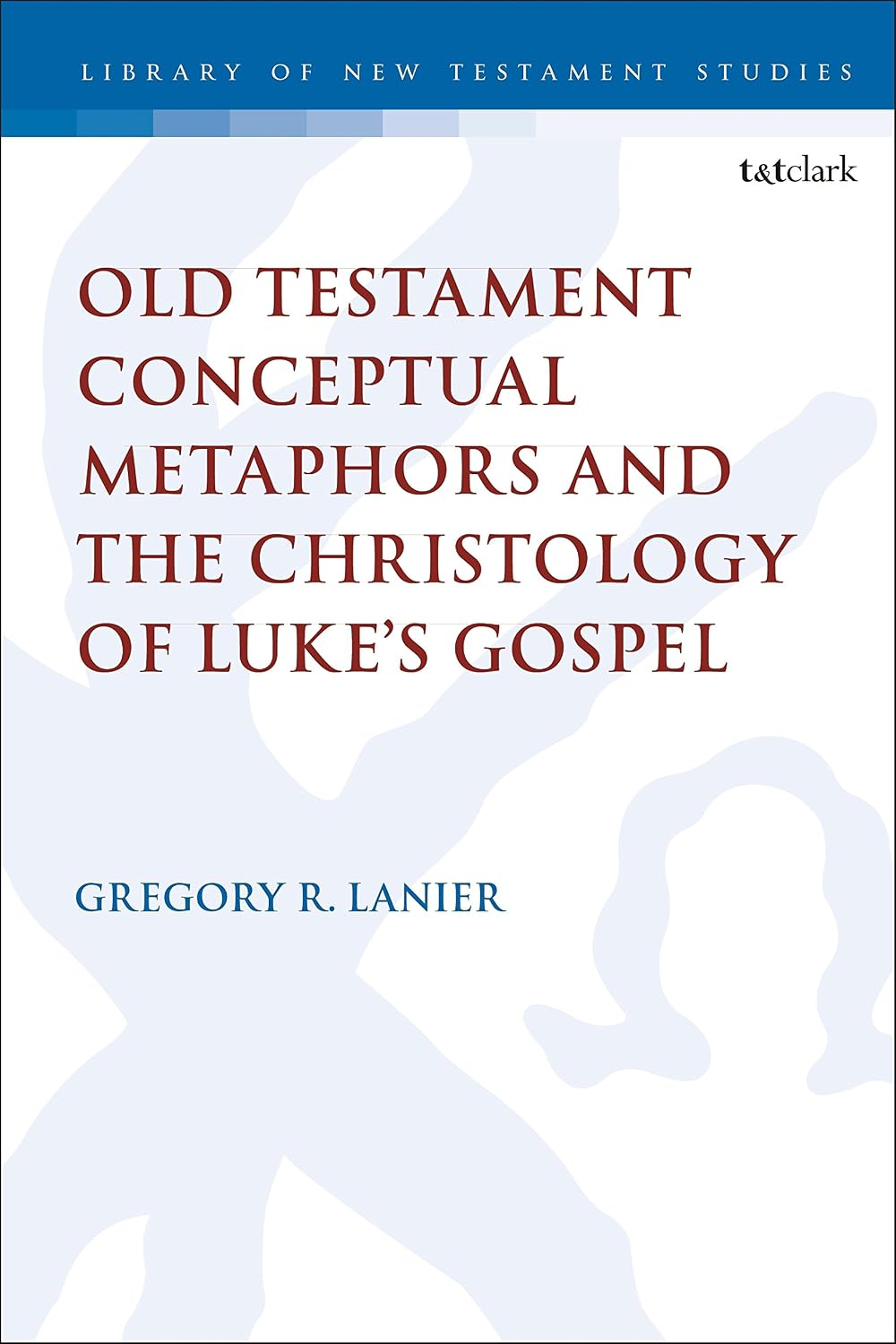
Lanier, Gregory R. Old Testament Conceptual Metaphors and the Christology of Luke’s Gospel. Library of New Testament Studies. London: T&T Clark, 2018.
The Christology of the canonical Gospels is remarkably multifaceted. From titles such as Son of God, Son of Man, Lord, and Christ, to John’s “I AM” statements, to the numerous Old Testament images and metaphors applied to Jesus, the Gospel writers employ a variety of categories to describe the complexity of Jesus’s person and work. No single title or image exhausts their Christological portrait; rather, it is through the convergence of these various titles, images, actions, and scriptural patterns that we begin to appreciate the fullness of their presentation of Christ. This is particularly important for the Gospel of Luke. While some have characterized Luke’s Christology as comparatively “low,” such a description can easily undersell the intricate ways in which Luke presents the identity and mission of Jesus. In his published dissertation, Old Testament Conceptual Metaphors and the Christology of Luke’s Gospel, Gregory R. Lanier takes up the question of Luke’s Christology by examining four characteristic metaphors that are distinctive to Luke’s Gospel. The result is a masterpiece of literary and exegetical analysis that demonstrates how deeply Luke’s presentation of Jesus is shaped by Old Testament patterns of thought. By tracing these metaphors through their Old Testament backgrounds and their distinctive deployment within Luke’s narrative, Lanier demonstrates that Luke’s Christology is considerably richer and more sophisticated than attention to explicit Christological titles alone might suggest.
Using the tools of conceptual metaphor theory (CMT), Lanier takes up four metaphors from the Gospel of Luke whose precise scriptural backgrounds and Christological significance have been variously interpreted. These four metaphors include the “horn of salvation” (Luke 1.68–69), the “dawn from on high” (Luke 1.78–79), the bird that gathers her chicks under her wings (Luke 13.34), and the “stone the builders rejected” (Luke 20.17–18). While scholars generally agree that these images draw upon the Old Testament and the interpretive world of Second Temple Judaism, there is considerably less agreement concerning which particular Scripture or Scriptures stand behind them and how those backgrounds illuminate Luke’s use of the images. Using CMT, Lanier approaches each image not simply as an allusion to a single Old Testament passage but as a conceptual metaphor drawing upon a wider network of Old Testament texts and images to map out the contours of Jesus’s person and work. Most significantly, Lanier argues that these metaphors draw upon imagery used in the Old Testament to describe the identity and activity of God, which Luke then reapplies to Jesus. The result contributes to a kind of “divine identity Christology” in which Jesus is portrayed as doing the kinds of things that Israel’s God does. Of course, these four metaphors do not exhaust Luke’s Christological perspective. Luke’s Christology is multilayered and must be constructed from the convergence of numerous titles, images, actions, and narrative patterns. Nevertheless, Lanier’s analysis demonstrates why the simple dichotomy between “high” and “low” Christology is inadequate for describing the complexity of Luke’s presentation of Jesus.
One of the greatest strengths of Lanier’s study is the explanatory power that conceptual metaphor theory brings to Luke’s use of Old Testament imagery. Studies of the New Testament’s use of the Old Testament often focus on identifying a particular source text behind a quotation or allusion. While this approach is useful when the textual relationship is relatively clear, it can prove more difficult when dealing with images that appear across a wide range of Old Testament texts. Lanier’s use of CMT provides a compelling way forward by allowing these metaphors to draw upon a broader network of scriptural associations rather than requiring them to depend upon a single identifiable source text. Thus, an image such as the “horn of salvation,” the dawning of light, the protection of a bird’s wings, or the rejected stone can evoke a constellation of Old Testament texts in which the same conceptual associations repeatedly occur. Importantly, this approach does not amount simply to collecting possible verbal parallels. Lanier demonstrates how recurring patterns of language and imagery establish conceptual relationships that would have shaped the meaning of these metaphors within the scriptural world inherited by Luke. This allows him to account for the richness of Luke’s imagery without reducing it to dependence upon any one passage. Lanier’s use of CMT therefore does more than identify additional Old Testament backgrounds for Luke’s language; it provides a compelling account of how a network of scriptural imagery can contribute cumulatively to Luke’s presentation of Jesus.
A second major strength of Lanier’s study is the Christological payoff that emerges from his analysis of these metaphors. Discussions of Luke’s Christology have often focused primarily on explicit Christological titles such as “Son of God,” “Son of Man,” “Lord,” and “Christ.” While these titles are undoubtedly important, Lanier demonstrates that Luke’s presentation of Jesus cannot be adequately reconstructed from titles alone. The conceptual metaphors examined in this study provide another important avenue through which Luke communicates Jesus’s identity and mission. Particularly significant is Lanier’s demonstration that each of these metaphors participates in patterns of Old Testament imagery associated with the identity and activity of YHWH. The significance of Luke’s application of these images to Jesus is therefore greater than the metaphors might initially suggest. Jesus does not merely perform actions analogous to those of other divinely appointed figures; he is portrayed through images that describe the saving, protecting, judging, and vindicating activity of Israel’s God. Lanier thus demonstrates how a robust Christology can emerge through the cumulative effect of Luke’s scriptural imagery without depending exclusively upon explicit statements concerning Jesus’s identity. This is one reason the traditional distinction between “high” and “low” Christology can prove inadequate for describing Luke’s Gospel. Lanier’s study shows that some of Luke’s most significant Christological claims are embedded within the scriptural images through which he narrates the identity and mission of Jesus.
The principal limitation of Lanier’s approach arises, somewhat ironically, from the same methodological breadth that makes his analysis so illuminating. By moving beyond the search for a single source text, CMT allows Lanier to account for the wider network of scriptural associations that may inform Luke’s metaphors. Yet this breadth also raises the question of how the interpreter determines the boundaries of that network. If a metaphor can draw upon a constellation of Old Testament texts without requiring a direct verbal correspondence with any one passage, it can become difficult to distinguish between conceptual associations that Luke plausibly intends to evoke and associations that are present within the broader scriptural tradition but may not contribute directly to the meaning of the Lukan text. Consequently, some of Lanier’s proposed connections are necessarily more persuasive than others, particularly where the linguistic or contextual relationship between Luke and the proposed Old Testament background is less explicit. This does not undermine the usefulness of CMT or the cumulative force of Lanier’s argument. Indeed, the recurrence of similar patterns across the four metaphors provides considerable support for his broader Christological conclusions. Nevertheless, the method places a significant burden upon the interpreter to demonstrate why particular texts and conceptual associations should be included within the relevant metaphorical network. Lanier’s study therefore demonstrates both the promise of CMT for the study of Luke’s use of Scripture and the need for careful exegetical controls when reconstructing the scriptural world that informs Luke’s Christological imagery.
In the final analysis, Old Testament Conceptual Metaphors and the Christology of Luke’s Gospel is an outstanding contribution to the study of Luke’s Christology and his use of the Old Testament. Lanier demonstrates both the explanatory value of conceptual metaphor theory and the importance of attending to forms of scriptural influence that extend beyond explicit quotations, direct allusions, and traditional Christological titles. His analysis of the “horn of salvation,” the “dawn from on high,” the gathering bird, and the rejected stone reveals how seemingly familiar images can carry a remarkable amount of Christological significance when situated within the broader conceptual world of Israel’s Scriptures. Although the breadth of CMT raises important questions concerning the boundaries and controls of these scriptural networks, Lanier applies the method with considerable exegetical care and produces a cumulative argument that is difficult to dismiss. More importantly, his study reminds us that Luke’s Christology cannot be adequately described simply by cataloguing the titles applied to Jesus or locating the Gospel somewhere along a spectrum from “low” to “high” Christology. Luke’s presentation of Jesus emerges from the convergence of titles, actions, narrative patterns, and deeply embedded scriptural images. Lanier has provided a compelling account of one important dimension of that portrait, and his study deserves serious attention from anyone interested in Luke’s Christology, Luke’s use of Scripture, or the relationship between the Old and New Testaments.