Tag Archives: The Olivet Discourse

On Mark 13 and the Return of the Shepherd: A Book Review

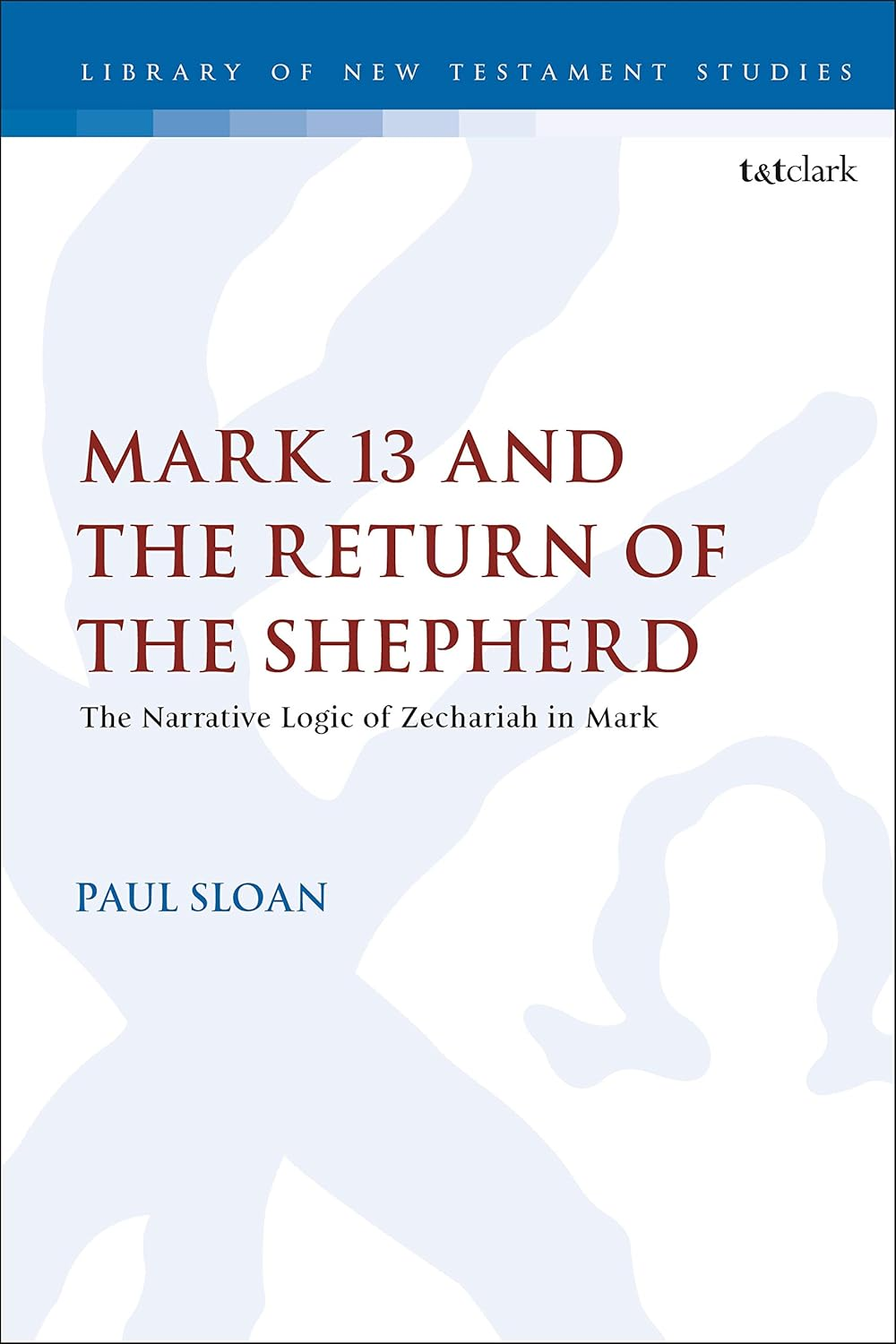
Sloan, Paul T. Mark 13 and the Return of the Shepherd: The Narrative of Zechariah in Mark. Library of New Testament Studies. London: T&T Clark, 2019.

One of the most difficult interpretive questions in the study of the Synoptic Gospels concerns the Olivet Discourse (Mark 13; Matt 24–25; Luke 21). When the disciples marvel at the magnificence of the temple buildings, Jesus responds by predicting the destruction of the temple itself. Later, on the Mount of Olives—from which the discourse derives its name—the disciples ask Jesus about the timing of these events and their relationship to the coming of the Son of Man. How these events relate to one another, namely the destruction of the temple and the coming of Jesus, is the crux interpretum of the discourse, and no shortage of solutions have been proposed within modern Gospel scholarship. (For an overview of the major interpretive positions, along with my own view, see here.) In his published PhD dissertation, Mark 13 and the Return of the Shepherd, Paul T. Sloan, Chair of Theology at Houston Christian University and Associate Professor of New Testament, offers his own answer to these questions by exploring the influence of Zechariah 9–14 upon the Gospel of Mark generally and on Mark 13 specifically. In the space that follows, I will offer my review of his work.

Sloan’s essential thesis is that Zechariah 13.7–14.6 provides the primary narrative scaffolding for understanding the logic of the Olivet Discourse in Mark 13. He takes his cue from Mark 14.27, which is a quotation of Zechariah 13.7, “I will strike the shepherd, and the sheep will be scattered.” For Sloan, the “scattering of the sheep” entails more than merely the flight of the disciples on the night Jesus’s arrest. Rather, the striking of the shepherd, i.e. the death of Jesus, initiates a time of eschatological scattering that is described in Mark 13:5-23 and which spans the time between the death and the return of Jesus as the Son of Man. After examining the reception of Zechariah 13–14 in Second Temple Judaism and Mark’s use of Zecharian imagery elsewhere in the Gospel, Sloan develops his thesis through a detailed analysis of the logic and structure of Mark 13. According to Sloan, Jesus answers the disciples’ question concerning the timing of the temple’s destruction in verses 5–23 of the chapter, a section marked by an inclusio. He then turns to the coming of the Son of Man, not because the discourse changes subjects, but because this is the next stage in the eschatological sequence established by Zechariah 13–14. Thus, there is no break in logic between Jesus’s description of the events leading up to the temple’s destruction and his description of the coming of the Son of Man. Rather, both belong to a single prophetic scenario structured by the narrative flow of Zechariah’s vision.

One of the greatest strengths of Sloan’s work is the way that he brings coherence to the logic and flow of the Olivet Discourse. One of the persistent challenges in the interpretation of Mark 13 has been explaining the relationship between the destruction of the temple, the period of tribulation described in the discourse, and the coming of the Son of Man. Rather than treating these as disconnected subjects, Sloan argues that they belong to a single prophetic scenario structured by the narrative flow of Zechariah 13–14. Whether one ultimately agrees with all the details of his proposal or not, his reading has the significant advantage of explaining why the discourse unfolds in the sequence that it does. A second strength of the book is Sloan’s sustained attention to the Old Testament background of Jesus’s teaching. Too often discussions of Mark 13 become preoccupied with historical reconstruction or modern eschatological systems, but Sloan consistently grounds his interpretation in the scriptural world that shaped both Jesus and the Evangelist. In particular, he demonstrates that Zechariah functions as more than a source of isolated proof texts; rather, it provides an important theological and narrative framework for understanding the discourse as a whole. Finally, Sloan’s treatment of the relationship between the Olivet Discourse and the Passion Narrative is particularly illuminating. By connecting Mark 13 with the citation of Zechariah 13.7 in Mark 14.27, he highlights a literary and theological relationship that is often overlooked. The striking of the shepherd is not merely the occasion for the disciples’ flight, but the initiating event of the eschatological drama that unfolds throughout the remainder of the Gospel. Taken together, these features make Sloan’s work a significant and valuable contribution to the ongoing discussion surrounding Mark 13.

Despite these strengths, there are a couple of areas where Sloan’s proposal left me wanting further development. First, while he successfully demonstrates the narrative relationship between the destruction of the temple and the coming of the Son of Man, he gives comparatively little attention to the possibility of a typological relationship between these events. In my view, the destruction of Jerusalem in AD 70 functions not merely as an event that precedes the coming of the Son of Man, but as a historical anticipation of the final judgment and vindication that will accompany Christ’s return. A stronger account of typology would help explain not only why these events appear together in the discourse, but also why Jesus is able to move so naturally from one to the other. Second, although Sloan makes a compelling case for the importance of Zechariah 13–14, there are points at which Zechariah threatens to become so dominant that other important Old Testament backgrounds recede into the background. In particular, I would have appreciated more interaction with the book of Daniel, which plays a central role in Jesus’s eschatological teaching elsewhere and provides much of the conceptual framework for the coming of the Son of Man. These observations do not undermine Sloan’s thesis, but they do suggest avenues where the discussion might be further refined and developed.

In the final analysis, Sloan’s work represents a significant contribution to the ongoing discussion surrounding the Olivet Discourse and the interpretation of Mark 13. Whether one ultimately agrees with every aspect of his proposal or not, he succeeds in demonstrating the importance of Zechariah 13–14 for understanding the logic and structure of the discourse. His emphasis on the striking of the shepherd as the initiating event of the eschatological drama provides a fresh and compelling way of reading Mark’s Gospel as a coherent narrative whole. Moreover, his careful attention to Old Testament backgrounds serves as a helpful reminder that Jesus’s eschatological teaching must be interpreted within the scriptural world that shaped both him and his earliest followers. While I remain unconvinced that Zechariah alone can account for every feature of the discourse, and would have appreciated more discussion of the typological relationship between the destruction of Jerusalem and the final coming of the Son of Man, these reservations do little to diminish the overall value of the work. Sloan has produced a thoughtful, carefully argued, and highly stimulating study that deserves serious engagement from anyone interested in Mark’s Gospel, the Olivet Discourse, or the eschatological teaching of Jesus.

On the Theological Unity of Daniel’s Visions

The unfortunate reality today is that the bulk of biblical scholarship on the Book of Daniel is mired in the abyss of higher critical presuppositions, not the least of which is a thoroughgoing rejection of predictive biblical prophecy as such. Because of this the Book of Daniel is viewed as a composite work that was compiled in the middle second century BCE in the midst of the Maccabean Crisis. This view would seem to be supported by the linguistic and generic divisions that exist within the text. Linguistically, chapters 2 thru 7 are written in Aramaic while chapter 1 and chapters 8 thru 12 are written in Hebrew; similarly, though not an exact correspondence, chapters 1 thru 6 comprise the court tails while chapters 7 thru 12 consist of the visionary material. The conclusion then of most biblical scholarship on Daniel is that the eschatological expectations of Daniel are essentially a contradictory hodgepodge of ex eventu (after the fact) depictions of the actions of the Seleucid King Antiochus IV Epiphanes.

Of course, to defend the book’s 6th century Danielic authorship would go beyond the limits of this medium, but in the space that follows I would like to briefly demonstrate the essential unity of Daniel’s visions. The clearest indication of this unity comes in the correspondence between Nebuchadnezzar’s dream in chapter 2 and in Daniel’s vision in chapter 7. While these chapters come from seemingly disparate parts of the book, they both present a sequence of four kingdoms followed by the establishment of the Kingdom of God. Of course, critical scholarship widely identifies these kingdoms as Babylon, Media, Persia, and Greece. This is mostly because they understand the actions of the fourth kingdom, and particularly the little horn, to be fulfilled in the actions of Antiochus IV Epiphanes during the Maccabean Crisis from 167-164 CE. I will come back to the identification of these kingdoms in a little bit, but suffice it to say here that it is difficult to see how Daniel’s expectation for the establishment Kingdom of God is fulfilled in this time period. The subsequent period of Hasmonean independence which followed was a far cry from the grandeur of Daniel’s expectations.

This is especially so when we turn our attention to Daniel chapter 9; in that chapter, Daniel is praying about the end of the exile, and he receives an answer from the angel Gabriel, which reads,

Seventy weeks are decreed about your people and your holy city—to bring the rebellion to an end, to put a stop to sin, to atone for iniquity, to bring in everlasting righteousness, to seal up vision and prophecy, and to anoint the most holy place.

Daniel 9.24

It seems rather clear that these seventy weeks span the timeframe from Daniel’s day (“from the issuing of the decree to restore and rebuild Jerusalem” in verse 25) to the time of final consummation, the time of “everlasting righteousness”. Because of this, we may presume then that the seventy weeks of Daniel 9 cover the same span of time as the visions of Daniel 2 and 7.

Now, the key to identifying the four kingdoms mentioned in Daniel’s sequence would seem to come in Daniel chapter 8. In that chapter, Daniel sees a vision of a ram with two horns, one longer than the other, and a goat whose large horn was broken off and replaced by four smaller horns. Again, the angel Gabriel gives the interpretation.

The two-horned ram that you saw represents the kings of Media and Persia. The shaggy goat represents the king of Greece, and the large horn between his eyes represents the first king. The four horns that took the place of the broken horn represent four kingdoms. They will rise from that nation, but without its power.

Daniel 8.20-22

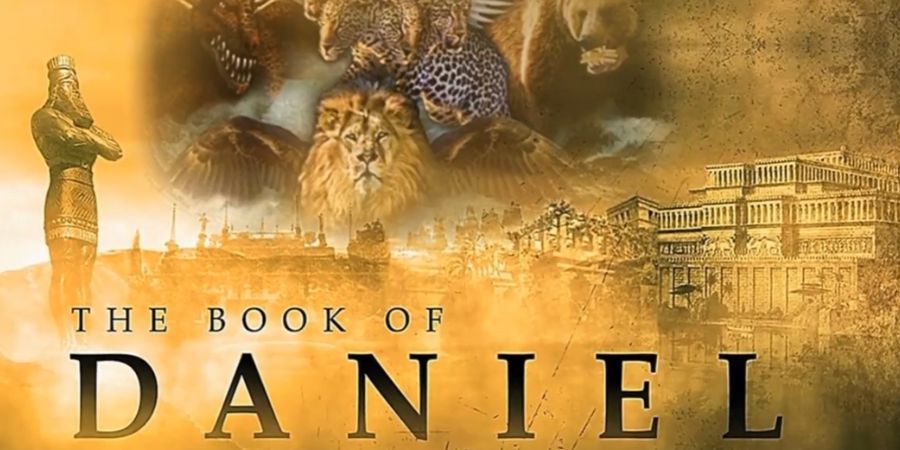
This interpretation indicates that the second kingdom in Daniel’s sequence should be understood as the unified Kingdom of the Medes and Persians. It is described as a ram with two horns, one longer than the other (8.3) and as a bear which was raised up on one side (7.5). The third kingdom, then, should be understood as the Kingdom of Greece which is represented, of course, by Alexander the Great and the Diadochi, the four generals who followed him. They are variously described as a goat whose large horn was broken off and replaced by four smaller horns (8.8) and as a leopard with four wings and four heads (7.6).

This understanding is confirmed in Daniel chapter 11, where we read,

Three more kings will arise in Persia, and the fourth will be far richer than the others. By the power he gains through his riches, he will stir up everyone against the kingdom of Greece. Then a warrior king will arise; he will rule a vast realm and do whatever he wants. But as soon as he is established, his kingdom will be broken up and divided to the four winds of heaven, but not to his descendants; it will not be the same kingdom that he ruled, because his kingdom will be uprooted and will go to others besides them.

Daniel 11.3-4

The rest of chapter 11, then, goes on to detail the various campaigns of the “King of the North” and the “King of the South”, which describes the various conflicts between the Seleucids and the Ptolemies during the Third and Second century BCE respectively. The point of all this is to say that Daniel’s sequence of four kingdoms is best understood to refer to the progression of empires from Babylon to Medo-Persia to Greece and finally to Rome*. Of course, it must be noted that while the Roman Empire corresponds to Daniel’s fourth kingdom, it doesn’t completely fulfill it. That fulfillment comes ultimately in the eschatological kingdom of the beast, which is described in Book of Revelation, but this is a topic for another time.

By way of conclusion, then, Daniel’s visions reveal a remarkable and multifaceted unity in their expectation despite their seeming disparities. Daniel chapters 2, 7, and 9 give the overarching flow from Daniel’s day to the establishment of God’s Kingdom, and chapters 8 and 11 zoom in on the specific actions of the second and especially the third kingdom. More importantly, this understanding lays the foundation for the typological connection that Daniel draws between the third and fourth kingdoms, specifically between the actions of Antiochus IV Epiphanes and the eschatological little horn of the fourth kingdom. In addition, it helps us see how Daniel’s eschatological paradigm serves as the foundation for the message and ministry of Jesus, especially the Olivet Discourse, and for the message of the New Testament, particularly the Book of Revelation.

Of course, the most important aspect of all of this is the certain promise of God’s victory over His enemies and the enemies of His people. Our hope rests not in earthly powers, nations, or empires, but in the Kingdom of God and in His promised Messiah. That Messiah came incarnate 2000 years ago. He lived a perfect life, and then, He died on the cross for sin and rose again. Forty days later, He ascended to be seated at the right hand of the Father, and He left us this promise, that in the same way he ascended, he will also one day descend in glory and power (Acts 1.11). This is our glorious hope, and so we pray, “Amen, Come, Lord Jesus! (Revelation 22.20)

For further study, see:
Hamilton, James M. With the Clouds of Heaven: The Book of Daniel in Biblical Theology. New Studies in Biblical Theology. Downers Grove, IL: InterVarsity, 2014


On Three Views for Interpreting the Olivet Discourse

TEXT

24 As Jesus left and was going out of the temple, his disciples came up and called his attention to its buildings. He replied to them, “Do you see all these things? Truly I tell you, not one stone will be left here on another that will not be thrown down.” While he was sitting on the Mount of Olives, the disciples approached him privately and said, “Tell us, when will these things happen? And what is the sign of your coming and of the end of the age?”

Text: Matthew 24-25, c.f. Mark 13, Luke 21
Series: Eschatology: A Study of the End Times
Church: South Caraway Baptist Church, Jonesboro, AR
Date: September 7 , 2022


Slow To Write

"let every person be quick to hear, slow to speak, slow to anger."

lovegavehope

Just another WordPress.com site

Jared Cornutt

Pastor | Speaker | Writer

Denny Burk

A commentary on theology, politics, and culture

G3 Ministries

Events + Resources for the Local Church

Biblical Reasoning

Biblical and Systematic Theology According to the Scriptures

RetroChristianity

Reclaiming the Forgotten Faith

SBC Voices

Southern Baptist News & Opinion

Lucid Theology

Thoughts on words, books, theology, and life.

Baptist21

A pastor-led voice for Baptists in the 21st century

Center For Baptist Renewal

The Personal and Professional Blog of Phillip Powers

The Pastor's Well - Pastor Well

The Personal and Professional Blog of Phillip Powers

Articles - AlbertMohler.com

The Personal and Professional Blog of Phillip Powers

The Gospel Coalition

The Personal and Professional Blog of Phillip Powers