Tag Archives: Obedience
On Justification and the Roman Catholic Church

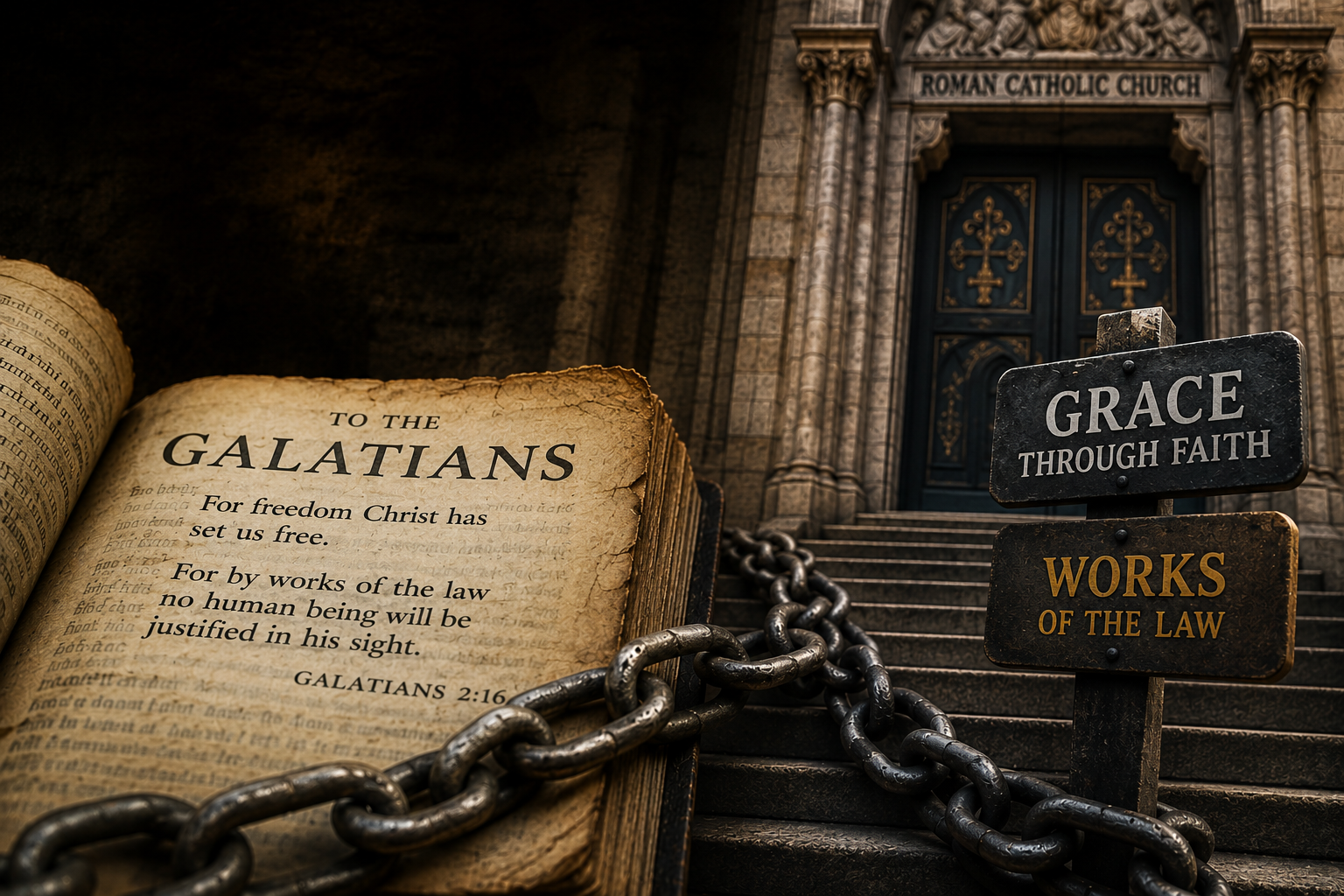
Some time ago, I reviewed a debate between Allen S. Nelson IV, pastor of Providence Baptist Church, and Father Stephen Hart of Sacred Heart Church on the question of whether the Roman Catholic Church is a gospel-denying church. (See my review here.) This debate centered on the doctrine of justification and exposed the fundamental differences between Protestant and Roman Catholic understandings of how a person is made right before God. Of course, justification stands at the very center of the gospel itself; it is not merely a secondary disagreement between theological traditions. A distorted understanding of justification necessarily distorts the good news because it touches the question of how sinners are reconciled to God through Christ. And this is precisely the issue that the Apostle Paul takes up in the Epistle to the Galatians. In Galatians, Paul argues with remarkable force that justification is by faith apart from works of the law and warns that any alteration of the gospel strikes at the heart of Christian truth. In this post, then, I would like to consider how Paul’s argument in Galatians relates to the Roman Catholic understanding of justification, because if the message of Galatians is taken seriously, it forces us to ask whether justification can, in any sense, be grounded in works without compromising the gospel itself.
The situation addressed in the Epistle to the Galatians is relatively well known, but it is worth reviewing briefly for the sake of clarity. Sometime after Paul’s first missionary journey, it appears that a group of Jewish Christians came into the churches of Galatia and began teaching that Gentile believers needed to be circumcised and adopt the Torah in order to be fully included among the people of God. (On the timeline of events in Galatia, see here.) These teachers are often described as “Judaizers,” though the issue at stake is frequently misunderstood. They were not simply advocating for moral effort or “legalism” in the modern sense of the term. Rather, they were challenging the basis upon which Gentiles could belong to the covenant community. Was faith in Christ sufficient, or did covenant membership require obedience to the Mosaic law as well? In other words, the issue was not whether obedience mattered in the Christian life. Paul himself repeatedly affirms the necessity of holiness and faithful living. The question, rather, was whether obedience to the law contributed in any sense to justification and covenant inclusion. And it is precisely at this point that Paul responds with extraordinary urgency, because for him the integrity of the gospel itself was at stake.
Against this backdrop, Paul’s central claim is that “no one is justified before God by the law, because the righteous will live by faith” (3.11). The question, of course, revolves around what Paul means by the term “justified.” However, the qualifying phrase “before God” is especially revealing. Paul is not speaking primarily about inward moral transformation or spiritual renewal, important as those realities are elsewhere in his theology. Rather, he is speaking about a person’s standing before the divine judge. Justification, then, is fundamentally forensic in nature. It is a legal declaration in which the believer is counted righteous before God on the basis of faith rather than works of the law. This is why Paul consistently contrasts justification with human obedience throughout Galatians. If righteousness could be obtained through the law, then there would be no need for Christ’s death (2.21). The issue is not whether good works follow genuine faith; Paul clearly believes that they do. The issue is whether those works contribute in any sense to the believer’s right standing before God. Paul’s answer is emphatic and uncompromising: sinners are justified by faith in Christ apart from the works of the law. Their acceptance before God rests not in their own obedience, but in the saving work of Christ received through faith.
However, the question must still be asked: what exactly does Paul mean by “works of the law”? In recent decades, the so-called “New Perspective on Paul,” especially in the work of James D. G. Dunn, has argued that these “works” refer primarily to Jewish socio-religious boundary markers such as circumcision, Sabbath observance, and food laws. On this reading, Paul’s concern is chiefly horizontal. The issue is how Jews and Gentiles can exist together within the same covenant community without the Torah functioning as a barrier between them. There is certainly truth in this observation, especially given the prominence of circumcision in Galatians itself. However, this understanding is ultimately too narrow because it does not fully account for Paul’s repeated emphasis on justification “before God.” Paul’s concern is not merely social fellowship, but a person’s standing before the divine judge. Therefore, “works of the law” cannot be reduced simply to ceremonial observances or ethnic boundary markers. Rather, the phrase must encompass any attempt to establish righteousness before God through obedience to the law. This is precisely why Paul contrasts law and promise, works and faith, curse and blessing. For Paul, the law cannot justify because fallen humanity cannot keep it perfectly. Faith, by contrast, receives what God promises in Christ rather than attempting to achieve righteousness through human obedience.
This is made clear by the way that Paul builds his argument in Galatians, namely on a series of theological contrasts that structure his understanding of the gospel itself. Central to his reasoning is the example of Abraham. Long before the giving of the law, Abraham “believed God, and it was credited to him for righteousness” (3.6). This point is crucial because it demonstrates that justification by faith precedes the Mosaic covenant altogether. The promise given to Abraham was received through faith, not through obedience to the law. The law, therefore, cannot function as the basis of justification because it was never the foundation of God’s covenant promises to begin with. Rather, Paul argues that the law was temporary, added “because of transgressions” until the coming of Christ (3.19). This is why Paul consistently contrasts promise and law, Spirit and flesh, faith and works throughout the letter. These are not complementary paths to justification, but fundamentally different principles. The law demands obedience and pronounces a curse upon those who fail to keep it perfectly, whereas faith receives the promise of God fulfilled in Christ. This is why Paul reacts so strongly to the Galatian error. The law does not complete what faith begins—it belongs to a different order altogether. To return to the law as the ground of justification is not spiritual maturity; it is, in Paul’s view, a departure from the very logic of the gospel itself.
This is perhaps why Paul speaks with such force in the opening of the Epistle to the Galatians. In 1:9, he writes, “As we have said before, I now say again: If anyone is preaching to you a gospel contrary to what you received, a curse be on him!” For Paul, this is not rhetorical exaggeration or emotional overstatement; it is covenantal seriousness. The gospel is not infinitely flexible or open to revision. It is the announcement of what God has accomplished in Christ for the salvation of sinners, and therefore to alter the basis of justification is to alter the gospel itself. This is precisely why Paul reacts so strongly to the teaching of the Judaizers. In his view, adding obedience to the law as a condition of justification does not merely supplement the gospel—it fundamentally changes its character. The issue is not whether circumcision or obedience have value in themselves; the issue is whether they contribute to a person’s right standing before God. Once works are introduced as part of the ground of justification, faith in Christ alone is no longer sufficient. And for Paul, that is not a small theological mistake, but a corruption of the gospel itself.
At this point, it is worth bringing Paul’s argument into conversation with the Roman Catholic understanding of justification, especially as articulated at the Council of Trent. To be clear, the Roman Catholic position is not identical to the error confronted in Galatia. The Judaizers were specifically requiring circumcision and Torah observance for covenant inclusion, whereas Roman Catholic theology affirms the necessity of grace and the centrality of Christ’s work. Nevertheless, there are important structural similarities that raise serious theological concerns. According to Trent, justification is not merely the forgiveness of sins, but also “the sanctification and renewal of the inward man” (Session 6, Chapter 7). Likewise, Trent teaches that the justified “through the observance of the commandments of God and of the Church, faith cooperating with good works, increase in that justice received through the grace of Christ” (Session 6, Chapter 10). In other words, justification in Roman Catholic theology includes transformative righteousness and can increase through obedience. But this is precisely where the tension with Galatians emerges. Paul consistently treats justification as a forensic declaration received through faith apart from works of the law. The question, then, is unavoidable: if justification is maintained or increased through works, even grace-enabled works, does this not reintroduce the very dynamic Paul rejects? Put differently, does the Roman Catholic system preserve the sufficiency of faith in Christ alone, or does it ultimately ground final justification, at least in part, in human obedience? At the very least, Trent’s understanding of justification is horribly confused and differs significantly from Paul’s argument in Galatians.
Now, in the interest of completeness, it is equally important to consider how the message of the Epistle to the Galatians might speak to those of us on the Protestant side of the aisle as well. As I noted in my original review, Protestants often have a tendency to underemphasize the importance—indeed, even the necessity—of good works in the Christian life. In some circles, the gospel is reduced to little more than a kind of “get out of hell free” card: simply believe in Jesus and secure your eternal destiny. But this reductionistic understanding of salvation severely minimizes the transforming power of grace and the necessity of Spirit-empowered obedience. Paul himself never makes this mistake. While he fiercely rejects works as the basis of justification, he equally insists that genuine faith necessarily produces obedience. This is why he can say in Galatians 5.6 that “what matters is faith working through love.” For Paul, obedience is not opposed to faith; rather, obedience is the fruit of true faith. The problem, then, is not works in themselves, but works placed in the wrong category. Works cannot justify the sinner before God, but they are the inevitable result of union with Christ and the indwelling work of the Spirit. Grace does not merely forgive; it transforms.
In theological categories, this process is known as sanctification, that is, the lifelong work of growing in conformity to the character of Christ through the power of the Holy Spirit. In the language of the Epistle to the Galatians, this is described as “walking by the Spirit” and cultivating the “fruit of the Spirit,” namely “love, joy, peace, patience, kindness, goodness, faithfulness, gentleness, and self-control” (5.22–23). The point is that while sanctification is logically distinct from justification, it is not altogether separate from it. The faith that justifies is never barren or inactive. We are justified by faith alone, but the person who is truly justified by faith will necessarily grow in holiness and produce the good works of Christlike character. This is why Paul can reject works as the basis of justification while simultaneously insisting upon obedience as the necessary fruit of life in the Spirit. Indeed, this is essentially the same point made by the Epistle of James in its discussion of faith and works, a point Paul himself would affirm wholeheartedly. Works do not secure our standing before God; rather, they demonstrate that our faith is living and genuine. Grace not only pardons the sinner, it transforms him.
What emerges from Galatians, then, is a clear theological order that must not be confused or reversed. First comes faith, and through faith comes justification, that once-for-all declaration in which the sinner is counted righteous before God on the basis of Christ alone. Then comes the gift of the Spirit, through whom the believer is progressively transformed into the image of Christ. Finally, obedience follows as the fruit of this new life in the Spirit. In other words, the imperatives of the Christian life flow out of the indicatives of the gospel. We obey because we have been accepted in Christ, not in order to be accepted by him. This is precisely why Paul can simultaneously reject justification by works while insisting upon the necessity of holiness. The Christian life is not opposed to obedience; it is grounded in grace-enabled obedience that flows from faith. But the order matters immensely. To place works before justification, or to make obedience part of the ground of our acceptance before God, is to reverse Paul’s entire theological structure and, in doing so, distort the very nature of the gospel itself.
In conclusion, then, we must affirm that the question of justification as it relates to faith and works is a foundational question when it comes to the clarity of the gospel itself. As Paul warns in the Epistle to the Galatians, to distort the gospel is to come under the curse of God. And while I do not think that the Roman Catholic Church falls under this curse in a simplistic or one-to-one sense, I do believe that the formulations of the Council of Trent are deeply confused on the question of justification and, in important ways, structurally parallel the very concerns Paul raises in Galatians. At the same time, Protestants must also resist the temptation to reduce the gospel to mere intellectual assent divorced from holiness and obedience. Paul rejects both legalism and moral indifference. The gospel he proclaims is one in which sinners are justified by faith alone and then transformed by the power of the Spirit into lives of joyful obedience. Faithful theology, then, requires more than loyalty to tradition or theological systems. It requires that we let Paul define the gospel on his own terms—and then have the courage to examine our systems in light of that definition.
On Fuel for the Fires of Revival
TEXT
8 The high priest Hilkiah told the court secretary Shaphan, “I have found the book of the law in the Lord’s temple,” and he gave the book to Shaphan, who read it. 9 Then the court secretary Shaphan went to the king and reported, “Your servants have emptied out the silver that was found in the temple and have given it to those doing the work—those who oversee the Lord’s temple.” 10 Then the court secretary Shaphan told the king, “The priest Hilkiah has given me a book,” and Shaphan read it in the presence of the king.
11 When the king heard the words of the book of the law, he tore his clothes. 12 Then he commanded the priest Hilkiah, Ahikam son of Shaphan, Achbor son of Micaiah, the court secretary Shaphan, and the king’s servant Asaiah, 13 “Go and inquire of the Lord for me, for the people, and for all Judah about the words in this book that has been found. For great is the Lord’s wrath that is kindled against us because our ancestors have not obeyed the words of this book in order to do everything written about us.”
14 So the priest Hilkiah, Ahikam, Achbor, Shaphan, and Asaiah went to the prophetess Huldah, wife of Shallum son of Tikvah, son of Harhas, keeper of the wardrobe. She lived in Jerusalem in the Second District. They spoke with her. 15 She said to them, “This is what the Lord God of Israel says: Say to the man who sent you to me, 16 ‘This is what the Lord says: I am about to bring disaster on this place and on its inhabitants, fulfilling all the words of the book that the king of Judah has read, 17 because they have abandoned me and burned incense to other gods in order to anger me with all the work of their hands. My wrath will be kindled against this place, and it will not be quenched.’
18 Say this to the king of Judah who sent you to inquire of the Lord: ‘This is what the Lord God of Israel says: As for the words that you heard, 19 because your heart was tender and you humbled yourself before the Lord when you heard what I spoke against this place and against its inhabitants, that they would become a desolation and a curse, and because you have torn your clothes and wept before me, I myself have heard’—this is the Lord’s declaration. 20 ‘Therefore, I will indeed gather you to your ancestors, and you will be gathered to your grave in peace. Your eyes will not see all the disaster that I am bringing on this place.’” Then they reported to the king.
~2 Kings 22.8-20
Title: On Fuel for the Fires of Revival
Text: 2 Kings 22-23
Series: Revival Us Again!
Church: Redeemer Baptist Church, Jonesboro, AR
Date: December 28, 2025
On the Roman Catholic Church and the Nature of the Gospel

Is the Roman Catholic Church a Gospel-denying church? This question was the theme of a recent debate between Allen S. Nelson IV, pastor of Providence Baptist Church in Perryville, AR, and Father Stephen Hart, pastor/priest at Sacred Heart Church in Morrilton, AR. (A video of the debate can be found on the YouTube page of Providence Baptist Church, here.) While it is true that both participants had strong moments in the two hour event, it is not my purpose to evaluate their performances or to name a winner. I think that Pastor Nelson was at his best when he was pushing the details of the official teachings of the Roman Catholic Church as stated in their published documents, and Father Hart was at his best when he was giving the Catholic understanding of relevant New Testament texts. In the final analysis, though, I suspect that most people went away from the event feeling confirmed in the positions they held coming in and believing that their preferred candidate had won the evening. In the space that follows, I would simply like to suggest four important takeaways that were clarified for me.
First, the debate made it clear that the Roman Catholic Church generally misunderstands the New Testament concept of justification. Lexically, the δικαι- word group (words that are usually translated in the NT as righteousness and/or justified) refers to a forensic or legal status of innocence or guiltlessness. In his commentary on Romans in the NICNT series, Douglas Moo writes, “To justify signifies, according to forensic usage, to acquit a guilty one and declare him or her righteous.” (86) As we read in Romans 5.19, “For just as through one man’s disobedience the many were made sinners, so also through the one man’s obedience the many will be made righteous (δικαίωμα).” In other words, it is a once-for-all gavel dropping declaration that a person is not guilty of their sin before God because of their faith in the atoning work of Christ. And what is important is that this status cannot be changed because of our sin, nor can it be augmented by good works. From beginning to end, it is a gift that is given by faith alone and that is preserved, maintained, and completed by God through His Spirit. As the Apostle Paul writes, “I am sure of this, that he who started a good work in you will carry it on to completion until the day of Christ Jesus.” (Phil. 1.6) Or again, in Romans 8.29-30, we read, “For those he foreknew he also predestined to be conformed to the image of his Son, so that he would be the firstborn among many brothers and sisters. And those he predestined, he also called; and those he called, he also justified; and those he justified, he also glorified.”
However, the RCC insists that this declaration of righteousness, being God’s powerful word, must be effectual, and include thereby moral transformation. For example, the Council of Trent defines justification as that “which is not remission of sins merely, but also the sanctification and renewal of the inward man.” (Chapter 7) Trent goes on to argue that “by mortifying the members of their own flesh, and by presenting them as instruments of justice unto sanctification, they, through the observance of the commandments of God and of the Church, faith co-operating with good works, increase in that justice which they have received through the grace of Christ, and are still further justified.” (Chapter 10) And so, it logically follows when Trent resolves that, “If any one saith, that the justice received is not preserved and also increased before God through good works; but that the said works are merely the fruits and signs of Justification obtained, but not a cause of the increase thereof; let him be anathema.” (Canon 24) Of course, the Council of Trent, first convened in 1545, was the Church’s response to the Protestant Reformation, and so one can’t help but wonder if there isn’t some amount of reactionism that has influenced their positions on these matters. Nevertheless, it seems clear from these statements that Trent’s understanding of justification goes well beyond the New Testament understanding of the term.
Secondly, and the statements above demonstrates this, but the debate made it clear that the Roman Catholic Church confuses the doctrine of justification with the doctrines of regeneration and sanctification. Regeneration (aka new birth or “being born again”) refers to that work of the Spirit in which a person is given spiritual life. In other words, the Spirit transforms an individual from a state of spiritual death to a state of new creation in Christ, thus, enabling them to repent, believe, and live in accordance with God’s will. By the same token, sanctification is simply the lifelong process by which a person is gradually transformed more and more into the image of Christ, becomes more holy, and learns to walk in obedience to the law of Christ. As we read in Hebrews 10.14, “For by one offering he has perfected forever those who are being sanctified.” (ESV/LSB) Note especially in this verse that we are perfected forever, and yet we are being sanctified. The point is that these are logically distinct aspects of the salvation process (ordo salutis), even if in actual experience they are sometimes indistinguishable.
But in the teaching of the RCC, all of this inheres within the doctrine of justification. As we saw above, the Catholic church defines justification as that “which is not remission of sins merely, but also the sanctification and renewal of the inward man.” Whatever the reason for this lack of theological precision may be, this indiscriminate intermingling of categories leads inevitably to the conclusion that a person’s justification is dependent upon their sanctification. Or to put it another way, the Roman Catholic view seems that imply that while justification is begun by faith, it is continued, maintained, and eventually confirmed by good works. This is perhaps why Trent envisages the possibility that a person’s initial justification can be lost. In Chapter 14, Trent reads, “As regards those who, by sin, have fallen from the received grace of Justification, they may be again justified, when, God exciting them, through the sacrament of Penance they shall have attained to the recovery, by the merit of Christ, of the grace lost.” If a person’s justification can be lost by their disobedience, then it necessarily follows that it must be maintained (or should I say earned) by their obedience. Whatever the case, it is clear that in the Catholic understanding, the determining factor in a person’s justification is their obedience, i.e. their good “works”, and not their faith.
Now, I would be remiss if I did not also submit the opposing position to equal scrutiny, and so, before I conclude this article, I would like to offer two areas of weakness in our position that I believe were exposed in the aforementioned debate. And let me hasten to add that these points should not be received as any kind of criticism of Pastor Nelson; based on the limited interaction I have had with him, I find him to be a biblically faithful, theologically astute individual. But, as it regards the way that our views are typically represented in these discussions, I think there are two important takeaways for us to consider.
The first takeaway for those holding our perspective might be stated thus, namely that Protestants have a tendency to underemphasize the importance, nay even the necessity, of good works. In our zeal to proclaim and defend that time honored Reformation principle sola fide, or justification by faith alone, we inadvertently imply that living a life of obedience that issues forth in good works is some kind of optional add-on. We suggest, though perhaps unintentionally, that the Gospel’s call to live a life of ongoing discipleship to Jesus is something that is reserved for the religious elite, those who are really serious about their faith, those who are truly devout, so-called ‘super Christians’. But the Apostle James is clear on this point when he writes, “You see that a person is justified by works and not by faith alone.” (James 2.24) Of course, this is not a contradiction of the Apostle Paul, nor is it inconsistent with the Reformation’s emphasis on faith alone rightly understood (contra Luther). Rather, it is a reminder that the kind of faith that justifies is a faith that works. In other words, the principle of sola fide does not mean that a person can believe in Jesus and then live in whatever manner they so choose. This kind of “easy-believism’ is in truth no faith at all. In fact, it is demonic (James 2.19), and it does not and cannot save. A faith that saves, a faith that justifies, is a faith that works, and on this point, James and Paul are in complete agreement.
There is a sense in which our works will play a role at the final judgment. Jesus himself says in Matthew 16.27, “For the Son of Man is going to come with his angels in the glory of his Father, and then he will reward each according to what he has done. ” And in Second Corinthians 5.10, we read, “For we must all appear before the judgment seat of Christ, so that each may be repaid for what he has done in the body, whether good or evil.” Or again, in Romans 2.6-8, Paul writes (quoting Proverbs 24.12 et al.), “He will repay each one according to his works: eternal life to those who by persistence in doing good seek glory, honor, and immortality; but wrath and anger to those who are self-seeking and disobey the truth while obeying unrighteousness.” And finally, in Hebrews 12.14, we are told to “Pursue … holiness [because] without it no one will see the Lord.” This does not mean that we are “saved” by or because of our works, but it does mean that living a life of obedience to God validates or proves that our faith is indeed a saving faith. The message of the Gospel is built on both the indicatives of what Jesus has done for us and imperatives that we are called to obey for Him. We receive the indicatives by faith, and we obey the imperatives because of what we have received by faith. The order matters here. If we put the imperatives of the Gospel before the indicatives of the Gospel, then we distort the Gospel into a salvation by works. In the logic of the Gospel, the indicatives precede and enable the imperatives. But the point is that they are both necessary parts of the gospel.
And this brings me to the second weakness of the Protestant position that I believe was exposed in the debate, namely that Protestants have a tendency to reduce the Gospel to its lowest common denominator. There can be no doubt that justification by faith is an important, even essential, foundation for our salvation, but the Gospel is so much more than justification by faith. The Gospel is the good news that in the person and work of Jesus Christ God has entered into his creation to redeem his people by dying for their sin as an atonement and by defeating death through His resurrection and to renew his creation by establishing his rule on earth, so that through the Spirit they can walk in perfect conformity to His ways and experience the blessings of His ongoing presence in and among them. It is this vision of a renewed humanity living in a renewed world in which God is eternally present to bless that is the goal of the biblical narrative (Revelation 21-22). This is why we must constantly remind ourselves that even though we have already been saved (justification), we are still being saved (sanctification), and yet one day we will be saved (glorification). And all of this is received and experienced by and through faith, but this faith must be a faith by which we walk in conformity to the way and will of Christ.
So, is the Roman Catholic Church a Gospel-denying church? I don’t know, but it does seem to me that their official teachings, whether explicitly or implicitly, confuse important concepts and components of the Gospel, and in doing so, it has the potential to lead even the most sincere and devout parishioner to believe that they are saved by living a morally upright and generally good and charitable life. Can a person be genuinely saved in the Roman Catholic Church? I think yes, but I would suspect that this is in spite of its official dogmas and teachings. And beyond their doctrine of salvation, there are many other tenets and teachings of the Roman Catholic tradition that I consider to be in clear contradiction to the teaching of Scripture. However, that is a question for another time. I will simply close this post with the words of the Apostle Paul, because I think they sum up the issues discussed in this article particularly well. “For you are saved by grace through faith, and this is not from yourselves; it is God’s gift— not from works, so that no one can boast. For we are his workmanship, created in Christ Jesus for good works, which God prepared ahead of time for us to do.” (Ephesians 2.8-10)
On Psalm 119.121-128 (Ayin)
121 I have done what is just and right;
do not leave me to my oppressors.
122 Guarantee your servant’s well-being;
do not let the arrogant oppress me.
123 My eyes grow weary looking for your salvation
and for your righteous promise.
124 Deal with your servant based on your faithful love;
teach me your statutes.
125 I am your servant; give me understanding
so that I may know your decrees.
126 It is time for the Lord to act,
for they have violated your instruction.
127 Since I love your commands
more than gold, even the purest gold,
128 I carefully follow all your precepts
and hate every false way.
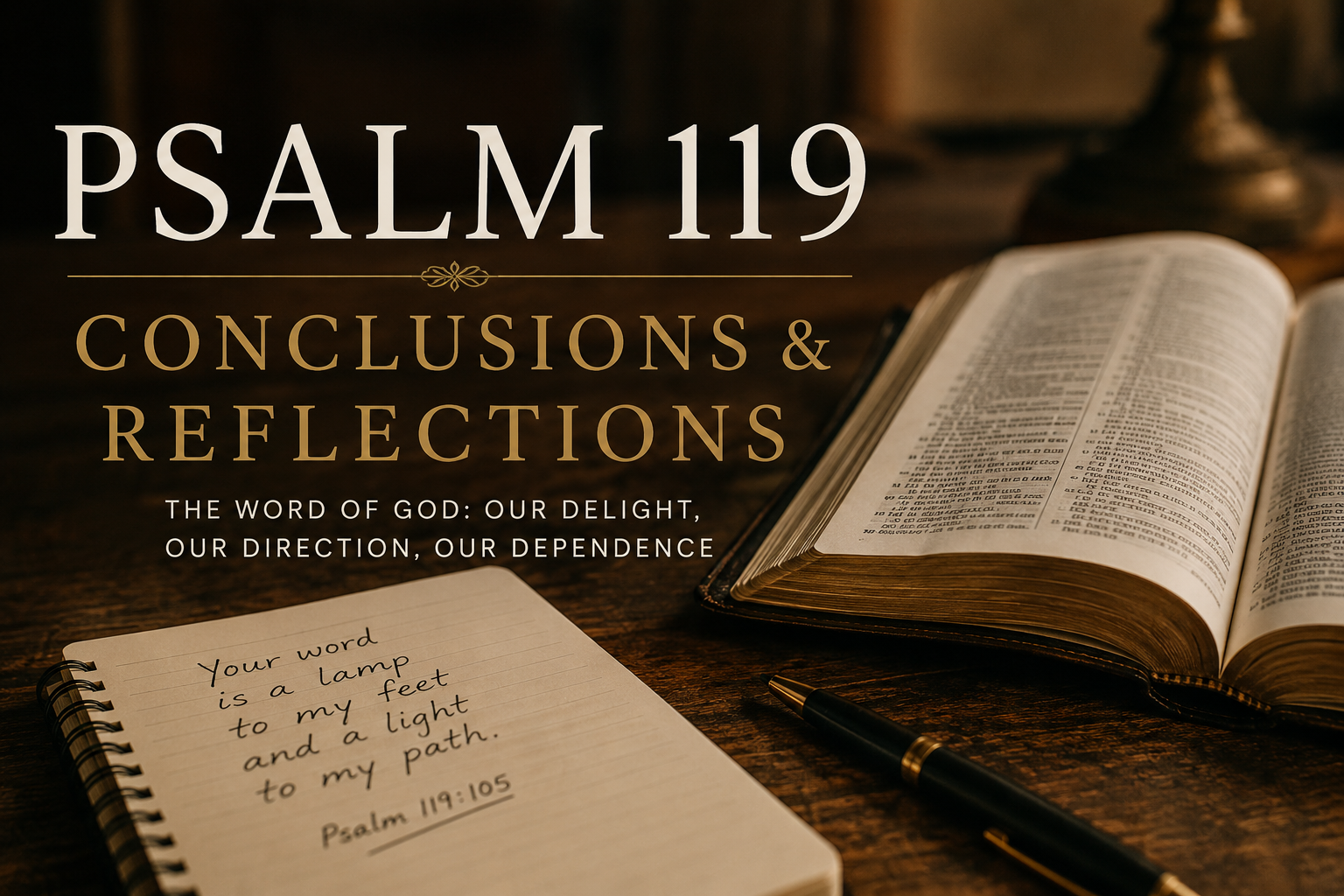
The sixteenth stanza of Psalm 119 (ע/ayin) deals with the age old dilemma of faith; it is a question that the people of God have been asking for four millenia. “How long, O Lord?” How long will the wicked prosper? How long will sin and evil endure? How long until you come again to judge the wicked and vindicate the righteous, O Lord? Is it all worth it? Is my obedience and my faithfulness and my suffering worthwhile in the grand scheme of your eternal plan, O Lord? These are the perennial questions of faith. In the face of ever growing evil and the ongoing glorification of sin and wickedness, we are left to wonder if our struggles to walk in faith and obedience are worth it? If we are honest with ourselves, these are questions that even the most faithful of Christians have asked themselves at some point or another. Our psalmist puts it this way: “My eyes grow weary looking for your salvation and for your righteous promise.” (Verse 123)
This is perhaps what is most refreshing about the Word of God, especially in the Psalms but equally so throughout the canon of Scripture, namely that it is real and honest about the human predicament. The Scriptures do not whitewash the ugly and painful realities of human experience; rather, they acknowledge them with an honesty that is both brutal and refreshing. Moreover, they speak to the complexities of maintaining faith and hope in the face of such realities that would otherwise drive us to depression and despair. This is why our psalmist can say, “It is time for the Lord to act, for they have violated your instruction.” (Verse 126) Even though he feels the weariness and the temptations to despair, our psalmist holds on to his hope that God will act, that He will judge those who have violated His instruction. Our psalmist sees this hope as both good and right; it is both good and right that the wicked should finally be punished.
And it is this hope that drives our psalmist to maintain his faith in steadfast obedience to God and His word. He says, “I have done what is just and right; do not leave me to my oppressors,” (Verse 121) and he says, “I carefully follow all your precepts and hate every false way.” (Verse 128) His hope in God and his justice drives his perseverance in faith and obedience. He is convinced that his obedience is not meaningless, that the persecution and suffering that he has endured in not random or without purpose. No, our every effort to walk by faith and obedience, our every difficulty and heartache for the sake of God and His Word, will be ultimately vindicated and rewarded. We look forward to those gracious words of our Lord Jesus, when He will say, “Well done, good and faithful servant! Enter into your master’s joy.” This is why our psalmist can pray, “Deal with your servant based on your faithful love; teach me your statutes.” (Verse 124)
The word here translated “faithful love” is a central and primary concept in the Old Testament’s conception of God. It’s closest New Testament equivalent is the word “grace.” This attribute of God’s character is enshrined in the covenantal formula,
The Lord—the Lord is a compassionate and gracious God, slow to anger and abounding in faithful love and truth, maintaining faithful love to a thousand generations, forgiving iniquity, rebellion, and sin. But he will not leave the guilty unpunished, bringing the consequences of the fathers’ iniquity on the children and grandchildren to the third and fourth generation. (Exodus 34:6-7)
This covenantal formula is the basis for all of the Old Testament’s theology, and it forms the foundation of our psalmist’s faith in this stanza of Psalm 119. The God of the Bible is a God who is longsuffering and gracious toward those who submit to Him in faith, but He is just and holy toward those who reject His sovereign rule over their lives.
And it is this faith that leads him to pray, “Guarantee your servant’s well-being; do not let the arrogant oppress me.” (Verse 122) Literally translated, the line reads, “Be surety for your servant for good.” The idea is that God himself is the surety, the earnest money, the down payment, of good for his servant. In other words, our good, our blessing, our prosperity and human flourishing flows only from God and His promises. This is why we must trust in Him and walk in His ways. As our psalmist puts it, “Since I love your commands more than gold, even the purest gold, I carefully follow all your precepts.” Our fulfillment, our purpose, our joy and happiness is only available when we submit ourselves to God Word, when we walk in God’s ways, even if when it feels like everyone is going in the other direction. Christian perseverance is driven by a faith full of hope. When and only when we walk in this hope will we experience genuine human flourishing and fulfillment.
For further study:
Introduction
Psalm 119.1-8
Psalm 119.9-16
Psalm 119.17-24
Psalm 119.25-32
Psalm 119.33-40
Psalm 119.41-48
Psalm 119.49-56
Psalm 119.57-64
Psalm 119.65-72
Psalm 119.73-80
Psalm 119.81-88
Psalm 119.89-96
Psalm 119.97-104
Psalm 119.105-112
Psalm 119.113-120
On Psalm 119:113-120 (Samek)
113 I hate those who are double-minded,
but I love your instruction.
114 You are my shelter and my shield;
I put my hope in your word.
115 Depart from me, you evil ones,
so that I may obey my God’s commands.
116 Sustain me as you promised, and I will live;
do not let me be ashamed of my hope.
117 Sustain me so that I can be safe
and always be concerned about your statutes.
118 You reject all who stray from your statutes,
for their deceit is a lie.
119 You remove all the wicked on earth
as if they were dross from metal;
therefore, I love your decrees.
120 I tremble in awe of you;
I fear your judgments.
The fifteenth stanza of Psalm 119 begins with the Hebrew letter ס/samek, and in this stanza, we read some lines that are quite startling to our modern sensibilities. Right out of the gate, we read, “I hate those who are double-minded” (Verse 113), and a couple of verses later, we read, “Depart from me, you evil ones” (Verse 115). Again, to our moderns ears, these lines seem unduly harsh. But I think we have to look at where our psalmist ends in verse 120, “I tremble in awe of you; I fear your judgments”; in the King’s English, the line reads, “My flesh trembleth for fear of thee; and I am afraid of thy judgments” (KJV). The word for “tremble” here only occurs in the Hebrew Bible in one other place, that being Job 4:15, and the context there clearly implies trepidation (see Job 4:13-15). So likewise, here the word implies that our psalmist is feeling fear, healthy trepidation, a holy terror, at the authority of God and His Word. And it is this fear, this holy terror, that drives him to pursue obedience and submission to the Word of God.
Likewise, it is this intense sense of fear and respect, of submission and devotion to the Word of the one true and living God, that motivates our psalmist’s statements regarding the wicked. Our psalmist understands that God rejects all who stray from His statutes (verse 118) and that He removes all the wicked on the earth (verse 119). So, in verse 115, he says, “Depart from me, you evil ones so that I may obey my God’s commands.” He doesn’t want anything, or anyone for that matter, to prevent him from obeying the laws and statutes of God. I will say more about his obedience in a moment, but suffice it say here that he is so devoted to God and to His word, that he “hates” those who are “double-minded.” The NET Bible renders the line this way, “I hate people with divided loyalties.” The word in question refers to those who are split in their allegiances, those who are two faced or hypocritical in their intentions. They are those who say one thing and yet do another; their verbal confession and their actual behavior are not consistent. “Their deceit is a lie.” (Verse 118). They lack integrity, and in the face of the authority and gravity of God and His word, this kind of attitude is wholly unthinkable for our psalmist.
However, it is imperative that we understand that our psalmists submission to God and His word is not simply motivated by fear of punishment. On the contrary, it comes from a place of deep conviction and faith regarding the goodness of God and His commands. His commands are not burdensome; they are not dull drudgery meant to keep us from enjoying the pleasures of life. No, they are the only path that leads to ultimate fulfillment and genuine human flourishing. This is why our psalmist writes, “You are my shelter and my shield; I put my hope in your word.” It is also why he says, “I love your instruction.” (Verse 113). There is nothing that is more delightful, nothing that is more empowering, nothing that is more fulfilling for our psalmist than obeying the Word of God. By committing himself to God and to keeping His word, he has entrusted his entire self to the goodness and grace of the law-giving God. His obedience is nor forced; it is not against his will. No, his entire will is submitted to the one before whom he stands in awe.
He expresses his faith further when he prays, “Sustain me as you promised, and I will live; do not let me be ashamed of my hope. Sustain me so that I can be safe and always be concerned about your statutes.” (Verse 116-117). It is interesting, though, that this would be his prayer. He has already committed himself to obey God Word. Why, then, would he need to ask God to sustain him? I think there are two reasons. First, he is asking God to sustain him in his obedience. Our psalmist is not naive; he knows the power of temptation, he knows the weakness of his own heart. He knows how easily and how quickly he would abandon his obedience if he were left to himself. So he prays that God would sustain him in his obedience. But secondly, I think he prays for God’s sustaining power because he understands that obedience before God cannot be motivated purely by what we might get out of it. We don’t obey God, so that he will in turn bless us. This tit for tat reckoning is in many ways alien to the economy of God. Our psalmist understands that we obey God because it is right in and of itself to do so; we obey God because that is what we owe Him as creatures. But, as creatures, we are completely dependent upon his sustaining grace every moment of every day for every need that we have. Without Him, we can do nothing. So he prays, “O God, sustain me.”
Sadly, for many Christians in the world today, this attitude of holy terror coupled with desperate faith is somewhat of an oxymoron. On the one hand, we have domesticated God and diminished his authority in our lives to the extent that we treat Him like an elderly grandparent who might give us a piece of candy if we behave, and on the other, we are so self-reliant and comfortable that we have forgotten just how weak and needy we truly are. In this light then, the attitude of our psalmist in this stanza is both a rebuke and an invitation. It is a rebuke of our selfishness and pride, and it is an invitation to rediscover the greatness and the grace of the God that we serve. As C.S. Lewis puts it, “‘Course he isn’t safe. But he’s good. He’s the King, I tell you.”
For further study:
Introduction
Psalm 119.1-8
Psalm 119.9-16
Psalm 119.17-24
Psalm 119.25-32
Psalm 119.33-40
Psalm 119.41-48
Psalm 119.49-56
Psalm 119.57-64
Psalm 119.65-72
Psalm 119.73-80
Psalm 119.81-88
Psalm 119.89-96
Psalm 119.97-104
Psalm 119.105-112
On Psalm 119.97-104 (Mem)
97 How I love your instruction!
It is my meditation all day long.
98 Your command makes me wiser than my enemies,
for it is always with me.
99 I have more insight than all my teachers
because your decrees are my meditation.
100 I understand more than the elders
because I obey your precepts.
101 I have kept my feet from every evil path
to follow your word.
102 I have not turned from your judgments,
for you yourself have instructed me.
103 How sweet your word is to my taste—
sweeter than honey in my mouth.
104 I gain understanding from your precepts;
therefore I hate every false way.
The question of the Law and its relevance for New Testament believers is a question that has boggled the minds of Christians ever since the first disciples. As New Covenent believers, we understand that Christ has fulfilled the Law, and this in every way. No part of the Law has been left unfulfilled by Christ. Paul even says that the Law has been “abolished” in the work of Christ (Eph 2.15). And yet, we also understand that the Law, as part of the Old Testament Scriptures, is profitable and valuable for “training in righteousness.” (2 Tim 3.16) Genuine believers love the Word of God, and they yearn to be transformed by its truths. The Law, however, appears to be so difficult, so out of touch, so unrelated to life in Christ, we naturally wonder what transformative relevance it might still have.
More than that, we are well aware of what the New Testament says about the Law, particularly in the Pauline Epistles. For example, we understand that “the letter [of the Law] kills, but the Spirit gives life” (2 Cor 3.6), and that “[we] are not under the law but under grace.” (Rom 6.14) We all stand condemned by the law, for “it is clear that no one is justified before God by the law.” (Gal 3.11) We have been taught that the purpose of the Law is to expose our failures to live up the righteous standards of God, to convicts us of our sin, and to reveal our need for a savior. In other words, if the Law has a role in the faith of New Testament believers, then it is largely negative, convicting, and condemning.
But this does not seem to be the attitude of our psalmist here in Psalm 119; he views the law positively and with deep adoration and affection. In this stanza, he writes “How I love your instruction” (verse 97), and “How sweet your word is to my taste—sweeter than honey in my mouth.” (verse 103) Of course, we could simply conclude that this psalmist is writing before the advent of Christ, and so perhaps his words are no longer relevant for how we should relate to the Old Testament Law. For Old Testament believers, the Law was the basis for their covenant relationship with God. It was the gift of God’s grace to make them His people and enter into a covenant with them. Clearly, we have something greater. We are under the Law of Christ. (1 Cor 9:21)
But I believe this perspective would fail to do justice to the words of our psalmist. Believers in both the Old and the New Testament are united by the principle of faith; they are a part of us. So, the attitude of our psalmist throughout Psalm 119, but especially here in the mem (מ, pronounced maym) stanza, is particularly instructive for us. We too should learn to love God’s Law, to meditate upon it all day long. We should find in it words of wisdom and life and understanding about the ways of right and wrong as they are determined by the one who gave it. We should read Old Testament books like Leviticus and Deuteronomy, and let them be like sweet honey in the mouths of our soul, because they reveal the one whom our soul loves.
The bottom line is this, that the Old Testament, especially the Law, is good and valuable and profitable and transformative for God’s people of all times. It does not merely convict us and condemn us and reveal to us that we deserve hell and need salvation; it also reveals the character, the virtues, and perfections of the one who is true and pure and holy. We must learn to appreciate these positive aspects of the Law’s role in our lives as Christians, because if we do not, we cut ourselves off from the sustaining and nourishing benefits that come through its pages. No, we are not bound under the covenant mediating authority of the Law; it is not the basis of our relationship with God in Christ by the Spirit. But it is part of God’s revelation of himself, and as such, it continues to have value and relevance for those of who are in Christ, much as the writer of Psalm 119 affirms.
For further study:
Introduction
Psalm 119.1-8
Psalm 119.9-16
Psalm 119.17-24
Psalm 119.25-32
Psalm 119.33-40
Psalm 119.41-48
Psalm 119.49-56
Psalm 119.57-64
Psalm 119.65-72
Psalm 119.73-80
Psalm 119.81-88
Psalm 119.89-96
On Faithfulness in the Face of Evil
TEXT
4 When Mordecai learned all that had occurred, he tore his clothes, put on sackcloth and ashes, went into the middle of the city, and cried loudly and bitterly. 2 He went only as far as the King’s Gate, since the law prohibited anyone wearing sackcloth from entering the King’s Gate. 3 There was great mourning among the Jewish people in every province where the king’s command and edict reached. They fasted, wept, and lamented, and many lay in sackcloth and ashes.
4 Esther’s female servants and her eunuchs came and reported the news to her, and the queen was overcome with fear. She sent clothes for Mordecai to wear so that he would take off his sackcloth, but he did not accept them. 5 Esther summoned Hathach, one of the king’s eunuchs who attended her, and dispatched him to Mordecai to learn what he was doing and why. 6 So Hathach went out to Mordecai in the city square in front of the King’s Gate. 7 Mordecai told him everything that had happened as well as the exact amount of money Haman had promised to pay the royal treasury for the slaughter of the Jews.
8 Mordecai also gave him a copy of the written decree issued in Susa ordering their destruction, so that Hathach might show it to Esther, explain it to her, and command her to approach the king, implore his favor, and plead with him personally for her people. 9 Hathach came and repeated Mordecai’s response to Esther.
10 Esther spoke to Hathach and commanded him to tell Mordecai, 11 “All the royal officials and the people of the royal provinces know that one law applies to every man or woman who approaches the king in the inner courtyard and who has not been summoned—the death penalty—unless the king extends the gold scepter, allowing that person to live. I have not been summoned to appear before the king for the last thirty days.” 12 Esther’s response was reported to Mordecai.
13 Mordecai told the messenger to reply to Esther, “Don’t think that you will escape the fate of all the Jews because you are in the king’s palace. 14 If you keep silent at this time, relief and deliverance will come to the Jewish people from another place, but you and your father’s family will be destroyed. Who knows, perhaps you have come to your royal position for such a time as this.”
15 Esther sent this reply to Mordecai: 16 “Go and assemble all the Jews who can be found in Susa and fast for me. Don’t eat or drink for three days, night or day. I and my female servants will also fast in the same way. After that, I will go to the king even if it is against the law. If I perish, I perish.” 17 So Mordecai went and did everything Esther had commanded him.
~Esther 4.1-17
Title: On Faithfulness in the Face of Evil
Text: Esther 4.1-17
Series: The Book of Esther
Church: South Caraway Baptist Church, Jonesboro, AR
Date: March 19, 2023
On Psalm 119.81-88 (Kaf)
81 I long for your salvation;
I put my hope in your word.
82 My eyes grow weary
looking for what you have promised;
I ask, “When will you comfort me?”
83 Though I have become like a wineskin dried by smoke,
I do not forget your statutes.
84 How many days must your servant wait?
When will you execute judgment on my persecutors?
85 The arrogant have dug pits for me;
they violate your instruction.
86 All your commands are true;
people persecute me with lies—help me!
87 They almost ended my life on earth,
but I did not abandon your precepts.
88 Give me life in accordance with your faithful love,
and I will obey the decree you have spoken.
We now come to the eleventh stanza of Psalm 119 (Kaf/Kaph – כ, final form – ך), and with this stanza, we are halfway through the longest chapter in the Bible. This is somewhat appropriate since the theme of this stanza concerns waiting. “How many days must your servant wait?” (verse 84a) In the same way that this psalm requires endurance and perseverance to read and work through, so also the life of faith requires endurance and perseverance. Or, to borrow the title of Eugene Peterson’s book on the Psalms of Ascent (120-134), the Christian life is A Long Obedience in the Same Direction. As the subtitle of the book states, Peterson uses these psalms to reflect on “discipleship in an instant society”. As a culture, we are addicted to instant gratification, and the proliferation of social media with its “likes” and “follows” has only made this incessant need more consuming. We desperately need to relearn what it means to wait, to persevere in faith, to appreciate delayed fulfillment. But, of course, waiting is not easy; it is not fun. Most of the time, it is hard, and this is the struggle that our psalmist is wrestling with in these verses.
It would seem that he is facing intense persecution for his devotion to God and His ways. As he writes in verse 86, “people persecute me with lies; they almost ended my life on earth.” This is because “they violate your instruction, but I did not abandon your precepts.” (verse 85) Clearly, the psalmist is facing opposition, ridicule, even the threat of physical harm because of his commitment to the Word and ways of God. Sadly, this is the reality of living in the already but not yet. As believers in Christ, we are already citizens of His kingdom; we live by a set of standards and convictions, principles and values, that stand in complete contradiction to the kingdom of this world. This inevitably leads to conflict with those who are on the outside of the faith, which results in ridicule, ostracism, and eventually outright persecution. The more that we obey the Word of God, the more that we will face criticism for it. As the Apostle Paul puts it in Second Timothy, chapter 3, verse 12, “In fact, all who want to live a godly life in Christ Jesus will be persecuted.” This is a lived reality for our psalmist.
And so, understandably, our psalmist cries out to God, “How many days must your servant wait? When will you execute judgment on my persecutors? When will you comfort me?” (verse 84) This prayer has been the prayer of the people of God for the entirety of history. Every moment, we wonder, “How long, O Lord? How long until you will come to do away with sin, vindicate your people, fulfill your promises, and establish your perfect rule on earth? How long?!” This is our heart’s deepest and truest longing, as our psalmist says, “I long for your salvation.” Of course, salvation here, as our psalmist envisions it, is a much more robust concept than we usually understand. As a post-reformation, post-enlightenment, westernized people, we have been conditioned to understand salvation in individualistic terms. We generally think of salvation as the forgiveness of sin, the removal of guilt, and inheritance of eternal life (when we die). But for our psalmist, salvation is vindication; it the victory of God over those who would oppose Him and His people. However, these two understandings of salvation are not in contradiction. The Bible presents the work of Christ in redeeming His people as a both/and, as an already/not yet. We have already received the forgiveness of sin resulting in eternal life, but we are also waiting for the day when Christ will come again to defeat sin and Satan once and for all and establish His Kingdom on earth.
This is our blessed hope, and as our psalmist writes, “I put my hope in your word.” Our psalmist understands that hope is the source of the strength that is necessary for waiting, and the promises of God found in His Word are the foundation of hope. It is hope that empowers our psalmist’s unflinching obedience in spite of the persecution that he is facing. This is why he prays in verse 88, “Give me life in accordance with your faithful love, and I will obey the decree you have spoken.” The word that is translated as “faithful love” here is the Hebrew word חֶסֶד (hesed), and according to Darrell Bock, it encompasses “all the positive attributes of God: love, covenant faithfulness, mercy, grace, kindness, loyalty–in short, acts of devotion and loving-kindness that go beyond the requirements of duty.” It is variously translated as “faithful love, lovingkindness, loyalty, etc.”, and it refers to His promise keeping devotion to His covenant people. Our psalmist is confident that God will keep the promises of His Word, because that is who He is. He is a promise keeping God, and this is the ground of hope for our psalmist. It is what empowers him to step out in obedience expecting that it will result in the abundant life.
In many ways, the Christian life is a life lived in between, a life of the already but not yet, a life of waiting. We understandably wonder how long we will have to wait for the promises of God to be fulfilled, but there is a question that is more important than this. And that question is simply this: how shall we wait? Will we wait in faithfulness and obedience strengthened by our confident hope in the promises of God’s Word? Or will we give in to the pressures of the world as it seeks to conform us to itself? There will certainly be times when our waiting will be difficult, when continuing in faithfulness will feel pointless, when our hope will appear to be in vain. But these are the times that we must renew our faith in God and the promises are found in His Word and live in light of them. Then and only then will hear those most blessed words on that final day when our Lord Jesus says, “Well done, good and faithful servant! You were faithful over a few things; I will put you in charge of many things. Share your master’s joy.” (Matthew 24.23)
For further study:
Introduction
Psalm 119.1-8
Psalm 119.9-16
Psalm 119.17-24
Psalm 119.25-32
Psalm 119.33-40
Psalm 119.41-48
Psalm 119.49-56
Psalm 119.57-64
Psalm 119.65-72
Psalm 119.73-80