Tag Archives: Word of God

On Psalm 119: A Conclusion and Reflection
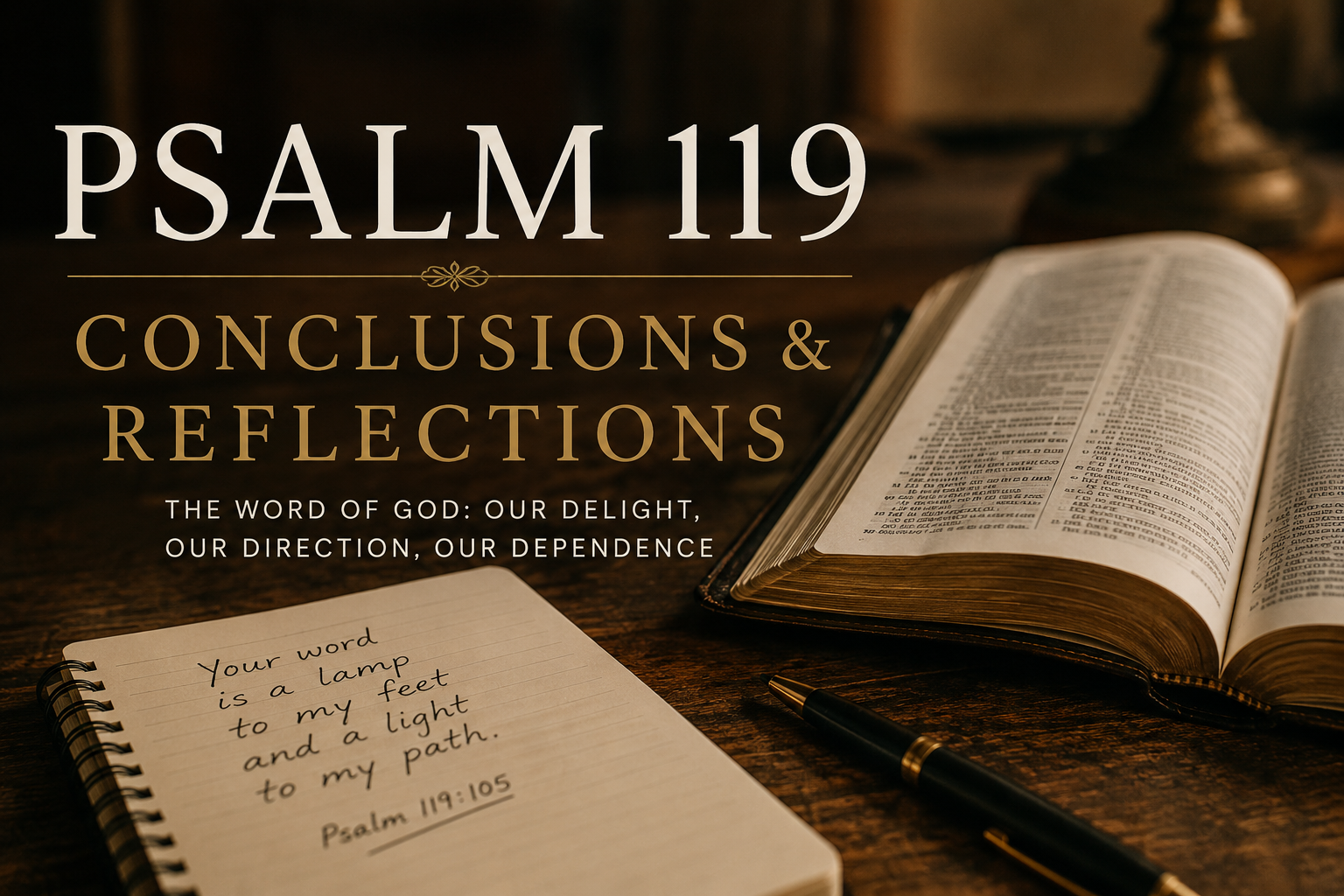
Well, we have now come to the end of our journey through Psalm 119. Twenty-two stanzas. One hundred and seventy-six verses. The longest chapter in the Bible. At first glance, reading through this psalm from beginning to end can feel somewhat repetitive. Yet, if our journey has revealed anything, it is that sustained meditation upon its lines uncovers remarkable depth. Each stanza approaches God’s Word from a distinct perspective, and each verse contributes another facet to the psalm’s rich theological portrait of Scripture. What initially appears repetitive gradually proves to be profoundly complementary, as the psalmist returns again and again to the same central theme with fresh insight and renewed appreciation. After spending the past several years working through this magnificent chapter, I would like to conclude our study by reflecting on some of the primary theological themes and practical lessons that have emerged along the way. While these observations certainly do not exhaust the riches of Psalm 119, they represent some of the truths that have most profoundly shaped my own understanding of God’s Word and its indispensable place in the life of every believer.
Of course, the primary lesson of Psalm 119 is immediately evident, and that is the absolute centrality of God’s Word. Nearly every verse contains some reference to or synonym for divine revelation—law, statutes, precepts, commandments, testimonies, judgments, ordinances, promises, etc. Regardless of what is happening in the psalmist’s life, whether he is rejoicing, suffering, praying, or pleading for deliverance, he continually returns to God’s revelation as the foundation of his faith and the source of his hope. Yet, in doing so, the psalmist reminds us that God’s Word is far more than a collection of sacred information. It is God’s self-revelation, through which He makes Himself known to His people. Through His Word, God instructs, corrects, comforts, warns, and sustains those who belong to Him. Every encounter with God’s Word is ultimately an encounter with the living God who still addresses His covenant people through the Scriptures He has breathed out. In that sense, Psalm 119 is not ultimately a celebration of the Bible as an end in itself, but of the God who graciously reveals Himself through His Word. The psalmist delights in Scripture because, through it, he encounters the living God.
Closely related to the centrality of God’s Word is another theme that has surfaced repeatedly throughout our study: the covenantal nature of the psalmist’s relationship with God. The Word is never presented as an impersonal code of conduct or a collection of detached religious obligations. Rather, it is the covenant document through which God reveals His character, declares His promises, and defines what covenant faithfulness looks like for His people. To delight in God’s Word, therefore, is to delight in the God who has graciously entered into relationship with His people. This covenantal perspective also explains why the psalm is so thoroughly saturated with prayer. Again and again the psalmist cries, “Teach me,” “Give me understanding,” “Revive me,” “Strengthen me,” and “Sustain me.” These are not the prayers of someone attempting to earn God’s favor through obedience, but of one who already belongs to God and longs to live faithfully within that covenant relationship. His obedience is never portrayed as self-generated moral achievement; it is the grateful response of a servant who desires to know his Lord more fully and to walk in the path that God Himself has graciously revealed. Throughout Psalm 119, studying God’s Word and communing with God are inseparable realities, for the believer encounters the covenant God precisely through the covenant Word He has given.
Another theme that emerged with surprising frequency throughout our study is the reality of affliction. At first glance, many readers approach Psalm 119 expecting a lengthy meditation on the beauty and benefits of God’s Word. While it is certainly that, it is also a psalm written in the midst of suffering. References to enemies, reproach, persecution, oppression, and distress appear again and again, particularly in the latter portions of the psalm. The psalmist is rarely speaking from a position of comfort or ease. More often than not, he is crying out to God in the midst of hardship, pleading for deliverance while clinging to the promises of His Word. This observation is significant because it reveals one of the primary purposes of Scripture in the life of the believer. God’s Word is not merely given to increase our knowledge or deepen our understanding during seasons of peace; it is given to sustain our faith when life is hardest. Again and again, the psalmist finds hope in God’s promises, strength in God’s commandments, and comfort in God’s faithfulness precisely because suffering has stripped away every other source of security. Affliction, rather than diminishing his confidence in God’s Word, drives him back to it with even greater urgency. Psalm 119 therefore reminds us that Scripture is not simply a companion for life’s brightest moments, but an anchor for its darkest ones. It is in the crucible of suffering that the enduring sufficiency of God’s Word is most clearly displayed.
Closely connected to this theme of affliction is another characteristic of Psalm 119 that is often overlooked: its persistent spirit of prayer. Although the psalm is rightly celebrated for its exaltation of God’s Word, it is equally a sustained conversation with the God who gave that Word. Throughout its twenty-two stanzas, the psalmist repeatedly prays, “Teach me,” “Give me understanding,” “Revive me,” “Sustain me,” “Strengthen me,” and “Rescue me.” Nearly every meditation upon God’s revelation naturally gives rise to another petition for God’s gracious work in his life. This reminds us of an important spiritual truth. Knowledge of Scripture is never intended to produce self-sufficiency. Rather, it cultivates ever-deepening dependence upon God. The more clearly the psalmist understands God’s holiness, the more aware he becomes of his own weakness. The more he delights in God’s commandments, the more earnestly he prays for grace to obey them. The more he meditates upon God’s promises, the more confidently he casts himself upon God’s faithfulness. In this way, Scripture and prayer are inseparable companions. God’s Word reveals His will, while prayer expresses our continual dependence upon His power to accomplish it. Far from fostering spiritual independence, Psalm 119 teaches us that genuine maturity is marked by an ever-growing reliance upon the God who speaks through His Word and graciously enables His people to live according to it.
Perhaps the most compelling feature of Psalm 119 is that the psalmist’s relationship with God’s Word is characterized not merely by obedience, but by delight. Throughout the psalm he repeatedly speaks of loving God’s law, rejoicing in His testimonies, delighting in His commandments, meditating upon His precepts, and treasuring His promises. These are not the words of someone reluctantly fulfilling religious obligations. They are the language of deep affection, revealing a heart that has come to cherish God’s Word as one of life’s greatest treasures. This emphasis offers an important corrective for many Christians today. We often approach Scripture primarily as a duty to perform or a discipline to maintain, measuring success by how consistently we complete our daily reading plans. While faithful discipline certainly has its place, Psalm 119 calls us to something far deeper. The ultimate goal is not simply external conformity to God’s commands, but an inward delight in the God who has spoken. Obedience reaches its fullest expression when it flows from love rather than mere obligation, when God’s Word becomes not simply something we read but something we long for. The psalmist reminds us that genuine spirituality is measured not only by what we know or even by what we do, but by what we love. A heart captivated by God’s Word is ultimately a heart captivated by God Himself.
As we come to the close of Psalm 119, we discover that the psalmist’s final words are not a declaration of victory but a confession of dependence: “I have gone astray like a lost sheep; seek your servant, for I do not forget your commandments” (v. 176). After 176 verses celebrating God’s Word, he does not conclude by boasting in his obedience but by casting himself upon God’s grace. In many ways, this final prayer gathers together every major theme of the psalm. The Word has revealed the covenant God. Affliction has driven the psalmist to His promises. Prayer has expressed continual dependence upon His strength. Delight has cultivated a heart that loves His ways. Yet all of these themes ultimately lead to the recognition that God’s people never outgrow their need for the Shepherd who seeks, sustains, and preserves them. Indeed, the One who perfectly delighted in the Father’s will is also the Good Shepherd who came “to seek and to save the lost.” It is therefore fitting that Psalm 119 ends not with human achievement, but with divine grace. Ultimately, this magnificent psalm teaches us that the goal of God’s Word is not merely that we know His commandments, but that we know and love the God who speaks, trust His promises, delight in His ways, and depend upon His grace until the end.
For further study:
Introduction
Psalm 119.1-8
Psalm 119.9-16
Psalm 119.17-24
Psalm 119.25-32
Psalm 119.33-40
Psalm 119.41-48
Psalm 119.49-56
Psalm 119.57-64
Psalm 119.65-72
Psalm 119.73-80
Psalm 119.81-88
Psalm 119.89-96
Psalm 119.97-104
Psalm 119.105-112
Psalm 119.113-120
Psalm 119.121-128
Psalm 119.129-136
Psalm 119.137-144
Psalm 119.145-152
Psalm 119.153-160
Psalm 119.161-168
Psalm 119.169-176
Share this:

On Psalm 119.169-176 (Taw)
169 Let my cry reach you, Lord;
give me understanding according to your word.
170 Let my plea reach you;
rescue me according to your promise.
171 My lips pour out praise,
for you teach me your statutes.
172 My tongue sings about your promise,
for all your commands are righteous.
173 May your hand be ready to help me,
for I have chosen your precepts.
174 I long for your salvation, Lord,
and your instruction is my delight.
175 Let me live, and I will praise you;
may your judgments help me.
176 I wander like a lost sheep;
seek your servant,
for I do not forget your commands.

Well, we have finally come to the last stanza of Psalm 119 (ת/taw), and it is fitting that our psalmist opens with a prayer. In verses 169–170, he petitions the Lord, “Let my cry reach you, Lord; give me understanding according to your word. Let my plea reach you; rescue me according to your promise.” After nearly 170 verses extolling the beauty, perfection, and life-giving power of God’s Word, he is still asking for understanding. In other words, his extensive knowledge of Holy Scripture has not diminished his dependence upon God. In the language of systematic theology, this truth is often described as the doctrine of illumination. Illumination is the gracious work of the Holy Spirit whereby he enlightens our minds and hearts to understand and receive God’s Word as he intended. (For a more extended discussion of this doctrine, see On Biblical Interpretation and the Holy Spirit.) The point is that a right understanding of Scripture is ultimately a gift of God. It certainly comes through careful study and diligent reflection, but our study must always be accompanied by humble dependence upon the Spirit who inspired the Scriptures in the first place. Throughout Psalm 119, we have repeatedly seen that God’s Word imparts wisdom, yet wisdom comes as God illumines the heart. The mature believer, therefore, never outgrows the need to pray, “Give me understanding according to your word.”
He also prays for deliverance when he says, “Rescue me according to your promise.” Once again, we are reminded that our psalmist continues to face hardship and opposition. Throughout Psalm 119 he has repeatedly cried out for God’s intervention, and here the same prayer rises once more from his lips. Yet what is particularly striking is the basis upon which he asks for deliverance. He does not appeal to his own merit, his own worthiness, or even his own obedience. Rather, he appeals to God’s promise. In other words, his confidence rests not in himself but in God’s covenant faithfulness. Or to put it another way, even after all his devotion to God’s Word, he still depends entirely upon divine grace. As D. Martyn Lloyd-Jones wisely observed, “Everything is of grace in the Christian life from the very beginning to the very end.” Apart from God’s grace we have nothing and are nothing. Even our most faithful obedience must be sustained and empowered by the God who first called us to himself. This is why the promises of Scripture are such a source of comfort for the believer. They remind us that God’s faithfulness does not fluctuate with our circumstances or our performance. Rather, his promises are rooted in his unchanging character. It is these gracious promises that become the foundation of confident prayer, enabling us to approach the throne of grace with boldness because we know that the God who has spoken is always faithful to his Word.
In verses 171–172, our psalmist moves from prayer to praise when he says, “My lips pour out praise, for you teach me your statutes. My tongue sings about your promise, for all your commands are righteous.” Notice here the motivation for his praise: it is that God has taught him his righteous commands and statutes. In other words, the purpose of Holy Scripture is not merely information. Our study of God’s Word should produce praise, obedience, and delight. Or, to put it another way, theology should produce doxology. God’s commands are righteous; therefore, praise is the fitting response. This has been one of the dominant themes throughout Psalm 119. The psalmist has repeatedly reminded us that God’s Word is sweeter than honey, more valuable than gold, a lamp to his feet, and a source of wisdom, comfort, hope, and peace. Yet all of these blessings ultimately direct his attention back to the God who has spoken. Scripture never terminates upon itself. It reveals the character, faithfulness, wisdom, and holiness of the Lord, and as we behold these divine perfections, our hearts are moved to worship. This is why genuine knowledge of God can never remain merely intellectual. The more deeply God’s truth takes root within us, the more naturally praise flows from our lips. If our study of Scripture produces greater knowledge without greater love for God, then we have missed the very purpose for which the Scriptures were given. True biblical understanding always culminates in joyful worship, because the ultimate goal of God’s Word is not simply that we know about him, but that we know him, delight in him, and glorify him with our lives.
In verses 173–174, our psalmist continues this theme of dependence when he prays, “May your hand be ready to help me, for I have chosen your precepts. I long for your salvation, Lord, and your instruction is my delight.” At first glance, these two statements may seem contradictory. On the one hand, he declares that he has chosen God’s precepts. On the other hand, he immediately asks for God’s help. Yet this is precisely the balance that runs throughout the Christian life. Genuine obedience is never independent of divine grace. Our willingness to follow the Lord is itself sustained by his continual presence and power. The psalmist recognizes that choosing God’s ways does not eliminate his need for God’s help; rather, it deepens his awareness of that need. Likewise, his longing for God’s salvation reminds us that he continues to look forward in hope. Though he delights in God’s instruction, he still awaits the full realization of God’s saving purposes. Throughout Psalm 119 we have repeatedly encountered this tension between present obedience and future expectation. God’s Word teaches us how to live faithfully today while at the same time directing our hope toward the salvation that God has promised to complete. The Christian life, therefore, is one of continual dependence upon the Lord, trusting that the God who calls us to walk in his ways is also the God who strengthens us to persevere until his work of redemption is brought to completion.
The final verses of Psalm 119 bring us to one of the most surprising conclusions in all of Scripture. After extolling the beauty, wisdom, and sufficiency of God’s Word for 175 verses, our psalmist concludes with this remarkable confession: “Let me live, and I will praise you;
may your judgments help me. I wander like a lost sheep; seek your servant, for I do not forget your commands.” At first glance, this seems almost out of place. Has not our psalmist repeatedly affirmed his love for God’s law, his delight in God’s commandments, and his commitment to walk in God’s ways? Why, then, does he end by describing himself as a wandering sheep? The answer is that this is not a confession of apostasy but of humble dependence. He recognizes that even the most faithful believer remains vulnerable apart from the preserving grace of God. Yet his wandering is immediately balanced by a profound affirmation: “I do not forget your commands.” Though he stumbles, he still belongs to the Lord. His hope rests not in his own ability to remain faithful but in the God who faithfully seeks and restores his servants. It is difficult to read these words without thinking of the Good Shepherd who came “to seek and to save the lost” (Luke 19.10), or of Jesus’ parable of the shepherd who leaves the ninety-nine sheep to search for the one that has wandered (Luke 15.4–7). Indeed, Isaiah had already declared, “We all went astray like sheep; we all have turned to our own way; and the Lord has punished him for the iniquity of us all” (Isa. 53.6). Thus, the final note of Psalm 119 is not one of self-confidence but of grace. The believer’s security ultimately rests not in the strength of his obedience but in the faithfulness of the Shepherd who continually seeks, preserves, and restores his wandering sheep.
As Psalm 119 draws to a close, we discover that its final emphasis is not human achievement but divine faithfulness. Throughout these twenty-two stanzas, our psalmist has celebrated the beauty, wisdom, sufficiency, and life-giving power of God’s Word. He has endured persecution, wrestled with suffering, delighted in God’s commandments, longed for deliverance, and found peace amid adversity. Yet the final word of the psalm is not self-confidence but humble dependence. Even after a lifetime devoted to God’s Word, he still cries out for understanding, seeks God’s help, and confesses his need for the Shepherd who alone can preserve him. In this way, Psalm 119 reminds us that the purpose of Scripture is never merely to increase our knowledge but to deepen our dependence upon the God who has spoken. The more faithfully we walk according to God’s Word, the more clearly we recognize our continual need for his sustaining grace. It is this gracious God who teaches, strengthens, seeks, and restores his people. And that, perhaps, is the greatest lesson of Psalm 119: the written Word continually directs us to the living God, whose truth, presence, and faithfulness are the sure foundation of the believer’s life.
For further study:
Introduction
Psalm 119.1-8
Psalm 119.9-16
Psalm 119.17-24
Psalm 119.25-32
Psalm 119.33-40
Psalm 119.41-48
Psalm 119.49-56
Psalm 119.57-64
Psalm 119.65-72
Psalm 119.73-80
Psalm 119.81-88
Psalm 119.89-96
Psalm 119.97-104
Psalm 119.105-112
Psalm 119.113-120
Psalm 119.121-128
Psalm 119.129-136
Psalm 119.137-144
Psalm 119.145-152
Psalm 119.153-160
Psalm 119.161-168
Share this:

On Acts and the Isaianic New Exodus: A Book Review

Pao, David W. Acts and the Isaianic New Exodus. Reprint Edition. Eugene, OR: Wipf & Stock, 2016.
Among the books of the New Testament, the book of Acts is arguably one of the most unique. Whereas the Gospels focus primarily on the life and ministry of Jesus and the Epistles provide theological instruction and practical guidance for the Christian life, Acts records the expansion of the early church and the missionary ministry of the Apostle Paul. Consequently, the theological message of Acts is sometimes overshadowed by its historical narrative. Yet beneath its historical narrative lies a rich and carefully constructed theological message, one that is especially evident in Luke’s extensive use of the Old Testament. In Acts and the Isaianic New Exodus, David W. Pao explores this important dimension of Acts by arguing that Luke deliberately presents the mission of Jesus and the early church against the backdrop of Isaiah’s vision of the New Exodus. Originally published as Pao’s doctoral dissertation by Mohr Siebeck in 2000, the work remains one of the most significant studies of Isaiah’s influence on Acts. Therefore, it is the thesis of this review that Acts and the Isaianic New Exodus makes a compelling case for the centrality of Isaiah’s New Exodus motif in Luke’s theology, even if certain aspects of Pao’s argument invite further discussion.
In the book of Isaiah, the “New Exodus” is a way of describing God’s future work of redemption by drawing upon the imagery and language of Israel’s original exodus from Egypt. Just as God once delivered his people from slavery under Pharaoh, so Isaiah portrays God as bringing about a second and greater act of deliverance through the restoration from Babylonian exile. The first exodus thus becomes the typological pattern for God’s future saving work. It is Pao’s central thesis that this Isaianic vision of restoration provides the foundational theological framework for Luke’s understanding of the growth and mission of the early church in the book of Acts. After demonstrating the significance of Isaiah 40:1–11 for Luke’s two-volume work and showing how key Isaianic texts frame the narrative of Acts, Pao identifies four major themes that reveal the influence of the New Exodus motif: the identity of the true people of God as restored Israel, the Word of God as the primary agent of God’s redemptive work, the anti-idolatry polemic as a demonstration of God’s universal sovereignty, and the expansion of Isaiah’s vision to include the salvation of the Gentiles alongside believing Israel. In other words, Pao argues that Luke presents the church not as a departure from Israel’s story but as the fulfillment of Isaiah’s restoration promises, with the mission of the apostles representing the continuation of God’s New Exodus restoration through the risen and exalted Messiah.
The greatest strength of Pao’s work lies in its careful and convincing demonstration that Isaiah provides the conceptual framework through which Luke understands the theological message of Acts. Rather than merely identifying quotations and allusions to Isaiah scattered throughout the narrative, Pao argues that Luke has intentionally structured his theology around Isaiah’s vision of the New Exodus. This approach gives remarkable coherence to the book of Acts by showing that themes such as restoration, mission, the Word of God, the inclusion of the Gentiles, and the identity of the people of God are not isolated theological concerns but interconnected aspects of a single redemptive program. Closely related to this is Pao’s rigorous intertextual methodology. His argument rests not upon superficial verbal parallels but upon sustained literary and theological analysis that demonstrates how Luke appropriates and develops Isaiah’s message. As a result, even readers who remain unconvinced by every aspect of his thesis will gain a much deeper appreciation for the pervasive influence of Isaiah upon Luke’s writing. Particularly valuable is Pao’s treatment of restoration theology. He persuasively demonstrates that the mission of the church should not be understood as a departure from Israel’s story but as the fulfillment of God’s promises to restore his covenant people, promises that now embrace believing Jews and Gentiles alike through the risen Messiah. Finally, Pao’s work serves as an excellent model of canonical interpretation. Rather than reading Acts in isolation, he consistently interprets Luke’s narrative within the larger context of Scripture, thereby illustrating the profound unity of God’s redemptive plan. Whether or not one accepts every detail of Pao’s argument, his study permanently enriches the way one reads the book of Acts and its theological message.
Pao’s work is remarkably persuasive in establishing the significance of Isaiah for the theology of Acts. At the same time, the breadth of his argument gives rise to several questions that invite further discussion. Ironically, one of the book’s greatest strengths—its comprehensive argument for the centrality of Isaiah’s New Exodus—also becomes its primary limitation. At times, Pao’s thesis is so comprehensive that other significant Old Testament trajectories receive comparatively little attention. While Isaiah undoubtedly provides one of the principal theological frameworks for Luke’s theology, greater attention to Luke’s Christology and to the complementary influence of other Old Testament traditions—particularly Daniel’s vision of the Son of Man and the kingdom of God—would have presented an even fuller picture of Luke’s theological vision. Closely related to this is the fact that some of Pao’s proposed intertextual connections are more persuasive than others. In several instances, he moves rather quickly from thematic similarity to literary dependence, leaving readers wishing for a more sustained defense of particular allusions. Finally, because the volume originated as a doctoral dissertation, portions of the discussion are necessarily technical and assume a significant degree of familiarity with contemporary scholarship on Luke-Acts and intertextuality. Nevertheless, these observations should be understood as limitations of emphasis rather than substantive weaknesses. They do little to diminish the enduring value of Pao’s work or its significant contribution to the study of Acts and biblical theology.
Even after more than two decades, Acts and the Isaianic New Exodus continues to stand as one of the most significant contributions to the study of Luke-Acts and biblical theology. Pao convincingly demonstrates that the book of Acts should be read as far more than a historical record of the early church’s expansion; it is a carefully crafted theological narrative that presents the mission of Jesus and his apostles as the fulfillment of Isaiah’s vision of restoration and New Exodus. Although readers may differ with certain aspects of Pao’s thesis or wish that other Old Testament themes received greater attention, these observations do little to diminish the overall value of his work. Indeed, the greatest achievement of this volume is its ability to teach readers to read Acts canonically, recognizing that Luke’s theology is deeply rooted in the Scriptures of Israel and unfolds as the continuation of God’s covenant purposes for his people. For this reason, I would highly recommend this book to pastors, seminary students, scholars, thoughtful Christians who desire a deeper appreciation of the theological richness of Acts. Even readers who ultimately qualify portions of Pao’s argument will find themselves returning to the book of Acts with fresh eyes and a renewed awareness of the profound influence of Isaiah upon Luke’s presentation of the gospel and the mission of the church.
Share this:

On Psalm 119.161-168 (Sin/Shin)
161 Princes have persecuted me without cause,
but my heart fears only your word.
162 I rejoice over your promise
like one who finds vast treasure.
163 I hate and abhor falsehood,
but I love your instruction.
164 I praise you seven times a day
for your righteous judgments.
165 Abundant peace belongs to those
who love your instruction;
nothing makes them stumble.
166 Lord, I hope for your salvation
and carry out your commands.
167 I obey your decrees
and love them greatly.
168 I obey your precepts and decrees,
for all my ways are before you.

The twenty-first stanza (ש/sin or shin, depending on the placement of the dot) continues the theme of suffering that we have encountered throughout the last several stanzas. Our psalmist opens with the observation, “Princes have persecuted me without cause.” Once again, we are not given all the details of his circumstances, but it is clear that his troubles originate from those who possess power and authority. It is often the case that the righteous suffer not because they have done anything wrong, but simply because they belong to God. Our psalmist finds himself opposed by the powers that be without just cause. Of course, this pattern runs throughout the history of God’s people and finds its fullest expression in the suffering of Jesus Christ, who “left you an example, that you should follow in his steps” (1 Pet. 2.21). As Jesus himself warned, “A servant is not greater than his master. If they persecuted me, they will also persecute you” (John 15.20). Yet in the face of this persecution, our psalmist does not surrender to fear, bitterness, or despair. Rather, he declares, “My heart fears only your word.” The princes may possess earthly authority, but God’s Word possesses ultimate authority. The defining feature of this stanza, therefore, is not the persecution itself, but the psalmist’s response to it. Instead of allowing his circumstances to govern his heart, he finds comfort, stability, and confidence in the promises of God.
This is perhaps why he says, “I rejoice over your promise like one who finds vast treasure.” The image is striking. Imagine the excitement of stumbling upon a fortune beyond anything you could have imagined. That is how our psalmist views the Word of God. He recognizes that true and lasting value is found not in possessions, accomplishments, status, or worldly comforts, but in the promises of God. Indeed, no earthly treasure can compare with the life-giving riches that are found in God’s Word. And this is cause for great joy, because no matter what difficulties may arise, we always have God’s promises to uphold and sustain us. This is an important lesson for us as well, namely that the value we assign to God’s Word reveals much about the orientation of our hearts. Are our hearts consumed by anxiety, fear, and uncertainty about the future, or are they resting in the promises of the one true and living God? Do we rejoice in God’s Word even when circumstances are difficult and answers seem far away? Our psalmist’s joy is not rooted in changing circumstances but in the unchanging faithfulness of God revealed through his Word.
And it is this treasuring of God’s Word that leads our psalmist to say in verse 163, “I hate and abhor falsehood, but I love your instruction.” This is strong language, but compared to the surpassing value of God’s truth, all falsehood must appear by contrast as hateful and abhorrent. Of course, this is not the language of emotional volatility or personal animosity. Rather, it is the language of covenant loyalty and moral commitment. Our psalmist’s love for God and his Word has shaped his affections in such a way that he delights in what is true and rejects what is false. Covenant love for God necessarily produces opposition to anything that contradicts his character and his revelation. Yet modern notions of love often seek to separate love from truth. Many assume that to love someone means affirming whatever they believe or shielding them from difficult truths. But the Scriptures know nothing of such a separation. Genuine love rejoices in the truth because truth ultimately leads us to God himself. For this reason, our psalmist refuses to separate love from truthfulness. To love God is to love what is true, right, good, and beautiful, and to reject whatever stands opposed to it.
Of course, this kind of love should stand at the very center of our worship, as our psalmist writes, “I praise you seven times a day for your righteous judgments.” In other words, our psalmist’s heart is so filled with covenant love and loyalty that he cannot help but burst forth in praise. The reference to “seven times a day” likely signifies more than a literal number. Throughout Scripture, the number seven often conveys the idea of fullness or completeness. The point, then, is that praise has become the regular habit of his soul. Worship is not an occasional activity reserved for certain moments or certain days of the week. Rather, it permeates the very fabric of his life. And we might be tempted to ask how such continual praise is possible in the face of unjust persecution and suffering. The answer is simple: God’s righteous judgments are continually before him. His mind is saturated with the truth of God’s Word, and his heart responds with worship. The more deeply Scripture shapes our thinking and affections, the more naturally praise emerges from our lives. This is because the ultimate goal of Scripture is not merely information but worship, not merely knowledge about God but joyful devotion to the God who has revealed himself in his Word.
Now, the result of this life of covenant loyalty, delight in God’s Word, and continual worship is what our psalmist describes in verse 165: “Abundant peace belongs to those who love your instruction; nothing makes them stumble.” This is perhaps the central affirmation of the entire stanza. However, we must be careful to understand what kind of peace the psalmist has in mind. He is not speaking of ease, comfort, or the absence of hardship. After all, he has already told us that he is being persecuted by princes without cause. His circumstances have not changed. The opposition remains. The suffering continues. Yet he possesses peace. This is because biblical peace is not primarily the absence of conflict but the presence of stability, wholeness, and confidence in God. It is the settled assurance that God remains faithful to his promises regardless of what may be happening around us. This is why peace belongs specifically to those who love God’s instruction. The Word of God anchors the believer amid the storms of life. It provides a sure foundation when everything else seems uncertain and unstable. As we have seen in the previous stanzas, our circumstances may remain difficult, our prayers may seem unanswered, and our suffering may continue for a season. Yet the foundation remains secure because God’s Word remains true. Peace, therefore, does not flow from our ability to control our circumstances but from our confidence in the God who governs them. The more deeply we trust his Word, the more firmly our hearts are established in peace.
Our psalmist concludes the stanza by reminding us why all of this is possible: “I obey your precepts and decrees, for all my ways are before you.” Though he is persecuted, pressured, and opposed by powerful enemies, he continues to rejoice in God’s Word, to praise God continually, and to walk in faithful obedience. More remarkably still, he enjoys a peace that transcends his circumstances. The reason for this confidence is that he lives Coram Deo, that is to say, before the face of God. His life is not hidden from the Lord. His sufferings are known. His prayers are heard. His obedience is seen. The God who gave these promises is the same God who remains present with his people and faithful to his covenant. This is why the stability of the believer is ultimately grounded not in favorable circumstances but in the enduring truth of God’s Word. Though the people of God may face opposition from every side, they possess a peace the world cannot give because their lives are anchored in the truth, presence, and faithfulness of the God who speaks.
For further study:
Introduction
Psalm 119.1-8
Psalm 119.9-16
Psalm 119.17-24
Psalm 119.25-32
Psalm 119.33-40
Psalm 119.41-48
Psalm 119.49-56
Psalm 119.57-64
Psalm 119.65-72
Psalm 119.73-80
Psalm 119.81-88
Psalm 119.89-96
Psalm 119.97-104
Psalm 119.105-112
Psalm 119.113-120
Psalm 119.121-128
Psalm 119.129-136
Psalm 119.137-144
Psalm 119.145-152
Psalm 119.153-160
Share this:

On Psalm 119. 153-160 (Resh)
153 Consider my affliction and rescue me,
for I have not forgotten your instruction.
154 Champion my cause and redeem me;
give me life as you promised.
155 Salvation is far from the wicked
because they do not study your statutes.
156 Your compassions are many, Lord;
give me life according to your judgments.
157 My persecutors and foes are many.
I have not turned from your decrees.
158 I have seen the disloyal and feel disgust
because they do not keep your word.
159 Consider how I love your precepts;
Lord, give me life according to your faithful love.
160 The entirety of your word is truth,
each of your righteous judgments endures forever.

We now come to the twentieth stanza of Psalm 119 (ר/resh, pronounced raysh), and many of the thoughts and themes are a continuation from the previous stanza (qoph). Our psalmist begins by asking God to “consider my affliction and rescue me.“ Clearly, our psalmist is experiencing some measure of personal suffering and sorrow. And we must affirm that suffering and difficulty are a regular part of the life of faith. The Christian life is not lived apart from suffering, but through it. The question is not whether we will suffer and face difficulties, but how we will suffer and face difficulties. Our psalmist’s suffering drives him toward God, not away from him, as he says, “for I have not forgotten your instruction.” In other words, in the midst of his suffering and troubles, our psalmist clings to God’s Word, because he believes that God is fundamentally faithful to his promises. His suffering may be real, but so too is the steadfast faithfulness of the God who speaks.
This is why he goes on to pray in verse 154, “Champion my cause and redeem me; give me life as your promised.” Notice that the psalmist appeals not to his own personal merits, but to God’s covenant mercy. He understands that he cannot ultimately save himself and that he depends entirely upon God’s intervention. And this is exactly the point, namely that our affliction and difficulties are meant to expose our weaknesses and our inabilities to sustain ourselves apart from God. Yet the psalmist does not collapse into despair or hopelessness. Rather, he cultivates a posture of active dependence upon the Lord. His suffering does not destroy his faith; it drives him more deeply into dependence upon God and his promises. He prays, he cries out, he seeks the Lord, and he clings to the certainty of God’s covenant faithfulness. This is what true dependence looks like. It is not passive resignation, but persevering trust that continues to hold firmly to the faithfulness of God even in the face of suffering and uncertainty.
Of course, this is not true for those who stand outside of covenant relationship with God. Verse 155 reads, “Salvation is far from the wicked because they do not study your statutes.” This is not merely a rejection of moral instruction in an abstract sense; rather, it is a wholesale covenant repudiation. The wicked are described as those whose lives are fundamentally oriented away from God and his Word. By contrast, the righteous cling to God’s promises and seek refuge in his instruction. This distinction is incredibly important because the psalmist understands that salvation and deliverance cannot be separated from relationship with God himself. Life, truth, obedience, and salvation all belong together. This stands in direct contrast to the instincts of our fallen nature. So often, we desire comfort, peace, and deliverance while resisting submission to God and his Word. We want the blessings of covenant without the God of the covenant. But the psalmist refuses to separate these realities. To reject the Word of God is ultimately to reject the God who gives life, because his Word is the very means through which he reveals himself, sustains his people, and leads them into salvation and truth.
The God of the Bible is the only one who can truly give life, as our psalmist prays, “Your compassions are many, Lord; give me life according to your judgments.” Of course, our psalmist is not merely praying for physical preservation, though that is certainly included within his request. The “life” he prays for is spiritual, covenantal, and relational; it is grounded in the Lord’s many compassions. This is why he repeatedly prays for God to revive him according to his steadfast love, his judgments, and his Word. True and abundant life, a life that is full and flourishing, flows from the character of God as he reveals himself through his Word and remains faithful to his covenant promises. In other words, the Word of God is not abstract information, bare command, or mere doctrine; it is life-giving revelation. And this notion stands in direct contrast to the instincts of our modern world. We often seek life and renewal through changing circumstances, distractions, self-help strategies, or emotional experiences, but none of these things can truly sustain the soul. The psalmist understands that real life can only be found in God and in his Word. Scripture does not merely inform the people of God; it sustains, revives, and gives them life.
And so, our psalmist concludes in verse 160, “The entirety of your word is truth, each of your righteous judgments endures forever.” In many ways, this is the theological climax of the stanza. The psalmist’s confidence ultimately rests not in changing circumstances, nor even in the immediate easing of his affliction, but in the enduring truthfulness of God’s Word. As we saw in the previous stanza, the details and circumstances of human experience change constantly, sometimes day by day, even moment by moment. Our emotions fluctuate, our trials intensify, and the uncertainties of life often leave us feeling unstable and weary. But the truthfulness of God does not change. His Word remains fixed, enduring, and eternally true. This is why the stability of the Christian life ultimately depends upon the stability of divine revelation rather than the instability of human experience. Like the psalmist, then, we are able to persevere through every season of suffering and uncertainty because the God who speaks remains faithful and true, and his Word endures forever.
In the end, then, the Resh stanza of Psalm 119 teaches us what it means to seek life through the Word of God in the midst of suffering and affliction. The psalmist cries out, waits, longs for deliverance, and pleads for God to revive him, and yet throughout the stanza he continually turns back to the certainty of God’s promises and covenant faithfulness. Affliction does not sever his relationship with God; rather, suffering becomes the very context in which his dependence upon God deepens. And the same is true for the people of God today. We continue to seek life not in changing circumstances or fleeting comforts, but in the enduring faithfulness of the God who speaks. Though affliction surrounds the people of God, true life is found in the God who speaks, whose Word remains forever true and whose covenant faithfulness never fails.
For further study:
Introduction
Psalm 119.1-8
Psalm 119.9-16
Psalm 119.17-24
Psalm 119.25-32
Psalm 119.33-40
Psalm 119.41-48
Psalm 119.49-56
Psalm 119.57-64
Psalm 119.65-72
Psalm 119.73-80
Psalm 119.81-88
Psalm 119.89-96
Psalm 119.97-104
Psalm 119.105-112
Psalm 119.113-120
Psalm 119.121-128
Psalm 119.129-136
Psalm 119.137-144
Psalm 119.145-152
Share this:


On Psalm 119.145-152 (Qoph)
145 I call with all my heart; answer me, Lord.
I will obey your statutes.
146 I call to you; save me,
and I will keep your decrees.
147 I rise before dawn and cry out for help;
I put my hope in your word.
148 I am awake through each watch of the night
to meditate on your promise.
149 In keeping with your faithful love, hear my voice.
Lord, give me life in keeping with your justice.
150 Those who pursue evil plans come near;
they are far from your instruction.
151 You are near, Lord,
and all your commands are true.
152 Long ago I learned from your decrees
that you have established them forever.

It has been a while since I have continued my work through Psalm 119, but we now come to the nineteenth stanza (ק/Qoph). Immediately in the opening verses, we are met with the heartfelt cry of the psalmist. He rises before the dawn and cries out; he watches through the night and longs for deliverance. There is a desperation and urgency in his prayers that is all too familiar to the people of God. And yet, what grounds the psalmist in the midst of his anxieties is a profound confidence in God and in his Word. In other words, even amid the uncertainties of his circumstances, there remains a quiet confidence, a sure and certain foundation upon which he can stand, namely the faithfulness of God to his promises. Even as he waits for God to intervene in his particular situation, he does so with the expectation that God will do what he has said he will do. He will keep his promises; he will remain true to his Word.
This is perhaps why the psalmist’s prayers are so heartfelt and sincere. He cries out “with all my heart.” This is not empty emotionalism or emotion for emotion’s sake; rather, it is the full orientation of the whole self toward God in utter dependence upon him and his promises. It is only from this posture of dependence that we are truly able to express our deepest fears, longings, and vulnerabilities before God. This is one of the great comforts of covenant relationship with him, namely that we can entrust even our most personal anxieties and desperations into his hands because he hears the cries of his people. At the same time, the psalmist balances his cries for deliverance with his own commitment to walk in obedience and faithfulness. This is not a kind of tit-for-tat arrangement in which obedience earns God’s favor. Rather, it is the logic of covenant itself. God has promised to remain faithful to his word, and the psalmist responds with trust expressed through obedience. In other words, true dependence upon God does not produce passivity, but faithful perseverance. It is a radical dependence that issues forth in both trust and obedience.
It is this covenant relationship that also strengthens the psalmist’s perseverance; he rises before the dawn and watches through the night. These actions express hopeful expectation even in the midst of waiting. The fact of the matter is that we simply do not know how long the psalmist has been observing these rhythms of prayer and longing. Perhaps he has been crying out for deliverance for a very long time. And yet he persists in the offering because he remains confident that God will one day answer his prayers. Of course, waiting is a common season in the Christian life. We have all experienced moments in which we long for God’s intervention and yet it does not seem to be forthcoming. It is precisely this kind of hopeful expectation that provides the strength necessary to persevere through such seasons. Indeed, this is how waiting itself can be transformed into worship, namely when it is sustained by confidence in the promises of God. The dawn has not yet come, but hope keeps the people of God awake in the darkness.
Because, let’s face it, we do live in the midst of pervasive darkness. The psalmist puts it this way in verse 150: “Those who pursue evil plans come near; they are far from your instruction.” And yet, in the very next line, he says, “You are near, Lord.” This is one of the great comforts of covenant relationship with God, namely that the nearness of affliction does not negate the nearness of God himself. The psalmist appears to be experiencing real oppression. He is pursued by those who would do him harm and likely lives under the constant threat of suffering and hostility. And yet, his confidence does not rest in the immediate resolution of his circumstances, but in the character and presence of God. This is an incredibly important insight because we are often tempted to interpret suffering as evidence of divine distance or absence. But Scripture repeatedly teaches us otherwise. Indeed, it is often in our deepest pains and afflictions that the nearness of God becomes most precious to his people. The psalmist knows this because his confidence is grounded not in changing circumstances, but in the sure and steadfast promises of God. The darkness may draw near, but the Lord is nearer still.
The psalmist knows this truth because, as he says in verse 152, “Long ago I learned from your decrees that you have established them forever.” This is an important statement because, in the midst of a stanza filled with emotional weight and longing, the psalmist ultimately grounds his confidence in the objective certainty of God’s Word. He is not led by his emotions, nor is he controlled by the instability of his circumstances. Rather, he is anchored in the enduring faithfulness of God and his promises. This is because God’s Word is not only true, but eternally true. In the midst of the shifting seasons of life, the highs and lows of our emotions, and the ever-changing nature of our trials and afflictions, the promises of God remain fixed and unchanging. The Lord himself is the same yesterday, today, and forever, and therefore his faithfulness does not fluctuate with the changing tides of human experience. This is why the people of God are able to persevere with expectant hope, because our confidence ultimately rests not in ourselves or our circumstances, but in the unchanging certainty of the Word of God.
In the end, then, the Qoph stanza of Psalm 119 teaches us what it means to persevere in hopeful dependence upon God. The psalmist cries out, waits, watches, suffers, and longs for deliverance, and yet the dominant note throughout the stanza is not despair, but confidence. Though darkness surrounds him and affliction draws near, he remains convinced that the Lord is nearer still. This is often the shape of the Christian life as well. We pray before the dawn; we wait through long nights of uncertainty; we trust God before deliverance finally comes. And yet, in all of these seasons, the people of God continue to hope because our confidence rests not in ourselves or in the stability of our circumstances, but in the unchanging faithfulness of God and his Word. The darkness may linger through the night, but the people of God continue to hope because the God who speaks remains near, and his word remains forever true.
For further study:
Introduction
Psalm 119.1-8
Psalm 119.9-16
Psalm 119.17-24
Psalm 119.25-32
Psalm 119.33-40
Psalm 119.41-48
Psalm 119.49-56
Psalm 119.57-64
Psalm 119.65-72
Psalm 119.73-80
Psalm 119.81-88
Psalm 119.89-96
Psalm 119.97-104
Psalm 119.105-112
Psalm 119.113-120
Psalm 119.121-128
Psalm 119.129-136
Psalm 119.137-144
Share this:

On Psalm 119.121-128 (Ayin)
121 I have done what is just and right;
do not leave me to my oppressors.
122 Guarantee your servant’s well-being;
do not let the arrogant oppress me.
123 My eyes grow weary looking for your salvation
and for your righteous promise.
124 Deal with your servant based on your faithful love;
teach me your statutes.
125 I am your servant; give me understanding
so that I may know your decrees.
126 It is time for the Lord to act,
for they have violated your instruction.
127 Since I love your commands
more than gold, even the purest gold,
128 I carefully follow all your precepts
and hate every false way.

The sixteenth stanza of Psalm 119 (ע/ayin) deals with the age old dilemma of faith; it is a question that the people of God have been asking for four millenia. “How long, O Lord?” How long will the wicked prosper? How long will sin and evil endure? How long until you come again to judge the wicked and vindicate the righteous, O Lord? Is it all worth it? Is my obedience and my faithfulness and my suffering worthwhile in the grand scheme of your eternal plan, O Lord? These are the perennial questions of faith. In the face of ever growing evil and the ongoing glorification of sin and wickedness, we are left to wonder if our struggles to walk in faith and obedience are worth it? If we are honest with ourselves, these are questions that even the most faithful of Christians have asked themselves at some point or another. Our psalmist puts it this way: “My eyes grow weary looking for your salvation and for your righteous promise.” (Verse 123)
This is perhaps what is most refreshing about the Word of God, especially in the Psalms but equally so throughout the canon of Scripture, namely that it is real and honest about the human predicament. The Scriptures do not whitewash the ugly and painful realities of human experience; rather, they acknowledge them with an honesty that is both brutal and refreshing. Moreover, they speak to the complexities of maintaining faith and hope in the face of such realities that would otherwise drive us to depression and despair. This is why our psalmist can say, “It is time for the Lord to act, for they have violated your instruction.” (Verse 126) Even though he feels the weariness and the temptations to despair, our psalmist holds on to his hope that God will act, that He will judge those who have violated His instruction. Our psalmist sees this hope as both good and right; it is both good and right that the wicked should finally be punished.
And it is this hope that drives our psalmist to maintain his faith in steadfast obedience to God and His word. He says, “I have done what is just and right; do not leave me to my oppressors,” (Verse 121) and he says, “I carefully follow all your precepts and hate every false way.” (Verse 128) His hope in God and his justice drives his perseverance in faith and obedience. He is convinced that his obedience is not meaningless, that the persecution and suffering that he has endured in not random or without purpose. No, our every effort to walk by faith and obedience, our every difficulty and heartache for the sake of God and His Word, will be ultimately vindicated and rewarded. We look forward to those gracious words of our Lord Jesus, when He will say, “Well done, good and faithful servant! Enter into your master’s joy.” This is why our psalmist can pray, “Deal with your servant based on your faithful love; teach me your statutes.” (Verse 124)
The word here translated “faithful love” is a central and primary concept in the Old Testament’s conception of God. It’s closest New Testament equivalent is the word “grace.” This attribute of God’s character is enshrined in the covenantal formula,
The Lord—the Lord is a compassionate and gracious God, slow to anger and abounding in faithful love and truth, maintaining faithful love to a thousand generations, forgiving iniquity, rebellion, and sin. But he will not leave the guilty unpunished, bringing the consequences of the fathers’ iniquity on the children and grandchildren to the third and fourth generation. (Exodus 34:6-7)
This covenantal formula is the basis for all of the Old Testament’s theology, and it forms the foundation of our psalmist’s faith in this stanza of Psalm 119. The God of the Bible is a God who is longsuffering and gracious toward those who submit to Him in faith, but He is just and holy toward those who reject His sovereign rule over their lives.
And it is this faith that leads him to pray, “Guarantee your servant’s well-being; do not let the arrogant oppress me.” (Verse 122) Literally translated, the line reads, “Be surety for your servant for good.” The idea is that God himself is the surety, the earnest money, the down payment, of good for his servant. In other words, our good, our blessing, our prosperity and human flourishing flows only from God and His promises. This is why we must trust in Him and walk in His ways. As our psalmist puts it, “Since I love your commands more than gold, even the purest gold, I carefully follow all your precepts.” Our fulfillment, our purpose, our joy and happiness is only available when we submit ourselves to God Word, when we walk in God’s ways, even if when it feels like everyone is going in the other direction. Christian perseverance is driven by a faith full of hope. When and only when we walk in this hope will we experience genuine human flourishing and fulfillment.
For further study:
Introduction
Psalm 119.1-8
Psalm 119.9-16
Psalm 119.17-24
Psalm 119.25-32
Psalm 119.33-40
Psalm 119.41-48
Psalm 119.49-56
Psalm 119.57-64
Psalm 119.65-72
Psalm 119.73-80
Psalm 119.81-88
Psalm 119.89-96
Psalm 119.97-104
Psalm 119.105-112
Psalm 119.113-120
Share this:

On Psalm 119.105-112 (Nun)
105 Your word is a lamp for my feet
and a light on my path.
106 I have solemnly sworn
to keep your righteous judgments.
107 I am severely afflicted;
Lord, give me life according to your word.
108 Lord, please accept my freewill offerings of praise,
and teach me your judgments.
109 My life is constantly in danger,
yet I do not forget your instruction.
110 The wicked have set a trap for me,
but I have not wandered from your precepts.
111 I have your decrees as a heritage forever;
indeed, they are the joy of my heart.
112 I am resolved to obey your statutes
to the very end.

The fourteenth stanza of Psalm 119 starts with the letter נ (nun/pronounced like noon). Yes, that is right; the fourteenth stanza out of twenty-two. Remember, Psalm 119 is an acrostic psalm in which every stanza starts with the next letter of the Hebrew alphabet. It truly is a wonder of our psalmist could write 22 stanzas, 186 verses, extolling the perfections of God’s Word. There is no repetition, no redundancies; no, every stanza addresses some new or different aspect of God’s Law than the one before. His heart was clearly enamored – no, that’s not right – it was consumed with love, affection, devotion for the precepts of God. They were his very life, the only nourishment that could satisfy the pangs of his soul. This attitude should challenge and convict us. Modern Christians struggle to devote 15 minutes of their day to reading the bible; I know, because I am one of them. Why do our souls not hunger and thirst for the nourishment, the soul satisfying pleasures of the Word of God? This is the question that Psalm 119 is asking us.
In this stanza, our psalmist begins with those famous words, “Thy word is a lamp unto my feet, and a light unto my path” (verse 105, KJV). If you were raised in church like I was, then you probably just sang the lyrics to yourself. The fact that someone set these words to music captures the right sentiment, I think. The Psalms were originally prayers and songs that were meant for Israel’s corporate worship, so in singing them, we are no doubt emulating the practice of our psalmist. However, the connection between song and lyric and the affections of the heart is one that is often so underappreciated in modern worship services. Music has a way of touching us, of forming us, in the most vulnerable recesses of our hearts. What we sing, what we shout, these are the things that are planted in the memory of our hearts. This is why we should sing songs that are biblically faithful. As our psalmist goes on to write here, “I have solemnly sworn to keep your righteous judgments.” (verse 106). He is clear in these verses that his greatest affection, his first and foremost guiding principle for life, is the revelation of God in his Word.
And it would appear that he is in particular need of this guidance, as he goes on to write, “I am severely afflicted” (verses 107), and again, “My life is constantly in danger” (verse 109). And in the next verse, “The wicked have set a trap for me” (verse 110). Of course, we do not know the nature of this particular psalmists troubles; we have no narrative of his life to appeal to for background information. But it would appear that he is deeply troubled; he is facing some kind of opposition, some kind of persecution or threat, possibly even up to and including his very life. There are several occasions in the Book of Psalms where David faces similar circumstances, so we may reasonably infer that this was no light or temporary concern for our psalmist. And yet, in the midst of this trail, he continues to affirm his allegiance to the commands and ordinances of God. “I do not forget your instruction” (verse 109); “I have not wandered from your precepts” (verse 110). In fact, he goes on to say in the last verse of the stanza, “I am resolved to obey your statutes to the very end” (verse 112). Here again, we don’t know if the persecution he was facing was directly caused by his commitment to the God and His Word, but we do know that he was resolved, committed, and steadfast in keeping that Word until the very end, no matter what opposition he may face.
Where does a person find this kind of strength, this kind of steadfast loyalty to keeping the Word of God? I think we have our psalmists answer in verse 111, “I have your decrees as a heritage forever; indeed, they are the joy of my heart.” The word “heritage,” or perhaps “possession,” implies the idea of an inheritance; it is a surety of future prosperity. It is the reward that awaits the firstborn. And for our psalmist, the inheritance that he is anticipating is nothing less than the promises of the Word of God. It is the words of Lord Jesus, when he says, “Well done good and faithful servant, enter into the joy of your master.” It is a certainty, a sure and firm hope, of future glories, even in the midst of present difficulties and hardships. The Word of God is our hope, and it is the joy of our hearts. Hope and joy; two out of three of the great triad of Christian virtues. These are the defining characteristics of those who trust in God’s word – unshakable hope, indomitable joy. Clearly, our psalmist had these in his heart, and no matter what troubles or heartaches may come, he was able to persevere because of he found his hope and his joy in the abiding Words of the living God.
This stanza, nay this entire psalm for that matter, is a wonder to me. It challenges and convicts my soul in ways that I am still trying to define even after writing on these first fourteen stanzas. I wonder why God would put a psalm like this one in the Bible; it seems somewhat self-congratulatory – 186 verses on the soul satisfying perfections of His own Word. But perhaps, he put it here because he know that in it he has provided the salve for every every need of the human heart. So often, we look for our comfort, our peace, our security, our hop, our joy in all the wrong places. This is sin. But if we could learn to emulate the attitude and affections of our psalmist, if we would truly begin to hide his Word in our hearts, then we might be able say with the psalmist, “I have not wandered from your precepts.” In His goodness, God has provided the solution to every problem, the cure for every heartache, the peace and comfort for every trial. It is Him, God himself; He is the only one who can answer the deepest longings of our souls. And he has done this in His Word. May we learn to emulate the conviction of our psalmist and find our peace, our hope, and our comfort in His Word.
For further study:
Introduction
Psalm 119.1-8
Psalm 119.9-16
Psalm 119.17-24
Psalm 119.25-32
Psalm 119.33-40
Psalm 119.41-48
Psalm 119.49-56
Psalm 119.57-64
Psalm 119.65-72
Psalm 119.73-80
Psalm 119.81-88
Psalm 119.89-96
Psalm 119.97-104


