Tag Archives: Delight in God’s Word

On Psalm 119: A Conclusion and Reflection
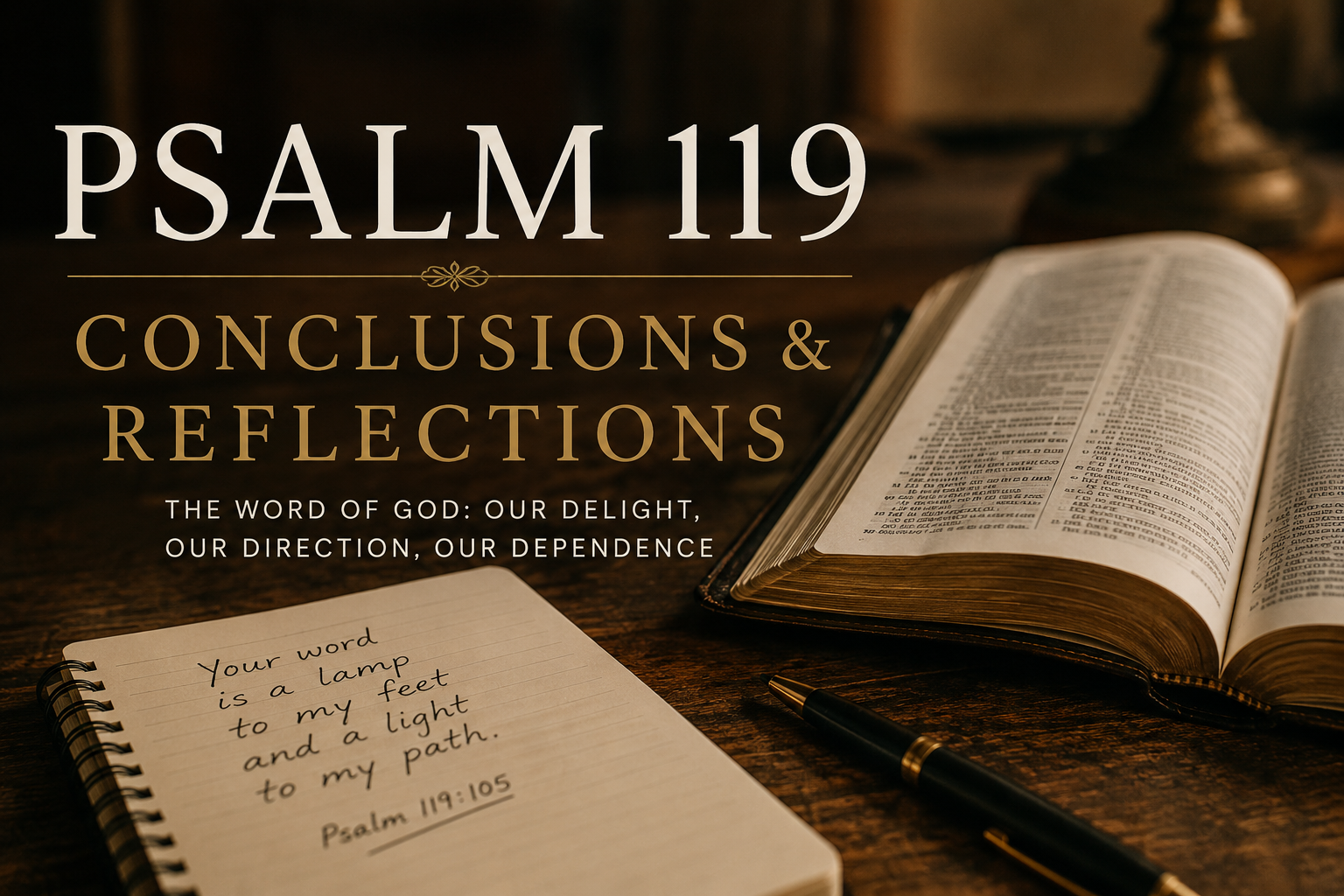
Well, we have now come to the end of our journey through Psalm 119. Twenty-two stanzas. One hundred and seventy-six verses. The longest chapter in the Bible. At first glance, reading through this psalm from beginning to end can feel somewhat repetitive. Yet, if our journey has revealed anything, it is that sustained meditation upon its lines uncovers remarkable depth. Each stanza approaches God’s Word from a distinct perspective, and each verse contributes another facet to the psalm’s rich theological portrait of Scripture. What initially appears repetitive gradually proves to be profoundly complementary, as the psalmist returns again and again to the same central theme with fresh insight and renewed appreciation. After spending the past several years working through this magnificent chapter, I would like to conclude our study by reflecting on some of the primary theological themes and practical lessons that have emerged along the way. While these observations certainly do not exhaust the riches of Psalm 119, they represent some of the truths that have most profoundly shaped my own understanding of God’s Word and its indispensable place in the life of every believer.
Of course, the primary lesson of Psalm 119 is immediately evident, and that is the absolute centrality of God’s Word. Nearly every verse contains some reference to or synonym for divine revelation—law, statutes, precepts, commandments, testimonies, judgments, ordinances, promises, etc. Regardless of what is happening in the psalmist’s life, whether he is rejoicing, suffering, praying, or pleading for deliverance, he continually returns to God’s revelation as the foundation of his faith and the source of his hope. Yet, in doing so, the psalmist reminds us that God’s Word is far more than a collection of sacred information. It is God’s self-revelation, through which He makes Himself known to His people. Through His Word, God instructs, corrects, comforts, warns, and sustains those who belong to Him. Every encounter with God’s Word is ultimately an encounter with the living God who still addresses His covenant people through the Scriptures He has breathed out. In that sense, Psalm 119 is not ultimately a celebration of the Bible as an end in itself, but of the God who graciously reveals Himself through His Word. The psalmist delights in Scripture because, through it, he encounters the living God.
Closely related to the centrality of God’s Word is another theme that has surfaced repeatedly throughout our study: the covenantal nature of the psalmist’s relationship with God. The Word is never presented as an impersonal code of conduct or a collection of detached religious obligations. Rather, it is the covenant document through which God reveals His character, declares His promises, and defines what covenant faithfulness looks like for His people. To delight in God’s Word, therefore, is to delight in the God who has graciously entered into relationship with His people. This covenantal perspective also explains why the psalm is so thoroughly saturated with prayer. Again and again the psalmist cries, “Teach me,” “Give me understanding,” “Revive me,” “Strengthen me,” and “Sustain me.” These are not the prayers of someone attempting to earn God’s favor through obedience, but of one who already belongs to God and longs to live faithfully within that covenant relationship. His obedience is never portrayed as self-generated moral achievement; it is the grateful response of a servant who desires to know his Lord more fully and to walk in the path that God Himself has graciously revealed. Throughout Psalm 119, studying God’s Word and communing with God are inseparable realities, for the believer encounters the covenant God precisely through the covenant Word He has given.
Another theme that emerged with surprising frequency throughout our study is the reality of affliction. At first glance, many readers approach Psalm 119 expecting a lengthy meditation on the beauty and benefits of God’s Word. While it is certainly that, it is also a psalm written in the midst of suffering. References to enemies, reproach, persecution, oppression, and distress appear again and again, particularly in the latter portions of the psalm. The psalmist is rarely speaking from a position of comfort or ease. More often than not, he is crying out to God in the midst of hardship, pleading for deliverance while clinging to the promises of His Word. This observation is significant because it reveals one of the primary purposes of Scripture in the life of the believer. God’s Word is not merely given to increase our knowledge or deepen our understanding during seasons of peace; it is given to sustain our faith when life is hardest. Again and again, the psalmist finds hope in God’s promises, strength in God’s commandments, and comfort in God’s faithfulness precisely because suffering has stripped away every other source of security. Affliction, rather than diminishing his confidence in God’s Word, drives him back to it with even greater urgency. Psalm 119 therefore reminds us that Scripture is not simply a companion for life’s brightest moments, but an anchor for its darkest ones. It is in the crucible of suffering that the enduring sufficiency of God’s Word is most clearly displayed.
Closely connected to this theme of affliction is another characteristic of Psalm 119 that is often overlooked: its persistent spirit of prayer. Although the psalm is rightly celebrated for its exaltation of God’s Word, it is equally a sustained conversation with the God who gave that Word. Throughout its twenty-two stanzas, the psalmist repeatedly prays, “Teach me,” “Give me understanding,” “Revive me,” “Sustain me,” “Strengthen me,” and “Rescue me.” Nearly every meditation upon God’s revelation naturally gives rise to another petition for God’s gracious work in his life. This reminds us of an important spiritual truth. Knowledge of Scripture is never intended to produce self-sufficiency. Rather, it cultivates ever-deepening dependence upon God. The more clearly the psalmist understands God’s holiness, the more aware he becomes of his own weakness. The more he delights in God’s commandments, the more earnestly he prays for grace to obey them. The more he meditates upon God’s promises, the more confidently he casts himself upon God’s faithfulness. In this way, Scripture and prayer are inseparable companions. God’s Word reveals His will, while prayer expresses our continual dependence upon His power to accomplish it. Far from fostering spiritual independence, Psalm 119 teaches us that genuine maturity is marked by an ever-growing reliance upon the God who speaks through His Word and graciously enables His people to live according to it.
Perhaps the most compelling feature of Psalm 119 is that the psalmist’s relationship with God’s Word is characterized not merely by obedience, but by delight. Throughout the psalm he repeatedly speaks of loving God’s law, rejoicing in His testimonies, delighting in His commandments, meditating upon His precepts, and treasuring His promises. These are not the words of someone reluctantly fulfilling religious obligations. They are the language of deep affection, revealing a heart that has come to cherish God’s Word as one of life’s greatest treasures. This emphasis offers an important corrective for many Christians today. We often approach Scripture primarily as a duty to perform or a discipline to maintain, measuring success by how consistently we complete our daily reading plans. While faithful discipline certainly has its place, Psalm 119 calls us to something far deeper. The ultimate goal is not simply external conformity to God’s commands, but an inward delight in the God who has spoken. Obedience reaches its fullest expression when it flows from love rather than mere obligation, when God’s Word becomes not simply something we read but something we long for. The psalmist reminds us that genuine spirituality is measured not only by what we know or even by what we do, but by what we love. A heart captivated by God’s Word is ultimately a heart captivated by God Himself.
As we come to the close of Psalm 119, we discover that the psalmist’s final words are not a declaration of victory but a confession of dependence: “I have gone astray like a lost sheep; seek your servant, for I do not forget your commandments” (v. 176). After 176 verses celebrating God’s Word, he does not conclude by boasting in his obedience but by casting himself upon God’s grace. In many ways, this final prayer gathers together every major theme of the psalm. The Word has revealed the covenant God. Affliction has driven the psalmist to His promises. Prayer has expressed continual dependence upon His strength. Delight has cultivated a heart that loves His ways. Yet all of these themes ultimately lead to the recognition that God’s people never outgrow their need for the Shepherd who seeks, sustains, and preserves them. Indeed, the One who perfectly delighted in the Father’s will is also the Good Shepherd who came “to seek and to save the lost.” It is therefore fitting that Psalm 119 ends not with human achievement, but with divine grace. Ultimately, this magnificent psalm teaches us that the goal of God’s Word is not merely that we know His commandments, but that we know and love the God who speaks, trust His promises, delight in His ways, and depend upon His grace until the end.
For further study:
Introduction
Psalm 119.1-8
Psalm 119.9-16
Psalm 119.17-24
Psalm 119.25-32
Psalm 119.33-40
Psalm 119.41-48
Psalm 119.49-56
Psalm 119.57-64
Psalm 119.65-72
Psalm 119.73-80
Psalm 119.81-88
Psalm 119.89-96
Psalm 119.97-104
Psalm 119.105-112
Psalm 119.113-120
Psalm 119.121-128
Psalm 119.129-136
Psalm 119.137-144
Psalm 119.145-152
Psalm 119.153-160
Psalm 119.161-168
Psalm 119.169-176
Share this:

On Psalm 119.161-168 (Sin/Shin)
161 Princes have persecuted me without cause,
but my heart fears only your word.
162 I rejoice over your promise
like one who finds vast treasure.
163 I hate and abhor falsehood,
but I love your instruction.
164 I praise you seven times a day
for your righteous judgments.
165 Abundant peace belongs to those
who love your instruction;
nothing makes them stumble.
166 Lord, I hope for your salvation
and carry out your commands.
167 I obey your decrees
and love them greatly.
168 I obey your precepts and decrees,
for all my ways are before you.

The twenty-first stanza (ש/sin or shin, depending on the placement of the dot) continues the theme of suffering that we have encountered throughout the last several stanzas. Our psalmist opens with the observation, “Princes have persecuted me without cause.” Once again, we are not given all the details of his circumstances, but it is clear that his troubles originate from those who possess power and authority. It is often the case that the righteous suffer not because they have done anything wrong, but simply because they belong to God. Our psalmist finds himself opposed by the powers that be without just cause. Of course, this pattern runs throughout the history of God’s people and finds its fullest expression in the suffering of Jesus Christ, who “left you an example, that you should follow in his steps” (1 Pet. 2.21). As Jesus himself warned, “A servant is not greater than his master. If they persecuted me, they will also persecute you” (John 15.20). Yet in the face of this persecution, our psalmist does not surrender to fear, bitterness, or despair. Rather, he declares, “My heart fears only your word.” The princes may possess earthly authority, but God’s Word possesses ultimate authority. The defining feature of this stanza, therefore, is not the persecution itself, but the psalmist’s response to it. Instead of allowing his circumstances to govern his heart, he finds comfort, stability, and confidence in the promises of God.
This is perhaps why he says, “I rejoice over your promise like one who finds vast treasure.” The image is striking. Imagine the excitement of stumbling upon a fortune beyond anything you could have imagined. That is how our psalmist views the Word of God. He recognizes that true and lasting value is found not in possessions, accomplishments, status, or worldly comforts, but in the promises of God. Indeed, no earthly treasure can compare with the life-giving riches that are found in God’s Word. And this is cause for great joy, because no matter what difficulties may arise, we always have God’s promises to uphold and sustain us. This is an important lesson for us as well, namely that the value we assign to God’s Word reveals much about the orientation of our hearts. Are our hearts consumed by anxiety, fear, and uncertainty about the future, or are they resting in the promises of the one true and living God? Do we rejoice in God’s Word even when circumstances are difficult and answers seem far away? Our psalmist’s joy is not rooted in changing circumstances but in the unchanging faithfulness of God revealed through his Word.
And it is this treasuring of God’s Word that leads our psalmist to say in verse 163, “I hate and abhor falsehood, but I love your instruction.” This is strong language, but compared to the surpassing value of God’s truth, all falsehood must appear by contrast as hateful and abhorrent. Of course, this is not the language of emotional volatility or personal animosity. Rather, it is the language of covenant loyalty and moral commitment. Our psalmist’s love for God and his Word has shaped his affections in such a way that he delights in what is true and rejects what is false. Covenant love for God necessarily produces opposition to anything that contradicts his character and his revelation. Yet modern notions of love often seek to separate love from truth. Many assume that to love someone means affirming whatever they believe or shielding them from difficult truths. But the Scriptures know nothing of such a separation. Genuine love rejoices in the truth because truth ultimately leads us to God himself. For this reason, our psalmist refuses to separate love from truthfulness. To love God is to love what is true, right, good, and beautiful, and to reject whatever stands opposed to it.
Of course, this kind of love should stand at the very center of our worship, as our psalmist writes, “I praise you seven times a day for your righteous judgments.” In other words, our psalmist’s heart is so filled with covenant love and loyalty that he cannot help but burst forth in praise. The reference to “seven times a day” likely signifies more than a literal number. Throughout Scripture, the number seven often conveys the idea of fullness or completeness. The point, then, is that praise has become the regular habit of his soul. Worship is not an occasional activity reserved for certain moments or certain days of the week. Rather, it permeates the very fabric of his life. And we might be tempted to ask how such continual praise is possible in the face of unjust persecution and suffering. The answer is simple: God’s righteous judgments are continually before him. His mind is saturated with the truth of God’s Word, and his heart responds with worship. The more deeply Scripture shapes our thinking and affections, the more naturally praise emerges from our lives. This is because the ultimate goal of Scripture is not merely information but worship, not merely knowledge about God but joyful devotion to the God who has revealed himself in his Word.
Now, the result of this life of covenant loyalty, delight in God’s Word, and continual worship is what our psalmist describes in verse 165: “Abundant peace belongs to those who love your instruction; nothing makes them stumble.” This is perhaps the central affirmation of the entire stanza. However, we must be careful to understand what kind of peace the psalmist has in mind. He is not speaking of ease, comfort, or the absence of hardship. After all, he has already told us that he is being persecuted by princes without cause. His circumstances have not changed. The opposition remains. The suffering continues. Yet he possesses peace. This is because biblical peace is not primarily the absence of conflict but the presence of stability, wholeness, and confidence in God. It is the settled assurance that God remains faithful to his promises regardless of what may be happening around us. This is why peace belongs specifically to those who love God’s instruction. The Word of God anchors the believer amid the storms of life. It provides a sure foundation when everything else seems uncertain and unstable. As we have seen in the previous stanzas, our circumstances may remain difficult, our prayers may seem unanswered, and our suffering may continue for a season. Yet the foundation remains secure because God’s Word remains true. Peace, therefore, does not flow from our ability to control our circumstances but from our confidence in the God who governs them. The more deeply we trust his Word, the more firmly our hearts are established in peace.
Our psalmist concludes the stanza by reminding us why all of this is possible: “I obey your precepts and decrees, for all my ways are before you.” Though he is persecuted, pressured, and opposed by powerful enemies, he continues to rejoice in God’s Word, to praise God continually, and to walk in faithful obedience. More remarkably still, he enjoys a peace that transcends his circumstances. The reason for this confidence is that he lives Coram Deo, that is to say, before the face of God. His life is not hidden from the Lord. His sufferings are known. His prayers are heard. His obedience is seen. The God who gave these promises is the same God who remains present with his people and faithful to his covenant. This is why the stability of the believer is ultimately grounded not in favorable circumstances but in the enduring truth of God’s Word. Though the people of God may face opposition from every side, they possess a peace the world cannot give because their lives are anchored in the truth, presence, and faithfulness of the God who speaks.
For further study:
Introduction
Psalm 119.1-8
Psalm 119.9-16
Psalm 119.17-24
Psalm 119.25-32
Psalm 119.33-40
Psalm 119.41-48
Psalm 119.49-56
Psalm 119.57-64
Psalm 119.65-72
Psalm 119.73-80
Psalm 119.81-88
Psalm 119.89-96
Psalm 119.97-104
Psalm 119.105-112
Psalm 119.113-120
Psalm 119.121-128
Psalm 119.129-136
Psalm 119.137-144
Psalm 119.145-152
Psalm 119.153-160


