Tag Archives: Holy Scripture

On Psalm 119: A Conclusion and Reflection
Well, we have now come to the end of our journey through Psalm 119. Twenty-two stanzas. One hundred and seventy-six verses. The longest chapter in the Bible. At first glance, reading through this psalm from beginning to end can feel somewhat repetitive. Yet, if our journey has revealed anything, it is that sustained meditation upon its lines uncovers remarkable depth. Each stanza approaches God’s Word from a distinct perspective, and each verse contributes another facet to the psalm’s rich theological portrait of Scripture. What initially appears repetitive gradually proves to be profoundly complementary, as the psalmist returns again and again to the same central theme with fresh insight and renewed appreciation. After spending the past several years working through this magnificent chapter, I would like to conclude our study by reflecting on some of the primary theological themes and practical lessons that have emerged along the way. While these observations certainly do not exhaust the riches of Psalm 119, they represent some of the truths that have most profoundly shaped my own understanding of God’s Word and its indispensable place in the life of every believer.
Of course, the primary lesson of Psalm 119 is immediately evident, and that is the absolute centrality of God’s Word. Nearly every verse contains some reference to or synonym for divine revelation—law, statutes, precepts, commandments, testimonies, judgments, ordinances, promises, etc. Regardless of what is happening in the psalmist’s life, whether he is rejoicing, suffering, praying, or pleading for deliverance, he continually returns to God’s revelation as the foundation of his faith and the source of his hope. Yet, in doing so, the psalmist reminds us that God’s Word is far more than a collection of sacred information. It is God’s self-revelation, through which He makes Himself known to His people. Through His Word, God instructs, corrects, comforts, warns, and sustains those who belong to Him. Every encounter with God’s Word is ultimately an encounter with the living God who still addresses His covenant people through the Scriptures He has breathed out. In that sense, Psalm 119 is not ultimately a celebration of the Bible as an end in itself, but of the God who graciously reveals Himself through His Word. The psalmist delights in Scripture because, through it, he encounters the living God.
Closely related to the centrality of God’s Word is another theme that has surfaced repeatedly throughout our study: the covenantal nature of the psalmist’s relationship with God. The Word is never presented as an impersonal code of conduct or a collection of detached religious obligations. Rather, it is the covenant document through which God reveals His character, declares His promises, and defines what covenant faithfulness looks like for His people. To delight in God’s Word, therefore, is to delight in the God who has graciously entered into relationship with His people. This covenantal perspective also explains why the psalm is so thoroughly saturated with prayer. Again and again the psalmist cries, “Teach me,” “Give me understanding,” “Revive me,” “Strengthen me,” and “Sustain me.” These are not the prayers of someone attempting to earn God’s favor through obedience, but of one who already belongs to God and longs to live faithfully within that covenant relationship. His obedience is never portrayed as self-generated moral achievement; it is the grateful response of a servant who desires to know his Lord more fully and to walk in the path that God Himself has graciously revealed. Throughout Psalm 119, studying God’s Word and communing with God are inseparable realities, for the believer encounters the covenant God precisely through the covenant Word He has given.
Another theme that emerged with surprising frequency throughout our study is the reality of affliction. At first glance, many readers approach Psalm 119 expecting a lengthy meditation on the beauty and benefits of God’s Word. While it is certainly that, it is also a psalm written in the midst of suffering. References to enemies, reproach, persecution, oppression, and distress appear again and again, particularly in the latter portions of the psalm. The psalmist is rarely speaking from a position of comfort or ease. More often than not, he is crying out to God in the midst of hardship, pleading for deliverance while clinging to the promises of His Word. This observation is significant because it reveals one of the primary purposes of Scripture in the life of the believer. God’s Word is not merely given to increase our knowledge or deepen our understanding during seasons of peace; it is given to sustain our faith when life is hardest. Again and again, the psalmist finds hope in God’s promises, strength in God’s commandments, and comfort in God’s faithfulness precisely because suffering has stripped away every other source of security. Affliction, rather than diminishing his confidence in God’s Word, drives him back to it with even greater urgency. Psalm 119 therefore reminds us that Scripture is not simply a companion for life’s brightest moments, but an anchor for its darkest ones. It is in the crucible of suffering that the enduring sufficiency of God’s Word is most clearly displayed.
Closely connected to this theme of affliction is another characteristic of Psalm 119 that is often overlooked: its persistent spirit of prayer. Although the psalm is rightly celebrated for its exaltation of God’s Word, it is equally a sustained conversation with the God who gave that Word. Throughout its twenty-two stanzas, the psalmist repeatedly prays, “Teach me,” “Give me understanding,” “Revive me,” “Sustain me,” “Strengthen me,” and “Rescue me.” Nearly every meditation upon God’s revelation naturally gives rise to another petition for God’s gracious work in his life. This reminds us of an important spiritual truth. Knowledge of Scripture is never intended to produce self-sufficiency. Rather, it cultivates ever-deepening dependence upon God. The more clearly the psalmist understands God’s holiness, the more aware he becomes of his own weakness. The more he delights in God’s commandments, the more earnestly he prays for grace to obey them. The more he meditates upon God’s promises, the more confidently he casts himself upon God’s faithfulness. In this way, Scripture and prayer are inseparable companions. God’s Word reveals His will, while prayer expresses our continual dependence upon His power to accomplish it. Far from fostering spiritual independence, Psalm 119 teaches us that genuine maturity is marked by an ever-growing reliance upon the God who speaks through His Word and graciously enables His people to live according to it.
Perhaps the most compelling feature of Psalm 119 is that the psalmist’s relationship with God’s Word is characterized not merely by obedience, but by delight. Throughout the psalm he repeatedly speaks of loving God’s law, rejoicing in His testimonies, delighting in His commandments, meditating upon His precepts, and treasuring His promises. These are not the words of someone reluctantly fulfilling religious obligations. They are the language of deep affection, revealing a heart that has come to cherish God’s Word as one of life’s greatest treasures. This emphasis offers an important corrective for many Christians today. We often approach Scripture primarily as a duty to perform or a discipline to maintain, measuring success by how consistently we complete our daily reading plans. While faithful discipline certainly has its place, Psalm 119 calls us to something far deeper. The ultimate goal is not simply external conformity to God’s commands, but an inward delight in the God who has spoken. Obedience reaches its fullest expression when it flows from love rather than mere obligation, when God’s Word becomes not simply something we read but something we long for. The psalmist reminds us that genuine spirituality is measured not only by what we know or even by what we do, but by what we love. A heart captivated by God’s Word is ultimately a heart captivated by God Himself.
As we come to the close of Psalm 119, we discover that the psalmist’s final words are not a declaration of victory but a confession of dependence: “I have gone astray like a lost sheep; seek your servant, for I do not forget your commandments” (v. 176). After 176 verses celebrating God’s Word, he does not conclude by boasting in his obedience but by casting himself upon God’s grace. In many ways, this final prayer gathers together every major theme of the psalm. The Word has revealed the covenant God. Affliction has driven the psalmist to His promises. Prayer has expressed continual dependence upon His strength. Delight has cultivated a heart that loves His ways. Yet all of these themes ultimately lead to the recognition that God’s people never outgrow their need for the Shepherd who seeks, sustains, and preserves them. Indeed, the One who perfectly delighted in the Father’s will is also the Good Shepherd who came “to seek and to save the lost.” It is therefore fitting that Psalm 119 ends not with human achievement, but with divine grace. Ultimately, this magnificent psalm teaches us that the goal of God’s Word is not merely that we know His commandments, but that we know and love the God who speaks, trust His promises, delight in His ways, and depend upon His grace until the end.
For further study:
Introduction
Psalm 119.1-8
Psalm 119.9-16
Psalm 119.17-24
Psalm 119.25-32
Psalm 119.33-40
Psalm 119.41-48
Psalm 119.49-56
Psalm 119.57-64
Psalm 119.65-72
Psalm 119.73-80
Psalm 119.81-88
Psalm 119.89-96
Psalm 119.97-104
Psalm 119.105-112
Psalm 119.113-120
Psalm 119.121-128
Psalm 119.129-136
Psalm 119.137-144
Psalm 119.145-152
Psalm 119.153-160
Psalm 119.161-168
Psalm 119.169-176
Share this:

On the Red Letters and the Authentic Words of Jesus
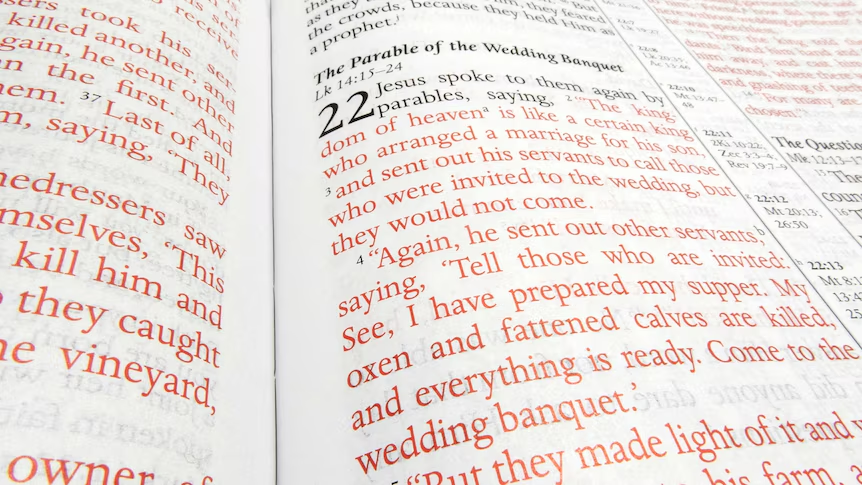
Most English versions of the Bible print the words of Jesus in the Gospels in red letters. It is a tradition that goes back nearly a century. The first red-letter New Testament was published in 1899; the full Bible with a red-letter New Testament was printed two years later in 1901. The reason for this practice is relatively clear, namely to highlight the words of Jesus over against the surrounding narrative and commentary. As noble as this aim is, it can lead to some unhealthy conclusions and applications. Readers might be tempted to conclude that the red letters are more important, more valuable, and more primary than the rest of the New Testament. For example, some so-called “red letter Christians” pit the words of Jesus against the rest of the New Testament and purport to follow the social ethic of Jesus which is characterized by love and compassion rather than the more conservative theology and ethics of the Apostle Paul et al. However, if Jesus is fully God, and there is only one God, and if God inspired the whole Bible, then in a sense all of the words of the Bible, whether black or red, are the words of Jesus.
Of course, this does not mean that the actual content of Jesus’s teaching ministry is unimportant. When it comes to the quest of the historical Jesus, the details of what Jesus said and did are essential for understanding who Jesus was and what he came to do. This is why scholars of the historical Jesus developed criteria of authenticity to determine which sayings in the canonical gospels authentically come from Jesus and which ones do not. Criteria like multiple attestation, dissimilarity, coherence, embarrassment and others like these are used to decide the authenticity of each individual saying or pericope. However, more often than not, these criteria have been used to dismiss more sayings than they have proven. This is most evident in work of the Jesus Seminar and their book The Five Gospels: What did Jesus Really Say? The Search for the Authentic Words of Jesus. Instead of establishing the authentic words of Jesus, they dismissed some 82 % of the sayings attributed to Jesus in the canonical Gospels either as things he definitely did not say (black bead) or as things he did not say but that might be close to his ideas (grey bead). Even sayings that met the established criteria were dismissed as inauthentic. This proves that there was probably another criteria at play in their judgment, that being if a saying evinced a relatively high Christology, then it was not authentic in their view.
More to the point, in my recent book review of Jesus and His Promised Second Coming by Tucker S. Ferda (see here), I suggested that the search for the “authentic” sayings of the historical Jesus in the gospels is a fundamentally flawed endeavor from the outset. This is because the Gospel writers did not set out to record the words of Jesus verbatim (ipsissima verba). They did, however, attempt to convey the words of Jesus by way of summary, thematic arrangement, implication, and interpretation. In other words, they were conveying the essential substance of the words of Jesus as well as it theological significance (ipsissima vox or substantia verba). This is partly because the Gospels are based on traditions that were passed down orally from the time of Jesus until the time the Gospels were composed. Even if the composition of the Gospels is dated early, i.e. in the 40s or 50s CE, then we are talking about 10+ years that have passed from the time Jesus to the time when the sayings of Jesus were written down. The point is that if “authentic” is understood to mean the actual words that Jesus spoke verbatim as he spoke to them, then we are searching for something that will never be found.
On the other hand, we must affirm that the Gospel writers were not simply making things up as they went along, putting words into the mouth of Jesus that he never said or thought. This is sometimes compared to the children’s game of “telephone”, where the first child hears a sentence, and then passes it along to the next child by whispering in their ear, and on to the next and so on. More often than not, when the final child reports the sentence, the final version is a far cry from the original, and usually so horribly garbled as to be beyond recognition. This analogy is a caricature of the actual nature of oral transmission. Not only was the culture at the time of Jesus thoroughly oral, but the Jews in particular took the transmission of oral tradition highly seriously. The Old Testament scriptures commanded them to pass on their faith orally from generation to generation, and Jewish children were trained in this from an early age in the temple and synagogues. The faithful transmission of oral tradition was practically sacrosanct in Jewish culture, and given the recognized authority of Jesus as a rabbi, the gospels writers would never have thought to put their own thoughts and agendas into his mouth. The same could be said for so-called prophetic utterances given by the risen Jesus; these would never have been treated as on par with actual Jesus tradition. As Luke himself indicates in the opening of his Gospel (1:1-4), the Gospel writers were faithfully writing down that which they had also remembered and received.
Now, someone might object, “What about the doctrine of inspiration? Weren’t the Gospel writers inspired by the Holy Spirit and so kept from error?” And I would answer, “Yes! Of course they were!” (2 Tim 3:16-17). But inspiration is not dictation. The Gospel writers were not mindless automatons simply transcribing by rote. Here again, Luke’s introduction indicates that he had done his research, had talked to eyewitnesses, had done the hard work “to write carefully and in order.” In other words, inspiration does not negate the normal processes of research and writing. In inspiration, the Holy Spirit works in, with, and through the human author in such a way that their words are his words. Moreover, the method of inspiration varies according to the genre of the literature being inspired. Clearly, prophetic texts, “thus saith the Lord” were directly inspired speech, but historical narrative, epistles, et al. allow for the creative engagement of the human author with the work of the Holy Spirit. B. B. Warfield puts it this way in The Inspiration and Authority of the Bible,
The Scriptures, in other words, are conceived by the writers of the New Testament as through and through God’s book, in every part expressive of His mind, given through men after a fashion which does no violence to their nature as men, and constitutes the book also men’s book as well as God’s, in every part expressive of the mind of its human authors.
The point of all this is to say that the Gospel writers have faithfully conveyed to us the real and true words of Jesus even if they have not conveyed to us his exact words. So, we should not take individual sayings (or even whole pericopes) out of their narrative context and then dismiss them as wholly inauthentic. This is a fundamentally flawed method of historical and exegetical inquiry. Rather we should attempt to understand how the words and actions of Jesus fit within the context of first century Judaism and how they gave rise to the theology and practice of the early church. As to whether we should continue to print the words of Jesus is red letters, I am of mixed opinion. Further, I suspect that my views on the question will do nothing to unseat standard publishing practice. Nevertheless, we must understand that there is no portion of Holy Scripture that is more authoritative, more valuable, more transformative than any other. Whether we are dealing with the letters of Paul or with the words of Jesus in the Gospels, we are dealing with the Word of God, and it is He who is speaking to us when we read. And so we should ask the Lord to give us the ears to hear and the hearts to receive what the Spirit is saying to us.
Share this:

On the Dead Sea Scrolls and the Reliability of the Bible

One of the most important advances in Biblical Studies in the last 100 years has clearly been the discovery of the Dead Sea Scrolls. Thanks to the curiosity of a young Bedouin shepherd, the first scrolls were discovered at Qumran in 1947. Over the next ten years, hundreds of papyrus fragments were found in some eleven caves in the area containing various biblical and extra biblical writings dating from 200 BCE to 100 CE. The general consensus has been that these represent the religious views of a sect of early Judaism known as the Essenes, known previously only through the writings of Josephus. Over the past 50 years, the study of these scrolls has provided valuable insight in the religious thought world of Jesus, Paul, and the first Christians, and comparative studies are now basically the norm in New Testament monographs and the other academic publications.
In this post, I am not interested in the content of the Dead Sea Scrolls, as fascinating as the material may be; I am more interested in the textual transmission of the scrolls, particularly as that might be compared to the textual transmission of the biblical text. It is truly a wonder of God’s providence that the Dead Sea Scrolls were preserved they way that they were. They were likely buried in the caves prior to the Jewish War (66-70 CE), and then subsequently abandoned when the Essene community was destroyed by the Romans. Thanks to the arid and dry climate of the area around the Dead Sea, these scrolls were preserved in glass jars for over 2000 years. However, they do show the signs of their age. They mostly consist of fragmentary pieces, and even the larger documents are missing significant parts due to decay (see the picture above, for one example). This means that translating the scrolls into English for modern study is mostly piecemeal at best. Large portions of the text must be reconstructed through textual emendation and scholarly conjecture, in order to make the text readable and understandable.
For example, one paragraph from The Temple Scroll (11QT) reads,
On the fifteenth day of the month …[the corresponding] grain offering [and drink offering, all on] the altar, an offering by fire, of s[oothing odour to YHWH. On] the second [day:] twelve young bulls, [two rams, four]teen [lambs] and on he-goat [for a sin offerin]g [and the corresponding gr]ai[n-offering and drink-offering] according to the statue concerning the young bulls, the ram[s], the lambs [and] the he-goat; it is an offering by fire, of soothing odour to YHWH.
The braketed text in the quote above indicates where the text has been conjecturally emended and filled in by the translator. The point is that as valuable as the scrolls are, the condition of the text is partial, fragmentary, and dependent on scholarly interpretation and emendation.
By contrast, the textual tradition of the biblical text is far more substantial and stable. The earliest portions of the New Testament that are extant today can be dated to within in a century of the actual writing of the documents themselves, and the earliest complete manuscripts that we have today are removed by only 2 or 3 centuries from the time of the New Testament. Further, we have over 5000 extant manuscript witnesses to the text of the Bible, in addition to ancient versions, liturgies, and quotations in the church fathers. The point is that through the discipline of text criticism (see my post here), we can reconstruct the text of scripture with 99% accuracy, and any questions that do remain are mostly of peripheral concerns and have no bearing on the actual meaning of the text. Unlike the Dead Sea Scrolls, the biblical text is not fragmentary and dependent on emendation; no, it is stable, clear, and firm in it is manuscript foundations.
This then is an even greater wonder of God’s providence as he has preserved His Word throughout the centuries. He has graciously and providentially watched over His Word, and He has not left himself without a witness. This should give us a great amount of confidence and faith in the textual foundations of our faith. The text of the Bible has been preserved and passed down by God’s providence through the ages, so that we might have reliable witness to His revelation of Himself in Christ. Where would we be if the text of the Bible had been hidden in desert caves for over 2000 years? I shudder to think of the possibilities. When we read the Bible, we should give great thanks that God has not left us as blind to grope in the darkness hoping we might find Him. No, he has spoken clearly, firmly, and faithfully, so that we might know Him even as we are known. Thanks be to God!
For further study, see:
Geza Vermes, trans. The Complete Dead Sea Scrolls in English. Revised Edition. London: Penguin Books, 2011.
Share this:

On the Testimonium and the Word
TEXT
5. The testimony of the church of God may stir and persuade us to adopt a high and reverent respect for the Holy Scriptures. Moreover, the heavenliness of the contents, the power of the system of truth, the majesty of the style, the harmony of all the parts, the central focus on giving all glory to God, the full revelation of the only way of salvation, and many other incomparable qualities and complete perfections, all provide abundant evidence that the Scriptures are the Word of God. Even so, our full persuasion and assurance of the infallible truth and divine authority of the Scriptures comes from the internal work of the Holy Spirit bearing witness by and with the Word in our hearts.
~Second London Baptist Confession (1689), 1.5
Series: The 1689 Baptist Confession of Faith
Church: South Caraway Baptist Church, Jonesboro, AR
Date: September 27, 2023
For further study, see also:
On the Spirit and the Word
On Biblical Interpretation and the Holy Spirit
Share this:

On the Authority of Scripture
TEXT
4. The authority of the Holy Scriptures obligates belief in them. This authority does not depend on the testimony of any person or church but on God the author alone, who is truth itself. Therefore, the Scriptures are to be received because they are the Word of God.
~Second London Baptist Confession (1689), 1.4
Series: The 1689 Baptist Confession of Faith
Church: South Caraway Baptist Church, Jonesboro, AR
Date: September 20, 2023
Share this:

On the Ground of Christian Hope
TEXT
15 This is why, since I heard about your faith in the Lord Jesus and your love for all the saints, 16 I never stop giving thanks for you as I remember you in my prayers. 17 I pray that the God of our Lord Jesus Christ, the glorious Father, would give you the Spirit of wisdom and revelation in the knowledge of him. 18 I pray that the eyes of your heart may be enlightened so that you may know what is the hope of his calling, what is the wealth of his glorious inheritance in the saints, 19 and what is the immeasurable greatness of his power toward us who believe, according to the mighty working of his strength.
20 He exercised this power in Christ by raising him from the dead and seating him at his right hand in the heavens— 21 far above every ruler and authority, power and dominion, and every title given, not only in this age but also in the one to come. 22 And he subjected everything under his feet and appointed him as head over everything for the church, 23 which is his body, the fullness of the one who fills all things in every way.
~Ephesians 1.15-23
Title: On the Ground of Christian Hope
Text: Ephesians 1.15-23
Series: The Letter to the Ephesians
Church: South Caraway Baptist Church, Jonesboro, AR
Date: May 28, 2023
Share this:

On Inspiration and Authorial Intent
Despite the claims of postmodern literary critics, it is reasonably certain that the meaning of any given document or literary work is grounded in and governed by its author. To put it another way, the meaning of the text is limited by the message that the writer of that text intended to communicate. This principle has been the foundation of biblical interpretation for most of the modern period, and rightly so. The Word of God comes to us through human authors who were writing to historical audiences, so we must work within the boundaries of literary and historical context in order to understand it. The problem, however, is that an overemphasis on authorial intent could relegate our interpretive efforts to nothing more than an exercise in historical investigation. But, the Word of God is more than a historical artifact; it is living and active, and its truths are just as relevant today as they were when they were first written. Over the last twenty years or so, more and more emphasis has been given to the intent of the divine author in an attempt to arrive at a more robustly theological interpretation.
However, this too has led to certain hermeneutical problems, particularly when the supposed divine intent in a given text is set in competition with or in contradiction to the human intent. This appears to be the underlying assumption of a question that was posed on Twitter a few days ago (pictured above). A pastor on Twitter recently asked, “Did the human authors have perfect/sinless intentions while writing Scripture?” Of course, Twitter polls are probably not the best resource for scholarly research, but the results are nevertheless concerning. Some 73% of respondents answered the question in the negative, meaning that almost three quarters of those who answered the poll believe that the human authors of the Bible had sinful intentions when they wrote the words of Holy Scripture. While the relationship between the human and the divine in the writing of Holy Scripture may be complex, we must conclude that this answer is out of bounds for those who believe that the Bible is the Word of God. How can sinful words be received as the Word of a sinless and righteous God? This is a contradiction in terms. As we read in Second Peter, chapter 1, verse 21, “instead men spoke from God as they were carried along by the Holy Spirit.”
Based on this text, we must affirm that there is no divine intent apart from the words of the human author. In other words, our interpretive efforts must deal directly with the words of Holy Scripture; we must labor to understand the genre, the syntax, the vocabulary, the grammatical relationships, and the literary flow of thought of the documents themselves. This is the fundamental work of biblical interpretation. There is no such thing as meaning that is separate from the text; there is no mystical or hidden Word that may be sought apart from the words on the page. Whatever the timeless supernatural theological implications of the text may be, these truths must be grounded in and derived from the actual words of Holy Scripture. In theology, this doctrine is known as verbal plenary inspiration, meaning that the quality of inspiration extends to very words that comprise the text and not just the ideas that stand behind those words. In the act of inspiration, God so worked in through and with the human authors of Holy Scripture, such that their words are His very words, thus they are without error in every way.
If their words are His words, then we may conclude that their intent is His intent as well. The difficulty, however, lies in the reality that the God of the Bible is infinite in His understanding, that He sees more and knows more than the human authors could possibly comprehend when they were writing. So, there is a sense in which the divine intent is so much more than what the human authors could understand; some have referred to this as the sensus plenior, or the fuller sense of the text. In their book Introduction to Biblical Interpretation, Klein, Blomberg, and Hubbard identify the problem with this idea, namely that “we have no objective criteria to posit the existence of a sensus, or to determine where it might exist, or how one might proceed to unravel its significance. In other words, if the human author of a text did not intend and was unaware of a deeper level of meaning, how can we be confident today that we can detect it?” To put it another way, if we understand textual meaning as something that is grounded in authorial intent, then we must assume a certain amount of similitude, if not even near identity, between the intent of both the Divine and the human author. Otherwise, we would never be able to understand what God is saying to us in any real or meaningful way.
In the final analysis, we must conclude that there is no competition or contradiction between the intent of the human the divine authors of Holy Scripture. While it is possible that the Spirit intended more than human authors, He certainly did not intend less than what they intended to communicate to their audiences through the words that they wrote. In other words, authorial intent in the Bible must be viewed as finely woven tapestry in which the human and divine is so interlaced and knitted together, such that any attempts to divide or separate them would in effect destroy its beauty and grandeur. As interpreters, we must hold these facets of the text in harmony and proceed with conviction the Bible is the very Word of God. B.B. Warfield puts it this way in his book The Inspiration and Authority of the Bible, “The Scriptures, in other words, are conceived by the writers of the New Testament as through and through God’s book, in every part expressive of His mind, given through men after a fashion which does no violence to their nature as men, and constitutes the book also men’s book as well as God’s, in every part expressive of the mind of its human authors.”
For further study, see:
Warfield, B.B. “The Divine and the Human in the Bible.” Pages 542-548 in Selected Shorter Writings, 2 Vols.
Share this:

On Psalm 119.89-96 (Lamed)

89 Lord, your word is forever;
it is firmly fixed in heaven.
90 Your faithfulness is for all generations;
you established the earth, and it stands firm.
91 Your judgments stand firm today,
for all things are your servants.
92 If your instruction had not been my delight,
I would have died in my affliction.
93 I will never forget your precepts,
for you have given me life through them.
94 I am yours; save me,
for I have studied your precepts.
95 The wicked hope to destroy me,
but I contemplate your decrees.
96 I have seen a limit to all perfection,
but your command is without limit.
The twelfth stanza of Psalm 119 (ל/Lamed) begins with a beautiful affirmation of the permanence and timelessness of God’s Word. “Lord, your Word is forever; it is firmly fixed in heaven.” (verse 89) It is not just another curiosity that has been passed down to us from antiquity; no, it is the living and abiding Word of the one true and living God. In theology, this is called the doctrine of inspiration, namely that God speaks through the human authors of the Biblical documents, such that their words are His very words. This is why the Bible has lasting relevance and authority even beyond the audiences to whom it was originally written. As our psalmist puts it, “Your judgments stand firm today. for all things are your servants.” (verse 91) Contrary to the opinions of modern culture, the Word of God is still the right and true prescription for human flourishing; the virtues it sanctions and the vices it prohibits are not outdated holdovers from people and places now long past. No, the Bible is special revelation from God in which He reveals the problem of humanity’s sin and the way of salvation that comes by grace through faith in the person and work of Jesus Christ.
Now, in verse 90, we read “Your faithfulness is for all generations; you established the earth, and it stands firm.” As we have noted in previous posts, most of the verses in Psalm 119 contain some synonym for God’s Word, e.g. laws, commands, instructions, precepts, etc., and so here we have “your faithfulness” (אֱמֽוּנָתֶךָ). It seems clear that this word is meant to stand in parallel relationship with “your word” (verse 89) and “your judgments” (verse 91); interestingly, the Septuagint (LXX) translates this word as “your truth” (ἡ ἀλήθειά σου). The point of all of this is to say that the abiding authority of God’s Word is grounded in who He is, i.e. in His unchanging character. He is faithful; He keeps His promises. Whatever He says, He will most certainly do. His Word is a reflection of who He is: His holiness, His grace, His power, His love, and even His incomprehensibility. This is why our psalmist writes in verse 96, “I have seen a limit to all perfection, but your command is without limit,” or as it reads in the NET Bible, “your commands are beyond full comprehension.” The God of the Bible is infinite; He is a mystery whose depths can never fully be exhausted. So also is His Word.
However, this does not mean that we should not read or study the Word of God. Yes, the depths of the Bible’s riches are inexhaustible, but they are also perspicuous and clear. I have previously written on this topic, here. But suffice it to say that in the act of inspiration, the infinite God condescended to our finite capacities for understanding. He is infinite in power, wisdom, and goodness, and we are His creatures, finite in our ability to comprehend His perfections. But He chose to reveal Himself in and through the Word so that we might know Him and be reconciled to Him. So yes, the Bible is so clear that any human being, regardless of their intellectual aptitude or educational achievement, can read it and understand their sin and their need for a savior; it is also, at the same time, a limitless source of mystery and wonder, such that even the finest minds throughout human history have been unable to fully explain all of its secrets.
For our psalmist, this means that the Word of God must be continuously read, studied, and contemplated. As he says in verse 93, “I will never forget your precepts, for you have given me life through them.” Here again, not only do we see that abiding authority of God’s Word, but we also see its all encompassing sufficiency. Our psalmist understands that every need of the human soul is provided for in the inspired Word of God. In verse 92, we read, “If your instruction had not been my delight, I would have died in my affliction.” The word “delight” conveys the idea of contentment, satisfaction, or pleasure. In other words, our psalmist understands that even in the midst of turmoil, adversity, and heartache, there is a joy, a “peace that passes all understanding” that is available when we rest in the promises of God’s Word. The spiritual disciplines of the Word (study, meditation, memorization) are the God prescribed antidote for our anxiety, our fear, our depression, our despair. Again, our psalmist writes in verse 95, “The wicked hope to destroy me, but I contemplate your decrees.”
This devotion, this diligence in the discipline of the Word, this affection for the perfections of God’s Law, is a distinguishing characteristic of those who belong to Him. As our psalmist writes in verse 94. “I am yours; save me, for I have studied your precepts.” We are a people of the Book. Our faith is not based on a human philosophy or mere reflections on the divine; no, it is based on the inspired, inerrant, authoritative, sufficient revelation of God Himself. In His Word, He has clearly and finally revealed the one and only path unto salvation, and He has called His people to walk upon it until we reach glory. So, when our psalmist prays “save me”, he is not simply expressing his desire to be saved from the penalty of sin. Rather, he is praying for the ongoing work of salvation to be applied in his life through sanctification, that God would save him from the power of sin through His sufficient Word. In the same breath, he is also expressing that most fundamental of Christian hopes, namely that one day he would be saved from the very presence of sin entirely, a hope that is grounded in the promises of God’s Word. In other words, our psalmist understands that the full experience of our salvation comes to us through the Word by the Spirit. Therefore, we should never cease to be amazed at the riches of His word, and we should constantly devote ourselves to its discipline.
For further study:
Introduction
Psalm 119.1-8
Psalm 119.9-16
Psalm 119.17-24
Psalm 119.25-32
Psalm 119.33-40
Psalm 119.41-48
Psalm 119.49-56
Psalm 119.57-64
Psalm 119.65-72
Psalm 119.73-80
Psalm 119.81-88
Share this:

On Preaching and the Grotesque: A Book Review
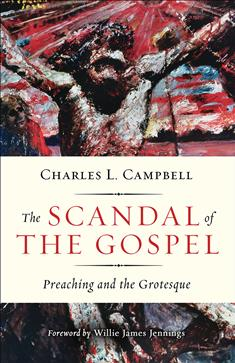
Campbell, Charles L. The Scandal of the Gospel: Preaching and the Grotesque. Louisville, KY: Westminster John Knox, 2021.
Painters have their colors and canvas, sculptors have their clay, and preachers have their words. And words are powerful. As the Bible so often indicates, words have the power to build up and to tear down, and this is especially so in the ministry of preaching, as Charles L. Campbell discusses in his latest book, The Scandal of the Gospel: Preaching and the Grotesque. Campbell is James T. and Alice Mead Cleland Professor Emeritus of Homiletics at Duke Divinity School. He is a past president of the Academy of Homiletics, a highly sought-after lecturer, and he is well published in the field. Most of the content for this latest book comes from his 2018 Lyman Beecher Lectures at Yale Divinity School; only the fourth chapter contains new material.
In the forward, Campbell explains that he is not seeking any consistency or system; rather, he says that he is “simply trying to make some homiletical connections between preaching and the grotesque” (p. xiv). This concept of the grotesque subsequently stands at the center of the book. The term is borrowed from the world of visual art, where it originally referred to paintings found in ancient Roman grottos, i.e. grotto-esque. These “murals presented unsettling, disorienting hybrids that transgressed accepted categories. They distorted what was considered ‘normal’ or ‘beautiful.’ They messed with accepted patterns. They were, as they came to be called, ‘grotesque’” (p. 6). This description encapsulates the homiletical vision that Campbell sets forth in these chapters, i.e. preaching that is unsettling, disorienting, that transgresses accepted categories and norms, that is “grotesque.”
In the first chapter Campbell considers how this concept of the grotesque fits with the scandal of the Gospel. Taking his cue from 1 Corinthians 1:23, he explains that the Gospel confronts with the destabilizing pairings of opposites: God-cross, life-death, repulsion-fascination, horror-hope. A God that is violently crucified on a cruel Roman cross is inherently “grotesque.” In chapter 2, Campbell explores how the grotesque is often weaponized in the act of preaching. Specifically, when one compares sociological and/or theological opponents with non-human objects, one is using the grotesque to dehumanize and minimize them in order to maintain one’s own particular understanding of order. In chapter 3, Campbell offers an alternative to this kind of weaponization by explaining how the grotesque creates preaching that is “open, protruding, irregular, secreting, multiple, and changing” (p. 55). Preaching that is grotesque welcomes input and insights from a variety of voices, and not merely biblical and theological ones. It is preaching that “becomes real when truth happens among the cacophony and incongruities of diverse voices and diverse lives” (p. 57). Finally, in chapter 4, Campbell imagines how the grotesque could be employed in preaching to address the environmental crisis.
Campbell’s application of the grotesque to the discipline of preaching is provocative to say the least because it stands in such stark contrast to the kind of preaching that is the focus of Campbell’s critiques. Sermons that offer simplistic principles for improving marriage, managing finances, or raising godly children attempt to “give people a nice focused nugget to carry home – not the shocking unresolved contradictions of the grotesque gospel” (p.11). This kind of preaching is neat, clean, even idealistic. The problem, however, is that “when we rush to order, when we avoid the interval of the grotesque, our preaching may become shallow, unreal, clichéd. We don’t go deep enough. We’re not honest enough. And we end up falsifying both the gospel and life itself – we end up imposing false patterns” (p. 12). Life is so often the opposite of the neat and clean categories we attempt to impose on it from the pulpit. It is complex and messy; it is “grotesque.” Campbell would have readers embrace these tensions rather than attempting to resolve them.
Though he rightly critiques this “humanistic” (his label) approach to preaching, the alternative that he proposes is inherently more so. Grotesque preaching is “shaped by the dynamic and open life of Jesus’ grotesque body. Grotesque preaching calls the church to be open to the world and calls the pulpit to be open to different bodies and new voices” (p. 56). It springs forth from the lived experiences of people rather than from the authoritative Word of God. What is glaringly absent from Campbell’s vision for preaching is how it relates to the principle of “Thus saith the Lord.” Christian preaching springs forth from the fact that God has spoken. The Apostle Paul instructed his protégé Timothy to “Preach the Word” (2 Timothy 4.2). God has spoken; therefore, we speak. In other words, the purpose of Christian preaching is to exposit the declared Word, “giving the meaning so that the people could understand what was read” (Nehemiah 8.8). It is not merely to listen to people’s stories or to appreciate the diversities and complexities of the human experience.
In the final analysis, Campbell’s invitation for preachers to approach the complexities, difficulties, and tensions of life with greater compassion is a welcomed alternative to the idealistic naiveté that characterizes most preaching today. That being said, his alternative is essentially void of the very resources that God has provided to address those complexities and difficulties. In other words, grotesque preaching, as Campbell envisions it, comes off merely as a way to exalt and platform human experiences over the Word of God. However, it is ultimately powerless as a homiletical method for proclaiming the inspired Word of the one true and living God. In my view, preachers would be better served by attending to the text of Holy Scripture, giving its meaning through systematic exposition, than by any clever attempts to be “grotesque.”
This Book Review was originally published in the Journal of Biblical and Theological Studies, here.


