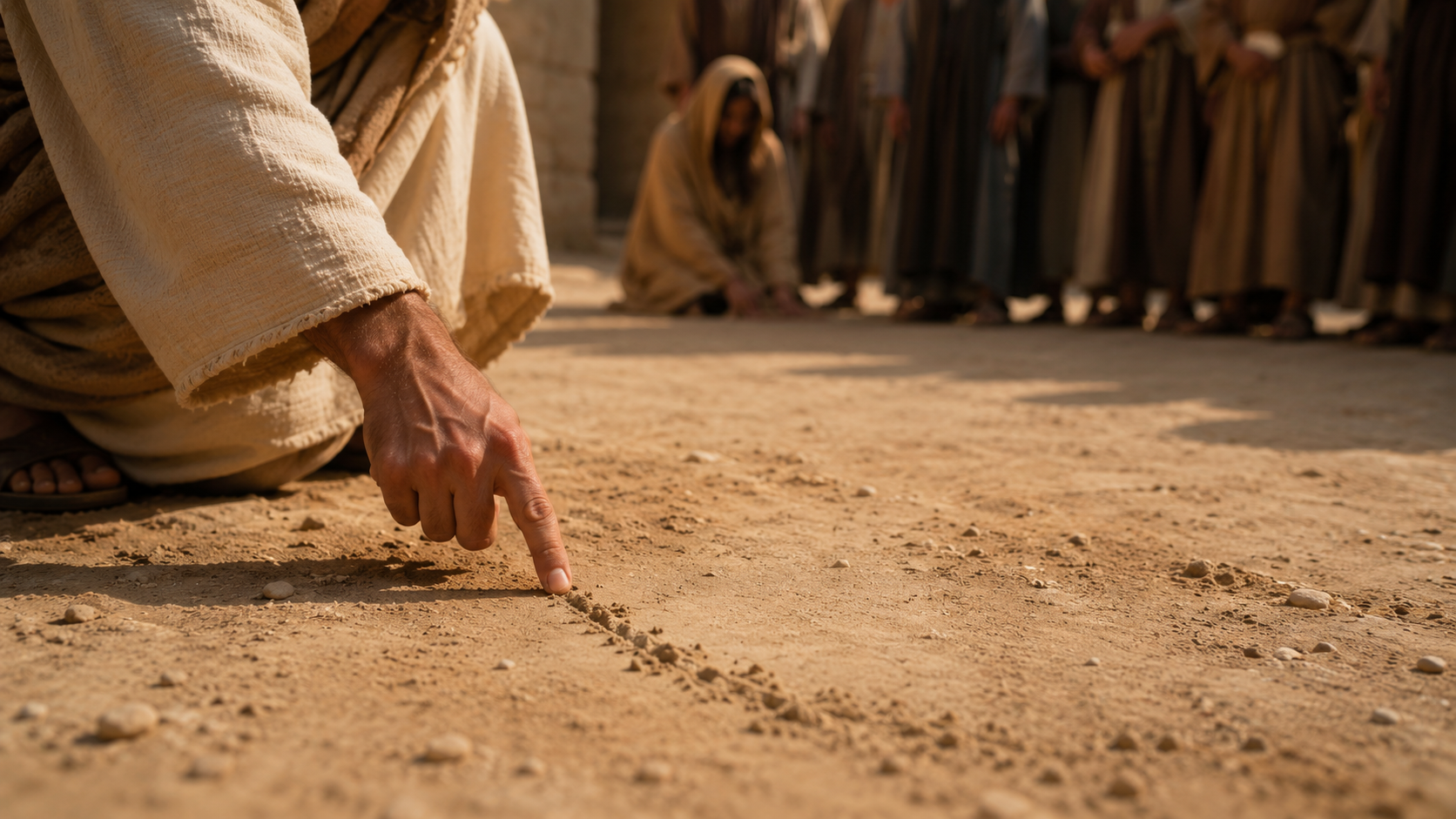
It is a familiar scene. The Jewish religious leaders bring a woman who has been caught in adultery before Jesus, seeking to trap him with the requirements of the Mosaic Law. Yet rather than immediately condemning her, Jesus responds, “The one without sin among you should be the first to throw a stone at her” (John 8.7). With their scheme exposed, the accusers depart one by one until only Jesus and the woman remain. He then tells her, “Neither do I condemn you. Go, and from now on do not sin anymore” (8.11). It is a beautiful picture of the compassion and grace of Jesus toward a guilty sinner. There is only one problem: a footnote in virtually every modern English translation informs us that “the earliest manuscripts do not include John 7.53–8.11.” Whether through brackets, footnotes, or some other notation, all modern translations alert readers that there is considerable doubt about whether this beloved story originally belonged to the Gospel of John. What, then, should Christians who believe in the inspiration and inerrancy of Scripture do with this passage? How should we think about a story about Jesus that may be historically ancient but was probably not written by John? In what follows, I would like to consider these questions by arguing that although the manuscript, internal, and patristic evidence strongly suggests that the Pericope Adulterae was not originally part of the Gospel of John, its textual status need not threaten Christian confidence in Scripture. Rather, the passage provides an important opportunity to distinguish between the possible historical authenticity of an ancient tradition about Jesus and the canonical authority of the inspired text.
Of course, our English Bibles are based upon a manuscript tradition that stretches back nearly two thousand years. Although we no longer possess the autographs—the original documents actually written by the New Testament authors—we have thousands of Greek manuscripts and manuscript fragments dating from the second century through the invention of the printing press in the fifteenth century. Through the process known as textual criticism, scholars compare these manuscripts with one another, alongside evidence from ancient translations, lectionaries, and quotations preserved in the church fathers in an effort to determine the earliest recoverable form of the text and, ultimately, reconstruct the original words of the inspired authors. (On the process of textual criticism, see my post here.) Importantly, however, textual criticism is not simply a matter of counting manuscripts. The evidence must be weighed according to such factors as age, provenance, textual relationships, and the character of the individual readings. A thousand late manuscripts containing a particular reading do not necessarily outweigh a handful of significantly earlier witnesses. This brings us to the problem of the Pericope Adulterae: the earliest and strongest manuscript evidence does not include the story at John 7.53–8.11. For this reason, most modern translations bracket the passage, place it in a footnote, or otherwise alert readers that its originality to the Gospel of John is seriously disputed.
The earliest extant Greek manuscript to include the story is Codex Bezae (D), a fifth-century diglot containing the text in both Greek and Latin. This is significant because the early textual reception of the passage appears to have been particularly strong in the Western church, where Latin increasingly became the primary ecclesiastical language. Moreover, although the story eventually appears in the majority of manuscripts from the medieval period, there is considerable discrepancy over where it should be located. It can be found in its familiar location after John 7.52, but in other manuscripts it appears after John 7.36, 7.44, or 21.25, while another textual tradition places it after Luke 21.38. In other words, this looks like a story looking for a home, so to speak. The early patristic evidence is similarly complicated. The Greek Fathers generally do not comment upon the passage, while in the West it appears in writers such as Ambrose of Milan, Augustine, and Jerome, all from the fourth century. Significantly, these Western witnesses themselves reflect awareness that the passage was absent from some manuscripts. Jerome nevertheless included it in the Latin Vulgate, after which the story became increasingly established within the Western textual and ecclesiastical tradition. However, the late appearance of the passage in extant Greek manuscripts, its unstable location within the manuscript tradition, and its uneven early reception provide substantial external evidence for concluding that it was probably not part of the original text of John’s Gospel.
There are still other reasons for doubting the story’s originality to the Gospel of John. For one, the passage contains some fourteen words that appear nowhere else in the Fourth Gospel—almost one distinctive word per verse. For example, John 8:3 is the only place in the Gospel where we encounter “the scribes” as a distinct group. John has several other ways of referring to Israel’s religious leaders, but he never refers to the scribes in this manner outside the Pericope Adulterae. Significantly, several of these words that are otherwise absent from John are quite common in the Synoptic Gospels (Matthew, Mark, and Luke), giving the story a linguistic character somewhat different from its surrounding Johannine context. This may also help explain why one manuscript tradition eventually placed the story after Luke 21:38. In addition to this linguistic evidence, the story appears to interrupt the natural flow of John’s narrative. At the end of chapter 7, Jesus is teaching in the temple precincts during the festival, culminating in his proclamation concerning “streams of living water.” Then, in John 8:12, Jesus continues his public teaching with the declaration, “I am the light of the world.” The Pericope Adulterae, however, interrupts this sequence with the statement that “each one went to his own house, but Jesus went to the Mount of Olives” (7:53–8:1). Read without the disputed passage, the narrative moves quite naturally from 7:52 to 8:12. When this internal evidence is considered alongside the external evidence discussed above, the cumulative case against the Pericope Adulterae being original to the Gospel of John appears very strong.
However, the textual question is quite separate from the historical question. It is entirely possible that this is an authentic story about Jesus that was passed down orally and only later written down and incorporated into the manuscript tradition. After all, the characterization of Jesus and the religious leaders is consistent with what we see elsewhere in the Gospel traditions, and the themes and principles of the story are consistent with what we know of Jesus’s teaching from the rest of the New Testament. In his A Textual Commentary on the Greek New Testament, Bruce Metzger concludes that “the story has all the earmarks of historical veracity.” In other words, even though the story may be textually secondary, this does not mean that it is historically late or fictitious. It is entirely possible that the Pericope Adulterae preserves an authentic tradition about the historical Jesus that circulated independently before eventually finding its way into copies of the Gospels. Nevertheless, we must carefully distinguish between saying, “Jesus may actually have done this,” and saying, “John wrote this under the inspiration of the Holy Spirit.” Historical authenticity does not by itself establish canonical authority. The early church undoubtedly preserved many true memories and traditions concerning Jesus that were never included in the canonical Gospels; indeed, John himself acknowledges that Jesus did “many other things” that were not written in his Gospel (John 21:25). The question of canonicity, therefore, is not merely whether an event actually happened, but whether the account of that event belongs to the text given through the inspired biblical authors. And that distinction has important implications for how Christians should read, teach, and preach the Pericope Adulterae.
Our doctrines of inspiration and inerrancy are specifically tied to the autographic text, that is to say, the documents that the biblical authors actually wrote are the locus of biblical authority. This is the text that we preach; this is the text that holds authority for our theology and doctrine. Therefore, if the Pericope Adulterae was not part of that original text, then we should not base any doctrinal claims upon it or preach it as though we know it possesses canonical authority. We can certainly discuss it as a potentially authentic tradition about the historical Jesus; we can also demonstrate how its principles and themes are consistent with what canonical Scripture teaches elsewhere. But we should be careful about preaching it as Holy Scripture. After all, consistency with Scripture does not make something Scripture. Many statements found in the writings of the early church fathers are thoroughly consistent with biblical teaching, but we do not therefore regard them as divinely inspired or canonically authoritative. The same distinction should guide our treatment of the Pericope Adulterae. Nothing essential to Christian doctrine is lost by recognizing its uncertain textual status: the grace and compassion of Jesus toward sinners, the universal reality of human sinfulness, the necessity of repentance, and the call to holiness are all abundantly taught in undisputed passages of the New Testament. We therefore lose nothing by allowing the textual evidence to determine the passage’s canonical status rather than our affection for the story. Indeed, a high view of Scripture requires us not merely to defend the Bible we have received, but to seek as carefully as possible the text that the inspired authors actually wrote.
In the final analysis, the textual questions surrounding the Pericope Adulterae should not weaken our confidence in Scripture. If anything, they demonstrate why the discipline of textual criticism is so important. Modern translations do not place brackets or footnotes around John 7.53–8.11 because translators have decided to remove an inconvenient passage from the Bible; they do so because they are attempting to be transparent about the manuscript evidence and recover as faithfully as possible the text that John actually wrote. The remarkable number of surviving New Testament manuscripts allows scholars to identify places where later additions, omissions, or other textual variations entered the tradition and to evaluate them openly. The Pericope Adulterae may preserve an ancient and even authentic memory of Jesus, and its beautiful portrayal of his grace toward sinners explains why Christians have cherished it for centuries. Yet our confidence in Scripture must rest not upon our attachment to a particular story, but upon the God who inspired his Word and has providentially preserved it through the manuscript tradition. Christians committed to the inspiration and inerrancy of Scripture should therefore have nothing to fear from textual criticism. Our desire should simply be to know, preserve, proclaim, and obey as faithfully as possible the words God actually inspired his servants to write.
See also:
On the Ending(s) of the Gospel of Mark


