Tag Archives: God the Son

On Messianic Sonship in the Gospel of John

In my previous post, I argued that in the New Testament the title “Son of God” should be understood primarily as royal and messianic before it is understood in fully developed theological terms. However, because of its clear emphasis on the divinity of Jesus, many assume that the Gospel of John moves away from this historical and messianic framework. In this post, I want to suggest that John does not abandon these categories; on the contrary, he deepens them in order to reveal what it truly means for Jesus to be the Messiah. Or to put it another way, John presents Jesus in continuity with Jewish messianic expectations, while also showing that this messianic sonship entails a uniquely intimate and divine relationship with the Father that exceeds what was previously anticipated. The question, then, is not whether John’s understanding of Jesus is messianic, but what kind of messianism he presents.

In his purpose statement, John writes that “these are written so that you may believe that Jesus is the Messiah, the Son of God.” Here again, the grammatical construction is significant. The term “Christ” (or “Messiah”) stands in apposition to the phrase “Son of God,” meaning that the two expressions are placed side by side, with one defining or clarifying the other. In this context, to confess Jesus as the Messiah is to confess him as the Son of God. This same connection appears at the beginning of the Gospel of John. In John 1:49, Nathanael declares, “You are the Son of God; you are the King of Israel.” The parallelism in these lines again equates divine sonship with messianic kingship, but more importantly, these two statements function as bookends to the Gospel, framing John’s presentation of Jesus from beginning to end. The point, then, is that John does not abandon the messianic meaning of “Son of God.” Rather, he affirms it at the structural level of his narrative. To believe in Jesus as the Messiah is to believe in him as the Son, and this understanding stands in direct continuity with the Synoptic presentation explored in the previous post.

This same connection appears at the midpoint of the Gospel of John. In the account of Lazarus in John 11, after Jesus declares that he is “the resurrection and the life,” he turns to Martha and asks, “Do you believe this?” She responds, “Yes, Lord; I believe that you are the Messiah, the Son of God, who is coming into the world.” This confession is loaded with Christological significance. Not only does it once again place “Messiah” and “Son of God” in apposition, reinforcing the connection we have already seen, but it also adds a further layer by describing Jesus as “the one who is coming into the world.” This language resonates with broader biblical expectations of a coming deliverer—one who is sent by God and arrives to accomplish his purposes. It echoes themes associated with the coming figure of Daniel 7 and the one who comes in the name of the Lord in Psalm 118. Taken together with John 1:49 and 20:31, this confession strengthens the pattern: to be the Son of God is to be the Messiah, the King of Israel, the one sent into the world. In other words, John clearly preserves and reinforces the traditional messianic categories that were already in circulation.

Of course, conceptions of the Messiah in the literature of Second Temple Judaism were far from uniform. Expectations were diverse and often overlapping rather than monolithic. Some traditions emphasized a royal figure in continuity with the promises to David, drawing on texts like 2 Samuel 7 and Psalm 2, where the Messiah is understood as the anointed king who would rule on God’s behalf. Others envisioned a more prophetic figure, in keeping with the promise of a prophet like Moses in Deuteronomy 18, one who would speak God’s word with unique authority. Still others anticipated a more exalted or even heavenly figure, shaped by texts like Daniel 7, where the “Son of Man” is portrayed as receiving dominion and glory from God himself. The point is not that these expectations were clearly defined or neatly separated, but that Jewish messianism already contained a range of categories capable of accommodating a figure of significant authority and even transcendent status. This is important for reading the Gospel of John. When John presents Jesus in elevated terms, he is not abandoning messianic categories or importing something foreign into the tradition. Rather, he is drawing on a rich and developing matrix of expectation already present within Second Temple Judaism and showing how these strands converge in the person of Jesus.

Now, as I argued in my previous post, in the Synoptic Gospels the idea of sonship is primarily representative. As the Messiah, Jesus stands as God’s appointed ruler on earth, the true king who embodies and fulfills the role that Israel and her kings failed to carry out. But in the Gospel of John, the concept of sonship is taken further. The relationship between the Father and the Son is not merely one of representation, but of participation. That is, the Son does not simply act on God’s behalf; he acts in a way that is inseparably bound up with the Father’s own activity. This is made clear in passages like John 5:19, where Jesus says, “Truly I tell you, the Son is not able to do anything on his own, but only what he sees the Father doing. For whatever the Father does, the Son likewise does these things.” The claim here is remarkable. It is not merely that the Son imitates the Father, but that his actions are perfectly coordinated with and reflective of the Father’s own work. The same idea appears in John 10:30: “I and the Father are one.” In other words, the Son does not merely represent the Father as his agent; he shares in his work in a unique and unparalleled way. This is not a departure from messianic sonship, but a deepening of it—one that begins to press beyond simple representation into a more profound unity between the Father and the Son.

At this point, it is helpful to introduce a category that has received significant attention in recent scholarship, namely the Jewish concept of agency. In the ancient Jewish world, an agent functioned as a representative of the one who sent him. The basic idea was that “the one sent is as the sender,” meaning that the agent could speak and act with the authority of the one who commissioned him. This framework helps explain much of the language in the Gospel of John, especially the repeated emphasis that Jesus is the one “sent” by the Father. He speaks the Father’s words, performs the Father’s works, and carries out the Father’s will. In this sense, Jesus clearly fits within recognizable Jewish categories of agency. And yet, as the Gospel unfolds, it becomes evident that his sonship cannot be fully contained within that framework. Jesus does not merely speak for God; he speaks as one who uniquely knows the Father. He does not simply carry out God’s works; he does what the Father himself does. The point, then, is that while the category of agency is helpful, it is ultimately insufficient. The Son does not merely act on God’s behalf—he acts with God’s authority in a way that is inseparably bound up with the Father himself. In other words, John presents a form of agency that is intensified to the point of revealing something more about the identity of the Son.

According to John, this is precisely why opposition to Jesus intensifies. In John 5:18, we read, “This is why the Jews began trying all the more to kill him: not only was he breaking the Sabbath, but he was even calling God his own Father, making himself equal to God.” This observation is significant because it shows that the implications of Jesus’s claims are drawn from within the narrative itself. John does not import the idea of divine sonship from some external philosophical framework; rather, it emerges organically from the way Jesus speaks about his relationship to the Father. What is particularly striking is that Jesus does not correct this interpretation. Instead, in the verses that follow, he deepens it. He speaks of doing whatever the Father does, of giving life as the Father gives life, and of exercising judgment as the Father does. In other words, the claim to sonship entails participation in divine prerogatives that belong to God alone. The response of his opponents, then, is not a misunderstanding but a recognition of the implications of his words. They perceive that Jesus is not merely claiming to be God’s representative, but is placing himself in a unique relationship of shared authority with God. The point, then, is that in John’s Gospel, messianic sonship presses beyond representation into a form of equality that raises unavoidable questions about the identity of the Son.

And this is why Jesus is uniquely able to reveal the Father. In John 1:18 we read, “No one has ever seen God. The one and only Son, who is himself God and is at the Father’s side—he has revealed him.” There is a well-known textual question here as to whether the verse should read “the only begotten God” or “the only begotten Son.” While the evidence favors the reading “the only begotten God”, what is most striking is that both readings point in the same direction: John is describing a relationship between the Father and the Son that is without parallel. The Son stands in the closest possible relation to the Father—“at his side”—and precisely for that reason he is able to make him known. This is not simply the language of a prophet who speaks on God’s behalf; it is the language of one who knows God from within that relationship. Jesus makes this point explicit in John 14. When Philip asks, “Lord, show us the Father,” Jesus responds, “The one who has seen me has seen the Father.” In other words, the Son does not merely communicate information about God—he reveals him. The Son is uniquely qualified to make the Father known because his identity is inseparably bound up with the Father himself.

As in the Synoptic Gospels, the identity of Jesus as the Son reaches its fullest expression in his death, but in the Gospel of John this moment is framed in a striking way. The crucifixion is not merely suffering; it is glorification. In John 12:32, Jesus says, “As for me, if I am lifted up from the earth I will draw all people to myself.” The language of being “lifted up” carries a deliberate double meaning. On the one hand, it refers to the physical lifting up of Jesus on the cross. On the other, it points to exaltation, to being lifted up in glory. For John, these are not separate events but one and the same reality viewed from different angles. This is confirmed in John 13:31, where, immediately after predicting his betrayal, Jesus declares, “Now the Son of Man is glorified, and God is glorified in him.” In other words, the cross is not a contradiction of Jesus’s identity as the Son—it is its revelation. The glory of his sonship is displayed precisely in his obedience, his self-giving, and his willingness to suffer. The Son is most fully revealed not in avoiding the cross, but in embracing it.

And the resurrection brings this trajectory to its proper conclusion. After seeing the risen Jesus and placing his hands in his wounds, Thomas responds with the climactic confession, “My Lord and my God!” (John 20.28). This is not merely an emotional outburst; it is the narrative’s decisive answer to the question that has been building throughout the Gospel of John: Who is this Jesus who claims to be the Son of God? Thomas’s confession brings together the strands that John has been developing from the beginning. The one who is the Messiah, the Son of God, is also rightly confessed as Lord and God. In this moment, the identity of Jesus is not revised but fully recognized. The resurrection does not introduce something new; it confirms and unveils what has been true all along. As such, the arc of the Gospel reaches its climax in the full acknowledgment of Jesus’s identity, echoing the claims of the opening prologue. The Son who was sent into the world is revealed to be none other than God himself, now seen, known, and confessed in the risen Christ.

So, to bring all of this together, we can now see the full trajectory of the title “Son of God” across the canon. In the Old Testament, sonship is grounded in covenant and kingship. Israel is called God’s son, and the Davidic king is identified as God’s son, functioning as his appointed ruler and representative. In the Synoptic Gospels, this category is sharpened and focused in the person of Jesus, who is confessed as the Messiah, the Son of God—the one who fulfills the role that Israel and her kings failed to carry out. But in the Gospel of John, this messianic sonship is not abandoned; it is brought to its fullest expression. John shows that the Messiah is the Son in a deeper sense than previously expected. The Son does not merely represent God’s rule; he participates in the Father’s work, shares in his authority, and uniquely reveals his identity. In other words, John does not move beyond messianism into something else entirely. Rather, he reveals what messianism was ultimately pointing toward all along. The royal Son of the Old Testament and the messianic Son of the Synoptics find their fullest meaning in the one who is not only God’s appointed king, but the Son who stands in a unique and unparalleled relationship with the Father.

What all of this means, then, is that the confession that Jesus is the Son of God is not merely a doctrinal statement to be affirmed, but a reality to be believed and lived. In the Gospel of John, belief in the Son is consistently tied to life. To believe in him is to receive life, to enter into a relationship with the Father, and to know God as he truly is. This is because the Son is the one who uniquely reveals the Father. He is not simply a messenger who brings information about God; he is the one in whom God is made known. And so to come to the Son is to come to the Father. At the same time, this confession is grounded in the unfolding story of Scripture. The title “Son of God” begins in the Old Testament as a royal and covenantal designation, is sharpened in the Synoptic Gospels as a messianic identity, and is brought to its fullest expression in John, where the Son is revealed in a uniquely intimate and participatory relationship with the Father. To confess Jesus as the Son of God, then, is not only to affirm his role as Messiah, but to recognize him as the one who stands at the very center of God’s redemptive purposes, the one who makes the Father known, and the one in whom we find life.

For further study:
Reynolds, Benjamin E., and Gabriele Boccaccini, eds. Reading the Gospel of John’s Christology as Jewish Messianism: Royal, Prophetic, and Divine Messiahs. Ancient Judaism and Early Christianity. Leiden: Brill, 2018.


On Thinking Theologically (Weekend Vlog)


On Love as the Heart of Christmas

TEXT

Dear friends, let us love one another, because love is from God, and everyone who loves has been born of God and knows God. The one who does not love does not know God, because God is love. God’s love was revealed among us in this way: God sent his one and only Son into the world so that we might live through him. 10 Love consists in this: not that we loved God, but that he loved us and sent his Son to be the atoning sacrifice for our sins. 11 Dear friends, if God loved us in this way, we also must love one another. 12 No one has ever seen God. If we love one another, God remains in us and his love is made complete in us. 13 This is how we know that we remain in him and he in us: He has given us of his Spirit. 14 And we have seen and we testify that the Father has sent his Son as the world’s Savior. 15 Whoever confesses that Jesus is the Son of God—God remains in him and he in God. 16 And we have come to know and to believe the love that God has for us.

God is love, and the one who remains in love remains in God, and God remains in him. 17 In this, love is made complete with us so that we may have confidence in the day of judgment, because as he is, so also are we in this world. 18 There is no fear in love; instead, perfect love drives out fear, because fear involves punishment. So the one who fears is not complete in love. 19 We love because he first loved us. 20 If anyone says, “I love God,” and yet hates his brother or sister, he is a liar. For the person who does not love his brother or sister whom he has seen cannot love God whom he has not seen. 21 And we have this command from him: The one who loves God must also love his brother and sister.

~1 John 4.7-21

Title: On Love as the Heart of Christmas
Text: 1 John 4.7-21
Church: South Caraway Baptist Church, Jonesboro, AR
Date: December 17, 2023


On Christian Living in the Last Hour

TEXT

The elder: To the elect lady and her children, whom I love in the truth—and not only I, but also all who know the truth— because of the truth that remains in us and will be with us forever. Grace, mercy, and peace will be with us from God the Father and from Jesus Christ, the Son of the Father, in truth and love.

I was very glad to find some of your children walking in truth, in keeping with a command we have received from the Father. So now I ask you, dear lady—not as if I were writing you a new command, but one we have had from the beginning—that we love one another. This is love: that we walk according to his commands. This is the command as you have heard it from the beginning: that you walk in love.

Many deceivers have gone out into the world; they do not confess the coming of Jesus Christ in the flesh. This is the deceiver and the antichrist. Watch yourselves so that you don’t lose what we have worked for, but that you may receive a full reward. Anyone who does not remain in Christ’s teaching but goes beyond it does not have God. The one who remains in that teaching, this one has both the Father and the Son. 10 If anyone comes to you and does not bring this teaching, do not receive him into your home, and do not greet him; 11 for the one who greets him shares in his evil works.

12 Though I have many things to write to you, I don’t want to use paper and ink. Instead, I hope to come to you and talk face to face so that our joy may be complete. 13 The children of your elect sister send you greetings.

~2 John 1-13

Title: On Christian Living in the Last Hour
Text: 2 John 1-13
Church: South Caraway Baptist Church, Jonesboro, AR
Date: September 24, 2023


On the Ground of Christian Hope

TEXT

15 This is why, since I heard about your faith in the Lord Jesus and your love for all the saints, 16 I never stop giving thanks for you as I remember you in my prayers. 17 I pray that the God of our Lord Jesus Christ, the glorious Father, would give you the Spirit of wisdom and revelation in the knowledge of him. 18 I pray that the eyes of your heart may be enlightened so that you may know what is the hope of his calling, what is the wealth of his glorious inheritance in the saints, 19 and what is the immeasurable greatness of his power toward us who believe, according to the mighty working of his strength.

20 He exercised this power in Christ by raising him from the dead and seating him at his right hand in the heavens— 21 far above every ruler and authority, power and dominion, and every title given, not only in this age but also in the one to come. 22 And he subjected everything under his feet and appointed him as head over everything for the church, 23 which is his body, the fullness of the one who fills all things in every way.

~Ephesians 1.15-23

Title: On the Ground of Christian Hope
Text: Ephesians 1.15-23
Series: The Letter to the Ephesians
Church: South Caraway Baptist Church, Jonesboro, AR
Date: May 28, 2023


On Christ Our Blessing

TEXT

Blessed is the God and Father of our Lord Jesus Christ, who has blessed us with every spiritual blessing in the heavens in Christ. For he chose us in him, before the foundation of the world, to be holy and blameless in love before him. He predestined us to be adopted as sons through Jesus Christ for himself, according to the good pleasure of his will, to the praise of his glorious grace that he lavished on us in the Beloved One.

~Ephesians 1.3-6

Title: On the Blessings of Election and Predestination in Christ
Text: Ephesians 1.3-6
Series: The Letter to the Ephesians
Church: South Caraway Baptist Church, Jonesboro, AR
Date: May 8, 2023


On Praying Through Psalm 2

TEXT

Why do the nations rage
and the peoples plot in vain?
The kings of the earth take their stand,
and the rulers conspire together
against the Lord and his Anointed One:
“Let’s tear off their chains
and throw their ropes off of us.”

The one enthroned in heaven laughs;
the Lord ridicules them.
Then he speaks to them in his anger
and terrifies them in his wrath:
“I have installed my king
on Zion, my holy mountain.”

I will declare the Lord’s decree.
He said to me, “You are my Son;
today I have become your Father.
Ask of me,
and I will make the nations your inheritance
and the ends of the earth your possession.
You will break them with an iron scepter;
you will shatter them like pottery.”

10 So now, kings, be wise;
receive instruction, you judges of the earth.
11 Serve the Lord with reverential awe
and rejoice with trembling.
12 Pay homage to the Son or he will be angry
and you will perish in your rebellion,
for his anger may ignite at any moment.
All who take refuge in him are happy.

~Psalm 2

Series: Praying through the Psalms
Text: Psalm 2.1-12
Church: South Caraway Baptist Church, Jonesboro, AR
Date: April 5, 2023


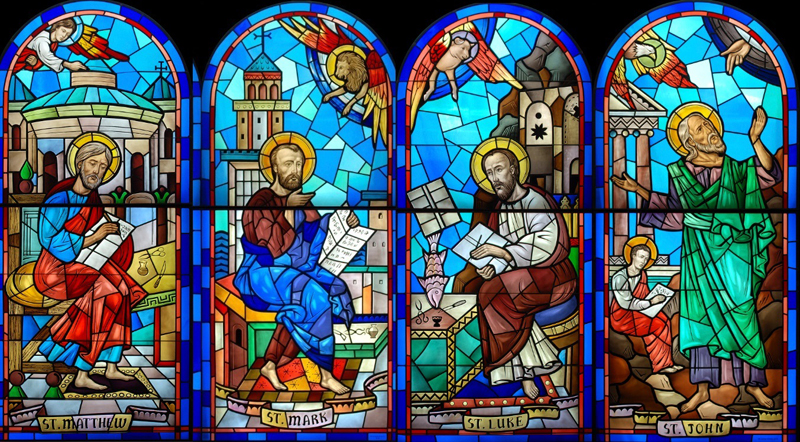
On the Beauty of the Fourfold Gospel Witness

It is truly a manifestation of the grace of God that there are four accounts of the life of Jesus in the New Testament. They are rightly called theological history, because each one of them details the life of Jesus in a way that emphasizes and highlights particular aspects of who He is and what He has done for His people. While any one of them may have been sufficient on their own to convey the pertinent historical facts of His life, the four of them together paint a beautiful multilayered tapestry that has sparked the reflection and devotion of His followers now for two millennia. In the space that follows, I will sketch out the contours of that tapestry by discussing the particular emphases of each Gospel. 

According to the documentary hypothesis, Mark wrote his gospel first based on the memoirs of the Apostle Peter. The vast majority of Mark’s gospel is reproduced in both Matthew and Luke, but this does not mean that Mark’s Gospel is incomplete, redundant, or lacking in historical and theological value. This value is seen clearly in the very first verse of his work, “The beginning of the Gospel of Jesus Christ, the Son of God.” Functioning somewhat like a title or purpose statement, this verse is packed with theological significance. It tells us that Mark’s work is a “gospel”, a word that means good news; it also states clearly that this good news has to do with Jesus, the messianic Son of God. That this is the primary way that Mark wants his audience to see Jesus is confirmed following His death, when a Roman Centurion says, “Truly, this man was the Son of God.” 

However, what makes Mark’s gospel so compelling is that this truth is hidden throughout most of the Gospel. The so-called messianic secret, in which Jesus repeatedly instructs people not to make His identity known, stands in stark contrast to the bold affirmations at the beginning and end of Mark’s Gospel. This is probably because Mark wants his readers to understand that the messianic identity of Jesus is defined by His death on the cross for sin. Almost half of Mark’s gospel is dedicated to the events of Passion week. Whereas the first ten chapters are quickly paced and action oriented, the final six slow down to something like a snail’s pace in detailing the events of the final seven days of Jesus’ life. This is why many have considered Mark’s gospel to be an apology or a defense of the cross that was likely written for Christians in Rome shortly before the persecutions of Nero. 

Of course, though chronologically prior, the Gospel of Mark is not ordered first in the New Testament canon; that pride of place belongs to the Gospel of Matthew, and it is easy to understand why. Not only does Matthew’s Gospel begin with a genealogy that traces the lineage of Jesus through David to Abraham, it also includes an infancy narrative that captivates those who read it. However, this is part of Matthew’s unique purpose to show that Jesus is the Son of David, Son of Abraham. Not only does this connect the New Testament back to the Old Testament, it also would have been particularly important if Matthew was writing to Jewish Christians, as many suppose. For Matthew, Jesus is the fulfillment of God’s covenant promises, both to Abraham and to David; he is the long awaited Davidic messiah, heir to the throne of  God’s Kingdom, and the one who mediates the blessings of the Abrahamic Covenant. 

More than that though, for Matthew, Jesus is a new and better Moses. This is evident in the many ways that the events of the first four chapters recapitulate the life of Moses. On top of this, Matthew has structured His gospel around five primary discourses, a fact that likely refers back to the five books of Moses. In the same way that Moses was the mediator of the Law under the Old Covenant, likewise, Jesus is the mediator of the “law” under the New Covenant.  This is confirmed in the Great Commission, where Jesus commands His disciples to “teach all that I have commanded you.” The phrase “all that I have commanded you” most naturally refers back to the content of the five primary discourses in Matthew’s Gospel. Because of this, many consider Matthew’s Gospel to be a handbook on discipleship, a manual that instructs us in what it means to follow Jesus. 

The Gospel of Luke rounds out the “Synoptic Gospels”, and like Matthew, it begins with a beautiful retelling of the Christmas story. However, what stands out in Luke’s infancy narrative is the role of the Holy Spirit. Of course, many consider Luke to be the theologian of the Spirit par excellence in the New Testament, not least of which is due to the continued role that the Spirit plays in Luke’s second volume, the Book of Acts, otherwise known as the Acts of the Holy Spirit. Luke’s emphasis on the role of the Spirit is largely due to his desire to present Jesus as the Spirit anointed messiah. This is confirmed in chapter 4 of Luke’s Gospel, when Jesus reads a passage from the Book of Isaiah, which says in part “The Spirit is upon me.” After He sits down, He says, “Today, this scripture is fulfilled in your hearing.” In other words, Luke wants us to see that Jesus is the spirit anointed Messiah who has finally come to pour out the blessings of the Messianic jubilee. According to the passage from Isaiah, chapter 61, these blessings are primarily manifested in the compassionate healing of those who are blind, deaf, mute, etc, and throughout Jesus’ ministry, Luke repeatedly details the compassion that Jesus demonstrated during his healing ministry. For Luke in particular, Jesus is a man of sorrows, well acquainted with grief, bearing the burdens and ailments of many. 

In addition to this, a large portion of Luke’s unique material is dedicated to Jesus’ final journey toward Jerusalem. In Luke, chapter 9, we read that “He set his face like flint to go to Jerusalem;” this simply means that the final journey of Jesus to Jerusalem to be crucified was purposeful and intentional on the part of Jesus, so that “the scriptures might be fulfilled.” The fulfillment of God’s plan for salvation history is a primary emphasis in both Luke’s Gospel and in the Book of Acts. In other words, Jesus was not a victim of circumstance or the maniacal plots of evil men; He was delivered up according to the predetermined plan of God from before the foundations of the world. Luke wants his audience to understand that everything that happened during the life of Jesus from his birth to his death, resurrection, ascension, and session is the fulfillment of God’s eternal plan to redeem humanity from their sins. In fact, in the final chapter of Luke’s gospel, we read on more than one occasion that “all that was written in the Law, the Prophets, and the Psalms must be fulfilled.”

Last, but certainly not least, is the Gospel of John, and the relationship between John and the synoptics is a question that has bewildered many throughout the centuries. This is mostly because John begins His gospel with a striking description of the eternal Word, God the Son, who came incarnate and “dwelt among us”. Clearly, “the disciple whom Jesus loved” wants his readers to understand that this Jesus was no ordinary man; He is the incarnate God man, the Word made flesh, and as he indicates at the end of His gospel, “These things are written so that you may believe that Jesus is the Christ, and by believing, have life in His name.” The deity of Jesus practically jumps off of the page in John’s gospel, not the least of which is because of the several “I am” statements that are found throughout the book, the most profound of which is “Before Abraham was, I am.” Of course, these “I am” statements refer back to the divine name which was revealed to Moses at the burning bush, and so indicate a startling awareness in the mind of Jesus of His own divinity. 

Of course, in the service of this purpose, John structures His gospel around seven specific miracles, or, as he calls them, “signs.” If John did, in fact, write two to three decades after the synoptics, then it seems clear that he did not believe it necessary to record all that Jesus began to do and teach; he even confesses that to do so would require more books than could be humanly conceived. But these seven signs were singled out by John because they advance His thesis that Jesus is the Christ. From the turning of water into wine to the raising of Lazarus from the dead, every one of these signs demonstrate a particular aspect of Jesus messianic identity and so prove that He is the Christ, the one who gives and sustains life in all those who are filled with His Spirit. 

In the final analysis, it seems clear that if one of these four gospels were lost or removed from the canon, the followers of Jesus would be at a severe disadvantage. Each and every one of them is necessary for us to appreciate the multi-faceted beauty of the person and work of Him who is called Christ. From the earliest centuries of the Christian movement, these four evangelists have stood together in chorus, singing not in unison but in harmony, and because of this, the followers of Jesus have a sure and certain foundation upon which they can stand as they attempt to follow Christ and be more like Him.


Slow To Write

"let every person be quick to hear, slow to speak, slow to anger."

lovegavehope

Just another WordPress.com site

Jared Cornutt

Pastor | Speaker | Writer

Denny Burk

A commentary on theology, politics, and culture

G3 Ministries

Events + Resources for the Local Church

Biblical Reasoning

Biblical and Systematic Theology According to the Scriptures

RetroChristianity

Reclaiming the Forgotten Faith

SBC Voices

Southern Baptist News & Opinion

Lucid Theology

Thoughts on words, books, theology, and life.

Baptist21

A pastor-led voice for Baptists in the 21st century

Center For Baptist Renewal

The Personal and Professional Blog of Phillip Powers

The Pastor's Well - Pastor Well

The Personal and Professional Blog of Phillip Powers

Articles - AlbertMohler.com

The Personal and Professional Blog of Phillip Powers

The Gospel Coalition

The Personal and Professional Blog of Phillip Powers