Tag Archives: Son of God

On Theology and History in the Gospel of John

When it comes to the study of the historical Jesus, there has long been a noticeable bias against the Gospel of John. While the Synoptic Gospels (Matthew, Mark, and Luke) are generally regarded as the primary sources for reconstructing the life and ministry of Jesus, the Fourth Gospel has often been treated with considerably greater suspicion because of its overt theological concerns. The assumption seems to be that because John is more explicitly theological, he must therefore be less historically reliable. Indeed, this tendency has led some scholars to call for a so-called “Fourth Quest” for the historical Jesus that takes the historical value of John more seriously. Nevertheless, the assumption that a more theological Gospel must necessarily be a less historical Gospel deserves to be challenged. Such an assumption depends upon a questionable distinction between historical reporting and theological interpretation. The simple fact of the matter is that all historical writing involves selection, organization, and interpretation according to the understanding and purposes of its author, and the Gospels are no different. In the Gospels, theology frequently consists of history interpreted in light of its ultimate significance, but interpreted history is still history. In this post, therefore, I will argue that John’s theological presentation of Jesus does not undermine the historical character of his Gospel; rather, John’s theology represents his interpretation of historical events whose significance he seeks to explain. But before making that case, we must first consider why theological interpretation should be regarded as historical distortion in the first place.
Let me be clear from the outset: there simply is no such thing as completely “neutral” history. No historian simply reproduces the past in a purely objective or uninterpreted manner. Every writer of history selects events, arranges material, emphasizes particular details, interprets their significance, and writes for particular purposes, and the author of the Fourth Gospel is no different. In John 20:30–31, he writes, “Jesus performed many other signs in the presence of his disciples that are not written in this book. But these are written so that you may believe that Jesus is the Messiah, the Son of God, and that by believing you may have life in his name.” John openly acknowledges that Jesus performed many other signs, but that he has deliberately selected certain signs in order to demonstrate that Jesus is the Messiah, the Son of God. (On Messianic Sonship in the Fourth Gospel, see my post here.) In other words, John tells his readers both what happened and why he has chosen to record it. His theological purpose could hardly be more explicit, but theological selection does not equal historical fabrication. Indeed, John presents the events he selects as signs actually performed by Jesus “in the presence of his disciples.” The events are historical; their selection and presentation are theological. Or, to put it somewhat differently, selectivity is not the enemy of historicity; it is an unavoidable feature of historical writing.
More importantly, John’s theology is grounded in historical claims. Throughout his narrative, Jesus attends identifiable Jewish festivals, travels between Galilee and Jerusalem, visits particular locations, and interacts with identifiable people. In other words, John presents the life and ministry of Jesus as events occurring within the concrete realities of first-century history. This historical grounding is essential because, as John declares at the beginning of his Gospel, “the Word became flesh and dwelt among us” (John 1:14). The eternal Logos entered into human history, meaning that John’s theology is fundamentally incarnational. It reflects the historical reality of the Word made flesh and therefore cannot be reduced to a collection of timeless spiritual ideals. Indeed, John explicitly grounds his narrative in eyewitness testimony: “He who saw this has testified so that you also may believe. His testimony is true, and he knows he is telling the truth” (John 19:35; cf. 21:24). John thus presents his theology as arising from testimony concerning things that actually happened. The point of all this is that John’s theological claims depend upon his historical claims; the two cannot simply be separated. If the Word did not actually become flesh, if Jesus did not die upon the cross, and if he did not rise again, then John’s entire theology collapses. Far from diminishing the importance of history, therefore, John’s theology depends upon it.
What I am suggesting, then, is that theological interpretation does not necessarily mean historical invention. Of course, John interprets the actions and words of Jesus, but interpretation is inherent to historical writing. He does not merely give us a transcript of Jesus’s life; rather, he seeks to explain what Jesus’s actions mean. For example, when Jesus feeds the five thousand, John presents him as the Bread of Life. When Jesus heals the blind man, he reveals himself as the Light of the World. When he raises Lazarus from the dead, Jesus declares that he is the Resurrection and the Life. When Jesus washes the disciples’ feet, the event reveals the nature of Christlike service and love. Even the crucifixion is paradoxically presented as the glorification and exaltation of the Son. In each of these instances, John takes events from the life and ministry of Jesus and unfolds their deeper theological significance. John does not merely ask, “What happened?” He also asks, “What did what happened mean?” The simple fact of the matter is that two people can describe the same historical event, with one explaining its significance much more deeply than the other, without the more interpretive account thereby becoming historically false. Interpretation and invention are simply not the same thing. John’s theological interpretation of the life of Jesus therefore need not be understood as the creation of a theological Jesus; rather, it represents his attempt to explain the true significance of the historical Jesus whom he presents to his readers.
In fact, John explicitly tells us that the disciples did not fully understand the actions and words of Jesus until after his resurrection and glorification. Reflecting upon Jesus’s entry into Jerusalem, John writes, “His disciples did not understand these things at first. However, when Jesus was glorified, then they remembered that these things had been written about him and that they had done these things to him” (John 12:16; cf. 2:22). Notice the progression. The disciples first experienced the historical events, later remembered what they had seen and heard, and then came to understand their deeper significance in light of Jesus’s resurrection and glorification. Moreover, Jesus himself promises that the Holy Spirit “will teach you all things and remind you of everything I have told you” (John 14:26). Thus, the resurrection and the coming of the Spirit did not require the disciples to invent a different Jesus; rather, they enabled them to understand more fully the Jesus they had already known. John’s Gospel therefore reflects both eyewitness memory and mature theological reflection upon that memory. His theological interpretation is retrospective, but retrospective interpretation need not entail historical fabrication. John’s mature Christology represents his retrospective understanding of Jesus, not necessarily a retrospective creation of Jesus. Indeed, by John’s own account, history came first and theological understanding followed as the disciples reflected upon what they had witnessed in light of the resurrection.
Of course, part of the confusion stems from the fact that the Fourth Gospel is noticeably different from the Synoptics (Matthew, Mark, and Luke). The Synoptics primarily focus on Jesus’s Galilean ministry, his parables, his proclamation of the kingdom of God, and his shorter sayings, while John gives considerably more attention to his ministry in Judea and Jerusalem, his identity and relationship with the Father, extended discourses, and signs. However, in my view, these differences are sometimes overplayed. There are significant points of continuity between the four Gospels, including but not limited to the ministry of John the Baptist, the calling of the disciples, the feeding of the five thousand, Jesus’s conflict with the religious authorities, his entry into Jerusalem, and the basic contours of the passion and resurrection narratives. Even where their emphases differ, they remain centered upon the same fundamental story of Jesus’s ministry, death, and resurrection. Moreover, we should hardly expect four different authors, writing for different audiences and emphasizing different theological concerns, to tell that story in precisely the same way. Difference in selection and emphasis does not necessarily amount to contradiction, any more than theological distinctiveness necessarily amounts to historical unreliability. John is not telling a different story; he is telling the same story from a distinct theological perspective. The Synoptics and John need not be flattened into identical accounts in order to be historically complementary.
In the final analysis, then, the relative marginalization of the Gospel of John in the study of the historical Jesus is unwarranted. John is both historical and theological. More to the point, John is theological because he believes that certain things actually happened. The Word became flesh. Jesus performed signs. Jesus died upon the cross. The tomb was empty. Jesus appeared alive. The disciples witnessed these events, and John’s theology represents his explanation of their significance. Of course, John writes with an explicitly theological purpose, namely that his readers “may believe that Jesus is the Messiah, the Son of God, and that by believing [they] may have life in his name” (John 20:31). John does not conceal his purpose; he wants his readers to believe. But the faith he seeks to produce rests upon eyewitness testimony concerning the actions and teachings of Jesus. His theology therefore does not replace history but interprets it. The question is not whether John gives us history or theology. He gives us theological history: testimony concerning real events interpreted in light of the identity of the One who stood at their center. John’s theology does not require us to abandon the Jesus of history; it invites us to recognize who the Jesus of history truly was.
For further study, see also
On the Jesus of History and the Christ of Faith
On the Johannine Pentecost
On the Narrative Logic of John 21
Share this:


On Messianic Sonship in the Gospel of John
In my previous post, I argued that in the New Testament the title “Son of God” should be understood primarily as royal and messianic before it is understood in fully developed theological terms. However, because of its clear emphasis on the divinity of Jesus, many assume that the Gospel of John moves away from this historical and messianic framework. In this post, I want to suggest that John does not abandon these categories; on the contrary, he deepens them in order to reveal what it truly means for Jesus to be the Messiah. Or to put it another way, John presents Jesus in continuity with Jewish messianic expectations, while also showing that this messianic sonship entails a uniquely intimate and divine relationship with the Father that exceeds what was previously anticipated. The question, then, is not whether John’s understanding of Jesus is messianic, but what kind of messianism he presents.
In his purpose statement, John writes that “these are written so that you may believe that Jesus is the Messiah, the Son of God.” Here again, the grammatical construction is significant. The term “Christ” (or “Messiah”) stands in apposition to the phrase “Son of God,” meaning that the two expressions are placed side by side, with one defining or clarifying the other. In this context, to confess Jesus as the Messiah is to confess him as the Son of God. This same connection appears at the beginning of the Gospel of John. In John 1:49, Nathanael declares, “You are the Son of God; you are the King of Israel.” The parallelism in these lines again equates divine sonship with messianic kingship, but more importantly, these two statements function as bookends to the Gospel, framing John’s presentation of Jesus from beginning to end. The point, then, is that John does not abandon the messianic meaning of “Son of God.” Rather, he affirms it at the structural level of his narrative. To believe in Jesus as the Messiah is to believe in him as the Son, and this understanding stands in direct continuity with the Synoptic presentation explored in the previous post.
This same connection appears at the midpoint of the Gospel of John. In the account of Lazarus in John 11, after Jesus declares that he is “the resurrection and the life,” he turns to Martha and asks, “Do you believe this?” She responds, “Yes, Lord; I believe that you are the Messiah, the Son of God, who is coming into the world.” This confession is loaded with Christological significance. Not only does it once again place “Messiah” and “Son of God” in apposition, reinforcing the connection we have already seen, but it also adds a further layer by describing Jesus as “the one who is coming into the world.” This language resonates with broader biblical expectations of a coming deliverer—one who is sent by God and arrives to accomplish his purposes. It echoes themes associated with the coming figure of Daniel 7 and the one who comes in the name of the Lord in Psalm 118. Taken together with John 1:49 and 20:31, this confession strengthens the pattern: to be the Son of God is to be the Messiah, the King of Israel, the one sent into the world. In other words, John clearly preserves and reinforces the traditional messianic categories that were already in circulation.
Of course, conceptions of the Messiah in the literature of Second Temple Judaism were far from uniform. Expectations were diverse and often overlapping rather than monolithic. Some traditions emphasized a royal figure in continuity with the promises to David, drawing on texts like 2 Samuel 7 and Psalm 2, where the Messiah is understood as the anointed king who would rule on God’s behalf. Others envisioned a more prophetic figure, in keeping with the promise of a prophet like Moses in Deuteronomy 18, one who would speak God’s word with unique authority. Still others anticipated a more exalted or even heavenly figure, shaped by texts like Daniel 7, where the “Son of Man” is portrayed as receiving dominion and glory from God himself. The point is not that these expectations were clearly defined or neatly separated, but that Jewish messianism already contained a range of categories capable of accommodating a figure of significant authority and even transcendent status. This is important for reading the Gospel of John. When John presents Jesus in elevated terms, he is not abandoning messianic categories or importing something foreign into the tradition. Rather, he is drawing on a rich and developing matrix of expectation already present within Second Temple Judaism and showing how these strands converge in the person of Jesus.
Now, as I argued in my previous post, in the Synoptic Gospels the idea of sonship is primarily representative. As the Messiah, Jesus stands as God’s appointed ruler on earth, the true king who embodies and fulfills the role that Israel and her kings failed to carry out. But in the Gospel of John, the concept of sonship is taken further. The relationship between the Father and the Son is not merely one of representation, but of participation. That is, the Son does not simply act on God’s behalf; he acts in a way that is inseparably bound up with the Father’s own activity. This is made clear in passages like John 5:19, where Jesus says, “Truly I tell you, the Son is not able to do anything on his own, but only what he sees the Father doing. For whatever the Father does, the Son likewise does these things.” The claim here is remarkable. It is not merely that the Son imitates the Father, but that his actions are perfectly coordinated with and reflective of the Father’s own work. The same idea appears in John 10:30: “I and the Father are one.” In other words, the Son does not merely represent the Father as his agent; he shares in his work in a unique and unparalleled way. This is not a departure from messianic sonship, but a deepening of it—one that begins to press beyond simple representation into a more profound unity between the Father and the Son.
At this point, it is helpful to introduce a category that has received significant attention in recent scholarship, namely the Jewish concept of agency. In the ancient Jewish world, an agent functioned as a representative of the one who sent him. The basic idea was that “the one sent is as the sender,” meaning that the agent could speak and act with the authority of the one who commissioned him. This framework helps explain much of the language in the Gospel of John, especially the repeated emphasis that Jesus is the one “sent” by the Father. He speaks the Father’s words, performs the Father’s works, and carries out the Father’s will. In this sense, Jesus clearly fits within recognizable Jewish categories of agency. And yet, as the Gospel unfolds, it becomes evident that his sonship cannot be fully contained within that framework. Jesus does not merely speak for God; he speaks as one who uniquely knows the Father. He does not simply carry out God’s works; he does what the Father himself does. The point, then, is that while the category of agency is helpful, it is ultimately insufficient. The Son does not merely act on God’s behalf—he acts with God’s authority in a way that is inseparably bound up with the Father himself. In other words, John presents a form of agency that is intensified to the point of revealing something more about the identity of the Son.
According to John, this is precisely why opposition to Jesus intensifies. In John 5:18, we read, “This is why the Jews began trying all the more to kill him: not only was he breaking the Sabbath, but he was even calling God his own Father, making himself equal to God.” This observation is significant because it shows that the implications of Jesus’s claims are drawn from within the narrative itself. John does not import the idea of divine sonship from some external philosophical framework; rather, it emerges organically from the way Jesus speaks about his relationship to the Father. What is particularly striking is that Jesus does not correct this interpretation. Instead, in the verses that follow, he deepens it. He speaks of doing whatever the Father does, of giving life as the Father gives life, and of exercising judgment as the Father does. In other words, the claim to sonship entails participation in divine prerogatives that belong to God alone. The response of his opponents, then, is not a misunderstanding but a recognition of the implications of his words. They perceive that Jesus is not merely claiming to be God’s representative, but is placing himself in a unique relationship of shared authority with God. The point, then, is that in John’s Gospel, messianic sonship presses beyond representation into a form of equality that raises unavoidable questions about the identity of the Son.
And this is why Jesus is uniquely able to reveal the Father. In John 1:18 we read, “No one has ever seen God. The one and only Son, who is himself God and is at the Father’s side—he has revealed him.” There is a well-known textual question here as to whether the verse should read “the only begotten God” or “the only begotten Son.” While the evidence favors the reading “the only begotten God”, what is most striking is that both readings point in the same direction: John is describing a relationship between the Father and the Son that is without parallel. The Son stands in the closest possible relation to the Father—“at his side”—and precisely for that reason he is able to make him known. This is not simply the language of a prophet who speaks on God’s behalf; it is the language of one who knows God from within that relationship. Jesus makes this point explicit in John 14. When Philip asks, “Lord, show us the Father,” Jesus responds, “The one who has seen me has seen the Father.” In other words, the Son does not merely communicate information about God—he reveals him. The Son is uniquely qualified to make the Father known because his identity is inseparably bound up with the Father himself.
As in the Synoptic Gospels, the identity of Jesus as the Son reaches its fullest expression in his death, but in the Gospel of John this moment is framed in a striking way. The crucifixion is not merely suffering; it is glorification. In John 12:32, Jesus says, “As for me, if I am lifted up from the earth I will draw all people to myself.” The language of being “lifted up” carries a deliberate double meaning. On the one hand, it refers to the physical lifting up of Jesus on the cross. On the other, it points to exaltation, to being lifted up in glory. For John, these are not separate events but one and the same reality viewed from different angles. This is confirmed in John 13:31, where, immediately after predicting his betrayal, Jesus declares, “Now the Son of Man is glorified, and God is glorified in him.” In other words, the cross is not a contradiction of Jesus’s identity as the Son—it is its revelation. The glory of his sonship is displayed precisely in his obedience, his self-giving, and his willingness to suffer. The Son is most fully revealed not in avoiding the cross, but in embracing it.
And the resurrection brings this trajectory to its proper conclusion. After seeing the risen Jesus and placing his hands in his wounds, Thomas responds with the climactic confession, “My Lord and my God!” (John 20.28). This is not merely an emotional outburst; it is the narrative’s decisive answer to the question that has been building throughout the Gospel of John: Who is this Jesus who claims to be the Son of God? Thomas’s confession brings together the strands that John has been developing from the beginning. The one who is the Messiah, the Son of God, is also rightly confessed as Lord and God. In this moment, the identity of Jesus is not revised but fully recognized. The resurrection does not introduce something new; it confirms and unveils what has been true all along. As such, the arc of the Gospel reaches its climax in the full acknowledgment of Jesus’s identity, echoing the claims of the opening prologue. The Son who was sent into the world is revealed to be none other than God himself, now seen, known, and confessed in the risen Christ.
So, to bring all of this together, we can now see the full trajectory of the title “Son of God” across the canon. In the Old Testament, sonship is grounded in covenant and kingship. Israel is called God’s son, and the Davidic king is identified as God’s son, functioning as his appointed ruler and representative. In the Synoptic Gospels, this category is sharpened and focused in the person of Jesus, who is confessed as the Messiah, the Son of God—the one who fulfills the role that Israel and her kings failed to carry out. But in the Gospel of John, this messianic sonship is not abandoned; it is brought to its fullest expression. John shows that the Messiah is the Son in a deeper sense than previously expected. The Son does not merely represent God’s rule; he participates in the Father’s work, shares in his authority, and uniquely reveals his identity. In other words, John does not move beyond messianism into something else entirely. Rather, he reveals what messianism was ultimately pointing toward all along. The royal Son of the Old Testament and the messianic Son of the Synoptics find their fullest meaning in the one who is not only God’s appointed king, but the Son who stands in a unique and unparalleled relationship with the Father.
What all of this means, then, is that the confession that Jesus is the Son of God is not merely a doctrinal statement to be affirmed, but a reality to be believed and lived. In the Gospel of John, belief in the Son is consistently tied to life. To believe in him is to receive life, to enter into a relationship with the Father, and to know God as he truly is. This is because the Son is the one who uniquely reveals the Father. He is not simply a messenger who brings information about God; he is the one in whom God is made known. And so to come to the Son is to come to the Father. At the same time, this confession is grounded in the unfolding story of Scripture. The title “Son of God” begins in the Old Testament as a royal and covenantal designation, is sharpened in the Synoptic Gospels as a messianic identity, and is brought to its fullest expression in John, where the Son is revealed in a uniquely intimate and participatory relationship with the Father. To confess Jesus as the Son of God, then, is not only to affirm his role as Messiah, but to recognize him as the one who stands at the very center of God’s redemptive purposes, the one who makes the Father known, and the one in whom we find life.
For further study:
Reynolds, Benjamin E., and Gabriele Boccaccini, eds. Reading the Gospel of John’s Christology as Jewish Messianism: Royal, Prophetic, and Divine Messiahs. Ancient Judaism and Early Christianity. Leiden: Brill, 2018.
Share this:


On Son of God as a Messianic Title
When Christians confess that Jesus is the Son of God, we are usually affirming something of his divinity. In other words, the title “Son of God” is typically understood in doctrinal terms as an affirmation that Jesus is the second person of the Trinity come incarnate. This understanding reaches back to the formulation of the First Council of Nicaea in AD 325. In that creed, we confess that Jesus is “the only begotten Son of God, born of the Father before all ages, God from God, Light from Light, true God from true God, begotten, not made, consubstantial with the Father.” These are beautiful words that faithfully express the truth of Christ’s divinity. However, they also risk skipping the story. In Scripture, the term “Son of God” first emerges as a royal, messianic title before it is developed into a fuller theological claim about his divine identity. Its meaning is shaped by covenant, kingship, and expectation, and only later expanded in light of who Jesus truly is.
The idea of sonship appears early in the Old Testament. As early as Exodus 4.22, God declares that “Israel is my firstborn son,” identifying the nation as his covenant people, set apart to represent him among the nations. Later, in the Davidic covenant, God speaks of the king in similar terms: “I will be his father, and he will be my son” (2 Sam. 7.14). Here, sonship is tied directly to kingship and divine appointment. The king stands as God’s representative, ruling on his behalf and under his authority. This same idea is expressed in Psalm 2, where, in the context of royal coronation, the king declares, “He said to me, ‘You are my Son; today I have begotten you.'” The language is not biological or metaphysical, but covenantal and functional. It marks the king as the one chosen and installed by God to exercise his rule. The point, then, is that in these texts divine sonship refers to representative, covenantal identity. It speaks of relational authority, divine election, and royal vocation rather than transcendent metaphysical realities. To be called ‘Son of God’ in this context is to be appointed as God’s king, entrusted with the responsibility of embodying his rule among his people.
The problem, however, is that these “sons of God” consistently fail to live up to the height of their calling. As God’s son, Israel was called to be a kingdom of priests, a light to the nations, and a visible reflection of God’s character in the world. Yet instead of faithfulness, they fell into sin and idolatry, broke the terms of the covenant, and were ultimately sent into exile under its curses. The same pattern emerges in the Davidic line. The kings of Israel and Judah, who were called to mediate God’s rule over his people, likewise failed through disobedience and compromise. This tension is reflected within the Psalms themselves. In Psalm 2, the authority of the Lord’s anointed king is met with resistance as the nations rage against him. In Psalm 89, the psalmist recalls God’s covenant promises to David, only to lament that those promises appear to stand in contradiction to present reality. The result is that the category of “son of God” begins to carry forward-looking weight. It no longer simply describes a present reality; it generates expectation. There emerges a longing for a faithful son, a greater son, who will succeed where Israel and her kings have failed, a hope captured in texts like Isaiah 9.6–7, where the promised son will finally bear the government in righteousness and peace. In other words, the Scriptures create space for a future Son who will succeed where others failed.
This hope for a greater Son of God becomes more clearly defined in the Second Temple period. Of course, these texts are not inspired Scripture, but they do provide important insight into the expectations and categories that were alive at the time of Jesus. What we see is a growing anticipation of deliverance increasingly framed in royal and messianic terms. While these expectations are diverse, there remains a significant continuity with Old Testament categories, especially the idea of the “Son of God.” For example, among the Dead Sea Scrolls, texts like 4Q174 (the Florilegium) link the Davidic covenant and the language of sonship in 2 Samuel 7.14 with the expectation of a coming royal Messiah. Likewise, 4Q246 explicitly uses the titles “Son of God” and “Son of the Most High” in reference to a future ruler. Another text, 1QSa (often cited as 1Q28a), appears to echo Psalm 2.7 with language of divine begetting applied to the Messiah. These examples could be multiplied, but the point is clear: in the Second Temple period, the concept of divine sonship is not abandoned or redefined, but carried forward and intensified. It remains closely tied to the Davidic king, even as it takes on heightened expectation in anticipation of the one who will finally fulfill that role. Or to put it another way, the term “Son of God” was already a loaded, expectation-filled term before Jesus appeared.
In the Synoptic Gospels, “Son of God” language appears at key moments in the life and ministry of Jesus. Most notably, at his baptism and again at his transfiguration, a voice from heaven declares, “This is my beloved Son,” marking him out as the one uniquely appointed and affirmed by God. The demons, too, recognize Jesus as the Son of God, a recognition that underscores his authority and signals his messianic identity, even when others fail to perceive it clearly. This comes into sharper focus at Caesarea Philippi. When Jesus asks his disciples, “Who do you say that I am?”, Peter responds, “You are the Messiah, the Son of the living God.” The grammar of this confession is particularly significant. The predicate nominative “Messiah” and the phrase “Son of the living God” stand in apposition, meaning that the second expression defines and clarifies the first. In other words, to confess Jesus as the Messiah is to confess him as the Son of God. In this context, divine sonship is directly tied to his mission, obedience, and kingship. At the same time, Jesus redefines contemporary messianic expectations. He rejects the political and nationalistic ambitions often associated with the Messiah and instead frames his identity around suffering, obedience, and ultimately his death. The point, then, is that throughout the Synoptic Gospels, the title “Son of God” functions primarily as a messianic designation, identifying who Jesus is and what he has come to do.
Even at his crucifixion, the language of sonship is front and center. The religious leaders mock him, saying, “If you are the Son of God, come down from the cross” (Matt. 27.40), and again, “He is the King of Israel! Let him come down now from the cross, and we will believe in him” (Matt. 27.42). The parallelism in these statements is striking. “Son of God” and “King of Israel” function as equivalent titles, reinforcing the connection between divine sonship and messianic kingship. And yet, this is the tension: the one who claims to be the Son of God appears to be defeated. He does not come down from the cross; he remains and suffers. But this apparent contradiction is precisely the point. Jesus does not abandon his identity as the Son; he fulfills it through obedience and suffering. His sonship is not negated at the cross; it is revealed there. The resurrection then serves as the divine vindication of his claims. As Paul writes in Romans 1.4, he was “appointed Son of God in power… by the resurrection from the dead.” That is, the resurrection publicly confirms what was already true of him, now revealed in power. The cross is not the denial of his kingship, but the path to it. As even the Roman centurion confesses at his death, “Truly this man was the Son of God.”
The early apostolic witness continues this same pattern by interpreting Jesus’s sonship in light of his resurrection and exaltation. In the book of Acts, the apostles repeatedly draw from the Psalms to explain what God has accomplished in Christ. For example, in Acts 13, Paul cites Psalm 2.7—“You are my Son; today I have begotten you”—and applies it to the resurrection of Jesus. In this context, the language of “begetting” is not about origin, but about installation. The resurrection marks the public declaration and vindication of Jesus as the Son of God, the one who now reigns in power. Similarly, Psalm 110 is used throughout the New Testament to describe Christ’s exaltation to the right hand of God, a position of authority, kingship, and rule over all things. The point is that the apostles read the Psalms as speaking directly to the identity and mission of Jesus, particularly as they relate to his enthronement. His sonship is not merely a title attached to his earthly ministry; it is confirmed and displayed in his exaltation. In other words, Jesus is revealed to be the Son of God in power as the risen and reigning king, fulfilling the royal and covenantal expectations embedded in the Psalter. (On Christ as the fulfillment of the Psalms, see here.)
Bringing all of this together, the title “Son of God” in Scripture carries a rich and layered meaning that is rooted in covenant, kingship, and ultimately fulfillment in Christ. It is a title that begins with Israel as God’s son, is focused and intensified in the Davidic king, and then expands into a forward-looking expectation for a faithful Son who will succeed where all others have failed. In Jesus, that expectation is finally realized. He is the true Son who embodies what Israel was called to be, the true King who fulfills the promises made to David, and the obedient Son who accomplishes the will of the Father. His sonship is not defined by abstract speculation, but by his mission—his life of perfect obedience, his suffering on the cross, his resurrection from the dead, and his exaltation to the right hand of God. To confess Jesus as the Son of God, then, is to confess him as the promised Messiah, the one in whom God’s purposes for his people and his world are brought to completion. And yet, as full and glorious as this picture is, the story does not end here. The New Testament, particularly in the Gospel of John, will press even further, showing that Jesus’s sonship is not only messianic, but also reveals something deeper about his identity. But that is a discussion for another time.
Share this:

On the Beauty of the Fourfold Gospel Witness
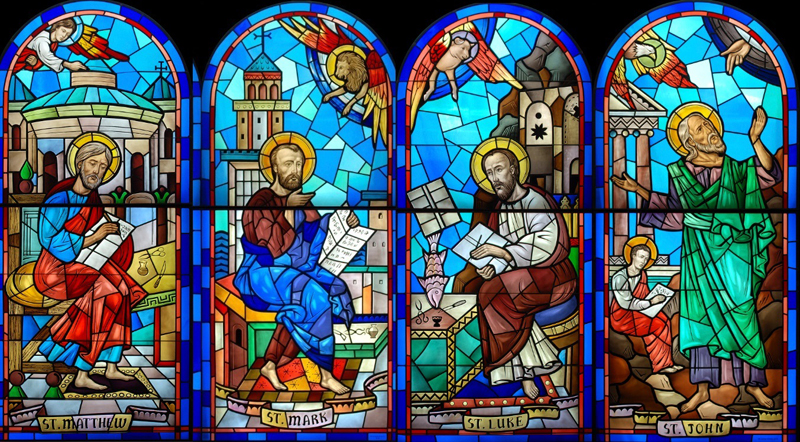
It is truly a manifestation of the grace of God that there are four accounts of the life of Jesus in the New Testament. They are rightly called theological history, because each one of them details the life of Jesus in a way that emphasizes and highlights particular aspects of who He is and what He has done for His people. While any one of them may have been sufficient on their own to convey the pertinent historical facts of His life, the four of them together paint a beautiful multilayered tapestry that has sparked the reflection and devotion of His followers now for two millennia. In the space that follows, I will sketch out the contours of that tapestry by discussing the particular emphases of each Gospel.
According to the documentary hypothesis, Mark wrote his gospel first based on the memoirs of the Apostle Peter. The vast majority of Mark’s gospel is reproduced in both Matthew and Luke, but this does not mean that Mark’s Gospel is incomplete, redundant, or lacking in historical and theological value. This value is seen clearly in the very first verse of his work, “The beginning of the Gospel of Jesus Christ, the Son of God.” Functioning somewhat like a title or purpose statement, this verse is packed with theological significance. It tells us that Mark’s work is a “gospel”, a word that means good news; it also states clearly that this good news has to do with Jesus, the messianic Son of God. That this is the primary way that Mark wants his audience to see Jesus is confirmed following His death, when a Roman Centurion says, “Truly, this man was the Son of God.”
However, what makes Mark’s gospel so compelling is that this truth is hidden throughout most of the Gospel. The so-called messianic secret, in which Jesus repeatedly instructs people not to make His identity known, stands in stark contrast to the bold affirmations at the beginning and end of Mark’s Gospel. This is probably because Mark wants his readers to understand that the messianic identity of Jesus is defined by His death on the cross for sin. Almost half of Mark’s gospel is dedicated to the events of Passion week. Whereas the first ten chapters are quickly paced and action oriented, the final six slow down to something like a snail’s pace in detailing the events of the final seven days of Jesus’ life. This is why many have considered Mark’s gospel to be an apology or a defense of the cross that was likely written for Christians in Rome shortly before the persecutions of Nero.
Of course, though chronologically prior, the Gospel of Mark is not ordered first in the New Testament canon; that pride of place belongs to the Gospel of Matthew, and it is easy to understand why. Not only does Matthew’s Gospel begin with a genealogy that traces the lineage of Jesus through David to Abraham, it also includes an infancy narrative that captivates those who read it. However, this is part of Matthew’s unique purpose to show that Jesus is the Son of David, Son of Abraham. Not only does this connect the New Testament back to the Old Testament, it also would have been particularly important if Matthew was writing to Jewish Christians, as many suppose. For Matthew, Jesus is the fulfillment of God’s covenant promises, both to Abraham and to David; he is the long awaited Davidic messiah, heir to the throne of God’s Kingdom, and the one who mediates the blessings of the Abrahamic Covenant.
More than that though, for Matthew, Jesus is a new and better Moses. This is evident in the many ways that the events of the first four chapters recapitulate the life of Moses. On top of this, Matthew has structured His gospel around five primary discourses, a fact that likely refers back to the five books of Moses. In the same way that Moses was the mediator of the Law under the Old Covenant, likewise, Jesus is the mediator of the “law” under the New Covenant. This is confirmed in the Great Commission, where Jesus commands His disciples to “teach all that I have commanded you.” The phrase “all that I have commanded you” most naturally refers back to the content of the five primary discourses in Matthew’s Gospel. Because of this, many consider Matthew’s Gospel to be a handbook on discipleship, a manual that instructs us in what it means to follow Jesus.
The Gospel of Luke rounds out the “Synoptic Gospels”, and like Matthew, it begins with a beautiful retelling of the Christmas story. However, what stands out in Luke’s infancy narrative is the role of the Holy Spirit. Of course, many consider Luke to be the theologian of the Spirit par excellence in the New Testament, not least of which is due to the continued role that the Spirit plays in Luke’s second volume, the Book of Acts, otherwise known as the Acts of the Holy Spirit. Luke’s emphasis on the role of the Spirit is largely due to his desire to present Jesus as the Spirit anointed messiah. This is confirmed in chapter 4 of Luke’s Gospel, when Jesus reads a passage from the Book of Isaiah, which says in part “The Spirit is upon me.” After He sits down, He says, “Today, this scripture is fulfilled in your hearing.” In other words, Luke wants us to see that Jesus is the spirit anointed Messiah who has finally come to pour out the blessings of the Messianic jubilee. According to the passage from Isaiah, chapter 61, these blessings are primarily manifested in the compassionate healing of those who are blind, deaf, mute, etc, and throughout Jesus’ ministry, Luke repeatedly details the compassion that Jesus demonstrated during his healing ministry. For Luke in particular, Jesus is a man of sorrows, well acquainted with grief, bearing the burdens and ailments of many.
In addition to this, a large portion of Luke’s unique material is dedicated to Jesus’ final journey toward Jerusalem. In Luke, chapter 9, we read that “He set his face like flint to go to Jerusalem;” this simply means that the final journey of Jesus to Jerusalem to be crucified was purposeful and intentional on the part of Jesus, so that “the scriptures might be fulfilled.” The fulfillment of God’s plan for salvation history is a primary emphasis in both Luke’s Gospel and in the Book of Acts. In other words, Jesus was not a victim of circumstance or the maniacal plots of evil men; He was delivered up according to the predetermined plan of God from before the foundations of the world. Luke wants his audience to understand that everything that happened during the life of Jesus from his birth to his death, resurrection, ascension, and session is the fulfillment of God’s eternal plan to redeem humanity from their sins. In fact, in the final chapter of Luke’s gospel, we read on more than one occasion that “all that was written in the Law, the Prophets, and the Psalms must be fulfilled.”
Last, but certainly not least, is the Gospel of John, and the relationship between John and the synoptics is a question that has bewildered many throughout the centuries. This is mostly because John begins His gospel with a striking description of the eternal Word, God the Son, who came incarnate and “dwelt among us”. Clearly, “the disciple whom Jesus loved” wants his readers to understand that this Jesus was no ordinary man; He is the incarnate God man, the Word made flesh, and as he indicates at the end of His gospel, “These things are written so that you may believe that Jesus is the Christ, and by believing, have life in His name.” The deity of Jesus practically jumps off of the page in John’s gospel, not the least of which is because of the several “I am” statements that are found throughout the book, the most profound of which is “Before Abraham was, I am.” Of course, these “I am” statements refer back to the divine name which was revealed to Moses at the burning bush, and so indicate a startling awareness in the mind of Jesus of His own divinity.
Of course, in the service of this purpose, John structures His gospel around seven specific miracles, or, as he calls them, “signs.” If John did, in fact, write two to three decades after the synoptics, then it seems clear that he did not believe it necessary to record all that Jesus began to do and teach; he even confesses that to do so would require more books than could be humanly conceived. But these seven signs were singled out by John because they advance His thesis that Jesus is the Christ. From the turning of water into wine to the raising of Lazarus from the dead, every one of these signs demonstrate a particular aspect of Jesus messianic identity and so prove that He is the Christ, the one who gives and sustains life in all those who are filled with His Spirit.
In the final analysis, it seems clear that if one of these four gospels were lost or removed from the canon, the followers of Jesus would be at a severe disadvantage. Each and every one of them is necessary for us to appreciate the multi-faceted beauty of the person and work of Him who is called Christ. From the earliest centuries of the Christian movement, these four evangelists have stood together in chorus, singing not in unison but in harmony, and because of this, the followers of Jesus have a sure and certain foundation upon which they can stand as they attempt to follow Christ and be more like Him.


