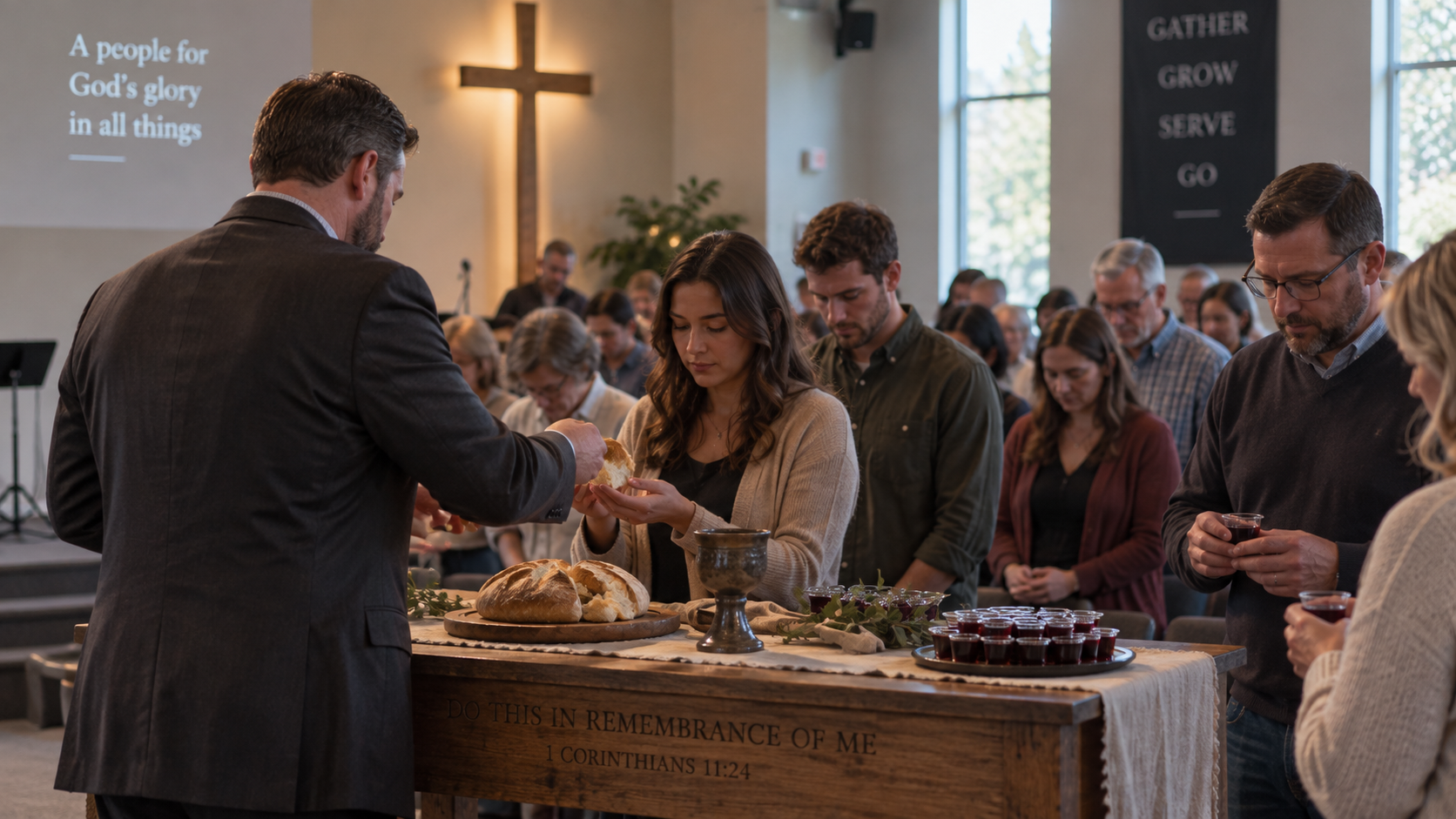
It is a typical Sunday at your local Baptist church. The service starts with some upbeat songs and maybe a Scripture reading. It continues with a time of prayer and giving, perhaps one or two more songs, a thirty- to forty-minute sermon on a particular text, and then a closing song and prayer. Everything seems normal. But then the pastor invites everyone to sit down, and the deacons begin passing plates containing small wafers and thimbles full of juice. It is communion Sunday, and suddenly everything feels different. Whether your church observes the Lord’s Supper monthly, quarterly, or only on designated occasions, communion can feel like something special added to the church’s worship rather than something that belongs to its normal rhythms. Of course, there is nothing inherently wrong with observing the Lord’s Supper less than weekly; Scripture never gives us an explicit command concerning its frequency. But when communion is something we rarely do, Christians can begin to think of it as something exceptional rather than ordinary. Yet when we look at the practice of the early church, what has become unusual for many churches seems remarkably ordinary in the life of the earliest Christians. The Lord’s Supper should therefore be recovered as a normal practice of the gathered church because the New Testament presents the Table not as an occasional ceremony added to Christian worship, but as an ordinary expression of the church’s life together in the gospel.
Perhaps the question is not simply how often we should observe the Lord’s Supper, but whether our practices have caused something ordinary in the life of the earliest church to become extraordinary in ours. We read in Acts 2.42 that, “They devoted themselves to the apostles’ teaching, to the fellowship, to the breaking of bread, and to prayer.” Or again, when Paul is in Troas, we read, “On the first day of the week, we assembled to break bread” (Acts 20.7). In other words, Luke does not portray the breaking of bread as a special ceremony added to the church’s life but as part of its regular shared life. Of course, the language of “breaking bread” could encompass a larger communal meal, but the Lord’s Supper would nevertheless have belonged within this larger practice of Christian table fellowship. Table fellowship was a regular part of the gathering of the early church, and Acts 20.7 is particularly striking because Luke describes breaking bread as the very purpose for which the believers had assembled. For the earliest Christians, then, breaking bread does not appear as an interruption of the church’s ordinary life together; it appears to belong to that life. So perhaps, instead of asking, “Where or when can we fit communion into the service?” we should be asking, “Why has communion become peripheral to what we think Christians ordinarily do when they gather?”
In his first letter to the Corinthians, Paul gives explicit instructions concerning the observance of the Lord’s Supper, and he continually refers to it as something that takes place “when you come together” (1 Cor. 11.17, 18, 20, 33). The irony, of course, is that the Corinthian Christians were intending to celebrate the Lord’s Supper, but their behavior so contradicted its meaning that Paul tells them, “when you come together, it is not really to eat the Lord’s Supper” (1 Cor. 11.20). Wealthy members of the congregation were eating ahead of the poorer members, and the poorer members were being humiliated. Social divisions were being reproduced at Christ’s Table. However, the important point is that Paul’s response to these errant practices demonstrates that the Supper is inherently ecclesial and communal. The Table not only proclaims, “Christ died for me,” but also, “Christ has made us one people through his death.” As Paul says in 1 Corinthians 10.17, “Because there is one bread, we who are many are one body, since all of us share the one bread.” Therefore, communion is not simply an individual devotional exercise conducted in the same room as other Christians; it is an act of the gathered body. The Lord’s Supper belongs to the church because at the Table the gospel that reconciles us to God also displays the new community that the gospel has created.
Moreover, the Apostle Paul says, “For as often as you eat this bread and drink the cup, you proclaim the Lord’s death until he comes” (1 Cor. 11.26). In other words, the Lord’s Supper is itself an act of proclamation. In preaching, the gospel is proclaimed through the words of the preacher; at the Table, the same gospel is proclaimed visibly and materially through the broken bread and poured cup. The point is that the Word and the Table are not competitors. Communion does not steal time from “gospel-centered worship”; communion is gospel-centered worship. The church hears what Christ has done through the preaching of the Word and then receives the signs Christ gave his church to remember and proclaim his saving work. And we must note here that Paul is clear that this proclamation continues “until he comes.” The Table therefore looks backward to the death of Christ while simultaneously looking forward to his return. As long as the church lives in the already and the not yet between Christ’s first coming and his second, it is called to proclaim the death by which its salvation was accomplished and anticipate the return by which that salvation will be consummated. What I am saying is that the Lord’s Supper is not an interruption of gospel-centered worship; it is one of the ways Christ has given his church to proclaim the gospel when we gather together.
Of course, someone might object, “If we take communion every week, won’t it become routine, empty, rote ritual?” This is a legitimate concern; our sacred rhythms can become thoughtless, and the familiarity of repetition can become mechanical if we are not careful. However, rarity does not automatically create reverence, and frequency does not automatically destroy it. Think of it this way: we don’t preach quarterly so that preaching remains special. We don’t pray occasionally to prevent prayer from becoming routine, and we don’t sing infrequently so that worship retains its significance. These practices become formative precisely through repetition, and the same can be true for communion. Regular observance at the Table reinforces the truths that Christ died for us, that we live by grace, that we belong to one another, and that Christ is coming again. The real question, then, is not frequency versus significance, but thoughtless repetition versus meaningful repetition. This is precisely where pastoral leadership matters. The Table should be intentionally connected to Scripture and the preaching of the Word so that its repeated observance continually directs the congregation to the different dimensions of the gospel it proclaims. However we approach it, the danger is not that the Lord’s Supper might become familiar; the danger is that familiarity might become thoughtlessness.
Now, to make the Lord’s Supper normal is not to make it casual or insignificant. If anything, Paul’s rebuke of the Corinthians in 1 Corinthians 11 demonstrates just the opposite. Their problem was not that they observed the Supper too frequently, but that they had lost sight of what their actions at the Table proclaimed. Their selfishness, divisions, and disregard for one another contradicted the gospel the meal was intended to display. Paul’s response was therefore not to discourage their observance of the Supper, but to call the Corinthians to discern what they were doing when they came together. The same should be true for us. Every time we come to the Table, we are reminded that Christ’s body was given and his blood was shed for us, that we belong to one another because we belong to Christ, and that the crucified and risen Lord will one day return. The Supper thus directs our attention backward to the cross, inward to the body of Christ gathered around the Table, and forward to the return of our Lord. To make the Lord’s Supper normal is not to make it ordinary in significance, but ordinary in practice—to weave it into the regular rhythm by which the gathered church is continually formed around the gospel.
None of this is to suggest that a church that observes the Lord’s Supper monthly or quarterly is somehow being disobedient to Scripture. The New Testament simply does not prescribe how frequently the church must come to the Table, and we should be careful not to create a command where Scripture has given us freedom. Nevertheless, Christian freedom does not mean that every possible practice equally reflects the patterns and priorities we find in the New Testament. Acts portrays breaking bread as part of the ordinary life of the earliest Christians. Paul assumes that the Lord’s Supper belongs to the gathering of the church, where the one bread displays the one body Christ has created. And every time the church eats the bread and drinks the cup, it proclaims the Lord’s death until he comes. Perhaps, then, we should ask whether some of our inherited practices have unintentionally pushed the Table toward the margins of Christian worship. The goal is not simply to observe communion more frequently, but to recover the Lord’s Supper as a regular, central, and joyful practice of the gathered church. Perhaps we have spent too much time trying to preserve the significance of the Lord’s Supper by making it extraordinary. The earliest Christians seem to have found its significance precisely in making it part of their ordinary life together. The Lord’s Supper does not need to become more extraordinary. Perhaps it simply needs to become normal again.
For further study, see:
On the Practice of the Lord’s Supper
On Partaking of the Lord’s Supper

 Faith Seeking Understanding