Tag Archives: Faith Seeking Understanding

On Religious Affections and Saving Faith

A few weeks ago, I was sitting in a Sunday school class, and we were discussing James 1.12, which says, “Blessed is the one who endures trials, because when he has stood the test he will receive the crown of life that God has promised to those who love him.” This verse raises an important question about the relationship between our affections for God and saving faith. In other words, if we are justified by faith alone in Christ alone, then what role do our affections play in saving faith. On the one hand, we do not want to reduce saving faith to mere intellectual agreement, i.e. “I believe that Christianity is true.” On the other hand, we do not want to reduce faith to sheer emotional experience, i.e. “I know I am saved simply because I feel close to God.” The Scriptures reject both of these reductions. Instead, the Scriptures present saving faith as the wholehearted response of a person to God’s self-revelation in Christ—a response that engages the mind, the will, and the affections. However, before we consider the relationship between saving faith and the affections, we must first ask a more basic question: What is saving faith?
Throughout the history of the church, theologians have commonly described saving faith as consisting of three essential elements: notitia (knowledge), assensus (assent), and fiducia (trust). Together, these categories help explain what it means to believe in Christ for salvation. First, a person must possess notitia, that is, a basic knowledge of the gospel and the identity of Jesus Christ. Second, that knowledge must be accompanied by assensus, an acknowledgment that the gospel is true. Yet Scripture makes it clear that knowledge and assent alone are not enough. James reminds us, “You believe that God is one. Good! Even the demons believe—and they shudder” (James 2:19). The demons possess both knowledge of God and an orthodox understanding of who he is, yet they remain in rebellion because they lack fiducia—a wholehearted trust that rests in God alone for salvation. Saving faith, therefore, is more than simply knowing the truth or agreeing that it is true; it is entrusting oneself to God in Christ. This naturally raises another question: What does that trust actually look like, and what role do our affections play in its expression?
The point, then, is that saving faith is never merely cognitive. As Paul writes in Romans 10:9, “If you confess with your mouth, ‘Jesus is Lord,’ and believe in your heart that God raised him from the dead, you will be saved.” In Scripture, the heart is far more than the seat of our emotions. It represents the very center of our personhood—the source of our thinking, willing, loving, and desiring. This is why, when Jesus is asked about the greatest commandment, he cites the Shema: “Love the Lord your God with all your heart, with all your soul, and with all your mind” (Matt. 22:37). Saving faith, therefore, is not merely the acceptance of certain propositions about Christ; it is the wholehearted entrusting of ourselves to him. Such faith redirects the deepest loves and loyalties of the heart toward the One who gave himself for us. At this point, however, an important distinction must be made. The affections are not the same thing as our passing emotions. Emotions often fluctuate with our circumstances, but the affections are the settled inclinations, desires, and loves of the soul. Consequently, when we trust in Christ for salvation, we do more than experience a passing feeling—we come to treasure him as the supreme object of our love and devotion.
Perhaps no theologian has reflected more deeply on this subject than Jonathan Edwards in his classic work Religious Affections. Writing during the First Great Awakening of the 1730s and 1740s, Edwards ministered in a period marked by extraordinary religious enthusiasm. As revival spread throughout the American colonies, many professed faith in Christ and displayed intense emotional experiences. Yet these developments raised an important question: How can we distinguish genuine saving faith from merely temporary or emotional religious excitement? It was this question that prompted Edwards to write Religious Affections. His central argument is that true religion “in great part consists in holy affections” because regeneration does more than inform the mind—it transforms the heart. Saving faith not only convinces us that Christ is worthy of our trust; it also reorients our deepest loves toward him. Edwards was therefore not measuring the authenticity of faith by the intensity of a person’s emotions. Rather, he sought to identify the enduring dispositions of the heart that inevitably accompany the new birth. In doing so, he helped clarify an important biblical truth: genuine saving faith transforms not only what we believe but also what we love.
The transformation of our affections begins with the regenerating work of God. Scripture does not describe salvation as the mere addition of new information to an otherwise unchanged heart. Rather, God promises, “I will give you a new heart and put a new spirit within you” (Ezek. 36:26). This is the new birth of which Jesus speaks in John 3 and the new creation Paul describes in 2 Corinthians 5:17. Regeneration changes the deepest orientation of the person, enabling us to see Christ as beautiful, trust him as sufficient, and love him as Lord. These new affections arise because, through faith, we are united to Christ by the Holy Spirit and begin to share in the life of the One to whom we belong. However, they do not earn our justification, nor do they become an additional ground of acceptance before God. We are justified by faith alone on the basis of Christ alone. Yet the faith through which we are justified is never left barren or unchanged. It becomes fruitful in sanctification because the Spirit who grants faith also renews the heart from which faith arises. The order, therefore, must be preserved: God regenerates, the sinner believes, God justifies, and the justified believer begins to grow in holiness. Our love for God, delight in Christ, and desire for obedience are not the merit of our salvation; they are the evidence that God has made us new.
This is the important distinction: our affections for Christ are evidence of our salvation and therefore contribute to our assurance, but they are never the ground of it. The foundation of our assurance rests entirely upon the finished work of Christ and the promises of God confirmed by the indwelling Holy Spirit. At the same time, the Spirit who assures us of our adoption also transforms our hearts, producing new desires and holy affections that testify to his ongoing work within us. Many believers ask the wrong questions when examining themselves. They wonder, “Do I feel enough?” or “Do I know enough?” Yet Scripture directs our attention elsewhere. The better question is, “Has Christ begun changing what I love?” Am I growing in my hatred of sin and my love for Christ? Do I desire to read and meditate upon God’s Word? Do I increasingly delight in holiness and long to obey him? Do I love God’s people and desire fellowship with them? None of these things earns God’s favor, but together they provide evidence that he has given us a new heart. The Christian’s assurance, therefore, rests on Christ alone, while the transformed affections of the heart bear witness that his saving work is truly taking root within us.
Saving faith, then, is far richer than either mere intellectual agreement or passing emotional experience. It knows the truth of the gospel, believes that truth to be certain, entrusts itself wholly to Christ, and, through the regenerating work of the Holy Spirit, comes to love the One in whom it has believed. In other words, saving faith engages the whole person—mind, will, and affections—in response to God’s gracious self-revelation in Jesus Christ. This is why the Christian life is not marked by perfect emotions or flawless devotion but by a heart that is being steadily transformed by the grace of God. None of us possesses perfect affections in this life. Our love for Christ is often weak, inconsistent, and mixed with the remnants of sin. Yet the Spirit who gave us a new heart does not abandon his work. Day by day, he continues to redirect our loves, deepen our trust, and conform us to the image of Christ. The mark of genuine saving faith, therefore, is not the perfection of our love but the presence of a new love—a heart that increasingly treasures Christ above all else. These affections do not save us, nor do they merit God’s favor. Rather, they testify that the One who does save us has already begun his transforming work within us. May we therefore fix our eyes on Christ, for as we behold his glory in the Scriptures, our faith is strengthened, our assurance deepened, and our hearts are increasingly taught to love the One who first loved us.
Share this:


On Psalm 119: A Conclusion and Reflection
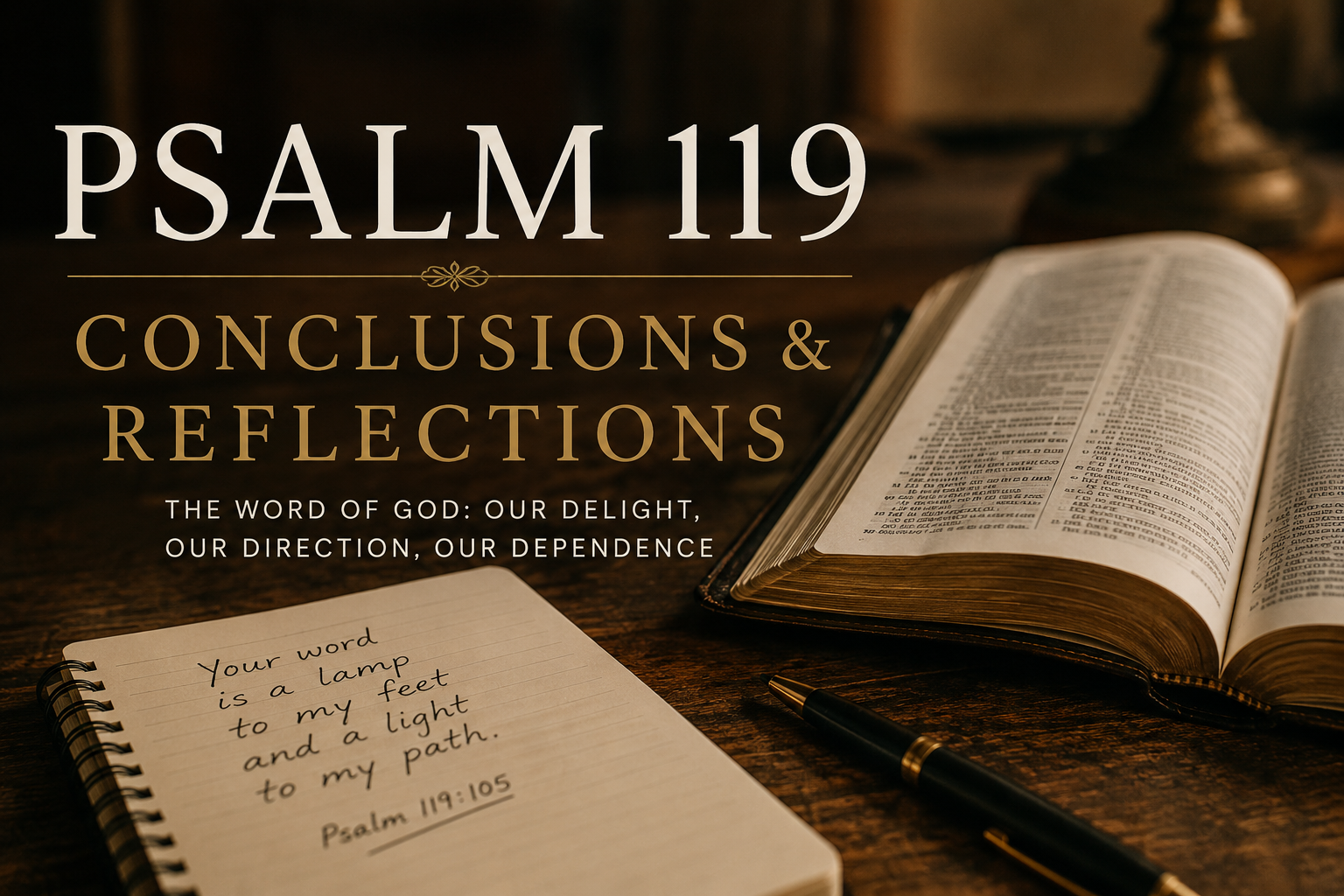
Well, we have now come to the end of our journey through Psalm 119. Twenty-two stanzas. One hundred and seventy-six verses. The longest chapter in the Bible. At first glance, reading through this psalm from beginning to end can feel somewhat repetitive. Yet, if our journey has revealed anything, it is that sustained meditation upon its lines uncovers remarkable depth. Each stanza approaches God’s Word from a distinct perspective, and each verse contributes another facet to the psalm’s rich theological portrait of Scripture. What initially appears repetitive gradually proves to be profoundly complementary, as the psalmist returns again and again to the same central theme with fresh insight and renewed appreciation. After spending the past several years working through this magnificent chapter, I would like to conclude our study by reflecting on some of the primary theological themes and practical lessons that have emerged along the way. While these observations certainly do not exhaust the riches of Psalm 119, they represent some of the truths that have most profoundly shaped my own understanding of God’s Word and its indispensable place in the life of every believer.
Of course, the primary lesson of Psalm 119 is immediately evident, and that is the absolute centrality of God’s Word. Nearly every verse contains some reference to or synonym for divine revelation—law, statutes, precepts, commandments, testimonies, judgments, ordinances, promises, etc. Regardless of what is happening in the psalmist’s life, whether he is rejoicing, suffering, praying, or pleading for deliverance, he continually returns to God’s revelation as the foundation of his faith and the source of his hope. Yet, in doing so, the psalmist reminds us that God’s Word is far more than a collection of sacred information. It is God’s self-revelation, through which He makes Himself known to His people. Through His Word, God instructs, corrects, comforts, warns, and sustains those who belong to Him. Every encounter with God’s Word is ultimately an encounter with the living God who still addresses His covenant people through the Scriptures He has breathed out. In that sense, Psalm 119 is not ultimately a celebration of the Bible as an end in itself, but of the God who graciously reveals Himself through His Word. The psalmist delights in Scripture because, through it, he encounters the living God.
Closely related to the centrality of God’s Word is another theme that has surfaced repeatedly throughout our study: the covenantal nature of the psalmist’s relationship with God. The Word is never presented as an impersonal code of conduct or a collection of detached religious obligations. Rather, it is the covenant document through which God reveals His character, declares His promises, and defines what covenant faithfulness looks like for His people. To delight in God’s Word, therefore, is to delight in the God who has graciously entered into relationship with His people. This covenantal perspective also explains why the psalm is so thoroughly saturated with prayer. Again and again the psalmist cries, “Teach me,” “Give me understanding,” “Revive me,” “Strengthen me,” and “Sustain me.” These are not the prayers of someone attempting to earn God’s favor through obedience, but of one who already belongs to God and longs to live faithfully within that covenant relationship. His obedience is never portrayed as self-generated moral achievement; it is the grateful response of a servant who desires to know his Lord more fully and to walk in the path that God Himself has graciously revealed. Throughout Psalm 119, studying God’s Word and communing with God are inseparable realities, for the believer encounters the covenant God precisely through the covenant Word He has given.
Another theme that emerged with surprising frequency throughout our study is the reality of affliction. At first glance, many readers approach Psalm 119 expecting a lengthy meditation on the beauty and benefits of God’s Word. While it is certainly that, it is also a psalm written in the midst of suffering. References to enemies, reproach, persecution, oppression, and distress appear again and again, particularly in the latter portions of the psalm. The psalmist is rarely speaking from a position of comfort or ease. More often than not, he is crying out to God in the midst of hardship, pleading for deliverance while clinging to the promises of His Word. This observation is significant because it reveals one of the primary purposes of Scripture in the life of the believer. God’s Word is not merely given to increase our knowledge or deepen our understanding during seasons of peace; it is given to sustain our faith when life is hardest. Again and again, the psalmist finds hope in God’s promises, strength in God’s commandments, and comfort in God’s faithfulness precisely because suffering has stripped away every other source of security. Affliction, rather than diminishing his confidence in God’s Word, drives him back to it with even greater urgency. Psalm 119 therefore reminds us that Scripture is not simply a companion for life’s brightest moments, but an anchor for its darkest ones. It is in the crucible of suffering that the enduring sufficiency of God’s Word is most clearly displayed.
Closely connected to this theme of affliction is another characteristic of Psalm 119 that is often overlooked: its persistent spirit of prayer. Although the psalm is rightly celebrated for its exaltation of God’s Word, it is equally a sustained conversation with the God who gave that Word. Throughout its twenty-two stanzas, the psalmist repeatedly prays, “Teach me,” “Give me understanding,” “Revive me,” “Sustain me,” “Strengthen me,” and “Rescue me.” Nearly every meditation upon God’s revelation naturally gives rise to another petition for God’s gracious work in his life. This reminds us of an important spiritual truth. Knowledge of Scripture is never intended to produce self-sufficiency. Rather, it cultivates ever-deepening dependence upon God. The more clearly the psalmist understands God’s holiness, the more aware he becomes of his own weakness. The more he delights in God’s commandments, the more earnestly he prays for grace to obey them. The more he meditates upon God’s promises, the more confidently he casts himself upon God’s faithfulness. In this way, Scripture and prayer are inseparable companions. God’s Word reveals His will, while prayer expresses our continual dependence upon His power to accomplish it. Far from fostering spiritual independence, Psalm 119 teaches us that genuine maturity is marked by an ever-growing reliance upon the God who speaks through His Word and graciously enables His people to live according to it.
Perhaps the most compelling feature of Psalm 119 is that the psalmist’s relationship with God’s Word is characterized not merely by obedience, but by delight. Throughout the psalm he repeatedly speaks of loving God’s law, rejoicing in His testimonies, delighting in His commandments, meditating upon His precepts, and treasuring His promises. These are not the words of someone reluctantly fulfilling religious obligations. They are the language of deep affection, revealing a heart that has come to cherish God’s Word as one of life’s greatest treasures. This emphasis offers an important corrective for many Christians today. We often approach Scripture primarily as a duty to perform or a discipline to maintain, measuring success by how consistently we complete our daily reading plans. While faithful discipline certainly has its place, Psalm 119 calls us to something far deeper. The ultimate goal is not simply external conformity to God’s commands, but an inward delight in the God who has spoken. Obedience reaches its fullest expression when it flows from love rather than mere obligation, when God’s Word becomes not simply something we read but something we long for. The psalmist reminds us that genuine spirituality is measured not only by what we know or even by what we do, but by what we love. A heart captivated by God’s Word is ultimately a heart captivated by God Himself.
As we come to the close of Psalm 119, we discover that the psalmist’s final words are not a declaration of victory but a confession of dependence: “I have gone astray like a lost sheep; seek your servant, for I do not forget your commandments” (v. 176). After 176 verses celebrating God’s Word, he does not conclude by boasting in his obedience but by casting himself upon God’s grace. In many ways, this final prayer gathers together every major theme of the psalm. The Word has revealed the covenant God. Affliction has driven the psalmist to His promises. Prayer has expressed continual dependence upon His strength. Delight has cultivated a heart that loves His ways. Yet all of these themes ultimately lead to the recognition that God’s people never outgrow their need for the Shepherd who seeks, sustains, and preserves them. Indeed, the One who perfectly delighted in the Father’s will is also the Good Shepherd who came “to seek and to save the lost.” It is therefore fitting that Psalm 119 ends not with human achievement, but with divine grace. Ultimately, this magnificent psalm teaches us that the goal of God’s Word is not merely that we know His commandments, but that we know and love the God who speaks, trust His promises, delight in His ways, and depend upon His grace until the end.
For further study:
Introduction
Psalm 119.1-8
Psalm 119.9-16
Psalm 119.17-24
Psalm 119.25-32
Psalm 119.33-40
Psalm 119.41-48
Psalm 119.49-56
Psalm 119.57-64
Psalm 119.65-72
Psalm 119.73-80
Psalm 119.81-88
Psalm 119.89-96
Psalm 119.97-104
Psalm 119.105-112
Psalm 119.113-120
Psalm 119.121-128
Psalm 119.129-136
Psalm 119.137-144
Psalm 119.145-152
Psalm 119.153-160
Psalm 119.161-168
Psalm 119.169-176
Share this:


On Psalm 119.169-176 (Taw)
169 Let my cry reach you, Lord;
give me understanding according to your word.
170 Let my plea reach you;
rescue me according to your promise.
171 My lips pour out praise,
for you teach me your statutes.
172 My tongue sings about your promise,
for all your commands are righteous.
173 May your hand be ready to help me,
for I have chosen your precepts.
174 I long for your salvation, Lord,
and your instruction is my delight.
175 Let me live, and I will praise you;
may your judgments help me.
176 I wander like a lost sheep;
seek your servant,
for I do not forget your commands.

Well, we have finally come to the last stanza of Psalm 119 (ת/taw), and it is fitting that our psalmist opens with a prayer. In verses 169–170, he petitions the Lord, “Let my cry reach you, Lord; give me understanding according to your word. Let my plea reach you; rescue me according to your promise.” After nearly 170 verses extolling the beauty, perfection, and life-giving power of God’s Word, he is still asking for understanding. In other words, his extensive knowledge of Holy Scripture has not diminished his dependence upon God. In the language of systematic theology, this truth is often described as the doctrine of illumination. Illumination is the gracious work of the Holy Spirit whereby he enlightens our minds and hearts to understand and receive God’s Word as he intended. (For a more extended discussion of this doctrine, see On Biblical Interpretation and the Holy Spirit.) The point is that a right understanding of Scripture is ultimately a gift of God. It certainly comes through careful study and diligent reflection, but our study must always be accompanied by humble dependence upon the Spirit who inspired the Scriptures in the first place. Throughout Psalm 119, we have repeatedly seen that God’s Word imparts wisdom, yet wisdom comes as God illumines the heart. The mature believer, therefore, never outgrows the need to pray, “Give me understanding according to your word.”
He also prays for deliverance when he says, “Rescue me according to your promise.” Once again, we are reminded that our psalmist continues to face hardship and opposition. Throughout Psalm 119 he has repeatedly cried out for God’s intervention, and here the same prayer rises once more from his lips. Yet what is particularly striking is the basis upon which he asks for deliverance. He does not appeal to his own merit, his own worthiness, or even his own obedience. Rather, he appeals to God’s promise. In other words, his confidence rests not in himself but in God’s covenant faithfulness. Or to put it another way, even after all his devotion to God’s Word, he still depends entirely upon divine grace. As D. Martyn Lloyd-Jones wisely observed, “Everything is of grace in the Christian life from the very beginning to the very end.” Apart from God’s grace we have nothing and are nothing. Even our most faithful obedience must be sustained and empowered by the God who first called us to himself. This is why the promises of Scripture are such a source of comfort for the believer. They remind us that God’s faithfulness does not fluctuate with our circumstances or our performance. Rather, his promises are rooted in his unchanging character. It is these gracious promises that become the foundation of confident prayer, enabling us to approach the throne of grace with boldness because we know that the God who has spoken is always faithful to his Word.
In verses 171–172, our psalmist moves from prayer to praise when he says, “My lips pour out praise, for you teach me your statutes. My tongue sings about your promise, for all your commands are righteous.” Notice here the motivation for his praise: it is that God has taught him his righteous commands and statutes. In other words, the purpose of Holy Scripture is not merely information. Our study of God’s Word should produce praise, obedience, and delight. Or, to put it another way, theology should produce doxology. God’s commands are righteous; therefore, praise is the fitting response. This has been one of the dominant themes throughout Psalm 119. The psalmist has repeatedly reminded us that God’s Word is sweeter than honey, more valuable than gold, a lamp to his feet, and a source of wisdom, comfort, hope, and peace. Yet all of these blessings ultimately direct his attention back to the God who has spoken. Scripture never terminates upon itself. It reveals the character, faithfulness, wisdom, and holiness of the Lord, and as we behold these divine perfections, our hearts are moved to worship. This is why genuine knowledge of God can never remain merely intellectual. The more deeply God’s truth takes root within us, the more naturally praise flows from our lips. If our study of Scripture produces greater knowledge without greater love for God, then we have missed the very purpose for which the Scriptures were given. True biblical understanding always culminates in joyful worship, because the ultimate goal of God’s Word is not simply that we know about him, but that we know him, delight in him, and glorify him with our lives.
In verses 173–174, our psalmist continues this theme of dependence when he prays, “May your hand be ready to help me, for I have chosen your precepts. I long for your salvation, Lord, and your instruction is my delight.” At first glance, these two statements may seem contradictory. On the one hand, he declares that he has chosen God’s precepts. On the other hand, he immediately asks for God’s help. Yet this is precisely the balance that runs throughout the Christian life. Genuine obedience is never independent of divine grace. Our willingness to follow the Lord is itself sustained by his continual presence and power. The psalmist recognizes that choosing God’s ways does not eliminate his need for God’s help; rather, it deepens his awareness of that need. Likewise, his longing for God’s salvation reminds us that he continues to look forward in hope. Though he delights in God’s instruction, he still awaits the full realization of God’s saving purposes. Throughout Psalm 119 we have repeatedly encountered this tension between present obedience and future expectation. God’s Word teaches us how to live faithfully today while at the same time directing our hope toward the salvation that God has promised to complete. The Christian life, therefore, is one of continual dependence upon the Lord, trusting that the God who calls us to walk in his ways is also the God who strengthens us to persevere until his work of redemption is brought to completion.
The final verses of Psalm 119 bring us to one of the most surprising conclusions in all of Scripture. After extolling the beauty, wisdom, and sufficiency of God’s Word for 175 verses, our psalmist concludes with this remarkable confession: “Let me live, and I will praise you;
may your judgments help me. I wander like a lost sheep; seek your servant, for I do not forget your commands.” At first glance, this seems almost out of place. Has not our psalmist repeatedly affirmed his love for God’s law, his delight in God’s commandments, and his commitment to walk in God’s ways? Why, then, does he end by describing himself as a wandering sheep? The answer is that this is not a confession of apostasy but of humble dependence. He recognizes that even the most faithful believer remains vulnerable apart from the preserving grace of God. Yet his wandering is immediately balanced by a profound affirmation: “I do not forget your commands.” Though he stumbles, he still belongs to the Lord. His hope rests not in his own ability to remain faithful but in the God who faithfully seeks and restores his servants. It is difficult to read these words without thinking of the Good Shepherd who came “to seek and to save the lost” (Luke 19.10), or of Jesus’ parable of the shepherd who leaves the ninety-nine sheep to search for the one that has wandered (Luke 15.4–7). Indeed, Isaiah had already declared, “We all went astray like sheep; we all have turned to our own way; and the Lord has punished him for the iniquity of us all” (Isa. 53.6). Thus, the final note of Psalm 119 is not one of self-confidence but of grace. The believer’s security ultimately rests not in the strength of his obedience but in the faithfulness of the Shepherd who continually seeks, preserves, and restores his wandering sheep.
As Psalm 119 draws to a close, we discover that its final emphasis is not human achievement but divine faithfulness. Throughout these twenty-two stanzas, our psalmist has celebrated the beauty, wisdom, sufficiency, and life-giving power of God’s Word. He has endured persecution, wrestled with suffering, delighted in God’s commandments, longed for deliverance, and found peace amid adversity. Yet the final word of the psalm is not self-confidence but humble dependence. Even after a lifetime devoted to God’s Word, he still cries out for understanding, seeks God’s help, and confesses his need for the Shepherd who alone can preserve him. In this way, Psalm 119 reminds us that the purpose of Scripture is never merely to increase our knowledge but to deepen our dependence upon the God who has spoken. The more faithfully we walk according to God’s Word, the more clearly we recognize our continual need for his sustaining grace. It is this gracious God who teaches, strengthens, seeks, and restores his people. And that, perhaps, is the greatest lesson of Psalm 119: the written Word continually directs us to the living God, whose truth, presence, and faithfulness are the sure foundation of the believer’s life.
For further study:
Introduction
Psalm 119.1-8
Psalm 119.9-16
Psalm 119.17-24
Psalm 119.25-32
Psalm 119.33-40
Psalm 119.41-48
Psalm 119.49-56
Psalm 119.57-64
Psalm 119.65-72
Psalm 119.73-80
Psalm 119.81-88
Psalm 119.89-96
Psalm 119.97-104
Psalm 119.105-112
Psalm 119.113-120
Psalm 119.121-128
Psalm 119.129-136
Psalm 119.137-144
Psalm 119.145-152
Psalm 119.153-160
Psalm 119.161-168
Share this:


On Acts and the Isaianic New Exodus: A Book Review

Pao, David W. Acts and the Isaianic New Exodus. Reprint Edition. Eugene, OR: Wipf & Stock, 2016.
Among the books of the New Testament, the book of Acts is arguably one of the most unique. Whereas the Gospels focus primarily on the life and ministry of Jesus and the Epistles provide theological instruction and practical guidance for the Christian life, Acts records the expansion of the early church and the missionary ministry of the Apostle Paul. Consequently, the theological message of Acts is sometimes overshadowed by its historical narrative. Yet beneath its historical narrative lies a rich and carefully constructed theological message, one that is especially evident in Luke’s extensive use of the Old Testament. In Acts and the Isaianic New Exodus, David W. Pao explores this important dimension of Acts by arguing that Luke deliberately presents the mission of Jesus and the early church against the backdrop of Isaiah’s vision of the New Exodus. Originally published as Pao’s doctoral dissertation by Mohr Siebeck in 2000, the work remains one of the most significant studies of Isaiah’s influence on Acts. Therefore, it is the thesis of this review that Acts and the Isaianic New Exodus makes a compelling case for the centrality of Isaiah’s New Exodus motif in Luke’s theology, even if certain aspects of Pao’s argument invite further discussion.
In the book of Isaiah, the “New Exodus” is a way of describing God’s future work of redemption by drawing upon the imagery and language of Israel’s original exodus from Egypt. Just as God once delivered his people from slavery under Pharaoh, so Isaiah portrays God as bringing about a second and greater act of deliverance through the restoration from Babylonian exile. The first exodus thus becomes the typological pattern for God’s future saving work. It is Pao’s central thesis that this Isaianic vision of restoration provides the foundational theological framework for Luke’s understanding of the growth and mission of the early church in the book of Acts. After demonstrating the significance of Isaiah 40:1–11 for Luke’s two-volume work and showing how key Isaianic texts frame the narrative of Acts, Pao identifies four major themes that reveal the influence of the New Exodus motif: the identity of the true people of God as restored Israel, the Word of God as the primary agent of God’s redemptive work, the anti-idolatry polemic as a demonstration of God’s universal sovereignty, and the expansion of Isaiah’s vision to include the salvation of the Gentiles alongside believing Israel. In other words, Pao argues that Luke presents the church not as a departure from Israel’s story but as the fulfillment of Isaiah’s restoration promises, with the mission of the apostles representing the continuation of God’s New Exodus restoration through the risen and exalted Messiah.
The greatest strength of Pao’s work lies in its careful and convincing demonstration that Isaiah provides the conceptual framework through which Luke understands the theological message of Acts. Rather than merely identifying quotations and allusions to Isaiah scattered throughout the narrative, Pao argues that Luke has intentionally structured his theology around Isaiah’s vision of the New Exodus. This approach gives remarkable coherence to the book of Acts by showing that themes such as restoration, mission, the Word of God, the inclusion of the Gentiles, and the identity of the people of God are not isolated theological concerns but interconnected aspects of a single redemptive program. Closely related to this is Pao’s rigorous intertextual methodology. His argument rests not upon superficial verbal parallels but upon sustained literary and theological analysis that demonstrates how Luke appropriates and develops Isaiah’s message. As a result, even readers who remain unconvinced by every aspect of his thesis will gain a much deeper appreciation for the pervasive influence of Isaiah upon Luke’s writing. Particularly valuable is Pao’s treatment of restoration theology. He persuasively demonstrates that the mission of the church should not be understood as a departure from Israel’s story but as the fulfillment of God’s promises to restore his covenant people, promises that now embrace believing Jews and Gentiles alike through the risen Messiah. Finally, Pao’s work serves as an excellent model of canonical interpretation. Rather than reading Acts in isolation, he consistently interprets Luke’s narrative within the larger context of Scripture, thereby illustrating the profound unity of God’s redemptive plan. Whether or not one accepts every detail of Pao’s argument, his study permanently enriches the way one reads the book of Acts and its theological message.
Pao’s work is remarkably persuasive in establishing the significance of Isaiah for the theology of Acts. At the same time, the breadth of his argument gives rise to several questions that invite further discussion. Ironically, one of the book’s greatest strengths—its comprehensive argument for the centrality of Isaiah’s New Exodus—also becomes its primary limitation. At times, Pao’s thesis is so comprehensive that other significant Old Testament trajectories receive comparatively little attention. While Isaiah undoubtedly provides one of the principal theological frameworks for Luke’s theology, greater attention to Luke’s Christology and to the complementary influence of other Old Testament traditions—particularly Daniel’s vision of the Son of Man and the kingdom of God—would have presented an even fuller picture of Luke’s theological vision. Closely related to this is the fact that some of Pao’s proposed intertextual connections are more persuasive than others. In several instances, he moves rather quickly from thematic similarity to literary dependence, leaving readers wishing for a more sustained defense of particular allusions. Finally, because the volume originated as a doctoral dissertation, portions of the discussion are necessarily technical and assume a significant degree of familiarity with contemporary scholarship on Luke-Acts and intertextuality. Nevertheless, these observations should be understood as limitations of emphasis rather than substantive weaknesses. They do little to diminish the enduring value of Pao’s work or its significant contribution to the study of Acts and biblical theology.
Even after more than two decades, Acts and the Isaianic New Exodus continues to stand as one of the most significant contributions to the study of Luke-Acts and biblical theology. Pao convincingly demonstrates that the book of Acts should be read as far more than a historical record of the early church’s expansion; it is a carefully crafted theological narrative that presents the mission of Jesus and his apostles as the fulfillment of Isaiah’s vision of restoration and New Exodus. Although readers may differ with certain aspects of Pao’s thesis or wish that other Old Testament themes received greater attention, these observations do little to diminish the overall value of his work. Indeed, the greatest achievement of this volume is its ability to teach readers to read Acts canonically, recognizing that Luke’s theology is deeply rooted in the Scriptures of Israel and unfolds as the continuation of God’s covenant purposes for his people. For this reason, I would highly recommend this book to pastors, seminary students, scholars, thoughtful Christians who desire a deeper appreciation of the theological richness of Acts. Even readers who ultimately qualify portions of Pao’s argument will find themselves returning to the book of Acts with fresh eyes and a renewed awareness of the profound influence of Isaiah upon Luke’s presentation of the gospel and the mission of the church.
Share this:


On Knowing Jesus through the Old Testament: A Book Review
Wright, Christopher J. H. Knowing God through the Old Testament. Second Edition. Grand Rapids: Intervarsity Press, 2014.
Who was Jesus? How should he be understood? It has become almost a truism among historical Jesus scholars that Jesus must be understood within the context of Second Temple Judaism. He was a man of his own time, and this means that his teachings, actions, and self-understanding must be interpreted against the backdrop of first-century Jewish beliefs and expectations. More specifically, Jesus’s understanding of his own identity and mission was profoundly shaped by Israel’s Scriptures, what Christians know as the Old Testament. Although this observation may seem obvious, its importance is frequently overlooked. There remains a widespread tendency in modern discussions to disconnect Jesus from his Old Testament background, resulting in a portrait of Jesus that is neither historically satisfying nor theologically coherent. In Knowing Jesus through the Old Testament, Christopher J. H. Wright seeks to correct this tendency by situating the person and work of Jesus firmly within the unfolding story of Israel’s Scriptures. First published in 1992 and now available in a revised second edition as of 2014, Wright’s work has become something of a modern classic in biblical theology. Therefore, it is the thesis of this review that Knowing Jesus through the Old Testament succeeds admirably in demonstrating that Jesus’s identity and mission can only be fully understood against the backdrop of Israel’s Scriptures, even if some aspects of Wright’s approach invite further discussion.
Wright’s essential thesis is that Jesus’s understanding of himself and his mission was profoundly shaped by his study of and reflection upon the Old Testament Scriptures. In other words, Jesus repeatedly presents himself as the fulfillment of Israel’s story in ways that demonstrate his unique identity as the Christ, the Son of the living God. Wright develops this thesis by examining the major themes of the Old Testament that converge in the person and work of Jesus. He begins with Israel’s story itself, arguing that Jesus consciously understood his life and ministry as the climax of God’s covenant dealings with his people. From there, Wright explores Jesus’s identity as Israel’s Messiah and Davidic King, showing how the hopes and expectations of the Old Testament find their fulfillment in him. He then turns to the mission of Jesus, demonstrating that Christ’s proclamation of the Kingdom of God, his suffering, death, and resurrection, and his calling of disciples all stand firmly within the trajectory established by Israel’s Scriptures. Throughout the book, Wright carefully weaves together themes such as covenant, kingdom, redemption, mission, and fulfillment in order to show that the Old Testament is not merely a collection of predictions about Jesus but the very theological framework through which Jesus understood his own identity and vocation. The result is a compelling portrait of Jesus that is both historically grounded in first-century Judaism and deeply rooted in the unfolding story of God’s redemptive purposes revealed throughout the Old Testament.
The greatest strength of Wright’s work lies in its thoroughly canonical and biblical-theological approach to the person of Jesus. Rather than treating the Old Testament as a collection of isolated messianic proof texts, Wright demonstrates that Jesus understood himself within the unfolding story of Israel. The significance of Jesus’s identity and mission, therefore, cannot be grasped apart from the covenant, kingdom, promises, and expectations established throughout the Old Testament. This approach not only reflects the way Jesus himself repeatedly interpreted his ministry, but it also provides readers with a richer and more coherent understanding of the unity of Scripture. Closely related to this is Wright’s remarkable ability to integrate historical context, theological reflection, and biblical theology into a single, compelling presentation. He consistently situates Jesus within the world of first-century Judaism while never losing sight of the larger redemptive story that stretches from Genesis to Revelation. As a result, the reader comes away with a portrait of Jesus that is historically grounded without becoming reductionistic and theologically profound without becoming overly speculative. Another significant strength is Wright’s emphasis upon the continuity between Israel, Jesus, and the church. Rather than presenting Christianity as a departure from the Old Testament, he shows that the mission of Jesus represents the fulfillment of God’s covenant purposes for Israel and, through Israel’s Messiah, extends those blessings to the nations. Finally, despite engaging substantial theological themes, Wright writes with exceptional clarity and accessibility. His prose is straightforward, his arguments are well organized, and his illustrations are both helpful and memorable. This makes for easy and enjoyable reading from beginning to end.
Of course, no book is without its limitations, and Knowing Jesus through the Old Testament is no exception. Perhaps the most noticeable weakness is that Wright’s broad biblical-theological synthesis occasionally comes at the expense of detailed exegetical interaction with individual texts. His purpose is clearly to present the larger contours of the Old Testament’s witness to Christ rather than to defend every interpretive conclusion in detail. Nevertheless, readers looking for sustained engagement with particular passages or with competing scholarly interpretations may occasionally find themselves wanting more. Closely related to this is the fact that some themes receive considerably more attention than others. Wright’s discussions of covenant, kingdom, and Israel’s story are among the strongest sections of the book, while other important Old Testament motifs could have been explored in greater depth. Likewise, although Wright consistently situates Jesus within the world of first-century Judaism, greater interaction with developments in Second Temple Judaism would have further strengthened certain aspects of his argument by demonstrating more explicitly how Jesus both fulfilled and challenged the expectations of his contemporaries. Finally, Wright occasionally moves rather quickly from Old Testament themes to their fulfillment in Christ, assuming typological connections that many readers will readily accept but that others may have wished to see defended more fully. Even so, these observations do little to diminish the overall value of the work. They reflect the inevitable limitations of a synthetic volume rather than any significant weakness in Wright’s central thesis.
In the final analysis, Knowing Jesus through the Old Testament is a compelling and important contribution to biblical theology. Wright reminds us that Jesus did not appear in history as the founder of a new religion or as a figure detached from Israel’s past. Rather, he came as the fulfillment of God’s covenant purposes, bringing Israel’s story to its divinely intended climax. By consistently situating Jesus within the theological world of the Old Testament, Wright demonstrates that the Scriptures of Israel are not merely the background to the New Testament but the indispensable foundation for understanding the identity, mission, and message of Jesus Christ. In an age when the Old Testament is too often neglected or treated as merely preparatory to the New Testament, Wright reminds readers that the story of Jesus cannot be separated from the story of Israel, for the latter finds its fulfillment in the former. For this reason, I would readily recommend this book to pastors, seminary students, Bible teachers, and thoughtful Christians who desire a richer understanding of the unity of Scripture and the centrality of Christ within God’s redemptive plan. Though readers may occasionally wish for more detailed exegetical interaction or greater engagement with certain scholarly discussions, these minor limitations do little to diminish the book’s overall contribution. If readers come away from this volume with a renewed appreciation that the Old Testament is essential for understanding the person and work of Jesus Christ, then Wright will have accomplished precisely what he set out to do. Few books succeed so well in helping readers know Jesus by first learning to read him through the Scriptures that he himself loved, studied, and fulfilled.


