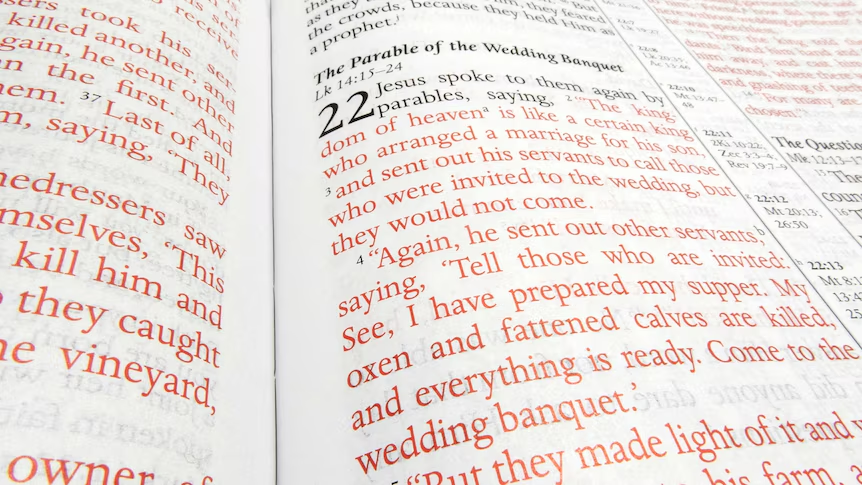
Most English versions of the Bible print the words of Jesus in the Gospels in red letters. It is a tradition that goes back nearly a century. The first red-letter New Testament was published in 1899; the full Bible with a red-letter New Testament was printed two years later in 1901. The reason for this practice is relatively clear, namely to highlight the words of Jesus over against the surrounding narrative and commentary. As noble as this aim is, it can lead to some unhealthy conclusions and applications. Readers might be tempted to conclude that the red letters are more important, more valuable, and more primary than the rest of the New Testament. For example, some so-called “red letter Christians” pit the words of Jesus against the rest of the New Testament and purport to follow the social ethic of Jesus which is characterized by love and compassion rather than the more conservative theology and ethics of the Apostle Paul et al. However, if Jesus is fully God, and there is only one God, and if God inspired the whole Bible, then in a sense all of the words of the Bible, whether black or red, are the words of Jesus.
Of course, this does not mean that the actual content of Jesus’s teaching ministry is unimportant. When it comes to the quest of the historical Jesus, the details of what Jesus said and did are essential for understanding who Jesus was and what he came to do. This is why scholars of the historical Jesus developed criteria of authenticity to determine which sayings in the canonical gospels authentically come from Jesus and which ones do not. Criteria like multiple attestation, dissimilarity, coherence, embarrassment and others like these are used to decide the authenticity of each individual saying or pericope. However, more often than not, these criteria have been used to dismiss more sayings than they have proven. This is most evident in work of the Jesus Seminar and their book The Five Gospels: What did Jesus Really Say? The Search for the Authentic Words of Jesus. Instead of establishing the authentic words of Jesus, they dismissed some 82 % of the sayings attributed to Jesus in the canonical Gospels either as things he definitely did not say (black bead) or as things he did not say but that might be close to his ideas (grey bead). Even sayings that met the established criteria were dismissed as inauthentic. This proves that there was probably another criteria at play in their judgment, that being if a saying evinced a relatively high Christology, then it was not authentic in their view.
More to the point, in my recent book review of Jesus and His Promised Second Coming by Tucker S. Ferda (see here), I suggested that the search for the “authentic” sayings of the historical Jesus in the gospels is a fundamentally flawed endeavor from the outset. This is because the Gospel writers did not set out to record the words of Jesus verbatim (ipsissima verba). They did, however, attempt to convey the words of Jesus by way of summary, thematic arrangement, implication, and interpretation. In other words, they were conveying the essential substance of the words of Jesus as well as it theological significance (ipsissima vox or substantia verba). This is partly because the Gospels are based on traditions that were passed down orally from the time of Jesus until the time the Gospels were composed. Even if the composition of the Gospels is dated early, i.e. in the 40s or 50s CE, then we are talking about 10+ years that have passed from the time Jesus to the time when the sayings of Jesus were written down. The point is that if “authentic” is understood to mean the actual words that Jesus spoke verbatim as he spoke to them, then we are searching for something that will never be found.
On the other hand, we must affirm that the Gospel writers were not simply making things up as they went along, putting words into the mouth of Jesus that he never said or thought. This is sometimes compared to the children’s game of “telephone”, where the first child hears a sentence, and then passes it along to the next child by whispering in their ear, and on to the next and so on. More often than not, when the final child reports the sentence, the final version is a far cry from the original, and usually so horribly garbled as to be beyond recognition. This analogy is a caricature of the actual nature of oral transmission. Not only was the culture at the time of Jesus thoroughly oral, but the Jews in particular took the transmission of oral tradition highly seriously. The Old Testament scriptures commanded them to pass on their faith orally from generation to generation, and Jewish children were trained in this from an early age in the temple and synagogues. The faithful transmission of oral tradition was practically sacrosanct in Jewish culture, and given the recognized authority of Jesus as a rabbi, the gospels writers would never have thought to put their own thoughts and agendas into his mouth. The same could be said for so-called prophetic utterances given by the risen Jesus; these would never have been treated as on par with actual Jesus tradition. As Luke himself indicates in the opening of his Gospel (1:1-4), the Gospel writers were faithfully writing down that which they had also remembered and received.
Now, someone might object, “What about the doctrine of inspiration? Weren’t the Gospel writers inspired by the Holy Spirit and so kept from error?” And I would answer, “Yes! Of course they were!” (2 Tim 3:16-17). But inspiration is not dictation. The Gospel writers were not mindless automatons simply transcribing by rote. Here again, Luke’s introduction indicates that he had done his research, had talked to eyewitnesses, had done the hard work “to write carefully and in order.” In other words, inspiration does not negate the normal processes of research and writing. In inspiration, the Holy Spirit works in, with, and through the human author in such a way that their words are his words. Moreover, the method of inspiration varies according to the genre of the literature being inspired. Clearly, prophetic texts, “thus saith the Lord” were directly inspired speech, but historical narrative, epistles, et al. allow for the creative engagement of the human author with the work of the Holy Spirit. B. B. Warfield puts it this way in The Inspiration and Authority of the Bible,
The Scriptures, in other words, are conceived by the writers of the New Testament as through and through God’s book, in every part expressive of His mind, given through men after a fashion which does no violence to their nature as men, and constitutes the book also men’s book as well as God’s, in every part expressive of the mind of its human authors.
The point of all this is to say that the Gospel writers have faithfully conveyed to us the real and true words of Jesus even if they have not conveyed to us his exact words. So, we should not take individual sayings (or even whole pericopes) out of their narrative context and then dismiss them as wholly inauthentic. This is a fundamentally flawed method of historical and exegetical inquiry. Rather we should attempt to understand how the words and actions of Jesus fit within the context of first century Judaism and how they gave rise to the theology and practice of the early church. As to whether we should continue to print the words of Jesus is red letters, I am of mixed opinion. Further, I suspect that my views on the question will do nothing to unseat standard publishing practice. Nevertheless, we must understand that there is no portion of Holy Scripture that is more authoritative, more valuable, more transformative than any other. Whether we are dealing with the letters of Paul or with the words of Jesus in the Gospels, we are dealing with the Word of God, and it is He who is speaking to us when we read. And so we should ask the Lord to give us the ears to hear and the hearts to receive what the Spirit is saying to us.
21 After these events, Paul resolved by the Spirit to pass through Macedonia and Achaia and go to Jerusalem. “After I’ve been there,” he said, “It is necessary for me to see Rome as well.” 22 After sending to Macedonia two of those who assisted him, Timothy and Erastus, he himself stayed in Asia for a while.
23 About that time there was a major disturbance about the Way. 24 For a person named Demetrius, a silversmith who made silver shrines of Artemis, provided a great deal of business for the craftsmen. 25 When he had assembled them, as well as the workers engaged in this type of business, he said, “Men, you know that our prosperity is derived from this business. 26 You see and hear that not only in Ephesus, but in almost all of Asia, this man Paul has persuaded and misled a considerable number of people by saying that gods made by hand are not gods. 27 Not only do we run a risk that our business may be discredited, but also that the temple of the great goddess Artemis may be despised and her magnificence come to the verge of ruin—the very one all of Asia and the world worship.”
28 When they had heard this, they were filled with rage and began to cry out, “Great is Artemis of the Ephesians!” 29 So the city was filled with confusion, and they rushed all together into the amphitheater, dragging along Gaius and Aristarchus, Macedonians who were Paul’s traveling companions. 30 Although Paul wanted to go in before the people, the disciples did not let him. 31 Even some of the provincial officials of Asia, who were his friends, sent word to him, pleading with him not to venture into the amphitheater. 32 Some were shouting one thing and some another, because the assembly was in confusion, and most of them did not know why they had come together. 33 Some Jews in the crowd gave instructions to Alexander after they pushed him to the front. Motioning with his hand, Alexander wanted to make his defense to the people. 34 But when they recognized that he was a Jew, they all shouted in unison for about two hours, “Great is Artemis of the Ephesians!”
35 When the city clerk had calmed the crowd down, he said, “People of Ephesus! What person is there who doesn’t know that the city of the Ephesians is the temple guardian of the great Artemis, and of the image that fell from heaven? 36 Therefore, since these things are undeniable, you must keep calm and not do anything rash. 37 For you have brought these men here who are not temple robbers or blasphemers of our goddess. 38 So if Demetrius and the craftsmen who are with him have a case against anyone, the courts are in session, and there are proconsuls. Let them bring charges against one another. 39 But if you seek anything further, it must be decided in a legal assembly. 40 In fact, we run a risk of being charged with rioting for what happened today, since there is no justification that we can give as a reason for this disturbance.” 41 After saying this, he dismissed the assembly.
~Acts 19.21-41
Title: On the Priorities of the Gospel Text: Acts 19.21-41 Series: The Book of Acts Church: Redeemer Baptist Church, Jonesboro, AR Date: October 20, 2024
129 Your decrees are wondrous; therefore I obey them. 130 The revelation of your words brings light and gives understanding to the inexperienced. 131 I open my mouth and pant because I long for your commands. 132 Turn to me and be gracious to me, as is your practice toward those who love your name. 133 Make my steps steady through your promise; don’t let any sin dominate me. 134 Redeem me from human oppression, and I will keep your precepts. 135 Make your face shine on your servant, and teach me your statutes. 136 My eyes pour out streams of tears because people do not follow your instruction.
The next stanza of the acrostic begins with the letter פ/pe (pronounced like pay), and at this point, it would be tempting to think that our psalmist is beginning to be a little repetitive. After all, hasn’t he said what he needed to say in the first 130 verses of this Psalm? But no, there are five more stanzas after this one containing some 40 more verses. Let’s be honest with ourselves, the sheer length of this chapter is intimidating, especially in a culture that prefers 240 character soundbites. We have lost the capacity for sustained reflection; we simply have no taste for prolonged meditation on the scriptures. And as Christians, this is much to our shame. The Bible invites us into the life of the mind, to the disciplines of reading, study, and meditation. We must read and reread, we must ponder and linger over the scriptures, if we truly desire to be transformed by them. A 240 character nugget simply cannot provide the soul sustaining nourishment our life in Christ requires. It is clear that our psalmist has learned what it means to linger over the Word of God, to nourish himself on its inexhaustible depths. This psalm, 22 stanzas, 176 verses, is an invitation to linger, to pause, to meander slowly in the perfections of God’s sufficient Word.
Another reason that this psalm intimidates us as modern readers is that not only have we lost the ability to appreciate sustained reflection, but we have also lost the ability to appreciate beauty for the sake beauty. Of course, the psalms are not the only poetry that is found in the Bible, but they do represent a whole collection of hymns, prayers, and songs that speak to the human soul in ways that are unique and distinct from other portions of Holy Scripture. One of these ways is through their beauty. This psalm, in particular, is a masterpiece in poetic form and verse. We should be enraptured by its majesty, caught up in its elegance; it should capture our soul’s imagination and transport us to the pristine presence of God himself. In a world that is filled with ugliness and horrors and the sheer grossness of sin, we desperately need to reminded of what is beautiful, what is praiseworthy, what is lovely, what is good and righteous and true (Philippians 4.8). As our psalmist himself writes, “The revelation of your words brings light and gives understanding to the inexperienced.” (Verse 130) Interestingly enough, that last word could also be translated as “thoughtless”.
Speaking of beauty, there are two lines that stand out to me in this stanza; the first is verse 132, which reads, “Turn to me and be gracious to me, as is your practice toward those who love your name.” Here again, in a psalm where almost every line contains some synonym for God’s Word, this verse stands out from the pattern, although “those who love your name” could be taken as a loose reference to obeying God’s Word. In the Old Testament, and in Deuteronomy in particularly, love of God is synonymous with obedience. After all, Jesus himself said, “If you love me, you will keep my commands.” (John 14.15) But we must be clear in affirming that this verse does not condition our reception of God’s grace upon our obedience. Love for God is much more than simply obedience; it is obedience that grows out of the soil of faith. Obedience apart from faith is nothing more than dead works. Faith in the ground of obedience resulting in our love for God. And grace is simply God’s response to those that come to Him in genuine repentance and faith.
The second verse that stands out is verse 136, which reads, “My eyes pour out streams of tears because people do not follow your instruction.” In other words, the disobedience and sin around him causes our psalmist great and deep mourning. Of course, we have seen similar sentiments throughout the psalm, and just a couple of stanzas back, our psalmist confessed his hate for the double-minded (verse 113), a statement that is somewhat startling to modern sensibilities. (For more on this verse, see my post here.) But here, we see that this hate is not malicious or malevolent in any way; rather, it issues forth in tears of sorrow and genuine grief. We live in a culture of outrage; in fact, there was a book recently published by Ed Stetzer entitled Christians in the Age of Outrage. When we are faced with the sin and disobedience of this world, it is easier to scoff, to respond in anger and outrage, but we should respond in mourning, in deep grief and sorrow over the corruption of God’s good creation, over the enslavement of human beings made in the image of God to the world, the flesh, and the devil. Our psalmist loves the Word of God so much; he is convicted by the goodness and righteousness of God’s ways so deeply that the disobedience of his fellow human being drives him to real grief.
But, of course, we have seen that our psalmist’s tears are not the end of the story; no, he is looking forward to a day when God will judge the living and the dead, when he will establish his righteousness on the earth forever, when God’s people will be perfected in holiness. This is the hope; this is the silver lining. This is the light at the end of the darkness. It is the grace of redemption. As our psalmist prays, “Redeem me from human oppressionand I will keep your precepts (verse 134), or again, “Make your face shine on your servant, and teach me your statutes (verse 135). Even when we are confronted with the total depravity of the world we live in, we can maintain our hope, because God has promised to right every wrong, to heal every wound, to deliver and vindicate his people. We stand firm in this promise by faith, even as our dear psalmist did so many centuries ago.
It has been said on more than one occasion that “A text without a context is a pretext for a prooftext.” The point is that faithful bible reading must take the historical and literary context of the text into consideration. God spoke through real people living real lives with real questions, and in order to understand His Word, we must read it on its own terms, that is to say we must seek to understand it as it would have been understood by its intended audience. We must put ourselves into their shoes, so to speak, and look at things through their eyes. Then, and only then, will we be able to draw the parallel applications that transform our own lives. However, in the academic study of the New Testament, historical reconstructions of the life and times of the biblical audience can sometimes feel overly speculative and somewhat disconnected from the actual text. This is why, no matter how sophisticated our historical reconstruction may be, we must ask the question, “How does this help me to understand the text better?,” because at the end of the day, biblical studies is an irreducibly textual endeavor.
I recently had this point reiterated to me by a brother who is preparing to teach Paul’s Letter to the Galatians in our adult Sunday school class. Of course, the basic situation in Galatians is pretty straightforward. The newly converted Gentile Christians in Galatia are facing social and theological pressure from a group of Jewish “Christians” to be circumcised, so that they can truly be part of God’s (Jewish) people. This is a position that the Apostle Paul simply will not countenance under any circumstances; in fact, he condemns it outright in some of the harshest language in all of the New Testament. “As we have said before, I now say again: If anyone is preaching to you a gospel contrary to what you received, a curse be on him!” (1.9) Of course, Paul goes on in the letter to give historical and theological arguments against the position in question in chapters 3-4, and then he uses chapters 5-6 to emphasize those virtues and habits of character that truly distinguish someone as belonging to the people of God. In other words, the message of the letter is pretty clear.
However, we must ask whether or not this is all way can say about the situation in Galatians, particularly as this relates to chapters 1-2 and their relationship with the events in Acts 9-15. In these first two chapters, Paul gives a brief history of his own salvation and his relationship with the Jerusalem church; his point is that his gospel is not based on the traditions of men, but on the supernatural revelation of God himself in the person of Christ on the Damascus road. But the correspondence between Paul’s testimony and the events in Acts is less than clear to say the least. Of course, there are some that would say that the two are inherently incompatible, and to attempt any kind of combined reconstruction is hopeless and probably not even necessary. But for those of us who hold convictions regarding the inerrancy of the Scriptures, this is simply not an option. We must ask questions regarding the text’s larger coherence with the New Testament witness, especially when that text addresses events that are recorded by another author. For example, is the Jerusalem visit that Paul mentions in 2.1-10 to be understood as corresponding his visit at the Jerusalem council as it is recorded in Acts 15, or is it the famine visit that is mentioned in Acts 11? Who are these “men from James” (2.12), and what is the purpose of their visit in Antioch? Are they part of the circumcision party? Why would Peter withdraw from table fellowship from the Gentile Christians after his transformative experience with Cornelius (Acts 10)? And the list could go on.
I don’t have the answers to all of these questions, but in the space that follows, I would like to suggest a brief timeline that attempts to reconcile Galatians 1-2 with the events of Acts 9-15. In academic scholarship, this position is known as the Southern Galatia Theory, and it is associated with names such as F.F. Bruce and Richard Longenecker, to name but a few. In general, this theory posits that the Letter to the Galatians was written around 47-48 AD to the churches that Paul started during his first missionary journey (Acts 13-14) in the southern region of the Roman province of Galatia. The alternative view, known as the Northern Galatia Theory, argues that the Letter to the Galatians was written around 56-57 AD from Ephesus to ethnic Galatians in the north, the former kingdom of Galatia. Due to space considerations, I will not lay out this opposing theory in detail.
The timeline for the Southern Galatia Theory flows as follows: AD 34 – Conversion of Paul (Galatians 1.13-16, Acts 9.1-19), AD 34-37 – Paul in Arabia and Damascus (Galatians 1.17, Acts 9.19-22, 27), AD 37 – Paul visits Jerusalem after three years (Galatians 1.18-20, Acts 9.26-29), AD 37-47 – Paul in Syria and Cilicia (Galatians 1.21-24, Acts 9:30-31), AD 47 – Paul visits Jerusalem after 14 years (Famine Visit) (Galatians 2:1-10, Acts 11.27-30), AD 47-48 – Paul’s first missionary journey (Acts 13:1-14:28), AD 48 – Peter visits Antioch and confronts Peter (Galatians 2:11-14), AD 48 – Paul writes the Letter to the Galatians, AD 49 – Paul speaks at the Jerusalem Council (Acts 15.1-29), AD 49-51 – Paul visits the Galatian churches on his second missionary journey (Acts 16-18), AD 52-57 – Paul’s visits the Galatian churches on his third missionary journey (Acts 19-21).
This theory seems to be the most widely accepted in New Testament scholarship today, but we must return to the initial question of this post, namely, “how does this help me to understand the text better?” Again, this is the fundamental question; no matter how insightful and innovative our reconstruction may be, if it does not shed greater light on the meaning of the text, then it is nothing more than pointless speculation. In particular, I think the early date offered by this theory helps explain the actions of James and Peter in chapter 2. At this point in the history of the early church, the inclusion of the Gentiles was still a relatively new phenomenon. The details were still being worked out in the lives of real people on the frontlines of the church’s ministry. So, yes, even after Peter’s incredible experience with Cornelius, it is still possible for him to waiver under the social pressures of the circumcision party. Perhaps he thought his actions in Antioch would somehow hinder the evangelistic effort among the Jews in Jerusalem.
Moreover, it explains the apparent hesitancy of James and his representatives. Of course, James will go on to give the final argument against the requirement of circumcision at the Jerusalem Council, and he will write the apostolic letter detailing the council’s decision (Acts 15.23-29). But, perhaps at this moment, before the council, he was still considering the question. We don’t know, and we may never know. But for any theory to be considered probable, it must explain the evidence better than all the other possible explanations, and I believe that the Southern Galatia Theory does just that. Moreover, it shows us that the authors of Scripture were real fallible human beings. James, Peter, Paul – they were just ordinary men who God chose to use in extraordinary ways. They didn’t get everything right all the time, but they were “men [who] spoke from God as they were carried along by the Holy Spirit” (2 Peter 1.21), and in so doing, the produced the inerrant words of Holy Scripture. Thanks be to God for His incredible grace!
One of the most important advances in Biblical Studies in the last 100 years has clearly been the discovery of the Dead Sea Scrolls. Thanks to the curiosity of a young Bedouin shepherd, the first scrolls were discovered at Qumran in 1947. Over the next ten years, hundreds of papyrus fragments were found in some eleven caves in the area containing various biblical and extra biblical writings dating from 200 BCE to 100 CE. The general consensus has been that these represent the religious views of a sect of early Judaism known as the Essenes, known previously only through the writings of Josephus. Over the past 50 years, the study of these scrolls has provided valuable insight in the religious thought world of Jesus, Paul, and the first Christians, and comparative studies are now basically the norm in New Testament monographs and the other academic publications.
In this post, I am not interested in the content of the Dead Sea Scrolls, as fascinating as the material may be; I am more interested in the textual transmission of the scrolls, particularly as that might be compared to the textual transmission of the biblical text. It is truly a wonder of God’s providence that the Dead Sea Scrolls were preserved they way that they were. They were likely buried in the caves prior to the Jewish War (66-70 CE), and then subsequently abandoned when the Essene community was destroyed by the Romans. Thanks to the arid and dry climate of the area around the Dead Sea, these scrolls were preserved in glass jars for over 2000 years. However, they do show the signs of their age. They mostly consist of fragmentary pieces, and even the larger documents are missing significant parts due to decay (see the picture above, for one example). This means that translating the scrolls into English for modern study is mostly piecemeal at best. Large portions of the text must be reconstructed through textual emendation and scholarly conjecture, in order to make the text readable and understandable.
For example, one paragraph from The Temple Scroll (11QT) reads,
On the fifteenth day of the month …[the corresponding] grain offering [and drink offering, all on] the altar, an offering by fire, of s[oothing odour to YHWH. On] the second [day:] twelve young bulls, [two rams, four]teen [lambs] and on he-goat [for a sin offerin]g [and the corresponding gr]ai[n-offering and drink-offering] according to the statue concerning the young bulls, the ram[s], the lambs [and] the he-goat; it is an offering by fire, of soothing odour to YHWH.
The braketed text in the quote above indicates where the text has been conjecturally emended and filled in by the translator. The point is that as valuable as the scrolls are, the condition of the text is partial, fragmentary, and dependent on scholarly interpretation and emendation.
By contrast, the textual tradition of the biblical text is far more substantial and stable. The earliest portions of the New Testament that are extant today can be dated to within in a century of the actual writing of the documents themselves, and the earliest complete manuscripts that we have today are removed by only 2 or 3 centuries from the time of the New Testament. Further, we have over 5000 extant manuscript witnesses to the text of the Bible, in addition to ancient versions, liturgies, and quotations in the church fathers. The point is that through the discipline of text criticism (see my post here), we can reconstruct the text of scripture with 99% accuracy, and any questions that do remain are mostly of peripheral concerns and have no bearing on the actual meaning of the text. Unlike the Dead Sea Scrolls, the biblical text is not fragmentary and dependent on emendation; no, it is stable, clear, and firm in it is manuscript foundations.
This then is an even greater wonder of God’s providence as he has preserved His Word throughout the centuries. He has graciously and providentially watched over His Word, and He has not left himself without a witness. This should give us a great amount of confidence and faith in the textual foundations of our faith. The text of the Bible has been preserved and passed down by God’s providence through the ages, so that we might have reliable witness to His revelation of Himself in Christ. Where would we be if the text of the Bible had been hidden in desert caves for over 2000 years? I shudder to think of the possibilities. When we read the Bible, we should give great thanks that God has not left us as blind to grope in the darkness hoping we might find Him. No, he has spoken clearly, firmly, and faithfully, so that we might know Him even as we are known. Thanks be to God!
For further study, see: Geza Vermes, trans. The Complete Dead Sea Scrolls in English. Revised Edition. London: Penguin Books, 2011.
113 I hate those who are double-minded, but I love your instruction. 114 You are my shelter and my shield; I put my hope in your word. 115 Depart from me, you evil ones, so that I may obey my God’s commands. 116 Sustain me as you promised, and I will live; do not let me be ashamed of my hope. 117 Sustain me so that I can be safe and always be concerned about your statutes. 118 You reject all who stray from your statutes, for their deceit is a lie. 119 You remove all the wicked on earth as if they were dross from metal; therefore, I love your decrees. 120 I tremble in awe of you; I fear your judgments.
The fifteenth stanza of Psalm 119 begins with the Hebrew letter ס/samek, and in this stanza, we read some lines that are quite startling to our modern sensibilities. Right out of the gate, we read, “I hate those who are double-minded” (Verse 113), and a couple of verses later, we read, “Depart from me, you evil ones” (Verse 115). Again, to our moderns ears, these lines seem unduly harsh. But I think we have to look at where our psalmist ends in verse 120, “I tremble in awe of you; I fear your judgments”; in the King’s English, the line reads, “My flesh trembleth for fear of thee; and I am afraid of thy judgments” (KJV). The word for “tremble” here only occurs in the Hebrew Bible in one other place, that being Job 4:15, and the context there clearly implies trepidation (see Job 4:13-15). So likewise, here the word implies that our psalmist is feeling fear, healthy trepidation, a holy terror, at the authority of God and His Word. And it is this fear, this holy terror, that drives him to pursue obedience and submission to the Word of God.
Likewise, it is this intense sense of fear and respect, of submission and devotion to the Word of the one true and living God, that motivates our psalmist’s statements regarding the wicked. Our psalmist understands that God rejects all who stray from His statutes (verse 118) and that He removes all the wicked on the earth (verse 119). So, in verse 115, he says, “Depart from me, you evil ones so that I may obey my God’s commands.” He doesn’t want anything, or anyone for that matter, to prevent him from obeying the laws and statutes of God. I will say more about his obedience in a moment, but suffice it say here that he is so devoted to God and to His word, that he “hates” those who are “double-minded.” The NET Bible renders the line this way, “I hate people with divided loyalties.” The word in question refers to those who are split in their allegiances, those who are two faced or hypocritical in their intentions. They are those who say one thing and yet do another; their verbal confession and their actual behavior are not consistent. “Their deceit is a lie.” (Verse 118). They lack integrity, and in the face of the authority and gravity of God and His word, this kind of attitude is wholly unthinkable for our psalmist.
However, it is imperative that we understand that our psalmists submission to God and His word is not simply motivated by fear of punishment. On the contrary, it comes from a place of deep conviction and faith regarding the goodness of God and His commands. His commands are not burdensome; they are not dull drudgery meant to keep us from enjoying the pleasures of life. No, they are the only path that leads to ultimate fulfillment and genuine human flourishing. This is why our psalmist writes, “You are my shelter and my shield; I put my hope in your word.” It is also why he says, “I love your instruction.” (Verse 113). There is nothing that is more delightful, nothing that is more empowering, nothing that is more fulfilling for our psalmist than obeying the Word of God. By committing himself to God and to keeping His word, he has entrusted his entire self to the goodness and grace of the law-giving God. His obedience is nor forced; it is not against his will. No, his entire will is submitted to the one before whom he stands in awe.
He expresses his faith further when he prays, “Sustain me as you promised, and I will live; do not let me be ashamed of my hope. Sustain me so that I can be safe and always be concerned about your statutes.” (Verse 116-117). It is interesting, though, that this would be his prayer. He has already committed himself to obey God Word. Why, then, would he need to ask God to sustain him? I think there are two reasons. First, he is asking God to sustain him in his obedience. Our psalmist is not naive; he knows the power of temptation, he knows the weakness of his own heart. He knows how easily and how quickly he would abandon his obedience if he were left to himself. So he prays that God would sustain him in his obedience. But secondly, I think he prays for God’s sustaining power because he understands that obedience before God cannot be motivated purely by what we might get out of it. We don’t obey God, so that he will in turn bless us. This tit for tat reckoning is in many ways alien to the economy of God. Our psalmist understands that we obey God because it is right in and of itself to do so; we obey God because that is what we owe Him as creatures. But, as creatures, we are completely dependent upon his sustaining grace every moment of every day for every need that we have. Without Him, we can do nothing. So he prays, “O God, sustain me.”
Sadly, for many Christians in the world today, this attitude of holy terror coupled with desperate faith is somewhat of an oxymoron. On the one hand, we have domesticated God and diminished his authority in our lives to the extent that we treat Him like an elderly grandparent who might give us a piece of candy if we behave, and on the other, we are so self-reliant and comfortable that we have forgotten just how weak and needy we truly are. In this light then, the attitude of our psalmist in this stanza is both a rebuke and an invitation. It is a rebuke of our selfishness and pride, and it is an invitation to rediscover the greatness and the grace of the God that we serve. As C.S. Lewis puts it, “‘Course he isn’t safe. But he’s good. He’s the King, I tell you.”
105 Your word is a lamp for my feet and a light on my path. 106 I have solemnly sworn to keep your righteous judgments. 107 I am severely afflicted; Lord, give me life according to your word. 108 Lord, please accept my freewill offerings of praise, and teach me your judgments. 109 My life is constantly in danger, yet I do not forget your instruction. 110 The wicked have set a trap for me, but I have not wandered from your precepts. 111 I have your decrees as a heritage forever; indeed, they are the joy of my heart. 112 I am resolved to obey your statutes to the very end.
The fourteenth stanza of Psalm 119 starts with the letter נ (nun/pronounced like noon). Yes, that is right; the fourteenth stanza out of twenty-two. Remember, Psalm 119 is an acrostic psalm in which every stanza starts with the next letter of the Hebrew alphabet. It truly is a wonder of our psalmist could write 22 stanzas, 186 verses, extolling the perfections of God’s Word. There is no repetition, no redundancies; no, every stanza addresses some new or different aspect of God’s Law than the one before. His heart was clearly enamored – no, that’s not right – it was consumed with love, affection, devotion for the precepts of God. They were his very life, the only nourishment that could satisfy the pangs of his soul. This attitude should challenge and convict us. Modern Christians struggle to devote 15 minutes of their day to reading the bible; I know, because I am one of them. Why do our souls not hunger and thirst for the nourishment, the soul satisfying pleasures of the Word of God? This is the question that Psalm 119 is asking us.
In this stanza, our psalmist begins with those famous words, “Thy word is a lamp unto my feet, and a light unto my path” (verse 105, KJV). If you were raised in church like I was, then you probably just sang the lyrics to yourself. The fact that someone set these words to music captures the right sentiment, I think. The Psalms were originally prayers and songs that were meant for Israel’s corporate worship, so in singing them, we are no doubt emulating the practice of our psalmist. However, the connection between song and lyric and the affections of the heart is one that is often so underappreciated in modern worship services. Music has a way of touching us, of forming us, in the most vulnerable recesses of our hearts. What we sing, what we shout, these are the things that are planted in the memory of our hearts. This is why we should sing songs that are biblically faithful. As our psalmist goes on to write here, “I have solemnly sworn to keep your righteous judgments.” (verse 106). He is clear in these verses that his greatest affection, his first and foremost guiding principle for life, is the revelation of God in his Word.
And it would appear that he is in particular need of this guidance, as he goes on to write, “I am severely afflicted” (verses 107), and again, “My life is constantly in danger” (verse 109). And in the next verse, “The wicked have set a trap for me” (verse 110). Of course, we do not know the nature of this particular psalmists troubles; we have no narrative of his life to appeal to for background information. But it would appear that he is deeply troubled; he is facing some kind of opposition, some kind of persecution or threat, possibly even up to and including his very life. There are several occasions in the Book of Psalms where David faces similar circumstances, so we may reasonably infer that this was no light or temporary concern for our psalmist. And yet, in the midst of this trail, he continues to affirm his allegiance to the commands and ordinances of God. “I do not forget your instruction” (verse 109); “I have not wandered from your precepts” (verse 110). In fact, he goes on to say in the last verse of the stanza, “I am resolved to obey your statutes to the very end” (verse 112). Here again, we don’t know if the persecution he was facing was directly caused by his commitment to the God and His Word, but we do know that he was resolved, committed, and steadfast in keeping that Word until the very end, no matter what opposition he may face.
Where does a person find this kind of strength, this kind of steadfast loyalty to keeping the Word of God? I think we have our psalmists answer in verse 111, “I have your decrees as a heritage forever; indeed, they are the joy of my heart.” The word “heritage,” or perhaps “possession,” implies the idea of an inheritance; it is a surety of future prosperity. It is the reward that awaits the firstborn. And for our psalmist, the inheritance that he is anticipating is nothing less than the promises of the Word of God. It is the words of Lord Jesus, when he says, “Well done good and faithful servant, enter into the joy of your master.” It is a certainty, a sure and firm hope, of future glories, even in the midst of present difficulties and hardships. The Word of God is our hope, and it is the joy of our hearts. Hope and joy; two out of three of the great triad of Christian virtues. These are the defining characteristics of those who trust in God’s word – unshakable hope, indomitable joy. Clearly, our psalmist had these in his heart, and no matter what troubles or heartaches may come, he was able to persevere because of he found his hope and his joy in the abiding Words of the living God.
This stanza, nay this entire psalm for that matter, is a wonder to me. It challenges and convicts my soul in ways that I am still trying to define even after writing on these first fourteen stanzas. I wonder why God would put a psalm like this one in the Bible; it seems somewhat self-congratulatory – 186 verses on the soul satisfying perfections of His own Word. But perhaps, he put it here because he know that in it he has provided the salve for every every need of the human heart. So often, we look for our comfort, our peace, our security, our hop, our joy in all the wrong places. This is sin. But if we could learn to emulate the attitude and affections of our psalmist, if we would truly begin to hide his Word in our hearts, then we might be able say with the psalmist, “I have not wandered from your precepts.” In His goodness, God has provided the solution to every problem, the cure for every heartache, the peace and comfort for every trial. It is Him, God himself; He is the only one who can answer the deepest longings of our souls. And he has done this in His Word. May we learn to emulate the conviction of our psalmist and find our peace, our hope, and our comfort in His Word.
In a frequently repeated statement, Ernst Käsemann famously said that “Apocalyptic was the mother of all Christian theology.” Not as well-known is that two years later, Käsemann clarified what he actually meant by “apocalyptic”: for him, it referred to “eschatology,” or in his words, “the expectation of an imminent Parousia.” Personally, I would define apocalyptic eschatology a bit more broadly. Apocalyptic eschatology is the belief that this present age is irredeemably corrupted by sin, that God is coming to intervene in a final judgment on the wicked, and that at that time he will vindicate the righteous and deliver them into a new of age of eschatological salvation that is both personal in the sense of resurrection and cosmic in the sense of renewal. The question remains, however, as to how this perspective might rightly be considered to be the “mother of all Christian theology,” and in the space that remains, I would simply like to offer a few brief explanations for this claim.
First, apocalyptic eschatology revolves around the final, climactic visitation of God to the earth. In the Old Testament, this visitation was often referred to as “the Day of the Lord.” In fact, there were many “days of the Lord” in the Old Testament, all of which function as typological portends of the final Day of the Lord when God comes in eschatological glory and power. Christian theology believes that this final Day of the Lord began when God came to earth in the incarnate Lord Jesus Christ. He was to be called Emmanuel, which is translated “God with us.” (Matthew 1.23). And the Lord Jesus himself said of Jerusalem, “you did not recognize the time when God visited you.” (Luke 19.44) This is exactly the point, namely that the coming of Christ in his incarnation was the beginning of the apocalyptic visitation of God to the earth. Of course, we know that He is coming again in glory and power to bring to consummation that which he began in His first coming, but the point here is that in Christ, God himself came in climactic apocalyptic visitation.
And this brings me to the second reason why apocalyptic eschatology is the mother of all Christian theology, namely that the first coming of Christ to the earth as a baby in a manger marked the beginning of the end of this corrupt present age. In New Testament theology, this is commonly referred to as the already and the not yet, namely that God’s plan for the final redemption of his people has already begun in Christ but it is not yet complete. Consequently, we live in this in between time of already and not yet, already saved, already filled with the eschatological spirit, already living under the blessings of God’s eschatological salvation in part, but we await the time when Christ will come again to consummate, or to bring to completion, that which he began by his death, resurrection and ascension. This is why Peter, in his Pentecost sermon, can say, “And it will be in the last days, says God, that I will pour out my Spirit on all people.” (Acts 2.17). The underlined phrase marks a change that Peter has applied to his source text (Joel 2.28), which simply says, “After this.” Peter understood that in Christ the last days had begun, and we have been living “in the [apocalyptic] last days” now for 2000 years.
But what about the final judgment of the wicked? Isn’t this something that is still yet future? How can we say that the apocalyptic judgment of the wicked began in Christ at his first coming? The answer is that this is exactly what we must say, as Jesus says in John 12.31-32, “Now is the judgment of this world. Now the ruler of this world will be cast out. As for me, if I am lifted up from the earth I will draw all people to myself.” The verb here, “lift up”, means to lift up on high, to exalt, or to raise to dignity and honor. This is why it is so ironic that John goes on to add the explanatory note, “He said this to indicate what kind of death he was about to die.” (John 12.33) The death of Jesus on the cross is nothing less than his enthronement. By his death, he judges the wickedness of this world and its ruler; He exposes the sinfulness and the ultimate fate of those that would reject him. This is why we can say that the final judgment began in Jesus, because a person’s response to the crucified and risen Christ will determine their eternal fate. In the death of Christ, judgment has begun, and it will be meted out when “the lamb who was slain,” as the Revelation calls him, returns in glory and power.
Finally, apocalyptic eschatology is the mother of all Christian theology because in Christ eschatological salvation has come. Salvation is inherently and irreducibly an eschatological concept. Saved from what, we might ask? We are saved from the eschatological wrath of God toward sin. And in Christ this salvation has broken into this present age and been made available to all those who respond to Christ in faith. This is why Peter refers to Joel’s prophecy to explain the coming of the Spirit at Pentecost, as we saw above. We have been filled with the eschatological Spirit, the seal and sign of the new age. We are new creatures, the fruit of a new creation, in Christ because of the Spirit. This is why the Apostle Paul can say, “Blessed is the God and Father of our Lord Jesus Christ, who has blessed us with every spiritual blessing in the heavens in Christ.” (Ephesians 1.3) Every spiritual blessing, every blessing of the age to come is already ours in Christ. We have been saved. We are being saved. And we will be saved. Apocalyptic salvation has already begun in Christ, and we are partakers of it by His indwelling Spirit.
So, I agree with the sentiments of Ernst Käsemann as expressed above. Apocalyptic eschatology is the mother of all Christian theology, because in Christ the apocalyptic visitation of God has come. All of the rest of our theology must be derived from this point, that the climactic work of God for the salvation of His people and His world has come in Christ. This is the Gospel; this is the good news of our salvation. In Christ, God himself has broken into this present age to redeem his people from their sin and set us free from its bondage, its corruption, even its very presence. And this is why we can have hope.
97 How I love your instruction! It is my meditation all day long. 98 Your command makes me wiser than my enemies, for it is always with me. 99 I have more insight than all my teachers because your decrees are my meditation. 100 I understand more than the elders because I obey your precepts. 101 I have kept my feet from every evil path to follow your word. 102 I have not turned from your judgments, for you yourself have instructed me. 103 How sweet your word is to my taste— sweeter than honey in my mouth. 104 I gain understanding from your precepts; therefore I hate every false way.
The question of the Law and its relevance for New Testament believers is a question that has boggled the minds of Christians ever since the first disciples. As New Covenent believers, we understand that Christ has fulfilled the Law, and this in every way. No part of the Law has been left unfulfilled by Christ. Paul even says that the Law has been “abolished” in the work of Christ (Eph 2.15). And yet, we also understand that the Law, as part of the Old Testament Scriptures, is profitable and valuable for “training in righteousness.” (2 Tim 3.16) Genuine believers love the Word of God, and they yearn to be transformed by its truths. The Law, however, appears to be so difficult, so out of touch, so unrelated to life in Christ, we naturally wonder what transformative relevance it might still have.
More than that, we are well aware of what the New Testament says about the Law, particularly in the Pauline Epistles. For example, we understand that “the letter [of the Law] kills, but the Spirit gives life” (2 Cor 3.6), and that “[we] are not under the law but under grace.” (Rom 6.14) We all stand condemned by the law, for “it is clear that no one is justified before God by the law.” (Gal 3.11) We have been taught that the purpose of the Law is to expose our failures to live up the righteous standards of God, to convicts us of our sin, and to reveal our need for a savior. In other words, if the Law has a role in the faith of New Testament believers, then it is largely negative, convicting, and condemning.
But this does not seem to be the attitude of our psalmist here in Psalm 119; he views the law positively and with deep adoration and affection. In this stanza, he writes “How I love your instruction” (verse 97), and “How sweet your word is to my taste—sweeter than honey in my mouth.” (verse 103) Of course, we could simply conclude that this psalmist is writing before the advent of Christ, and so perhaps his words are no longer relevant for how we should relate to the Old Testament Law. For Old Testament believers, the Law was the basis for their covenant relationship with God. It was the gift of God’s grace to make them His people and enter into a covenant with them. Clearly, we have something greater. We are under the Law of Christ. (1 Cor 9:21)
But I believe this perspective would fail to do justice to the words of our psalmist. Believers in both the Old and the New Testament are united by the principle of faith; they are a part of us. So, the attitude of our psalmist throughout Psalm 119, but especially here in the mem (מ, pronounced maym) stanza, is particularly instructive for us. We too should learn to love God’s Law, to meditate upon it all day long. We should find in it words of wisdom and life and understanding about the ways of right and wrong as they are determined by the one who gave it. We should read Old Testament books like Leviticus and Deuteronomy, and let them be like sweet honey in the mouths of our soul, because they reveal the one whom our soul loves.
The bottom line is this, that the Old Testament, especially the Law, is good and valuable and profitable and transformative for God’s people of all times. It does not merely convict us and condemn us and reveal to us that we deserve hell and need salvation; it also reveals the character, the virtues, and perfections of the one who is true and pure and holy. We must learn to appreciate these positive aspects of the Law’s role in our lives as Christians, because if we do not, we cut ourselves off from the sustaining and nourishing benefits that come through its pages. No, we are not bound under the covenant mediating authority of the Law; it is not the basis of our relationship with God in Christ by the Spirit. But it is part of God’s revelation of himself, and as such, it continues to have value and relevance for those of who are in Christ, much as the writer of Psalm 119 affirms.
1. Those who are united to Christ and effectually called and regenerated have a new heart and a new spirit created in them through the power of Christ’s death and resurrection. They are also further sanctified, really and personally, through the same power, by his Word and Spirit dwelling in them. The dominion of the whole body of sin is destroyed, and the various evil desires that arise from it are more and more weakened and put to death. At the same time, those called and regenerated are more and more enlivened and strengthened in all saving graces so that they practice true holiness, without which no one will see the Lord.
2. This sanctification extends throughout the whole person, though it is never completed in this life. Some corruption remains in every part. From this arises a continual and irreconcilable war, with the desires of the flesh against the Spirit and the Spirit against the flesh.
3. In this war, the remaining corruption may greatly prevail for a time. Yet through the continual supply of strength from the sanctifying Spirit of Christ, the regenerate part overcomes. So the saints grow in grace, perfecting holiness in the fear of God. They pursue a heavenly life, in gospel obedience to all the commands that Christ as Head and King has given them in his Word.
Series: The 1689 Baptist Confession of Faith Church: Redeemer Baptist Church, Jonesboro, AR Date: February 28, 2024













 Faith seeking Understanding