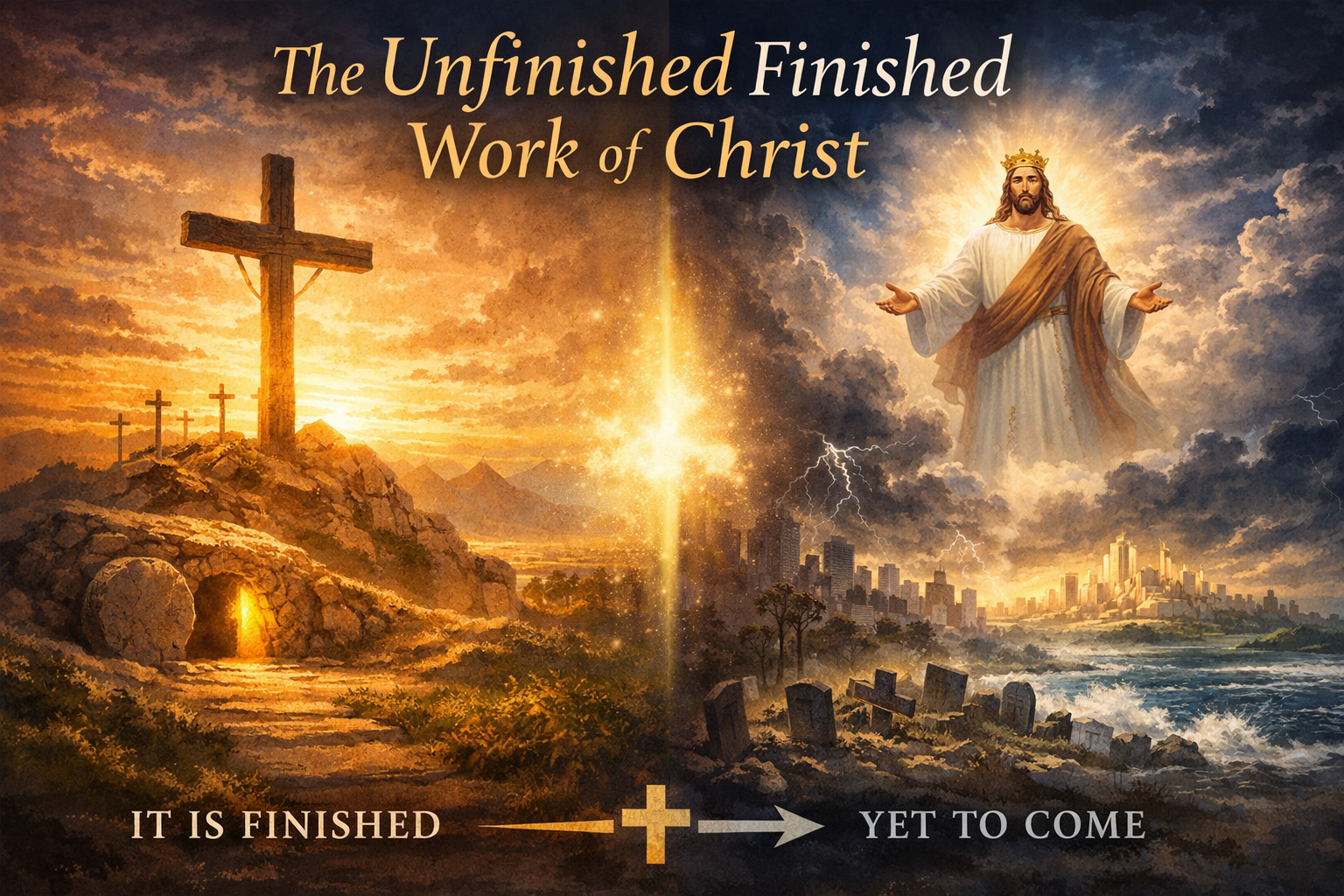
In light of this being the week of our Lord’s passion, it is interesting to note that one of the last things that he said before he gave up his Spirit on the cross was, “It is finished.” (τετέλεσται, John 19.30). With this powerful word, Jesus declared that his work on the cross in making full atonement for sin was completed, and “bowing his head, he gave up his spirit.” It must have been a powerful scene, and no more pregnant words have perhaps ever been spoken. However, the problem is that even though Christ finished his work, sin still seems to run rampant in this world. If it is finished, why, we might ask, is the world still broken, still full of pain and suffering and sin and death? Because of this, we might be tempted to suggest that his work is unfinished. Many Christians struggle to hold together what has already been accomplished and what still remains. However, what we must realize is that Christ’s work is finished; it is fully accomplished in its foundation, but not yet fully realized in its effects. In this post, I would like to consider this tension by offering just a few thoughts on what Christ accomplished in his first coming and what waits to be realized at his second coming.
In one sense, then, it is completely accurate to say that the work of Christ has been fully accomplished, and there are at least three aspects of his work that are completely finished. First, atonement has been accomplished. When Christ died on the cross, he made the full and final payment for our sin. In systematic theology, this is called penal substitutionary atonement. In other words, this means that Christ paid the penalty (penal) that we deserve (substitutionary) for our sin. (On the fact that this was Christ’s view of his death, see here.) He died the death that we deserve by dying in our place. But he did not stay dead; he rose again on the third day. This is the second aspect of Christ’s finished work, namely that victory over death has been secured. When Jesus walked out of the grave on the third day, he defeated death and disarmed Satan of his power. Death no longer has hold over those who are in Christ. We need not fear, we can have hope, even in the face of death. (On hope in the face of death, see here.) And lastly, by dying on the cross, Christ finished his work of establishing righteousness. In other words, his finished work on the cross is now the ground upon which God grants our justification, when we place our faith in Jesus. He lived a perfect life, he died an innocent death. And his righteousness is imputed to us by faith. We are made right, declared innocent, because of Christ’s finished work. This is the gospel. Nothing needs to be added to what Christ accomplished; his work is complete, sufficient, and final. It is not partial, not provisional. It is finished!
Moreover, his finished work on the cross inaugurated several important realities in which we now live. For one, the Kingdom of God has been inaugurated. Forty days after his resurrection, Jesus ascended into heaven to be seated at the right hand of the Father, and he is now reigning with all authority on earth as it is in heaven. (Matt. 28.18) He is not waiting to become King; he is already reigning as King. And he does this by his Spirit. This is the second reality in which we now live, namely that Christ has sent his Spirit to indwell his people. The Spirit mediates Christ’s real presence in and among his people. He is the down payment, the seal, and the guarantee of our faith. And he is actively working in us to make us more like Jesus. And lastly, but certainly not leastly, new life has begun. When we place our faith in Christ, the Spirit regenerates us. He brings to life what was once spiritually dead, and we are born again. In this way we are new creatures in Christ. The old has passed away, and behold the new has come. (2 Cor. 5.17) New creation realities are already at work in us through the Spirit. In these ways, the future has already broken into the present through the risen Christ, and we live in these future realities even now.
And yet, in spite of all of this, several aspects of Christ’s work remain unfinished. Perhaps most clearly, sin still remains in the world. We have been saved from the penalty of sin, but we have not yet been saved from the presence of sin. Our world is saturated and polluted with sin at every turn. People are burdened down with sin and its consequences. Our relationships suffer, bodies are diseased, conflict and turmoil abound at every level of our society. Sin continues its reign of terror nearly unchecked. In addition to this, death still operates in this world. This world reeks with the stench of death; it fills our nostrils everywhere we turn. Our loved ones get sick and die. Accidents and tragedy take lives too soon. Christ has been raised, and death has been defeated. But death still reigns in our mortal bodies, and we ache and groan for that day when death will be no more. Thirdly, the created order groans under the weight of humanity’s sin. When our first parents fell, the creation itself was subjected to futility and decay. The idyllic paradise of Eden was lost to the corruption of sin. And lastly, justice and restoration are yet to be realized. Injustice abounds in our society. From all appearances, the weak get weaker and the strong get stronger. There is no real justice; there is no real peace. Wickedness and evil seem to grow day by day. What is wrong is celebrated as right, and what is right is condemned as wrong. The world is turned upside down, and we long for the day when justice will flow like rivers and when peace will rest upon the earth. And we cry out with the Scriptures, “How long, O Lord? How long?”
In theological parlance, this tension between the finished and the unfinished work of Christ is often referred to by the shorthand phrase “already/not yet”. It simply means that God’s plan of redemption for the world has already begun, has already been inaugurated, but has not yet been fully consummated. The work of Christ’s first coming is finished. He died on the cross, he rose again the third day, he sent his life-giving Spirit. But we are still waiting for the work of his second coming, namely the resurrection of the dead, the final judgment, and the new creation. This is the tension in which we now live, and in this tension, we must avoid two extremes. First, we must avoid living as if nothing has been finished. We must learn to rest in the finished work of Christ. We have been forgiven; we have been indwelled by His Spirit. We can have peace. On the other hand, however, we must not live as if everything is already complete. We do live under the burdens of sin and death; we do long for justice and peace. And we can have hope. The work of Christ is finished in its accomplishment, but it is unfinished in its application to the whole of creation. And so, we wait faithfully as Christ has instructed us.
And this is the point, namely that this tension is not ultimately about stages of fulfillment, though that is certainly the best framework for understanding it. Ultimately, this tension is about Christ. His work is unfinished because his story is not over. (On my argument for the centrality of Christ in our eschatological reflection, see here.) In other words, the same Jesus who said, “It is finished” is the same Jesus who is coming again to make all things new. The same Jesus who died on the cross is the same Jesus who is coming again in glory. Or to put it another way, the second coming of Jesus is not a different work; no, it is the completion of the same work that he began 2000 years ago. The second coming completes what the first coming began, because Christ himself is the fulfillment of all our hopes. Our hope is not just about what Christ has done and will do; it is about Christ himself. It is about his presence. In John 14.3, Jesus promised that he would come again and receive us unto himself, that where he is there we may be also. And so, the unfinished nature of Christ’s work is not a failure of the first coming, but the promise of the second. He is our blessed hope.
And so, yes, we live in the middle of this tension; we live in between the already and the not yet. We are already forgiven, but we are still struggling. We are already alive, yet we are still dying. We are already redeemed, yet we are still waiting. We are waiting to be set free from the presence and the corruption of sin once and for all. This is the lived reality of the Christian life—caught between what has been accomplished and what has not yet been revealed. And I suggest that we must embrace this tension with open arms, because it is only when we embrace this tension that we will be able to hope without denying the pain of our sufferings, that we can be confident without giving into naive triumphalism, and that we can have patience without being paralyzed by despair. If we collapse this tension in either direction, we lose something essential. Either we deny the reality of our present struggle, or we forget the certainty of our future hope. This is the ground that we must stand on, the already and the not yet. We do not live as those waiting for Christ to begin his work, but as those waiting for him to complete it.
When Jesus said, “It is finished.”, he surely meant it. Christ’s work is finished, and yet, it is not yet finished completely. It is finished in its foundation, but it is unfinished in its consummation. We are waiting for the full glory of Christ and his work to be finally revealed on earth. And even in acknowledging the unfinished aspects of Christ work, we must affirm that the work of the cross is not undone; it is unfolding. The resurrection is not isolated; it is expanding. And one day, we will all be raised to meet him in the air, and from that point on, we will always be with the Lord. This is our hope, namely that the Christ who finished his work on the cross is coming again to bring it to final completion. Even so, come quickly, Lord Jesus! Maranatha!
12 The iniquity of Ephraim is bound up; His sin is stored up. 13 The pains of childbirth come upon him; He is not a wise son, For it is not the time that he should delay at the opening of the womb. 14 Shall I ransom them from the power of Sheol? Shall I redeem them from death? O Death, where are your thorns? O Sheol, where is your sting? Compassion will be hidden from My sight.
15 Though he flourishes among the reeds, An east wind will come, The wind of the Lord coming up from the wilderness; And his fountain will become dry And his spring will be dried up; It will plunder his treasury of every precious article. 16 Samaria will be held guilty, For she has rebelled against her God. They will fall by the sword, Their little ones will be dashed in pieces, And their pregnant women will be ripped open.
~Hosea 13.12-16 (NASB95)
Title: On the Curse of Death and the Hope of Resurrection Text: Hosea 13.12-16 Series: Hosea: A Love Story Like No Other Church: Redeemer Baptist Church, Jonesboro, AR Date: July 13, 2025
*Audio begins around two minutes in due to technical difficulties*
TEXT
4 Hear the word of the Lord, people of Israel, for the Lord has a case against the inhabitants of the land: There is no truth, no faithful love, and no knowledge of God in the land! 2 Cursing, lying, murder, stealing, and adultery are rampant; one act of bloodshed follows another. 3 For this reason the land mourns, and everyone who lives in it languishes, along with the wild animals and the birds of the sky; even the fish of the sea disappear. 4 But let no one dispute; let no one argue, for my case is against you priests. 5 You will stumble by day; the prophet will also stumble with you by night. And I will destroy your mother. 6 My people are destroyed for lack of knowledge. Because you have rejected knowledge, I will reject you from serving as my priest. Since you have forgotten the law of your God, I will also forget your sons.
7 The more they multiplied, the more they sinned against me. I will change their honor into disgrace. 8 They feed on the sin of my people; they have an appetite for their iniquity. 9 The same judgment will happen to both people and priests. I will punish them for their ways and repay them for their deeds. 10 They will eat but not be satisfied; they will be promiscuous but not multiply. For they have abandoned their devotion to the Lord. 11 Promiscuity, wine, and new wine take away one’s understanding.
Title: On God’s Case Against Israel Text: Hosea 4.1-11 Series: Hosea: A Love Story Like No Other Church: Redeemer Baptist Church, Jonesboro, AR Date: March 30, 2025
1 The word of the Lord that came to Hosea son of Beeri during the reigns of Uzziah, Jotham, Ahaz, and Hezekiah, kings of Judah, and of Jeroboam son of Jehoash, king of Israel.
2 When the Lord first spoke to Hosea, he said this to him:
Go and marry a woman of promiscuity, and have children of promiscuity, for the land is committing blatant acts of promiscuity by abandoning the Lord.
3 So he went and married Gomer daughter of Diblaim, and she conceived and bore him a son. 4 Then the Lord said to him:
Name him Jezreel, for in a little while I will bring the bloodshed of Jezreel on the house of Jehu and put an end to the kingdom of the house of Israel. 5 On that day I will break the bow of Israel in Jezreel Valley.
6 She conceived again and gave birth to a daughter, and the Lord said to him:
Name her Lo-ruhamah, for I will no longer have compassion on the house of Israel. I will certainly take them away. 7 But I will have compassion on the house of Judah, and I will deliver them by the Lord their God. I will not deliver them by bow, sword, or war, or by horses and cavalry.
8 After Gomer had weaned Lo-ruhamah, she conceived and gave birth to a son. 9 Then the Lord said:
Name him Lo-ammi, for you are not my people, and I will not be your God. 10 Yet the number of the Israelites will be like the sand of the sea, which cannot be measured or counted. And in the place where they were told: You are not my people, they will be called: Sons of the living God. 11 And the Judeans and the Israelites will be gathered together. They will appoint for themselves a single ruler and go up from the land. For the day of Jezreel will be great. 2 Call your brothers: My People and your sisters: Compassion.
Title: On the Love and Justice of God Text: Hosea 1.1-2.1; 3.1-5 Series: Hosea: A Love Story Like No Other Church: Redeemer Baptist Church, Jonesboro, AR Date: March 9, 2025
137 You are righteous, Lord, and your judgments are just. 138 The decrees you issue are righteous and altogether trustworthy. 139 My anger overwhelms me because my foes forget your words. 140 Your word is completely pure, and your servant loves it. 141 I am insignificant and despised, but I do not forget your precepts. 142 Your righteousness is an everlasting righteousness, and your instruction is true. 143 Trouble and distress have overtaken me, but your commands are my delight. 144 Your decrees are righteous forever. Give me understanding, and I will live.
In keeping with the Hebrew alphabet acrostic form, the next stanza of Psalm 119 begins with the Hebrew letter tsade (צ), and it revolves around the Hebrew word for righteousness (צֶדֶק/ṣeḏeq). The word itself occurs in one form another some five times in these eight verses. It is a word that is rich with significance, both for our understanding of God and our relationship with Him, and for our our understanding of ourselves and our relationships with one another. Literally, it refers to something that is straight, like “straight paths” (Psalm 23.3, where the same word is used), but more often than not, it also carries the figurative sense of upright, true, normal, and just. Clearly, it is in this sense that we read, “You are righteous, Lord, and your judgments are just.” (Verse 137) There are few statements that define the character of God in this way, e.g. God is holy, God is perfect, God is Spirit, God is love. So also, here, we read that God is righteous. In other words, righteousness is a perfection of his being; it is essential to His essence. It is an attribute of His divine character. He is righteous, i.e. morally perfect and true, in every way, in what He thinks, in what He feels, in what He says, in what He does. It is impossible for Him to be otherwise, it is who He is. He is righteous. Of course, this is why His judgments are just, where the word used is a synonym for the word in question.
Of course, righteousness is more than simply who He is in himself; His righteousness extends to everything that He does. “Your decrees are righteous forever. Give me understanding, and I will live.” (Verse 144) This is an important affirmation especially in the context of the Old Testament. The Old Testament is filled with divine actions and events that make no sense to our modern minds, that stand as an affront to our modern sensibilities. The most often cited example of this is God’s command to the Israelites to exterminate the Canaanites in the conquest of the Promised Land. According to our Psalmist, even this deed of God is righteous. Of course, we may immediately ask, “how can this be?” I think it is important that we understand that we cannot understand the rightness of God’s ways by our own standards. Our perception of right and wrong and fundamentally flawed by sin. This is why our psalmist prays, “Give me understanding.” The only way we can hope to understand the righteousness of God and His ways is by divine illumination. This comes as a result of the Holy Spirit’s indwelling. As the Apostle Paul puts it in 1 Corinthians 2.14, “But the person without the Spirit does not receive what comes from God’s Spirit, because it is foolishness to him; he is not able to understand it since it is evaluated spiritually.”
Of course, the question for our psalmist remains, “how can we, as fallen individuals, experience or participate in the righteousness of God?” As our psalmist confesses, “I am insignificant and despised, but I do not forget your precepts.” (Verse 141) Compared to God’s righteousness, our righteousness is nothing more than “filthy rags” (Isaiah 64.6). We are sinners, and even our best attempts at cultivating our own righteousness fall short of the standard of righteousness that God is in himself (Romans 3.23). For our psalmist, however, the answer to this question is simple; it is to live in submission before and obedience to the Word of God. As he says in verse 140, “Your word is completely pure, and your servant loves it.” Now, we must be careful here, because this answer could come across as a legalistic effort to earn righteousness. I don’t believe that is what our psalmist is saying. As we have already seen, even our best efforts at attaining righteousness are tinged with sin. No, our psalmist understands that righteousness is something that is imputed from God to us. This is why he says in verse 144, “Your decrees are righteous forever. Give me understanding, and I will live.” In other words, he understands that the righteousness of God comes to us by the transformative revelation of God. This is why he prays for understanding.
As New Testament believers, we know that that ultimate revelation of God’s righteousness came to earth in the person and work of Jesus Christ; He was God incarnate in all the fullness of His being. “He made the one who did not know sin to be sin for us, so that in him we might become the righteousness of God.” (2 Corinthians 5.21) Ours is an alien righteousness; it is not our own. It is imputed to us by grace through faith because of Christ’s death and resurrection. This is why the Apostle Paul could write,
For I am not ashamed of the gospel, because it is the power of God for salvation to everyone who believes, first to the Jew, and also to the Greek. For in it the righteousness of God is revealed from faith to faith, just as it is written: The righteous will live by faith. (Romans 1.16-17)
Our justification, our right standing before God, is by grace alone through faith alone in Christ alone. And I think even our psalmist knew that. Old Testament saints were made righteous in the same way that New Testament believers are made righteous, that is by faith. This principle is confirmed in the example of Abraham, “Abram believed the Lord, and he credited it to him as righteousness .” (Genesis 15.6, c.f. Romans 4 and Galatians 3) The point of all this is to say that righteousness is a perfection of God’s eternal being, and by grace we who believe in Christ have been covered in that same righteousness. This is the beauty of the Gospel. “It is from him that you are in Christ Jesus, who became wisdom from God for us—our righteousness, sanctification, and redemption—in order that, as it is written: Let the one who boasts, boast in the Lord.“ (1 Corinthians 1.30-31)
129 Your decrees are wondrous; therefore I obey them. 130 The revelation of your words brings light and gives understanding to the inexperienced. 131 I open my mouth and pant because I long for your commands. 132 Turn to me and be gracious to me, as is your practice toward those who love your name. 133 Make my steps steady through your promise; don’t let any sin dominate me. 134 Redeem me from human oppression, and I will keep your precepts. 135 Make your face shine on your servant, and teach me your statutes. 136 My eyes pour out streams of tears because people do not follow your instruction.
The next stanza of the acrostic begins with the letter פ/pe (pronounced like pay), and at this point, it would be tempting to think that our psalmist is beginning to be a little repetitive. After all, hasn’t he said what he needed to say in the first 130 verses of this Psalm? But no, there are five more stanzas after this one containing some 40 more verses. Let’s be honest with ourselves, the sheer length of this chapter is intimidating, especially in a culture that prefers 240 character soundbites. We have lost the capacity for sustained reflection; we simply have no taste for prolonged meditation on the scriptures. And as Christians, this is much to our shame. The Bible invites us into the life of the mind, to the disciplines of reading, study, and meditation. We must read and reread, we must ponder and linger over the scriptures, if we truly desire to be transformed by them. A 240 character nugget simply cannot provide the soul sustaining nourishment our life in Christ requires. It is clear that our psalmist has learned what it means to linger over the Word of God, to nourish himself on its inexhaustible depths. This psalm, 22 stanzas, 176 verses, is an invitation to linger, to pause, to meander slowly in the perfections of God’s sufficient Word.
Another reason that this psalm intimidates us as modern readers is that not only have we lost the ability to appreciate sustained reflection, but we have also lost the ability to appreciate beauty for the sake beauty. Of course, the psalms are not the only poetry that is found in the Bible, but they do represent a whole collection of hymns, prayers, and songs that speak to the human soul in ways that are unique and distinct from other portions of Holy Scripture. One of these ways is through their beauty. This psalm, in particular, is a masterpiece in poetic form and verse. We should be enraptured by its majesty, caught up in its elegance; it should capture our soul’s imagination and transport us to the pristine presence of God himself. In a world that is filled with ugliness and horrors and the sheer grossness of sin, we desperately need to reminded of what is beautiful, what is praiseworthy, what is lovely, what is good and righteous and true (Philippians 4.8). As our psalmist himself writes, “The revelation of your words brings light and gives understanding to the inexperienced.” (Verse 130) Interestingly enough, that last word could also be translated as “thoughtless”.
Speaking of beauty, there are two lines that stand out to me in this stanza; the first is verse 132, which reads, “Turn to me and be gracious to me, as is your practice toward those who love your name.” Here again, in a psalm where almost every line contains some synonym for God’s Word, this verse stands out from the pattern, although “those who love your name” could be taken as a loose reference to obeying God’s Word. In the Old Testament, and in Deuteronomy in particularly, love of God is synonymous with obedience. After all, Jesus himself said, “If you love me, you will keep my commands.” (John 14.15) But we must be clear in affirming that this verse does not condition our reception of God’s grace upon our obedience. Love for God is much more than simply obedience; it is obedience that grows out of the soil of faith. Obedience apart from faith is nothing more than dead works. Faith in the ground of obedience resulting in our love for God. And grace is simply God’s response to those that come to Him in genuine repentance and faith.
The second verse that stands out is verse 136, which reads, “My eyes pour out streams of tears because people do not follow your instruction.” In other words, the disobedience and sin around him causes our psalmist great and deep mourning. Of course, we have seen similar sentiments throughout the psalm, and just a couple of stanzas back, our psalmist confessed his hate for the double-minded (verse 113), a statement that is somewhat startling to modern sensibilities. (For more on this verse, see my post here.) But here, we see that this hate is not malicious or malevolent in any way; rather, it issues forth in tears of sorrow and genuine grief. We live in a culture of outrage; in fact, there was a book recently published by Ed Stetzer entitled Christians in the Age of Outrage. When we are faced with the sin and disobedience of this world, it is easier to scoff, to respond in anger and outrage, but we should respond in mourning, in deep grief and sorrow over the corruption of God’s good creation, over the enslavement of human beings made in the image of God to the world, the flesh, and the devil. Our psalmist loves the Word of God so much; he is convicted by the goodness and righteousness of God’s ways so deeply that the disobedience of his fellow human being drives him to real grief.
But, of course, we have seen that our psalmist’s tears are not the end of the story; no, he is looking forward to a day when God will judge the living and the dead, when he will establish his righteousness on the earth forever, when God’s people will be perfected in holiness. This is the hope; this is the silver lining. This is the light at the end of the darkness. It is the grace of redemption. As our psalmist prays, “Redeem me from human oppressionand I will keep your precepts (verse 134), or again, “Make your face shine on your servant, and teach me your statutes (verse 135). Even when we are confronted with the total depravity of the world we live in, we can maintain our hope, because God has promised to right every wrong, to heal every wound, to deliver and vindicate his people. We stand firm in this promise by faith, even as our dear psalmist did so many centuries ago.
Full preterism, or consistent eschatology as it is sometimes called, is the belief that all of the Bible’s prophecies regarding the consummation of God’s plan for the redemption of humanity, including but not limited to the second coming of Jesus, the resurrection, final judgment, and the establishment of the new heavens and the new earth, occurred in 70 AD when the Romans destroyed the temple in Jerusalem. This event in their understanding marked the eschatological transition from the Old Covenant to the New Covenant, meaning that no further fulfillment is necessary. The new has come; it is really and truly here to its fullest extent. There is no need for any further act of God to complete his redemptive purposes in the world.
Now, let me be clear, this position is complete and utter heresy. It is a false gospel, because it denies the essential orthodox belief that “He will come again to judge the living and the dead” (Apostle’s Creed). It denies “the resurrection of the dead and the life of the world to come” (Nicene Creed). These denials among others put the views of full preterism wholly outside the boundaries of historic Christian orthodoxy. In the space that remains here, I would simply like to outline a few of the methodological and theological errors that are typical of this view, and then I will conclude by reaffirming the orthodox Christian hope.
The first error of full preterism is that they have a conspiracy theory view of hermeneutical method. In other words, their interpretations are based on a string of loosely related or even unrelated texts that are tied together by the occurrence of similar words. Of course, they would claim that they are following the principle of sola scriptura, namely that “scripture interprets scripture,” but I would submit that this is a theological conviction for biblical interpretation not a hermeneutical method for biblical interpretation. (See my post here). In stringing texts together the way that they do, they completely disregard concerns for the text’s historical and theological context and the author’s flow of thought. Instead, they flatten out the distinctive emphases of particular texts by smashing them together to say that same thing. More often than not, their exegesis comes across like someone throwing paint against a wall and then concluding they’ve painted Mona Lisa.
A second error of full preterism is that they hold to a gnostic view of the human person. Gnosticism is a heresy from the second century CE that suggests that Christ came to save us from this evil material world so that we could throw off the limits of our physical bodies and exist eternally as pure spirit. Of course, there is much more to it than this simple definition, but its weakness is that it disregards God’s design for human beings as embodied souls. We were made with a body and a soul, and to exist without either one of these is to be incomplete from the biblical point of view. This is why the resurrection of the body is such a primary doctrine; we are not merely transformed spiritually, we will be transformed physically when He comes again. Full preterism denies the future bodily resurrection of both the righteous and the wicked, and they suppose that when we die, we either go to heaven or hell to continue on as a “spiritual” being for eternity.
Thirdly, full preterism has an adoptionistic view of the incarnation. Adoptionism, or dynamic monarchianism, is a heresy from the third century CE that suggests that the divine logos came upon the man Jesus as his baptism, left him at his crucifixion, but then came upon him again at his resurrection. In other words, the man Jesus was “adopted” by God at his resurrection. The view of full preterism is not unlike adoptionistic Christology because they seem to believe the body of Jesus was only necessary during his earthly life. Often they suggest that his body was burnt up, or maybe it disappeared, at His ascension, so that He no longer has a body in heaven now. In other words, the son “adopted” a body for as long as he needed it, but then, when he no longer needed it, he discarded it. Along with the gnostic notions discussed above, this position negates the necessity of the resurrection. Why did Jesus even have to be resurrected from the dead with a body? Why not just rise as pure spirit? Here again, this view cannot explain the glorified body of Jesus, because it makes the incarnation temporary.
A fourth error that is part of the full preterist view is that they seem to have a fatalistic view of human history. Since they view this world as it is now as the “new heavens and new earth,” they have no expectation for any kind of renewal or transformation of the created order. According to this view, sin, death, disease, heartache, and the like will continue in perpetuity, eternally, without end. The only escape from the harsh realities of this world is when we die and go to heaven. But a renewed earth free of the corruption of sin and death is not in the purview of full preterism. This is fatalistic, because it essentially says that this is how the world is and this is how it will be. Nothing will ever get better, paradise will never be restored. Among others problems, this perspective denies the original purity and goodness of God’s creation and God’s intent to restore creation to that state of purity and goodness.
The final error that I see with full preterism, and perhaps the greatest, is that it offers a hopeless view of the Gospel. The reason for this is that it does not offer a final and full defeat of sin. Sure, the penalty of sin has been paid on the cross, and Satan has been defeated. But according to the full preterists, Satan and sin continue to run free forever. There is no final end to sin; there is no final defeat of Satan, no final judgment of the wicked. These things continue into perpetuity. The fact of the matter is that this is not the Gospel. Christ came, yes to pay the penalty for our sin, but also to free us from sin, and not only us, but the entirety of His creation. This is why the creation groans with yearning for the revelation of the sons of God (Romans 8.19-22). We look forward to a world that will be free of the domination and corruption of sin, free of the decay of death, where there will be no more tears, no more pains, no more heartaches. This is hope. This is the Gospel. And so we say, “Amen! Come, Lord Jesus!” (Revelation 22.20)
TEXT 7 “Are these things true?” the high priest asked.
2 “Brothers and fathers,” he replied, “listen: The God of glory appeared to our father Abraham when he was in Mesopotamia, before he settled in Haran, 3 and said to him: Leave your country and relatives, and come to the land that I will show you.4 “Then he left the land of the Chaldeans and settled in Haran. From there, after his father died, God had him move to this land in which you are now living. 5 He didn’t give him an inheritance in it—not even a foot of ground—but he promised to give it to him as a possession, and to his descendants after him, even though he was childless. 6 God spoke in this way: His descendants would be strangers in a foreign country, and they would enslave and oppress them for four hundred years.7 I will judge the nation that they will serve as slaves, God said. After this, they will come out and worship me in this place.8 And so he gave Abraham the covenant of circumcision. After this, he fathered Isaac and circumcised him on the eighth day. Isaac became the father of Jacob, and Jacob became the father of the twelve patriarchs.
9 “The patriarchs became jealous of Joseph and sold him into Egypt, but God was with him 10 and rescued him out of all his troubles. He gave him favor and wisdom in the sight of Pharaoh, king of Egypt, who appointed him ruler over Egypt and over his whole household. 11 Now a famine and great suffering came over all of Egypt and Canaan, and our ancestors could find no food. 12 When Jacob heard there was grain in Egypt, he sent our ancestors there the first time. 13 The second time, Joseph revealed himself to his brothers, and Joseph’s family became known to Pharaoh. 14 Joseph invited his father Jacob and all his relatives, seventy-five people in all, 15 and Jacob went down to Egypt. He and our ancestors died there, 16 were carried back to Shechem, and were placed in the tomb that Abraham had bought for a sum of silver from the sons of Hamor in Shechem.
17 “As the time was approaching to fulfill the promise that God had made to Abraham, the people flourished and multiplied in Egypt 18 until a different king who did not know Joseph ruled over Egypt. 19 He dealt deceitfully with our race and oppressed our ancestors by making them abandon their infants outside so that they wouldn’t survive. 20 At this time Moses was born, and he was beautiful in God’s sight. He was cared for in his father’s home for three months. 21 When he was put outside, Pharaoh’s daughter adopted and raised him as her own son. 22 So Moses was educated in all the wisdom of the Egyptians and was powerful in his speech and actions.
23 “When he was forty years old, he decided to visit his own people, the Israelites. 24 When he saw one of them being mistreated, he came to his rescue and avenged the oppressed man by striking down the Egyptian. 25 He assumed his people would understand that God would give them deliverance through him, but they did not understand. 26 The next day he showed up while they were fighting and tried to reconcile them peacefully, saying, ‘Men, you are brothers. Why are you mistreating each other?’ 27 “But the one who was mistreating his neighbor pushed Moses aside, saying: Who appointed you a ruler and a judge over us?28 Do you want to kill me, the same way you killed the Egyptian yesterday?
29 “When he heard this, Moses fled and became an exile in the land of Midian, where he became the father of two sons. 30 After forty years had passed, an angel appeared to him in the wilderness of Mount Sinai, in the flame of a burning bush. 31 When Moses saw it, he was amazed at the sight. As he was approaching to look at it, the voice of the Lord came: 32 I am the God of your ancestors—the God of Abraham, of Isaac, and of Jacob. Moses began to tremble and did not dare to look. 33 “The Lord said to him: Take off the sandals from your feet, because the place where you are standing is holy ground.34 I have certainly seen the oppression of my people in Egypt; I have heard their groaning and have come down to set them free. And now, come, I will send you to Egypt.35 “This Moses, whom they rejected when they said, Who appointed you a ruler and a judge?—this one God sent as a ruler and a deliverer through the angel who appeared to him in the bush. 36 This man led them out and performed wonders and signs in the land of Egypt, at the Red Sea, and in the wilderness for forty years.
37 “This is the Moses who said to the Israelites: Godwill raise up for you a prophet like me from among your brothers.38 He is the one who was in the assembly in the wilderness, with the angel who spoke to him on Mount Sinai, and with our ancestors. He received living oracles to give to us. 39 Our ancestors were unwilling to obey him. Instead, they pushed him aside, and in their hearts turned back to Egypt. 40 They told Aaron: Make us gods who will go before us. As for this Moses who brought us out of the land of Egypt, we don’t know what’s happened to him.41 They even made a calf in those days, offered sacrifice to the idol, and were celebrating what their hands had made. 42 God turned away and gave them up to worship the stars of heaven, as it is written in the book of the prophets: House of Israel, did you bring me offerings and sacrificesfor forty years in the wilderness?43 You took up the tent of Molochand the star of your god Rephan,the images that you made to worship.So I will send you into exile beyond Babylon.
44 “Our ancestors had the tabernacle of the testimony in the wilderness, just as he who spoke to Moses commanded him to make it according to the pattern he had seen. 45 Our ancestors in turn received it and with Joshua brought it in when they dispossessed the nations that God drove out before them, until the days of David. 46 He found favor in God’s sight and asked that he might provide a dwelling place for the God of Jacob. 47 It was Solomon, rather, who built him a house, 48 but the Most High does not dwell in sanctuaries made with hands, as the prophet says: 49 Heaven is my throne,and the earth my footstool.What sort of house will you build for me?says the Lord,or what will be my resting place?50 Did not my hand make all these things?
51 “You stiff-necked people with uncircumcised hearts and ears! You are always resisting the Holy Spirit. As your ancestors did, you do also. 52 Which of the prophets did your ancestors not persecute? They even killed those who foretold the coming of the Righteous One, whose betrayers and murderers you have now become. 53 You received the law under the direction of angels and yet have not kept it.”
~Acts 7.1-53
Title: On the Value and Relevance of the Old Testament Text: Acts 7.1-53 Series: The Book of Acts Church: Redeemer Baptist Church, Jonesboro, AR Date: April 7, 2024
Today is Good Friday, a day when Christians around the world will pause to think about the death of Jesus Christ. It is a scene that has gripped the imaginations of Christian artists and sculptors now for two millennia, the Son of God hanging, naked, beaten, and bleeding, nailed to a Roman cross, and left to die. The brutal and gory realities of the scene would probably turn even the strongest of stomachs. And yet, for followers of Jesus, the words of the old hymn writer capture it well, “O that old rugged cross, so despised by the world, has a wondrous attraction for me.” This is because for those whose sins have been washed away by the shed blood of Christ, there is simply nothing more beautiful, nothing more deeply profound, than the substitutionary death of Son of God.
The profundity of the scene is best expressed in the words of Jesus; “About three in the afternoon Jesus cried out with a loud voice, “Elí, Elí, lemásabachtháni?” that is, “My God, my God, why have you abandoned me?” (Matthew 27.46) This “cry of dereliction”, which Jesus quotes from Psalm 22.1, is typically explained as the moment in which the full weight of God’s wrath toward sin was placed on the Son, and because God is essentially holy and cannot look upon sin, “the father turned his face away”, as we often sing. Of course, I am not sure that we will ever understand what Jesus was feeling in that moment, but the significance of the moment invites us to spend the next few moments attempting to understanding its theological implications.
And our reflection on this scene must begin with the affirmation of the hypostatic union, or the truth that Jesus was both God and man. He was God the Son incarnate. So, what might it mean for the Son to be “abandoned” by the Father? From a trinitarian perspective, it cannot mean that the godhead was divided in any kind of way. We confess that the God of the Bible is three in one – Father, Son, and Holy Spirit – one in essence, three in person. As a corollary, we confess that there is one God; we are not tri-theists. So, if there is only one God, then, it is metaphysically impossible for God to be divided from himself. In other words, the “cry of dereliction” cannot be understood to imply a separation or a division of the Father from the Son, or of God from himself.
Secondly, the doctrine of the Trinity also implies the idea of inseparable operations, meaning that whatever the Father does, the Son and the Holy Spirit do also, because there is only one God. This means that when the Father poured out His wrath on Jesus at the cross, that wrath belonged equally to the Son and the Spirit as well. So, it is completely accurate to say that the Son poured out His own wrath toward sin on Himself at the cross. This is the beauty of the Gospel, namely that what the justice of God required the love of God supplied. God took into Himself, in the person of Jesus Christ, the wrath that we deserve, so that we could be saved from His wrath. This truth should always leave us absolutely breathless and without words.
So, can we still sing the words “the father turned His face away”? I think yes; as Paul writes in 2 Corinthians 5:21, “He made the one who did not know sin to be sin for us.” One commentator that I recently read explains, “In a sense beyond human comprehension, God treated Christ as ‘sin,’ aligning him so totally with sin and its dire consequences that from God’s viewpoint he became indistinguishable from sin itself.” Jesus knew this to be his fate. He was fully and completely human, and, on the night He was betrayed, the burden of this task was so heavy that it caused even to sweat great drops of blood. Whatever the god-man felt in that moment, hanging there as the perfect and final sacrifice for our sin, is simply beyond our capability to fathom. Nevertheless, it was a fate that He willingly embraced for the sake of our salvation. And so we sing,
In that old rugged cross, stained with blood so divine, a wondrous beauty I see, for ’twas on that old cross Jesus suffered and died, to pardon and sanctify me.
Navigating the eschatological frenzy can sometimes be quite daunting and intimidating. There are many questions, and to the dismay of many earnest students of the Bible, not many answers. Because of this, eschatological discussions among Christians often end up resulting in more confusion than clarity. This is especially true when those who affirm a particular position begin to misrepresent and/or caricature those who hold different conclusions than their own. We have seen this dynamic play out most recently in some social media forums, where some who hold the post-millennial position have begun to criticize the pre-millennial position as having a fundamentally pessimistic and defeatist outlook on the future, or even an essentially negative assessment of the power of the Gospel to save people and transform lives.
For those who are not aware, the post-millennial position holds that the millennial reign of Christ is the gradual result of the church’s mission. Through making disciples of all nations, the mission of the church will eventually result in a time when millennial conditions will characterize the whole earth. Christ is reigning at the right hand of the Father, and He reigns on earth through the ministry of His church. After an extended period of time of such conditions, Christ will return to judge the world, and the final state will begin. This, they suggest, is an essentially optimistic and hopeful assessment of the success of the Gospel, because it expects the gospel to be so effective in transforming lives, that it will organically result in a kind of utopian experience of the Kingdom of God on earth before Jesus comes again.
Consequently, they charge that the pre-millennial position expects conditions across the world to continue to deteriorate until Jesus comes again to establish His Kingdom on earth. Over time, sin will abound more and more, persecution of the righteous will become ever more intense, and things will progressively get worse until they reach their climax in the events of the Great Tribulation. Scripturally, this point of view might be based on verses like Second Timothy 3.1-5, which reads in part, “But know this: Hard times will come in the last days.” (See also Matthew 24.4-14) However, the question must be asked whether this is an accurate representation of the pre-millennial view. As someone who holds to the position in question, I would suggest that this portrayal of the pre-millennial view is partial at best and a dishonest caricature at worst. So, in the space that follows, I would like to offer two considerations that might help to bring clarity to this discussion.
First, every eschatological position must affirm that sin will remain present and active in the world until Jesus comes again to defeat it once and for all. The devil continues to prowl around like a lion seeking whom he might devour (1 Peter 5.8); spiritual warfare continues to be an ever present reality in the lives of followers of Jesus (Ephesians 6.10-18). The created order continues to groan under the burden of the curse even as it waits for the day of redemption (Romans 8.18-25). This is not some kind of pessimistic defeatism; no, this is simply theological realism. This is the tension that is the already and not yet. Yes, the death of Jesus on the cross made full and complete atonement for sin, and He cried out from the cross, “It is finished.” Those who trust in Him can be forgiven; in Christ, we have been saved from the punishment of sin. But we are not yet saved from the presence of sin, and we won’t be until Jesus comes again in glory and victory. But, a day is coming, a glorious day, when sin and death, pain and sorrow, brokenness and loss will be done away with once and for all (1 Corinthians 15.51-57, Revelation 21.3-4); a day is coming when the enemy will be finally and completely defeated and thrown into the lake of fire for eternity to torment the people of God no longer. (Revelation 20.7-10). And what a day that will be!
Secondly, we must affirm that Christians should be neither overly pessimistic nor naively optimistic; these emotions have zero connection to the idea of Christian hope. Christians should be a people of unshakable hope, but our hope is not some vague well wish that things might eventually get better. No, Christian hope is the firm conviction that what God has promised He will most certainly do. He has promised that He will come again to receive us to himself, that where He is we may be also; He has promised that He will come again to right every wrong, to heal every pain, to put a final and eternal end to sin and death. And it is because of this promise that we can face the difficulties and the ugliness of the world with honesty and compassion and perseverance. As the Apostle Paul puts it in 2 Corinthians, chapter 4, verses 8-10, “We are afflicted in every way but not crushed; we are perplexed but not in despair; we are persecuted but not abandoned; we are struck down but not destroyed.” He goes on to explain in verse 14 of that text, “For we know that the one who raised the Lord Jesus will also raise us with Jesus and present us with you.” This is Christian hope; it is neither a defeated pessimism nor a naïve optimism. Rather, it is a resolute conviction of future glory in the face of difficulty and hardship. It understand the reality of sin; it does not turn away from the ugliness and brokenness of this world. Instead, it holds onto the promise and power of the Gospel that Christ is our only hope, our only rescue, from the penalty, the power, and one day even the presence of sin.
Eschatology is the doctrine of hope; it is the biblical vision of the victory that we have in Christ. It should not be a source of conflict or consternation among Bible believing Christians. Of course, there are interpretive details over which we may continue to disagree, and “iron sharpens iron, and one person sharpens another.” (Proverbs 27.17) And there are other interpretations out there that must be recognized and dismissed as the rank heresy that they are. This is why we must redouble and retriple our commitment to the tutelage of the Word of God. It is the Bible that defines the contours of our eschatological expectation, not our emotional perception of its outlook on the future, whether we consider that be optimistic or pessimistic. Christians should be people of firm and committed hope, because we know that Christ has promised to return bodily. As He said, “Look, I am coming soon, and my reward is with me to repay each person according to his work.” (Revelation 22.12) He is our hope, and this is something all Christians can agree on.









 Faith seeking Understanding