1 The word of the Lord that came to Hosea son of Beeri during the reigns of Uzziah, Jotham, Ahaz, and Hezekiah, kings of Judah, and of Jeroboam son of Jehoash, king of Israel.
2 When the Lord first spoke to Hosea, he said this to him:
Go and marry a woman of promiscuity, and have children of promiscuity, for the land is committing blatant acts of promiscuity by abandoning the Lord.
3 So he went and married Gomer daughter of Diblaim, and she conceived and bore him a son. 4 Then the Lord said to him:
Name him Jezreel, for in a little while I will bring the bloodshed of Jezreel on the house of Jehu and put an end to the kingdom of the house of Israel. 5 On that day I will break the bow of Israel in Jezreel Valley.
6 She conceived again and gave birth to a daughter, and the Lord said to him:
Name her Lo-ruhamah, for I will no longer have compassion on the house of Israel. I will certainly take them away. 7 But I will have compassion on the house of Judah, and I will deliver them by the Lord their God. I will not deliver them by bow, sword, or war, or by horses and cavalry.
8 After Gomer had weaned Lo-ruhamah, she conceived and gave birth to a son. 9 Then the Lord said:
Name him Lo-ammi, for you are not my people, and I will not be your God. 10 Yet the number of the Israelites will be like the sand of the sea, which cannot be measured or counted. And in the place where they were told: You are not my people, they will be called: Sons of the living God. 11 And the Judeans and the Israelites will be gathered together. They will appoint for themselves a single ruler and go up from the land. For the day of Jezreel will be great. 2 Call your brothers: My People and your sisters: Compassion.
Title: On the Love and Justice of God Text: Hosea 1.1-2.1; 3.1-5 Series: Hosea: A Love Story Like No Other Church: Redeemer Baptist Church, Jonesboro, AR Date: March 9, 2025
26 In the sixth month, the angel Gabriel was sent by God to a town in Galilee called Nazareth, 27 to a virgin engaged to a man named Joseph, of the house of David. The virgin’s name was Mary. 28 And the angel came to her and said, “Greetings, favored woman! The Lord is with you.” 29 But she was deeply troubled by this statement, wondering what kind of greeting this could be. 30 Then the angel told her, “Do not be afraid, Mary, for you have found favor with God. 31 Now listen: You will conceive and give birth to a son, and you will name him Jesus. 32 He will be great and will be called the Son of the Most High, and the Lord God will give him the throne of his father David. 33 He will reign over the house of Jacob forever, and his kingdom will have no end.”
34 Mary asked the angel, “How can this be, since I have not had sexual relations with a man?” 35 The angel replied to her, “The Holy Spirit will come upon you, and the power of the Most High will overshadow you. Therefore, the holy one to be born will be called the Son of God. 36 And consider your relative Elizabeth—even she has conceived a son in her old age, and this is the sixth month for her who was called childless. 37 For nothing will be impossible with God.” 38 “See, I am the Lord’s servant,” said Mary. “May it happen to me as you have said.” Then the angel left her.
Title: On Jesus was Born to Reign Text: Isaiah 9.6-7, Luke 1. 26-38, Matthew 2.1-12, Revelation 11.15-19 Series: Promises Fulfilled Church: Redeemer Baptist Church, Jonesboro, AR Date: December 29, 2024
21 After these events, Paul resolved by the Spirit to pass through Macedonia and Achaia and go to Jerusalem. “After I’ve been there,” he said, “It is necessary for me to see Rome as well.” 22 After sending to Macedonia two of those who assisted him, Timothy and Erastus, he himself stayed in Asia for a while.
23 About that time there was a major disturbance about the Way. 24 For a person named Demetrius, a silversmith who made silver shrines of Artemis, provided a great deal of business for the craftsmen. 25 When he had assembled them, as well as the workers engaged in this type of business, he said, “Men, you know that our prosperity is derived from this business. 26 You see and hear that not only in Ephesus, but in almost all of Asia, this man Paul has persuaded and misled a considerable number of people by saying that gods made by hand are not gods. 27 Not only do we run a risk that our business may be discredited, but also that the temple of the great goddess Artemis may be despised and her magnificence come to the verge of ruin—the very one all of Asia and the world worship.”
28 When they had heard this, they were filled with rage and began to cry out, “Great is Artemis of the Ephesians!” 29 So the city was filled with confusion, and they rushed all together into the amphitheater, dragging along Gaius and Aristarchus, Macedonians who were Paul’s traveling companions. 30 Although Paul wanted to go in before the people, the disciples did not let him. 31 Even some of the provincial officials of Asia, who were his friends, sent word to him, pleading with him not to venture into the amphitheater. 32 Some were shouting one thing and some another, because the assembly was in confusion, and most of them did not know why they had come together. 33 Some Jews in the crowd gave instructions to Alexander after they pushed him to the front. Motioning with his hand, Alexander wanted to make his defense to the people. 34 But when they recognized that he was a Jew, they all shouted in unison for about two hours, “Great is Artemis of the Ephesians!”
35 When the city clerk had calmed the crowd down, he said, “People of Ephesus! What person is there who doesn’t know that the city of the Ephesians is the temple guardian of the great Artemis, and of the image that fell from heaven? 36 Therefore, since these things are undeniable, you must keep calm and not do anything rash. 37 For you have brought these men here who are not temple robbers or blasphemers of our goddess. 38 So if Demetrius and the craftsmen who are with him have a case against anyone, the courts are in session, and there are proconsuls. Let them bring charges against one another. 39 But if you seek anything further, it must be decided in a legal assembly. 40 In fact, we run a risk of being charged with rioting for what happened today, since there is no justification that we can give as a reason for this disturbance.” 41 After saying this, he dismissed the assembly.
~Acts 19.21-41
Title: On the Priorities of the Gospel Text: Acts 19.21-41 Series: The Book of Acts Church: Redeemer Baptist Church, Jonesboro, AR Date: October 20, 2024
17 After they passed through Amphipolis and Apollonia, they came to Thessalonica, where there was a Jewish synagogue. 2 As usual, Paul went into the synagogue, and on three Sabbath days reasoned with them from the Scriptures, 3 explaining and proving that it was necessary for the Messiah to suffer and rise from the dead: “This Jesus I am proclaiming to you is the Messiah.” 4 Some of them were persuaded and joined Paul and Silas, including a large number of God-fearing Greeks, as well as a number of the leading women.
5 But the Jews became jealous, and they brought together some wicked men from the marketplace, formed a mob, and started a riot in the city. Attacking Jason’s house, they searched for them to bring them out to the public assembly. 6 When they did not find them, they dragged Jason and some of the brothers before the city officials, shouting, “These men who have turned the world upside down have come here too, 7 and Jason has welcomed them. They are all acting contrary to Caesar’s decrees, saying that there is another king—Jesus.” 8 The crowd and city officials who heard these things were upset. 9 After taking a security bond from Jason and the others, they released them.
~ Acts 17.1-9
Title: On the Rejection of the Gospel at Thessalonica Text: Acts 17.1-9 Series: The Book of Acts Church: Redeemer Baptist Church, Jonesboro, AR Date: September 8, 2024
It is common in Biblical studies to suggest that the doctrine of the resurrection is a late development in Old Testament theology. Of course, the clearest Old Testament affirmation of this belief is found in Daniel 12.2, where we read, “Many who sleep in the dust of the earth will awake, some to eternal life, and some to disgrace and eternal contempt.” While the dating of Daniel is a much debated question, this verse certainly stands as a clear affirmation of the doctrine of a general resurrection possibly from as early as the exilic period. But is it possible that the doctrine of resurrection has a much longer presence in the Old Testament. I would suggest that it does, and I would base this suggestion, at least in part, on the words of David in Psalm 16, verse 10, where we read, “For you will not abandon me to Sheol; you will not allow your faithful one to see decay.” In this psalm, David is seeking divine protection because he has remained loyal to God, and he is praising God for his rich blessings with full confidence God will vindicate him and deliver him from death.
Now, this particular verse is quoted twice in the in the Book of Acts in defense of the resurrection of Jesus, once by Peter in Acts 2.27, and once again by Paul in Acts 13.35. Of course, their appeal to this verse raises all kinds of questions regarding the interpretive methods of Luke and the other apostles, but suffice it to say here that there is no need to suggest that they have misinterpreted it. They haven’t read something into it that wasn’t actually there in the first place. No, they have rightly understood the implications of David’s words, and by way of typological prediction, they have applied these words to the Messianic Son of David, Jesus the Christ. David genuinely believed that that God could and would deliver him even from death, so while the doctrine of resurrection is not spelled out explicitly, we have ample reason to believe that David held some conception of physical life after death. This is why he says, “you will not allow your faithful one to see decay.”
However, Peter’s explanation here deserves our attention. In Acts 2.29, he says, “Brothers and sisters, I can confidently speak to you about the patriarch David: He is both dead and buried, and his tomb is with us to this day.” Likewise, Paul explains similarly in Acts 13.36-37, “For David, after serving God’s purpose in his own generation, fell asleep, was buried with his fathers, and decayed,but the one God raised up did not decay.” Jesus was only in the grave for three days; there simply wasn’t enough time for his physical body to see decay. But David’s bones turned to dust a long time ago, as it is written, “All are going to the same place; all come from dust, and all return to dust.” (Ecclesiastes 3.20) This dusty fate is part of God’s curse on human sin, as we read in Genesis 3.19, “For you are dust, and you will return to dust.” It is a fate that awaits us all. So, we must ask the question: was David wrong in his expectation that his body would not see decay? Was he wrong in his hope for a bodily resurrection?
The answer to these questions must be a resounding, “May it never be.” David was not wrong to believe that God could and would deliver him even from the depths of death itself, and even though his physical body has long returned to the dust from whence it came, one day, his body will be raised new, perfectly whole and completely glorified. This is the hope of resurrection; it is the hope of de-dustification. As the Apostle Paul writes in Romans 8.11, “And if the Spirit of him who raised Jesus from the dead lives in you, then he who raised Christ from the dead will also bring your mortal bodies to life through his Spirit who lives in you.” Or again, in Philippians 3.21, “He will transform the body of our humble condition into the likeness of his glorious body, by the power that enables him to subject everything to himself.” If God can create man from the dust and breath the breath (the Hebrew word is the same word sometimes translated Spirit) of life into him so that he becomes a living soul, then he can certainly raise our bodies from the dust and give them eternal physical life by His Spirit.
In other words, far from being some late postulate in Old Testament theology, the idea of resurrection has a long standing place in Old Testament thought. It goes back at least to the time of David and the monarchy, some 1000 years before the time of Daniel and the exile, and it possibly goes back farther than that (but that is a topic for another time.) The point here is simply the Christian hope, nay, the biblical hope, is for nothing less than the perfected glory of bodily resurrection. As Jesus himself says, “a time is coming when all who are in the graves will hear his voice and come out—those who have done good things, to the resurrection of life, but those who have done wicked things, to the resurrection of condemnation.” (John 5.28-29) Maranatha!
137 You are righteous, Lord, and your judgments are just. 138 The decrees you issue are righteous and altogether trustworthy. 139 My anger overwhelms me because my foes forget your words. 140 Your word is completely pure, and your servant loves it. 141 I am insignificant and despised, but I do not forget your precepts. 142 Your righteousness is an everlasting righteousness, and your instruction is true. 143 Trouble and distress have overtaken me, but your commands are my delight. 144 Your decrees are righteous forever. Give me understanding, and I will live.
In keeping with the Hebrew alphabet acrostic form, the next stanza of Psalm 119 begins with the Hebrew letter tsade (צ), and it revolves around the Hebrew word for righteousness (צֶדֶק/ṣeḏeq). The word itself occurs in one form another some five times in these eight verses. It is a word that is rich with significance, both for our understanding of God and our relationship with Him, and for our our understanding of ourselves and our relationships with one another. Literally, it refers to something that is straight, like “straight paths” (Psalm 23.3, where the same word is used), but more often than not, it also carries the figurative sense of upright, true, normal, and just. Clearly, it is in this sense that we read, “You are righteous, Lord, and your judgments are just.” (Verse 137) There are few statements that define the character of God in this way, e.g. God is holy, God is perfect, God is Spirit, God is love. So also, here, we read that God is righteous. In other words, righteousness is a perfection of his being; it is essential to His essence. It is an attribute of His divine character. He is righteous, i.e. morally perfect and true, in every way, in what He thinks, in what He feels, in what He says, in what He does. It is impossible for Him to be otherwise, it is who He is. He is righteous. Of course, this is why His judgments are just, where the word used is a synonym for the word in question.
Of course, righteousness is more than simply who He is in himself; His righteousness extends to everything that He does. “Your decrees are righteous forever. Give me understanding, and I will live.” (Verse 144) This is an important affirmation especially in the context of the Old Testament. The Old Testament is filled with divine actions and events that make no sense to our modern minds, that stand as an affront to our modern sensibilities. The most often cited example of this is God’s command to the Israelites to exterminate the Canaanites in the conquest of the Promised Land. According to our Psalmist, even this deed of God is righteous. Of course, we may immediately ask, “how can this be?” I think it is important that we understand that we cannot understand the rightness of God’s ways by our own standards. Our perception of right and wrong and fundamentally flawed by sin. This is why our psalmist prays, “Give me understanding.” The only way we can hope to understand the righteousness of God and His ways is by divine illumination. This comes as a result of the Holy Spirit’s indwelling. As the Apostle Paul puts it in 1 Corinthians 2.14, “But the person without the Spirit does not receive what comes from God’s Spirit, because it is foolishness to him; he is not able to understand it since it is evaluated spiritually.”
Of course, the question for our psalmist remains, “how can we, as fallen individuals, experience or participate in the righteousness of God?” As our psalmist confesses, “I am insignificant and despised, but I do not forget your precepts.” (Verse 141) Compared to God’s righteousness, our righteousness is nothing more than “filthy rags” (Isaiah 64.6). We are sinners, and even our best attempts at cultivating our own righteousness fall short of the standard of righteousness that God is in himself (Romans 3.23). For our psalmist, however, the answer to this question is simple; it is to live in submission before and obedience to the Word of God. As he says in verse 140, “Your word is completely pure, and your servant loves it.” Now, we must be careful here, because this answer could come across as a legalistic effort to earn righteousness. I don’t believe that is what our psalmist is saying. As we have already seen, even our best efforts at attaining righteousness are tinged with sin. No, our psalmist understands that righteousness is something that is imputed from God to us. This is why he says in verse 144, “Your decrees are righteous forever. Give me understanding, and I will live.” In other words, he understands that the righteousness of God comes to us by the transformative revelation of God. This is why he prays for understanding.
As New Testament believers, we know that that ultimate revelation of God’s righteousness came to earth in the person and work of Jesus Christ; He was God incarnate in all the fullness of His being. “He made the one who did not know sin to be sin for us, so that in him we might become the righteousness of God.” (2 Corinthians 5.21) Ours is an alien righteousness; it is not our own. It is imputed to us by grace through faith because of Christ’s death and resurrection. This is why the Apostle Paul could write,
For I am not ashamed of the gospel, because it is the power of God for salvation to everyone who believes, first to the Jew, and also to the Greek. For in it the righteousness of God is revealed from faith to faith, just as it is written: The righteous will live by faith. (Romans 1.16-17)
Our justification, our right standing before God, is by grace alone through faith alone in Christ alone. And I think even our psalmist knew that. Old Testament saints were made righteous in the same way that New Testament believers are made righteous, that is by faith. This principle is confirmed in the example of Abraham, “Abram believed the Lord, and he credited it to him as righteousness .” (Genesis 15.6, c.f. Romans 4 and Galatians 3) The point of all this is to say that righteousness is a perfection of God’s eternal being, and by grace we who believe in Christ have been covered in that same righteousness. This is the beauty of the Gospel. “It is from him that you are in Christ Jesus, who became wisdom from God for us—our righteousness, sanctification, and redemption—in order that, as it is written: Let the one who boasts, boast in the Lord.“ (1 Corinthians 1.30-31)
Thirty-some years ago, the Christian band D.C. Talk released a song entitled “Luv is a verb”; it was a song that resonated with the biblical truth that love is more than simply a feeling. Genuine love, true biblical love is demonstrated through acts of giving and service, putting the needs of others before our own, and seeking their good as a matter of first priority. As we read in Romans 5.8, “But God proves his own love for us in that while we were still sinners, Christ died for us.” Or again, in 1 John 4.10, “Love consists in this: not that we loved God, but that he loved us and sent his Son to be the atoning sacrifice for our sins.” Or even in the most memorable of verses, in John 3.16, “For God loved the world in this way: He gave his one and only Son, so that everyone who believes in him will not perish but have eternal life.” The love of God toward sinners is the exemplar par excellence of true love. He loves, and so he gave. He acted for the good of those he loved, even when they didn’t love him. It is a love that is unconditional and undeserved, and it is a love that acts. Love, true biblical love, is indeed a actoin. It is a verb.
Of course, this understanding of love stands in stark contradiction to the sentiments of popular culture. For many, love is a feeling. It is something that is primarily felt in the warm fuzzies of attraction and desire. It is sensual, passionate, and oftentimes fleeting. People fall out of love just as easily and as quickly as the fall into love. The feelings of love ebb and flow like the tides of the ocean, and the more the feelings of love wane in a relationship, the more desperately we chase them. “Follow you’re heart”, we are told, but the scriptures remind us that our hearts are deceitful and wicked (Jeremiah 17.9). Christians rightly react to the idea that love is no more than an emotion. Love is commitment, love is service, love is a choice. Love is something we are called to give even if it is not returned in kind. We are called to love each other, even to love our enemies.
However, I think that this contrast sets up a false dichotomy. It is true that love is more than a mere emotion, but it is certainly not less than that. Emotions are good; they are God-given capacities, part of what it means to be made in the image of God. Even God has emotions, though His are perfect and completely without sin or selfishness. He is compassionate, merciful, gracious, and loving. “God is love” (1 John 4.8). Our emotions are a good and essential part of what makes us human, but as with our other capacities, they are fallen, corrupted by the sin. But they should not be rejected as if they are sinful in and of themselves, or somehow illegitimate partners in our sanctification. Just like our other human capacities, they need to be redeemed, reordered, transformed by the Spirit. This is why one of the fruit of the Spirit is, among others, love.
Therefore, I would submit that true biblical love is both action and affection; it is both something that we do and something that we feel. Of course, the question must be raised regarding what to do when we just aren’t feeling. Are we still required to love when the affections aren’t there. I would suggest yes, because, contrary to cultural sentiments, our emotions are not to be our guiding principle. We submit our emotions to the Word of God, to the work of the Spirit, such that they begin to follow our volition. So, yes, we are called to love others through acts of self-giving service and sacrifice, but we are also called to like others, as well. This, too, is part of the biblical command to love.
But how would this relate to a command like we find in Matthew 5.44, where we read, “But I tell you, love your enemies and pray for those who persecute you.” In this case, I think we have to be reminded that “our struggle is not against flesh and blood, but against the rulers, against the authorities, against the cosmic powers of this darkness, against evil, spiritual forces in the heavens.” (Ephesians 6.12). Our “enemies” are human beings made in the image of God who are enslaved and corrupted by sin, and but by the grace of God, there go we. So, we can have compassion and empathy for those who oppose us. We don’t have to agree with them or condone their actions; we don’t have to lower our defenses and pretend like no separation exists between us. But we cannot hate them outright; we cannot wish for their pain and destruction all the while trying to love them through acts of service and sacrifice. We must have some level of compassion and empathy, even for those who we consider “enemies”, because they too are made in the image of God. They have dignity, value, and worth, and we must loving actions toward them must be grounded in compassion rather than anger and animosity.
The point here is that feelings follow actions. If we set ourselves to love others through acts of service, I think we will be amazed at the affections that will well up for them in our hearts. No, biblical love is not some dry, emotionless, unfeeling command that we are called to obey. We are called to obey, but to do so holistically, with our whole selves. As Jesus reminds us, the greatest commandments are these, to “love the Lord your God with all your heart, with all your soul, and with all your mind” and to “love your neighbor as yourself.” (Matthew 22.37-40) When we do this, we will find ourselves become more and more like the one who is love in himself. So, “Dear friends, let us love one another, because love is from God, and everyone who loves has been born of God and knows God. The one who does not love does not know God, because God is love.” (1 John 4.7-8)
129 Your decrees are wondrous; therefore I obey them. 130 The revelation of your words brings light and gives understanding to the inexperienced. 131 I open my mouth and pant because I long for your commands. 132 Turn to me and be gracious to me, as is your practice toward those who love your name. 133 Make my steps steady through your promise; don’t let any sin dominate me. 134 Redeem me from human oppression, and I will keep your precepts. 135 Make your face shine on your servant, and teach me your statutes. 136 My eyes pour out streams of tears because people do not follow your instruction.
The next stanza of the acrostic begins with the letter פ/pe (pronounced like pay), and at this point, it would be tempting to think that our psalmist is beginning to be a little repetitive. After all, hasn’t he said what he needed to say in the first 130 verses of this Psalm? But no, there are five more stanzas after this one containing some 40 more verses. Let’s be honest with ourselves, the sheer length of this chapter is intimidating, especially in a culture that prefers 240 character soundbites. We have lost the capacity for sustained reflection; we simply have no taste for prolonged meditation on the scriptures. And as Christians, this is much to our shame. The Bible invites us into the life of the mind, to the disciplines of reading, study, and meditation. We must read and reread, we must ponder and linger over the scriptures, if we truly desire to be transformed by them. A 240 character nugget simply cannot provide the soul sustaining nourishment our life in Christ requires. It is clear that our psalmist has learned what it means to linger over the Word of God, to nourish himself on its inexhaustible depths. This psalm, 22 stanzas, 176 verses, is an invitation to linger, to pause, to meander slowly in the perfections of God’s sufficient Word.
Another reason that this psalm intimidates us as modern readers is that not only have we lost the ability to appreciate sustained reflection, but we have also lost the ability to appreciate beauty for the sake beauty. Of course, the psalms are not the only poetry that is found in the Bible, but they do represent a whole collection of hymns, prayers, and songs that speak to the human soul in ways that are unique and distinct from other portions of Holy Scripture. One of these ways is through their beauty. This psalm, in particular, is a masterpiece in poetic form and verse. We should be enraptured by its majesty, caught up in its elegance; it should capture our soul’s imagination and transport us to the pristine presence of God himself. In a world that is filled with ugliness and horrors and the sheer grossness of sin, we desperately need to reminded of what is beautiful, what is praiseworthy, what is lovely, what is good and righteous and true (Philippians 4.8). As our psalmist himself writes, “The revelation of your words brings light and gives understanding to the inexperienced.” (Verse 130) Interestingly enough, that last word could also be translated as “thoughtless”.
Speaking of beauty, there are two lines that stand out to me in this stanza; the first is verse 132, which reads, “Turn to me and be gracious to me, as is your practice toward those who love your name.” Here again, in a psalm where almost every line contains some synonym for God’s Word, this verse stands out from the pattern, although “those who love your name” could be taken as a loose reference to obeying God’s Word. In the Old Testament, and in Deuteronomy in particularly, love of God is synonymous with obedience. After all, Jesus himself said, “If you love me, you will keep my commands.” (John 14.15) But we must be clear in affirming that this verse does not condition our reception of God’s grace upon our obedience. Love for God is much more than simply obedience; it is obedience that grows out of the soil of faith. Obedience apart from faith is nothing more than dead works. Faith in the ground of obedience resulting in our love for God. And grace is simply God’s response to those that come to Him in genuine repentance and faith.
The second verse that stands out is verse 136, which reads, “My eyes pour out streams of tears because people do not follow your instruction.” In other words, the disobedience and sin around him causes our psalmist great and deep mourning. Of course, we have seen similar sentiments throughout the psalm, and just a couple of stanzas back, our psalmist confessed his hate for the double-minded (verse 113), a statement that is somewhat startling to modern sensibilities. (For more on this verse, see my post here.) But here, we see that this hate is not malicious or malevolent in any way; rather, it issues forth in tears of sorrow and genuine grief. We live in a culture of outrage; in fact, there was a book recently published by Ed Stetzer entitled Christians in the Age of Outrage. When we are faced with the sin and disobedience of this world, it is easier to scoff, to respond in anger and outrage, but we should respond in mourning, in deep grief and sorrow over the corruption of God’s good creation, over the enslavement of human beings made in the image of God to the world, the flesh, and the devil. Our psalmist loves the Word of God so much; he is convicted by the goodness and righteousness of God’s ways so deeply that the disobedience of his fellow human being drives him to real grief.
But, of course, we have seen that our psalmist’s tears are not the end of the story; no, he is looking forward to a day when God will judge the living and the dead, when he will establish his righteousness on the earth forever, when God’s people will be perfected in holiness. This is the hope; this is the silver lining. This is the light at the end of the darkness. It is the grace of redemption. As our psalmist prays, “Redeem me from human oppressionand I will keep your precepts (verse 134), or again, “Make your face shine on your servant, and teach me your statutes (verse 135). Even when we are confronted with the total depravity of the world we live in, we can maintain our hope, because God has promised to right every wrong, to heal every wound, to deliver and vindicate his people. We stand firm in this promise by faith, even as our dear psalmist did so many centuries ago.
It has been said on more than one occasion that “A text without a context is a pretext for a prooftext.” The point is that faithful bible reading must take the historical and literary context of the text into consideration. God spoke through real people living real lives with real questions, and in order to understand His Word, we must read it on its own terms, that is to say we must seek to understand it as it would have been understood by its intended audience. We must put ourselves into their shoes, so to speak, and look at things through their eyes. Then, and only then, will we be able to draw the parallel applications that transform our own lives. However, in the academic study of the New Testament, historical reconstructions of the life and times of the biblical audience can sometimes feel overly speculative and somewhat disconnected from the actual text. This is why, no matter how sophisticated our historical reconstruction may be, we must ask the question, “How does this help me to understand the text better?,” because at the end of the day, biblical studies is an irreducibly textual endeavor.
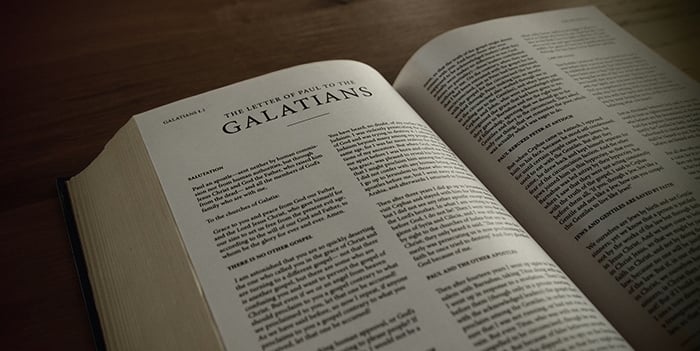
I recently had this point reiterated to me by a brother who is preparing to teach Paul’s Letter to the Galatians in our adult Sunday school class. Of course, the basic situation in Galatians is pretty straightforward. The newly converted Gentile Christians in Galatia are facing social and theological pressure from a group of Jewish “Christians” to be circumcised, so that they can truly be part of God’s (Jewish) people. This is a position that the Apostle Paul simply will not countenance under any circumstances; in fact, he condemns it outright in some of the harshest language in all of the New Testament. “As we have said before, I now say again: If anyone is preaching to you a gospel contrary to what you received, a curse be on him!” (1.9) Of course, Paul goes on in the letter to give historical and theological arguments against the position in question in chapters 3-4, and then he uses chapters 5-6 to emphasize those virtues and habits of character that truly distinguish someone as belonging to the people of God. In other words, the message of the letter is pretty clear.
However, we must ask whether or not this is all way can say about the situation in Galatians, particularly as this relates to chapters 1-2 and their relationship with the events in Acts 9-15. In these first two chapters, Paul gives a brief history of his own salvation and his relationship with the Jerusalem church; his point is that his gospel is not based on the traditions of men, but on the supernatural revelation of God himself in the person of Christ on the Damascus road. But the correspondence between Paul’s testimony and the events in Acts is less than clear to say the least. Of course, there are some that would say that the two are inherently incompatible, and to attempt any kind of combined reconstruction is hopeless and probably not even necessary. But for those of us who hold convictions regarding the inerrancy of the Scriptures, this is simply not an option. We must ask questions regarding the text’s larger coherence with the New Testament witness, especially when that text addresses events that are recorded by another author. For example, is the Jerusalem visit that Paul mentions in 2.1-10 to be understood as corresponding his visit at the Jerusalem council as it is recorded in Acts 15, or is it the famine visit that is mentioned in Acts 11? Who are these “men from James” (2.12), and what is the purpose of their visit in Antioch? Are they part of the circumcision party? Why would Peter withdraw from table fellowship from the Gentile Christians after his transformative experience with Cornelius (Acts 10)? And the list could go on.
I don’t have the answers to all of these questions, but in the space that follows, I would like to suggest a brief timeline that attempts to reconcile Galatians 1-2 with the events of Acts 9-15. In academic scholarship, this position is known as the Southern Galatia Theory, and it is associated with names such as F.F. Bruce and Richard Longenecker, to name but a few. In general, this theory posits that the Letter to the Galatians was written around 47-48 AD to the churches that Paul started during his first missionary journey (Acts 13-14) in the southern region of the Roman province of Galatia. The alternative view, known as the Northern Galatia Theory, argues that the Letter to the Galatians was written around 56-57 AD from Ephesus to ethnic Galatians in the north, the former kingdom of Galatia. Due to space considerations, I will not lay out this opposing theory in detail.
The timeline for the Southern Galatia Theory flows as follows: AD 34 – Conversion of Paul (Galatians 1.13-16, Acts 9.1-19), AD 34-37 – Paul in Arabia and Damascus (Galatians 1.17, Acts 9.19-22, 27), AD 37 – Paul visits Jerusalem after three years (Galatians 1.18-20, Acts 9.26-29), AD 37-47 – Paul in Syria and Cilicia (Galatians 1.21-24, Acts 9:30-31), AD 47 – Paul visits Jerusalem after 14 years (Famine Visit) (Galatians 2:1-10, Acts 11.27-30), AD 47-48 – Paul’s first missionary journey (Acts 13:1-14:28), AD 48 – Peter visits Antioch and confronts Peter (Galatians 2:11-14), AD 48 – Paul writes the Letter to the Galatians, AD 49 – Paul speaks at the Jerusalem Council (Acts 15.1-29), AD 49-51 – Paul visits the Galatian churches on his second missionary journey (Acts 16-18), AD 52-57 – Paul’s visits the Galatian churches on his third missionary journey (Acts 19-21).
This theory seems to be the most widely accepted in New Testament scholarship today, but we must return to the initial question of this post, namely, “how does this help me to understand the text better?” Again, this is the fundamental question; no matter how insightful and innovative our reconstruction may be, if it does not shed greater light on the meaning of the text, then it is nothing more than pointless speculation. In particular, I think the early date offered by this theory helps explain the actions of James and Peter in chapter 2. At this point in the history of the early church, the inclusion of the Gentiles was still a relatively new phenomenon. The details were still being worked out in the lives of real people on the frontlines of the church’s ministry. So, yes, even after Peter’s incredible experience with Cornelius, it is still possible for him to waiver under the social pressures of the circumcision party. Perhaps he thought his actions in Antioch would somehow hinder the evangelistic effort among the Jews in Jerusalem.
Moreover, it explains the apparent hesitancy of James and his representatives. Of course, James will go on to give the final argument against the requirement of circumcision at the Jerusalem Council, and he will write the apostolic letter detailing the council’s decision (Acts 15.23-29). But, perhaps at this moment, before the council, he was still considering the question. We don’t know, and we may never know. But for any theory to be considered probable, it must explain the evidence better than all the other possible explanations, and I believe that the Southern Galatia Theory does just that. Moreover, it shows us that the authors of Scripture were real fallible human beings. James, Peter, Paul – they were just ordinary men who God chose to use in extraordinary ways. They didn’t get everything right all the time, but they were “men [who] spoke from God as they were carried along by the Holy Spirit” (2 Peter 1.21), and in so doing, the produced the inerrant words of Holy Scripture. Thanks be to God for His incredible grace!
121 I have done what is just and right; do not leave me to my oppressors. 122 Guarantee your servant’s well-being; do not let the arrogant oppress me. 123 My eyes grow weary looking for your salvation and for your righteous promise. 124 Deal with your servant based on your faithful love; teach me your statutes. 125 I am your servant; give me understanding so that I may know your decrees. 126 It is time for the Lord to act, for they have violated your instruction. 127 Since I love your commands more than gold, even the purest gold, 128 I carefully follow all your precepts and hate every false way.
The sixteenth stanza of Psalm 119 (ע/ayin) deals with the age old dilemma of faith; it is a question that the people of God have been asking for four millenia. “How long, O Lord?” How long will the wicked prosper? How long will sin and evil endure? How long until you come again to judge the wicked and vindicate the righteous, O Lord? Is it all worth it? Is my obedience and my faithfulness and my suffering worthwhile in the grand scheme of your eternal plan, O Lord? These are the perennial questions of faith. In the face of ever growing evil and the ongoing glorification of sin and wickedness, we are left to wonder if our struggles to walk in faith and obedience are worth it? If we are honest with ourselves, these are questions that even the most faithful of Christians have asked themselves at some point or another. Our psalmist puts it this way: “My eyes grow weary looking for your salvation and for your righteous promise.” (Verse 123)
This is perhaps what is most refreshing about the Word of God, especially in the Psalms but equally so throughout the canon of Scripture, namely that it is real and honest about the human predicament. The Scriptures do not whitewash the ugly and painful realities of human experience; rather, they acknowledge them with an honesty that is both brutal and refreshing. Moreover, they speak to the complexities of maintaining faith and hope in the face of such realities that would otherwise drive us to depression and despair. This is why our psalmist can say, “It is time for the Lord to act, for they have violated your instruction.” (Verse 126) Even though he feels the weariness and the temptations to despair, our psalmist holds on to his hope that God will act, that He will judge those who have violated His instruction. Our psalmist sees this hope as both good and right; it is both good and right that the wicked should finally be punished.
And it is this hope that drives our psalmist to maintain his faith in steadfast obedience to God and His word. He says, “I have done what is just and right; do not leave me to my oppressors,” (Verse 121) and he says, “I carefully follow all your precepts and hate every false way.” (Verse 128) His hope in God and his justice drives his perseverance in faith and obedience. He is convinced that his obedience is not meaningless, that the persecution and suffering that he has endured in not random or without purpose. No, our every effort to walk by faith and obedience, our every difficulty and heartache for the sake of God and His Word, will be ultimately vindicated and rewarded. We look forward to those gracious words of our Lord Jesus, when He will say, “Well done, good and faithful servant! Enter into your master’s joy.” This is why our psalmist can pray, “Deal with your servant based on your faithful love; teach me your statutes.” (Verse 124)
The word here translated “faithful love” is a central and primary concept in the Old Testament’s conception of God. It’s closest New Testament equivalent is the word “grace.” This attribute of God’s character is enshrined in the covenantal formula,
The Lord—the Lord is a compassionate and gracious God, slow to anger and abounding in faithful love and truth, maintaining faithful love to a thousand generations, forgiving iniquity, rebellion, and sin. But he will not leave the guilty unpunished, bringing the consequences of the fathers’ iniquity on the children and grandchildren to the third and fourth generation. (Exodus 34:6-7)
This covenantal formula is the basis for all of the Old Testament’s theology, and it forms the foundation of our psalmist’s faith in this stanza of Psalm 119. The God of the Bible is a God who is longsuffering and gracious toward those who submit to Him in faith, but He is just and holy toward those who reject His sovereign rule over their lives.
And it is this faith that leads him to pray, “Guarantee your servant’s well-being; do not let the arrogant oppress me.” (Verse 122) Literally translated, the line reads, “Be surety for your servant for good.” The idea is that God himself is the surety, the earnest money, the down payment, of good for his servant. In other words, our good, our blessing, our prosperity and human flourishing flows only from God and His promises. This is why we must trust in Him and walk in His ways. As our psalmist puts it, “Since I love your commands more than gold, even the purest gold, I carefully follow all your precepts.” Our fulfillment, our purpose, our joy and happiness is only available when we submit ourselves to God Word, when we walk in God’s ways, even if when it feels like everyone is going in the other direction. Christian perseverance is driven by a faith full of hope. When and only when we walk in this hope will we experience genuine human flourishing and fulfillment.










 Faith seeking Understanding