For the choir director: on the Gittith. A psalm of David.
1 Lord, our Lord, how magnificent is your name throughout the earth! You have covered the heavens with your majesty. 2 From the mouths of infants and nursing babies, you have established a stronghold on account of your adversaries in order to silence the enemy and the avenger.
3 When I observe your heavens, the work of your fingers, the moon and the stars, which you set in place, 4 what is a human being that you remember him, a son of man that you look after him? 5 You made him little less than God and crowned him with glory and honor. 6 You made him ruler over the works of your hands; you put everything under his feet: 7 all the sheep and oxen, as well as the animals in the wild, 8 the birds of the sky, and the fish of the sea that pass through the currents of the seas.
9 Lord, our Lord, how magnificent is your name throughout the earth!
~Psalm 8
Series: Praying through the Psalms Text: Psalm 8.1-9 Church: South Caraway Baptist Church, Jonesboro, AR Date: May 17, 2023
In my previous post, I argued that our hermeneutic for interpreting the Bible must be grounded in the conviction that what God intended to say in the Scriptures is accurately and faithfully conveyed in what the human authors actually wrote, and for most of the Bible, this seems to be rather clear. The question, however, arises when we come to texts in the New Testament that seem to interpret the Old Testament against the grain of the author’s intent. If we believe that “scripture interprets scripture” (see my post, here), then it would makes sense to suggest that we should follow the interpretive principles of the Apostles, and if they were not bound by a strict conception of authorial intent, then perhaps we should jettison this hermeneutical ground in our interpretive efforts as well. This then is the point that must be proven, namely that the New Testament authors did in fact disregard the human author’s intent when they interpreted the Old Testament. Of course, to examine every place where the New Testament author’s quote from or allude to the Old Testament would require far more space than is available here, and this work has already been done by many fine scholars in the field. I recommend Commentary on the New Testament use of the Old Testament, edited by G.K. Beale and D.A. Carson. But in lieu of that, I would like to explore one text as a test case for the thesis that the New Testament authors ignored the principle of authorial intent in their use of the Old Testament, that being Matthew’s use of Hosea 11.1 in chapter 2, verse 15 of his Gospel.
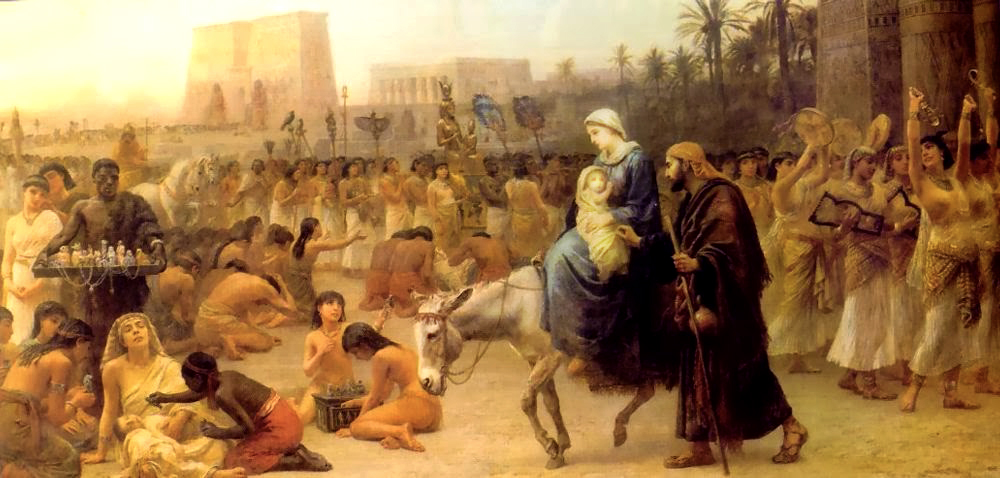
After they were gone, an angel of the Lord appeared to Joseph in a dream, saying, “Get up! Take the child and his mother, flee to Egypt, and stay there until I tell you. For Herod is about to search for the child to kill him.” So he got up, took the child and his mother during the night, and escaped to Egypt. He stayed there until Herod’s death, so that what was spoken by the Lord through the prophet might be fulfilled: Out of Egypt I called my Son.
~Matthew 2.13-15
The book of the prophet Hosea is a story of love and betrayal; set against the backdrop of Hosea’s own marriage to the adulteress Gomer, throughout the book, God repeatedly rebukes the northern Kingdom of Israel for scorning His grace, rejecting His love, forgetting His covenant, and playing the whore with the false gods of Baal. And so, in chapter 11, and verse 1, we read, “When Israel was a child, I loved him, and out of Egypt I called my son.” In these verses, God is looking back on the Exodus experience of His people as the initial overture of His love for Israel; as He goes on to say in verse 4 of that chapter, “I led them with human cords, with ropes of love. To them I was like one who eases the yoke from their jaws; I bent down to give them food.” It is clear that these verses are operating on the paternal imagery of parenthood. In the same way that parents nurture their newborn children, so also God nurtured His “son” Israel by bringing them out of Egyptian slavery, providing for them in the wilderness, and leading them into a land flowing with milk and honey. Even in spite of their repeated betrayal, God goes on to say in verse 8, “How can I give you up, Ephraim? How can I surrender you, Israel? How can I make you like Admah? How can I treat you like Zeboiim? I have had a change of heart; my compassion is stirred!” This chapter is a beautiful picture of the tenderness and mercy of God toward His rebellious son, and even though, the people of Israel will suffer His discipline, it holds out the hope that God has not ceased loving His people.
Now, in chapter 2 of the first canonical Gospel, Matthew connects the flight of the Holy family to Egypt to the words of Hosea 11.1, “so that what was spoken by the Lord through the prophet might be fulfilled: Out of Egypt I have called my Son“ (quoting Hosea 11.1b). But if the prophet Hosea wasn’t making a direct messianic prediction in the text in question, as we saw above, then how can the Egyptian flight of Mary, Joseph, and Jesus properly be considered a fulfillment? The answer is that this is a fulfillment by way of typology not prediction. Part of Matthew’s portrayal of Jesus is to show that He is the long awaited “prophet like Moses” (c.f. Deut 18.15-19), and he demonstrates this by highlighting the ways that Jesus recapitulates the story of Moses. A few examples should suffice. When Moses was born, Pharaoh killed all the Hebrew boys; when Jesus was born, Herod killed all the Jewish boys. According to 1 Corinthians 10.1-2, Moses had a baptism experience in the Red Sea, and Jesus was baptized in the Jordan River. Moses and the Israelites spent forty years in the wilderness; Jesus spent forty days in the wilderness. Moses went up on Mount Sinai to receive the Law; Jesus went up on a mountain to give the law (Sermon on the Mount). There are five books of Moses (Pentateuch); there are five discourses of Jesus’ sermons in the Gospel of Matthew. And “out of Egypt, I called my Son.” Based on this evidence, it is reasonably clear that the fulfillment that Matthew sees in the text of Hosea 11.1 is typological. Even as Israel was God’s typological “son”, Jesus is the true and better messianic Son of God.
In the final analysis, rather than violating the principle of authorial intent in his use of Hosea 11.1, the typological connection drawn by Matthew actually affirms the authorial intent of Hosea. And still, the question remains, “what of God’s intent in Hosea 11.1? When He inspired Hosea to write “out of Egypt, I called my son,” did he know that Matthew would take it in a different direction?” Of course, it is a theological truism to say that God knew the theological connections that Matthew would draw when He inspired Hosea to write, and so it is not wrong to say God “intended” more than Hosea understood at the time. However, this doesn’t mean that His intent stands in contradiction to or competition with the intent of Hosea. We must assume that God’s intent in Hosea 11 was to spark His people to repentance by reminding them of the great depths of His love that was demonstrated in the events of the Exodus, especially because the words of Hosea 11 are reported by the prophet as the very words spoken by God. (This is the Lord’s declaration, Hosea 11.11) Whatever “fuller sense” that we may understand from Hosea’s words, it must be grounded in the inspired intent of the human author, and this is exemplified in Matthew’s use of the text to explain the flight to Egypt.
But there is something that Matthew’s use of the Old Testament can teach us about our own interpretive efforts, namely that our hermeneutic for understanding of the Old Testament must reckon with the person and work of Christ. As Jesus himself affirms, “everything written about me in the Law of Moses, the Prophets, and the Psalms must be fulfilled.” (Luke 24.44) In other words, we have not done our full interpretive work in the Old Testament if we fail to consider how the text points to or is fulfilled in Jesus. If our understanding of the Old Testament would be accepted in a Jewish synagogue, then we haven’t understood the text Christianly. However, this does not mean that we can disregard the principle of authorial intent; we must still labor within the boundaries of literary and historical context before we can consider the broader canonical and theological implications. At the very least, our understanding of the human author’s intent must function as the true and necessary foundation upon which we stand as we seek the illumination of the Spirit in understanding the theological and applicational implications of the text for our lives in Christ. This is a thoroughly Christian understanding of how to interpret the Bible.
3 Blessed is the God and Father of our Lord Jesus Christ, who has blessed us with every spiritual blessing in the heavens in Christ. 4 For he chose us in him, before the foundation of the world, to be holy and blameless in love before him. 5 He predestined us to be adopted as sons through Jesus Christ for himself, according to the good pleasure of his will, 6 to the praise of his glorious grace that he lavished on us in the Beloved One.
~Ephesians 1.3-6
Title: On the Blessings of Election and Predestination in Christ Text: Ephesians 1.3-6 Series: The Letter to the Ephesians Church: South Caraway Baptist Church, Jonesboro, AR Date: May 8, 2023
1 Paul, an apostle of Christ Jesus by God’s will: To the faithful saints in Christ Jesus at Ephesus. 2 Grace to you and peace from God our Father and the Lord Jesus Christ.
~Ephesians 1.1-2
Title: On a Historical, Literary, and Theological Overview of Ephesians Text: Ephesians 1.1-2 Series: The Letter to the Ephesians Church: South Caraway Baptist Church, Jonesboro, AR Date: April 30, 2023
A psalm of David when he fled from his son Absalom.
1 Lord, how my foes increase! There are many who attack me. 2 Many say about me, “There is no help for him in God.” Selah
3 But you, Lord, are a shield around me, my glory, and the one who lifts up my head. 4 I cry aloud to the Lord, and he answers me from his holy mountain. Selah
5 I lie down and sleep; I wake again because the Lord sustains me. 6 I will not be afraid of thousands of people who have taken their stand against me on every side.
7 Rise up, Lord! Save me, my God! You strike all my enemies on the cheek; you break the teeth of the wicked. 8 Salvation belongs to the Lord; may your blessing be on your people. Selah
~Psalm 3
Series: Praying through the Psalms Text: Psalm 3.1-8 Church: South Caraway Baptist Church, Jonesboro, AR Date: April 12, 2023
1 Why do the nations rage and the peoples plot in vain? 2 The kings of the earth take their stand, and the rulers conspire together against the Lord and his Anointed One: 3 “Let’s tear off their chains and throw their ropes off of us.”
4 The one enthroned in heaven laughs; the Lord ridicules them. 5 Then he speaks to them in his anger and terrifies them in his wrath: 6 “I have installed my king on Zion, my holy mountain.”
7 I will declare the Lord’s decree. He said to me, “You are my Son; today I have become your Father. 8 Ask of me, and I will make the nations your inheritance and the ends of the earth your possession. 9 You will break them with an iron scepter; you will shatter them like pottery.”
10 So now, kings, be wise; receive instruction, you judges of the earth. 11 Serve the Lord with reverential awe and rejoice with trembling. 12 Pay homage to the Son or he will be angry and you will perish in your rebellion, for his anger may ignite at any moment. All who take refuge in him are happy.
~Psalm 2
Series: Praying through the Psalms Text: Psalm 2.1-12 Church: South Caraway Baptist Church, Jonesboro, AR Date: April 5, 2023
4 When Mordecai learned all that had occurred, he tore his clothes, put on sackcloth and ashes, went into the middle of the city, and cried loudly and bitterly. 2 He went only as far as the King’s Gate, since the law prohibited anyone wearing sackcloth from entering the King’s Gate. 3 There was great mourning among the Jewish people in every province where the king’s command and edict reached. They fasted, wept, and lamented, and many lay in sackcloth and ashes.
4 Esther’s female servants and her eunuchs came and reported the news to her, and the queen was overcome with fear. She sent clothes for Mordecai to wear so that he would take off his sackcloth, but he did not accept them. 5 Esther summoned Hathach, one of the king’s eunuchs who attended her, and dispatched him to Mordecai to learn what he was doing and why. 6 So Hathach went out to Mordecai in the city square in front of the King’s Gate. 7 Mordecai told him everything that had happened as well as the exact amount of money Haman had promised to pay the royal treasury for the slaughter of the Jews.
8 Mordecai also gave him a copy of the written decree issued in Susa ordering their destruction, so that Hathach might show it to Esther, explain it to her, and command her to approach the king, implore his favor, and plead with him personally for her people. 9 Hathach came and repeated Mordecai’s response to Esther.
10 Esther spoke to Hathach and commanded him to tell Mordecai, 11 “All the royal officials and the people of the royal provinces know that one law applies to every man or woman who approaches the king in the inner courtyard and who has not been summoned—the death penalty—unless the king extends the gold scepter, allowing that person to live. I have not been summoned to appear before the king for the last thirty days.” 12 Esther’s response was reported to Mordecai.
13 Mordecai told the messenger to reply to Esther, “Don’t think that you will escape the fate of all the Jews because you are in the king’s palace. 14 If you keep silent at this time, relief and deliverance will come to the Jewish people from another place, but you and your father’s family will be destroyed. Who knows, perhaps you have come to your royal position for such a time as this.”
15 Esther sent this reply to Mordecai: 16 “Go and assemble all the Jews who can be found in Susa and fast for me. Don’t eat or drink for three days, night or day. I and my female servants will also fast in the same way. After that, I will go to the king even if it is against the law. If I perish, I perish.” 17 So Mordecai went and did everything Esther had commanded him.
~Esther 4.1-17
Title: On Faithfulness in the Face of Evil Text: Esther 4.1-17 Series: The Book of Esther Church: South Caraway Baptist Church, Jonesboro, AR Date: March 19, 2023
If there was one word that might be used to describe the culture that we live in, it would most likely be “discontent”; we are a people who have forgotten what it means to be content with what we have. We are constantly inundated with media and ad campaigns that promise satisfaction and fulfillment through some new product or service. On top of that, the proliferation of social media has caused the disease of comparison to rise to pandemic levels, such that we are unconsciously driven by a nagging need to have more and better than our “friends”. Whether because of materialistic consumerism or the sickness of comparison, we have become a culture that has completely forgotten how to be content. However, for those who are in Christ, the Scriptures remind us that “godliness with contentment is great gain.” (1 Timothy 6.6) In other words, our submission to the kingship of Christ, our citizenship in His Kingdom, is exhibited in our contentment with all that He has and has not blessed us with.
This is exactly the point that Jesus makes in the “Sermon on the Mount” in Matthew, chapters 5-7. The Sermon on the Mount is essentially the manifesto of Jesus’ Kingdom; it is Jesus’ vision for what life in His Kingdom should look like. In it, He describes the attitudes, the habits of character, and the behaviors that should identify His people. And this is exactly the point, namely that the Kingdom of God is not something that is just a future hope to be realized. It is that, but during His earthly ministry, by His death, resurrection, and ascension, Jesus inaugurated the Kingdom of God, and now, He is seated at the right hand of the Father, ruling over His people through the indwelling presence of His Spirit. This is often described by the phrase “already but not yet”, which is a short hand way of saying that the Kingdom of God is already inaugurated but not yet consummated. And because we are currently living under the benevolent and gracious rule of King Jesus, we are able to cultivate the spiritual discipline of contentment. As Jesus himself says,
Therefore I tell you: Don’t worry about your life, what you will eat or what you will drink; or about your body, what you will wear. … But seek first the kingdom of God and his righteousness, and all these things will be provided for you.
Matthew 6.25, 33
In these verses, Jesus encourages His disciples to replace their worry and anxiety with contentment because His good Father knows their needs before they even ask Him. Even as He cares for the birds of the sky and lilies of the field, how much more will He certainly care for those who have been united with His Son by faith. “Therefore don’t worry about tomorrow, because tomorrow will worry about itself. Each day has enough trouble of its own.” (Matthew 6.34) But, of course, this is easier said than done. Worry and anxiety are subtle; they are feelings that often well up inside of us unexpectedly and unnoticed. How, then, can we prevent ourselves from being overcome by these stumbling blocks? Is there a spiritual inoculation that will help us fight against their infection? I would submit that there is, and I believe Jesus identifies it for us in the section that immediately precedes His discussion of contentment.
In the first half of Matthew, chapter 6, Jesus discusses the spiritual disciplines of giving, prayer, and fasting. Of course, He lays out the primary principle for the practice of these disciplines in verse 1 of the chapter, “Be careful not to practice your righteousness in front of others to be seen by them. Otherwise, you have no reward with your Father in heaven.” However, there is a reason why He follows up His discussion of these by commands us not to worry. These spiritual disciplines are the primary means by which we cultivate the inner quietude of peace and contentment. When we give sacrificially of our material possessions for the blessing of others and devote ourselves the pursuit of God rather than material comforts through prayer and fasting, we will find ourselves being more and more content with what we do or do not have. In other words, spiritual contentment is borne out of soul that is fully satisfied in its own communion with the one true and living God.
In the piety of American Evangelicalism, the discipline of contentment among the disciples of Jesus is a glaring whole in our cultivation of Christlikeness. Sadly, we often look more like citizens of this world than citizens of the already but not yet Kingdom of God. We are driven by the felt needs of the moment instead of walking in satisfied contentment with our God, and it shows. We would do well to reconsider what it means to live under the reign of Christ and submit our material resources and our physical needs to the one who taught us to pray, “Give us this day our daily bread.” (Matthew 6.11) This is the secret to the cultivation of contentment. As the Apostle Paul said,
I don’t say this out of need, for I have learned to be content in whatever circumstances I find myself. I know how to make do with little, and I know how to make do with a lot. In any and all circumstances I have learned the secret of being content—whether well fed or hungry, whether in abundance or in need. I am able to do all things through him who strengthens me.
81 I long for your salvation; I put my hope in your word. 82 My eyes grow weary looking for what you have promised; I ask, “When will you comfort me?” 83 Though I have become like a wineskin dried by smoke, I do not forget your statutes. 84 How many days must your servant wait? When will you execute judgment on my persecutors? 85 The arrogant have dug pits for me; they violate your instruction. 86 All your commands are true; people persecute me with lies—help me! 87 They almost ended my life on earth, but I did not abandon your precepts. 88 Give me life in accordance with your faithful love, and I will obey the decree you have spoken.
We now come to the eleventh stanza of Psalm 119 (Kaf/Kaph – כ, final form – ך), and with this stanza, we are halfway through the longest chapter in the Bible. This is somewhat appropriate since the theme of this stanza concerns waiting. “How many days must your servant wait?” (verse 84a) In the same way that this psalm requires endurance and perseverance to read and work through, so also the life of faith requires endurance and perseverance. Or, to borrow the title of Eugene Peterson’s book on the Psalms of Ascent (120-134), the Christian life is A Long Obedience in the Same Direction. As the subtitle of the book states, Peterson uses these psalms to reflect on “discipleship in an instant society”. As a culture, we are addicted to instant gratification, and the proliferation of social media with its “likes” and “follows” has only made this incessant need more consuming. We desperately need to relearn what it means to wait, to persevere in faith, to appreciate delayed fulfillment. But, of course, waiting is not easy; it is not fun. Most of the time, it is hard, and this is the struggle that our psalmist is wrestling with in these verses.
It would seem that he is facing intense persecution for his devotion to God and His ways. As he writes in verse 86, “people persecute me with lies; they almost ended my life on earth.” This is because “they violate your instruction, but I did not abandon your precepts.” (verse 85) Clearly, the psalmist is facing opposition, ridicule, even the threat of physical harm because of his commitment to the Word and ways of God. Sadly, this is the reality of living in the already but not yet. As believers in Christ, we are already citizens of His kingdom; we live by a set of standards and convictions, principles and values, that stand in complete contradiction to the kingdom of this world. This inevitably leads to conflict with those who are on the outside of the faith, which results in ridicule, ostracism, and eventually outright persecution. The more that we obey the Word of God, the more that we will face criticism for it. As the Apostle Paul puts it in Second Timothy, chapter 3, verse 12, “In fact, all who want to live a godly life in Christ Jesus will be persecuted.” This is a lived reality for our psalmist.
And so, understandably, our psalmist cries out to God, “How many days must your servant wait? When will you execute judgment on my persecutors? When will you comfort me?” (verse 84) This prayer has been the prayer of the people of God for the entirety of history. Every moment, we wonder, “How long, O Lord? How long until you will come to do away with sin, vindicate your people, fulfill your promises, and establish your perfect rule on earth? How long?!” This is our heart’s deepest and truest longing, as our psalmist says, “I long for your salvation.” Of course, salvation here, as our psalmist envisions it, is a much more robust concept than we usually understand. As a post-reformation, post-enlightenment, westernized people, we have been conditioned to understand salvation in individualistic terms. We generally think of salvation as the forgiveness of sin, the removal of guilt, and inheritance of eternal life (when we die). But for our psalmist, salvation is vindication; it the victory of God over those who would oppose Him and His people. However, these two understandings of salvation are not in contradiction. The Bible presents the work of Christ in redeeming His people as a both/and, as an already/not yet. We have already received the forgiveness of sin resulting in eternal life, but we are also waiting for the day when Christ will come again to defeat sin and Satan once and for all and establish His Kingdom on earth.
This is our blessed hope, and as our psalmist writes, “I put my hope in your word.” Our psalmist understands that hope is the source of the strength that is necessary for waiting, and the promises of God found in His Word are the foundation of hope. It is hope that empowers our psalmist’s unflinching obedience in spite of the persecution that he is facing. This is why he prays in verse 88, “Give me life in accordance with your faithful love, and I will obey the decree you have spoken.” The word that is translated as “faithful love” here is the Hebrew word חֶסֶד (hesed), and according to Darrell Bock, it encompasses “all the positive attributes of God: love, covenant faithfulness, mercy, grace, kindness, loyalty–in short, acts of devotion and loving-kindness that go beyond the requirements of duty.” It is variously translated as “faithful love, lovingkindness, loyalty, etc.”, and it refers to His promise keeping devotion to His covenant people. Our psalmist is confident that God will keep the promises of His Word, because that is who He is. He is a promise keeping God, and this is the ground of hope for our psalmist. It is what empowers him to step out in obedience expecting that it will result in the abundant life.
In many ways, the Christian life is a life lived in between, a life of the already but not yet, a life of waiting. We understandably wonder how long we will have to wait for the promises of God to be fulfilled, but there is a question that is more important than this. And that question is simply this: how shall we wait? Will we wait in faithfulness and obedience strengthened by our confident hope in the promises of God’s Word? Or will we give in to the pressures of the world as it seeks to conform us to itself? There will certainly be times when our waiting will be difficult, when continuing in faithfulness will feel pointless, when our hope will appear to be in vain. But these are the times that we must renew our faith in God and the promises are found in His Word and live in light of them. Then and only then will hear those most blessed words on that final day when our Lord Jesus says, “Well done, good and faithful servant! You were faithful over a few things; I will put you in charge of many things. Share your master’s joy.” (Matthew 24.23)
1 The pronouncement that the prophet Habakkuk saw.
2 How long, Lord, must I call for help and you do not listen or cry out to you about violence and you do not save? 3 Why do you force me to look at injustice? Why do you tolerate wrongdoing? Oppression and violence are right in front of me. Strife is ongoing, and conflict escalates. 4 This is why the law is ineffective and justice never emerges. For the wicked restrict the righteous; therefore, justice comes out perverted.
~Habakkuk 1.1-4
16 I heard, and I trembled within; my lips quivered at the sound. Rottenness entered my bones; I trembled where I stood. Now I must quietly wait for the day of distress to come against the people invading us. 17 Though the fig tree does not bud and there is no fruit on the vines, though the olive crop fails and the fields produce no food, though the flocks disappear from the pen and there are no herds in the stalls, 18 yet I will celebrate in the Lord; I will rejoice in the God of my salvation! 19 The Lord my Lord is my strength; he makes my feet like those of a deer and enables me to walk on mountain heights!
For the choir director: on stringed instruments.
~Habakkuk 3.16-19
Text: Habakkuk 1.1-4, 3.16-19 Series: Supply Preaching Church: Fitzgerald Crossing Baptist Church, Wynne, AR Date: January 15, 2023