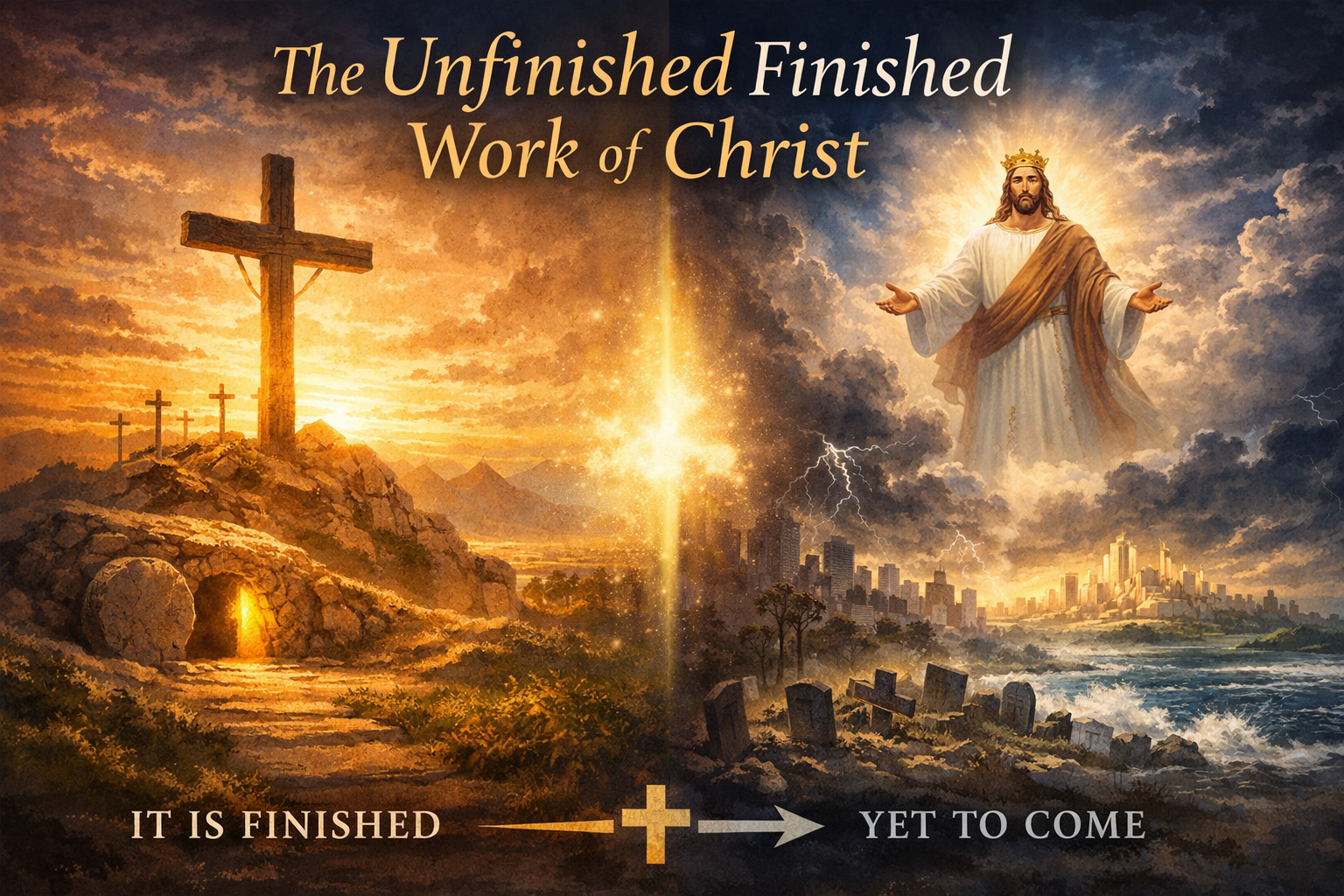
In light of this being the week of our Lord’s passion, it is interesting to note that one of the last things that he said before he gave up his Spirit on the cross was, “It is finished.” (τετέλεσται, John 19.30). With this powerful word, Jesus declared that his work on the cross in making full atonement for sin was completed, and “bowing his head, he gave up his spirit.” It must have been a powerful scene, and no more pregnant words have perhaps ever been spoken. However, the problem is that even though Christ finished his work, sin still seems to run rampant in this world. If it is finished, why, we might ask, is the world still broken, still full of pain and suffering and sin and death? Because of this, we might be tempted to suggest that his work is unfinished. Many Christians struggle to hold together what has already been accomplished and what still remains. However, what we must realize is that Christ’s work is finished; it is fully accomplished in its foundation, but not yet fully realized in its effects. In this post, I would like to consider this tension by offering just a few thoughts on what Christ accomplished in his first coming and what waits to be realized at his second coming.
In one sense, then, it is completely accurate to say that the work of Christ has been fully accomplished, and there are at least three aspects of his work that are completely finished. First, atonement has been accomplished. When Christ died on the cross, he made the full and final payment for our sin. In systematic theology, this is called penal substitutionary atonement. In other words, this means that Christ paid the penalty (penal) that we deserve (substitutionary) for our sin. (On the fact that this was Christ’s view of his death, see here.) He died the death that we deserve by dying in our place. But he did not stay dead; he rose again on the third day. This is the second aspect of Christ’s finished work, namely that victory over death has been secured. When Jesus walked out of the grave on the third day, he defeated death and disarmed Satan of his power. Death no longer has hold over those who are in Christ. We need not fear, we can have hope, even in the face of death. (On hope in the face of death, see here.) And lastly, by dying on the cross, Christ finished his work of establishing righteousness. In other words, his finished work on the cross is now the ground upon which God grants our justification, when we place our faith in Jesus. He lived a perfect life, he died an innocent death. And his righteousness is imputed to us by faith. We are made right, declared innocent, because of Christ’s finished work. This is the gospel. Nothing needs to be added to what Christ accomplished; his work is complete, sufficient, and final. It is not partial, not provisional. It is finished!
Moreover, his finished work on the cross inaugurated several important realities in which we now live. For one, the Kingdom of God has been inaugurated. Forty days after his resurrection, Jesus ascended into heaven to be seated at the right hand of the Father, and he is now reigning with all authority on earth as it is in heaven. (Matt. 28.18) He is not waiting to become King; he is already reigning as King. And he does this by his Spirit. This is the second reality in which we now live, namely that Christ has sent his Spirit to indwell his people. The Spirit mediates Christ’s real presence in and among his people. He is the down payment, the seal, and the guarantee of our faith. And he is actively working in us to make us more like Jesus. And lastly, but certainly not leastly, new life has begun. When we place our faith in Christ, the Spirit regenerates us. He brings to life what was once spiritually dead, and we are born again. In this way we are new creatures in Christ. The old has passed away, and behold the new has come. (2 Cor. 5.17) New creation realities are already at work in us through the Spirit. In these ways, the future has already broken into the present through the risen Christ, and we live in these future realities even now.
And yet, in spite of all of this, several aspects of Christ’s work remain unfinished. Perhaps most clearly, sin still remains in the world. We have been saved from the penalty of sin, but we have not yet been saved from the presence of sin. Our world is saturated and polluted with sin at every turn. People are burdened down with sin and its consequences. Our relationships suffer, bodies are diseased, conflict and turmoil abound at every level of our society. Sin continues its reign of terror nearly unchecked. In addition to this, death still operates in this world. This world reeks with the stench of death; it fills our nostrils everywhere we turn. Our loved ones get sick and die. Accidents and tragedy take lives too soon. Christ has been raised, and death has been defeated. But death still reigns in our mortal bodies, and we ache and groan for that day when death will be no more. Thirdly, the created order groans under the weight of humanity’s sin. When our first parents fell, the creation itself was subjected to futility and decay. The idyllic paradise of Eden was lost to the corruption of sin. And lastly, justice and restoration are yet to be realized. Injustice abounds in our society. From all appearances, the weak get weaker and the strong get stronger. There is no real justice; there is no real peace. Wickedness and evil seem to grow day by day. What is wrong is celebrated as right, and what is right is condemned as wrong. The world is turned upside down, and we long for the day when justice will flow like rivers and when peace will rest upon the earth. And we cry out with the Scriptures, “How long, O Lord? How long?”
In theological parlance, this tension between the finished and the unfinished work of Christ is often referred to by the shorthand phrase “already/not yet”. It simply means that God’s plan of redemption for the world has already begun, has already been inaugurated, but has not yet been fully consummated. The work of Christ’s first coming is finished. He died on the cross, he rose again the third day, he sent his life-giving Spirit. But we are still waiting for the work of his second coming, namely the resurrection of the dead, the final judgment, and the new creation. This is the tension in which we now live, and in this tension, we must avoid two extremes. First, we must avoid living as if nothing has been finished. We must learn to rest in the finished work of Christ. We have been forgiven; we have been indwelled by His Spirit. We can have peace. On the other hand, however, we must not live as if everything is already complete. We do live under the burdens of sin and death; we do long for justice and peace. And we can have hope. The work of Christ is finished in its accomplishment, but it is unfinished in its application to the whole of creation. And so, we wait faithfully as Christ has instructed us.
And this is the point, namely that this tension is not ultimately about stages of fulfillment, though that is certainly the best framework for understanding it. Ultimately, this tension is about Christ. His work is unfinished because his story is not over. (On my argument for the centrality of Christ in our eschatological reflection, see here.) In other words, the same Jesus who said, “It is finished” is the same Jesus who is coming again to make all things new. The same Jesus who died on the cross is the same Jesus who is coming again in glory. Or to put it another way, the second coming of Jesus is not a different work; no, it is the completion of the same work that he began 2000 years ago. The second coming completes what the first coming began, because Christ himself is the fulfillment of all our hopes. Our hope is not just about what Christ has done and will do; it is about Christ himself. It is about his presence. In John 14.3, Jesus promised that he would come again and receive us unto himself, that where he is there we may be also. And so, the unfinished nature of Christ’s work is not a failure of the first coming, but the promise of the second. He is our blessed hope.
And so, yes, we live in the middle of this tension; we live in between the already and the not yet. We are already forgiven, but we are still struggling. We are already alive, yet we are still dying. We are already redeemed, yet we are still waiting. We are waiting to be set free from the presence and the corruption of sin once and for all. This is the lived reality of the Christian life—caught between what has been accomplished and what has not yet been revealed. And I suggest that we must embrace this tension with open arms, because it is only when we embrace this tension that we will be able to hope without denying the pain of our sufferings, that we can be confident without giving into naive triumphalism, and that we can have patience without being paralyzed by despair. If we collapse this tension in either direction, we lose something essential. Either we deny the reality of our present struggle, or we forget the certainty of our future hope. This is the ground that we must stand on, the already and the not yet. We do not live as those waiting for Christ to begin his work, but as those waiting for him to complete it.
When Jesus said, “It is finished.”, he surely meant it. Christ’s work is finished, and yet, it is not yet finished completely. It is finished in its foundation, but it is unfinished in its consummation. We are waiting for the full glory of Christ and his work to be finally revealed on earth. And even in acknowledging the unfinished aspects of Christ work, we must affirm that the work of the cross is not undone; it is unfolding. The resurrection is not isolated; it is expanding. And one day, we will all be raised to meet him in the air, and from that point on, we will always be with the Lord. This is our hope, namely that the Christ who finished his work on the cross is coming again to bring it to final completion. Even so, come quickly, Lord Jesus! Maranatha!
Christmas really is one of my most favorite times of the year. I love the decorations, the gifts, the parties, and the church Christmas programs, but most of all I love the music. The traditional Christmas carols, the sacred Christmas hymns, they just give me all the feels when it comes to Christmas; in the car, at home, at church, you will almost always find me listening to Christmas music during the month of December. And one of my most favorite Christmas songs is the song “Mary, Did You Know?”, and my most favorite arrangement of the song is performed by Mark Lowry with the acapella group Voctave singing backup (posted above). Mark Lowry wrote the lyrics in 1985 when he was asked to write a script for a church Christmas play, and the lyrics were put to music in 1991 by Buddy Greene. Of course, it has been recorded by many varied recording artists over the years, both secular and sacred, and it is sung and played regularly during Christmas programs in churches all across the United States and, no doubt, around the world.
However, every year it seems, I read some renewed or repeated criticism of the song on social media. Some attempt to dismiss the song theologically, citing the Annunciation and the Magnificat as evidence that “she knew”. I have even seen some who have attempted to go line by line through the song to give a yes or no answer to each rhetorical question. Similarly, those in the Roman Catholic tradition take issue with the suggestion that Mary needed to be “delivered” and “made new” because of their (erroneous) beliefs about the sinlessness of Mary. Others argue that the song is mawkish, sappy, and infantilizing, that it is “the most sexist Christmas song ever written,” or that it “treats her like a clueless child.” Still others dismiss the song simply because it is overplayed and/or poorly performed by well-meaning church members during the Christmas season as “special” music. And to be honest, when I read criticisms like these, I just shake my head and wonder how we have lost our wonder at the miracle of the incarnation.
Biblically, it is true that Luke presents Mary as a paragon of faith. When she is confronted by the angel Gabriel with the news that she will conceive by the Holy Spirit and give birth to the Son of God, she responds with simple faith, “See, I am the Lord’s servant. May it happen to me as you have said.” (Luke 1.38) And her Magnificat (Luke 1.46-55) clearly indicates that she understood that this was a pivotal moment in the unfolding of God’s plan of redemption for the world. However, we also know that at one point during his earthly ministry, she came with her other children to try to hide Jesus away because they thought he was an embarrassment to the family. (Mark 3:31-35, parallels Matthew 12.46-50, Luke 8.19-21) Time and again, the Gospels detail how the first followers of Jesus struggled to fully understanding the significance of who he was and what he had come to do, and we should assume that Mary would have been no different. We know that Mary treasured and pondered all these things in her heart, but the Bible is clear that the first followers of Jesus, including Mary and his brothers, grew in their understanding of the person and work of Jesus over the course of his life and ministry and that they did not understand him in full until after his resurrection and the coming of the Spirit.
The point is that we should not underestimate the richness of what it means for God to become flesh. When Jesus was born in the Bethlehem 2000 years ago, there was already plenty of theological and cultural expectations as to what he was supposed to be and do. But Jesus turned those expectations on their heads, and he demonstrated that he is a Messiah who cannot be fit into a preconceived box. And as his followers, we should never lose our wonder at this fact. Jesus will always be more than we could possibly hope to comprehend; we will never have him fully figured out. Even when we reach glory, we are told that “He had a name written that no one knows except himself.” (Revelation 19.12) This means that even then there will be more to learn and understand about him when he returns as glorious king. We must never lose our wonder at the person and work of Jesus. Even the things we think we know about him pale in comparison to the fullness of his glory.
And so, when we hear the song “Mary, Did You Know?” this Christmas season, we shouldn’t try to dissect it theologically. We shouldn’t dismiss it because of its musical style, its tone and perspective, or even its emotionality. We should allow it to spur our reflections, to feed our wonder, to drive us to worship the God who became flesh for our sakes, who suffered and died in our place, and who is coming again to receive us unto himself. The song is an artistic, poetic reflection on the miracle of Christmas and the sheer mystery of the incarnation. Mary was in a unique position to feel the weight and wonder of it all, and at Christmas, it is right for us to enter into her experience, to ponder anew what it must have been like, and to fall down in worship of the God who became flesh. This Christmas, let us rekindle our wonder. Let us stand in awe and silence, and let us rejoice in the fact that we have a savior who came to heal our brokenness, to free us from sin, and to restore in us the joy of living in his presence. He is Emmanuel; He is God with us!
21 For me, to live is Christ and to die is gain. 22 Now if I live on in the flesh, this means fruitful work for me; and I don’t know which one I should choose. 23 I am torn between the two. I long to depart and be with Christ—which is far better— 24 but to remain in the flesh is more necessary for your sake. 25 Since I am persuaded of this, I know that I will remain and continue with all of you for your progress and joy in the faith, 26 so that, because of my coming to you again, your boasting in Christ Jesus may abound.
~Philippians 1.21-26
Title: On Death as Gain when Life is Christ Text: Philippians 1.21-26 Occasion: Celebration of Life for Mr. Bobby Garrison Church: Redeemer Baptist Church, Jonesboro, AR Date: November 15, 2025
6 If you point these things out to the brothers and sisters, you will be a good servant of Christ Jesus, nourished by the words of the faith and the good teaching that you have followed. 7 But have nothing to do with pointless and silly myths. Rather, train yourself in godliness.8 For the training of the body has limited benefit, but godliness is beneficial in every way, since it holds promise for the present life and also for the life to come. 9 This saying is trustworthy and deserves full acceptance. 10 For this reason we labor and strive, because we have put our hope in the living God, who is the Savior of all people, especially of those who believe.
~1 Timothy 3.14-16
Title: On Our Training for Godliness Text: 1 Timothy 4.6-10 Series: 1 Timothy: God’s Design for a Healthy Church Church: Redeemer Baptist Church, Jonesboro, AR Date: October 19, 2025
12 The iniquity of Ephraim is bound up; His sin is stored up. 13 The pains of childbirth come upon him; He is not a wise son, For it is not the time that he should delay at the opening of the womb. 14 Shall I ransom them from the power of Sheol? Shall I redeem them from death? O Death, where are your thorns? O Sheol, where is your sting? Compassion will be hidden from My sight.
15 Though he flourishes among the reeds, An east wind will come, The wind of the Lord coming up from the wilderness; And his fountain will become dry And his spring will be dried up; It will plunder his treasury of every precious article. 16 Samaria will be held guilty, For she has rebelled against her God. They will fall by the sword, Their little ones will be dashed in pieces, And their pregnant women will be ripped open.
~Hosea 13.12-16 (NASB95)
Title: On the Curse of Death and the Hope of Resurrection Text: Hosea 13.12-16 Series: Hosea: A Love Story Like No Other Church: Redeemer Baptist Church, Jonesboro, AR Date: July 13, 2025
129 Your decrees are wondrous; therefore I obey them. 130 The revelation of your words brings light and gives understanding to the inexperienced. 131 I open my mouth and pant because I long for your commands. 132 Turn to me and be gracious to me, as is your practice toward those who love your name. 133 Make my steps steady through your promise; don’t let any sin dominate me. 134 Redeem me from human oppression, and I will keep your precepts. 135 Make your face shine on your servant, and teach me your statutes. 136 My eyes pour out streams of tears because people do not follow your instruction.
The next stanza of the acrostic begins with the letter פ/pe (pronounced like pay), and at this point, it would be tempting to think that our psalmist is beginning to be a little repetitive. After all, hasn’t he said what he needed to say in the first 130 verses of this Psalm? But no, there are five more stanzas after this one containing some 40 more verses. Let’s be honest with ourselves, the sheer length of this chapter is intimidating, especially in a culture that prefers 240 character soundbites. We have lost the capacity for sustained reflection; we simply have no taste for prolonged meditation on the scriptures. And as Christians, this is much to our shame. The Bible invites us into the life of the mind, to the disciplines of reading, study, and meditation. We must read and reread, we must ponder and linger over the scriptures, if we truly desire to be transformed by them. A 240 character nugget simply cannot provide the soul sustaining nourishment our life in Christ requires. It is clear that our psalmist has learned what it means to linger over the Word of God, to nourish himself on its inexhaustible depths. This psalm, 22 stanzas, 176 verses, is an invitation to linger, to pause, to meander slowly in the perfections of God’s sufficient Word.
Another reason that this psalm intimidates us as modern readers is that not only have we lost the ability to appreciate sustained reflection, but we have also lost the ability to appreciate beauty for the sake beauty. Of course, the psalms are not the only poetry that is found in the Bible, but they do represent a whole collection of hymns, prayers, and songs that speak to the human soul in ways that are unique and distinct from other portions of Holy Scripture. One of these ways is through their beauty. This psalm, in particular, is a masterpiece in poetic form and verse. We should be enraptured by its majesty, caught up in its elegance; it should capture our soul’s imagination and transport us to the pristine presence of God himself. In a world that is filled with ugliness and horrors and the sheer grossness of sin, we desperately need to reminded of what is beautiful, what is praiseworthy, what is lovely, what is good and righteous and true (Philippians 4.8). As our psalmist himself writes, “The revelation of your words brings light and gives understanding to the inexperienced.” (Verse 130) Interestingly enough, that last word could also be translated as “thoughtless”.
Speaking of beauty, there are two lines that stand out to me in this stanza; the first is verse 132, which reads, “Turn to me and be gracious to me, as is your practice toward those who love your name.” Here again, in a psalm where almost every line contains some synonym for God’s Word, this verse stands out from the pattern, although “those who love your name” could be taken as a loose reference to obeying God’s Word. In the Old Testament, and in Deuteronomy in particularly, love of God is synonymous with obedience. After all, Jesus himself said, “If you love me, you will keep my commands.” (John 14.15) But we must be clear in affirming that this verse does not condition our reception of God’s grace upon our obedience. Love for God is much more than simply obedience; it is obedience that grows out of the soil of faith. Obedience apart from faith is nothing more than dead works. Faith in the ground of obedience resulting in our love for God. And grace is simply God’s response to those that come to Him in genuine repentance and faith.
The second verse that stands out is verse 136, which reads, “My eyes pour out streams of tears because people do not follow your instruction.” In other words, the disobedience and sin around him causes our psalmist great and deep mourning. Of course, we have seen similar sentiments throughout the psalm, and just a couple of stanzas back, our psalmist confessed his hate for the double-minded (verse 113), a statement that is somewhat startling to modern sensibilities. (For more on this verse, see my post here.) But here, we see that this hate is not malicious or malevolent in any way; rather, it issues forth in tears of sorrow and genuine grief. We live in a culture of outrage; in fact, there was a book recently published by Ed Stetzer entitled Christians in the Age of Outrage. When we are faced with the sin and disobedience of this world, it is easier to scoff, to respond in anger and outrage, but we should respond in mourning, in deep grief and sorrow over the corruption of God’s good creation, over the enslavement of human beings made in the image of God to the world, the flesh, and the devil. Our psalmist loves the Word of God so much; he is convicted by the goodness and righteousness of God’s ways so deeply that the disobedience of his fellow human being drives him to real grief.
But, of course, we have seen that our psalmist’s tears are not the end of the story; no, he is looking forward to a day when God will judge the living and the dead, when he will establish his righteousness on the earth forever, when God’s people will be perfected in holiness. This is the hope; this is the silver lining. This is the light at the end of the darkness. It is the grace of redemption. As our psalmist prays, “Redeem me from human oppressionand I will keep your precepts (verse 134), or again, “Make your face shine on your servant, and teach me your statutes (verse 135). Even when we are confronted with the total depravity of the world we live in, we can maintain our hope, because God has promised to right every wrong, to heal every wound, to deliver and vindicate his people. We stand firm in this promise by faith, even as our dear psalmist did so many centuries ago.
121 I have done what is just and right; do not leave me to my oppressors. 122 Guarantee your servant’s well-being; do not let the arrogant oppress me. 123 My eyes grow weary looking for your salvation and for your righteous promise. 124 Deal with your servant based on your faithful love; teach me your statutes. 125 I am your servant; give me understanding so that I may know your decrees. 126 It is time for the Lord to act, for they have violated your instruction. 127 Since I love your commands more than gold, even the purest gold, 128 I carefully follow all your precepts and hate every false way.
The sixteenth stanza of Psalm 119 (ע/ayin) deals with the age old dilemma of faith; it is a question that the people of God have been asking for four millenia. “How long, O Lord?” How long will the wicked prosper? How long will sin and evil endure? How long until you come again to judge the wicked and vindicate the righteous, O Lord? Is it all worth it? Is my obedience and my faithfulness and my suffering worthwhile in the grand scheme of your eternal plan, O Lord? These are the perennial questions of faith. In the face of ever growing evil and the ongoing glorification of sin and wickedness, we are left to wonder if our struggles to walk in faith and obedience are worth it? If we are honest with ourselves, these are questions that even the most faithful of Christians have asked themselves at some point or another. Our psalmist puts it this way: “My eyes grow weary looking for your salvation and for your righteous promise.” (Verse 123)
This is perhaps what is most refreshing about the Word of God, especially in the Psalms but equally so throughout the canon of Scripture, namely that it is real and honest about the human predicament. The Scriptures do not whitewash the ugly and painful realities of human experience; rather, they acknowledge them with an honesty that is both brutal and refreshing. Moreover, they speak to the complexities of maintaining faith and hope in the face of such realities that would otherwise drive us to depression and despair. This is why our psalmist can say, “It is time for the Lord to act, for they have violated your instruction.” (Verse 126) Even though he feels the weariness and the temptations to despair, our psalmist holds on to his hope that God will act, that He will judge those who have violated His instruction. Our psalmist sees this hope as both good and right; it is both good and right that the wicked should finally be punished.
And it is this hope that drives our psalmist to maintain his faith in steadfast obedience to God and His word. He says, “I have done what is just and right; do not leave me to my oppressors,” (Verse 121) and he says, “I carefully follow all your precepts and hate every false way.” (Verse 128) His hope in God and his justice drives his perseverance in faith and obedience. He is convinced that his obedience is not meaningless, that the persecution and suffering that he has endured in not random or without purpose. No, our every effort to walk by faith and obedience, our every difficulty and heartache for the sake of God and His Word, will be ultimately vindicated and rewarded. We look forward to those gracious words of our Lord Jesus, when He will say, “Well done, good and faithful servant! Enter into your master’s joy.” This is why our psalmist can pray, “Deal with your servant based on your faithful love; teach me your statutes.” (Verse 124)
The word here translated “faithful love” is a central and primary concept in the Old Testament’s conception of God. It’s closest New Testament equivalent is the word “grace.” This attribute of God’s character is enshrined in the covenantal formula,
The Lord—the Lord is a compassionate and gracious God, slow to anger and abounding in faithful love and truth, maintaining faithful love to a thousand generations, forgiving iniquity, rebellion, and sin. But he will not leave the guilty unpunished, bringing the consequences of the fathers’ iniquity on the children and grandchildren to the third and fourth generation. (Exodus 34:6-7)
This covenantal formula is the basis for all of the Old Testament’s theology, and it forms the foundation of our psalmist’s faith in this stanza of Psalm 119. The God of the Bible is a God who is longsuffering and gracious toward those who submit to Him in faith, but He is just and holy toward those who reject His sovereign rule over their lives.
And it is this faith that leads him to pray, “Guarantee your servant’s well-being; do not let the arrogant oppress me.” (Verse 122) Literally translated, the line reads, “Be surety for your servant for good.” The idea is that God himself is the surety, the earnest money, the down payment, of good for his servant. In other words, our good, our blessing, our prosperity and human flourishing flows only from God and His promises. This is why we must trust in Him and walk in His ways. As our psalmist puts it, “Since I love your commands more than gold, even the purest gold, I carefully follow all your precepts.” Our fulfillment, our purpose, our joy and happiness is only available when we submit ourselves to God Word, when we walk in God’s ways, even if when it feels like everyone is going in the other direction. Christian perseverance is driven by a faith full of hope. When and only when we walk in this hope will we experience genuine human flourishing and fulfillment.
113 I hate those who are double-minded, but I love your instruction. 114 You are my shelter and my shield; I put my hope in your word. 115 Depart from me, you evil ones, so that I may obey my God’s commands. 116 Sustain me as you promised, and I will live; do not let me be ashamed of my hope. 117 Sustain me so that I can be safe and always be concerned about your statutes. 118 You reject all who stray from your statutes, for their deceit is a lie. 119 You remove all the wicked on earth as if they were dross from metal; therefore, I love your decrees. 120 I tremble in awe of you; I fear your judgments.
The fifteenth stanza of Psalm 119 begins with the Hebrew letter ס/samek, and in this stanza, we read some lines that are quite startling to our modern sensibilities. Right out of the gate, we read, “I hate those who are double-minded” (Verse 113), and a couple of verses later, we read, “Depart from me, you evil ones” (Verse 115). Again, to our moderns ears, these lines seem unduly harsh. But I think we have to look at where our psalmist ends in verse 120, “I tremble in awe of you; I fear your judgments”; in the King’s English, the line reads, “My flesh trembleth for fear of thee; and I am afraid of thy judgments” (KJV). The word for “tremble” here only occurs in the Hebrew Bible in one other place, that being Job 4:15, and the context there clearly implies trepidation (see Job 4:13-15). So likewise, here the word implies that our psalmist is feeling fear, healthy trepidation, a holy terror, at the authority of God and His Word. And it is this fear, this holy terror, that drives him to pursue obedience and submission to the Word of God.
Likewise, it is this intense sense of fear and respect, of submission and devotion to the Word of the one true and living God, that motivates our psalmist’s statements regarding the wicked. Our psalmist understands that God rejects all who stray from His statutes (verse 118) and that He removes all the wicked on the earth (verse 119). So, in verse 115, he says, “Depart from me, you evil ones so that I may obey my God’s commands.” He doesn’t want anything, or anyone for that matter, to prevent him from obeying the laws and statutes of God. I will say more about his obedience in a moment, but suffice it say here that he is so devoted to God and to His word, that he “hates” those who are “double-minded.” The NET Bible renders the line this way, “I hate people with divided loyalties.” The word in question refers to those who are split in their allegiances, those who are two faced or hypocritical in their intentions. They are those who say one thing and yet do another; their verbal confession and their actual behavior are not consistent. “Their deceit is a lie.” (Verse 118). They lack integrity, and in the face of the authority and gravity of God and His word, this kind of attitude is wholly unthinkable for our psalmist.
However, it is imperative that we understand that our psalmists submission to God and His word is not simply motivated by fear of punishment. On the contrary, it comes from a place of deep conviction and faith regarding the goodness of God and His commands. His commands are not burdensome; they are not dull drudgery meant to keep us from enjoying the pleasures of life. No, they are the only path that leads to ultimate fulfillment and genuine human flourishing. This is why our psalmist writes, “You are my shelter and my shield; I put my hope in your word.” It is also why he says, “I love your instruction.” (Verse 113). There is nothing that is more delightful, nothing that is more empowering, nothing that is more fulfilling for our psalmist than obeying the Word of God. By committing himself to God and to keeping His word, he has entrusted his entire self to the goodness and grace of the law-giving God. His obedience is nor forced; it is not against his will. No, his entire will is submitted to the one before whom he stands in awe.
He expresses his faith further when he prays, “Sustain me as you promised, and I will live; do not let me be ashamed of my hope. Sustain me so that I can be safe and always be concerned about your statutes.” (Verse 116-117). It is interesting, though, that this would be his prayer. He has already committed himself to obey God Word. Why, then, would he need to ask God to sustain him? I think there are two reasons. First, he is asking God to sustain him in his obedience. Our psalmist is not naive; he knows the power of temptation, he knows the weakness of his own heart. He knows how easily and how quickly he would abandon his obedience if he were left to himself. So he prays that God would sustain him in his obedience. But secondly, I think he prays for God’s sustaining power because he understands that obedience before God cannot be motivated purely by what we might get out of it. We don’t obey God, so that he will in turn bless us. This tit for tat reckoning is in many ways alien to the economy of God. Our psalmist understands that we obey God because it is right in and of itself to do so; we obey God because that is what we owe Him as creatures. But, as creatures, we are completely dependent upon his sustaining grace every moment of every day for every need that we have. Without Him, we can do nothing. So he prays, “O God, sustain me.”
Sadly, for many Christians in the world today, this attitude of holy terror coupled with desperate faith is somewhat of an oxymoron. On the one hand, we have domesticated God and diminished his authority in our lives to the extent that we treat Him like an elderly grandparent who might give us a piece of candy if we behave, and on the other, we are so self-reliant and comfortable that we have forgotten just how weak and needy we truly are. In this light then, the attitude of our psalmist in this stanza is both a rebuke and an invitation. It is a rebuke of our selfishness and pride, and it is an invitation to rediscover the greatness and the grace of the God that we serve. As C.S. Lewis puts it, “‘Course he isn’t safe. But he’s good. He’s the King, I tell you.”
105 Your word is a lamp for my feet and a light on my path. 106 I have solemnly sworn to keep your righteous judgments. 107 I am severely afflicted; Lord, give me life according to your word. 108 Lord, please accept my freewill offerings of praise, and teach me your judgments. 109 My life is constantly in danger, yet I do not forget your instruction. 110 The wicked have set a trap for me, but I have not wandered from your precepts. 111 I have your decrees as a heritage forever; indeed, they are the joy of my heart. 112 I am resolved to obey your statutes to the very end.
The fourteenth stanza of Psalm 119 starts with the letter נ (nun/pronounced like noon). Yes, that is right; the fourteenth stanza out of twenty-two. Remember, Psalm 119 is an acrostic psalm in which every stanza starts with the next letter of the Hebrew alphabet. It truly is a wonder of our psalmist could write 22 stanzas, 186 verses, extolling the perfections of God’s Word. There is no repetition, no redundancies; no, every stanza addresses some new or different aspect of God’s Law than the one before. His heart was clearly enamored – no, that’s not right – it was consumed with love, affection, devotion for the precepts of God. They were his very life, the only nourishment that could satisfy the pangs of his soul. This attitude should challenge and convict us. Modern Christians struggle to devote 15 minutes of their day to reading the bible; I know, because I am one of them. Why do our souls not hunger and thirst for the nourishment, the soul satisfying pleasures of the Word of God? This is the question that Psalm 119 is asking us.
In this stanza, our psalmist begins with those famous words, “Thy word is a lamp unto my feet, and a light unto my path” (verse 105, KJV). If you were raised in church like I was, then you probably just sang the lyrics to yourself. The fact that someone set these words to music captures the right sentiment, I think. The Psalms were originally prayers and songs that were meant for Israel’s corporate worship, so in singing them, we are no doubt emulating the practice of our psalmist. However, the connection between song and lyric and the affections of the heart is one that is often so underappreciated in modern worship services. Music has a way of touching us, of forming us, in the most vulnerable recesses of our hearts. What we sing, what we shout, these are the things that are planted in the memory of our hearts. This is why we should sing songs that are biblically faithful. As our psalmist goes on to write here, “I have solemnly sworn to keep your righteous judgments.” (verse 106). He is clear in these verses that his greatest affection, his first and foremost guiding principle for life, is the revelation of God in his Word.
And it would appear that he is in particular need of this guidance, as he goes on to write, “I am severely afflicted” (verses 107), and again, “My life is constantly in danger” (verse 109). And in the next verse, “The wicked have set a trap for me” (verse 110). Of course, we do not know the nature of this particular psalmists troubles; we have no narrative of his life to appeal to for background information. But it would appear that he is deeply troubled; he is facing some kind of opposition, some kind of persecution or threat, possibly even up to and including his very life. There are several occasions in the Book of Psalms where David faces similar circumstances, so we may reasonably infer that this was no light or temporary concern for our psalmist. And yet, in the midst of this trail, he continues to affirm his allegiance to the commands and ordinances of God. “I do not forget your instruction” (verse 109); “I have not wandered from your precepts” (verse 110). In fact, he goes on to say in the last verse of the stanza, “I am resolved to obey your statutes to the very end” (verse 112). Here again, we don’t know if the persecution he was facing was directly caused by his commitment to the God and His Word, but we do know that he was resolved, committed, and steadfast in keeping that Word until the very end, no matter what opposition he may face.
Where does a person find this kind of strength, this kind of steadfast loyalty to keeping the Word of God? I think we have our psalmists answer in verse 111, “I have your decrees as a heritage forever; indeed, they are the joy of my heart.” The word “heritage,” or perhaps “possession,” implies the idea of an inheritance; it is a surety of future prosperity. It is the reward that awaits the firstborn. And for our psalmist, the inheritance that he is anticipating is nothing less than the promises of the Word of God. It is the words of Lord Jesus, when he says, “Well done good and faithful servant, enter into the joy of your master.” It is a certainty, a sure and firm hope, of future glories, even in the midst of present difficulties and hardships. The Word of God is our hope, and it is the joy of our hearts. Hope and joy; two out of three of the great triad of Christian virtues. These are the defining characteristics of those who trust in God’s word – unshakable hope, indomitable joy. Clearly, our psalmist had these in his heart, and no matter what troubles or heartaches may come, he was able to persevere because of he found his hope and his joy in the abiding Words of the living God.
This stanza, nay this entire psalm for that matter, is a wonder to me. It challenges and convicts my soul in ways that I am still trying to define even after writing on these first fourteen stanzas. I wonder why God would put a psalm like this one in the Bible; it seems somewhat self-congratulatory – 186 verses on the soul satisfying perfections of His own Word. But perhaps, he put it here because he know that in it he has provided the salve for every every need of the human heart. So often, we look for our comfort, our peace, our security, our hop, our joy in all the wrong places. This is sin. But if we could learn to emulate the attitude and affections of our psalmist, if we would truly begin to hide his Word in our hearts, then we might be able say with the psalmist, “I have not wandered from your precepts.” In His goodness, God has provided the solution to every problem, the cure for every heartache, the peace and comfort for every trial. It is Him, God himself; He is the only one who can answer the deepest longings of our souls. And he has done this in His Word. May we learn to emulate the conviction of our psalmist and find our peace, our hope, and our comfort in His Word.
In a frequently repeated statement, Ernst Käsemann famously said that “Apocalyptic was the mother of all Christian theology.” Not as well-known is that two years later, Käsemann clarified what he actually meant by “apocalyptic”: for him, it referred to “eschatology,” or in his words, “the expectation of an imminent Parousia.” Personally, I would define apocalyptic eschatology a bit more broadly. Apocalyptic eschatology is the belief that this present age is irredeemably corrupted by sin, that God is coming to intervene in a final judgment on the wicked, and that at that time he will vindicate the righteous and deliver them into a new of age of eschatological salvation that is both personal in the sense of resurrection and cosmic in the sense of renewal. The question remains, however, as to how this perspective might rightly be considered to be the “mother of all Christian theology,” and in the space that remains, I would simply like to offer a few brief explanations for this claim.
First, apocalyptic eschatology revolves around the final, climactic visitation of God to the earth. In the Old Testament, this visitation was often referred to as “the Day of the Lord.” In fact, there were many “days of the Lord” in the Old Testament, all of which function as typological portends of the final Day of the Lord when God comes in eschatological glory and power. Christian theology believes that this final Day of the Lord began when God came to earth in the incarnate Lord Jesus Christ. He was to be called Emmanuel, which is translated “God with us.” (Matthew 1.23). And the Lord Jesus himself said of Jerusalem, “you did not recognize the time when God visited you.” (Luke 19.44) This is exactly the point, namely that the coming of Christ in his incarnation was the beginning of the apocalyptic visitation of God to the earth. Of course, we know that He is coming again in glory and power to bring to consummation that which he began in His first coming, but the point here is that in Christ, God himself came in climactic apocalyptic visitation.
And this brings me to the second reason why apocalyptic eschatology is the mother of all Christian theology, namely that the first coming of Christ to the earth as a baby in a manger marked the beginning of the end of this corrupt present age. In New Testament theology, this is commonly referred to as the already and the not yet, namely that God’s plan for the final redemption of his people has already begun in Christ but it is not yet complete. Consequently, we live in this in between time of already and not yet, already saved, already filled with the eschatological spirit, already living under the blessings of God’s eschatological salvation in part, but we await the time when Christ will come again to consummate, or to bring to completion, that which he began by his death, resurrection and ascension. This is why Peter, in his Pentecost sermon, can say, “And it will be in the last days, says God, that I will pour out my Spirit on all people.” (Acts 2.17). The underlined phrase marks a change that Peter has applied to his source text (Joel 2.28), which simply says, “After this.” Peter understood that in Christ the last days had begun, and we have been living “in the [apocalyptic] last days” now for 2000 years.
But what about the final judgment of the wicked? Isn’t this something that is still yet future? How can we say that the apocalyptic judgment of the wicked began in Christ at his first coming? The answer is that this is exactly what we must say, as Jesus says in John 12.31-32, “Now is the judgment of this world. Now the ruler of this world will be cast out. As for me, if I am lifted up from the earth I will draw all people to myself.” The verb here, “lift up”, means to lift up on high, to exalt, or to raise to dignity and honor. This is why it is so ironic that John goes on to add the explanatory note, “He said this to indicate what kind of death he was about to die.” (John 12.33) The death of Jesus on the cross is nothing less than his enthronement. By his death, he judges the wickedness of this world and its ruler; He exposes the sinfulness and the ultimate fate of those that would reject him. This is why we can say that the final judgment began in Jesus, because a person’s response to the crucified and risen Christ will determine their eternal fate. In the death of Christ, judgment has begun, and it will be meted out when “the lamb who was slain,” as the Revelation calls him, returns in glory and power.
Finally, apocalyptic eschatology is the mother of all Christian theology because in Christ eschatological salvation has come. Salvation is inherently and irreducibly an eschatological concept. Saved from what, we might ask? We are saved from the eschatological wrath of God toward sin. And in Christ this salvation has broken into this present age and been made available to all those who respond to Christ in faith. This is why Peter refers to Joel’s prophecy to explain the coming of the Spirit at Pentecost, as we saw above. We have been filled with the eschatological Spirit, the seal and sign of the new age. We are new creatures, the fruit of a new creation, in Christ because of the Spirit. This is why the Apostle Paul can say, “Blessed is the God and Father of our Lord Jesus Christ, who has blessed us with every spiritual blessing in the heavens in Christ.” (Ephesians 1.3) Every spiritual blessing, every blessing of the age to come is already ours in Christ. We have been saved. We are being saved. And we will be saved. Apocalyptic salvation has already begun in Christ, and we are partakers of it by His indwelling Spirit.
So, I agree with the sentiments of Ernst Käsemann as expressed above. Apocalyptic eschatology is the mother of all Christian theology, because in Christ the apocalyptic visitation of God has come. All of the rest of our theology must be derived from this point, that the climactic work of God for the salvation of His people and His world has come in Christ. This is the Gospel; this is the good news of our salvation. In Christ, God himself has broken into this present age to redeem his people from their sin and set us free from its bondage, its corruption, even its very presence. And this is why we can have hope.








 Faith seeking Understanding