Tag Archives: Christ

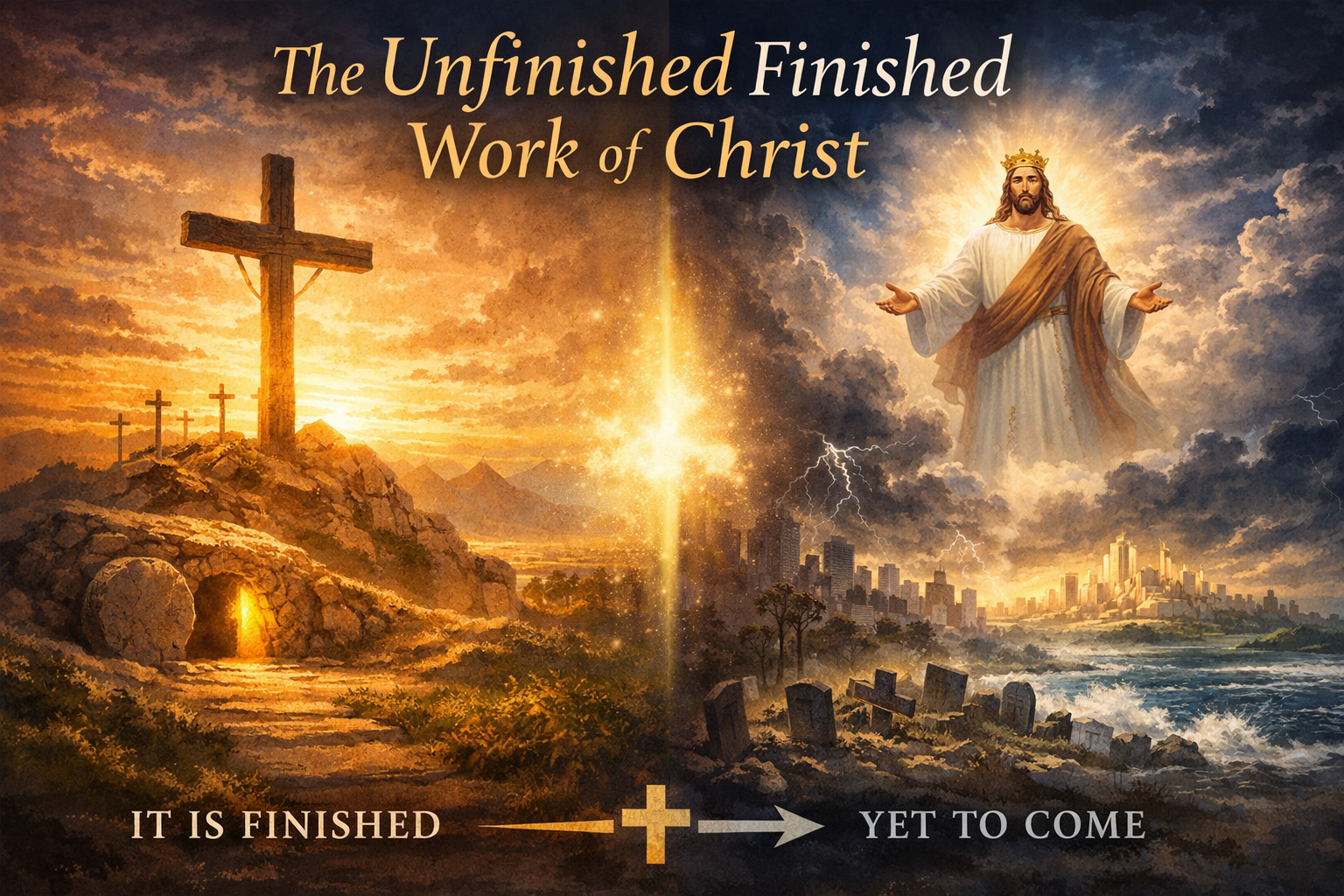
On the Unfinished Finished Work of Christ

In light of this being the week of our Lord’s passion, it is interesting to note that one of the last things that he said before he gave up his Spirit on the cross was, “It is finished.” (τετέλεσται, John 19.30). With this powerful word, Jesus declared that his work on the cross in making full atonement for sin was completed, and “bowing his head, he gave up his spirit.” It must have been a powerful scene, and no more pregnant words have perhaps ever been spoken. However, the problem is that even though Christ finished his work, sin still seems to run rampant in this world. If it is finished, why, we might ask, is the world still broken, still full of pain and suffering and sin and death? Because of this, we might be tempted to suggest that his work is unfinished. Many Christians struggle to hold together what has already been accomplished and what still remains. However, what we must realize is that Christ’s work is finished; it is fully accomplished in its foundation, but not yet fully realized in its effects. In this post, I would like to consider this tension by offering just a few thoughts on what Christ accomplished in his first coming and what waits to be realized at his second coming.

In one sense, then, it is completely accurate to say that the work of Christ has been fully accomplished, and there are at least three aspects of his work that are completely finished. First, atonement has been accomplished. When Christ died on the cross, he made the full and final payment for our sin. In systematic theology, this is called penal substitutionary atonement. In other words, this means that Christ paid the penalty (penal) that we deserve (substitutionary) for our sin. (On the fact that this was Christ’s view of his death, see here.) He died the death that we deserve by dying in our place. But he did not stay dead; he rose again on the third day. This is the second aspect of Christ’s finished work, namely that victory over death has been secured. When Jesus walked out of the grave on the third day, he defeated death and disarmed Satan of his power. Death no longer has hold over those who are in Christ. We need not fear, we can have hope, even in the face of death. (On hope in the face of death, see here.) And lastly, by dying on the cross, Christ finished his work of establishing righteousness. In other words, his finished work on the cross is now the ground upon which God grants our justification, when we place our faith in Jesus. He lived a perfect life, he died an innocent death. And his righteousness is imputed to us by faith. We are made right, declared innocent, because of Christ’s finished work. This is the gospel. Nothing needs to be added to what Christ accomplished; his work is complete, sufficient, and final. It is not partial, not provisional. It is finished!

Moreover, his finished work on the cross inaugurated several important realities in which we now live. For one, the Kingdom of God has been inaugurated. Forty days after his resurrection, Jesus ascended into heaven to be seated at the right hand of the Father, and he is now reigning with all authority on earth as it is in heaven. (Matt. 28.18) He is not waiting to become King; he is already reigning as King. And he does this by his Spirit. This is the second reality in which we now live, namely that Christ has sent his Spirit to indwell his people. The Spirit mediates Christ’s real presence in and among his people. He is the down payment, the seal, and the guarantee of our faith. And he is actively working in us to make us more like Jesus. And lastly, but certainly not leastly, new life has begun. When we place our faith in Christ, the Spirit regenerates us. He brings to life what was once spiritually dead, and we are born again. In this way we are new creatures in Christ. The old has passed away, and behold the new has come. (2 Cor. 5.17) New creation realities are already at work in us through the Spirit. In these ways, the future has already broken into the present through the risen Christ, and we live in these future realities even now.

And yet, in spite of all of this, several aspects of Christ’s work remain unfinished. Perhaps most clearly, sin still remains in the world. We have been saved from the penalty of sin, but we have not yet been saved from the presence of sin. Our world is saturated and polluted with sin at every turn. People are burdened down with sin and its consequences. Our relationships suffer, bodies are diseased, conflict and turmoil abound at every level of our society. Sin continues its reign of terror nearly unchecked. In addition to this, death still operates in this world. This world reeks with the stench of death; it fills our nostrils everywhere we turn. Our loved ones get sick and die. Accidents and tragedy take lives too soon. Christ has been raised, and death has been defeated. But death still reigns in our mortal bodies, and we ache and groan for that day when death will be no more. Thirdly, the created order groans under the weight of humanity’s sin. When our first parents fell, the creation itself was subjected to futility and decay. The idyllic paradise of Eden was lost to the corruption of sin. And lastly, justice and restoration are yet to be realized. Injustice abounds in our society. From all appearances, the weak get weaker and the strong get stronger. There is no real justice; there is no real peace. Wickedness and evil seem to grow day by day. What is wrong is celebrated as right, and what is right is condemned as wrong. The world is turned upside down, and we long for the day when justice will flow like rivers and when peace will rest upon the earth. And we cry out with the Scriptures, “How long, O Lord? How long?”

In theological parlance, this tension between the finished and the unfinished work of Christ is often referred to by the shorthand phrase “already/not yet”. It simply means that God’s plan of redemption for the world has already begun, has already been inaugurated, but has not yet been fully consummated. The work of Christ’s first coming is finished. He died on the cross, he rose again the third day, he sent his life-giving Spirit. But we are still waiting for the work of his second coming, namely the resurrection of the dead, the final judgment, and the new creation. This is the tension in which we now live, and in this tension, we must avoid two extremes. First, we must avoid living as if nothing has been finished. We must learn to rest in the finished work of Christ. We have been forgiven; we have been indwelled by His Spirit. We can have peace. On the other hand, however, we must not live as if everything is already complete. We do live under the burdens of sin and death; we do long for justice and peace. And we can have hope. The work of Christ is finished in its accomplishment, but it is unfinished in its application to the whole of creation. And so, we wait faithfully as Christ has instructed us.

And this is the point, namely that this tension is not ultimately about stages of fulfillment, though that is certainly the best framework for understanding it. Ultimately, this tension is about Christ. His work is unfinished because his story is not over. (On my argument for the centrality of Christ in our eschatological reflection, see here.) In other words, the same Jesus who said, “It is finished” is the same Jesus who is coming again to make all things new. The same Jesus who died on the cross is the same Jesus who is coming again in glory. Or to put it another way, the second coming of Jesus is not a different work; no, it is the completion of the same work that he began 2000 years ago. The second coming completes what the first coming began, because Christ himself is the fulfillment of all our hopes. Our hope is not just about what Christ has done and will do; it is about Christ himself. It is about his presence. In John 14.3, Jesus promised that he would come again and receive us unto himself, that where he is there we may be also. And so, the unfinished nature of Christ’s work is not a failure of the first coming, but the promise of the second. He is our blessed hope.

And so, yes, we live in the middle of this tension; we live in between the already and the not yet. We are already forgiven, but we are still struggling. We are already alive, yet we are still dying. We are already redeemed, yet we are still waiting. We are waiting to be set free from the presence and the corruption of sin once and for all. This is the lived reality of the Christian life—caught between what has been accomplished and what has not yet been revealed. And I suggest that we must embrace this tension with open arms, because it is only when we embrace this tension that we will be able to hope without denying the pain of our sufferings, that we can be confident without giving into naive triumphalism, and that we can have patience without being paralyzed by despair. If we collapse this tension in either direction, we lose something essential. Either we deny the reality of our present struggle, or we forget the certainty of our future hope. This is the ground that we must stand on, the already and the not yet. We do not live as those waiting for Christ to begin his work, but as those waiting for him to complete it.

When Jesus said, “It is finished.”, he surely meant it. Christ’s work is finished, and yet, it is not yet finished completely. It is finished in its foundation, but it is unfinished in its consummation. We are waiting for the full glory of Christ and his work to be finally revealed on earth. And even in acknowledging the unfinished aspects of Christ work, we must affirm that the work of the cross is not undone; it is unfolding. The resurrection is not isolated; it is expanding. And one day, we will all be raised to meet him in the air, and from that point on, we will always be with the Lord. This is our hope, namely that the Christ who finished his work on the cross is coming again to bring it to final completion. Even so, come quickly, Lord Jesus! Maranatha!


On Apocalyptic Eschatology and Christian Theology

In a frequently repeated statement, Ernst Käsemann famously said that “Apocalyptic was the mother of all Christian theology.” Not as well-known is that two years later, Käsemann clarified what he actually meant by “apocalyptic”: for him, it referred to “eschatology,” or in his words, “the expectation of an imminent Parousia.” Personally, I would define apocalyptic eschatology a bit more broadly. Apocalyptic eschatology is the belief that this present age is irredeemably corrupted by sin, that God is coming to intervene in a final judgment on the wicked, and that at that time he will vindicate the righteous and deliver them into a new of age of eschatological salvation that is both personal in the sense of resurrection and cosmic in the sense of renewal. The question remains, however, as to how this perspective might rightly be considered to be the “mother of all Christian theology,” and in the space that remains, I would simply like to offer a few brief explanations for this claim.

First, apocalyptic eschatology revolves around the final, climactic visitation of God to the earth. In the Old Testament, this visitation was often referred to as “the Day of the Lord.” In fact, there were many “days of the Lord” in the Old Testament, all of which function as typological portends of the final Day of the Lord when God comes in eschatological glory and power. Christian theology believes that this final Day of the Lord began when God came to earth in the incarnate Lord Jesus Christ. He was to be called Emmanuel, which is translated “God with us.” (Matthew 1.23). And the Lord Jesus himself said of Jerusalem, “you did not recognize the time when God visited you.” (Luke 19.44) This is exactly the point, namely that the coming of Christ in his incarnation was the beginning of the apocalyptic visitation of God to the earth. Of course, we know that He is coming again in glory and power to bring to consummation that which he began in His first coming, but the point here is that in Christ, God himself came in climactic apocalyptic visitation.

And this brings me to the second reason why apocalyptic eschatology is the mother of all Christian theology, namely that the first coming of Christ to the earth as a baby in a manger marked the beginning of the end of this corrupt present age. In New Testament theology, this is commonly referred to as the already and the not yet, namely that God’s plan for the final redemption of his people has already begun in Christ but it is not yet complete. Consequently, we live in this in between time of already and not yet, already saved, already filled with the eschatological spirit, already living under the blessings of God’s eschatological salvation in part, but we await the time when Christ will come again to consummate, or to bring to completion, that which he began by his death, resurrection and ascension. This is why Peter, in his Pentecost sermon, can say, “And it will be in the last days, says God, that I will pour out my Spirit on all people.” (Acts 2.17). The underlined phrase marks a change that Peter has applied to his source text (Joel 2.28), which simply says, “After this.” Peter understood that in Christ the last days had begun, and we have been living “in the [apocalyptic] last days” now for 2000 years.

But what about the final judgment of the wicked? Isn’t this something that is still yet future? How can we say that the apocalyptic judgment of the wicked began in Christ at his first coming? The answer is that this is exactly what we must say, as Jesus says in John 12.31-32, “Now is the judgment of this world. Now the ruler of this world will be cast out. As for me, if I am lifted up from the earth I will draw all people to myself.” The verb here, “lift up”, means to lift up on high, to exalt, or to raise to dignity and honor. This is why it is so ironic that John goes on to add the explanatory note, “He said this to indicate what kind of death he was about to die.” (John 12.33) The death of Jesus on the cross is nothing less than his enthronement. By his death, he judges the wickedness of this world and its ruler; He exposes the sinfulness and the ultimate fate of those that would reject him. This is why we can say that the final judgment began in Jesus, because a person’s response to the crucified and risen Christ will determine their eternal fate. In the death of Christ, judgment has begun, and it will be meted out when “the lamb who was slain,” as the Revelation calls him, returns in glory and power.

Finally, apocalyptic eschatology is the mother of all Christian theology because in Christ eschatological salvation has come. Salvation is inherently and irreducibly an eschatological concept. Saved from what, we might ask? We are saved from the eschatological wrath of God toward sin. And in Christ this salvation has broken into this present age and been made available to all those who respond to Christ in faith. This is why Peter refers to Joel’s prophecy to explain the coming of the Spirit at Pentecost, as we saw above. We have been filled with the eschatological Spirit, the seal and sign of the new age. We are new creatures, the fruit of a new creation, in Christ because of the Spirit. This is why the Apostle Paul can say, “Blessed is the God and Father of our Lord Jesus Christ, who has blessed us with every spiritual blessing in the heavens in Christ.” (Ephesians 1.3) Every spiritual blessing, every blessing of the age to come is already ours in Christ. We have been saved. We are being saved. And we will be saved. Apocalyptic salvation has already begun in Christ, and we are partakers of it by His indwelling Spirit.

So, I agree with the sentiments of Ernst Käsemann as expressed above. Apocalyptic eschatology is the mother of all Christian theology, because in Christ the apocalyptic visitation of God has come. All of the rest of our theology must be derived from this point, that the climactic work of God for the salvation of His people and His world has come in Christ. This is the Gospel; this is the good news of our salvation. In Christ, God himself has broken into this present age to redeem his people from their sin and set us free from its bondage, its corruption, even its very presence. And this is why we can have hope.


On Psalm 119.97-104 (Mem)

97 How I love your instruction!
It is my meditation all day long.
98 Your command makes me wiser than my enemies,
for it is always with me.
99 I have more insight than all my teachers
because your decrees are my meditation.
100 I understand more than the elders
because I obey your precepts.
101 I have kept my feet from every evil path
to follow your word.
102 I have not turned from your judgments,
for you yourself have instructed me.
103 How sweet your word is to my taste—
sweeter than honey in my mouth.
104 I gain understanding from your precepts;
therefore I hate every false way.

The question of the Law and its relevance for New Testament believers is a question that has boggled the minds of Christians ever since the first disciples. As New Covenent believers, we understand that Christ has fulfilled the Law, and this in every way. No part of the Law has been left unfulfilled by Christ. Paul even says that the Law has been “abolished” in the work of Christ (Eph 2.15). And yet, we also understand that the Law, as part of the Old Testament Scriptures, is profitable and valuable for “training in righteousness.” (2 Tim 3.16) Genuine believers love the Word of God, and they yearn to be transformed by its truths. The Law, however, appears to be so difficult, so out of touch, so unrelated to life in Christ, we naturally wonder what transformative relevance it might still have.

More than that, we are well aware of what the New Testament says about the Law, particularly in the Pauline Epistles. For example, we understand that “the letter [of the Law] kills, but the Spirit gives life” (2 Cor 3.6), and that “[we] are not under the law but under grace.” (Rom 6.14) We all stand condemned by the law, for “it is clear that no one is justified before God by the law.” (Gal 3.11) We have been taught that the purpose of the Law is to expose our failures to live up the righteous standards of God, to convicts us of our sin, and to reveal our need for a savior. In other words, if the Law has a role in the faith of New Testament believers, then it is largely negative, convicting, and condemning.

But this does not seem to be the attitude of our psalmist here in Psalm 119; he views the law positively and with deep adoration and affection. In this stanza, he writes “How I love your instruction” (verse 97), and “How sweet your word is to my taste—sweeter than honey in my mouth.” (verse 103) Of course, we could simply conclude that this psalmist is writing before the advent of Christ, and so perhaps his words are no longer relevant for how we should relate to the Old Testament Law. For Old Testament believers, the Law was the basis for their covenant relationship with God. It was the gift of God’s grace to make them His people and enter into a covenant with them. Clearly, we have something greater. We are under the Law of Christ. (1 Cor 9:21)

But I believe this perspective would fail to do justice to the words of our psalmist. Believers in both the Old and the New Testament are united by the principle of faith; they are a part of us. So, the attitude of our psalmist throughout Psalm 119, but especially here in the mem (מ, pronounced maym) stanza, is particularly instructive for us. We too should learn to love God’s Law, to meditate upon it all day long. We should find in it words of wisdom and life and understanding about the ways of right and wrong as they are determined by the one who gave it. We should read Old Testament books like Leviticus and Deuteronomy, and let them be like sweet honey in the mouths of our soul, because they reveal the one whom our soul loves.

The bottom line is this, that the Old Testament, especially the Law, is good and valuable and profitable and transformative for God’s people of all times. It does not merely convict us and condemn us and reveal to us that we deserve hell and need salvation; it also reveals the character, the virtues, and perfections of the one who is true and pure and holy. We must learn to appreciate these positive aspects of the Law’s role in our lives as Christians, because if we do not, we cut ourselves off from the sustaining and nourishing benefits that come through its pages. No, we are not bound under the covenant mediating authority of the Law; it is not the basis of our relationship with God in Christ by the Spirit. But it is part of God’s revelation of himself, and as such, it continues to have value and relevance for those of who are in Christ, much as the writer of Psalm 119 affirms.

For further study:
Introduction
Psalm 119.1-8
Psalm 119.9-16
Psalm 119.17-24
Psalm 119.25-32
Psalm 119.33-40
Psalm 119.41-48
Psalm 119.49-56
Psalm 119.57-64
Psalm 119.65-72
Psalm 119.73-80
Psalm 119.81-88
Psalm 119.89-96


On Praying Through Psalm 2

TEXT

Why do the nations rage
and the peoples plot in vain?
The kings of the earth take their stand,
and the rulers conspire together
against the Lord and his Anointed One:
“Let’s tear off their chains
and throw their ropes off of us.”

The one enthroned in heaven laughs;
the Lord ridicules them.
Then he speaks to them in his anger
and terrifies them in his wrath:
“I have installed my king
on Zion, my holy mountain.”

I will declare the Lord’s decree.
He said to me, “You are my Son;
today I have become your Father.
Ask of me,
and I will make the nations your inheritance
and the ends of the earth your possession.
You will break them with an iron scepter;
you will shatter them like pottery.”

10 So now, kings, be wise;
receive instruction, you judges of the earth.
11 Serve the Lord with reverential awe
and rejoice with trembling.
12 Pay homage to the Son or he will be angry
and you will perish in your rebellion,
for his anger may ignite at any moment.
All who take refuge in him are happy.

~Psalm 2

Series: Praying through the Psalms
Text: Psalm 2.1-12
Church: South Caraway Baptist Church, Jonesboro, AR
Date: April 5, 2023


Slow To Write

"let every person be quick to hear, slow to speak, slow to anger."

lovegavehope

Just another WordPress.com site

Jared Cornutt

Pastor | Speaker | Writer

Denny Burk

A commentary on theology, politics, and culture

G3 Ministries

Events + Resources for the Local Church

Biblical Reasoning

Biblical and Systematic Theology According to the Scriptures

RetroChristianity

Reclaiming the Forgotten Faith

SBC Voices

Southern Baptist News & Opinion

Lucid Theology

Thoughts on words, books, theology, and life.

Baptist21

A pastor-led voice for Baptists in the 21st century

Center For Baptist Renewal

The Personal and Professional Blog of Phillip Powers

The Pastor's Well - Pastor Well

The Personal and Professional Blog of Phillip Powers

Articles - AlbertMohler.com

The Personal and Professional Blog of Phillip Powers

The Gospel Coalition

The Personal and Professional Blog of Phillip Powers