Tag Archives: Justice

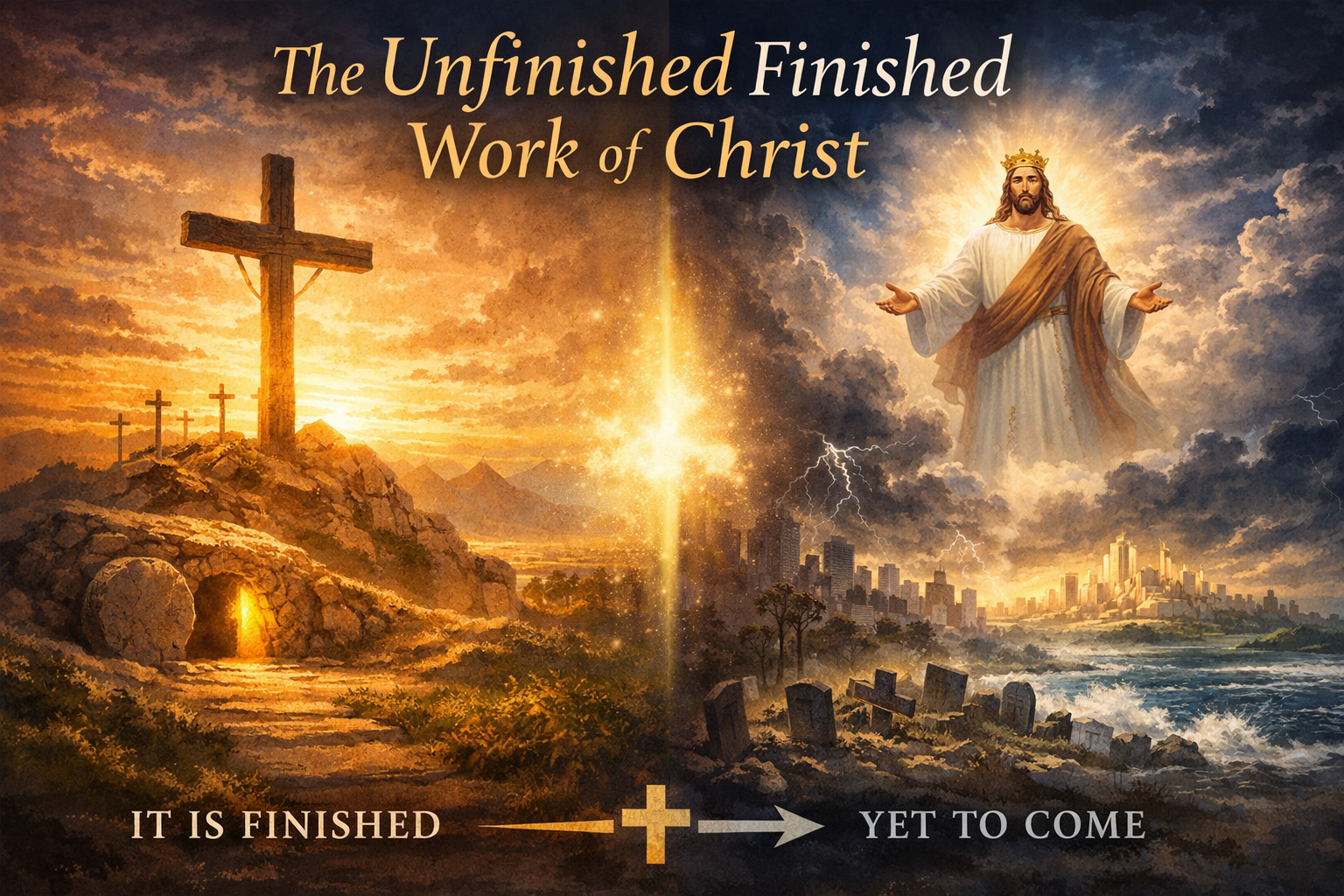
On the Unfinished Finished Work of Christ

In light of this being the week of our Lord’s passion, it is interesting to note that one of the last things that he said before he gave up his Spirit on the cross was, “It is finished.” (τετέλεσται, John 19.30). With this powerful word, Jesus declared that his work on the cross in making full atonement for sin was completed, and “bowing his head, he gave up his spirit.” It must have been a powerful scene, and no more pregnant words have perhaps ever been spoken. However, the problem is that even though Christ finished his work, sin still seems to run rampant in this world. If it is finished, why, we might ask, is the world still broken, still full of pain and suffering and sin and death? Because of this, we might be tempted to suggest that his work is unfinished. Many Christians struggle to hold together what has already been accomplished and what still remains. However, what we must realize is that Christ’s work is finished; it is fully accomplished in its foundation, but not yet fully realized in its effects. In this post, I would like to consider this tension by offering just a few thoughts on what Christ accomplished in his first coming and what waits to be realized at his second coming.

In one sense, then, it is completely accurate to say that the work of Christ has been fully accomplished, and there are at least three aspects of his work that are completely finished. First, atonement has been accomplished. When Christ died on the cross, he made the full and final payment for our sin. In systematic theology, this is called penal substitutionary atonement. In other words, this means that Christ paid the penalty (penal) that we deserve (substitutionary) for our sin. (On the fact that this was Christ’s view of his death, see here.) He died the death that we deserve by dying in our place. But he did not stay dead; he rose again on the third day. This is the second aspect of Christ’s finished work, namely that victory over death has been secured. When Jesus walked out of the grave on the third day, he defeated death and disarmed Satan of his power. Death no longer has hold over those who are in Christ. We need not fear, we can have hope, even in the face of death. (On hope in the face of death, see here.) And lastly, by dying on the cross, Christ finished his work of establishing righteousness. In other words, his finished work on the cross is now the ground upon which God grants our justification, when we place our faith in Jesus. He lived a perfect life, he died an innocent death. And his righteousness is imputed to us by faith. We are made right, declared innocent, because of Christ’s finished work. This is the gospel. Nothing needs to be added to what Christ accomplished; his work is complete, sufficient, and final. It is not partial, not provisional. It is finished!

Moreover, his finished work on the cross inaugurated several important realities in which we now live. For one, the Kingdom of God has been inaugurated. Forty days after his resurrection, Jesus ascended into heaven to be seated at the right hand of the Father, and he is now reigning with all authority on earth as it is in heaven. (Matt. 28.18) He is not waiting to become King; he is already reigning as King. And he does this by his Spirit. This is the second reality in which we now live, namely that Christ has sent his Spirit to indwell his people. The Spirit mediates Christ’s real presence in and among his people. He is the down payment, the seal, and the guarantee of our faith. And he is actively working in us to make us more like Jesus. And lastly, but certainly not leastly, new life has begun. When we place our faith in Christ, the Spirit regenerates us. He brings to life what was once spiritually dead, and we are born again. In this way we are new creatures in Christ. The old has passed away, and behold the new has come. (2 Cor. 5.17) New creation realities are already at work in us through the Spirit. In these ways, the future has already broken into the present through the risen Christ, and we live in these future realities even now.

And yet, in spite of all of this, several aspects of Christ’s work remain unfinished. Perhaps most clearly, sin still remains in the world. We have been saved from the penalty of sin, but we have not yet been saved from the presence of sin. Our world is saturated and polluted with sin at every turn. People are burdened down with sin and its consequences. Our relationships suffer, bodies are diseased, conflict and turmoil abound at every level of our society. Sin continues its reign of terror nearly unchecked. In addition to this, death still operates in this world. This world reeks with the stench of death; it fills our nostrils everywhere we turn. Our loved ones get sick and die. Accidents and tragedy take lives too soon. Christ has been raised, and death has been defeated. But death still reigns in our mortal bodies, and we ache and groan for that day when death will be no more. Thirdly, the created order groans under the weight of humanity’s sin. When our first parents fell, the creation itself was subjected to futility and decay. The idyllic paradise of Eden was lost to the corruption of sin. And lastly, justice and restoration are yet to be realized. Injustice abounds in our society. From all appearances, the weak get weaker and the strong get stronger. There is no real justice; there is no real peace. Wickedness and evil seem to grow day by day. What is wrong is celebrated as right, and what is right is condemned as wrong. The world is turned upside down, and we long for the day when justice will flow like rivers and when peace will rest upon the earth. And we cry out with the Scriptures, “How long, O Lord? How long?”

In theological parlance, this tension between the finished and the unfinished work of Christ is often referred to by the shorthand phrase “already/not yet”. It simply means that God’s plan of redemption for the world has already begun, has already been inaugurated, but has not yet been fully consummated. The work of Christ’s first coming is finished. He died on the cross, he rose again the third day, he sent his life-giving Spirit. But we are still waiting for the work of his second coming, namely the resurrection of the dead, the final judgment, and the new creation. This is the tension in which we now live, and in this tension, we must avoid two extremes. First, we must avoid living as if nothing has been finished. We must learn to rest in the finished work of Christ. We have been forgiven; we have been indwelled by His Spirit. We can have peace. On the other hand, however, we must not live as if everything is already complete. We do live under the burdens of sin and death; we do long for justice and peace. And we can have hope. The work of Christ is finished in its accomplishment, but it is unfinished in its application to the whole of creation. And so, we wait faithfully as Christ has instructed us.

And this is the point, namely that this tension is not ultimately about stages of fulfillment, though that is certainly the best framework for understanding it. Ultimately, this tension is about Christ. His work is unfinished because his story is not over. (On my argument for the centrality of Christ in our eschatological reflection, see here.) In other words, the same Jesus who said, “It is finished” is the same Jesus who is coming again to make all things new. The same Jesus who died on the cross is the same Jesus who is coming again in glory. Or to put it another way, the second coming of Jesus is not a different work; no, it is the completion of the same work that he began 2000 years ago. The second coming completes what the first coming began, because Christ himself is the fulfillment of all our hopes. Our hope is not just about what Christ has done and will do; it is about Christ himself. It is about his presence. In John 14.3, Jesus promised that he would come again and receive us unto himself, that where he is there we may be also. And so, the unfinished nature of Christ’s work is not a failure of the first coming, but the promise of the second. He is our blessed hope.

And so, yes, we live in the middle of this tension; we live in between the already and the not yet. We are already forgiven, but we are still struggling. We are already alive, yet we are still dying. We are already redeemed, yet we are still waiting. We are waiting to be set free from the presence and the corruption of sin once and for all. This is the lived reality of the Christian life—caught between what has been accomplished and what has not yet been revealed. And I suggest that we must embrace this tension with open arms, because it is only when we embrace this tension that we will be able to hope without denying the pain of our sufferings, that we can be confident without giving into naive triumphalism, and that we can have patience without being paralyzed by despair. If we collapse this tension in either direction, we lose something essential. Either we deny the reality of our present struggle, or we forget the certainty of our future hope. This is the ground that we must stand on, the already and the not yet. We do not live as those waiting for Christ to begin his work, but as those waiting for him to complete it.

When Jesus said, “It is finished.”, he surely meant it. Christ’s work is finished, and yet, it is not yet finished completely. It is finished in its foundation, but it is unfinished in its consummation. We are waiting for the full glory of Christ and his work to be finally revealed on earth. And even in acknowledging the unfinished aspects of Christ work, we must affirm that the work of the cross is not undone; it is unfolding. The resurrection is not isolated; it is expanding. And one day, we will all be raised to meet him in the air, and from that point on, we will always be with the Lord. This is our hope, namely that the Christ who finished his work on the cross is coming again to bring it to final completion. Even so, come quickly, Lord Jesus! Maranatha!


On the Curse of Death and the Hope of Resurrection

TEXT

12 The iniquity of Ephraim is bound up;
His sin is stored up.
13 The pains of childbirth come upon him;
He is not a wise son,
For it is not the time that he should delay at the opening of the womb.
14 Shall I ransom them from the power of Sheol?
Shall I redeem them from death?
O Death, where are your thorns?
O Sheol, where is your sting?
Compassion will be hidden from My sight.

15 Though he flourishes among the reeds,
An east wind will come,
The wind of the Lord coming up from the wilderness;
And his fountain will become dry
And his spring will be dried up;
It will plunder his treasury of every precious article.
16 Samaria will be held guilty,
For she has rebelled against her God.
They will fall by the sword,
Their little ones will be dashed in pieces,
And their pregnant women will be ripped open.

~Hosea 13.12-16 (NASB95)

Title: On the Curse of Death and the Hope of Resurrection
Text: Hosea 13.12-16
Series: Hosea: A Love Story Like No Other
Church: Redeemer Baptist Church, Jonesboro, AR
Date: July 13, 2025


On the Love and the Justice of God

TEXT

The word of the Lord that came to Hosea son of Beeri during the reigns of Uzziah, Jotham, Ahaz, and Hezekiah, kings of Judah, and of Jeroboam son of Jehoash, king of Israel.

When the Lord first spoke to Hosea, he said this to him:

Go and marry a woman of promiscuity,
and have children of promiscuity,
for the land is committing blatant acts of promiscuity
by abandoning the Lord.

So he went and married Gomer daughter of Diblaim, and she conceived and bore him a son. Then the Lord said to him:

Name him Jezreel, for in a little while
I will bring the bloodshed of Jezreel
on the house of Jehu
and put an end to the kingdom of the house of Israel.
On that day I will break the bow of Israel
in Jezreel Valley.

She conceived again and gave birth to a daughter, and the Lord said to him:

Name her Lo-ruhamah,
for I will no longer have compassion
on the house of Israel.
I will certainly take them away.
But I will have compassion on the house of Judah,
and I will deliver them by the Lord their God.
I will not deliver them by bow, sword, or war,
or by horses and cavalry.

After Gomer had weaned Lo-ruhamah, she conceived and gave birth to a son. Then the Lord said:

Name him Lo-ammi,
for you are not my people,
and I will not be your God.
10 Yet the number of the Israelites
will be like the sand of the sea,
which cannot be measured or counted.
And in the place where they were told:
You are not my people,
they will be called: Sons of the living God.
11 And the Judeans and the Israelites
will be gathered together.
They will appoint for themselves a single ruler
and go up from the land.
For the day of Jezreel will be great.
Call your brothers: My People
and your sisters: Compassion.

Title: On the Love and Justice of God
Text: Hosea 1.1-2.1; 3.1-5
Series: Hosea: A Love Story Like No Other
Church: Redeemer Baptist Church, Jonesboro, AR
Date: March 9, 2025


On the Fear of God and the Fulfilled Life

TEXT

In addition to the Teacher being a wise man, he constantly taught the people knowledge; he weighed, explored, and arranged many proverbs. 10 The Teacher sought to find delightful sayings and write words of truth accurately. 11 The sayings of the wise are like cattle prods, and those from masters of collections are like firmly embedded nails. The sayings are given by one Shepherd.

12 But beyond these, my son, be warned: there is no end to the making of many books, and much study wearies the body. 13 When all has been heard, the conclusion of the matter is this: fear God and keep his commands, because this is for all humanity. 14 For God will bring every act to judgment, including every hidden thing, whether good or evil.

Text: Ecclesiastes 12.9-14
Series: The Book of Ecclesiastes
Church: South Caraway Baptist Church, Jonesboro, AR
Date: October 2, 2022


On the Second Sunday of Advent

second-sunday-in-advent

In the second week of Advent, we focus on peace, that the Christ-child came into the world to offer us peace. Peace, meaning the absence of conflict, of animosity, of antagonism. In the words of the angels on the night of His birth, “Glory to God in the highest heaven, and peace on earth to people he favors.” (Luke 2.14) And when the Prince of Peace returns one day, He will establish His kingdom of perpetual peace once and for all. However, the good news pf Advent is that this is a peace that we, as His people, already experience in the here and now. And so, the lectionary readings for the Second Sunday of Advent invite us into the peace that His coming offers us and that we desperately look forward to at His coming.

Old Testament: Isaiah 11.1-10
Of course, the prophecies of Isaiah are replete with messianic overtones, and this week’s Old Testament reading is no different. In verse 1, we read, “Then a shoot will grow from the stump of Jesse,” which is Isaiah’s way of describing the Messiah according to His biological lineage descended from David, Son of Jesse. But the important thing about Him is what He will do, specifically how He will rule. Verse 2 of the passage tells us that, “The Spirit of the Lord will rest on him.” In other words, Messiah will be anointed with the Spirit of God for the purpose of ruling in justice. And what we must understand is that a just rule, established in righteousness and faithfulness (verse 5), is a prerequisite for peace, because, “He will judge the poor righteously and execute justice for the oppressed of the land.” (verse 4)

And it is His just rule that establishes the idyllic serenity that Isaiah goes on to describe in verses 6-9. “The wolf (traditionally read as lion) will dwell with lamb, and the leopard will lie down with the goat,” etc. And notice in verse 9, “They will not harm or destroy each other on my entire holy mountain, for the land will be full of the knowledge of the Lord as the sea is filled with water.” This is Isaiah’s vision for the reign of Messiah, that violence will be no more, that bloodshed and conflict will be no more. Oh, how we long for that day, because, “On that day the root of Jesse will stand as a banner for the peoples. The nations will look to him for guidance, and his resting place will be glorious.” In other words, the reign of Messiah will be characterized by perfect peace. 

Psalm: Psalm 72.1-7, 18-19
According to the traditional heading, this psalm appears to be a prayer that was written by King David (see verse 20) for his son and successor Solomon. David is praying for Solomon as he prepares to ascend to the throne. And so, in verse 1, we read, “God, give your justice to the king and your righteousness to the king’s son.” However, given the messianic implications of the term “son of David”, we must see this as a prayer for the perfect and peaceful rule of Messiah. “He will judge your people with righteousness and your afflicted ones with justice.” (verse 2) And again, “May he vindicate the afflicted among the people, help the poor, and crush the oppressor.” (verse 4)  In other words, this psalm is an expression of longing for peace that is written on every human soul, and it reminds us that our longings for peace on earth will never be fully satisified by any human ruler or government. No, “Blessed be the Lord God, the God of Israel, who alone does wonders. Blessed be his glorious name forever; the whole earth is filled with his glory. Amen and amen.” (verse 18-19). There is a deep and severe longing in every human soul for the peace, and in this prayer, we affirm that it will only be realized with the coming of Messiah.

Gospel: Matthew 3.1-12
In the Gospel reading, then, we read of a familiar character in the Gospel accounts, namely John the Baptizer. And though we may not think of him in conjunction with the Christmas story, he is, nevertheless, important because of His role as herald. “For he is the one spoke of through the prophet Isaiah, who said: A voice of one crying out in the wilderness: Prepare the way for the Lord; make his paths straight.” (verse 3) And so, as we think about our Lord’s Advent, we must recognize that John was the appointed herald to announce His initial arrival. And he did so my preaching, “Repent, because the kingdom of heaven has come near.” (verse 2) This, by the way, is the same message that Jesus preached at the beginning of His ministry in Galilee.

But what makes this passage appropriate for Advent is what John says to the Pharisees and Sadducees who came out to be baptized. In verse 7, we read, “Brood of vipers! Who warned you to flee from the coming wrath?” Admittedly, it is somewhat awkward to read about wrath when we are supposed to be focusing on peace; however, John has hit on something that is important to understand about our Lord’s coming, namely that before there can be peace, there must be wrath. Evil must be dealt with, and the wicked must be removed so that peace can rise.  And so, John proclaims that one who comes after him has “His winnowing shovel is in his hand, and he will clear his threshing floor and gather his wheat into the barn. But the chaff he will burn with the fire that never goes out.” When our Lord Christ returns to in glory, He will bring with Him two things, peace for those who repent of their sins and wrath for those that do not. And so John tells us, “Therefore produce fruit consistent with repentance.”

New Testament: Romans 15.4-13
And finally, in the New Testament reading, we can see exactly what kind of fruit that is, namely that we who have repented of our sins, trusted in Christ, and received His peace should show forth that peace toward others. As Paul puts it in verse 7, “Therefore accept one another, just as Christ also accepted you, to the glory of God.” In other words, we are called to be Christ’s agents of peace in the world; we give to others what we ourselves have already received. This is in keeping with Paul’s prayer in verse 13, where he prays, “Now may the God of hope fill you with all joy and peace as you believe so that you may overflow with hope by the power of the Holy Spirit.” The point is that the foundation for peaceful human relationships is grounded in the finished work of the Christ-child.

And the proof of Paul’s point in this passage is the full and equal inclusion of the Gentiles in the people of God. In the first century, there was no more antagonistic vitriolic relationship as that between the Jews and the Gentiles, but Paul strings together a handful of Old Testament quotes in this passage to show that it was always God’s plan to bring the Gentiles into the kingdom of Messiah. So, all of a sudden, Jewish followers of Jesus were faced with a dilemma, namely how could they accept Gentile followers of Jesus  into their communities as brothers and sisters in Christ. And Paul’s answer is that they can because they have received the peace of Christ. So, he prays, “Now may the God who gives endurance and encouragement grant you to live in harmony with one another, according to Christ Jesus, so that you may glorify the God and Father of our Lord Jesus Christ with one mind and one voice.” This is the crucial point: He gives peace, we embrace peace, and He gets the glory.

May this Advent season bring you and yours all the peace of Christ that passes all understanding, and may we all show forth His peace to a world that is in so desperate need of it!

For Further Study:
On the Season of Advent
On the First Sunday of Advent


Slow To Write

"let every person be quick to hear, slow to speak, slow to anger."

lovegavehope

Just another WordPress.com site

Jared Cornutt

Pastor | Speaker | Writer

Denny Burk

A commentary on theology, politics, and culture

G3 Ministries

Events + Resources for the Local Church

Biblical Reasoning

Biblical and Systematic Theology According to the Scriptures

RetroChristianity

Reclaiming the Forgotten Faith

SBC Voices

Southern Baptist News & Opinion

Lucid Theology

Thoughts on words, books, theology, and life.

Baptist21

A pastor-led voice for Baptists in the 21st century

Center For Baptist Renewal

The Personal and Professional Blog of Phillip Powers

The Pastor's Well - Pastor Well

The Personal and Professional Blog of Phillip Powers

Articles - AlbertMohler.com

The Personal and Professional Blog of Phillip Powers

The Gospel Coalition

The Personal and Professional Blog of Phillip Powers