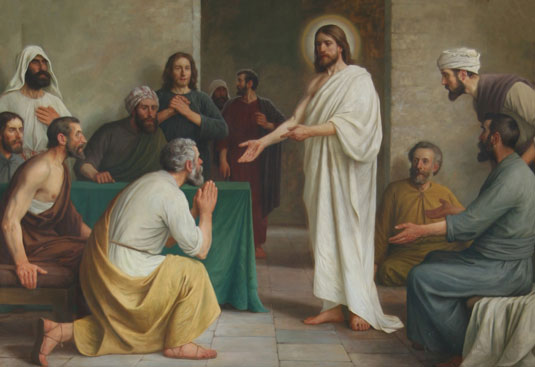
In John 20.19-23, Jesus appears in the upper room on the eve of his resurrection, and he breathes on the disciples saying, “Receive the Holy Spirit.” This is the so-called Johannine Pentecost, and at a glance, it would seem to contradict the very clear teaching of the book of Acts that the Spirit was given on the Day of Pentecost some 50 days after Jesus’s resurrection. If the events of that first Pentecost are understood as the climactic coming of the Spirit to indwell the followers of Christ, then Jesus’ giving of the Spirit in John 20.22 would seem to indicate that John (who was present at Pentecost) was hopelessly confused about the timeline. In the space the follows, I would like to suggest that John is not confused; rather, I think that John 20 presents Jesus’ giving of the Spirit as the breath of the new creation in fulfillment of Ezekiel’s restoration promises and in turn, it grounds the church’s corporate authority to forgive in the life of the risen Christ.
Of course, scholars and pastors have tried to resolve this tension in a variety of ways throughout the history of the church, and here I will identify just four. First, some suggest that the giving of the Spirit in John 20 is a kind of proleptic gift, a partial filling, that was meant to steel the disciples until the climactic coming of the Spirit 50 days later. Others suggest that John has theologized the giving of the Spirit by temporally relocating the event to the resurrection and directly connecting it with the risen Christ in light of his own “realized eschatology”. Still others suggest that John 20 functions as a kind of apostolic commission for the disciples which establishes their role as authoritative leaders in the early church. Finally, and this is my view, but the giving of the Spirit in John 20 should be understood as the inauguration of the age of the New Covenant/New Creation. This is not in contradiction to the Book of Acts and its descriptions of the Day of Pentecost. Rather, John has compressed these events theologically by linking the resurrection of Jesus with the concept of new creation, the giving of the Spirit, and the inauguration of eschatological life. He does this by alluding to the creation account in Genesis 1-2 and the New Covenant/Resurrection account in Ezekiel 36-37.
In John 20, the scene opens “On the first day of the week” (20.1), and this temporal note is repeated in our passage in 20.19, “when it was evening on the first day of the week.” This is a clear allusion to the first day of creation in Genesis 1. In other words, with the resurrection of Jesus comes a new first day, a new creation. This allusion is further confirmed by the fact that the scene takes place in a garden (19.31), and Mary mistakes the risen Christ for the “gardener” (20. 15). This is most likely a typological allusion to Christ as the second Adam. More significantly, we are told that Jesus “breathed on them.” The Greek word here (ἐνεφύσησεν ) is a verb that only occurs here in the New Testament. In the Greek translation of the Old Testament (LXX), in Genesis 2.7, we read that “The the Lord God formed the man out of the dust from the ground and breathed the breath of life into his nostrils, and the man became a living being.” In the same way (and with same word) that God breathed life into Adam, so also the risen Christ breathes life into his disciples. This is not just incidental language; the Evangelist has utilized this rare word intentionally, because he wants to connect the resurrection of Jesus with the new creation. When Jesus breathes the Holy Spirit on the disciples, they become participants in a new humanity.
However, there is another important Old Testament allusion that stands in the background of John 20, and that is the description of the New Covenant and the story of the Dry Bones in Ezekiel 36-37. In Ezekiel 36.26-27 (also 37.14), we read,
I will give you a new heart and put a new spirit within you; I will remove your heart of stone and give you a heart of flesh. I will place my Spirit within you and cause you to follow my statutes and carefully observe my ordinances.
And in Ezekiel 37.1-14, we read where Ezekiel is commanded to prophesy to the breath to “come from the four winds and breath (ἐμφύσησον) into these slain so that they may live.” In the same way that Ezekiel stood in the midst of the valley of dry bones and the dead came to life by the “breath/Spirit” of God, so also the risen Christ stands in the midst of his disciples who are “dead/paralyzed” in fear, and breathes into them the Spirit of life. Now, in the book of Ezekiel, these chapters drip with corporate overtones, particularly in regard to the restoration of the people of Israel. The dry bones coming to life is a symbol of national (and individual) resurrection and restoration, and the Johannine Pentecost symbolizes the eschatological restoration of the people of God, such that the 12 (or 11) disciples function as the nucleus of that people as a renewed Israel. The point is that John portrays the resurrection of Jesus as the moment when the promised Spirit of restoration becomes reality.
Now, it is important here that we stop and recall what John has already said back in John 7. 39, where we read, “Those who believed in Jesus were going to receive the Spirit, for the Spirit had not yet been given because Jesus had not yet been glorified.” This is the heart of John’s theology, namely that the glorification/exaltation of Christ comes in the crucifixion/resurrection of Jesus. We know this because, Jesus said in John 12:32, “As for me, if I am lifted up from the earth I will draw all people to myself.” He said this to indicate what kind of death he was about to die.” The verbal idea of being “lifted up” refers both to the kind of death he would die but also to the idea of exaltation. Point being that in John 20, Jesus has now been glorified and so the Spirit can now be given as a sign of eschatological life.
However, there is one more problem in this passage. In verse 23, we read where Jesus tells the disciples, “If you forgive the sins of any, they are forgiven them; if you retain the sins of any, they are retained.” Of course, this language also occurs in the Gospel of Matthew, in Matthew 16:19 in Jesus words to Peter and then again in 18:18 in the context of the Community Discourse. Clearly, this is the language of commissioning and authority, but exactly what kind of authority is in view here is debated. Some (particularly in the Roman Catholic and Eastern Orthodox traditions) understand these words to signify Apostolic/priestly authority to absolve sins. Others understand them to describe the authority of the church to announce the promise of forgiveness on the basis of the gospel. In my view, in the context of John 20, these words demonstrate that the Spirit-empowered community participates in the eschatological sorting of humanity. Forgiveness is determined by a person’s acceptance or rejection of the person and work of the Son (cf. John 3:18-21), but the church’s authority to forgive is part of its new-creation governance. In other words, just as the first humans were given dominion in the Garden of Eden (Genesis 1:28), so also the church as a new humanity is given Spirit-authorized responsibility as an agent of new-creation reconciliation. And John is clear that this authority is derivative, not autonomous; it flows from the risen Christ’s life and breath (i.e. Spirit).
In conclusion, then we must conclude that the Johannine Pentecost is not simply the relocation of the events of Acts 2; these are distinct narrative events serving distinct theological purposes. Whereas Acts emphasizes the public outpouring of the Spirit, the gift of tongues, and the church’s mission to the nations, John emphasizes the new creation, the restoration of the people of God, and ecclesial authority and identity. To put it more simply, John narrates the ontological beginning of the New Covenant age, and Luke narrates the Spirit-empowered expansion of the church’s mission. There is no contradiction; these are simply two theological angles on one redemptive reality. By tying his narrative to Genesis and Ezekiel, John gives us a theologically robust understanding of the significance of Christ’s resurrection. More importantly though, John 20.19-23 clearly demonstrates that the church exists because the risen Christ breathes his life into it. Its life is cruciform and Spirit-dependent, and its mission is one of reconciliation in the power of the new creation.
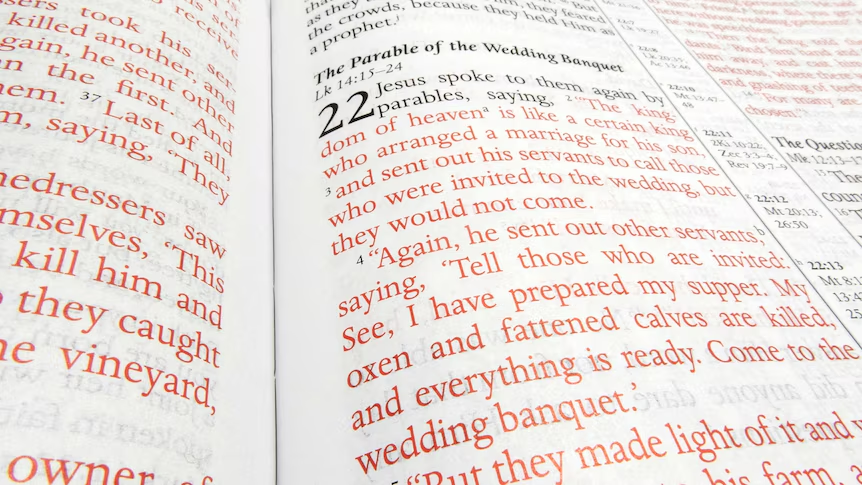
Most English versions of the Bible print the words of Jesus in the Gospels in red letters. It is a tradition that goes back nearly a century. The first red-letter New Testament was published in 1899; the full Bible with a red-letter New Testament was printed two years later in 1901. The reason for this practice is relatively clear, namely to highlight the words of Jesus over against the surrounding narrative and commentary. As noble as this aim is, it can lead to some unhealthy conclusions and applications. Readers might be tempted to conclude that the red letters are more important, more valuable, and more primary than the rest of the New Testament. For example, some so-called “red letter Christians” pit the words of Jesus against the rest of the New Testament and purport to follow the social ethic of Jesus which is characterized by love and compassion rather than the more conservative theology and ethics of the Apostle Paul et al. However, if Jesus is fully God, and there is only one God, and if God inspired the whole Bible, then in a sense all of the words of the Bible, whether black or red, are the words of Jesus.
Of course, this does not mean that the actual content of Jesus’s teaching ministry is unimportant. When it comes to the quest of the historical Jesus, the details of what Jesus said and did are essential for understanding who Jesus was and what he came to do. This is why scholars of the historical Jesus developed criteria of authenticity to determine which sayings in the canonical gospels authentically come from Jesus and which ones do not. Criteria like multiple attestation, dissimilarity, coherence, embarrassment and others like these are used to decide the authenticity of each individual saying or pericope. However, more often than not, these criteria have been used to dismiss more sayings than they have proven. This is most evident in work of the Jesus Seminar and their book The Five Gospels: What did Jesus Really Say? The Search for the Authentic Words of Jesus. Instead of establishing the authentic words of Jesus, they dismissed some 82 % of the sayings attributed to Jesus in the canonical Gospels either as things he definitely did not say (black bead) or as things he did not say but that might be close to his ideas (grey bead). Even sayings that met the established criteria were dismissed as inauthentic. This proves that there was probably another criteria at play in their judgment, that being if a saying evinced a relatively high Christology, then it was not authentic in their view.
More to the point, in my recent book review of Jesus and His Promised Second Coming by Tucker S. Ferda (see here), I suggested that the search for the “authentic” sayings of the historical Jesus in the gospels is a fundamentally flawed endeavor from the outset. This is because the Gospel writers did not set out to record the words of Jesus verbatim (ipsissima verba). They did, however, attempt to convey the words of Jesus by way of summary, thematic arrangement, implication, and interpretation. In other words, they were conveying the essential substance of the words of Jesus as well as it theological significance (ipsissima vox or substantia verba). This is partly because the Gospels are based on traditions that were passed down orally from the time of Jesus until the time the Gospels were composed. Even if the composition of the Gospels is dated early, i.e. in the 40s or 50s CE, then we are talking about 10+ years that have passed from the time Jesus to the time when the sayings of Jesus were written down. The point is that if “authentic” is understood to mean the actual words that Jesus spoke verbatim as he spoke to them, then we are searching for something that will never be found.
On the other hand, we must affirm that the Gospel writers were not simply making things up as they went along, putting words into the mouth of Jesus that he never said or thought. This is sometimes compared to the children’s game of “telephone”, where the first child hears a sentence, and then passes it along to the next child by whispering in their ear, and on to the next and so on. More often than not, when the final child reports the sentence, the final version is a far cry from the original, and usually so horribly garbled as to be beyond recognition. This analogy is a caricature of the actual nature of oral transmission. Not only was the culture at the time of Jesus thoroughly oral, but the Jews in particular took the transmission of oral tradition highly seriously. The Old Testament scriptures commanded them to pass on their faith orally from generation to generation, and Jewish children were trained in this from an early age in the temple and synagogues. The faithful transmission of oral tradition was practically sacrosanct in Jewish culture, and given the recognized authority of Jesus as a rabbi, the gospels writers would never have thought to put their own thoughts and agendas into his mouth. The same could be said for so-called prophetic utterances given by the risen Jesus; these would never have been treated as on par with actual Jesus tradition. As Luke himself indicates in the opening of his Gospel (1:1-4), the Gospel writers were faithfully writing down that which they had also remembered and received.
Now, someone might object, “What about the doctrine of inspiration? Weren’t the Gospel writers inspired by the Holy Spirit and so kept from error?” And I would answer, “Yes! Of course they were!” (2 Tim 3:16-17). But inspiration is not dictation. The Gospel writers were not mindless automatons simply transcribing by rote. Here again, Luke’s introduction indicates that he had done his research, had talked to eyewitnesses, had done the hard work “to write carefully and in order.” In other words, inspiration does not negate the normal processes of research and writing. In inspiration, the Holy Spirit works in, with, and through the human author in such a way that their words are his words. Moreover, the method of inspiration varies according to the genre of the literature being inspired. Clearly, prophetic texts, “thus saith the Lord” were directly inspired speech, but historical narrative, epistles, et al. allow for the creative engagement of the human author with the work of the Holy Spirit. B. B. Warfield puts it this way in The Inspiration and Authority of the Bible,
The Scriptures, in other words, are conceived by the writers of the New Testament as through and through God’s book, in every part expressive of His mind, given through men after a fashion which does no violence to their nature as men, and constitutes the book also men’s book as well as God’s, in every part expressive of the mind of its human authors.
The point of all this is to say that the Gospel writers have faithfully conveyed to us the real and true words of Jesus even if they have not conveyed to us his exact words. So, we should not take individual sayings (or even whole pericopes) out of their narrative context and then dismiss them as wholly inauthentic. This is a fundamentally flawed method of historical and exegetical inquiry. Rather we should attempt to understand how the words and actions of Jesus fit within the context of first century Judaism and how they gave rise to the theology and practice of the early church. As to whether we should continue to print the words of Jesus is red letters, I am of mixed opinion. Further, I suspect that my views on the question will do nothing to unseat standard publishing practice. Nevertheless, we must understand that there is no portion of Holy Scripture that is more authoritative, more valuable, more transformative than any other. Whether we are dealing with the letters of Paul or with the words of Jesus in the Gospels, we are dealing with the Word of God, and it is He who is speaking to us when we read. And so we should ask the Lord to give us the ears to hear and the hearts to receive what the Spirit is saying to us.
8 The high priest Hilkiah told the court secretary Shaphan, “I have found the book of the law in the Lord’s temple,” and he gave the book to Shaphan, who read it. 9 Then the court secretary Shaphan went to the king and reported, “Your servants have emptied out the silver that was found in the temple and have given it to those doing the work—those who oversee the Lord’s temple.” 10 Then the court secretary Shaphan told the king, “The priest Hilkiah has given me a book,” and Shaphan read it in the presence of the king.
11 When the king heard the words of the book of the law, he tore his clothes. 12 Then he commanded the priest Hilkiah, Ahikam son of Shaphan, Achbor son of Micaiah, the court secretary Shaphan, and the king’s servant Asaiah, 13 “Go and inquire of the Lord for me, for the people, and for all Judah about the words in this book that has been found. For great is the Lord’s wrath that is kindled against us because our ancestors have not obeyed the words of this book in order to do everything written about us.”
14 So the priest Hilkiah, Ahikam, Achbor, Shaphan, and Asaiah went to the prophetess Huldah, wife of Shallum son of Tikvah, son of Harhas, keeper of the wardrobe. She lived in Jerusalem in the Second District. They spoke with her. 15 She said to them, “This is what the Lord God of Israel says: Say to the man who sent you to me, 16 ‘This is what the Lord says: I am about to bring disaster on this place and on its inhabitants, fulfilling all the words of the book that the king of Judah has read, 17 because they have abandoned me and burned incense to other gods in order to anger me with all the work of their hands. My wrath will be kindled against this place, and it will not be quenched.’
18 Say this to the king of Judah who sent you to inquire of the Lord: ‘This is what the Lord God of Israel says: As for the words that you heard, 19 because your heart was tender and you humbled yourself before the Lord when you heard what I spoke against this place and against its inhabitants, that they would become a desolation and a curse, and because you have torn your clothes and wept before me, I myself have heard’—this is the Lord’s declaration. 20 ‘Therefore, I will indeed gather you to your ancestors, and you will be gathered to your grave in peace. Your eyes will not see all the disaster that I am bringing on this place.’” Then they reported to the king.
~2 Kings 22.8-20
Title: On Fuel for the Fires of Revival Text: 2 Kings 22-23 Series: Revival Us Again! Church: Redeemer Baptist Church, Jonesboro, AR Date: December 28, 2025
Christmas really is one of my most favorite times of the year. I love the decorations, the gifts, the parties, and the church Christmas programs, but most of all I love the music. The traditional Christmas carols, the sacred Christmas hymns, they just give me all the feels when it comes to Christmas; in the car, at home, at church, you will almost always find me listening to Christmas music during the month of December. And one of my most favorite Christmas songs is the song “Mary, Did You Know?”, and my most favorite arrangement of the song is performed by Mark Lowry with the acapella group Voctave singing backup (posted above). Mark Lowry wrote the lyrics in 1985 when he was asked to write a script for a church Christmas play, and the lyrics were put to music in 1991 by Buddy Greene. Of course, it has been recorded by many varied recording artists over the years, both secular and sacred, and it is sung and played regularly during Christmas programs in churches all across the United States and, no doubt, around the world.
However, every year it seems, I read some renewed or repeated criticism of the song on social media. Some attempt to dismiss the song theologically, citing the Annunciation and the Magnificat as evidence that “she knew”. I have even seen some who have attempted to go line by line through the song to give a yes or no answer to each rhetorical question. Similarly, those in the Roman Catholic tradition take issue with the suggestion that Mary needed to be “delivered” and “made new” because of their (erroneous) beliefs about the sinlessness of Mary. Others argue that the song is mawkish, sappy, and infantilizing, that it is “the most sexist Christmas song ever written,” or that it “treats her like a clueless child.” Still others dismiss the song simply because it is overplayed and/or poorly performed by well-meaning church members during the Christmas season as “special” music. And to be honest, when I read criticisms like these, I just shake my head and wonder how we have lost our wonder at the miracle of the incarnation.
Biblically, it is true that Luke presents Mary as a paragon of faith. When she is confronted by the angel Gabriel with the news that she will conceive by the Holy Spirit and give birth to the Son of God, she responds with simple faith, “See, I am the Lord’s servant. May it happen to me as you have said.” (Luke 1.38) And her Magnificat (Luke 1.46-55) clearly indicates that she understood that this was a pivotal moment in the unfolding of God’s plan of redemption for the world. However, we also know that at one point during his earthly ministry, she came with her other children to try to hide Jesus away because they thought he was an embarrassment to the family. (Mark 3:31-35, parallels Matthew 12.46-50, Luke 8.19-21) Time and again, the Gospels detail how the first followers of Jesus struggled to fully understanding the significance of who he was and what he had come to do, and we should assume that Mary would have been no different. We know that Mary treasured and pondered all these things in her heart, but the Bible is clear that the first followers of Jesus, including Mary and his brothers, grew in their understanding of the person and work of Jesus over the course of his life and ministry and that they did not understand him in full until after his resurrection and the coming of the Spirit.
The point is that we should not underestimate the richness of what it means for God to become flesh. When Jesus was born in the Bethlehem 2000 years ago, there was already plenty of theological and cultural expectations as to what he was supposed to be and do. But Jesus turned those expectations on their heads, and he demonstrated that he is a Messiah who cannot be fit into a preconceived box. And as his followers, we should never lose our wonder at this fact. Jesus will always be more than we could possibly hope to comprehend; we will never have him fully figured out. Even when we reach glory, we are told that “He had a name written that no one knows except himself.” (Revelation 19.12) This means that even then there will be more to learn and understand about him when he returns as glorious king. We must never lose our wonder at the person and work of Jesus. Even the things we think we know about him pale in comparison to the fullness of his glory.
And so, when we hear the song “Mary, Did You Know?” this Christmas season, we shouldn’t try to dissect it theologically. We shouldn’t dismiss it because of its musical style, its tone and perspective, or even its emotionality. We should allow it to spur our reflections, to feed our wonder, to drive us to worship the God who became flesh for our sakes, who suffered and died in our place, and who is coming again to receive us unto himself. The song is an artistic, poetic reflection on the miracle of Christmas and the sheer mystery of the incarnation. Mary was in a unique position to feel the weight and wonder of it all, and at Christmas, it is right for us to enter into her experience, to ponder anew what it must have been like, and to fall down in worship of the God who became flesh. This Christmas, let us rekindle our wonder. Let us stand in awe and silence, and let us rejoice in the fact that we have a savior who came to heal our brokenness, to free us from sin, and to restore in us the joy of living in his presence. He is Emmanuel; He is God with us!
The New Testament is clear that the Christian Gospel rises and falls on the historical factuality of this truth, that Jesus Christ truly lived, truly died, and truly rose again. There simply is no way around it; as the Apostle Paul writes, “If there is no resurrection of the dead, then not even Christ has been raised; and if Christ has not been raised, then our proclamation is in vain, and so is your faith. … And if Christ has not been raised, your faith is worthless; you are still in your sins.” (1 Cor 15.13-14, 17) Jesus had to truly die in our place to satisfy the wrath of God toward sin, and he had to truly be raised from the dead in victory over sin and death. The work of Christ in His death and resurrection is the means by which he secures our salvation; His death achieves for us our forgiveness, and His resurrections assures us of our life eternal.
However, the crucifixion and resurrection of Jesus is more than simply a historical event; it is more than merely a transaction between the Father and the Son. No, the logic of the Gospel is that the work of Christ in his crucifixion is the pattern for our life as well. By faith, we are united with Christ; we have died with him to sin and we have been raised with him in newness of life. (Romans 6.4-5) This is the logic of the Gospel, namely that His death becomes our death and his resurrection becomes our resurrection. In the space that follows, I would like to spend just a few brief moments reflecting on the implications of this essential principle of the Christian Gospel.
On the one hand, we participate in his death and resurrection spiritually, which means we experience it through the indwelling of His Holy Spirit. This happens at the point of conversion; when someone trusts in Christ, they die with Him to the tyranny and slavery of sin, they die with Him to the old self and its fleshly desires. “For we know that our old self was crucified with him so that the body ruled by sin might be rendered powerless so that we may no longer be enslaved to sin.” (Romans 6.6) Consequently, they are, then, indwelt by the Holy Spirit who gives life. As Paul goes on to write, “Now if Christ is in you, the body is dead because of sin, but the Spirit gives life because of righteousness.” (Romans 8.10) We are renewed and transformed by the Spirit that we might walk in righteousness and holiness before God and others in this life. This is what it means to be resurrected with Him spiritually; as Paul says elsewhere, “Therefore, if anyone is in Christ, he is a new creation; the old has passed away, and see, the new has come!” (2 Cor 5.17) This is the good news of the Gospel.
However, we must also affirm that we will participate in his death and resurrection physically. This is also essential to the logic of the Gospel. Death is the consequence of sin and its corruption in a fallen creation. As the author of Hebrews writes, “it is appointed for people to die once—and after this, judgment.” Every human being, saved and unsaved, will die physically, but those who die in Christ will also be resurrected physically. The Apostle Paul writes, “the dead in Christ will rise,” (1 Thess. 4.16) or again, “the dead will be raised incorruptible, and we will be changed.” (1 Cor 15.52) In the same way that he was raised in a glorified and perfected physical body, so also we will be raised in a glorified and perfected body. “We know that when he appears, we will be like him because we will see him as he is.” (1 John 3.2) This is the hope; this is the promise. This is the logic of the Gospel. “Just as we have borne the image of the man of dust, we will also bear the image of the man of heaven.” (1 Cor 15.49)
Of course, we may be tempted to conclude that the position that I have sketched out here is hopelessly illogical. How can it be possible that we must die and be raised both spiritually and physically? This seems like a contradiction in terms. How can Paul claim that we have been raised with Christ but then claim that we will one day be raised with Christ. I believe the answer to this apparent contradiction lies in the New Testament reality of the already and the not yet. In fact, I believe that this hermeneutical principle is fundamental for understanding the New Testament in general. In Christ, the last days have already been inaugurated. The fulfillment of God’s work of salvation has begun in the person and work of Christ. Christ has been raised from the dead as the “firstfruits”, and he has given us the eschatological indwelling of the Spirit. We already live the life of the age to come, aka eternal life, and we stand redeemed under the promise of the New Covenant.
And yet, we understand that the full consequences of the redeeming work of Christ have not yet been completely realized. We await the day when he will come again in power and glory to do away with sin once and for all, and it is then that we will be raised in glorified bodies. This is how the Apostle Paul describes the order of the resurrection, “Christ, the firstfruits; afterward, at his coming, those who belong to Christ.” (1 Cor 15.23) Yes, those who are in Christ by faith have already been made new; we are already regenerated by the indwelling Spirit,. But we await the day when our faith will be made sight. “We ourselves have the Spirit as the firstfruits, [yet] we also groan within ourselves, eagerly waiting for adoption, the redemption of our bodies.” (Romans 8.23) Christ is risen; he came up out of the grave – physically, bodily, gloriously, and one day we too will be raised from the dead physically, bodily, and gloriously.
The point of all this is to say that the inherent logic of Christ’s resurrection requires the physical bodily resurrection of believers. To deny this truth is to deny the gospel itself. We cannot have a gospel, we cannot have a salvation, we cannot have a redemption, that does not find its completion in the physical bodily resurrection of those who have been united with Christ by faith. One article I recently read sums up this truth by saying, “The end of the work of God, as regards man, is the glorification of his restored and sanctified nature—body and soul—in eternity. Without this, salvation and restitution would be incomplete. The adoption cannot be consummated without the redemption of the body.” Or to put it more sharply, a gospel that denies the physical resurrection of believers at the physical second coming of Christ is a false gospel, as the Apostle Paul would say, “If anyone is preaching to you a gospel contrary to what you received, a curse be on him!” (Galatians 1.9)
7 Dear friends, let us love one another, because love is from God, and everyone who loves has been born of God and knows God. 8 The one who does not love does not know God, because God is love. 9 God’s love was revealed among us in this way: God sent his one and only Son into the world so that we might live through him. 10 Love consists in this: not that we loved God, but that he loved us and sent his Son to be the atoning sacrifice for our sins. 11 Dear friends, if God loved us in this way, we also must love one another. 12 No one has ever seen God. If we love one another, God remains in us and his love is made complete in us. 13 This is how we know that we remain in him and he in us: He has given us of his Spirit. 14 And we have seen and we testify that the Father has sent his Son as the world’s Savior. 15 Whoever confesses that Jesus is the Son of God—God remains in him and he in God. 16 And we have come to know and to believe the love that God has for us.
God is love, and the one who remains in love remains in God, and God remains in him. 17 In this, love is made complete with us so that we may have confidence in the day of judgment, because as he is, so also are we in this world. 18 There is no fear in love; instead, perfect love drives out fear, because fear involves punishment. So the one who fears is not complete in love. 19 We love because he first loved us. 20 If anyone says, “I love God,” and yet hates his brother or sister, he is a liar. For the person who does not love his brother or sister whom he has seen cannot love God whom he has not seen. 21 And we have this command from him: The one who loves God must also love his brother and sister.
~1 John 4.7-21
Title: On Love as the Heart of Christmas Text: 1 John 4.7-21 Church: South Caraway Baptist Church, Jonesboro, AR Date: December 17, 2023
6. The whole counsel of God concerning everything essential for his own glory and man’s salvation, faith, and life is either explicitly stated or by necessary inference contained in the Holy Scriptures. Nothing is ever to be added to the Scriptures, either by new revelation of the Spirit or by human traditions.
Nevertheless, we acknowledge that the inward illumination of the Spirit of God is necessary for a saving understanding of what is revealed in the Word. We recognize that some circumstances concerning the worship of God and government of the church are common to human actions and organizations and are to be ordered by the light of nature and Christian wisdom, following the general rules of the Word, which must always be observed.
7. Some things in Scripture are clearer than others, and some people understand the teachings more clearly than others. However, the things that must be known, believed, and obeyed for salvation are so clearly set forth and explained in one part of Scripture or another that both the educated and uneducated may achieve a sufficient understanding of them by properly using ordinary measures.
~Second London Baptist Confession (1689), 1.6, 1.7
Series: The 1689 Baptist Confession of Faith Church: South Caraway Baptist Church, Jonesboro, AR Date: October 11, 2023
5. The testimony of the church of God may stir and persuade us to adopt a high and reverent respect for the Holy Scriptures. Moreover, the heavenliness of the contents, the power of the system of truth, the majesty of the style, the harmony of all the parts, the central focus on giving all glory to God, the full revelation of the only way of salvation, and many other incomparable qualities and complete perfections, all provide abundant evidence that the Scriptures are the Word of God. Even so, our full persuasion and assurance of the infallible truth and divine authority of the Scriptures comes from the internal work of the Holy Spirit bearing witness by and with the Word in our hearts.
~Second London Baptist Confession (1689), 1.5
Series: The 1689 Baptist Confession of Faith Church: South Caraway Baptist Church, Jonesboro, AR Date: September 27, 2023
8 For you were once darkness, but now you are light in the Lord. Walk as children of light— 9 for the fruit of the light consists of all goodness, righteousness, and truth— 10 testing what is pleasing to the Lord. 11 Don’t participate in the fruitless works of darkness, but instead expose them. 12 For it is shameful even to mention what is done by them in secret. 13 Everything exposed by the light is made visible, 14 for what makes everything visible is light. Therefore it is said:
Get up, sleeper, and rise up from the dead, and Christ will shine on you.
15 Pay careful attention, then, to how you walk—not as unwise people but as wise— 16 making the most of the time, because the days are evil. 17 So don’t be foolish, but understand what the Lord’s will is. 18 And don’t get drunk with wine, which leads to reckless living, but be filled by the Spirit: 19 speaking to one another in psalms, hymns, and spiritual songs, singing and making music with your heart to the Lord, 20 giving thanks always for everything to God the Father in the name of our Lord Jesus Christ, 21 submitting to one another in the fear of Christ.
~Ephesians 5.8-21
Title: On the Value of a Distinctively Christian Life Text: Ephesians 5.8-21 Series: The Letter to the Ephesians Church: South Caraway Baptist Church, Jonesboro, AR Date: August 20, 2023
19 So, then, you are no longer foreigners and strangers, but fellow citizens with the saints, and members of God’s household, 20 built on the foundation of the apostles and prophets, with Christ Jesus himself as the cornerstone. 21 In him the whole building, being put together, grows into a holy temple in the Lord. 22 In him you are also being built together for God’s dwelling in the Spirit.
~Ephesians 2.19-22
Title: On the Security, Preservation, and Success of the Church Text: Ephesians 2.19-22 Series: The Letter to the Ephesians Church: South Caraway Baptist Church, Jonesboro, AR Date: June 25, 2023



 Faith seeking Understanding