Tag Archives: Word of God

On Psalm 119.121-128 (Ayin)

121 I have done what is just and right;
do not leave me to my oppressors.
122 Guarantee your servant’s well-being;
do not let the arrogant oppress me.
123 My eyes grow weary looking for your salvation
and for your righteous promise.
124 Deal with your servant based on your faithful love;
teach me your statutes.
125 I am your servant; give me understanding
so that I may know your decrees.
126 It is time for the Lord to act,
for they have violated your instruction.
127 Since I love your commands
more than gold, even the purest gold,
128 I carefully follow all your precepts
and hate every false way.

The sixteenth stanza of Psalm 119 (ע/ayin) deals with the age old dilemma of faith; it is a question that the people of God have been asking for four millenia. “How long, O Lord?” How long will the wicked prosper? How long will sin and evil endure? How long until you come again to judge the wicked and vindicate the righteous, O Lord? Is it all worth it? Is my obedience and my faithfulness and my suffering worthwhile in the grand scheme of your eternal plan, O Lord? These are the perennial questions of faith. In the face of ever growing evil and the ongoing glorification of sin and wickedness, we are left to wonder if our struggles to walk in faith and obedience are worth it? If we are honest with ourselves, these are questions that even the most faithful of Christians have asked themselves at some point or another. Our psalmist puts it this way: “My eyes grow weary looking for your salvation and for your righteous promise.” (Verse 123)

This is perhaps what is most refreshing about the Word of God, especially in the Psalms but equally so throughout the canon of Scripture, namely that it is real and honest about the human predicament. The Scriptures do not whitewash the ugly and painful realities of human experience; rather, they acknowledge them with an honesty that is both brutal and refreshing. Moreover, they speak to the complexities of maintaining faith and hope in the face of such realities that would otherwise drive us to depression and despair. This is why our psalmist can say, “It is time for the Lord to act, for they have violated your instruction.” (Verse 126) Even though he feels the weariness and the temptations to despair, our psalmist holds on to his hope that God will act, that He will judge those who have violated His instruction. Our psalmist sees this hope as both good and right; it is both good and right that the wicked should finally be punished.

And it is this hope that drives our psalmist to maintain his faith in steadfast obedience to God and His word. He says, “I have done what is just and right; do not leave me to my oppressors,” (Verse 121) and he says, “I carefully follow all your precepts and hate every false way.” (Verse 128) His hope in God and his justice drives his perseverance in faith and obedience. He is convinced that his obedience is not meaningless, that the persecution and suffering that he has endured in not random or without purpose. No, our every effort to walk by faith and obedience, our every difficulty and heartache for the sake of God and His Word, will be ultimately vindicated and rewarded. We look forward to those gracious words of our Lord Jesus, when He will say, “Well done, good and faithful servant! Enter into your master’s joy.” This is why our psalmist can pray, “Deal with your servant based on your faithful love; teach me your statutes.” (Verse 124)

The word here translated “faithful love” is a central and primary concept in the Old Testament’s conception of God. It’s closest New Testament equivalent is the word “grace.” This attribute of God’s character is enshrined in the covenantal formula,

The Lord—the Lord is a compassionate and gracious God, slow to anger and abounding in faithful love and truth, maintaining faithful love to a thousand generations, forgiving iniquity, rebellion, and sin. But he will not leave the guilty unpunished, bringing the consequences of the fathers’ iniquity on the children and grandchildren to the third and fourth generation. (Exodus 34:6-7)

This covenantal formula is the basis for all of the Old Testament’s theology, and it forms the foundation of our psalmist’s faith in this stanza of Psalm 119. The God of the Bible is a God who is longsuffering and gracious toward those who submit to Him in faith, but He is just and holy toward those who reject His sovereign rule over their lives.

And it is this faith that leads him to pray, “Guarantee your servant’s well-being; do not let the arrogant oppress me.” (Verse 122) Literally translated, the line reads, “Be surety for your servant for good.” The idea is that God himself is the surety, the earnest money, the down payment, of good for his servant. In other words, our good, our blessing, our prosperity and human flourishing flows only from God and His promises. This is why we must trust in Him and walk in His ways. As our psalmist puts it, “Since I love your commands more than gold, even the purest gold, I carefully follow all your precepts.” Our fulfillment, our purpose, our joy and happiness is only available when we submit ourselves to God Word, when we walk in God’s ways, even if when it feels like everyone is going in the other direction. Christian perseverance is driven by a faith full of hope. When and only when we walk in this hope will we experience genuine human flourishing and fulfillment.

For further study:
Introduction
Psalm 119.1-8
Psalm 119.9-16
Psalm 119.17-24
Psalm 119.25-32
Psalm 119.33-40
Psalm 119.41-48
Psalm 119.49-56
Psalm 119.57-64
Psalm 119.65-72
Psalm 119.73-80
Psalm 119.81-88
Psalm 119.89-96
Psalm 119.97-104
Psalm 119.105-112
Psalm 119.113-120


On Psalm 119.105-112 (Nun)

105 Your word is a lamp for my feet
and a light on my path.
106 I have solemnly sworn
to keep your righteous judgments.
107 I am severely afflicted;
Lord, give me life according to your word.
108 Lord, please accept my freewill offerings of praise,
and teach me your judgments.
109 My life is constantly in danger,
yet I do not forget your instruction.
110 The wicked have set a trap for me,
but I have not wandered from your precepts.
111 I have your decrees as a heritage forever;
indeed, they are the joy of my heart.
112 I am resolved to obey your statutes
to the very end.

The fourteenth stanza of Psalm 119 starts with the letter נ (nun/pronounced like noon). Yes, that is right; the fourteenth stanza out of twenty-two. Remember, Psalm 119 is an acrostic psalm in which every stanza starts with the next letter of the Hebrew alphabet. It truly is a wonder of our psalmist could write 22 stanzas, 186 verses, extolling the perfections of God’s Word. There is no repetition, no redundancies; no, every stanza addresses some new or different aspect of God’s Law than the one before. His heart was clearly enamored – no, that’s not right – it was consumed with love, affection, devotion for the precepts of God. They were his very life, the only nourishment that could satisfy the pangs of his soul. This attitude should challenge and convict us. Modern Christians struggle to devote 15 minutes of their day to reading the bible; I know, because I am one of them. Why do our souls not hunger and thirst for the nourishment, the soul satisfying pleasures of the Word of God? This is the question that Psalm 119 is asking us.

In this stanza, our psalmist begins with those famous words, “Thy word is a lamp unto my feet, and a light unto my path” (verse 105, KJV). If you were raised in church like I was, then you probably just sang the lyrics to yourself. The fact that someone set these words to music captures the right sentiment, I think. The Psalms were originally prayers and songs that were meant for Israel’s corporate worship, so in singing them, we are no doubt emulating the practice of our psalmist. However, the connection between song and lyric and the affections of the heart is one that is often so underappreciated in modern worship services. Music has a way of touching us, of forming us, in the most vulnerable recesses of our hearts. What we sing, what we shout, these are the things that are planted in the memory of our hearts. This is why we should sing songs that are biblically faithful. As our psalmist goes on to write here, “I have solemnly sworn to keep your righteous judgments.” (verse 106). He is clear in these verses that his greatest affection, his first and foremost guiding principle for life, is the revelation of God in his Word.

And it would appear that he is in particular need of this guidance, as he goes on to write, “I am severely afflicted” (verses 107), and again, “My life is constantly in danger” (verse 109). And in the next verse, “The wicked have set a trap for me” (verse 110). Of course, we do not know the nature of this particular psalmists troubles; we have no narrative of his life to appeal to for background information. But it would appear that he is deeply troubled; he is facing some kind of opposition, some kind of persecution or threat, possibly even up to and including his very life. There are several occasions in the Book of Psalms where David faces similar circumstances, so we may reasonably infer that this was no light or temporary concern for our psalmist. And yet, in the midst of this trail, he continues to affirm his allegiance to the commands and ordinances of God. “I do not forget your instruction” (verse 109); I have not wandered from your precepts” (verse 110). In fact, he goes on to say in the last verse of the stanza, “I am resolved to obey your statutes to the very end” (verse 112). Here again, we don’t know if the persecution he was facing was directly caused by his commitment to the God and His Word, but we do know that he was resolved, committed, and steadfast in keeping that Word until the very end, no matter what opposition he may face.

Where does a person find this kind of strength, this kind of steadfast loyalty to keeping the Word of God? I think we have our psalmists answer in verse 111, “I have your decrees as a heritage forever; indeed, they are the joy of my heart.” The word “heritage,” or perhaps “possession,” implies the idea of an inheritance; it is a surety of future prosperity. It is the reward that awaits the firstborn. And for our psalmist, the inheritance that he is anticipating is nothing less than the promises of the Word of God. It is the words of Lord Jesus, when he says, “Well done good and faithful servant, enter into the joy of your master.” It is a certainty, a sure and firm hope, of future glories, even in the midst of present difficulties and hardships. The Word of God is our hope, and it is the joy of our hearts. Hope and joy; two out of three of the great triad of Christian virtues. These are the defining characteristics of those who trust in God’s word – unshakable hope, indomitable joy. Clearly, our psalmist had these in his heart, and no matter what troubles or heartaches may come, he was able to persevere because of he found his hope and his joy in the abiding Words of the living God.

This stanza, nay this entire psalm for that matter, is a wonder to me. It challenges and convicts my soul in ways that I am still trying to define even after writing on these first fourteen stanzas. I wonder why God would put a psalm like this one in the Bible; it seems somewhat self-congratulatory – 186 verses on the soul satisfying perfections of His own Word. But perhaps, he put it here because he know that in it he has provided the salve for every every need of the human heart. So often, we look for our comfort, our peace, our security, our hop, our joy in all the wrong places. This is sin. But if we could learn to emulate the attitude and affections of our psalmist, if we would truly begin to hide his Word in our hearts, then we might be able say with the psalmist, “I have not wandered from your precepts.” In His goodness, God has provided the solution to every problem, the cure for every heartache, the peace and comfort for every trial. It is Him, God himself; He is the only one who can answer the deepest longings of our souls. And he has done this in His Word. May we learn to emulate the conviction of our psalmist and find our peace, our hope, and our comfort in His Word.

For further study:
Introduction
Psalm 119.1-8
Psalm 119.9-16
Psalm 119.17-24
Psalm 119.25-32
Psalm 119.33-40
Psalm 119.41-48
Psalm 119.49-56
Psalm 119.57-64
Psalm 119.65-72
Psalm 119.73-80
Psalm 119.81-88
Psalm 119.89-96
Psalm 119.97-104


On Psalm 119.97-104 (Mem)

97 How I love your instruction!
It is my meditation all day long.
98 Your command makes me wiser than my enemies,
for it is always with me.
99 I have more insight than all my teachers
because your decrees are my meditation.
100 I understand more than the elders
because I obey your precepts.
101 I have kept my feet from every evil path
to follow your word.
102 I have not turned from your judgments,
for you yourself have instructed me.
103 How sweet your word is to my taste—
sweeter than honey in my mouth.
104 I gain understanding from your precepts;
therefore I hate every false way.

The question of the Law and its relevance for New Testament believers is a question that has boggled the minds of Christians ever since the first disciples. As New Covenent believers, we understand that Christ has fulfilled the Law, and this in every way. No part of the Law has been left unfulfilled by Christ. Paul even says that the Law has been “abolished” in the work of Christ (Eph 2.15). And yet, we also understand that the Law, as part of the Old Testament Scriptures, is profitable and valuable for “training in righteousness.” (2 Tim 3.16) Genuine believers love the Word of God, and they yearn to be transformed by its truths. The Law, however, appears to be so difficult, so out of touch, so unrelated to life in Christ, we naturally wonder what transformative relevance it might still have.

More than that, we are well aware of what the New Testament says about the Law, particularly in the Pauline Epistles. For example, we understand that “the letter [of the Law] kills, but the Spirit gives life” (2 Cor 3.6), and that “[we] are not under the law but under grace.” (Rom 6.14) We all stand condemned by the law, for “it is clear that no one is justified before God by the law.” (Gal 3.11) We have been taught that the purpose of the Law is to expose our failures to live up the righteous standards of God, to convicts us of our sin, and to reveal our need for a savior. In other words, if the Law has a role in the faith of New Testament believers, then it is largely negative, convicting, and condemning.

But this does not seem to be the attitude of our psalmist here in Psalm 119; he views the law positively and with deep adoration and affection. In this stanza, he writes “How I love your instruction” (verse 97), and “How sweet your word is to my taste—sweeter than honey in my mouth.” (verse 103) Of course, we could simply conclude that this psalmist is writing before the advent of Christ, and so perhaps his words are no longer relevant for how we should relate to the Old Testament Law. For Old Testament believers, the Law was the basis for their covenant relationship with God. It was the gift of God’s grace to make them His people and enter into a covenant with them. Clearly, we have something greater. We are under the Law of Christ. (1 Cor 9:21)

But I believe this perspective would fail to do justice to the words of our psalmist. Believers in both the Old and the New Testament are united by the principle of faith; they are a part of us. So, the attitude of our psalmist throughout Psalm 119, but especially here in the mem (מ, pronounced maym) stanza, is particularly instructive for us. We too should learn to love God’s Law, to meditate upon it all day long. We should find in it words of wisdom and life and understanding about the ways of right and wrong as they are determined by the one who gave it. We should read Old Testament books like Leviticus and Deuteronomy, and let them be like sweet honey in the mouths of our soul, because they reveal the one whom our soul loves.

The bottom line is this, that the Old Testament, especially the Law, is good and valuable and profitable and transformative for God’s people of all times. It does not merely convict us and condemn us and reveal to us that we deserve hell and need salvation; it also reveals the character, the virtues, and perfections of the one who is true and pure and holy. We must learn to appreciate these positive aspects of the Law’s role in our lives as Christians, because if we do not, we cut ourselves off from the sustaining and nourishing benefits that come through its pages. No, we are not bound under the covenant mediating authority of the Law; it is not the basis of our relationship with God in Christ by the Spirit. But it is part of God’s revelation of himself, and as such, it continues to have value and relevance for those of who are in Christ, much as the writer of Psalm 119 affirms.

For further study:
Introduction
Psalm 119.1-8
Psalm 119.9-16
Psalm 119.17-24
Psalm 119.25-32
Psalm 119.33-40
Psalm 119.41-48
Psalm 119.49-56
Psalm 119.57-64
Psalm 119.65-72
Psalm 119.73-80
Psalm 119.81-88
Psalm 119.89-96


On Ordinary Means for Interpreting the Bible

TEXT

6. The whole counsel of God concerning everything essential for his own glory and man’s salvation, faith, and life is either explicitly stated or by necessary inference contained in the Holy Scriptures. Nothing is ever to be added to the Scriptures, either by new revelation of the Spirit or by human traditions.

Nevertheless, we acknowledge that the inward illumination of the Spirit of God is necessary for a saving understanding of what is revealed in the Word. We recognize that some circumstances concerning the worship of God and government of the church are common to human actions and organizations and are to be ordered by the light of nature and Christian wisdom, following the general rules of the Word, which must always be observed.

7. Some things in Scripture are clearer than others, and some people understand the teachings more clearly than others. However, the things that must be known, believed, and obeyed for salvation are so clearly set forth and explained in one part of Scripture or another that both the educated and uneducated may achieve a sufficient understanding of them by properly using ordinary measures.

~Second London Baptist Confession (1689), 1.6, 1.7

Series: The 1689 Baptist Confession of Faith
Church: South Caraway Baptist Church, Jonesboro, AR
Date: October 11, 2023


On the Testimonium and the Word

TEXT

5. The testimony of the church of God may stir and persuade us to adopt a high and reverent respect for the Holy Scriptures. Moreover, the heavenliness of the contents, the power of the system of truth, the majesty of the style, the harmony of all the parts, the central focus on giving all glory to God, the full revelation of the only way of salvation, and many other incomparable qualities and complete perfections, all provide abundant evidence that the Scriptures are the Word of God. Even so, our full persuasion and assurance of the infallible truth and divine authority of the Scriptures comes from the internal work of the Holy Spirit bearing witness by and with the Word in our hearts.

~Second London Baptist Confession (1689), 1.5

Series: The 1689 Baptist Confession of Faith
Church: South Caraway Baptist Church, Jonesboro, AR
Date: September 27, 2023

For further study, see also:
On the Spirit and the Word
On Biblical Interpretation and the Holy Spirit


On the Authority of Scripture

TEXT

4. The authority of the Holy Scriptures obligates belief in them. This authority does not depend on the testimony of any person or church but on God the author alone, who is truth itself. Therefore, the Scriptures are to be received because they are the Word of God.

~Second London Baptist Confession (1689), 1.4

Series: The 1689 Baptist Confession of Faith
Church: South Caraway Baptist Church, Jonesboro, AR
Date: September 20, 2023


On Inspiration and Authorial Intent

Despite the claims of postmodern literary critics, it is reasonably certain that the meaning of any given document or literary work is grounded in and governed by its author. To put it another way, the meaning of the text is limited by the message that the writer of that text intended to communicate. This principle has been the foundation of biblical interpretation for most of the modern period, and rightly so. The Word of God comes to us through human authors who were writing to historical audiences, so we must work within the boundaries of literary and historical context in order to understand it. The problem, however, is that an overemphasis on authorial intent could relegate our interpretive efforts to nothing more than an exercise in historical investigation. But, the Word of God is more than a historical artifact; it is living and active, and its truths are just as relevant today as they were when they were first written. Over the last twenty years or so, more and more emphasis has been given to the intent of the divine author in an attempt to arrive at a more robustly theological interpretation.

However, this too has led to certain hermeneutical problems, particularly when the supposed divine intent in a given text is set in competition with or in contradiction to the human intent. This appears to be the underlying assumption of a question that was posed on Twitter a few days ago (pictured above). A pastor on Twitter recently asked, “Did the human authors have perfect/sinless intentions while writing Scripture?” Of course, Twitter polls are probably not the best resource for scholarly research, but the results are nevertheless concerning. Some 73% of respondents answered the question in the negative, meaning that almost three quarters of those who answered the poll believe that the human authors of the Bible had sinful intentions when they wrote the words of Holy Scripture. While the relationship between the human and the divine in the writing of Holy Scripture may be complex, we must conclude that this answer is out of bounds for those who believe that the Bible is the Word of God. How can sinful words be received as the Word of a sinless and righteous God? This is a contradiction in terms. As we read in Second Peter, chapter 1, verse 21, “instead men spoke from God as they were carried along by the Holy Spirit.”

Based on this text, we must affirm that there is no divine intent apart from the words of the human author. In other words, our interpretive efforts must deal directly with the words of Holy Scripture; we must labor to understand the genre, the syntax, the vocabulary, the grammatical relationships, and the literary flow of thought of the documents themselves. This is the fundamental work of biblical interpretation. There is no such thing as meaning that is separate from the text; there is no mystical or hidden Word that may be sought apart from the words on the page. Whatever the timeless supernatural theological implications of the text may be, these truths must be grounded in and derived from the actual words of Holy Scripture. In theology, this doctrine is known as verbal plenary inspiration, meaning that the quality of inspiration extends to very words that comprise the text and not just the ideas that stand behind those words. In the act of inspiration, God so worked in through and with the human authors of Holy Scripture, such that their words are His very words, thus they are without error in every way.

If their words are His words, then we may conclude that their intent is His intent as well. The difficulty, however, lies in the reality that the God of the Bible is infinite in His understanding, that He sees more and knows more than the human authors could possibly comprehend when they were writing. So, there is a sense in which the divine intent is so much more than what the human authors could understand; some have referred to this as the sensus plenior, or the fuller sense of the text. In their book Introduction to Biblical Interpretation, Klein, Blomberg, and Hubbard identify the problem with this idea, namely that “we have no objective criteria to posit the existence of a sensus, or to determine where it might exist, or how one might proceed to unravel its significance. In other words, if the human author of a text did not intend and was unaware of a deeper level of meaning, how can we be confident today that we can detect it?” To put it another way, if we understand textual meaning as something that is grounded in authorial intent, then we must assume a certain amount of similitude, if not even near identity, between the intent of both the Divine and the human author. Otherwise, we would never be able to understand what God is saying to us in any real or meaningful way.

In the final analysis, we must conclude that there is no competition or contradiction between the intent of the human the divine authors of Holy Scripture. While it is possible that the Spirit intended more than human authors, He certainly did not intend less than what they intended to communicate to their audiences through the words that they wrote. In other words, authorial intent in the Bible must be viewed as finely woven tapestry in which the human and divine is so interlaced and knitted together, such that any attempts to divide or separate them would in effect destroy its beauty and grandeur. As interpreters, we must hold these facets of the text in harmony and proceed with conviction the Bible is the very Word of God. B.B. Warfield puts it this way in his book The Inspiration and Authority of the Bible, “The Scriptures, in other words, are conceived by the writers of the New Testament as through and through God’s book, in every part expressive of His mind, given through men after a fashion which does no violence to their nature as men, and constitutes the book also men’s book as well as God’s, in every part expressive of the mind of its human authors.”

For further study, see:
Warfield, B.B. “The Divine and the Human in the Bible.” Pages 542-548 in Selected Shorter Writings, 2 Vols.


On Psalm 119.73-80 (Yod)

73 Your hands made me and formed me;
give me understanding
so that I can learn your commands.
74 Those who fear you will see me and rejoice,
for I put my hope in your word.
75 I know, Lord, that your judgments are just
and that you have afflicted me fairly.
76 May your faithful love comfort me
as you promised your servant.
77 May your compassion come to me
so that I may live,
for your instruction is my delight.
78 Let the arrogant be put to shame
for slandering me with lies;
I will meditate on your precepts.
79 Let those who fear you,
those who know your decrees, turn to me.
80 May my heart be blameless regarding your statutes
so that I will not be put to shame.

In the tenth stanza of Psalm 119 ( י/yod), our psalmist continues to reflect on the compassion, comfort, and hope that comes to us through God’s Word. As we read in verses 76 and 77, “May your faithful love comfort me as you promised your servant. May your compassion come to me so that I may live.” This is perhaps what is most challenging about this entire psalm, and yet, at the same time, it is the most encouraging. In every stanza of the psalm, the psalmist is relentless in affirming that the Word of God is the primary means by which we experience God’s grace. The comfort, the peace, the hope, the love, the wisdom that we so desperately need day by day is readily available if we would just open our Bibles and read. And yet, so many Christians today live and long for the mountain top experience, that emotional or spiritual high that thrills and exhilarates in the moment. But our psalmist is clear; lasting transformation happens through the ordinary disciplines of the Spirit and the Word, those repeated rhythms of grace that bring us back time and again to the foot of the cross.

Of course, the God of the Bible is free to dispense His grace by whatever means and in whatever ways He so chooses. Sometimes He does carry us to the top of the mountain of religious experience, but more often than not He meets us in the regular moments of faithfulness in our day to day lives. And this is exactly the point, namely that as our creator, He knows exactly what we need to grow in godliness. As our psalmist says here in verse 73, “Your hands made me and formed me; give me understanding so that I can learn your commands.” God has ordained the regular disciplines of the Spirit as the primary means by which we are transformed by His Word; steady, plodding faithfulness in the disciplines of the Spirit is His preferred method of transformation. By way of analogy, we understand that the regular intake of a well balanced diet leads to general health and well being; on the other hand, a diet of large and rich meals eaten only sporadically and intermittently would not provide the nutrition that we need to grow physically. So, also the regular intake of the Word through the classic spiritual disciplines leads to our growth and transformation into the image of Christ.

Another way that the psalmist challenges our experiential expectations is that he affirms that these rhythms are not to be solitary or individual affairs. As we read in verse 74, “Those who fear you will see me and rejoice, for I put my hope in your word”, so also in verse 79, “Let those who fear you, those who know your decrees, turn to me.” While daily devotional reading is a crucial part of the Christian life, God’s grace also comes when we gather with other Christians around the Word. The vision of the New Testament is that the regular gathering of the Christian community, i.e. the church, would be saturated in the Word. The simple fact of the matter is that no one person has exhaustive and complete knowledge of God’s Word; we need each other’s perspectives and experiences to help us grasp God’s Word more fully. As Proverbs 27.17 reminds us, “Iron sharpens iron, and one person sharpens another. Or as we read in Colossians 3.16, “Let the word of Christ dwell richly among you, in all wisdom teaching and admonishing one another through psalms, hymns, and spiritual songs, singing to God with gratitude in your hearts.” In other words, the Spirit of God brings the people of God together by the Word of God that they might grow in the grace of God.

This principle, namely the necessity of each other as we grow in godliness, is even more pressing when we are facing the difficulties and hardships of life. As our psalmist writes in verse 75, “I know, Lord, that your judgments are just and that you have afflicted me fairly.” Now, this verse deserves extensive treatment all on its own, and perhaps we can return to this thought another time. But the Bible is clear that God uses the trials in our lives to bring us to the end of ourselves, so that we have no other choice but to rely upon Him and his Word. As Elihu says in Job 33.29-30, “God certainly does all these things two or three times to a person in order to turn him back from the Pit, so he may shine with the light of life.” After all of the discussion between Job and his three friends, Elihu comes along to minister the grace of God’s Word to Job in his trials, and in the same way, when we are facing hardships and heartaches, we need the Word infused grace of God’s people to help us persevere in godliness. As our psalmist prays in verse 78, “Let the arrogant be put to shame for slandering me with lies; I will meditate on your precepts.” and again in verse 80, “May my heart be blameless regarding your statutes so that I will not be put to shame.”

With all of being said, the main point is that we are fundamentally dependent upon God’s grace; it is a posture that we called to live in, one of dependence, of trust, of faith. And the good news is that God has already provided all that we need through His Son by His Spirit in His Word. As the apostle Peter writes, “His divine power has given us everything required for life and godliness through the knowledge of him who called us by his own glory and goodness.” (2 Peter 1.3) The resources of His grace come to us through the ordinary means of faith, those classic spiritual disciplines, whose efficacy has been witnessed in every generation of believers. Scripture, prayer, community. These are the primary ways in which God renews and transforms, disciplines and heals. Of course, when God takes us to the mountain top, we should revel in it and enjoy Him to the utmost. But rather than living for the next spiritual or emotional high, we must learn to embrace the grace of the ordinary, to celebrate the small moments of God’s faithfulness, and to pursue steady and intentional growth in Christ through His Word moment by moment, day by day.

For further study:
Introduction
Psalm 119.1-8
Psalm 119.9-16
Psalm 119.17-24
Psalm 119.25-32
Psalm 119.33-40
Psalm 119.41-48
Psalm 119.49-56
Psalm 119.57-64
Psalm 119.65-72


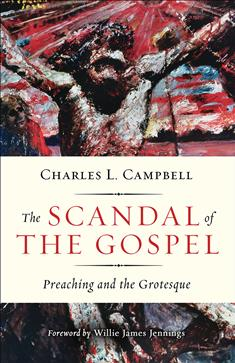
On Preaching and the Grotesque: A Book Review

Campbell, Charles L. The Scandal of the Gospel: Preaching and the Grotesque. Louisville, KY: Westminster John Knox, 2021.

Painters have their colors and canvas, sculptors have their clay, and preachers have their words. And words are powerful. As the Bible so often indicates, words have the power to build up and to tear down, and this is especially so in the ministry of preaching, as Charles L. Campbell discusses in his latest book, The Scandal of the Gospel: Preaching and the Grotesque. Campbell is James T. and Alice Mead Cleland Professor Emeritus of Homiletics at Duke Divinity School. He is a past president of the Academy of Homiletics, a highly sought-after lecturer, and he is well published in the field.  Most of the content for this latest book comes from his 2018 Lyman Beecher Lectures at Yale Divinity School; only the fourth chapter contains new material.

In the forward, Campbell explains that he is not seeking any consistency or system; rather, he says that he is “simply trying to make some homiletical connections between preaching and the grotesque” (p. xiv). This concept of the grotesque subsequently stands at the center of the book. The term is borrowed from the world of visual art, where it originally referred to paintings found in ancient Roman grottos, i.e. grotto-esque. These “murals presented unsettling, disorienting hybrids that transgressed accepted categories. They distorted what was considered ‘normal’ or ‘beautiful.’ They messed with accepted patterns. They were, as they came to be called, ‘grotesque’” (p. 6). This description encapsulates the homiletical vision that Campbell sets forth in these chapters, i.e. preaching that is unsettling, disorienting, that transgresses accepted categories and norms, that is “grotesque.”

In the first chapter Campbell considers how this concept of the grotesque fits with the scandal of the Gospel. Taking his cue from 1 Corinthians 1:23, he explains that the Gospel confronts with the destabilizing pairings of opposites: God-cross, life-death, repulsion-fascination, horror-hope. A God that is violently crucified on a cruel Roman cross is inherently “grotesque.” In chapter 2, Campbell explores how the grotesque is often weaponized in the act of preaching. Specifically, when one compares sociological and/or theological opponents with non-human objects, one is using the grotesque to dehumanize and minimize them in order to maintain one’s own particular understanding of order. In chapter 3, Campbell offers an alternative to this kind of weaponization by explaining how the grotesque creates preaching that is “open, protruding, irregular, secreting, multiple, and changing” (p. 55). Preaching that is grotesque welcomes input and insights from a variety of voices, and not merely biblical and theological ones. It is preaching that “becomes real when truth happens among the cacophony and incongruities of diverse voices and diverse lives” (p. 57). Finally, in chapter 4, Campbell imagines how the grotesque could be employed in preaching to address the environmental crisis.

Campbell’s application of the grotesque to the discipline of preaching is provocative to say the least because it stands in such stark contrast to the kind of preaching that is the focus of Campbell’s critiques. Sermons that offer simplistic principles for improving marriage, managing finances, or raising godly children attempt to “give people a nice focused nugget to carry home – not the shocking unresolved contradictions of the grotesque gospel” (p.11).  This kind of preaching is neat, clean, even idealistic. The problem, however, is that “when we rush to order, when we avoid the interval of the grotesque, our preaching may become shallow, unreal, clichéd. We don’t go deep enough. We’re not honest enough. And we end up falsifying both the gospel and life itself – we end up imposing false patterns” (p. 12). Life is so often the opposite of the neat and clean categories we attempt to impose on it from the pulpit. It is complex and messy; it is “grotesque.” Campbell would have readers embrace these tensions rather than attempting to resolve them.

Though he rightly critiques this “humanistic” (his label) approach to preaching, the alternative that he proposes is inherently more so. Grotesque preaching is “shaped by the dynamic and open life of Jesus’ grotesque body. Grotesque preaching calls the church to be open to the world and calls the pulpit to be open to different bodies and new voices” (p. 56). It springs forth from the lived experiences of people rather than from the authoritative Word of God. What is glaringly absent from Campbell’s vision for preaching is how it relates to the principle of “Thus saith the Lord.” Christian preaching springs forth from the fact that God has spoken. The Apostle Paul instructed his protégé Timothy to “Preach the Word” (2 Timothy 4.2). God has spoken; therefore, we speak. In other words, the purpose of Christian preaching is to exposit the declared Word, “giving the meaning so that the people could understand what was read” (Nehemiah 8.8). It is not merely to listen to people’s stories or to appreciate the diversities and complexities of the human experience.

In the final analysis, Campbell’s invitation for preachers to approach the complexities, difficulties, and tensions of life with greater compassion is a welcomed alternative to the idealistic naiveté that characterizes most preaching today. That being said, his alternative is essentially void of the very resources that God has provided to address those complexities and difficulties. In other words, grotesque preaching, as Campbell envisions it, comes off merely as a way to exalt and platform human experiences over the Word of God. However, it is ultimately powerless as a homiletical method for proclaiming the inspired Word of the one true and living God. In my view, preachers would be better served by attending to the text of Holy Scripture, giving its meaning through systematic exposition, than by any clever attempts to be “grotesque.”

This Book Review was originally published in the Journal of Biblical and Theological Studies, here.


On Psalm 119: An Introduction and Overview

megillat-esther-persia-long-view

The Psalms are perhaps the best kept secret of the Old Testament; they are a deep well of food for the weary Christian soul. They are a rich resource for our spirituality, but sadly, more often than not, we neglect this spring of spiritual life in favor of the well worn tracts of the New Testament. However, this is merely a symptom of the larger problem, that being our fundamental neglect of the Old Testament in general, but more on that another time. For the purpose of this post, it is enough to say that most Christians are suffering from a feeble weakened spiritual life due to a basic disregard for the Book of Psalms.

Of course, there isn’t enough time or space here to completely explore the spiritual richness of each and every chapter in this central Old Testament Book, but there is one chapter in particular that demands our attention – Psalm 119. This chapter is a vast ocean of refreshing spiritual water for the dry and weary soul, and yet, so often, we fearfully ignore it simply due to its size. And at first glance it can be overwhelming; there are 176 total verses in this single chapter. However, in spite of its imposing length, there is an artistry about this chapter that is beautiful and majestic. It lifts us out of the despair of our circumstances into the glory and hope that is the Word of God.

From a composition perspective, this chapter is an absolute masterpiece of literary artistry. It is structured in a Hebrew acrostic pattern, which means that each successive stanza begins with the next letter of the Hebrew alphabet. There are twenty-two stanzas, one each for every letter of the Hebrew alphabet, and each stanza contains eight lines, each beginning with the designated Hebrew letter for that stanza. (22 x 8 = 176) However, what is truly masterful is that almost every line contains some synonym for the Word of God. Law, testimonies, ways, precepts, statutes, commandments, judgments/ordinances, Word, promises, etc. The psalmist enumerates the perfections of God’s Word in every line literally from A to Z.

And this is perhaps the most important aspect of this glorious chapter, namely that it is written as poetry, and as such, it is intended not only to speak to our intellect but to stir our affections, to lift our souls, to restore our hope and joy. It is impossible to read this psalm and not be completely awestruck by the authors absolute joy in God’s Word. In other words, for the psalmist, the Word of God is more than a mere resource for right thinking and right doing. No, it is so much more than that. It is the foundation upon which he stands; it is the source of all his hope and joy and comfort and assurance. It is the sustenance and provision for all of his being, all of his spirituality and devotion. The Word of the one true and living God is all that he needs.

However, in spite of all of this magnificent and majestic artistry, this Psalm is still largely neglected and/or completely ignored in the devotions of most Christians and their churches. Whether it is because we find it imposing and off putting due to its length, or simply because we believe it to be redundant and repetitive, we refuse to refresh our souls at this inexhaustible spring of spiritual life. And this is absolutely to our spiritual detriment. We severely need the testimony of this Psalm in both our personal and corporate devotions, especially at a time when the sufficiency of God’s Word is being questioned more and more. Let us turn back once again to the well worn paths of biblical spirituality, and linger long over Psalm 119.

For further study:
Spurgeon, Charles H. The Golden Alphabet: An Exposition of Psalm 119. Revised and Updated. Abbotsford, WI: Aneko Press, 2018.


Slow To Write

"let every person be quick to hear, slow to speak, slow to anger."

lovegavehope

Just another WordPress.com site

Jared Cornutt

Pastor | Speaker | Writer

Denny Burk

A commentary on theology, politics, and culture

G3 Ministries

Events + Resources for the Local Church

Biblical Reasoning

Biblical and Systematic Theology According to the Scriptures

RetroChristianity

Reclaiming the Forgotten Faith

SBC Voices

Southern Baptist News & Opinion

Lucid Theology

Thoughts on words, books, theology, and life.

Baptist21

A pastor-led voice for Baptists in the 21st century

Center For Baptist Renewal

The Personal and Professional Blog of Phillip Powers

The Pastor's Well - Pastor Well

The Personal and Professional Blog of Phillip Powers

Articles - AlbertMohler.com

The Personal and Professional Blog of Phillip Powers

The Gospel Coalition

The Personal and Professional Blog of Phillip Powers