The twentieth chapter of John’s Gospel is full of climactic moments. Not only does it record the resurrection of Jesus and his interaction with Mary in the garden, but it also tells the story of Jesus’s appearance to his disciples in the upper room (On the Johannine Pentecost) and the climactic confession of Thomas a week later. The chapter ends with a clear purpose statement when John writes, “Jesus performed many other signs in the presence of his disciples that are not written in this book. But these are written so that you may believe that Jesus is the Messiah, the Son of God, and that by believing you may have life in his name.” (20.30-31) To many, these verses sound like an appropriate conclusion to John’s Gospel; for this reason, many scholars (and some readers) treat John 21 as a kind of appendix or addendum or afterthought. Although there is no manuscript evidence to support this claim, it is often argued that if chapter 20 brings the Gospel to its climactic conclusion, then why would John write chapter 21? It seems unnecessary. From a narrative perspective, John 21 is not an awkward appendix but the necessary completion of the Gospel’s story. It resolves tensions left intentionally open in chapter 20 and brings the Gospel’s themes — discipleship, love, witness, and mission — to their proper conclusion.
As I noted above, John 20 is the clear climax of John’s Gospel. Jesus is resurrected, the disciples are commissioned, and Thomas confesses Jesus as “My Lord and my God.” (20.28) This confession serves as a kind of bookend in the book that points the reader back to John’s opening where he affirms that Jesus is the Word that was with God and was God and was made flesh and dwelt among us. (1.1, 14) Following these climactic moments, it only makes sense that John’s purpose statement in verses 30-31 would bring the Gospel to its logical conclusion. This chapter proves that Jesus is the Christ of God, and that faith in Him as the resurrected one results in eternal life. The end. Or so one would think. Not only is there no manuscript evidence that John’s Gospel should end in chapter 20 (as there is with Mark’s ending, on which see here), but if John were to end his gospel with chapter 20, then there would be many narrative threads that would remain unresolved. What becomes of Peter after his denial? What becomes of the beloved disciple? What becomes of the disciples’ mission? Yes, chapter 20 concludes the narrative arc of Jesus’s identity, but chapter 21 goes on to explain what that revelation now means for the followers of Jesus.
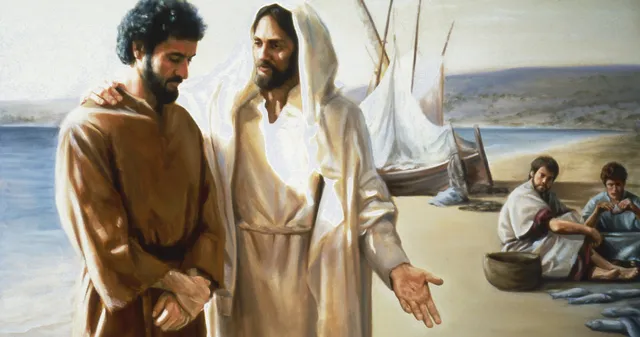
John 21 returns the reader to the Sea of Tiberias, aka the Sea of Galilee. Narratively, this is a return to where it all began. Not only did Jesus begin his public ministry in Galilee, but he also called the first four disciples after a night of fishing on the Sea of Galilee. The scene intentionally echoes the earlier calling narrative familiar from Luke 5. After a night of fruitless labor, Jesus shows up and tells them to cast their nets on the other side of the boat. They haul in a catch that is nearly too large, and Jesus commissions them to discipleship and mission. Many interpret this scene as a regression for the disciples, a return to the life and vocation before Christ. However, in light of this parallel, this scene should be understood not as a regression, but as narrative symmetry. John intentionally returns his readers to the beginning to show that the resurrection does not erase vocation — it redefines it. Vocation that is engaged apart from radical dependence on the risen Christ is utterly futile, but when vocation is entered into from a position of dependence and obedience to the risen Christ, then it is abundantly fruitful. When we submit our vocation to the mission of Jesus, then we will reap abundant fruit and reward. Even so, the real center of John 21 is not fish, it is Peter.
Of course, all four Gospels record Peter’s three denials of Jesus on the night of Jesus’s arrest, but John is the only one who records Peter’s restoration. (Luke hints at the idea when Jesus tells him that after returning, he will encourage his brothers.) John deliberately connects the scene in John 21 back to the denial scene by noting that Jesus prepared a “charcoal fire” and the threefold repetition of the question “Peter, do you love me?” matching Peter’s three denials. Some tend to make a big deal out of the various words that are used for love in Peter’s answers, but this is overplayed. Not only were the words basically synonymous in the first century, but the idea that Peter’s love did not rise to some divine standard is wholly alien to the logic of the text. This is a threefold public restoration that corresponds to Peter’s threefold public failure. Moreover, it reveals the pastoral tenderness of Jesus. Jesus does not scold Peter; he does not call him out over his failures. He doesn’t berate or condemn him. He graciously restores Peter to ecclesial service. “Feed my lambs. Shepherd my sheep. Feed my sheep.” This commission is not merely personal therapy for Peter; it is an ecclesial necessity. John cannot end his Gospel with Peter in unresolved failure. The shepherd of the disciple group must be restored if the flock is to endure. But Peter is not the only disciple in view here either.
After his restoration, Peter noticed the disciple whom Jesus loved and he asks Jesus, “Lord, what about him?”, and Jesus responds, “What is that to you? As for you, follow me.” (21.20-22) Jesus’s point is that he has different callings for each of his followers, and that following Christ is more important than comparing callings. Peter’s calling was to shepherding and martyrdom; the beloved disciple’s calling was to abiding ministry and public/written testimony. As he writes in 21.24, “This is the disciple who testifies to these things and who wrote them down. We know that his testimony is true.” Not only is this important for establishing the credibility and reliability of John’s Gospel, but it is also a fundamental component of John’s understanding of what it means to be a disciple of Jesus. To put it another way, John 21 grounds the authority of the Gospel in eyewitness testimony while clarifying that discipleship does not look identical for all. We all serve the risen Christ, but we all serve him in different and varied ways. These verses are not just random narrative details added on to the end of the story; they are essential for completing John’s theology of discipleship.
In other words, for John, discipleship is a life that is characterized by following Jesus, loving Jesus, abiding in Jesus, and witnessing to the truth about Jesus. When we confess Christ (chapter 20), he commissions us to a life of embodied mission (chapter 21). If we truly believe that Jesus is the risen Christ (and he is), then we will follow him in whatever calling he has placed on our lives. Put differently, discipleship is the vocation of following Jesus. The risen Christ is not merely to be believed in — he is to be followed. If we say we love Christ, we will commit ourselves to and give ourselves for the care of his people. Moreover, John hints at the fact that discipleship can involve suffering. In 21.18, Jesus tells Peter, “when you grow old, you will stretch out your hands and someone else will tie you and carry you where you don’t want to go.”, and John explains that “He said this to indicate by what kind of death Peter would glorify God.” (21.19) This is part of the vocation of discipleship, too. We must be willing to follow Jesus wherever he leads; this is the kind of discipleship that Jesus is calling us all too.
However, returning to my thesis, without John 21, Peter’s denial remains unresolved, the beloved disciple’s authority is unexplained, and the future of the community of Jesus followers is unclear. In terms of John’s narrative, John ends his gospel not with spectacle but with discipleship as vocation. Chapter 20 concludes the revelation of Jesus’s identity, and chapter 21 concludes the formation of Jesus’s community. Or to put it another way, John 20 answers the question “Who is Jesus?”, and John 21 answers the question “What now?” Without this pastoral and ecclesial resolution, John’s Gospel would be incomplete. John does not end his Gospel in private mystical belief. He ends it with shepherding, witness, martyrdom, and mission. And he leaves the end of the story open when he writes, “And there are also many other things that Jesus did, which, if every one of them were written down, I suppose not even the world itself could contain the books that would be written.” In other words, the story is ongoing, and all the things that the risen Jesus will do have not yet been completed even two thousand years later. John 21 is not a loose epilogue. It brings the Gospel to its proper end — not merely with a confession of Christ, but with the commissioning of those who will testify to him. The risen Lord restores the fallen, distinguishes callings, anchors testimony, and sends his followers into a future shaped by love and sacrifice. That is not an afterthought. That is narrative completion. And it poses the question to the reader, “Will you follow Jesus?”
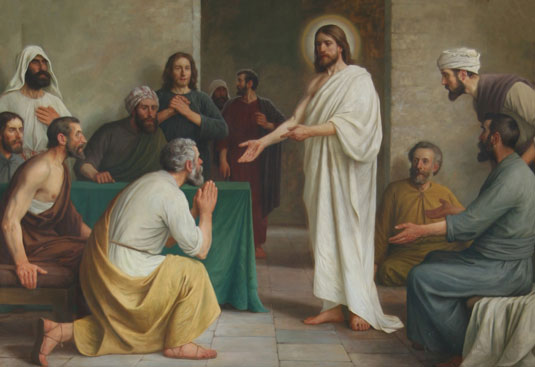
In John 20.19-23, Jesus appears in the upper room on the eve of his resurrection, and he breathes on the disciples saying, “Receive the Holy Spirit.” This is the so-called Johannine Pentecost, and at a glance, it would seem to contradict the very clear teaching of the book of Acts that the Spirit was given on the Day of Pentecost some 50 days after Jesus’s resurrection. If the events of that first Pentecost are understood as the climactic coming of the Spirit to indwell the followers of Christ, then Jesus’ giving of the Spirit in John 20.22 would seem to indicate that John (who was present at Pentecost) was hopelessly confused about the timeline. In the space the follows, I would like to suggest that John is not confused; rather, I think that John 20 presents Jesus’ giving of the Spirit as the breath of the new creation in fulfillment of Ezekiel’s restoration promises and in turn, it grounds the church’s corporate authority to forgive in the life of the risen Christ.
Of course, scholars and pastors have tried to resolve this tension in a variety of ways throughout the history of the church, and here I will identify just four. First, some suggest that the giving of the Spirit in John 20 is a kind of proleptic gift, a partial filling, that was meant to steel the disciples until the climactic coming of the Spirit 50 days later. Others suggest that John has theologized the giving of the Spirit by temporally relocating the event to the resurrection and directly connecting it with the risen Christ in light of his own “realized eschatology”. Still others suggest that John 20 functions as a kind of apostolic commission for the disciples which establishes their role as authoritative leaders in the early church. Finally, and this is my view, but the giving of the Spirit in John 20 should be understood as the inauguration of the age of the New Covenant/New Creation. This is not in contradiction to the Book of Acts and its descriptions of the Day of Pentecost. Rather, John has compressed these events theologically by linking the resurrection of Jesus with the concept of new creation, the giving of the Spirit, and the inauguration of eschatological life. He does this by alluding to the creation account in Genesis 1-2 and the New Covenant/Resurrection account in Ezekiel 36-37.
In John 20, the scene opens “On the first day of the week” (20.1), and this temporal note is repeated in our passage in 20.19, “when it was evening on the first day of the week.” This is a clear allusion to the first day of creation in Genesis 1. In other words, with the resurrection of Jesus comes a new first day, a new creation. This allusion is further confirmed by the fact that the scene takes place in a garden (19.31), and Mary mistakes the risen Christ for the “gardener” (20. 15). This is most likely a typological allusion to Christ as the second Adam. More significantly, we are told that Jesus “breathed on them.” The Greek word here (ἐνεφύσησεν ) is a verb that only occurs here in the New Testament. In the Greek translation of the Old Testament (LXX), in Genesis 2.7, we read that “The the Lord God formed the man out of the dust from the ground and breathed the breath of life into his nostrils, and the man became a living being.” In the same way (and with same word) that God breathed life into Adam, so also the risen Christ breathes life into his disciples. This is not just incidental language; the Evangelist has utilized this rare word intentionally, because he wants to connect the resurrection of Jesus with the new creation. When Jesus breathes the Holy Spirit on the disciples, they become participants in a new humanity.
However, there is another important Old Testament allusion that stands in the background of John 20, and that is the description of the New Covenant and the story of the Dry Bones in Ezekiel 36-37. In Ezekiel 36.26-27 (also 37.14), we read,
I will give you a new heart and put a new spirit within you; I will remove your heart of stone and give you a heart of flesh. I will place my Spirit within you and cause you to follow my statutes and carefully observe my ordinances.
And in Ezekiel 37.1-14, we read where Ezekiel is commanded to prophesy to the breath to “come from the four winds and breath (ἐμφύσησον) into these slain so that they may live.” In the same way that Ezekiel stood in the midst of the valley of dry bones and the dead came to life by the “breath/Spirit” of God, so also the risen Christ stands in the midst of his disciples who are “dead/paralyzed” in fear, and breathes into them the Spirit of life. Now, in the book of Ezekiel, these chapters drip with corporate overtones, particularly in regard to the restoration of the people of Israel. The dry bones coming to life is a symbol of national (and individual) resurrection and restoration, and the Johannine Pentecost symbolizes the eschatological restoration of the people of God, such that the 12 (or 11) disciples function as the nucleus of that people as a renewed Israel. The point is that John portrays the resurrection of Jesus as the moment when the promised Spirit of restoration becomes reality.
Now, it is important here that we stop and recall what John has already said back in John 7. 39, where we read, “Those who believed in Jesus were going to receive the Spirit, for the Spirit had not yet been given because Jesus had not yet been glorified.” This is the heart of John’s theology, namely that the glorification/exaltation of Christ comes in the crucifixion/resurrection of Jesus. We know this because, Jesus said in John 12:32, “As for me, if I am lifted up from the earth I will draw all people to myself.” He said this to indicate what kind of death he was about to die.” The verbal idea of being “lifted up” refers both to the kind of death he would die but also to the idea of exaltation. Point being that in John 20, Jesus has now been glorified and so the Spirit can now be given as a sign of eschatological life.
However, there is one more problem in this passage. In verse 23, we read where Jesus tells the disciples, “If you forgive the sins of any, they are forgiven them; if you retain the sins of any, they are retained.” Of course, this language also occurs in the Gospel of Matthew, in Matthew 16:19 in Jesus words to Peter and then again in 18:18 in the context of the Community Discourse. Clearly, this is the language of commissioning and authority, but exactly what kind of authority is in view here is debated. Some (particularly in the Roman Catholic and Eastern Orthodox traditions) understand these words to signify Apostolic/priestly authority to absolve sins. Others understand them to describe the authority of the church to announce the promise of forgiveness on the basis of the gospel. In my view, in the context of John 20, these words demonstrate that the Spirit-empowered community participates in the eschatological sorting of humanity. Forgiveness is determined by a person’s acceptance or rejection of the person and work of the Son (cf. John 3:18-21), but the church’s authority to forgive is part of its new-creation governance. In other words, just as the first humans were given dominion in the Garden of Eden (Genesis 1:28), so also the church as a new humanity is given Spirit-authorized responsibility as an agent of new-creation reconciliation. And John is clear that this authority is derivative, not autonomous; it flows from the risen Christ’s life and breath (i.e. Spirit).
In conclusion, then we must conclude that the Johannine Pentecost is not simply the relocation of the events of Acts 2; these are distinct narrative events serving distinct theological purposes. Whereas Acts emphasizes the public outpouring of the Spirit, the gift of tongues, and the church’s mission to the nations, John emphasizes the new creation, the restoration of the people of God, and ecclesial authority and identity. To put it more simply, John narrates the ontological beginning of the New Covenant age, and Luke narrates the Spirit-empowered expansion of the church’s mission. There is no contradiction; these are simply two theological angles on one redemptive reality. By tying his narrative to Genesis and Ezekiel, John gives us a theologically robust understanding of the significance of Christ’s resurrection. More importantly though, John 20.19-23 clearly demonstrates that the church exists because the risen Christ breathes his life into it. Its life is cruciform and Spirit-dependent, and its mission is one of reconciliation in the power of the new creation.
8 The high priest Hilkiah told the court secretary Shaphan, “I have found the book of the law in the Lord’s temple,” and he gave the book to Shaphan, who read it. 9 Then the court secretary Shaphan went to the king and reported, “Your servants have emptied out the silver that was found in the temple and have given it to those doing the work—those who oversee the Lord’s temple.” 10 Then the court secretary Shaphan told the king, “The priest Hilkiah has given me a book,” and Shaphan read it in the presence of the king.
11 When the king heard the words of the book of the law, he tore his clothes. 12 Then he commanded the priest Hilkiah, Ahikam son of Shaphan, Achbor son of Micaiah, the court secretary Shaphan, and the king’s servant Asaiah, 13 “Go and inquire of the Lord for me, for the people, and for all Judah about the words in this book that has been found. For great is the Lord’s wrath that is kindled against us because our ancestors have not obeyed the words of this book in order to do everything written about us.”
14 So the priest Hilkiah, Ahikam, Achbor, Shaphan, and Asaiah went to the prophetess Huldah, wife of Shallum son of Tikvah, son of Harhas, keeper of the wardrobe. She lived in Jerusalem in the Second District. They spoke with her. 15 She said to them, “This is what the Lord God of Israel says: Say to the man who sent you to me, 16 ‘This is what the Lord says: I am about to bring disaster on this place and on its inhabitants, fulfilling all the words of the book that the king of Judah has read, 17 because they have abandoned me and burned incense to other gods in order to anger me with all the work of their hands. My wrath will be kindled against this place, and it will not be quenched.’
18 Say this to the king of Judah who sent you to inquire of the Lord: ‘This is what the Lord God of Israel says: As for the words that you heard, 19 because your heart was tender and you humbled yourself before the Lord when you heard what I spoke against this place and against its inhabitants, that they would become a desolation and a curse, and because you have torn your clothes and wept before me, I myself have heard’—this is the Lord’s declaration. 20 ‘Therefore, I will indeed gather you to your ancestors, and you will be gathered to your grave in peace. Your eyes will not see all the disaster that I am bringing on this place.’” Then they reported to the king.
~2 Kings 22.8-20
Title: On Fuel for the Fires of Revival Text: 2 Kings 22-23 Series: Revival Us Again! Church: Redeemer Baptist Church, Jonesboro, AR Date: December 28, 2025
21 For me, to live is Christ and to die is gain. 22 Now if I live on in the flesh, this means fruitful work for me; and I don’t know which one I should choose. 23 I am torn between the two. I long to depart and be with Christ—which is far better— 24 but to remain in the flesh is more necessary for your sake. 25 Since I am persuaded of this, I know that I will remain and continue with all of you for your progress and joy in the faith, 26 so that, because of my coming to you again, your boasting in Christ Jesus may abound.
~Philippians 1.21-26
Title: On Death as Gain when Life is Christ Text: Philippians 1.21-26 Occasion: Celebration of Life for Mr. Bobby Garrison Church: Redeemer Baptist Church, Jonesboro, AR Date: November 15, 2025
6 If you point these things out to the brothers and sisters, you will be a good servant of Christ Jesus, nourished by the words of the faith and the good teaching that you have followed. 7 But have nothing to do with pointless and silly myths. Rather, train yourself in godliness.8 For the training of the body has limited benefit, but godliness is beneficial in every way, since it holds promise for the present life and also for the life to come. 9 This saying is trustworthy and deserves full acceptance. 10 For this reason we labor and strive, because we have put our hope in the living God, who is the Savior of all people, especially of those who believe.
~1 Timothy 3.14-16
Title: On Our Training for Godliness Text: 1 Timothy 4.6-10 Series: 1 Timothy: God’s Design for a Healthy Church Church: Redeemer Baptist Church, Jonesboro, AR Date: October 19, 2025
14 I write these things to you, hoping to come to you soon. 15 But if I should be delayed, I have written so that you will know how people ought to conduct themselves in God’s household, which is the church of the living God, the pillar and foundation of the truth. 16 And most certainly, the mystery of godliness is great:
He was manifested in the flesh, vindicated in the Spirit, seen by angels, preached among the nations, believed on in the world, taken up in glory.
~1 Timothy 3.14-16
Title: On Our Conduct in the Local Church Text: 1 Timothy 3.14-16 Series: 1 Timothy: God’s Design for a Healthy Church Church: Redeemer Baptist Church, Jonesboro, AR Date: October 5, 2025
12 The iniquity of Ephraim is bound up; His sin is stored up. 13 The pains of childbirth come upon him; He is not a wise son, For it is not the time that he should delay at the opening of the womb. 14 Shall I ransom them from the power of Sheol? Shall I redeem them from death? O Death, where are your thorns? O Sheol, where is your sting? Compassion will be hidden from My sight.
15 Though he flourishes among the reeds, An east wind will come, The wind of the Lord coming up from the wilderness; And his fountain will become dry And his spring will be dried up; It will plunder his treasury of every precious article. 16 Samaria will be held guilty, For she has rebelled against her God. They will fall by the sword, Their little ones will be dashed in pieces, And their pregnant women will be ripped open.
~Hosea 13.12-16 (NASB95)
Title: On the Curse of Death and the Hope of Resurrection Text: Hosea 13.12-16 Series: Hosea: A Love Story Like No Other Church: Redeemer Baptist Church, Jonesboro, AR Date: July 13, 2025
8 Put the ram’s horn to your mouth! One like an eagle comes against the house of the Lord, because they transgress my covenant and rebel against my law. 2 Israel cries out to me, “My God, we know you!” 3 Israel has rejected what is good; an enemy will pursue him.
4 They have installed kings, but not through me. They have appointed leaders, but without my approval. They make their silver and gold into idols for themselves for their own destruction. 5 Your calf-idol is rejected, Samaria. My anger burns against them. How long will they be incapable of innocence? 6 For this thing is from Israel— a craftsman made it, and it is not God. The calf of Samaria will be smashed to bits!
7 Indeed, they sow the wind and reap the whirlwind. There is no standing grain; what sprouts fails to yield flour. Even if they did, foreigners would swallow it up. 8 Israel is swallowed up! Now they are among the nations like discarded pottery. 9 For they have gone up to Assyria like a wild donkey going off on its own. Ephraim has paid for love. 10 Even though they hire lovers among the nations, I will now round them up, and they will begin to decrease in number under the burden of the king and leaders. 11 When Ephraim multiplied his altars for sin, they became his altars for sinning. 12 Though I were to write out for him ten thousand points of my instruction, they would be regarded as something strange. 13 Though they offer sacrificial gifts and eat the flesh, the Lord does not accept them. Now he will remember their guilt and punish their sins; they will return to Egypt. 14 Israel has forgotten his Maker and built palaces; Judah has also multiplied fortified cities. I will send fire on their cities, and it will consume their citadels.
Title: On the Danger of Mixing Religion with Politics Text: Hosea 8.1-14 Series: Hosea: A Love Story Like No Other Church: Redeemer Baptist Church, Jonesboro, AR Date: May 11, 2025
4 What am I going to do with you, Ephraim? What am I going to do with you, Judah? Your love is like the morning mist and like the early dew that vanishes. 5 This is why I have used the prophets to cut them down; I have killed them with the words from my mouth. My judgment strikes like lightning. 6 For I desire faithful love and not sacrifice, the knowledge of God rather than burnt offerings.
7 But they, like Adam, have violated the covenant; there they have betrayed me. 8 Gilead is a city of evildoers, tracked with bloody footprints. 9 Like raiders who wait in ambush for someone, a band of priests murders on the road to Shechem. They commit atrocities. 10 I have seen something horrible in the house of Israel: Ephraim’s promiscuity is there; Israel is defiled. 11 A harvest is also appointed for you, Judah.
Title: On God’s Lament Over False Repentance Text: Hosea 6.4-11 Series: Hosea: A Love Story Like No Other Church: Redeemer Baptist Church, Jonesboro, AR Date: April 27, 2025
*Audio begins around two minutes in due to technical difficulties*
TEXT
4 Hear the word of the Lord, people of Israel, for the Lord has a case against the inhabitants of the land: There is no truth, no faithful love, and no knowledge of God in the land! 2 Cursing, lying, murder, stealing, and adultery are rampant; one act of bloodshed follows another. 3 For this reason the land mourns, and everyone who lives in it languishes, along with the wild animals and the birds of the sky; even the fish of the sea disappear. 4 But let no one dispute; let no one argue, for my case is against you priests. 5 You will stumble by day; the prophet will also stumble with you by night. And I will destroy your mother. 6 My people are destroyed for lack of knowledge. Because you have rejected knowledge, I will reject you from serving as my priest. Since you have forgotten the law of your God, I will also forget your sons.
7 The more they multiplied, the more they sinned against me. I will change their honor into disgrace. 8 They feed on the sin of my people; they have an appetite for their iniquity. 9 The same judgment will happen to both people and priests. I will punish them for their ways and repay them for their deeds. 10 They will eat but not be satisfied; they will be promiscuous but not multiply. For they have abandoned their devotion to the Lord. 11 Promiscuity, wine, and new wine take away one’s understanding.
Title: On God’s Case Against Israel Text: Hosea 4.1-11 Series: Hosea: A Love Story Like No Other Church: Redeemer Baptist Church, Jonesboro, AR Date: March 30, 2025



 Faith seeking Understanding