
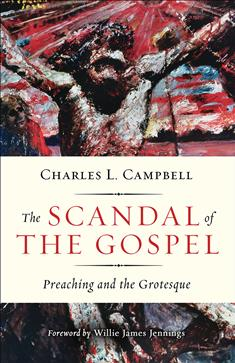
Campbell, Charles L. The Scandal of the Gospel: Preaching and the Grotesque. Louisville, KY: Westminster John Knox, 2021.
Painters have their colors and canvas, sculptors have their clay, and preachers have their words. And words are powerful. As the Bible so often indicates, words have the power to build up and to tear down, and this is especially so in the ministry of preaching, as Charles L. Campbell discusses in his latest book, The Scandal of the Gospel: Preaching and the Grotesque. Campbell is James T. and Alice Mead Cleland Professor Emeritus of Homiletics at Duke Divinity School. He is a past president of the Academy of Homiletics, a highly sought-after lecturer, and he is well published in the field. Most of the content for this latest book comes from his 2018 Lyman Beecher Lectures at Yale Divinity School; only the fourth chapter contains new material.
In the forward, Campbell explains that he is not seeking any consistency or system; rather, he says that he is “simply trying to make some homiletical connections between preaching and the grotesque” (p. xiv). This concept of the grotesque subsequently stands at the center of the book. The term is borrowed from the world of visual art, where it originally referred to paintings found in ancient Roman grottos, i.e. grotto-esque. These “murals presented unsettling, disorienting hybrids that transgressed accepted categories. They distorted what was considered ‘normal’ or ‘beautiful.’ They messed with accepted patterns. They were, as they came to be called, ‘grotesque’” (p. 6). This description encapsulates the homiletical vision that Campbell sets forth in these chapters, i.e. preaching that is unsettling, disorienting, that transgresses accepted categories and norms, that is “grotesque.”
In the first chapter Campbell considers how this concept of the grotesque fits with the scandal of the Gospel. Taking his cue from 1 Corinthians 1:23, he explains that the Gospel confronts with the destabilizing pairings of opposites: God-cross, life-death, repulsion-fascination, horror-hope. A God that is violently crucified on a cruel Roman cross is inherently “grotesque.” In chapter 2, Campbell explores how the grotesque is often weaponized in the act of preaching. Specifically, when one compares sociological and/or theological opponents with non-human objects, one is using the grotesque to dehumanize and minimize them in order to maintain one’s own particular understanding of order. In chapter 3, Campbell offers an alternative to this kind of weaponization by explaining how the grotesque creates preaching that is “open, protruding, irregular, secreting, multiple, and changing” (p. 55). Preaching that is grotesque welcomes input and insights from a variety of voices, and not merely biblical and theological ones. It is preaching that “becomes real when truth happens among the cacophony and incongruities of diverse voices and diverse lives” (p. 57). Finally, in chapter 4, Campbell imagines how the grotesque could be employed in preaching to address the environmental crisis.
Campbell’s application of the grotesque to the discipline of preaching is provocative to say the least because it stands in such stark contrast to the kind of preaching that is the focus of Campbell’s critiques. Sermons that offer simplistic principles for improving marriage, managing finances, or raising godly children attempt to “give people a nice focused nugget to carry home – not the shocking unresolved contradictions of the grotesque gospel” (p.11). This kind of preaching is neat, clean, even idealistic. The problem, however, is that “when we rush to order, when we avoid the interval of the grotesque, our preaching may become shallow, unreal, clichéd. We don’t go deep enough. We’re not honest enough. And we end up falsifying both the gospel and life itself – we end up imposing false patterns” (p. 12). Life is so often the opposite of the neat and clean categories we attempt to impose on it from the pulpit. It is complex and messy; it is “grotesque.” Campbell would have readers embrace these tensions rather than attempting to resolve them.
Though he rightly critiques this “humanistic” (his label) approach to preaching, the alternative that he proposes is inherently more so. Grotesque preaching is “shaped by the dynamic and open life of Jesus’ grotesque body. Grotesque preaching calls the church to be open to the world and calls the pulpit to be open to different bodies and new voices” (p. 56). It springs forth from the lived experiences of people rather than from the authoritative Word of God. What is glaringly absent from Campbell’s vision for preaching is how it relates to the principle of “Thus saith the Lord.” Christian preaching springs forth from the fact that God has spoken. The Apostle Paul instructed his protégé Timothy to “Preach the Word” (2 Timothy 4.2). God has spoken; therefore, we speak. In other words, the purpose of Christian preaching is to exposit the declared Word, “giving the meaning so that the people could understand what was read” (Nehemiah 8.8). It is not merely to listen to people’s stories or to appreciate the diversities and complexities of the human experience.
In the final analysis, Campbell’s invitation for preachers to approach the complexities, difficulties, and tensions of life with greater compassion is a welcomed alternative to the idealistic naiveté that characterizes most preaching today. That being said, his alternative is essentially void of the very resources that God has provided to address those complexities and difficulties. In other words, grotesque preaching, as Campbell envisions it, comes off merely as a way to exalt and platform human experiences over the Word of God. However, it is ultimately powerless as a homiletical method for proclaiming the inspired Word of the one true and living God. In my view, preachers would be better served by attending to the text of Holy Scripture, giving its meaning through systematic exposition, than by any clever attempts to be “grotesque.”
This Book Review was originally published in the Journal of Biblical and Theological Studies, here.








 Faith seeking Understanding
On Biblical Interpretation and the Holy Spirit
Recently, I was following a thread on a friends Facebook post where the participants were discussing their disagreement on a question of biblical interpretation. The specific issue under debate is not important at the moment, and I’ll just say that I was surprised to find that this particular exchange was more graceful than these kinds of forums usually are. However, with that being said, after reading through the various points and counterpoints being made, I came across one response that made me pause. Figuring that the minds of the other participants were unlikely to change, one commenter attempted to conclude the discussion by saying:
In my previous post, I examined the question of “man-made” bible study resources, and I concluded that there is great wisdom in listening to the voices of those who have studied the Bible before us. We were never intended to approach Bible study as if we are the “lone ranger” of Bible interpretation, carving a path that has somehow never been carved before. Commentaries, theologies, and the like are part of God’s gift to the church (Ephesians 4.11-13); they are part of that “great cloud of witnesses” within which we pursue Christian maturity and godliness (Hebrews 12.1). However, even greater than these is the gift that is God’s Spirit. In the New Covenant, we who have been united with Christ by faith have been indwelt by God’s very Spirit, and He is the one who writes the Word upon our hearts and moves us to obey it (Jeremiah 31.33, Ezekiel 36.27). This is what makes Christian biblical interpretation unique; we have God’s Spirit (1 Corinthians 2.10-16).
Unfortunately, there is great misunderstanding as to the exact nature of the Spirit’s role in biblical interpretation, and in the space that follows, I would like to explore the contours of the Spirit’s work in Bible interpretation. According to the view represented by the Facebook comment above, all we need to do is read the Bible and then open our hearts and minds so that the Spirit can tell us what the Scripture means. This approach is essentially a recapitulation of the ancient heresy of Gnosticism. In other words, it suggests that Biblical knowledge comes to us by some kind of secret mystical experiential revelation from the Spirit apart from the text. But this is not the way that the Spirit works. Revelation is fixed, and the canon is closed. Moreover, the Spirit will not do for us what God has equipped us to do for ourselves. He has given us rational minds with the ability to read and comprehend His revealed Word. This is why we are repeatedly commanded to read, study, and grow in the knowledge of the Scriptures.
The Spirit’s work in biblical interpretation is not primarily revelatory; He does not impart the content of biblical meaning. Rather, His work pertains more to our accepting and obeying the principles that are revealed in the Scriptures. This is what is known in theology as the doctrine of illumination.
The Spirit illuminates our hearts to accept the truth of God’s Word, and He helps to conform our will in submission to that Word through conviction. This illumination comes to us not through some mystical experiential supra-rational revelation, but through the classic word-centered spiritual disciplines. In other words, once we have done our exegetical work in the text, then we must do our closet work (ala Matt 6.6) through memorization, meditation, and prayer. When we engage in these rhythms of the Spirit, we put ourselves in a posture where He can use the fruits of our study to sift our souls. As the Scripture says,
Under the New Covenant, one of the primary roles of the Spirit is to mediate the knowledge of God, but this ministry cannot, nay must not, be separated from the Word of God. Throughout all of Holy Scripture, the Spirit of God and the Word of God work together to transform the people of God into the image of God. More often than not, this transformation happens in ways and means that are consistent with the way God has made us. We do not seek any secret mystical revelation of God’s Word; rather, we use all of the natural and supernatural resources that God has given us to understand His revelation of Himself to us through His Word.
For further study:
On the Spirit and the Word
Share this:
2 Comments | tags: Bible Study Resources, Closet Work, Commentaries, Exegetical Work, Gnosticism, Holy Spirit, Illumination, Meditation, Memorization, New Covenant, Phillip Powers, Prayer, Spiritual Disciplines, Theologies | posted in Biblical Theology, Hermeneutics, Spiritual Formation