Christmas really is one of my most favorite times of the year. I love the decorations, the gifts, the parties, and the church Christmas programs, but most of all I love the music. The traditional Christmas carols, the sacred Christmas hymns, they just give me all the feels when it comes to Christmas; in the car, at home, at church, you will almost always find me listening to Christmas music during the month of December. And one of my most favorite Christmas songs is the song “Mary, Did You Know?”, and my most favorite arrangement of the song is performed by Mark Lowry with the acapella group Voctave singing backup (posted above). Mark Lowry wrote the lyrics in 1985 when he was asked to write a script for a church Christmas play, and the lyrics were put to music in 1991 by Buddy Greene. Of course, it has been recorded by many varied recording artists over the years, both secular and sacred, and it is sung and played regularly during Christmas programs in churches all across the United States and, no doubt, around the world.
However, every year it seems, I read some renewed or repeated criticism of the song on social media. Some attempt to dismiss the song theologically, citing the Annunciation and the Magnificat as evidence that “she knew”. I have even seen some who have attempted to go line by line through the song to give a yes or no answer to each rhetorical question. Similarly, those in the Roman Catholic tradition take issue with the suggestion that Mary needed to be “delivered” and “made new” because of their (erroneous) beliefs about the sinlessness of Mary. Others argue that the song is mawkish, sappy, and infantilizing, that it is “the most sexist Christmas song ever written,” or that it “treats her like a clueless child.” Still others dismiss the song simply because it is overplayed and/or poorly performed by well-meaning church members during the Christmas season as “special” music. And to be honest, when I read criticisms like these, I just shake my head and wonder how we have lost our wonder at the miracle of the incarnation.
Biblically, it is true that Luke presents Mary as a paragon of faith. When she is confronted by the angel Gabriel with the news that she will conceive by the Holy Spirit and give birth to the Son of God, she responds with simple faith, “See, I am the Lord’s servant. May it happen to me as you have said.” (Luke 1.38) And her Magnificat (Luke 1.46-55) clearly indicates that she understood that this was a pivotal moment in the unfolding of God’s plan of redemption for the world. However, we also know that at one point during his earthly ministry, she came with her other children to try to hide Jesus away because they thought he was an embarrassment to the family. (Mark 3:31-35, parallels Matthew 12.46-50, Luke 8.19-21) Time and again, the Gospels detail how the first followers of Jesus struggled to fully understanding the significance of who he was and what he had come to do, and we should assume that Mary would have been no different. We know that Mary treasured and pondered all these things in her heart, but the Bible is clear that the first followers of Jesus, including Mary and his brothers, grew in their understanding of the person and work of Jesus over the course of his life and ministry and that they did not understand him in full until after his resurrection and the coming of the Spirit.
The point is that we should not underestimate the richness of what it means for God to become flesh. When Jesus was born in the Bethlehem 2000 years ago, there was already plenty of theological and cultural expectations as to what he was supposed to be and do. But Jesus turned those expectations on their heads, and he demonstrated that he is a Messiah who cannot be fit into a preconceived box. And as his followers, we should never lose our wonder at this fact. Jesus will always be more than we could possibly hope to comprehend; we will never have him fully figured out. Even when we reach glory, we are told that “He had a name written that no one knows except himself.” (Revelation 19.12) This means that even then there will be more to learn and understand about him when he returns as glorious king. We must never lose our wonder at the person and work of Jesus. Even the things we think we know about him pale in comparison to the fullness of his glory.
And so, when we hear the song “Mary, Did You Know?” this Christmas season, we shouldn’t try to dissect it theologically. We shouldn’t dismiss it because of its musical style, its tone and perspective, or even its emotionality. We should allow it to spur our reflections, to feed our wonder, to drive us to worship the God who became flesh for our sakes, who suffered and died in our place, and who is coming again to receive us unto himself. The song is an artistic, poetic reflection on the miracle of Christmas and the sheer mystery of the incarnation. Mary was in a unique position to feel the weight and wonder of it all, and at Christmas, it is right for us to enter into her experience, to ponder anew what it must have been like, and to fall down in worship of the God who became flesh. This Christmas, let us rekindle our wonder. Let us stand in awe and silence, and let us rejoice in the fact that we have a savior who came to heal our brokenness, to free us from sin, and to restore in us the joy of living in his presence. He is Emmanuel; He is God with us!
Several months ago, Matthew Barrett, then a professor at Midwestern Baptist Theological Seminary, announced that he was leaving the SBC to become Anglican. Shortly thereafter, he took a position as Research Professor of Theology at Trinity Anglican Seminary, and he and his family joined St. Aidan’s Anglican Church in Kansas City. He detailed his reasons for making this change in an article on his blog/newsletter, Anselm House. Basically, he suggests that the SBC “officially rejected” Nicene orthodoxy, that the SBC values image over external (read episcopal) authority, and that the “baptist” hermeneutic is ultimately individualistic in its rejection of infant baptism. Though I find these criticisms to be greatly flawed and wholly inaccurate as representations of Baptist theology and ecclesiology, it is not my purpose to respond to them here. This has already been done by several others who are more capable than me. (For example, see Denny Burke’s response here.)
Rather, I would like to respond to another component of Barrett’s argument for Anglicanism, that being the beauty and and antiquity of its liturgy. After giving a rather glowing description of the elements and order of an Anglican worship service, including pictures, he goes on to write, “What a comfort to tell our kids, “The way we are worshipping is how Christians have worshipped across history. It’s really, really old. You are participating in the church universal.”” Now, let me just say that I have no small appreciation for high church liturgy. I have previously written on the use and value of the lectionary, the Christian calendar, and church tradition. I think there is much that modern churches, with their consumeristic performance based, emotion driven worship services, could learn from these practices. However, to say that “Anglicanism is the most beautiful representation of classical Christianity” is surely to place preferences of form over matters of substance.
The fact of the matter is that the early church’s worship was simple; it revolved around Word and Table, fellowship and prayer. As we read in Acts 2.42, “They devoted themselves to the apostles’ teaching, to the fellowship, to the breaking of bread, and to prayer.” Beyond this, we simply do not know what worship services in the early church consisted of. We have scattered liturgical details and other descriptions throughout the New Testament, but we do not have an official liturgy for the early church. Did they sing psalms? Probably. Did they read the Scriptures? Definitely. Did they pray together? Likely. Did they observe the ordinances of baptism an the Lord’s Supper? Clearly. Did they recite early kinds of creedal statements? Possibly. Of course, as the church grew, more formal liturgies were understandably developed, especially in the second and third centuries, and by the fourth century, there seems to have been a common or shared understanding of what the worship of the church should include and how it should progress. But, contrary to Dr. Barrett’s claim above, there is simply no proof that the Anglican liturgy is “how Christians have worshipped across history.” No doubt there are many similarities, but there is likely just as many differences that vary across place and time.
However, the more basic point that needs to be underscored here, I believe, is that the church’s worship, no matter what form or style it is expressed in, is beautiful. When God’s people gather together to sing His praise, to hear from His Word, to intercede in prayer for one another, to commemorate the Gospel is baptism and eucharist, there is simply nothing that is more beautiful, nothing more majestic, nothing more glorious. The voices of the saints singing and praying and confessing and expositing the great works of God in Christ as one gathered and united body in the Spirit is the most beautiful thing in this world. Of course, as I noted above, this beauty has sadly been lost in many churches today; we have turned the church’s worship into a show. We have exchanged beauty for spectacle, truth for emotion, participation for entertainment, and this is especially so in churches that do not come stand in the line of high church traditions. But, the point is that it is narrow minded and arrogant to suggest that one particular form or tradition of worship is the most beautiful, the most ancient, the most formation to the exclusion of all others.
In the Book of Revelation, John writes, “After this I looked, and there was a vast multitude from every nation, tribe, people, and language, which no one could number, standing before the throne and before the Lamb” (Revelation 7.9). This vision of the diversified and redeemed people of God standing before the heavenly throne praising God should help us to understand the beauty of the church’s worship. We do not all sing with one voice, we do not all worship in the same way. Every tradition, every culture, every community has its own way of worshiping God, and this is beautiful. The glory of God in Christ cannot be wholly encapsulated in just one worship tradition, but wherever there are genuine believers who are gathered together to worship God in Spirit an truth, this is beautiful. Every church has its own liturgy, whether it be formal or informal, but when we prioritize the form of our worship over the object of our worship, then we have missed the mark. Christ is the focus of our worship, there is no way that we could ever find enough ways to magnify and exult in His glory.
According to the Christian calendar, Thursday, May 9, 2024 marked the celebration of our Lord’s ascension, because it marks 40 days after the celebration of His resurrection, which we celebrated on March 31, 2024. (See Acts 1.1-11) But for many Christians, who are not part of more liturgically minded traditions, I would surmise that this “holiday” likely came and went without any fireworks or fanfare. For most folks, it was probably just another Thursday, which like all Thursdays was likely filled with the normal day to day responsibilities of professional and personal life. The question, then, that must be answered here is why celebrate the Ascension at all? Should it be considered a “holiday” on the pale with Christmas and Easter? Or is just another ritualistic trapping of church tradition that has been held over from ages now past? In the space that remains, I would like to suggest that Ascension Day is in fact a Christian “holiday”, because it is an opportunity to reflection on and celebrate another aspect of the person and work of Christ, particularly his session at the right hand of the Father.
Etymologically, the word “holiday” comes from the Old English word hāligdæg, which literally means “holy day”, and it was originally used to refer solely to days that were set aside for religious observance. These original “holy-days” are laid out in in the church’s annual calendar. For more on the traditional Christian calendar, see my post here. The point, however, is that a holiday is first and foremost a time for celebration and reflection on what Christ has done on our behalf. Of course, this significance is mostly all but lost on the secular society in which we now live, but as Christians, we have an opportunity to recover this particular significance, especially on days that otherwise have no cultural significance. I would submit that the Ascension is just such an opportunity.
But it is necessary to ask what an Ascension holiday would even celebrate. Sadly, for most Christians, the ascension of our Lord Jesus is somewhat of an after thought. It pales in significance to other aspects of His work, e.g. crucifixion, resurrection, return. While all of those are primary for understanding the person and work of Christ, the ascension is no less significant for our reflection on what Christ has accomplished for our salvation. The ascension celebrates the enthronement of Christ at the right hand of the Father. It is the fulfillment of the most quoted Old Testament verse in the New Testament, Psalm 110:1, which says “The Lord says to my lord: ‘Sit at my right hand until I make your enemies a footstool for your feet.’” He is now seated at the right hand of God, reigning in power until such a time as He should come again to finally defeat sin and establish His kingdom on earth.
The reality that Jesus is seated at the right hand of God is rich with significance for the devotion, reflection, and worship of Christians today. From this, we understand that Christ intercedes for his people (Hebrews 7:23-25), that he rules over and guides His church (Ephesians 1:20-23), that He will come again to receive us unto Himself (John 14:2-4). The present session of Christ is vital for our understanding of the ongoing ministry of the resurrected Christ, but so many churches, so many Christians for that matter, give it such short shrift. The Ascension holiday calls us back to an understanding of Christian time, to the perspective that all of the cycles and rhythms of life should revolve around the Gospel. Jesus Christ – His person and His work – should stand at the center of Christian living, and holidays like Ascension Day, just like Easter and Christmas, call us to focus on the centrality and necessity of Christ and His work.
Of course, there is no prescribed ritual or formula for observing the Ascension. It could be as simple as a private devotion, giving some time to the reading of relevant biblical texts, to meditation and prayer. On the other hand, it could be observed with a church service dedicated to the theme in which we sing and pray together and hear a sermon on some aspect of its significance. It may mean that someone who is a member of a church that does not observe the holiday looks for a more liturgically oriented church that does. It is perfectly fine to visit and participate in other Christian worship traditions, but, of course, we must use discernment in this. Families could set aside a time for family bible study and worship in which the story and significance of the ascension is related to children or other family members. It could even include the observance of the Lord’s supper, for Jesus promised us, “I will not drink from this fruit of the vine from now on until that day when I drink it new with you in my Father’s kingdom” (Matthew 26.29). And when we observe the Lord’s Supper, we “proclaim the Lord’s death until he comes.” (1 Corinthians 11.26)
The point of all this is to say that Ascension Day is another opportunity to extol the worth of Christ Jesus, to proclaim his powerful name, to relish in His sustaining grace that is constantly at work on our behalf. And there simply is no other person in our lives who deserves to be celebrated in this way. We celebrate birthdays, anniversaries, and other Hallmark holidays; these things order our lives. Wouldn’t it be better to order our lives around the person and work of Christ, so that we are constantly reminded of the great salvation in which we share. I think so.
For further study, see: Schreiner, Patrick. The Ascension of Christ: Recovering a Neglected Doctrine. Bellingham, WA: Lexham Press, 2020.
Today is Good Friday, a day when Christians around the world will pause to think about the death of Jesus Christ. It is a scene that has gripped the imaginations of Christian artists and sculptors now for two millennia, the Son of God hanging, naked, beaten, and bleeding, nailed to a Roman cross, and left to die. The brutal and gory realities of the scene would probably turn even the strongest of stomachs. And yet, for followers of Jesus, the words of the old hymn writer capture it well, “O that old rugged cross, so despised by the world, has a wondrous attraction for me.” This is because for those whose sins have been washed away by the shed blood of Christ, there is simply nothing more beautiful, nothing more deeply profound, than the substitutionary death of Son of God.
The profundity of the scene is best expressed in the words of Jesus; “About three in the afternoon Jesus cried out with a loud voice, “Elí, Elí, lemásabachtháni?” that is, “My God, my God, why have you abandoned me?” (Matthew 27.46) This “cry of dereliction”, which Jesus quotes from Psalm 22.1, is typically explained as the moment in which the full weight of God’s wrath toward sin was placed on the Son, and because God is essentially holy and cannot look upon sin, “the father turned his face away”, as we often sing. Of course, I am not sure that we will ever understand what Jesus was feeling in that moment, but the significance of the moment invites us to spend the next few moments attempting to understanding its theological implications.
And our reflection on this scene must begin with the affirmation of the hypostatic union, or the truth that Jesus was both God and man. He was God the Son incarnate. So, what might it mean for the Son to be “abandoned” by the Father? From a trinitarian perspective, it cannot mean that the godhead was divided in any kind of way. We confess that the God of the Bible is three in one – Father, Son, and Holy Spirit – one in essence, three in person. As a corollary, we confess that there is one God; we are not tri-theists. So, if there is only one God, then, it is metaphysically impossible for God to be divided from himself. In other words, the “cry of dereliction” cannot be understood to imply a separation or a division of the Father from the Son, or of God from himself.
Secondly, the doctrine of the Trinity also implies the idea of inseparable operations, meaning that whatever the Father does, the Son and the Holy Spirit do also, because there is only one God. This means that when the Father poured out His wrath on Jesus at the cross, that wrath belonged equally to the Son and the Spirit as well. So, it is completely accurate to say that the Son poured out His own wrath toward sin on Himself at the cross. This is the beauty of the Gospel, namely that what the justice of God required the love of God supplied. God took into Himself, in the person of Jesus Christ, the wrath that we deserve, so that we could be saved from His wrath. This truth should always leave us absolutely breathless and without words.
So, can we still sing the words “the father turned His face away”? I think yes; as Paul writes in 2 Corinthians 5:21, “He made the one who did not know sin to be sin for us.” One commentator that I recently read explains, “In a sense beyond human comprehension, God treated Christ as ‘sin,’ aligning him so totally with sin and its dire consequences that from God’s viewpoint he became indistinguishable from sin itself.” Jesus knew this to be his fate. He was fully and completely human, and, on the night He was betrayed, the burden of this task was so heavy that it caused even to sweat great drops of blood. Whatever the god-man felt in that moment, hanging there as the perfect and final sacrifice for our sin, is simply beyond our capability to fathom. Nevertheless, it was a fate that He willingly embraced for the sake of our salvation. And so we sing,
In that old rugged cross, stained with blood so divine, a wondrous beauty I see, for ’twas on that old cross Jesus suffered and died, to pardon and sanctify me.
4. The authority of the Holy Scriptures obligates belief in them. This authority does not depend on the testimony of any person or church but on God the author alone, who is truth itself. Therefore, the Scriptures are to be received because they are the Word of God.
~Second London Baptist Confession (1689), 1.4
Series: The 1689 Baptist Confession of Faith Church: South Caraway Baptist Church, Jonesboro, AR Date: September 20, 2023
8 For you were once darkness, but now you are light in the Lord. Walk as children of light— 9 for the fruit of the light consists of all goodness, righteousness, and truth— 10 testing what is pleasing to the Lord. 11 Don’t participate in the fruitless works of darkness, but instead expose them. 12 For it is shameful even to mention what is done by them in secret. 13 Everything exposed by the light is made visible, 14 for what makes everything visible is light. Therefore it is said:
Get up, sleeper, and rise up from the dead, and Christ will shine on you.
15 Pay careful attention, then, to how you walk—not as unwise people but as wise— 16 making the most of the time, because the days are evil. 17 So don’t be foolish, but understand what the Lord’s will is. 18 And don’t get drunk with wine, which leads to reckless living, but be filled by the Spirit: 19 speaking to one another in psalms, hymns, and spiritual songs, singing and making music with your heart to the Lord, 20 giving thanks always for everything to God the Father in the name of our Lord Jesus Christ, 21 submitting to one another in the fear of Christ.
~Ephesians 5.8-21
Title: On the Value of a Distinctively Christian Life Text: Ephesians 5.8-21 Series: The Letter to the Ephesians Church: South Caraway Baptist Church, Jonesboro, AR Date: August 20, 2023
3 Blessed is the God and Father of our Lord Jesus Christ, who has blessed us with every spiritual blessing in the heavens in Christ. 4 For he chose us in him, before the foundation of the world, to be holy and blameless in love before him. 5 He predestined us to be adopted as sons through Jesus Christ for himself, according to the good pleasure of his will, 6 to the praise of his glorious grace that he lavished on us in the Beloved One.
~Ephesians 1.3-6
Title: On the Blessings of Election and Predestination in Christ Text: Ephesians 1.3-6 Series: The Letter to the Ephesians Church: South Caraway Baptist Church, Jonesboro, AR Date: May 8, 2023
There is a reason that previous generations referred to the pulpit as “the sacred desk;” it is, no doubt, the same reason that the prophets of the Old Testament sometimes referred to “the burden of the Lord”. The responsibility of proclaiming the Word of God to the people of God is a serious and oftentimes heavy calling, and those who have been entrusted with this task should carry out their service with the utmost theological fidelity and personal integrity. In recent years, this concern has become even more evident in light of the growing awareness of the problem of plagiarism. This problem soared to the forefront of denominational concerns a couple of years ago when Ed Litton, then president of the SBC, was found to have plagiarized sermons of the previous president, J.D. Greear. Now, with the proliferation of AI programs like chatGPT that can not only check for plagiarism anywhere on the internet but also write full original sermons on their own, the need for sincere and authentic work in the pulpit is even more pressing.
So, when I came across an article from 2021 entitled “6 Undeniable Reasons Its Nearly Impossible to Plagiarize a Sermon”, I was obviously perplexed, to say the least. At the time of writing, the author was a regional consultant for the Kentucky Baptist Convention, but now he serves on staff at a megachurch in the DFW metroplex area where his son is the pastor. His purpose for writing this article seems to be to defend pastors from erroneous or perhaps even malicious accusations of plagiarism; the article begins, “Recently there have been pastors dismissed based on the ignorance of a few influential, judgmental, overzealous, Internet-exploring individuals.” Of course, he eventually acknowledges that the wholesale presentation of another individual’s sermon word for word is plagiarism, but he argues throughout the piece that borrowing a theological or textual observation here or an effective illustration or application there is not only not plagiarism, but is both wise and good. He concludes, “I want to say to preachers: if my bullet fits your gun then shoot it. I’m guessing you’d say the same to me and I’m nearly certain that almost every pastor in the world would give the same wise counsel to every other pastor.”
Now, I take no issue with the overall thesis of this article; certainly, every preacher of God’s Word is formed and informed by the voices that they consult in the study process, and of course, that will inevitably show up in the pulpit. Moreover, the accusation of plagiarism should never be made lightly, nor should it ever be weaponized. However, it is the underlying reasoning for sermonic borrowing that is assumed in this piece that I find problematic, namely that if I want to be an effective preacher, then I should borrow from other more effective (read celebrity) preachers. In other words, there is an unstated assumption that success in the preaching enterprise is measured by the number of people sitting in the pews or listening online, and that those who have achieved this success are worthy of emulation. In the Evangelical subculture, we have regularly platformed and praised those whose personality and charisma in preaching is able to draw the biggest crowds, and this has lead to an epidemic of comparison whose only cure seems to be achieved by copying both the style and the content of those who epitomize it. But the problem is that this way of evaluating preaching is more cultural than it is biblical. We are not called to preaching methods and styles that tickle the ears and fill the seats; we are called to preaching that transforms lives, both the life of the preacher and the life of those who hear him.
The biblical standard for sermon evaluation is not charisma but fidelity. If we are faithful to the text, clear in our delivery of its truth, and consistent in pointing people to Jesus, then we have accomplished the task. We are called to faithfully expound upon the Word of God, to proclaim its message, and to bring its truths to bear upon the lives of those with whom we have been entrusted. The only way that this can be accomplished is by being absorbed in, with, and by the text, by letting the text form and mold us through the illumination of the Holy Spirit. When and only when the heart of the preacher has been truly convicted by the scripture’s truth will he then be able to preach it effectively and with power. Effective preaching is not achieved through the polish of personal charisma, rhetorical flourish, or grandiloquence. It comes only through the personal conviction of a heart and mind that has been gripped by the power of the Word of God. After we have done our historical work in the text, our literary and linguistic work, our theological work, we must do our “closet work”. Then and only then will we be prepared and equipped to do our homiletical work. This, and this alone, is what makes the preaching of the Word of God effective and powerful, and the truth of the matter is that this is the only part of sermon preparation that simply cannot be plagiarized.
The problem of plagiarism will continue to be a problem in the church as long as we continue to worship and glorify the personas and personalities that draw the biggest followings, whether in person or online. However, the reality is that the most effective preaching comes from someone who knows their congregation intimately, someone who knows how to exegete people as well as they exegete the Scriptures. Celebrity pastors and online personalities do not know the people that sit in our pews; therefore, they will never be able to shepherd our churches effectively. The most effective pastors/preachers are those who know the Scriptures, know themselves, and know their congregations, because this allows them to bring the truths of God’s Word to bear on the specific questions, the real problems, that their people are facing in their day to day lives. While plagiarism may seem to offer the hope of effective and powerful preaching, ultimately, it is an empty promise that will never be able to deliver. There is simply no substitute, no shortcuts, for the transformation that comes by the Spirit through the disciplines of the Word.
The events of Holy Week stand as the climax of the public ministry of Jesus in the Gospel accounts. All four of the Gospel writers devote almost half of their material to these events. Clearly, they intended for this story to stand at the center of our reflection on the person and work of Jesus. However, for most modern Christians, the events of Holy Week receive only a passing nod. Of course, we look forward to Easter and the cultural dressings that accompany it, and most churches emphasize the resurrection of Jesus on Easter Sunday, whether through song, sermon, or drama. But other than that, the final week of our Lord’s life mostly goes unacknowledged in the reflection and devotion of many people who call themselves His followers. As the Apostle James would say, “My brothers and sisters, these things should not be this way.” (James 3.10) The person and work of our Lord Jesus Christ should be the central focus of our reflection, not only during Holy Week, but every week of the year, because He is the never ending source of the sustaining grace that we need to live as His followers. So, in the space that follows, I would like to briefly sketch out the daily events of Holy week, so that we may grow in our understanding of what He accomplished on our behalf.
Palm Sunday On Palm Sunday, Jesus made His triumphant entry into Jerusalem. This was His official presentation before the Jerusalem religious establishment as the long-awaited Messianic King. Matthew informs us that this event is the fulfillment of the prophecy of Zechariah 9.9 (Matthew 21.4-5), and we have this confirmed by the shouts of the Galilean pilgrims who sang “Hosanna” (Mark 11.9-10). However, as elated and joyous as the crowds were that day, we know that there is darkness on the horizon. Even as He was approaching the Holy City, He paused to weep over their lack of faith (Luke 19.41-44). It is likely that many of those who joined in the procession that day expected that this would be the day when Jesus would overthrow the Romans and establish Israel as an independent kingdom, and yet His disciples knew that He had already predicted three times that He would be crucified in Jerusalem. So, even as the disciples celebrated the arrival of Messiah, they waited with bated breath as His public ministry began to approach its primary purpose.
Monday The last thing Jesus did on Sunday before retiring to Bethany for the night was to inspect the Temple (Mark 11.11), and in the subsequent scenes, the Gospel writers make it clear what He found there. On Monday, as they were heading back into the city, Jesus happened upon a fig tree that appeared to be fruitful, but finding it empty, He cursed it. It subsequently withered. In between these scenes, we have the familiar story of the temple cleansing. The implication is clear; the temple (and the Jerusalem religious establishment that it represents) was fruitless and empty. Though it had all the right external dressings, it was empty of any and all spiritual substance. And so, in what can only be described as a public act of prophetic judgment, Jesus clears the temple and begins to teach the people. This act was the final straw for the Jewish religious leaders, and from that point on, they began to look intently for a way to kill Him.
Tuesday, the “Day of Controversy” On Tuesday of His passion, Jesus returned to the “scene of the crime”, so to speak, and as He was walking through the Temple, various factions representing the leadership of the Jewish religious establishment began to question him. The first question that they ask is the most telling and sets the tone for the rest of the day. “By what authority are you doing these things? Who gave you this authority to do these things?” they asked, in what was clearly an accusatory manor. It is obvious that their questions were not in earnest, and each successive interaction reveals their scheme with more clarity. But as the “Day of Controversy” unfolds, Jesus ably avoids their traps, and in the process, He exposes the true nature of their problem. Time and again, He brings the discussion back to the Scriptures, exposing the stubborn refusal of His opponents to submit to their authority. In other words, their problem is not with Him per se; rather, it is with the authority of God which He represents as Messiah. His is an authority that they all but refuse to submit to, and it is this refusal that ultimately provokes Jesus to condemn of the Temple and all that it represents in the Olivet Discourse. In this discourse, Jesus turns the attention of His disciples away from the religious, political, and nationalistic hopes of the Jewish religious establishment to a hope that culminates in His return in glory to establish the Kingdom of God once and for all.
“Silent” Wednesday Wednesday of Holy Week is known as “Silent Wednesday”, because the Gospels are practically silent as to the activity of Jesus and the Disciples on that day. It is most likely that they spent the day in Bethany with Mary, Martha, and Lazarus enjoying the limited time that they had left to be together. It is also likely that it was on this Wednesday, as they were sharing a meal together in the home of Simon the Leper, that the woman with the alabaster jar came to anoint Jesus (Mark 14.3-10). Immediately, Judas raised the alarm that this valuable commodity had been wasted when it could have been sold and the profits given to the poor. But, when his concerns were seemingly dismissed by Jesus, it was the final straw. Apparently, this event was the breaking point for Judas, and immediately, he went out to plot with the Jewish religious leaders to betray Jesus for 30 pieces of silver. This is why this day is also known as “Spy” Wednesday.
Maundy Thursday (See also “On Maundy Thursday”) On Thursday morning, Jesus instructed His disciples on where they could prepare to celebrate the Passover, and later that evening, Jesus arrived at the location where He would celebrate His Last Supper with them. The evening began with Jesus donning the apparel of a servant and washing the disciples feet. Using this action as an object lesson, Jesus went on to teach them in the Upper Room Discourse (John 13-17) about a New Commandment, “that you should love one another.” This is why we call it “Maundy” Thursday; the name comes from the Latin mandatum which means command, “a new commandment.” During the course of the evening, Jesus predicted that the disciples would betray Him (even Peter would do so three times before the rooster crowed), and Judas left to prepare for his act of betrayal. The evening concluded with the sharing of the bread and cup as symbols of His body that was about to be broken and His blood that was about to be shed for the forgiveness of sins as the inauguration of the New Covenant. After their meal, they adjourned to the Garden of Gethsemane, and while the disciples slept, Jesus prayed three times that “this cup” (by which He meant His passion) would pass from Him. Shortly thereafter, the mob arrived, Judas completed his betrayal with a kiss, and Jesus was arrested.
Good Friday After His arrest, Jesus was carried away to the house of the High Priest where He was subjected to a sham trial in the darkness of night. The fix was in, as they say, as one by one witnesses were brought in to make false accusations against Him, and yet, throughout it all, He remained quiet. At first light, they brought Him before the Roman authorities, because the Jewish religious leaders lacked the authority to put anyone to death, and after being examined and found innocent by both Pontius Pilate and Herod Antipas, the religious leaders stirred up the crowd to call for His death. So, Pilate offered them a choice; he would release Barabbas the murderer or Jesus, the so-called King of the Jews. Again, the religious leaders stirred up the crowd, and they called for the release of Barabbas and for the crucifixion of Jesus. Pilate gave them what they asked for; he turned Jesus over to the Romans soldiers to be mocked and beaten, and then they led him away to be crucified. At the top of Golgotha, they nailed him to a cross and crucified him between two criminals. The soldiers cast lots for His clothes, and the Jewish religious leaders mocked him. At about three in the afternoon, He cried out with a loud voice “It is finished” and yielded up His Spirit to His Father. The Roman soldiers pierced His side with a spear to confirm that He was dead. Joseph of Arimathea requested His body and buried it in his own personal tomb before the start of the Sabbath at sundown.
Holy Saturday The Gospels are mostly silent as to the details of Holy Saturday. Of course, it was the Jewish sabbath, a day dedicated to rest and to the worship of God, but for the followers of Jesus, this day was probably not very restful, to say the least. After all, they had just watched in horror as their beloved Master was wrongfully accused, unjustly convicted, and tragically executed. Jesus was dead, and it appeared that all their hopes had died with Him. He was supposed to be the Messiah, the prophesied and anointed King who would establish the Kingdom of God on earth, and He had been murdered, seemingly defeated by the worldly powers that be. Sure, he had predicted His own death and resurrection, but it is clear that they had no understanding of what that might mean until after all these things had taken place. On this Saturday, they were most likely overcome with grief and despair, and on top of that, there was the fear that what happened to Him might yet happen to them as well. And so, it is most likely that they spent the day locked behind closed doors cowering in terror. It was a dark day indeed, and yet, we know looking back that His death would not be the final word, that light and hope were still on the horizon. But this is the nature of Christian discipleship; sometimes we must endure the depths of the darkness before we ever begin to see the light of hope.
Resurrection Sunday On the first day of the week, Sunday morning, at daybreak, Mary Magdalene, Mary the mother of James, and Salome went to the tomb to anoint His body for burial; there hadn’t been time to do so on Friday due to the haste of getting Him buried before the start of the Sabbath. As they made their way to the tomb, they began to wonder how they might roll the stone away. However, when they arrived, they found the stone had already been rolled away, and when they looked inside the tomb, they were met by an angelic being who informed them of what had taken place. “Don’t be alarmed,” he told them. “You are looking for Jesus of Nazareth, who was crucified. He has risen! He is not here.” (Mark 16.6) Immediately, and with the angel’s express instruction, they returned to the city to inform the disciples of what they had seen. Of course, Peter, along with John ran off to see it for themselves, and finding it as the women had said, they were amazed at what this could mean. But Mary Magdalene stayed behind at the tomb, crying and confused. A man approached her, and at first, she did not recognize Him, assuming Him to be the gardener. “Sir, if you’ve carried him away, tell me where you’ve put him, and I will take him away.” (John 20.15) But when He called her by name, she immediately understood that this man was none other than her Lord and Savior. Later that day, He appeared to all of them in the upper room, even though the door was still locked, comforted them with the peace of His presence, and commissioned them to proclaim all that they had seen and heard.
If you are like me, and you have been raised in church, this may seem like the same ole’ story that has been told and retold too many times to count, but we must remember that this is the greatest story that has ever been told. These events are the pendulum upon which the course and destiny of human history hangs. The story of Jesus, especially His death and resurrection, are the foundation of God’s redemptive work in the world, and it is the very soul of our salvation. As followers of Jesus, we must never tire of hearing it, telling it, reading it, and singing it; we must never cease to be amazed at the wondrous work of Jesus on our behalf. And so this Holy week, let us echo the words of that great hymn writer, who wrote,
Tell me the story of Jesus Write on my heart every word Tell me the story most precious Sweetest that ever was heard
A well known seminary president recently tweeted, “Any consideration of Christian preaching must begin with the realization that preaching is essentially an act of worship—the central act of Christian worship.” Putting the possible overstatement aside, the preached word has been a staple of the church’s theological, doxological, and ethical life together since its very inception. Even today, in most churches, preaching occupies the primary place of emphasis and importance in the weekly worship gathering. However, more often than not, the priority of preaching in today’s churches has to do with the charisma and polish of the preacher rather than the authority of God’s Word. We have created a celebrity culture that platforms the personality of the most proficient speakers among us, so that the local church’s experience of the word of God revolves around the insight and understanding of one man.
However, if we believe that a plurality model is the most biblically consistent model for pastoral leadership in the church, then it necessarily follows that we should apply that model to the ministry of preaching as well. In other words, if the responsibilities and burdens of pastoral ministry are best shared among a band of brothers who are equal in position and authority, then the responsibility and burden of the word of God should be shared also. In the paragraphs that follow, I would like to highlight three ways in which a cooperative approach to preaching can benefit the local church, and then I would like to sketch briefly what this approach might look like practically.
The first way that this approach benefits the local church is that it nourishes the primary preaching pastor(s) by helping him to keep his spiritual tank full and avoid burnout. Week after week, the teaching pastor is responsible for feeding the flock; he is locked away in his study preparing lessons and bible studies and sermons. He is expected to give and give and give of himself, and when this continues without any respite, eventually his spiritual fuel tank will hit zero. Of course, most teaching pastors are glad to do this, but the question remains: who feeds the pastors? Shouldn’t the teaching pastor also be able to find spiritual nourishment within the local body of Christ as God intended, or must he resort to online preaching from pastors he admires but doesn’t know personally? A cooperative approach to teaching in the local church helps us to care for and sustain every part of our body, especially the pastors and teachers who faithfully sustain us.
A second way this approach benefits the local church is that it provides the flock with a diversified diet of spiritual truth. Of course, God’s truth is absolute and unchanging, but it comes to us in vessels that are finite, broken, incomplete. No one has an exhaustive and complete understanding of everything in the Bible. No matter how much they might prepare and study, on this side of glory, their understanding of its truths will always be incomplete. Moreover, every minister of God’s Word comes to the text with different backgrounds, different experiences, different perspectives, and this is a good thing, because, as the Scriptures remind us, “iron sharpens iron” (Proverbs 27.17). There is nothing wrong with one pastor or elder holding the primary teaching responsibility, but it is good and healthy for the congregation to hear from other faithful voices from time to time. In this way, the congregation cultivates a complementary and more holistic understanding of the truth.
And lastly, the third way that a cooperative approach to pulpit ministry benefits the local church is that it accomplishes our commission. The Great Commission is to make disciples, and part of making disciples, as the Apostle Paul instructed Timothy in Second Timothy, chapter 2, verse 2, is committing to faithful men what we have heard who will then be able to teach others also. Local churches are called to train up the next generation of leaders, faithful men who can step into the pulpit and teach the Word of God faithfully. As pastors and elders, we must look forward to our succession. Who have we invested in that will be able to take up the baton of God’s Word when we are gone? A collaborative approach to teaching allows us to train and prepare faithful men, to give them the opportunity to stand before their spiritual family and teach the Word of God in the safety of a community that loves and supports them.
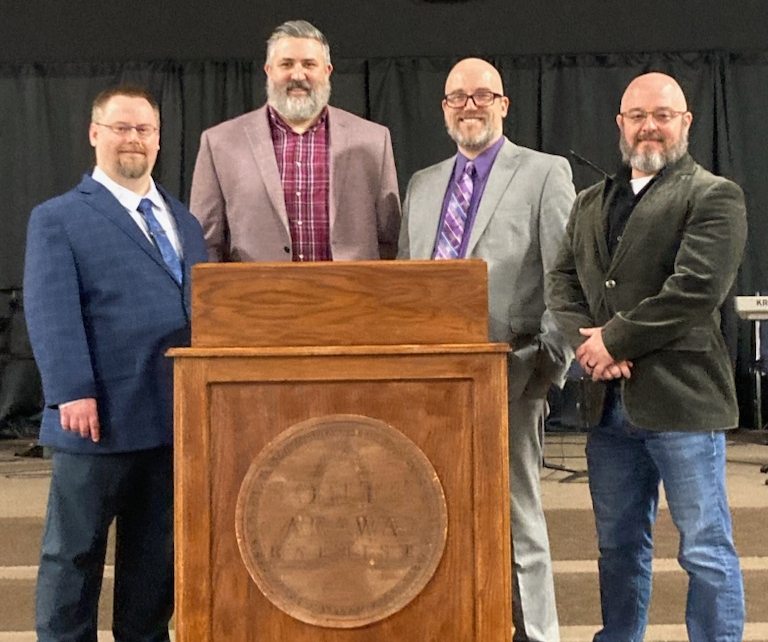
In an ideal plurality situation, the primary preaching pastor should preach between 35 and 40 sermons annually; mathematically, this would come out to about three sermons per month. The remaining 15 or so can be equally shared among the other members of the elder team. However, a cooperative approach to the ministry of preaching goes beyond the allocation of Sundays. It should include discussion and planning of the direction for not only the series overall but of individual texts, and it should also include the opportunity for evaluation and feedback. Of course, this approach does not remove the individual pastor’s responsibility for textual work; every minister of the word must commit themselves to hard work of plumbing its depths. But it does mean that we are not alone in the process. As plurality of brothers, we come alongside each other in the ministry of the Word, so that we all can attain unto “maturity with a stature measured by Christ’s fullness.” (Ephesians 4.13)








 Faith seeking Understanding