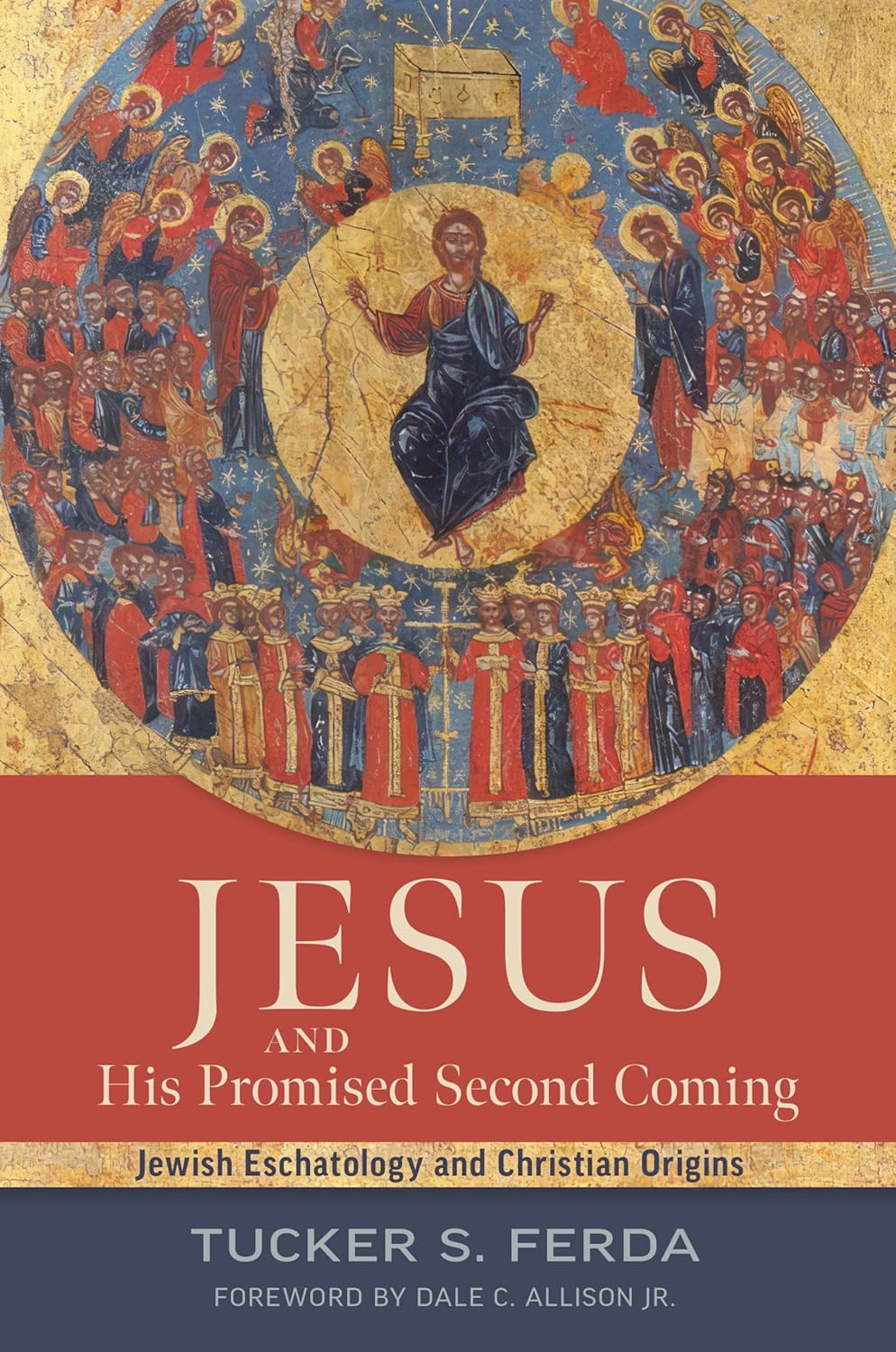
Ferda, Tucker S. Jesus and His Promised Second Coming: Jewish Eschatology and Christian Origins. Grand Rapids: Eerdmans, 2024.
One of the convictions that has Christians now for 2000 years is the expectation that Jesus will come again at the end of history to judge the living and the dead and to establish his kingdom on earth. This “blessed hope” (Titus 2:13) has been the confession of followers of Jesus from the very beginning of Christian history, as evidenced in the Apostle’s Creed. The problem is that this belief has somewhat of an embarrassment in the study of the historical Jesus. In other words, if Jesus truly believed that he would come again in the lifetime of “this generation” (Matthew 16:28, et al.), then either he made a simple mistake in his calculations or he was horribly deluded as to his understanding of himself and his role in the final consummation of all things. Scholars have typically followed two approaches in order to alleviate this embarrassment. On the one hand, there is a widespread consensus among critical scholars that the second coming is a belief that was created by the first followers of Jesus, and it does not go back to the historical Jesus. On the other, a large number of “evangelical” scholars have reinterpreted the coming of Jesus metaphorically/symbolically as a coming in judgment and have applied it to the destruction of Jerusalem in 70 AD.
In his most recent book, Jesus and His Promised Second Coming: Jewish Eschatology and Christian Origins, Tucker S. Ferda (Errett M. Grable Associate Professor of New Testament Exegesis and Early Christianity at Pittsburgh Theological Seminary) challenges both of these approaches by arguing that the second coming hope goes back to the historical Jesus. He advances this argument in four parts. In the first section, he considers questions related to historical and interpretive method, and he critiques certain “atomistic” approaches that attempt to sift through the Gospels in order to find the authentic sayings of Jesus and then then from them try to construct the beliefs of Jesus. In Ferda’s view, this methodological approach has it completely backward. Instead, he suggests that we should start with the beliefs of the early church as they are presented in the New Testament documents and then attempt to construct a plausible scenario that how these beliefs came to be. In the second section, Ferda considers the history of scholarship on the question of the Second Coming, and he identifies certain presuppositions and biases that have contributed to the current state of affairs. Particularly, he suggests that certain elitist and antisemitic tendences among scholars have caused them to want to distance Jesus from “outlandish” apocalyptic beliefs of Second Temple Judaism. In the third section, in keeping with the method that he outlined in section one, Ferda surveys the Gospels and and writings of Paul to demonstrate the widespread and ubiquitous belief in the Second Coming that characterized the early church, and finally, in section four, he offers a historical reconstruction of the Sitz im Leben Jesu (the life and ministry context of Jesus) which he believes explains the Second Coming beliefs of the early church and how they arose from the teaching and beliefs of the historical Jesus.
In the space that remains, I would simply like to identify two strengths and two weaknesses that stand out in Ferda’s work. First, Ferda’s critique of certain “atomistic” approaches to the study of the historical Jesus is spot on. So many reconstructions of the historical Jesus have relied on application of the so-called criterion of (in)authenticity to the saying of Jesus. In this approach, scholars utilize criteria like dissimilarity, multiple attestation, embarrassment, et al., to identify which sayings of Jesus in the Gospels are authentic . However, in practice, these criteria have led to the dismissal of more sayings of Jesus than they have authenticated. Moreover, this approach simply does not appreciate the what the Gospels actually are. They are not verbatim recordings of the teaching of Jesus; the Gospel writers were not attempting to record and convey the ipsissima verba (the very words) of Jesus. Given the literary and historical nature of Gospels, it is much more likely that they convey the ipsissima vox (the very voice) or the substantia verba (the substance of the words) of Jesus. So, the search for “authentic” sayings of the historical Jesus is a fundamentally flawed endeavor to begin with; it is not possible. Ferda’s alternative approach accounts for this by treating the Gospels as theological/interpretive history, and moving backward from how the church understood and interpreted Jesus to what Jesus likely understood and believed. In other words, it attempts to explain how the beliefs and expectations of the historical Jesus fit both within the context of Second Temple Judaism and how they give rise to the beliefs and hopes of the early church.
The second strength in Ferda’s argument has to do with his thorough and nuanced handling of messianic expectations in the Second Temple period. It is widely recognized that expectations for who the Messiah would be and what he would do were quite diverse during the time of Jesus. Of course, the liberation and restoration of Israel was foundational for these hopes, but expectations for how this would be accomplished were far from uniform. However, it seems relatively clear that book of Daniel played a primary role in the formulation of these expectations, and especially so for Jesus and his understanding of himself as the Son of Man. In his analysis of these expectations, Ferda clearly demonstrates the plausibility of Jesus’ belief in his own Second Coming. Moreover, he clarifies how notions of imminence and delay fit together in these scenarios. He writes, “It is also important to note that messianic hopes, varied though they were, frequently envisioned some kind of process of inauguration, whereby the coming of a messianic figure is climactic but does not necessarily change history instantaneously.” (390) The point is that the idea of imminence need not be equated with immediacy, and it need not preclude the idea Jesus expected an interim period between his death/resurrection and his coming in glory and power. Not only is this tension between imminence and interim present in the expectations of Second Temple Judaism, it is highly likely that it was a characteristic component of the eschatological expectations of the historical Jesus.
Overall, I think Ferda has made a strong and persuasive case for the idea that the Second Coming hope goes back to Jesus himself. Of course, this does not mean that I agree with every detail of his argument, and here I will identify two that stand out. First. while he is right to reject approaches that attempt to sift the Gospels for authentic sayings of Jesus, from time to time he still dismisses sayings that he considers clearly inauthentic. For example, he writes, “The threefold passion and resurrection predictions are highly suspect as they conveniently predict what exactly took place in Jerusalem (Mark 8.31, 9.30-32, 10.32-34, and parr.).” (327) In other words, because Jesus predicts the exact events that will unfold as to his death/resurrection, these predictions cannot be authentic sayings of the historical Jesus. This is a dismissive statement that reads more like a bias than an evidence based conclusion. Moreover, he goes on to argue that it is entirely plausible that Jesus had considered the possibility of his own death and that he likely expected to die in Jerusalem. Setting aside the question of Jesus’s understanding of his resurrection, it is not clear why Jesus could expect to die but not predict that he would be killed. Moreover, as noted above, the decision on whether a saying is authentic or inauthentic is at best not helpful and at worst irrelevant.
Secondly, as I noted above, Ferda makes a convincing case that Jesus’s understanding of imminence need not entail that the kingdom would come and that the would return within his own lifetime, especially since it is clear that he expected that he would die (rise again, and ascend). It is a truism to say that the proclamation of Jesus was characterized by the notion of imminence. However, how the notion of imminence should be understood is widely debated. Even though Ferda acknowledges the presence of a delay in Jesus’s expectations, he attempts to salvage the idea of imminence by limiting it to “this generation”, meaning that Jesus expected that he would come back within the lifetimes of his audience or a timespan of approximately 40 years. This is based on statements like the one found in Matthew 16:28, which says, “Truly I tell you, there are some standing here who will not taste death until they see the Son of Man coming in his kingdom,” or Matthew 24.34, “Truly I tell you, this generation will certainly not pass away until all these things take place.” These verses, and their parallels, are widely debated. Moreover, if Ferda’s interpretation is correct, then it is not clear how this saves Jesus from error. If he believed that he would come back within 40 years, and he clearly did not, then he was still wrong about his understanding of his coming. This is a fundamental question. Ferda doesn’t acknowledge the implications of his statements in this regard, nor does he attempt to resolve this tension. (See how I have attempted to address this problem, here.)
In the final analysis, we need not be ashamed to confess that “He will come again in glory to judge the living and the dead and his kingdom will have no end.” (Nicene Creed). This is our blessed hope, and to deny this in any way is to countenance heresy. It simply will not do to explain it away as a creation of the early church, and it will not do to reinterpret it as a metaphor or symbol. Jesus is coming again, visibly, bodily, in glory and power, to establish his kingdom on earth, to vindicate his people, and to defeat sin once and for all. Tucker S. Ferda has effectively demonstrated the plausibility that the church’s belief goes back to Jesus himself. Of course, he has not answered every question, and there is still more work to be done in terms of understanding the eschatology of the historical Jesus and how it is presented in Gospels particularly but also in the rest of the New Testament. But even if every question cannot be answered or every detail explained, followers of Jesus can boldly proclaim, “Amen! Come, Lord Jesus!”





 Faith seeking Understanding