Question: How do we connect the Old and New Testaments?
Series: Wednesday Night Bible Study – Q & A
Church: South Caraway Baptist Church, Jonesboro, AR
Date: July 13, 2022
Tag Archives: Phillip Powers

On Eschatology and the Gospel

The study of Eschatology in the church is usually met with two distinct responses. On the one hand, some become so consumed with an over fascination that it drives them to unhealthy speculations, and on the other hand, others are so filled with apathy and distaste that they would rather neglect its doctrines altogether. Recently, I heard about one church that spent eighteen months studying the Book of Revelation, and there is nothing wrong with that per se. However, to the external observer, it could appear as if this subject is more important than the Gospel itself. This is perhaps part of the reason why this area of theological reflection is so often met with such varied and disparate responses; we have failed to demonstrate clearly how these truths are connected to the saving work that God has accomplished in and through His Son, Jesus Christ. We have become so bogged down in controversial matters like tribulations, raptures, millenniums, antichrists, and the like, that we have lost the point that these events bring the promises of the Gospel to completion.
At its core, the Gospel is about how God has solved, is solving, and will solve the problem of sin. Of course, sin is first and foremost a personal individual problem; human beings are corrupted by and enslaved to sin, and because of this, they deserve to spend eternity in hell under the wrath of God. However, in the Gospel, Jesus Christ took upon himself the punishment that we deserve; He died in our place, satisfied the wrath of God, and declared, “It is finished!” Now, by grace through faith in Him, we are forgiven of our sin, clothed in His righteousness, and promised eternal life. But sin is also a cosmic problem, because all of creation has been polluted by and cursed because of sin. As the Scriptures explain,
For the creation eagerly waits with anticipation for God’s sons to be revealed. For the creation was subjected to futility—not willingly, but because of him who subjected it—in the hope that the creation itself will also be set free from the bondage to decay into the glorious freedom of God’s children.
~Romans 8.19-21
In the beginning, when God created the world, all was very good, but with the fall of mankind, sin and its consequences have hopelessly poisoned God’s good creation. This world reeks with the stench of death and decay; where there was once life and beauty, there is now sickness and death. But in the gospel, God is making all things new; he is restoring and recreating the paradise that was lost. In the Book of Revelation, chapters 21-22, we read of a new heaven and new earth which is completely free of sickness and death, heartache and pain, tear and loss. It is a world that is completely free from the stain of sin in every way. It is not just the Garden of Eden restored, it is the Garden of Eden made better.
In other words, the Gospel is inherently and irreducibly eschatological, because not only have we been set free from the penalty of sin, not only are we being set free from the power of sin, but one day we will be set free from the very presence of sin. Until then, we live in the tension of the already but not yet, already forgiven of our sin, already free from sin’s tyranny, but not yet free from its temptations and habituations in our daily lives. We rightly long for the day when the problem of sin and its effects will be no more; this is our blessed hope. And this is why the study of Eschatology should not be viewed as a distraction from the proclamation of the Gospel. On the contrary, the doctrines of Eschatology are so intricately and intimately woven into the fabric of the Gospel, that if we neglect or ignore them, we truncate the Gospel message, empty it of its power, misconstrue the nature of its promises.
This is not to say that the study of Eschatology is always done correctly. Certainly, there are many who have engaged this subject matter in improper or unhealthy ways that have shifted the focus or missed the mark. Eschatology is one of those areas in the study of which it is possible to miss the forest for the trees. There are many details and questions that fall into this category that could become a distraction. However, this does not mean that we should omit the study of it altogether, because Eschatology is fundamentally about hope, the hope of a world free from sin. This is the wonder of our salvation, not only that we have been forgiven of our sin and have received eternal life, but that the work of Christ in salvation has put something into motion that will completely transform the world as we know it.
For the grace of God has appeared, bringing salvation for all people, instructing us to deny godlessness and worldly lusts and to live in a sensible, righteous, and godly way in the present age, while we wait for the blessed hope, the appearing of the glory of our great God and Savior, Jesus Christ.
~Titus 2.11-13
Share this:

On Biblical Interpretation and the Analogy of Faith

The reality is that no one comes to the interpretation of Scripture with a completely blank slate; we all have some amount of pre-understanding that we bring with us when we read the Bible. This pre-understanding is formed through our education and our experiences, the combination of which overtime becomes part of the lenses through which we read Holy Scripture. Most of the time, our pre-understanding is helpful, because it forms a foundation from which we are able to engage the text and grasp its meaning; however, sometimes our pre-understanding can be a hindrance, if and when we are unwilling to submit it to the authority of the Biblical text. This is why the interpretive process is sometimes referred to as a “hermeneutical spiral”, because even as our pre-understanding helps us to understand the text, so in turn, the text shapes and forms our pre-understanding to be conformed with Biblical truth.
For those of us who are committed to the principle that the Bible is God’s Word, part of that pre-understanding includes our theological convictions about the nature of Bible. The inspiration, inerrancy, authority, sufficiency, perspicuity, et al. are foundational truths which ground Evangelical biblical interpretation. The truth that the one true and living God has spoken through His Word in ways that we may understand and apply is what makes our attempts to understand the Bible so significant. We are reading God’s very word. And it is precisely because we are reading God’s word that we hold to a conviction known as the “analogy of faith,” or the idea that scripture interprets scripture. It is a hermeneutical conviction that has been passed down to us from our Reformation forebears, and it is the veritable corner stone of Protestant biblical interpretation. However, in application, it has caused much confusion, because more often than not it is treated as an interpretive method rather than as a theological conviction.
The “analogy of faith”, sometimes also referred to as the “analogy of scripture,” is primarily a theological conviction about the unity and coherence of Biblical truth. It is grounded in the truth that the Bible, though it was written by many diverse human authors over several centuries, actually has only one primary author, i.e. the one true and living God. He has spoken clearly through His Word for the purpose that it may be understood, and He is not the author of confusion. Therefore, the overarching story of the Bible, its primary message and its central tenets, is essentially clear, consistent, and consonant with itself. There are no actual contradictions in the Biblical text, and if there is an apparent contradiction, then the problem lies with our understanding of the text and not with the text itself. So, the principle that scripture interprets scripture merely means that when multiple passages say something on a particular topic (either explicitly or implicitly), then what those passages say about that topic will be complementary and not contradictory.
On the other hand, the “analogy of faith” is not primarily a hermeneutical method; it does not necessarily tell us how to interpret the Bible. It does not permit us to ignore the social, cultural, or historical context of a passage, nor does it allow us to disregard the literary and grammatical conventions by which it is communicated. It also does not require that the various human authors of Holy Scripture say exactly the same thing in exactly the same way. In other words, we must allow for diversity of nuance, differences in emphasis, and uniqueness in application among the biblical authors. Our interpretation must be grounded in the meaning that the Spirit inspired human author intended to convey to his primary audience. We must follow his flow of thought, consider his purpose for writing, analyze his meaning on his terms. These are the essential building blocks of a sound interpretive method.
The “analogy of faith” also does not give us the license to move haphazardly through the Scriptures connecting passages that are otherwise unconnected. When the biblical authors quote directly from or make clear allusion to other passages, we may consider their relationship, but the principle that scripture interprets scripture does not mean that particularities and distinctions between passages can be minimized or ignored. Individual passages must be engaged on their own merits within their immediate context. This is because biblical meaning flows outward from smaller units of thought to wider units of thought, starting with the sentence, then the paragraph, then the pericope, then the section, the book, books by the same author, books in the same testament, and finally the whole Bible. To reverse this process is to impose meaning on the scriptures from the top down; it is reading meaning into the scriptures that may not otherwise be present or supported by the passage.
The composition and preservation of the Bible is nothing less than a manifestation of God’s providence and sovereignty. It was written over the course of 2000 years by several dozen different authors in three different languages across three continents, and yet, its central truths and primary message are remarkably consistent and harmonious. Its message is so simple that a child could understand it, and yet so profound that the greatest minds throughout history have failed to exhaust its mysteries. And God has ordained that it should be the primary means by which we might come to know Him and His will for our lives. The good news of the Gospel is that He wants to be known, and He has revealed Himself in the Bible so that we may read, understand, and be transformed. If we will simply seek Him in, by, and through His Word, then we may be sure that He will be found.
For further study, see also:
On Sola Scriptura and the Use of Bible Study Resources
On Biblical Interpretation and the Holy Spirit
On Hermeneutics & Interpreting the Bible
Share this:

On the Love and the Wrath of God
TEXT
11 When Israel was a child, I loved him,
and out of Egypt I called my son.
2 Israel called to the Egyptians
even as Israel was leaving them.
They kept sacrificing to the Baals
and burning offerings to idols.
3 It was I who taught Ephraim to walk,
taking them by the hand,
but they never knew that I healed them.
4 I led them with human cords,
with ropes of love.
To them I was like one
who eases the yoke from their jaws;
I bent down to give them food.
5 Israel will not return to the land of Egypt
and Assyria will be his king,
because they refused to repent.
6 A sword will whirl through his cities;
it will destroy and devour the bars of his gates,
because of their schemes.
7 My people are bent on turning from me.
Though they call to him on high,
he will not exalt them at all.
8 How can I give you up, Ephraim?
How can I surrender you, Israel?
How can I make you like Admah?
How can I treat you like Zeboiim?
I have had a change of heart;
my compassion is stirred!
9 I will not vent the full fury of my anger;
I will not turn back to destroy Ephraim.
For I am God and not man,
the Holy One among you;
I will not come in rage.
10 They will follow the Lord;
he will roar like a lion.
When he roars,
his children will come trembling from the west.
11 They will be roused like birds from Egypt
and like doves from the land of Assyria.
Then I will settle them in their homes.
This is the Lord’s declaration.
Text: Hosea 11.1-11
Series: Supply Preaching
Church: First Baptist Church, Mammoth Spring, AR
Date: June 5, 2022
Share this:

On the Fatherhood of God & the Discipline of Prayer
TEXT
11 He was praying in a certain place, and when he finished, one of his disciples said to him, “Lord, teach us to pray, just as John also taught his disciples.”
2 He said to them, “Whenever you pray, say,
Father,
your name be honored as holy.
Your kingdom come.
3 Give us each day our daily bread.
4 And forgive us our sins,
for we ourselves also forgive everyone
in debt to us.
And do not bring us into temptation.”
5 He also said to them, “Suppose one of you has a friend and goes to him at midnight and says to him, ‘Friend, lend me three loaves of bread, 6 because a friend of mine on a journey has come to me, and I don’t have anything to offer him.’ 7 Then he will answer from inside and say, ‘Don’t bother me! The door is already locked, and my children and I have gone to bed. I can’t get up to give you anything.’ 8 I tell you, even though he won’t get up and give him anything because he is his friend, yet because of his friend’s shameless boldness, he will get up and give him as much as he needs.
9 “So I say to you, ask, and it will be given to you. Seek, and you will find. Knock, and the door will be opened to you. 10 For everyone who asks receives, and the one who seeks finds, and to the one who knocks, the door will be opened. 11 What father among you, if his son asks for a fish, will give him a snake instead of a fish? 12 Or if he asks for an egg, will give him a scorpion? 13 If you then, who are evil, know how to give good gifts to your children, how much more will the heavenly Father give the Holy Spirit to those who ask him?”
Text: Luke 11.1-13
Series: Supply Preaching
Church: South Caraway Baptist Church, Jonesboro, AR
Date: August 9, 2020
See also:
On the Lord’s Prayer – Part 1
On Persistence in Prayer – Part 2
On Persistence in Prayer – Part 3
Share this:

On Sola Scriptura and the Use of Bible Study Resources
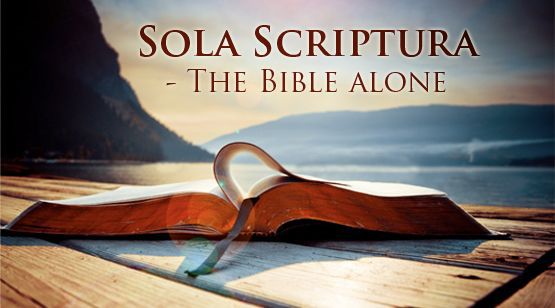
Five hundred years ago, the leaders of the Protestant Reformation championed the refrain sola scriptura, that scripture alone is the ultimate and final authority for all questions pertaining to Christian faith and practice. It is a refrain that continues to ring out today in Bible believing churches all over the world. The perspicuity, sufficiency, and authority of the Bible are convictions that are foundational for the overall health and wellbeing of the church, and this is especially so when these truths are under the kind of direct attack that they have suffered in this current cultural climate. It is no understatement to say that the trends of the culture are moving against the authority and sufficiency of Holy Scripture. Therefore, it is imperative for every new generation of Christians to affirm, proclaim and defend these truths.
However, in my experience, there is widespread misunderstanding about what the doctrine of sola scriptura actually means. Many Christians commonly confuse the doctrine of sola scriptura, or “scripture alone”, with a position that might be called solo scriptura, or “scripture only”. Solo scriptura is the position that Holy Scripture is the only valid resource for matters of Christian faith and practice, and usually, it holds that other kinds of extra biblical resources are unnecessary, nay even inappropriate. According to this perspective, biblical commentaries, historical studies, biblical and systematic theologies are typically viewed as distractions or obstacles in the study of the Bible rather than as aids in the process. These resources are typically viewed as merely the opinions of men, and so they are deemed to be inappropriate for the Christian who truly wants to hear the voice God in His Word.
Now, I think that the believers who hold this kind opinion are genuine in their desire to know and obey the Word of God, and this should be applauded. But, to eschew all extra biblical resources out of some supposed devotion to the primacy of Holy Scripture is fundamentally short sighted and unwise. This is primarily because God has gifted his church with pastors and teachers (Ephesians 4.11), and these gifts have been preserved for us in the form of commentaries, theologies, and the like that have been passed down through the ages. Moreover, the Proverbs remind us that “A fool’s way is right in his own eyes, but whoever listens to counsel is wise” (Proverbs 12.15), and “Without guidance, a people will fall, but with many counselors there is deliverance” (Proverbs 11.14). In other words, it is in keeping with Biblical wisdom to listen to the counsel of those who have studied the Bible before us. Or to put it another way, “[Interpretations] fail when there is no counsel, but with many advisers they succeed” (Proverbs 15.22).
Of course, the doctrine of sola scriptura rightly affirms that these extra biblical resources do not stand above the Bible in any kind of authoritative or determinative way. The Bible is norma normans non normata; it is the norming norm that is itself not normed. On the other hand, biblical commentaries, systematic theologies, and the like are norma normata, or “normed norms”, in the process of biblical interpretation. They are the guard rails that keep us from falling into the canyon of interpretive subjectivism, but they are ultimately subservient to that final authority which is the inspired and inerrant Word of the one true and living God. This is the doctrine of sola scriptura rightly understood; it is the affirmation that scripture the final and highest authority on matters pertaining to Christian life and practice, but it is not the only authority on these matters.
So, when it comes to reading and studying the Bible, Christians are right to avail themselves of the plethora of resources both modern and ancient that are available today. This includes but is not limited to biblical commentaries, biblical, systematic, and historical theologies, socio-cultural background studies, linguistic and literary aids, and many others. These are valuable helps in the interpretive process. However, as helpful as these kinds of books are, we must remember that nothing can substitute for simply reading the Bible; this is the God-ordained means by which we are transformed into His image by the renewing of our minds. As Charles Spurgeon once said, “Visit many good books, but live in the Bible. ” Or as the Bible itself reminds us,
“But beyond these, my son, be warned: there is no end to the making of many books, and much study wearies the body. When all has been heard, the conclusion of the matter is this: fear God and keep his commands, because this is for all humanity.”
~Ecclesiastes 12.12-13
For more on this topic, see also:
On the Use and Benefit of Tradition
On Hermeneutics & Interpreting the Bible
Share this:

On an Introduction to Ephesians
TEXT
1 Paul, an apostle of Christ Jesus by God’s will:
To the faithful saints in Christ Jesus at Ephesus.
2 Grace to you and peace from God our Father and the Lord Jesus Christ.
Title: On an Introduction to Ephesians
Series: John Newton Pastors Conference
Church: Grace Baptist Church, West Memphis, AR
Date: May 20, 2022
Share this:

On the Parable of the Rich Man and Lazarus
TEXT
19 “There was a rich man who would dress in purple and fine linen, feasting lavishly every day. 20 But a poor man named Lazarus, covered with sores, was lying at his gate. 21 He longed to be filled with what fell from the rich man’s table, but instead the dogs would come and lick his sores. 22 One day the poor man died and was carried away by the angels to Abraham’s side. The rich man also died and was buried. 23 And being in torment in Hades, he looked up and saw Abraham a long way off, with Lazarus at his side. 24 ‘Father Abraham!’ he called out, ‘Have mercy on me and send Lazarus to dip the tip of his finger in water and cool my tongue, because I am in agony in this flame!’
25 “‘Son,’ Abraham said, ‘remember that during your life you received your good things, just as Lazarus received bad things, but now he is comforted here, while you are in agony. 26 Besides all this, a great chasm has been fixed between us and you, so that those who want to pass over from here to you cannot; neither can those from there cross over to us.’
27 “‘Father,’ he said, ‘then I beg you to send him to my father’s house— 28 because I have five brothers—to warn them, so that they won’t also come to this place of torment.’
29 “But Abraham said, ‘They have Moses and the prophets; they should listen to them.’
30 “‘No, father Abraham,’ he said. ‘But if someone from the dead goes to them, they will repent.’
31 “But he told him, ‘If they don’t listen to Moses and the prophets, they will not be persuaded if someone rises from the dead.’”
~Luke 16.19-31
Title: On the Parable of the Rich Man and Lazarus
Series: Who is Jesus? A Study of the Gospel of Luke
Church: South Caraway Baptist Church, Jonesboro, AR
Date: May 08, 2022
Share this:

On the Ministry of the Local Association

Cooperation between local churches has long been a hallmark of Baptist identity. Going all the way back to the earliest English separatists, Baptists have always understood that, though local churches are autonomous, we are better able to accomplish the Great Commission to make disciples of all nations when we partner together. Our history is filled with example after example of local churches that have worked together to fund, train, and send missionaries around the world. In many ways, these precedents are the foundation for the denominational structures that exist today. Whether it is the national convention, the state conventions, or the local associations, all of these entities exist to facilitate the cooperation of like-minded churches for the advancement of the global cause of Christ.
Of course, it goes without saying that the strength and effectiveness of these entities is directly dependent on the participation of local churches. This is particularly true at the level of the local Baptist association; their ministry suffers drastically when local churches do not participate regularly. One factor that has contributed significantly to the weakness of associational ministry is the rise of the mega/multisite church. The overabundance of people and resources in these churches enables them to operate as independent self-sufficient organisms, essentially negating their need to cooperate with other churches in the area. In my own local association, there is a relatively large church, a mega church by all comparative measurements, and while their name appears on the association roster, their participation therein is practically nil save a token monthly financial contribution.
Whatever the reasons, when local churches do not participate in the ministry of the local association, all of the churches that partner with that association suffer. Local associations, especially those in more rural areas, have largely become weak, ineffective, and irrelevant due to the widespread apathy that characterizes attitudes in most local Baptist churches. It has come to the point that we might even begin to wonder why these entities still exist and whether they should continue at all. As the Apostle Paul would say, “May it never be!”. The point is that we desperately need to recover the value of local association ministry, and in the space that remains, I would like to highlight just a few of the ways that participation in the local association benefits the local church.
First, the local association provides pastors the opportunity to build relationships with other pastors. More often than not, pastors cannot find the kinds of relationships that sustain long term ministry success in their own congregations. This should not be the case, of course, but being a pastor can sometimes feel very lonely. Building relationships with other pastors through the local association can help to alleviate that isolation; it is a place where pastors can turn for encouragement, accountability, and mentoring. The latter of these is particularly important for younger first time pastors. The value of being mentored by seasoned, experienced, faithful pastors is a resource that will bear fruit long after those pastors retire. Older pastors have the opportunity to invest in and influence the next generation of pastors through meaningful self-giving relationships, and the best place for these to develop is through the local association. Or to put it more simply, pastors need each other.
A second way in which participation in the local association benefits the local church is by cooperative mission efforts. The simple fact of the matter is that the Great Commission to make disciples of all nations, while it is certainly not less than, it is so much more than the isolated ministry of one local church. Most local churches, the vast majority of which average less than 100 in weekly attendance, simply do not have the financial or people resources to develop an effective mission program. However, when those resources are pooled together with other churches through the local association, we are better able to reach not only our Jerusalem, but our Judea and Samaria, and even to the ends of the earth. This is essentially what the Cooperative Program is all about; in the Southern Baptist Convention, churches pool their resources through the cooperative program primarily for the purpose of national and international missions and theological education. If we truly care about the cause of Christ, then this kind of cooperation must begin at the local level.
Lastly, participation in the ministry of the local association helps churches cultivate a kingdom first mentality. This may be more of a result of the first two, but the point is that participating in the local association reminds us that Christianity is bigger than our little slice of the pie. The Kingdom of God is much more than our particular sphere of influence. However, it is all too easy for churches, particularly those that are experiencing seasons of meaningful ministry, to begin to believe that the work of the Kingdom revolves around the ministry efforts of their particular church. Pride begins to spring up in our hearts, and we develop a kind of competitive attitude where we measure our successes and achievements against other local churches. But, the fact of the matter is that local churches should not be in competition with each other. We are all on the same team, all striving for the same goal, and local association ministry helps keep this reality at the foreground of our ambitions.
I love the local church; I believe in the ministry of the local church. The local church is the primary avenue of God’s work in the world to bring people to faith in His Son and transform them into His image. But the Kingdom of God is bigger than individual churches; the Great Commission is bigger than individual churches. And denominational organizations from the local association all the way up to the national convention exist to facilitate and support the cooperation of likeminded churches for the cause of Christ. Denominations are not perfect, because they are made up of people that are not perfect. They can be frustrating, ineffective, and even disappointing at times, but when local association ministry is done well, it makes it all worth it.
Note: This post was originally posted at SBCvoices, here.


On Biblical Interpretation and the Holy Spirit
Recently, I was following a thread on a friends Facebook post where the participants were discussing their disagreement on a question of biblical interpretation. The specific issue under debate is not important at the moment, and I’ll just say that I was surprised to find that this particular exchange was more graceful than these kinds of forums usually are. However, with that being said, after reading through the various points and counterpoints being made, I came across one response that made me pause. Figuring that the minds of the other participants were unlikely to change, one commenter attempted to conclude the discussion by saying:
In my previous post, I examined the question of “man-made” bible study resources, and I concluded that there is great wisdom in listening to the voices of those who have studied the Bible before us. We were never intended to approach Bible study as if we are the “lone ranger” of Bible interpretation, carving a path that has somehow never been carved before. Commentaries, theologies, and the like are part of God’s gift to the church (Ephesians 4.11-13); they are part of that “great cloud of witnesses” within which we pursue Christian maturity and godliness (Hebrews 12.1). However, even greater than these is the gift that is God’s Spirit. In the New Covenant, we who have been united with Christ by faith have been indwelt by God’s very Spirit, and He is the one who writes the Word upon our hearts and moves us to obey it (Jeremiah 31.33, Ezekiel 36.27). This is what makes Christian biblical interpretation unique; we have God’s Spirit (1 Corinthians 2.10-16).
Unfortunately, there is great misunderstanding as to the exact nature of the Spirit’s role in biblical interpretation, and in the space that follows, I would like to explore the contours of the Spirit’s work in Bible interpretation. According to the view represented by the Facebook comment above, all we need to do is read the Bible and then open our hearts and minds so that the Spirit can tell us what the Scripture means. This approach is essentially a recapitulation of the ancient heresy of Gnosticism. In other words, it suggests that Biblical knowledge comes to us by some kind of secret mystical experiential revelation from the Spirit apart from the text. But this is not the way that the Spirit works. Revelation is fixed, and the canon is closed. Moreover, the Spirit will not do for us what God has equipped us to do for ourselves. He has given us rational minds with the ability to read and comprehend His revealed Word. This is why we are repeatedly commanded to read, study, and grow in the knowledge of the Scriptures.
The Spirit’s work in biblical interpretation is not primarily revelatory; He does not impart the content of biblical meaning. Rather, His work pertains more to our accepting and obeying the principles that are revealed in the Scriptures. This is what is known in theology as the doctrine of illumination.
The Spirit illuminates our hearts to accept the truth of God’s Word, and He helps to conform our will in submission to that Word through conviction. This illumination comes to us not through some mystical experiential supra-rational revelation, but through the classic word-centered spiritual disciplines. In other words, once we have done our exegetical work in the text, then we must do our closet work (ala Matt 6.6) through memorization, meditation, and prayer. When we engage in these rhythms of the Spirit, we put ourselves in a posture where He can use the fruits of our study to sift our souls. As the Scripture says,
Under the New Covenant, one of the primary roles of the Spirit is to mediate the knowledge of God, but this ministry cannot, nay must not, be separated from the Word of God. Throughout all of Holy Scripture, the Spirit of God and the Word of God work together to transform the people of God into the image of God. More often than not, this transformation happens in ways and means that are consistent with the way God has made us. We do not seek any secret mystical revelation of God’s Word; rather, we use all of the natural and supernatural resources that God has given us to understand His revelation of Himself to us through His Word.
For further study:
On the Spirit and the Word
Share this:
4 Comments | tags: Bible Study Resources, Closet Work, Commentaries, Exegetical Work, Gnosticism, Holy Spirit, Illumination, Meditation, Memorization, New Covenant, Phillip Powers, Prayer, Spiritual Disciplines, Theologies | posted in Biblical Theology, Hermeneutics, Spiritual Formation