Tag Archives: Penal Substitution

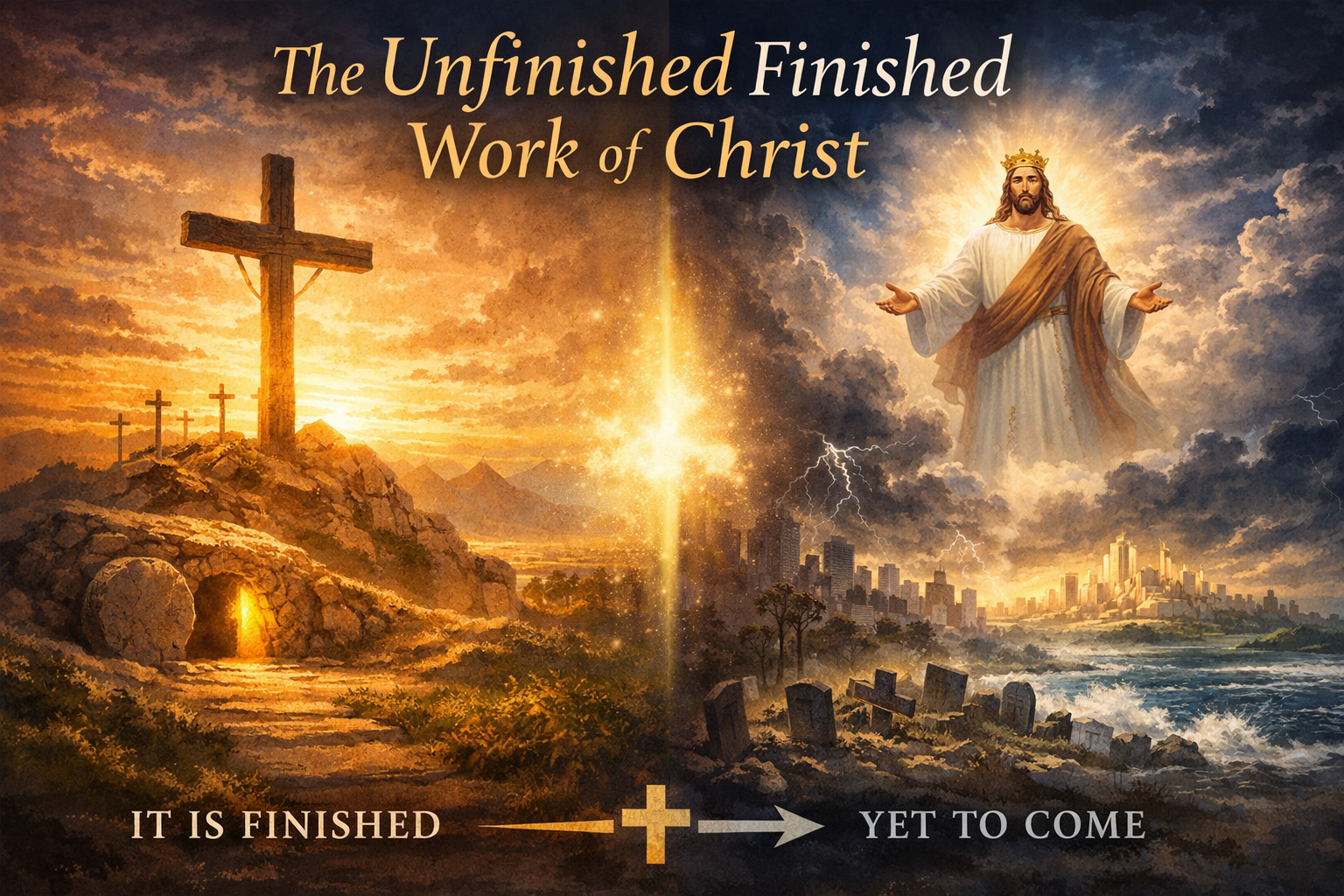
On the Crucifixion and Why It Matters at Christmas

TEXT

32 Two others—criminals—were also led away to be executed with him. 33 When they arrived at the place called The Skull, they crucified him there, along with the criminals, one on the right and one on the left. 34 Then Jesus said, “Father, forgive them, because they do not know what they are doing.” And they divided his clothes and cast lots.

35 The people stood watching, and even the leaders were scoffing: “He saved others; let him save himself if this is God’s Messiah, the Chosen One!” 36 The soldiers also mocked him. They came offering him sour wine 37 and said, “If you are the king of the Jews, save yourself!”

38 An inscription was above him: This Is the King of the Jews.

~Luke 23.32-38

Title: On the Crucifixion and Why It Matters at Christmas
Text: Luke 23.32-38
Series: Who is Jesus? A Study of the Gospel of Luke
Church: South Caraway Baptist Church, Jonesboro, AR
Date: December 18, 2022


On Penal Substitution Theory in the Early Church

church fathers

Recently, I have been reflecting on the penal substitution theory of the atonement as it relates to the significance of Jesus death, both in the thinking of Jesus himself and in the understanding of his first followers. And the conclusion that I came to in both of those posts is that a penal substitution understanding is essential and necessary for a proper understanding of the atonement. The witness of Holy Scripture requires us to conclude that Jesus died for our sin. He took the place we deserved when he was nailed to the cross, and, in his death, he satisfied the just and due penalty for our sin required by a Holy and Righteous God.

This my seem like an injustice to us, that the innocent Son of God was unjustly punished by His Father for the sins of human beings, but simply because our modern sensibilities may view this as distasteful and hard to swallow, we cannot simply dismiss this understanding of the cross as so-called “cosmic child abuse”. Any attempt to bypass the offense of the cross to make it more palatable must ultimately be rejected. It is the very injustice of the cross that makes the Gospel beautiful and powerful, because that injustice was suffered by God himself that we might be reconciled to Him. He himself paid the penalty that He himself required so that we might be saved.

However, if we truly believe that this understanding of the cross is true and necessary, then it would make sense that we would see it throughout the history of the church. In their attempts to disprove this view, some critics of penal substitution suggest that the theory did not exist in the early church. They argue that it first appeared in the late eleventh century in the writings of Anselm of Canterbury, specifically in his work Cur Deus Homo. It was then further developed in the 13th century by Thomas Aquinas in his work Summa Theologiae, and then crystalized into the doctrine we know today in the 16th century by John Calvin in The Institutes of Christian Religion.

While the contributions of these works to our understanding of the atonement certainly hold great value, these critics question that if a penal substitution theory of the atonement is so central and essential, then why is not represented in the theological tradition before the 11th century. It is further argued that the early church fathers unanimously held to a Christus Victor or ransom theory of the atonement, and that if that’s how the earliest theologians viewed the atonement, then so should we. The problem with this argument, though, is that this it is often more assumed than it is demonstrated.

So, in what follows, rather then examining the views of any specific church father, I would simply like to list some resources that challenge this prevailing understanding of the development of the theology of the atonement.

Books
Jeffery, Steve, et al. Pierced for Our Transgressions: Rediscovering the Glory of Penal Substitution. Wheaton, IL: Crossway, 2007.
McDonald, H.D. The Atonement of the Death of Christ: In Faith, Revelation, and History. Grand Rapids, MI: Baker, 1985.

Articles
Chatfield, Graeme. “Penal Substitutionary Atonement in the Early Church Fathers, the Creeds, and Trinitarian Theology.” The Pacific Journal of Baptist Research 10/1 (May 2015). 3-10.
Vlach, Michael J. “Penal Substitution in Church History.” The Masters Seminary Journal 20/2 (Fall 2009). 199-214.
Williams, Garry J. ” Penal Substitutionary Atonement in the Church Fathers.” Evangelical Quarterly 83/3 (Fall 2011). 195-216.

Weblinks
“Historical Reflections on Substitutionary Atonement” posted at FullerStudio.Fuller.edu
“Penal Substitution a Sixteenth-Century Innovation?” posted at ReformationTheology.com, 05.11.12
“No Christus Victor Here – Atonement According to the Apostolic Fathers” posted at HolySpiritActivism.com, 04.07.14
“A Common (But Bad) Reason for Rejecting Penal Substitution” posted at Christianity.com, 07.15.14
“Did Early Christians Believe in Substitutionary Atonement?” posted at TheGospelCoalition.org, 04.03.15
“Penal Substitution as a Theory of Atonement in the Early Church Fathers” posted at OrthodoxChristianTheology.com, 06.03.15
“Penal Substitution in the Church Fathers: Part II” posted at OrthodoxChristianTheology.com, 11.26.15
“10 Things You should Know about Penal Substitution” posted at SamStorms.com, 05.02.16
“Penal Substitution In The Writings Of The Church Fathers” posted at PirateChristian.com,  05.04.16

Now, we certainly do not want read later theological concepts back in to the early church fathers anachronistically, but we may conclude that “an author can be held to teach the penal doctrine if he plainly states that the punishment deserved by sin from God was borne and dealt with by Jesus Christ in his death on the cross.” This means that the early church fathers can be shown to affirm the essential features of a penal substitution view, even if their understanding of that essential truth was not as developed as it would be by later authors. The church fathers were not univocal or unanimous in their support of the Christus Victor view as critics of the penal substitution view claim. They seemingly held a multifaceted understanding of the atonement with no one view overshadowing any others.

And this final observation is quite instructive for Christians today. No one view, no matter how essential, central, and necessary it is, can exhaust the mystery of Jesus’ death on the cross. So, even while affirming the centrality of the penal substitution view, we must not overlook or ignore other possible significances. The crucifixion and resurrection of Jesus is to the Christian faith like a beautiful diamond whose many facets all shine forth the glory of God in our salvation.


On Jesus’ Understanding of His Death

JesusFinalHours-56a149da5f9b58b7d0bdda13

In a previous post, I began considering how we should understand the death of Jesus, and I argued that the overwhelming testimony of both the Old and New Testament point to a penal substitution view as essential for understanding the Gospel of Jesus Christ. Specifically, I gave a handful of quotations from the various New Testament authors that show that the very first followers of Jesus understood His death in this way. Now, it is only reasonable to suppose that they must have received this understanding from somewhere; they didn’t just come up with it on their own. And it is my thesis that they received this understanding of Jesus’ atonement from Jesus himself.

However, this proposition is not without its critics. One such voice is that which belongs to Brian Zahnd, founder and lead pastor of Word of Life Church in St. Joseph, Missouri and author of a book entitled, Sinners in the Hands of a Loving God: The Scandalous Truth of the Very Good News, where he argues:

“Among the many problems with [a penal substitution] theory of the cross is that it turns God into a petty tyrant and a moral monster. Punishing the innocent in order to forgive the guilty is monstrous logic, atrocious theology, and a gross distortion of the idea of justice. … A theory of the cross that says it was God who desired the torture and murder of Jesus on Good Friday turns the Father of Jesus into a cruel and sadistic monster. It’s salvation by divine sadism.” (101-102)

He has also stated that

“Even if penal substitutionary atonement theory is one of the correct models for interpreting the cross (personally I’m convinced its a pagan idea and an outrageous libel against God) its still not the gospel. The gospel is the story of Jesus – not abstract atonement theories.” (via @BrianZahnd, tweeted 3.20.18, 7:27PM)

And in his blog “How Did Jesus Understand His Death?”, he argues that Jesus understood his death in the vein of the Christus Victor theory of the atonement on the basis of John 12:31-32.

So, in order to understand the meaning of Jesus’ death, we must consider carefully how Jesus understood it and conveyed its significance to His first disciples. It is relatively obvious that Jesus anticipated his death by crucifixion at the hands of the Jewish and Roman authorities. In the Synoptics (Matthew, Mark, and Luke), He predicts his death at least three specific occasions. Those predictions, along with many other allusions, coupled with the obvious animosity between the Jewish religious establishment and Jesus clearly indicate that Jesus was well aware of the fate that awaited Him on that third and final trip to Jerusalem. However, not only did he expect his upcoming execution, he also very clearly saw it as the necessary culmination of His ministry and mission.

In this light then, it is reasonable to expect that He must have reflected on the meaning of His death. And there are three sayings of Jesus that give us some insight into how he understood that meaning. The first saying of Jesus that gives us some insight into how he understood His death is found in Mark 10:45 (also Matthew 20.28), which is known as the ransom saying, because Jesus says, “For even the Son of Man did not come to be served, but to serve, and to give his life as a ransom for many.” The second saying of Jesus that shows how he understood his death is found in the words of institution at the Last Supper (Mark 14:22-25, Matt. 26:26-29, Luke 22:14-20). There Jesus reinterprets the elements of the Passover meal in the light of His upcoming death. And the third saying that is also somewhat conceptually related is found in the prayer of Jesus in the Garden of Gethsemane, when he prayed “Take this cup away from me.” (Mark 14:36. Matt. 26:39,42, Luke 22:42)

These statements indicate that Jesus understood his death as a vicarious substitution for many, and it seems reasonably clear that the theological background of these sayings is to be found in that paradigmatic passage from the Old Testament which describes the vicarious substitution of the “suffering servant”. In Isaiah 52:13-53:12, the prophet vividly predicts the vicarious and expiatory suffering of the servant of the Lord for the many. The linguistic and conceptual parallels between the suffering servant song and these sayings of Jesus are quite telling. For example, the idea of a ransom in Mark 10:45, used as a metaphor, parallels the idea of a guilt offering in Isaiah 53:10, and the idea for many echoes the repetitive many in Isaiah 53:11-12. This indicates that Jesus clearly understood himself to be fulfilling the role of the suffering servant in His death on the cross.

Further, in the garden, when Jesus asks His Father to remove “the cup”, He is likely referring to “the cup of God’s wrath” or “judgment” so often described in the Old Testament prophets. And that is why He is able to say in John 12:31, “Now is the judgment of this world.” So, here again it seems fairly evident that Jesus understood His death as the satisfaction of God’s judgment on sin. In light of all this, it is safe to conclude that Jesus viewed His death as a substitutionary and expiatory act that satisfies the just judgment and due penalty for sin before a Holy God. It would seem, then, that the first followers of Jesus drew their penal substitution view of the atonement directly from the words of Jesus himself.


On so called ‘Cosmic Child Abuse’ and the Atonement

o-CRUCIFIXION-facebook

In recent years, it has become rather faddish for critics of traditional atonement theory to dismiss the idea of penal substitution as a form of cosmic child abuse. In other words, these critics assert that it is a morally evil injustice for God to punish His innocent Son for the sins of all other human beings. They further assert that this kind of “redemptive violence” is simply incompatible with a God who is love. Stephen Chalk and Alan Mann, in their book The Lost Message of Jesus, state it this way:

The fact is that the cross isn’t a form of cosmic child abuse—a vengeful Father, punishing his Son for an offence he has not even committed. Understandably, both people inside and outside of the church have found this twisted version of events morally dubious and a huge barrier to faith. Deeper than that, however, is that such a concept stands in total contradiction to the statement “God is love”. If the cross is a personal act of violence perpetrated by God towards humankind but borne by his Son, then it makes a mockery of Jesus’ own teaching to love your enemies and to refuse to repay evil with evil.

Later, they give their understanding of the atonement when they state:

The truth is, the cross is a symbol of love. It is a demonstration of just how far God as Father and Jesus as his Son are prepared to go to prove that love. The cross is a vivid statement of the powerlessness of love.

This moral influence theory of the atonement is not new or original with Chalk and Mann. It was first advanced by a medieval scholastic theologian named Peter Abelard (1079-1142), who

“emphasized the primacy of God’s love and insisted that Christ did not make some sort of sacrificial payment to the Father to satisfy his offended dignity. Rather, Jesus demonstrated to humanity the full extent of God’s love for them” (Millard J. Erickson, Christian Theology, 803)

In other words, on the cross, God showed to what extent He was willing to go to demonstrate the depth of His love for humanity, and His great love so demonstrated should cause human beings to respond in love to God. Certainly, God is love (1 John 4:7-21) and the cross is a demonstration of God’s love (Romans 5:8), but the above definition simply does not go far enough to explain why the cross is effective as a means of salvation for human beings. In what follows, I will give some reasons why this critique, that penal substitutionary atonement is “cosmic child abuse”, is completely unfounded and why a penal substitution view of the atonement is essential to the Gospel of our Lord Jesus Christ.

First, it goes against the overwhelming testimony of Holy Scripture. It is no overstatement to conclude that the nearly unanimous witness of the Biblical authors from beginning to end is that Christ died as a substitute for the sins of humanity. There is not enough space here to quote all the verses that would serve to prove this point, so a few will simply have to suffice. As it relates to the Old Testament, one could argue that the entire sacrificial system was pointing to the death of Jesus, because that system is based upon the foundational assumption that the death of animals can substitute and atone for the sins of human beings. But, the premier text on this topic is the “Suffering Servant Song” of Isaiah 53, which says in part:

But he was pierced because of our rebellion, crushed because of our iniquities; punishment for our peace was on him, and we are healed by his wounds. We all went astray like sheep; we all have turned to our own way; and the Lord has punished him for the iniquity of us all. (verses 5-6)

And, in the New Testament, there are numerous verses that could be quoted to show that the first followers of Jesus understood his death as a substitutionary atonement for sin. Due to space limitations, a few will have to suffice. In 1 Corinthians 15:3, Paul says, “For I passed on to you as most important what I also received: that Christ died for our sins according to the Scriptures.” Also, in 2 Corinthians 5:21, “He made the one who did not know sin to be sin for us, so that in him we might become the righteousness of God.” In Romans 4:25, he says “He was delivered up for our trespasses and raised for our justification.” And not only Paul, but we see that the other writers of the New Testament understood the atonement in this way as well. In 1 Peter 2:24, Peter wrote, “He himself bore our sins in his body on the tree; so that, having died to sins, we might live for righteousness.” And in 1 Peter 3:18, he wrote, “For Christ also suffered for sins once for all, the righteous for the unrighteous, that he might bring you to God.” In 1 John 4:10, John writes, “Love consists in this: not that we loved God, but that he loved us and sent his Son to be the atoning sacrifice (propitiation) for our sins.” And the author of Hebrews, says in Hebrews 2:9, “But we do see Jesus—made lower than the angels for a short time so that by God’s grace he might taste death for everyone.”

In light of all this, we are safe to conclude that the Old and New Testament authors unanimously understand the death of Jesus as a substitute making atonement to God for the sins of humanity.

Second, this view also misunderstands the essential character and nature of God in two ways. First, as it relates to His character, proponents of this kind of moral influence theory exalt God’s love over and against His other attributes, namely His holiness and justice. God’s character attributes cannot be so divided as to pit them against one another. He is a God of love, but he is also and equally a God of holiness and justice. Moreover, His attributes are interrelated, such that his love is just and holy, and his holiness and justice are loving. To pit God’s justice against His love is to recapitulate that ancient heresy attributed to Marcion of Sinope (c. 85-c. 160), who believed the wrathful Hebrew God of the Old Testament was a separate and lower entity than the all-forgiving God of the New Testament. That heresy was rightly condemned by the fathers of early church.

Also, as it relates to the nature of God, this view fundamentally misunderstands the doctrine of the trinity. These critics of the traditional penal substitutionary view seem to assume that the Son was an innocent third party separate and distinct from God the Father. Therefore, they argue that it is unjust for God to punish the Son for the sins of all humanity. However, the Son is not some innocent disconnected third party in this discussion; no, the Son is God himself. The second person of the trinity was incarnated as Jesus of Nazareth, so it was the second person of the Trinity that died on the cross. We must not disconnect God’s threeness (in persons) from his oneness (in essence). After all, Christians are fundamentally monotheists; Holy Scripture clearly teaches that there is one God. So, we must conclude that all three Persons are the same God. In other words, there is one God who eternally exists as three distinct Persons. So, if the second person of the trinity died on the cross for the sins of humanity, then we must say that God himself died on the cross for the sins of humanity. Thus, the Son was a willing participant in the crucifixion, as God took the sins of humanity onto himself.

The atonement, a penal substitutionary atonement, is at the very center of the Christian Gospel, that Jesus Christ bore the sins of humanity on the cross and died in their place to satisfy their deserved punishment before a just and holy God. Let us not shrink from this fact in fear or shame, but embrace it as the glorious demonstration of God’s love that it is.


Slow To Write

"let every person be quick to hear, slow to speak, slow to anger."

lovegavehope

Just another WordPress.com site

Jared Cornutt

Pastor | Speaker | Writer

Denny Burk

A commentary on theology, politics, and culture

G3 Ministries

Events + Resources for the Local Church

Biblical Reasoning

Biblical and Systematic Theology According to the Scriptures

RetroChristianity

Reclaiming the Forgotten Faith

SBC Voices

Southern Baptist News & Opinion

Lucid Theology

Thoughts on words, books, theology, and life.

Baptist21

A pastor-led voice for Baptists in the 21st century

Center For Baptist Renewal

The Personal and Professional Blog of Phillip Powers

The Pastor's Well - Pastor Well

The Personal and Professional Blog of Phillip Powers

Articles - AlbertMohler.com

The Personal and Professional Blog of Phillip Powers

The Gospel Coalition

The Personal and Professional Blog of Phillip Powers