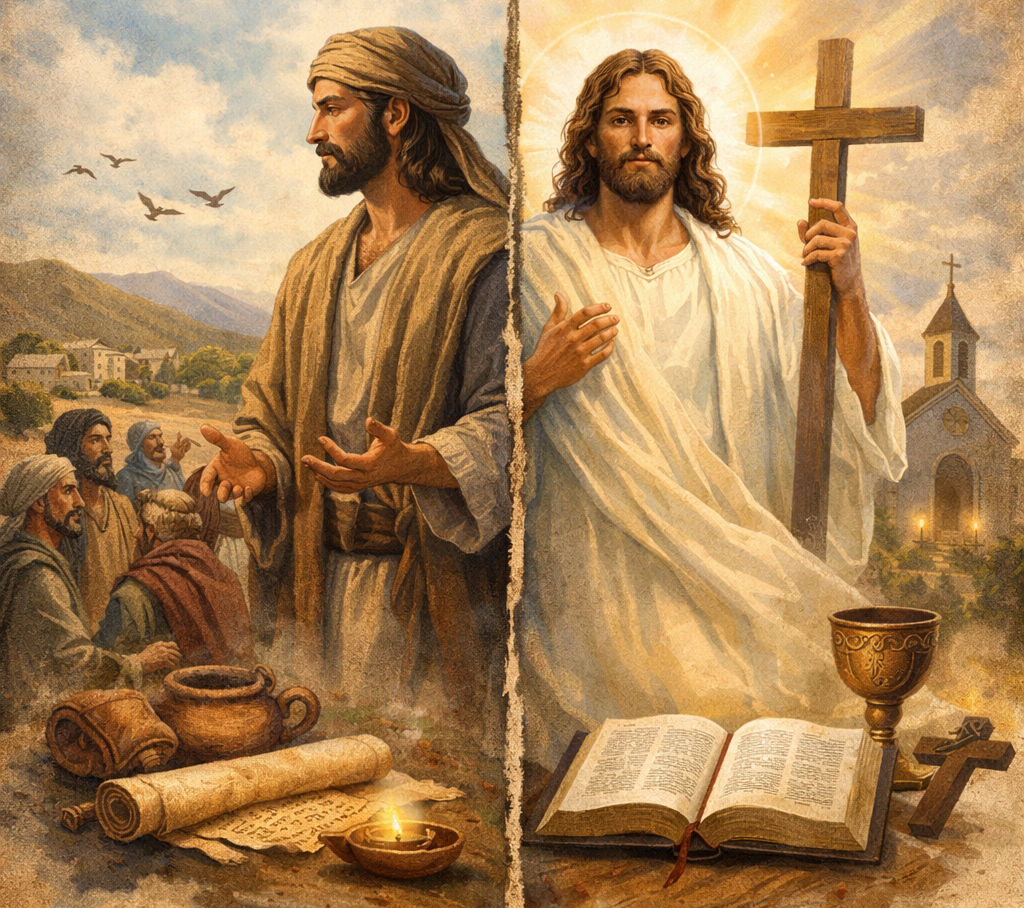
One of my favorite topics in the study of the New Testament is the historical Jesus; it is an area of study that attempts to understand Jesus as he was within the context of first century Judaism. However, many who study the historical Jesus argue that the Jesus of history (the first century Jewish teacher) is not the Christ of faith (the exalted Lord proclaimed by the church). In other words, the early church’s understanding of Jesus has been embellished and augmented by influences that go well beyond who Jesus actually was and what he taught. This presupposition is one of the the primary factors that originally inspired the now century old quest(s) for the historical Jesus. Of course, we must affirm that historical investigation is indispensable for understanding the person and work of Jesus, but the hard distinction between the Jesus of history and the Christ of faith collapses under the weight of the earliest evidence. The church’s confession of Christ emerges not as a departure from Jesus, but as the historically grounded interpretation of his life, death, and resurrection. In the space that follows, I would like to defend this thesis by examining why history matters, where the split came from, and why the evidence actually favors continuity and not discontinuity.
It would seem to be readily evident that the historical study of the New Testament is essential for understanding the Christian faith. This is because Christianity makes several direct and specific claims about real events that took place in historical space and time. So understanding these events and their historical and theological significance is a matter of first importance when it comes to understanding our faith. As a case in point, when the eternal Son came incarnate in the person of Jesus Christ, he stepped into a particular place at a particular time, the fullness of time according to Galatians 4.4. In other words, the doctrine of the incarnation requires some historical understanding of the place and time when Jesus was born. In fact, the Gospels themselves are anchored in the geography, personalities, and events of the first century Palestine. The point is that if Jesus is severed from the places and times in which he lived, then we run the risk of distorting the significance of his life and teaching. More than this, we run the risk of reshaping Jesus into a man of our making, as a some kind of modern therapist or social reform mascot. The bottom line is that the hard work of history disciplines our theology and grounds it in the life of our savior as he lived it. Or to put it more simply, to confess that the Word became flesh is to confess that history matters.
The point of this is to say that historical inquiry is not the enemy of faith. The problem comes when we presume to dictate what history is allowed to contain. During the Enlightenment of the 18th Century, philosophers and historians began to doubt the details of the New Testament’s depictions of Jesus. Because of their presuppositions about the supremacy of human reason in the pursuit of truth, they were highly skeptical of the Gospels’ accounts of Jesus’s miracles, particularly his resurrection. Their skepticism resulted in an approach to history that might be called methodological naturalism, or the idea that anything that even remotely smells like it might be supernatural must be ruled out as a theological fabrication. Ultimately, their dismissal of the miracles of Jesus, particularly his resurrection, led them to conclude that the church’s high Christology, or its understanding of Jesus as the divine Lord of heaven, must be a late addition to the New Testament that has nothing to do with who Jesus was and what he did and taught during his lifetime, a conclusion which had more to do with their own presuppositions than with any actual analysis of the evidence. The real question, however, is not whether the theology of the early church developed over time (it clearly did), but the question is whether that development moved away from Jesus or unfolded from within the impact of his life and resurrection. An examination of the earliest documents clearly demonstrates that this is in fact what happened.
Now, the earliest Christian documents are the 13 letters of Paul, which were likely written between the years 49 CE and 68 CE. (The earliest of these is most likely 1 Thessalonians, and the latest is 2 Timothy.) Important for this post is the fact that several of these letters include embedded hymns and creedal material that clearly exalt Jesus as the divine Lord. For example, in Philippians 2.6, he “existed in the form of God,” and in Colossians 1.15, “He is the image of the invisible God.” In 1 Corinthians 8.6, the Apostle writes, “for us there is one God, the Father. All things are from him, and we exist for him. And there is one Lord, Jesus Christ. All things are through him, and we exist through him.” This is clearly a reworking of the Shema (Deut 6.4) which equates Jesus with the God of Israel. Even outside of Paul, in Hebrews 1.3, Jesus is “the radiance of God’s glory and the exact expression of his nature, sustaining all things by his powerful word.” And in James 5.9 (possibly the earliest document in the New Testament), he is “the judge [who] stands at the door!” The point of all this is to show that the church’s so called “high Christology” developed very early in the life of the church, and that within the context of strict Jewish monotheism. And so the question must be asked, “How did first century Jews come to worship Jesus as God so quickly?” The only possible answer is that the seeds of this belief were already present in the life and ministry of Jesus.
Of course, Jesus never articulated his identity in the language of the Nicaean Creed, but he clearly acted with divine authority. When the Pharisees ask, “Who can forgive sins but God alone?” Jesus says to the paralytic, “Son, your sins are forgiven. Get up, take your mat, and go home.” (Mark 2.1-12) When his disciples were rebuked for picking heads of grain on the sabbath, he responded, “For the Son of Man is Lord of the Sabbath.” (Matthew 12.1-8) He calmed the storms, he healed the sick, he cast out demons, he raised the dead. He equated his body with the temple, and he proclaimed a Kingdom of God that centered on his own person and work. And when the High Priest asked him if he was indeed the Christ, he responded, ““I am, and you will see the Son of Man seated at the right hand of Power and coming with the clouds of heaven,” to which the High Priest responded by accusing him of blasphemy. (Mark 14.61-64) As a side note, the title Son of Man is most likely taken from Daniel 7, where Daniel sees “one like a son of Man” approaching the Ancient of Days to be vindicated and enthroned as king. The identity of this “one like a Son of Man” is debated, but it is highly likely that Daniel understood him as (quasi) divine figure. The point is that Jesus made several extraordinarily “high” claims about himself, claims that clearly threatened the Jerusalem religious establishment and eventually got him killed.
Moreover, the church did not invent these categories out of thin air; rather, it interpreted the shock of Jesus’ life and resurrection within the context and storyline of Israel’s Scriptures. And for them, the resurrection was the decisive interpretive key. The historical plausibility of the resurrection is practically certain given the cumulative effect of the evidence. The earliest confessions assume the truth of the resurrection (1 Cor 15.3-8). The earliest disciples went from fearing for their lives in the upper room to boldly proclaiming the truth of the resurrection in the temple square. The first witnesses of the resurrection were a couple of women whose testimony would have been viewed as untrustworthy in their day. All eleven of the disciples went to their deaths preaching Christ as risen from the dead, and the apostle Paul went from hateful persecutor of Christians to the most effective preacher and missionary in the early church. In other words, the resurrection was a central component of the early church’s belief, and its exalted understanding of Jesus flows naturally from this belief. If Christ was truly raised from the dead, then he truly was who he said he was, i.e. “the Christ, the Son of the living God.” The point is that the Christ of the church’s faith is what the Jesus of history looks like after Easter. Without the resurrection, a hard divide makes sense, but with the resurrection, the continuity between the two becomes inherently plausible. Or to put it another way, the resurrection is not some theological embroidery added to the story of the historical Jesus. No, it is the primary engine of the early church’s “high” Christology.
The bottom of line is simply this, namely that the hard division between historical events and their theological significance is a false dichotomy. There simply is no such thing as uninterpreted history; all historical events are immediately interpreted. The moment something happens, it is interpreted. The question, then, is not whether theology exists, but whether it faithfully corresponds to what actually occurred. In other words, theology is not the corruption of history; it is reflection upon it. And when it comes the person and work of Jesus, the Gospel accounts are just historical testimony that has been shaped by conviction. The faith of the early church was an organic and continuous development that grew out of the life and teaching of the historical Jesus, and the earliest confessions of Christ are best understood as historically grounded worship. If we separate the Jesus of history from the Christ of faith, the our faith becomes mere myth layered on memory. Jesus came incarnate at a particular time in a concrete place, and he was resurrected and he ascended to be seated at the right hand of the Father. And this is why both the history of Jesus and the faith of the early church matter. The one worshiped in the church is not a theological invention layered upon a forgotten Galilean. He is the crucified and risen Jesus of Nazareth. There is theological development, yes. There is interpretation, certainly. But there is no canyon between the Jesus who walked the hills of Galilee and the Christ that the church confesses as Lord. There is continuity — deep, historical, and theologically unavoidable continuity between the Jesus of history and the Christ of faith.



 Faith seeking Understanding