12 The iniquity of Ephraim is bound up; His sin is stored up. 13 The pains of childbirth come upon him; He is not a wise son, For it is not the time that he should delay at the opening of the womb. 14 Shall I ransom them from the power of Sheol? Shall I redeem them from death? O Death, where are your thorns? O Sheol, where is your sting? Compassion will be hidden from My sight.
15 Though he flourishes among the reeds, An east wind will come, The wind of the Lord coming up from the wilderness; And his fountain will become dry And his spring will be dried up; It will plunder his treasury of every precious article. 16 Samaria will be held guilty, For she has rebelled against her God. They will fall by the sword, Their little ones will be dashed in pieces, And their pregnant women will be ripped open.
~Hosea 13.12-16 (NASB95)
Title: On the Curse of Death and the Hope of Resurrection Text: Hosea 13.12-16 Series: Hosea: A Love Story Like No Other Church: Redeemer Baptist Church, Jonesboro, AR Date: July 13, 2025
8 Put the ram’s horn to your mouth! One like an eagle comes against the house of the Lord, because they transgress my covenant and rebel against my law. 2 Israel cries out to me, “My God, we know you!” 3 Israel has rejected what is good; an enemy will pursue him.
4 They have installed kings, but not through me. They have appointed leaders, but without my approval. They make their silver and gold into idols for themselves for their own destruction. 5 Your calf-idol is rejected, Samaria. My anger burns against them. How long will they be incapable of innocence? 6 For this thing is from Israel— a craftsman made it, and it is not God. The calf of Samaria will be smashed to bits!
7 Indeed, they sow the wind and reap the whirlwind. There is no standing grain; what sprouts fails to yield flour. Even if they did, foreigners would swallow it up. 8 Israel is swallowed up! Now they are among the nations like discarded pottery. 9 For they have gone up to Assyria like a wild donkey going off on its own. Ephraim has paid for love. 10 Even though they hire lovers among the nations, I will now round them up, and they will begin to decrease in number under the burden of the king and leaders. 11 When Ephraim multiplied his altars for sin, they became his altars for sinning. 12 Though I were to write out for him ten thousand points of my instruction, they would be regarded as something strange. 13 Though they offer sacrificial gifts and eat the flesh, the Lord does not accept them. Now he will remember their guilt and punish their sins; they will return to Egypt. 14 Israel has forgotten his Maker and built palaces; Judah has also multiplied fortified cities. I will send fire on their cities, and it will consume their citadels.
Title: On the Danger of Mixing Religion with Politics Text: Hosea 8.1-14 Series: Hosea: A Love Story Like No Other Church: Redeemer Baptist Church, Jonesboro, AR Date: May 11, 2025
4 What am I going to do with you, Ephraim? What am I going to do with you, Judah? Your love is like the morning mist and like the early dew that vanishes. 5 This is why I have used the prophets to cut them down; I have killed them with the words from my mouth. My judgment strikes like lightning. 6 For I desire faithful love and not sacrifice, the knowledge of God rather than burnt offerings.
7 But they, like Adam, have violated the covenant; there they have betrayed me. 8 Gilead is a city of evildoers, tracked with bloody footprints. 9 Like raiders who wait in ambush for someone, a band of priests murders on the road to Shechem. They commit atrocities. 10 I have seen something horrible in the house of Israel: Ephraim’s promiscuity is there; Israel is defiled. 11 A harvest is also appointed for you, Judah.
Title: On God’s Lament Over False Repentance Text: Hosea 6.4-11 Series: Hosea: A Love Story Like No Other Church: Redeemer Baptist Church, Jonesboro, AR Date: April 27, 2025
*Audio begins around two minutes in due to technical difficulties*
TEXT
4 Hear the word of the Lord, people of Israel, for the Lord has a case against the inhabitants of the land: There is no truth, no faithful love, and no knowledge of God in the land! 2 Cursing, lying, murder, stealing, and adultery are rampant; one act of bloodshed follows another. 3 For this reason the land mourns, and everyone who lives in it languishes, along with the wild animals and the birds of the sky; even the fish of the sea disappear. 4 But let no one dispute; let no one argue, for my case is against you priests. 5 You will stumble by day; the prophet will also stumble with you by night. And I will destroy your mother. 6 My people are destroyed for lack of knowledge. Because you have rejected knowledge, I will reject you from serving as my priest. Since you have forgotten the law of your God, I will also forget your sons.
7 The more they multiplied, the more they sinned against me. I will change their honor into disgrace. 8 They feed on the sin of my people; they have an appetite for their iniquity. 9 The same judgment will happen to both people and priests. I will punish them for their ways and repay them for their deeds. 10 They will eat but not be satisfied; they will be promiscuous but not multiply. For they have abandoned their devotion to the Lord. 11 Promiscuity, wine, and new wine take away one’s understanding.
Title: On God’s Case Against Israel Text: Hosea 4.1-11 Series: Hosea: A Love Story Like No Other Church: Redeemer Baptist Church, Jonesboro, AR Date: March 30, 2025
1 The word of the Lord that came to Hosea son of Beeri during the reigns of Uzziah, Jotham, Ahaz, and Hezekiah, kings of Judah, and of Jeroboam son of Jehoash, king of Israel.
2 When the Lord first spoke to Hosea, he said this to him:
Go and marry a woman of promiscuity, and have children of promiscuity, for the land is committing blatant acts of promiscuity by abandoning the Lord.
3 So he went and married Gomer daughter of Diblaim, and she conceived and bore him a son. 4 Then the Lord said to him:
Name him Jezreel, for in a little while I will bring the bloodshed of Jezreel on the house of Jehu and put an end to the kingdom of the house of Israel. 5 On that day I will break the bow of Israel in Jezreel Valley.
6 She conceived again and gave birth to a daughter, and the Lord said to him:
Name her Lo-ruhamah, for I will no longer have compassion on the house of Israel. I will certainly take them away. 7 But I will have compassion on the house of Judah, and I will deliver them by the Lord their God. I will not deliver them by bow, sword, or war, or by horses and cavalry.
8 After Gomer had weaned Lo-ruhamah, she conceived and gave birth to a son. 9 Then the Lord said:
Name him Lo-ammi, for you are not my people, and I will not be your God. 10 Yet the number of the Israelites will be like the sand of the sea, which cannot be measured or counted. And in the place where they were told: You are not my people, they will be called: Sons of the living God. 11 And the Judeans and the Israelites will be gathered together. They will appoint for themselves a single ruler and go up from the land. For the day of Jezreel will be great. 2 Call your brothers: My People and your sisters: Compassion.
Title: On the Love and Justice of God Text: Hosea 1.1-2.1; 3.1-5 Series: Hosea: A Love Story Like No Other Church: Redeemer Baptist Church, Jonesboro, AR Date: March 9, 2025
In my previous post, I argued that our hermeneutic for interpreting the Bible must be grounded in the conviction that what God intended to say in the Scriptures is accurately and faithfully conveyed in what the human authors actually wrote, and for most of the Bible, this seems to be rather clear. The question, however, arises when we come to texts in the New Testament that seem to interpret the Old Testament against the grain of the author’s intent. If we believe that “scripture interprets scripture” (see my post, here), then it would makes sense to suggest that we should follow the interpretive principles of the Apostles, and if they were not bound by a strict conception of authorial intent, then perhaps we should jettison this hermeneutical ground in our interpretive efforts as well. This then is the point that must be proven, namely that the New Testament authors did in fact disregard the human author’s intent when they interpreted the Old Testament. Of course, to examine every place where the New Testament author’s quote from or allude to the Old Testament would require far more space than is available here, and this work has already been done by many fine scholars in the field. I recommend Commentary on the New Testament use of the Old Testament, edited by G.K. Beale and D.A. Carson. But in lieu of that, I would like to explore one text as a test case for the thesis that the New Testament authors ignored the principle of authorial intent in their use of the Old Testament, that being Matthew’s use of Hosea 11.1 in chapter 2, verse 15 of his Gospel.
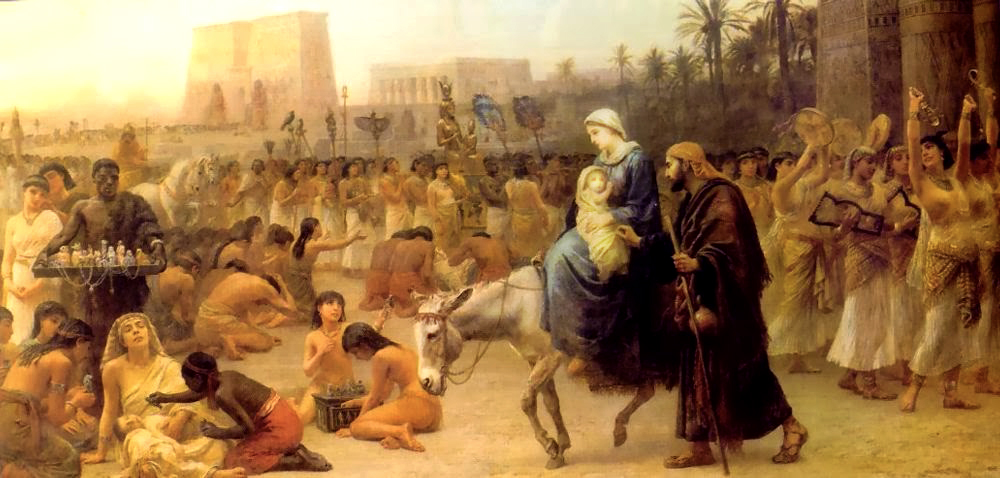
After they were gone, an angel of the Lord appeared to Joseph in a dream, saying, “Get up! Take the child and his mother, flee to Egypt, and stay there until I tell you. For Herod is about to search for the child to kill him.” So he got up, took the child and his mother during the night, and escaped to Egypt. He stayed there until Herod’s death, so that what was spoken by the Lord through the prophet might be fulfilled: Out of Egypt I called my Son.
~Matthew 2.13-15
The book of the prophet Hosea is a story of love and betrayal; set against the backdrop of Hosea’s own marriage to the adulteress Gomer, throughout the book, God repeatedly rebukes the northern Kingdom of Israel for scorning His grace, rejecting His love, forgetting His covenant, and playing the whore with the false gods of Baal. And so, in chapter 11, and verse 1, we read, “When Israel was a child, I loved him, and out of Egypt I called my son.” In these verses, God is looking back on the Exodus experience of His people as the initial overture of His love for Israel; as He goes on to say in verse 4 of that chapter, “I led them with human cords, with ropes of love. To them I was like one who eases the yoke from their jaws; I bent down to give them food.” It is clear that these verses are operating on the paternal imagery of parenthood. In the same way that parents nurture their newborn children, so also God nurtured His “son” Israel by bringing them out of Egyptian slavery, providing for them in the wilderness, and leading them into a land flowing with milk and honey. Even in spite of their repeated betrayal, God goes on to say in verse 8, “How can I give you up, Ephraim? How can I surrender you, Israel? How can I make you like Admah? How can I treat you like Zeboiim? I have had a change of heart; my compassion is stirred!” This chapter is a beautiful picture of the tenderness and mercy of God toward His rebellious son, and even though, the people of Israel will suffer His discipline, it holds out the hope that God has not ceased loving His people.
Now, in chapter 2 of the first canonical Gospel, Matthew connects the flight of the Holy family to Egypt to the words of Hosea 11.1, “so that what was spoken by the Lord through the prophet might be fulfilled: Out of Egypt I have called my Son“ (quoting Hosea 11.1b). But if the prophet Hosea wasn’t making a direct messianic prediction in the text in question, as we saw above, then how can the Egyptian flight of Mary, Joseph, and Jesus properly be considered a fulfillment? The answer is that this is a fulfillment by way of typology not prediction. Part of Matthew’s portrayal of Jesus is to show that He is the long awaited “prophet like Moses” (c.f. Deut 18.15-19), and he demonstrates this by highlighting the ways that Jesus recapitulates the story of Moses. A few examples should suffice. When Moses was born, Pharaoh killed all the Hebrew boys; when Jesus was born, Herod killed all the Jewish boys. According to 1 Corinthians 10.1-2, Moses had a baptism experience in the Red Sea, and Jesus was baptized in the Jordan River. Moses and the Israelites spent forty years in the wilderness; Jesus spent forty days in the wilderness. Moses went up on Mount Sinai to receive the Law; Jesus went up on a mountain to give the law (Sermon on the Mount). There are five books of Moses (Pentateuch); there are five discourses of Jesus’ sermons in the Gospel of Matthew. And “out of Egypt, I called my Son.” Based on this evidence, it is reasonably clear that the fulfillment that Matthew sees in the text of Hosea 11.1 is typological. Even as Israel was God’s typological “son”, Jesus is the true and better messianic Son of God.
In the final analysis, rather than violating the principle of authorial intent in his use of Hosea 11.1, the typological connection drawn by Matthew actually affirms the authorial intent of Hosea. And still, the question remains, “what of God’s intent in Hosea 11.1? When He inspired Hosea to write “out of Egypt, I called my son,” did he know that Matthew would take it in a different direction?” Of course, it is a theological truism to say that God knew the theological connections that Matthew would draw when He inspired Hosea to write, and so it is not wrong to say God “intended” more than Hosea understood at the time. However, this doesn’t mean that His intent stands in contradiction to or competition with the intent of Hosea. We must assume that God’s intent in Hosea 11 was to spark His people to repentance by reminding them of the great depths of His love that was demonstrated in the events of the Exodus, especially because the words of Hosea 11 are reported by the prophet as the very words spoken by God. (This is the Lord’s declaration, Hosea 11.11) Whatever “fuller sense” that we may understand from Hosea’s words, it must be grounded in the inspired intent of the human author, and this is exemplified in Matthew’s use of the text to explain the flight to Egypt.
But there is something that Matthew’s use of the Old Testament can teach us about our own interpretive efforts, namely that our hermeneutic for understanding of the Old Testament must reckon with the person and work of Christ. As Jesus himself affirms, “everything written about me in the Law of Moses, the Prophets, and the Psalms must be fulfilled.” (Luke 24.44) In other words, we have not done our full interpretive work in the Old Testament if we fail to consider how the text points to or is fulfilled in Jesus. If our understanding of the Old Testament would be accepted in a Jewish synagogue, then we haven’t understood the text Christianly. However, this does not mean that we can disregard the principle of authorial intent; we must still labor within the boundaries of literary and historical context before we can consider the broader canonical and theological implications. At the very least, our understanding of the human author’s intent must function as the true and necessary foundation upon which we stand as we seek the illumination of the Spirit in understanding the theological and applicational implications of the text for our lives in Christ. This is a thoroughly Christian understanding of how to interpret the Bible.
6 Come, let’s return to the Lord. For he has torn us, and he will heal us; he has wounded us, and he will bind up our wounds. 2 He will revive us after two days, and on the third day he will raise us up so we can live in his presence. 3 Let’s strive to know the Lord. His appearance is as sure as the dawn. He will come to us like the rain, like the spring showers that water the land.
4 What am I going to do with you, Ephraim? What am I going to do with you, Judah? Your love is like the morning mist and like the early dew that vanishes. 5 This is why I have used the prophets to cut them down; I have killed them with the words from my mouth. My judgment strikes like lightning. 6 For I desire faithful love and not sacrifice, the knowledge of God rather than burnt offerings.
7 But they, like Adam, have violated the covenant; there they have betrayed me.
8 Gilead is a city of evildoers, tracked with bloody footprints. 9 Like raiders who wait in ambush for someone, a band of priests murders on the road to Shechem. They commit atrocities. 10 I have seen something horrible in the house of Israel: Ephraim’s promiscuity is there; Israel is defiled.
11 A harvest is also appointed for you, Judah.
~Hosea 6.1-11
Text: Hosea 6.1-11 Series: Supply Preaching Church: Fellowship Baptist Church, Marion, AR Date: October 23, 2022




 Faith seeking Understanding