Tag Archives: Creation

On the Johannine Pentecost

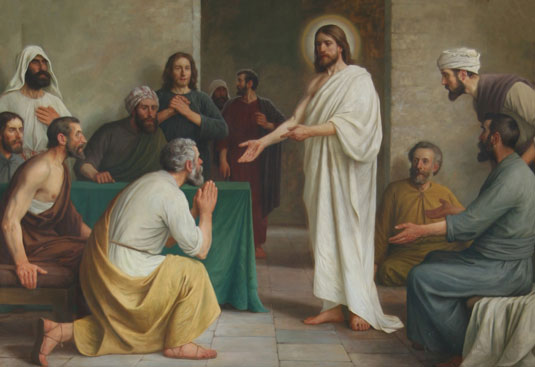
In John 20.19-23, Jesus appears in the upper room on the eve of his resurrection, and he breathes on the disciples saying, “Receive the Holy Spirit.” This is the so-called Johannine Pentecost, and at a glance, it would seem to contradict the very clear teaching of the book of Acts that the Spirit was given on the Day of Pentecost some 50 days after Jesus’s resurrection. If the events of that first Pentecost are understood as the climactic coming of the Spirit to indwell the followers of Christ, then Jesus’ giving of the Spirit in John 20.22 would seem to indicate that John (who was present at Pentecost) was hopelessly confused about the timeline. In the space the follows, I would like to suggest that John is not confused; rather, I think that John 20 presents Jesus’ giving of the Spirit as the breath of the new creation in fulfillment of Ezekiel’s restoration promises and in turn, it grounds the church’s corporate authority to forgive in the life of the risen Christ.

Of course, scholars and pastors have tried to resolve this tension in a variety of ways throughout the history of the church, and here I will identify just four. First, some suggest that the giving of the Spirit in John 20 is a kind of proleptic gift, a partial filling, that was meant to steel the disciples until the climactic coming of the Spirit 50 days later. Others suggest that John has theologized the giving of the Spirit by temporally relocating the event to the resurrection and directly connecting it with the risen Christ in light of his own “realized eschatology”. Still others suggest that John 20 functions as a kind of apostolic commission for the disciples which establishes their role as authoritative leaders in the early church. Finally, and this is my view, but the giving of the Spirit in John 20 should be understood as the inauguration of the age of the New Covenant/New Creation. This is not in contradiction to the Book of Acts and its descriptions of the Day of Pentecost. Rather, John has compressed these events theologically by linking the resurrection of Jesus with the concept of new creation, the giving of the Spirit, and the inauguration of eschatological life. He does this by alluding to the creation account in Genesis 1-2 and the New Covenant/Resurrection account in Ezekiel 36-37.

In John 20, the scene opens “On the first day of the week” (20.1), and this temporal note is repeated in our passage in 20.19, “when it was evening on the first day of the week.” This is a clear allusion to the first day of creation in Genesis 1. In other words, with the resurrection of Jesus comes a new first day, a new creation. This allusion is further confirmed by the fact that the scene takes place in a garden (19.31), and Mary mistakes the risen Christ for the “gardener” (20. 15). This is most likely a typological allusion to Christ as the second Adam. More significantly, we are told that Jesus “breathed on them.” The Greek word here (ἐνεφύσησεν ) is a verb that only occurs here in the New Testament. In the Greek translation of the Old Testament (LXX), in Genesis 2.7, we read that “The the Lord God formed the man out of the dust from the ground and breathed the breath of life into his nostrils, and the man became a living being.” In the same way (and with same word) that God breathed life into Adam, so also the risen Christ breathes life into his disciples. This is not just incidental language; the Evangelist has utilized this rare word intentionally, because he wants to connect the resurrection of Jesus with the new creation. When Jesus breathes the Holy Spirit on the disciples, they become participants in a new humanity.

However, there is another important Old Testament allusion that stands in the background of John 20, and that is the description of the New Covenant and the story of the Dry Bones in Ezekiel 36-37. In Ezekiel 36.26-27 (also 37.14), we read,

I will give you a new heart and put a new spirit within you; I will remove your heart of stone and give you a heart of flesh. I will place my Spirit within you and cause you to follow my statutes and carefully observe my ordinances. 

And in Ezekiel 37.1-14, we read where Ezekiel is commanded to prophesy to the breath to “come from the four winds and breath (ἐμφύσησον) into these slain so that they may live.” In the same way that Ezekiel stood in the midst of the valley of dry bones and the dead came to life by the “breath/Spirit” of God, so also the risen Christ stands in the midst of his disciples who are “dead/paralyzed” in fear, and breathes into them the Spirit of life. Now, in the book of Ezekiel, these chapters drip with corporate overtones, particularly in regard to the restoration of the people of Israel. The dry bones coming to life is a symbol of national (and individual) resurrection and restoration, and the Johannine Pentecost symbolizes the eschatological restoration of the people of God, such that the 12 (or 11) disciples function as the nucleus of that people as a renewed Israel. The point is that John portrays the resurrection of Jesus as the moment when the promised Spirit of restoration becomes reality.

Now, it is important here that we stop and recall what John has already said back in John 7. 39, where we read, “Those who believed in Jesus were going to receive the Spirit, for the Spirit had not yet been given because Jesus had not yet been glorified.” This is the heart of John’s theology, namely that the glorification/exaltation of Christ comes in the crucifixion/resurrection of Jesus. We know this because, Jesus said in John 12:32, “As for me, if I am lifted up from the earth I will draw all people to myself.” He said this to indicate what kind of death he was about to die.” The verbal idea of being “lifted up” refers both to the kind of death he would die but also to the idea of exaltation. Point being that in John 20, Jesus has now been glorified and so the Spirit can now be given as a sign of eschatological life.

However, there is one more problem in this passage. In verse 23, we read where Jesus tells the disciples, “If you forgive the sins of any, they are forgiven them; if you retain the sins of any, they are retained.” Of course, this language also occurs in the Gospel of Matthew, in Matthew 16:19 in Jesus words to Peter and then again in 18:18 in the context of the Community Discourse. Clearly, this is the language of commissioning and authority, but exactly what kind of authority is in view here is debated. Some (particularly in the Roman Catholic and Eastern Orthodox traditions) understand these words to signify Apostolic/priestly authority to absolve sins. Others understand them to describe the authority of the church to announce the promise of forgiveness on the basis of the gospel. In my view, in the context of John 20, these words demonstrate that the Spirit-empowered community participates in the eschatological sorting of humanity. Forgiveness is determined by a person’s acceptance or rejection of the person and work of the Son (cf. John 3:18-21), but the church’s authority to forgive is part of its new-creation governance. In other words, just as the first humans were given dominion in the Garden of Eden (Genesis 1:28), so also the church as a new humanity is given Spirit-authorized responsibility as an agent of new-creation reconciliation. And John is clear that this authority is derivative, not autonomous; it flows from the risen Christ’s life and breath (i.e. Spirit).

In conclusion, then we must conclude that the Johannine Pentecost is not simply the relocation of the events of Acts 2; these are distinct narrative events serving distinct theological purposes. Whereas Acts emphasizes the public outpouring of the Spirit, the gift of tongues, and the church’s mission to the nations, John emphasizes the new creation, the restoration of the people of God, and ecclesial authority and identity. To put it more simply, John narrates the ontological beginning of the New Covenant age, and Luke narrates the Spirit-empowered expansion of the church’s mission. There is no contradiction; these are simply two theological angles on one redemptive reality. By tying his narrative to Genesis and Ezekiel, John gives us a theologically robust understanding of the significance of Christ’s resurrection. More importantly though, John 20.19-23 clearly demonstrates that the church exists because the risen Christ breathes his life into it. Its life is cruciform and Spirit-dependent, and its mission is one of reconciliation in the power of the new creation.


On Praying Through Psalm 8

TEXT

For the choir director: on the Gittith. A psalm of David.

Lord, our Lord,
how magnificent is your name throughout the earth!
You have covered the heavens with your majesty.
From the mouths of infants and nursing babies,
you have established a stronghold
on account of your adversaries
in order to silence the enemy and the avenger.

When I observe your heavens,
the work of your fingers,
the moon and the stars,
which you set in place,
what is a human being that you remember him,
a son of man that you look after him?
You made him little less than God
and crowned him with glory and honor.
You made him ruler over the works of your hands;
you put everything under his feet:
all the sheep and oxen,
as well as the animals in the wild,
the birds of the sky,
and the fish of the sea
that pass through the currents of the seas.

Lord, our Lord,
how magnificent is your name throughout the earth!

~Psalm 8

Series: Praying through the Psalms
Text: Psalm 8.1-9
Church: South Caraway Baptist Church, Jonesboro, AR
Date: May 17, 2023


On Christian Hope: Heaven or Resurrection

It is commonplace in American Christianity to hear people talk about going to heaven when they die. For most people, this is the promise of the Gospel, that if you believe in Jesus for the forgiveness of sin and live a morally good and ethical life for the most part, then you will get to go to heaven when you die. This is usually conceptualized as a kind of purely spiritual (nonmaterial, nonphysical) existence of some kind (think halos, harps, and clouds). However, this is a far cry from the biblical picture of eternal life. First, eternal life is not simply a limitless quantity of life that we experience when we die, though it certainly includes this; rather is a certain quality of life, i.e. the life of the messianic age, that we begin to experience even now in part on this side of glory. But, more importantly, the Christian vision for life after death is for a resurrected embodied life. This is a crucial aspect of the biblical understanding of salvation, but it is so often neglected, ignored, or outright denied. And so, since this is the week in which we celebrate the resurrection of our Lord Jesus, I would like to use the space that follows to explore the biblical foundation of the biblical hope for resurrection.

First, we must affirm that human beings were created as composite wholes, that is with a body and a soul. Some theologians would argue for a tripartite division, i.e. body, soul, and spirit, but the point remains the same, namely that the body is essential for what it means to be human. In Genesis, chapter 2, verse 7, we read, “Then the Lord God formed the man out of the dust from the ground and breathed the breath of life into his nostrils, and the man became a living being.” In other words, when the “spirit of life” (the Hebrew word for “breath” can also be translated as “spirit”) entered into the body made of dust, the first man became a living being. Both components were necessary to complete the first man; therefore, to exist as spirit only would be an incomplete, non-human existence. This is why the incarnation was necessary; as the author of Hebrews argues in chapter 10, verse 5 (quoting Psalm 40.6 LXX), “Therefore, as he was coming into the world, he said: You did not desire sacrifice and offering, but you prepared a body for me.” In order to redeem humanity, it was necessary that the Son of God should become fully human, body and soul, and if He was anything less than fully human, then the redemption He secured would be incomplete. Or to put it another way, that which He did not assume, He cannot redeem. And the only way that the body can be redeemed from death is through resurrection.

Of course, this leads right into the second biblical foundation of our resurrection, namely that Jesus Christ was resurrected bodily from the dead. A cursory reading of the Gospel accounts of our Lord’s passion leads to the inescapable conclusion that Jesus died bodily, He was raised bodily, He ascended bodily, and He will return bodily. He was no mere apparition or ghost; He was not some kind of spirit only being that appeared at random. In the Gospel of Luke, we read that Jesus ate with the disciples after His resurrection, both on the road to Emmaus and in the upper room, and in the Gospel of John, we read that He invited Thomas to touch the holes in His hands and in His side. So, while His resurrected body was different in many ways, there was still a corporeal continuity to His bodily existence both before and after His resurrection. Moreover, and perhaps more importantly, the Apostle Paul argues that the physical bodily resurrection of Jesus is the lynchpin of the Gospel. “And if Christ has not been raised, your faith is worthless; you are still in your sins.” (1 Corinthians 15.17) In other words, the bodily resurrection of Jesus was necessary for our salvation to be complete. It was not only necessary for Him to die physically for our sin, but it was also necessary for Him to be raised physically to new life. The bodily resurrection makes His work of redemption complete, and because He has been raised, He is able to offer resurrection life to those who trust in Him.

Consequently, this is the third biblical foundation for the Christian hope of resurrection, namely that the bodily resurrection of Jesus is the ground and promise for the bodily resurrection of those who have trusted in Him. Because He has been raised bodily, we who have trusted in Him will also be raised bodily. This is the inescapable logic of our union with Christ. As the Apostle Paul argues in the Letter to the Romans, chapter 6, verse 5, “For if we have been united with him in the likeness of his death, we will certainly also be in the likeness of his resurrection.” Or again, in 1 Corinthians, chapter 15, verse 20, “But as it is, Christ has been raised from the dead, the firstfruits of those who have fallen asleep.” The fact that He is the “first fruit” necessarily implies that there will be more fruit to come, and it is clear that the fruit Paul is envisioning in this context is the bodily resurrection of those who have been united with Jesus by faith. So, the promise of the Gospel, the Christian hope, is not merely going to heaven when we die; it is nothing less than resurrection from the dead. “For if we believe that Jesus died and rose again, in the same way, through Jesus, God will bring with him those who have fallen asleep.” (1 Thessalonians 4.14)

So, while the idea of going to heaven when we die sounds nice and comforting, the truth of the matter is that those who ignore or deny the future resurrection of the body really have no hope at all. All they really have is a vague notion of something resembling hope, which is really no better than an empty wish. It has no substance, no grounding in biblical realities at all. Disembodied existence as spirit only is not true life, at least not life the way that God intended it for humanity. God alone is spirit, and we are His creatures. The desire to shed the flesh and exist as pure spirit is a desire that comes from pagan philosophy and not from the Bible. The true biblical Christian hope is far better. It is nothing less than the fullness of embodied life that God always intended for humanity. It is eternal life, resurrected life, in the presence of God forever. In other words, the promise of the Gospel is not so much that we will get to go up to heaven when we die, but that heaven will come down to us when Jesus comes again to establish His kingdom on earth once and for all. This is the blessed hope, the Christian hope.

See also:
Chase, Mitchell L. Resurrection Hope and the Death of Death. Short Studies in Biblical Theology. Wheaton, IL: Crossway, 2022.
Wright, N.T. Surprised by Hope: Rethinking Heaven, the Resurrection, and the Mission of the Church. New York, NY: HarperOne, 2008.


On Eschatology and the Gospel

The study of Eschatology in the church is usually met with two distinct responses. On the one hand, some become so consumed with an over fascination that it drives them to unhealthy speculations, and on the other hand, others are so filled with apathy and distaste that they would rather neglect its doctrines altogether. Recently, I heard about one church that spent eighteen months studying the Book of Revelation, and there is nothing wrong with that per se. However, to the external observer, it could appear as if this subject is more important than the Gospel itself. This is perhaps part of the reason why this area of theological reflection is so often met with such varied and disparate responses; we have failed to demonstrate clearly how these truths are connected to the saving work that God has accomplished in and through His Son, Jesus Christ. We have become so bogged down in controversial matters like tribulations, raptures, millenniums, antichrists, and the like, that we have lost the point that these events bring the promises of the Gospel to completion.

At its core, the Gospel is about how God has solved, is solving, and will solve the problem of sin. Of course, sin is first and foremost a personal individual problem; human beings are corrupted by and enslaved to sin, and because of this, they deserve to spend eternity in hell under the wrath of God. However, in the Gospel, Jesus Christ took upon himself the punishment that we deserve; He died in our place, satisfied the wrath of God, and declared, “It is finished!” Now, by grace through faith in Him, we are forgiven of our sin, clothed in His righteousness, and promised eternal life. But sin is also a cosmic problem, because all of creation has been polluted by and cursed because of sin. As the Scriptures explain,

For the creation eagerly waits with anticipation for God’s sons to be revealed. For the creation was subjected to futility—not willingly, but because of him who subjected it—in the hope that the creation itself will also be set free from the bondage to decay into the glorious freedom of God’s children. 

~Romans 8.19-21

In the beginning, when God created the world, all was very good, but with the fall of mankind, sin and its consequences have hopelessly poisoned God’s good creation. This world reeks with the stench of death and decay; where there was once life and beauty, there is now sickness and death. But in the gospel, God is making all things new; he is restoring and recreating the paradise that was lost. In the Book of Revelation, chapters 21-22, we read of a new heaven and new earth which is completely free of sickness and death, heartache and pain, tear and loss. It is a world that is completely free from the stain of sin in every way. It is not just the Garden of Eden restored, it is the Garden of Eden made better.

In other words, the Gospel is inherently and irreducibly eschatological, because not only have we been set free from the penalty of sin, not only are we being set free from the power of sin, but one day we will be set free from the very presence of sin. Until then, we live in the tension of the already but not yet, already forgiven of our sin, already free from sin’s tyranny, but not yet free from its temptations and habituations in our daily lives. We rightly long for the day when the problem of sin and its effects will be no more; this is our blessed hope. And this is why the study of Eschatology should not be viewed as a distraction from the proclamation of the Gospel. On the contrary, the doctrines of Eschatology are so intricately and intimately woven into the fabric of the Gospel, that if we neglect or ignore them, we truncate the Gospel message, empty it of its power, misconstrue the nature of its promises.

This is not to say that the study of Eschatology is always done correctly. Certainly, there are many who have engaged this subject matter in improper or unhealthy ways that have shifted the focus or missed the mark. Eschatology is one of those areas in the study of which it is possible to miss the forest for the trees. There are many details and questions that fall into this category that could become a distraction. However, this does not mean that we should omit the study of it altogether, because Eschatology is fundamentally about hope, the hope of a world free from sin. This is the wonder of our salvation, not only that we have been forgiven of our sin and have received eternal life, but that the work of Christ in salvation has put something into motion that will completely transform the world as we know it.

For the grace of God has appeared, bringing salvation for all people, instructing us to deny godlessness and worldly lusts and to live in a sensible, righteous, and godly way in the present age, while we wait for the blessed hope, the appearing of the glory of our great God and Savior, Jesus Christ.

~Titus 2.11-13

Slow To Write

"let every person be quick to hear, slow to speak, slow to anger."

lovegavehope

Just another WordPress.com site

Jared Cornutt

Pastor | Speaker | Writer

Denny Burk

A commentary on theology, politics, and culture

G3 Ministries

Events + Resources for the Local Church

Biblical Reasoning

Biblical and Systematic Theology According to the Scriptures

RetroChristianity

Reclaiming the Forgotten Faith

SBC Voices

Southern Baptist News & Opinion

Lucid Theology

Thoughts on words, books, theology, and life.

Baptist21

A pastor-led voice for Baptists in the 21st century

Center For Baptist Renewal

The Personal and Professional Blog of Phillip Powers

The Pastor's Well - Pastor Well

The Personal and Professional Blog of Phillip Powers

Articles - AlbertMohler.com

The Personal and Professional Blog of Phillip Powers

The Gospel Coalition

The Personal and Professional Blog of Phillip Powers