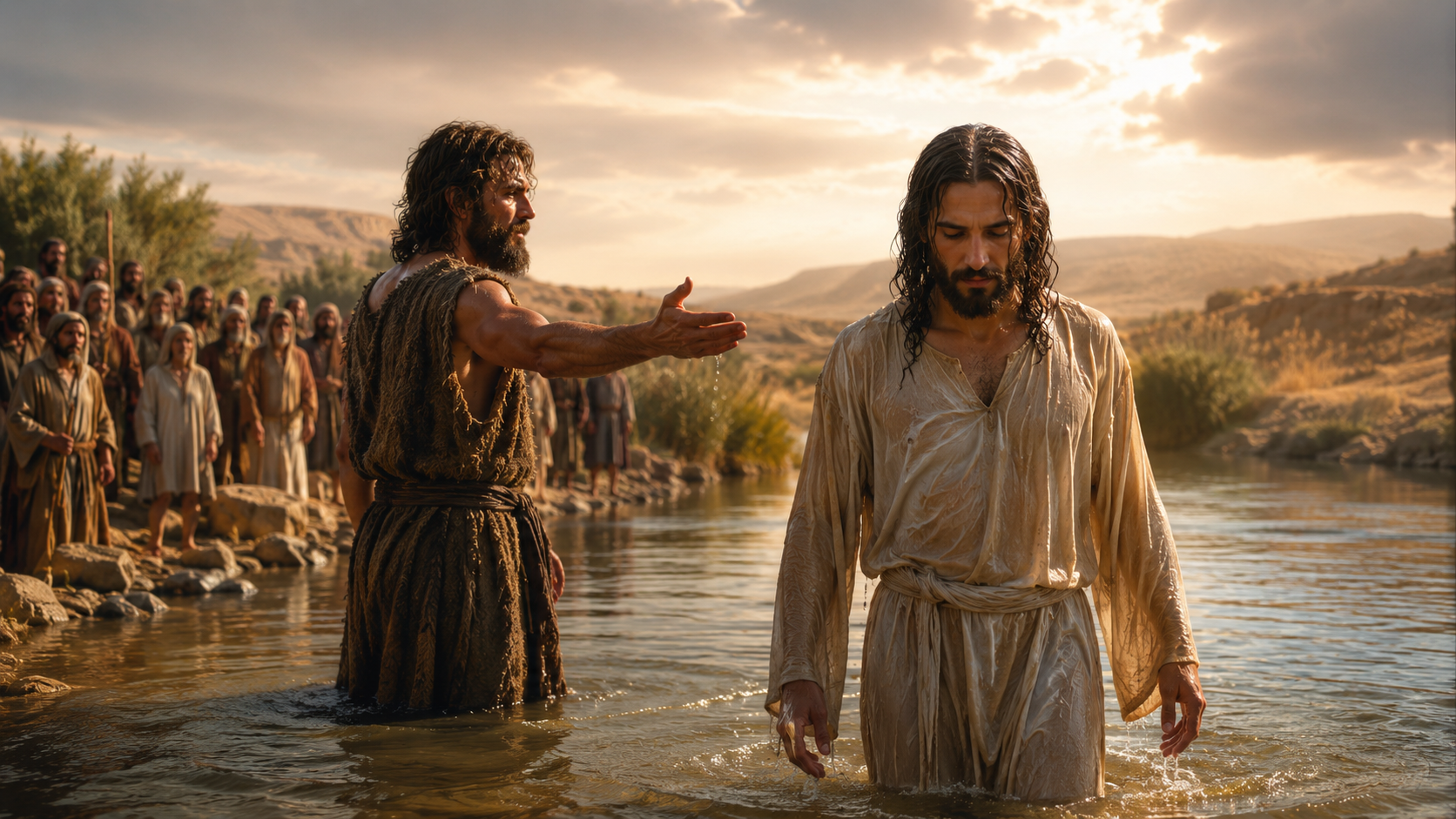
Have you ever wondered why all four Gospels begin the story of Jesus’s public ministry with the ministry of John the Baptist? Could it possibly be because John came preaching, “Repent, because the kingdom of heaven has come near!” (Matt. 3.2), and Jesus began his own ministry by preaching, “Repent, because the kingdom of heaven has come near!” (Matt. 4.17)? They begin their preaching with virtually the same message. What, then, is the relationship between the preaching and ministry of John the Baptist and that of Jesus? Sometimes John is treated as little more than a necessary but largely preparatory prelude to the more important ministry of Jesus, almost as though his primary purpose were simply to baptize Jesus and then disappear from the story. But the Gospels reveal remarkable continuity between the preaching of these two figures. Jesus’s preaching stands in fundamental continuity with John the Baptist’s proclamation of the approaching kingdom, repentance, salvation, and judgment; yet it also develops John’s message by announcing that the kingdom has become present in Jesus’s own ministry while its final judgment remains future. The transition from John to Jesus, therefore, is not a transition from one eschatological message to another, but from the announcement of what God is about to do to the inauguration of that promise in Jesus himself. To understand this development, however, we must first consider what John was actually announcing.
Of course, John the Baptist’s preaching is fundamentally eschatological. He appears in the wilderness announcing, “Repent, because the kingdom of heaven has come near!” (Matt. 3.2). The nearness of God’s kingdom means that Israel has reached a decisive moment in the history of salvation, and repentance is the necessary response to what God is about to do. Indeed, John warns his hearers not to presume upon their covenantal identity: “Don’t presume to say to yourselves, ‘We have Abraham as our father’” (Matt. 3.9). Instead, they must “produce fruit consistent with repentance” because “the ax is already at the root of the trees” (3.8, 10). John’s proclamation therefore contains both salvation and judgment. On the one hand, he announces the coming of one more powerful than himself who “will baptize you with the Holy Spirit and fire” (3.11). On the other hand, this Coming One already has “his winnowing shovel” in his hand and will separate the wheat from the chaff, burning the latter “with fire that never goes out” (3.12). John therefore stands at the threshold of Israel’s eschatological expectation, announcing that God’s promised intervention is no longer located in some distant future—it has drawn near. His call to repentance, promise of the Spirit, and warning of judgment all derive their urgency from this conviction. Most importantly, however, John does not present himself as the one who will accomplish these things. His entire proclamation points beyond himself toward the Coming One through whom God’s promised salvation and judgment will arrive.
The preaching of Jesus stands in basic continuity with the contours of John’s message. As noted above, Jesus also comes proclaiming the nearness of the kingdom and the need for repentance. In Matthew 4.17, Jesus declares, “Repent, because the kingdom of heaven has come near!” repeating verbatim the proclamation of John (Matt. 3.2). Similarly, Mark summarizes Jesus’s preaching: “The time is fulfilled, and the kingdom of God has come near. Repent and believe the good news!” (Mark 1.15). The point is that Jesus retains John’s basic eschatological framework: kingdom, repentance, salvation, judgment, restoration, and accountability before God. He does not correct John by suggesting that his expectation of judgment was mistaken or that Israel’s eschatological hopes were misguided. On the contrary, Jesus repeatedly warns of a coming judgment, whether in his teaching concerning Gehenna (Matt. 10.28), the separation of the righteous and wicked (Matt. 13.40–43), or the future judgment of the Son of Man (Matt. 25.31–46). We must therefore resist the simplistic dichotomy that John preached judgment while Jesus preached grace. Both proclaim salvation and judgment as dimensions of God’s coming kingdom. The fundamental difference between their preaching must be located somewhere else. The question is not whether Jesus abandoned John’s eschatological message, but what happened to that message once the One whom John announced actually arrived.
In Matthew 11.2–3, John sends messengers to Jesus to ask him, “Are you the one who is to come, or should we expect someone else?” We are not told exactly what prompted John’s question, but the apparent disconnect between his preaching and Jesus’s actual ministry was likely part of the equation. John had proclaimed the nearness of the kingdom alongside warnings of impending judgment, yet the ministry of Jesus did not seem to indicate that such judgment had arrived. This is why Jesus’s answer to John’s question is so significant. Rather than simply answering yes, Jesus points to the fruit of his ministry: “The blind receive their sight, the lame walk, those with leprosy are cleansed, the deaf hear, the dead are raised, and the poor are told the good news” (Matt. 11.5). These signs reflect the expectations of eschatological restoration found throughout the Book of Isaiah (especially Isa. 35:5–6; 61:1–2). The healings, exorcisms, forgiveness, restoration, and proclamation of good news therefore demonstrate that Israel’s promised salvation has begun. John announced what God was about to do; Jesus points to what God is now doing through him. Here we encounter the essential development from John’s preaching to that of Jesus: John announces the Coming One; Jesus announces and embodies the arrival of the kingdom because he is the Coming One. The transition from John to Jesus is therefore the transition from eschatological expectation to eschatological fulfillment. The promised blessings of the kingdom have begun to enter the present through the ministry of Jesus. But if the blessings have arrived, what has happened to the judgment John so urgently announced?
John had proclaimed that the ax was at the root, that the winnowing fork was in the Coming One’s hand, and that the chaff would be burned with unquenchable fire. Yet Jesus heals, forgives, restores, eats with sinners, and proclaims good news. What is important to remember, however, is that John was not wrong: judgment is coming. Rather, the ministry of Jesus brings greater clarity to the temporal structure of John’s eschatology. The kingdom has arrived in the earthly ministry of Jesus, but final judgment has not. This distinction is illustrated particularly well in Jesus’s sermon at Nazareth in Luke 4. There Jesus reads from Isaiah 61:1–2 and then proclaims, “Today as you listen, this Scripture has been fulfilled” (Luke 4:21). Interestingly, however, Jesus’s reading stops with “the year of the LORD’s favor” and does not include the following phrase, “the day of our God’s vengeance.” We should probably not build too much upon this omission alone, but it fits the larger pattern of Jesus’s ministry remarkably well. The promised blessings of Israel’s restoration are being inaugurated in the present, while final judgment remains future. This does not mean that Jesus abandons John’s expectation of judgment. As noted above, Jesus repeatedly warns of a coming judgment and associates its consummation with the future coming of the Son of Man in glory. Judgment has not disappeared from God’s eschatological program; Jesus has revealed that the kingdom’s saving blessings enter history before its final judgment arrives.
The point is that John’s basic expectations were correct. The Coming One would bring salvation, the Spirit, restoration, and judgment. But the earthly ministry of Jesus reveals that these realities do not all arrive simultaneously in their consummated form. The preaching and ministry of Jesus operate according to what is often described as the “already and not yet,” or inaugurated eschatology. This simply means that in the earthly ministry of Jesus, the kingdom of God was already present even though its final consummation remained future. For example, Jesus declares, “If I drive out demons by the Spirit of God, then the kingdom of God has come upon you” (Matt. 12:28). His ministry of healing, exorcism, forgiveness, and restoration therefore demonstrates that God’s saving reign had already broken into history. Yet Jesus continues to speak of realities that remain future: the resurrection of the dead, the return of the Son of Man, final judgment, and the consummation of God’s kingdom. The kingdom is therefore genuinely present without yet being present in its fullness. Salvation has been inaugurated, while final judgment and consummation remain future. This is not a rejection of John’s preaching but its clarification and fulfillment. The Coming One has arrived, just as John announced, but Jesus reveals something John did not fully articulate: his first advent inaugurates the promised salvation of the kingdom before his return brings that kingdom to its consummation in final judgment.
In the final analysis, the preaching of Jesus neither abandons nor merely repeats the preaching of John the Baptist. Both proclaim the nearness of God’s kingdom, call Israel to repentance, announce the arrival of eschatological salvation, and warn of coming judgment. This is why Matthew can summarize their preaching with precisely the same words: “Repent, because the kingdom of heaven has come near!” (Matt. 3:2; 4:17). Yet those words take on a new significance when spoken by Jesus. John stands at the threshold of fulfillment, announcing that the kingdom is near and pointing forward to the Coming One who will bring it. Jesus is that Coming One, and through his preaching, healings, exorcisms, forgiveness, and restoration, the saving power of the kingdom begins to enter the present. The transition from John to Jesus is therefore the transition from eschatological expectation to eschatological fulfillment—not yet fulfillment in all its fullness, but fulfillment genuinely inaugurated in history. John announces that God’s kingdom has drawn near; Jesus announces and demonstrates that in him its saving power has begun to arrive. Salvation has entered the present, while final judgment remains ahead, awaiting the return of the King who first came proclaiming good news.


