Tag Archives: Tradition

On the Beauty of the Church’s Worship

Several months ago, Matthew Barrett, then a professor at Midwestern Baptist Theological Seminary, announced that he was leaving the SBC to become Anglican. Shortly thereafter, he took a position as Research Professor of Theology at Trinity Anglican Seminary, and he and his family joined St. Aidan’s Anglican Church in Kansas City. He detailed his reasons for making this change in an article on his blog/newsletter, Anselm House. Basically, he suggests that the SBC “officially rejected” Nicene orthodoxy, that the SBC values image over external (read episcopal) authority, and that the “baptist” hermeneutic is ultimately individualistic in its rejection of infant baptism. Though I find these criticisms to be greatly flawed and wholly inaccurate as representations of Baptist theology and ecclesiology, it is not my purpose to respond to them here. This has already been done by several others who are more capable than me. (For example, see Denny Burke’s response here.)

Rather, I would like to respond to another component of Barrett’s argument for Anglicanism, that being the beauty and and antiquity of its liturgy. After giving a rather glowing description of the elements and order of an Anglican worship service, including pictures, he goes on to write, “What a comfort to tell our kids, “The way we are worshipping is how Christians have worshipped across history. It’s really, really old. You are participating in the church universal.”” Now, let me just say that I have no small appreciation for high church liturgy. I have previously written on the use and value of the lectionary, the Christian calendar, and church tradition. I think there is much that modern churches, with their consumeristic performance based, emotion driven worship services, could learn from these practices. However, to say that “Anglicanism is the most beautiful representation of classical Christianity” is surely to place preferences of form over matters of substance.

The fact of the matter is that the early church’s worship was simple; it revolved around Word and Table, fellowship and prayer. As we read in Acts 2.42,  “They devoted themselves to the apostles’ teaching, to the fellowship, to the breaking of bread, and to prayer.” Beyond this, we simply do not know what worship services in the early church consisted of. We have scattered liturgical details and other descriptions throughout the New Testament, but we do not have an official liturgy for the early church. Did they sing psalms? Probably. Did they read the Scriptures? Definitely. Did they pray together? Likely. Did they observe the ordinances of baptism an the Lord’s Supper? Clearly. Did they recite early kinds of creedal statements? Possibly. Of course, as the church grew, more formal liturgies were understandably developed, especially in the second and third centuries, and by the fourth century, there seems to have been a common or shared understanding of what the worship of the church should include and how it should progress. But, contrary to Dr. Barrett’s claim above, there is simply no proof that the Anglican liturgy is “how Christians have worshipped across history.” No doubt there are many similarities, but there is likely just as many differences that vary across place and time.

However, the more basic point that needs to be underscored here, I believe, is that the church’s worship, no matter what form or style it is expressed in, is beautiful. When God’s people gather together to sing His praise, to hear from His Word, to intercede in prayer for one another, to commemorate the Gospel is baptism and eucharist, there is simply nothing that is more beautiful, nothing more majestic, nothing more glorious. The voices of the saints singing and praying and confessing and expositing the great works of God in Christ as one gathered and united body in the Spirit is the most beautiful thing in this world. Of course, as I noted above, this beauty has sadly been lost in many churches today; we have turned the church’s worship into a show. We have exchanged beauty for spectacle, truth for emotion, participation for entertainment, and this is especially so in churches that do not come stand in the line of high church traditions. But, the point is that it is narrow minded and arrogant to suggest that one particular form or tradition of worship is the most beautiful, the most ancient, the most formation to the exclusion of all others.

In the Book of Revelation, John writes, “After this I looked, and there was a vast multitude from every nation, tribe, people, and language, which no one could number, standing before the throne and before the Lamb” (Revelation 7.9). This vision of the diversified and redeemed people of God standing before the heavenly throne praising God should help us to understand the beauty of the church’s worship. We do not all sing with one voice, we do not all worship in the same way. Every tradition, every culture, every community has its own way of worshiping God, and this is beautiful. The glory of God in Christ cannot be wholly encapsulated in just one worship tradition, but wherever there are genuine believers who are gathered together to worship God in Spirit an truth, this is beautiful. Every church has its own liturgy, whether it be formal or informal, but when we prioritize the form of our worship over the object of our worship, then we have missed the mark. Christ is the focus of our worship, there is no way that we could ever find enough ways to magnify and exult in His glory.


On the Annual Celebration of Christmas and Easter

When it comes to a church’s life together, there are two pillars around which the rest of the annual calendar swings, i.e. Christmas and Easter. These are the high points in the church’s worship every year. Many churches still commemorate these holidays with special programs, musical and dramatic presentations of the Biblical story, and a focus on inviting the community in for high attendance, after all these are the only days that the CEOs come to church anyway (Christmas and Easter Onlys). It is clear that these holidays hold a special place in the devotion of most Christians. They focus our reflection on the primary movements of the story of redemption, how God the Son came to earth incarnate as a baby in a manger and how he died on the cross for sin and rose again some thirty years later. Even though they are mostly overcome by the cultural consumerism that so obviously characterizes our society these days, they are still a meaningful season in the worship of the church.

However, the question remains, “why do we celebrate these annual holidays anyway?” After all, there is no explicit command in the Scriptures to commemorate the nativity and/or the passion of our Lord Jesus Christ annually by a special holiday. In the New Testament, the church’s worship moved away from the annual calendar marked by special holidays and feasts that characterized the worship of the Jews in the Old Testament, and they moved to a weekly calendar marked by the gathering of the saints on the Lord’s Day for the preaching of the Word and the breaking of bread. Further, the Regulative Principle for Worship (RPW) states that only those elements that are clearly prescribed in the Scriptures should be included in the church’s worship. A strict application of this principle would mean that since Christmas and Easter are not explicitly prescribed by the New Testament, then we are in error when we make them a primary emphasis or central component in our devotion and worship, whether corporately or individually.

We do know that the church began to celebrate these holidays fairly early on in her existence. Within a century or so of the life and death of Jesus and His first followers, the church began to include these annual feasts as a regular part of the worship calendar. Of course, critics often suggest that these festivals were borrowed and adapted from the pagan world; however, these criticisms tend to fall apart quickly under close historical scrutiny. After examining the evidence, one author recently concluded that “no modern Christmas [or Easter] tradition can draw a straight line to any clear and decisive pagan origin.” While there has certainly been growth over the centuries in the lore and cultural traditions that surround these holidays, none of this is original and/or essential to the Christian celebration of them. Rather, it is evident that Christians recognized very early on in their history how important it was to commemorate the two decisive moments in redemptive history, namely the birth and death/resurrection of the one who is called Christ.

Of course, tradition alone is not a sufficient enough reason to justify the continued celebration of Christmas and Easter, but neither is it a sufficient reason for discontinuing the observance of them either. All traditions are not bad; in fact, some are quite helpful in the formation of our faith and practice. I have previously written on the question of tradition here, but suffice it to say that there is great wisdom in learning from the faith and practice of our Christian forebears, both from what they did well and from what they did not do well. So, perhaps the proper question should not be whether the celebration of Christmas and Easter is right or wrong, but whether it is wise and good. Does the annual observance of these holidays have spiritual value for the growth of the followers of Jesus in conformity to His image? And if this is the question, then we must answer in the affirmative. The fact of the matter is that we are a people who are quick to forget, quick to move on, quick to believe that we have outgrown our need for the Gospel. But there is nothing more foundational, nothing more crucial, for our formation in Christlikeness than to be reminded regularly of exactly what Christ has done on our behalf.

His incarnation and resurrection are the primary aspects of His redemptive work; they tell the story of how God the Son came to earth as a child, lived a sinless life, died on the cross for sin, and then rose again. In fact, the Apostle Paul instructs us in Second Timothy, chapter 2, verse 8, “Remember Jesus Christ, risen from the dead and descended from David, according to my gospel.” Or again, in the Letter to the Romans, that Jesus Christ “was a descendant of David according to the flesh and was appointed to be the powerful Son of God according to the Spirit of holiness by the resurrection of the dead.” Throughout the New Testament, these movements – the incarnation and the resurrection – are the hinge pins upon which the Gospel swings. And as followers of Jesus, we take great joy in celebrating these glorious acts of redemption each and every year, because it reminds us of the beautiful salvation that we have in Christ. It reminds us who we are, and it reminds us of why we are here. The church is a body of believers whose existence and purpose are defined by the redemptive work of God in Christ. Therefore, it is right and good that we celebrate these movements of God’s grace, not only every week, but as a matter of purposeful reflection every year on Christmas and Easter.

This, however, would seem to be the challenge in our modern culture, focusing our worship on Christ during these holidays and not becoming distracted by the cultural baggage that is so obviously associated with them. Just last month, I was chided vociferously on social media for suggesting that Santa Claus is neither necessary nor useful in the Christian enjoyment of the Christmas holiday. It would seem that in this particular cultural milieu Christians will need to be purposeful and strategic in how they celebrate going forward. We must make it clear that Christmas and Easter are about Christ and Christ alone, and if that means dispensing with some of the traditional festivities that have become associated with these holidays, then so be it. The celebration of Christmas and Easter should be a time when those who follow Jesus can celebrate anew the wonder and glory of what Christ has done for us in the Gospel. May we never grow tired of celebrating this timeless story each and every year.

This article is also posted at SBCvoices, here.


On Common Objections to the Observation of Lent

Well, as they say, it is that time of year again. No, I am not talking about tax season; I am talking about the season in the traditional Christian calendar which is set aside for the purpose of self-reflection, examination, confession, and repentance. I am talking about that time of the year when we are asked to set aside the creature comforts that we are so dependent on and to cultivate that pure and singular dependence upon Christ through His Spirit. It is that time of year when Christians from all around the world from many varied theological and cultural backgrounds are invited to set their gaze on the cross of our Lord Jesus and the price that He paid for our sin, even as they begin to anticipate that victorious day when we will celebrate His resurrection from the dead. I am talking about the season of Lent. (For more on this season and its usefulness in the Christian life, see my post here.)

However, in most non-liturgical, low-church traditions, especially down here in the good ole’ Bible belt, the idea of observing the season of Lent is most often met with hostility and a host of objections as to why Christians should not observe this ancient practice. In this post, I would like to consider just a few of these, so that we may perhaps have a clearer understanding as to the benefits and the dangers of observing the season of Lent.

One of the primary objections that is most often given against the practice of Lent, as well as any other practice that might remotely be considered liturgical, is that it comes to us from the traditions of the Roman Catholic Church. There is a deep seated antipathy, an unstated but ever present aversion to any and all things Roman Catholic, that lives just under the surface in many Protestant denominations, and this is much to our shame. (This may be a symptom of a wider problem, i.e. the hubris of denominational tribalism that treats all those outside of our own tradition with skepticism and disdain.) Now, I will be the first to admit that there are many facets of Roman Catholic theology that I find troublesome and concerning, many aspects of their belief and practice that are hard to square with the teaching of the Bible, but we do ourselves a great disservice when we dismiss their contributions to the Christian faith altogether.

After all, the Roman Catholic Church was the only church for the first 1500 years of Christian history, and though they might have gone astray along the way, they actually got many things right. From their centuries long faithfulness comes classic formulations of doctrines like the trinity, the hypostatic union, etc., and for these we must be ever grateful. But not only in matters of doctrinal orthodoxy, but in the details of faithful orthopraxy, their contributions must be considered, and not merely dismissed. They have given us a rich and beautiful liturgical tradition which we would do well to consider in our own attempts to be faithful worshippers of Christ. Practices like the lectionary and the calendar are just some of the contributions that come to us from that tradition. I believe the season of Lent to be one of these contributions from which our faith and practice could benefit deeply. In other words, we don’t have to throw the baby out with the bathwater, so to speak.

A second objection that is somewhat connected with the first has do with the purpose of the season of Lent. In some traditions, Lent is presented as a way of “earning” God’s forgiveness, as a meritorious act by which we might deserve God’s grace, even as a kind of penance. In this light, the observance of Lent is made to be a mandatory practice for all of those who call themselves Christians. Clearly, this flies in the face of the clear teaching of the Bible. Our sins were once and for all completely forgiven when we placed our faith in Christ. This is what it means to be justified. There are no actions that we can take to earn or deserve more grace from God, because He has already poured out grace upon grace to us through the person and work of Jesus Christ. We are not required to do any works of penance for our sins, because the once and for all punishment for our sins fell on the shoulders of Jesus Christ as He was nailed to the cross to die. The payment for sin has been made in full; nothing more is necessary.

However, the repentance that God requires is more than a one time event; on the contrary, it is the lifelong discipline of a follower of Christ as we turn from our sin daily. This is the first of Martin Luther’s 95 Theses, that “When our Lord and Master Jesus Christ said, “Repent” (Mt 4:17), he willed the entire life of believers to be one of repentance.” Repentance is a habit, and setting aside a season for intentional reflection and cultivation of that habit can be quite beneficial in the life of the Christian. Especially as we prepare ourselves for the festivities of Holy Week, which culminate in the events of Good Friday and Easter Sunday, this season can aid us in our sanctification by exposing our sin and then reminding us anew of the wonder of the atoning work of our Savior and the victory that we have over sin through His resurrection. So, while the season of Lent should not be observed as a means to earning God’s grace, it can help us to understand and appreciate the grace that we have already received in new and fresh ways.

A final objection that is often raised in this conversation is that the practice of Lent is nowhere explicitly commanded in Holy Scripture. And if I am being honest, this is the strongest objection to be considered, because we all want to be biblical in the practice and expression of our faith. This is often expressed as a formulation of the regulative principle for worship (RPW), which states, “The acceptable way of worshiping the true God, is instituted by himself, and so limited by his own revealed will, that he may not be worshiped according to the imagination and devices of men, nor the suggestions of Satan, under any visible representations, or any other way not prescribed in the Holy Scriptures.” (2nd London Baptist Confession, 1689) Anyone who believes that the Bible is the inspired inerrant Word of the one true and living God must affirm this as being true. And so, if lent is nowhere commanded in Holy Scripture, then why would we concern ourselves with observing it. Aren’t the Scriptures sufficient for all matters of faith and practice?

We are required to answer this question in the affirmative. (2 Timothy 3.16-17) YES, the Scriptures are sufficient. But just because something is not expressly commanded in Scripture does not mean that it is not beneficial for our faith and practice. There are many things we do in the practice of our faith, both personally and corporately, that are not directly commanded in Scripture. For example, the Scriptures do not command us to have Vacation Bible Schools during the summer, but almost every church I know and have been a part of has a VBS. The point is simply that no one follows the RPW absolutely; in fact, to do so would be impossible. The Scriptures give us general guidelines, and we are called to use our Holy Spirit guided Biblically informed wisdom in the specific applications of those guidelines. (cf. Romans 12.1-2) In the case of Lent, the Bible clearly emphasizes the importance and priority of repentance, and it is up to us, with the help of Scripture and tradition, to cultivate repentance in our lives.

In the final analysis, we must conclude that the decision to observe the season of Lent, whether that observance is personal or corporate, it must remain at the level of Christian freedom. For those who have come out of liturgically rigorous traditions bordering on the legalistic, where observing Lent was a matter of obligation, then I would advise against it. Instead, I would encourage you to relish in the finished work of Christ. However, for others, and I would surmise that this is most of my readers, observing Lent can be an opportunity to cultivate the spiritual discipline of repentance, to intentionally reflect on the condition of our souls, to identify those unacknowledged and unadmitted sins, and to turn again toward Christ in faithful obedience. We are hardly in danger of taking our repentance too seriously, and the season of Lent can help us appreciate anew the reality and significance of sin and its ongoing power in our lives, even as we anticipate the day when we will finally be set free from its very presence. And oh, how we long for that day! Even so, Lord Jesus, come quickly!


On the Use and Benefit of Tradition

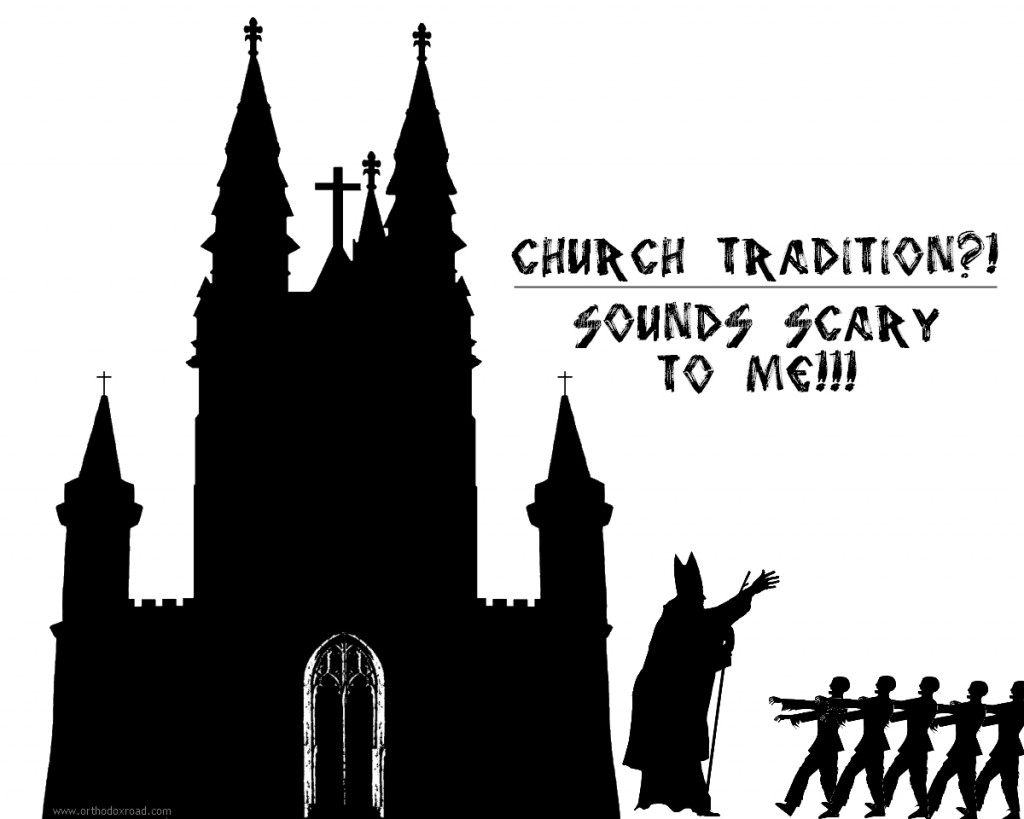
church-zombie-tradition-1024x819

In my recent posts, I have addressed the use and benefit of the lectionary and of the Christian calendar respectively. I also discussed the season of Lent. Here in the “buckle” of the Bible Belt, these types of discussions necessarily raise the bigger question about the church’s interaction with larger church history and tradition. Given the fundamental roots of most churches in this area, there is unspoken antagonism, or almost hostility, to adopting or adapting anything from the great traditions of church history. We have “no creed but the Bible” as it is often stated. It’s almost as if people believe that there was Jesus and the Apostles and now there is us, and no one has ever tried to follow Jesus in between the two. This kind of attitude leads to a Christian experience that is largely ahistorical, ungrounded, and lacking in any kind of depth or richness. This is easily seen in the lack of definition, conviction, and identity among so-called Evangelicals in the larger American culture.

The bottom line is that every church, every community for that matter, has some kind of tradition, whether formal or informal, whether spoken or assumed. And to act as if this is not so is simply intellectually dishonest. Traditions are the building blocks of culture; they are how culture is passed on from one generation to the next. Without them, ideas, values, and habits would die out and fade away as if they never existed. We are traditioned creatures, and that is not such a bad thing. Traditions tells us who we are and what we value, and they form our identity as members of the community to whom those particular traditions belong.

Of course, not all traditions are good and/or beneficial. There are many examples throughout Christian history going all the way back to times of Jesus or even into the Old Testament where the traditions of men were placed above the commands and teachings of Holy Scripture, where they were used to enslave people and populations rather than lift them up into the godly life. The Old Testament prophets, Jesus himself, and the New Testament authors are all very specific in their critiques of the misuse of traditions. But this does not mean that we may simply disregard them as having no benefit. Even Jesus kept the traditions of His people as an upstanding Jew.

Now, when it comes to the Great Tradition, as it is sometimes called, there are basically three ways we can respond, which are not original with me but are helpful nonetheless. We can reject the parts that are out of date, inappropriate, and/or unhelpful. We can receive the parts that are still good, helpful, and uplifting. Or we can “redeem” the parts that can be useful and beneficial by changing what is bad and reframing what is good. Reject. Receive. Redeem. Or, said another way: abandon, accept, accommodate, but the meaning is essentially the same.

The parts that we reject are easily identifiable, and most, but not all, stem from the Roman Catholic Church, because that was the only church for the first 1500 years of Christian history. So, concepts like those that pertain to the pope or the virgin Mary or purgatory, for example, are all parts of church tradition that we rightly reject. The Reformers were quite specific in their attacks on the traditions of the Catholic Church with which they disagreed. Another example of a tradition that we rightly reject might be John Calvin’s perspective on infant baptism. There is much we can learn from the writings and teachings of Calvin, but we should rightly reject his teaching on that particular topic. There are others, which need not be enumerated, but suffice it to say that some traditions that we see in Church history are temporally bound, specific to a particular people in particular place and time, and these should be respected and understood while not being emulated. Still others are downright unscriptural and should be rejected altogether.

Some parts that we can receive are the historic creeds of the church, e.g. the Apostle’s Creed, the Nicene-Constantinopolitan Creed, the Chalcedonian Creed, and the Athanasian Creed, and the insights from the historic ecumenical councils. There are also plenty of confessions and catechisms that have been passed down through the ages that still hold great value for theological education today. Southern Baptists themselves have their own version of this in the Baptist Faith and Message, first adopted in 1925, revised in 1963, amended in 1998, and revised again in 2000. Another aspect of the Great Tradition that we can receive are the writings of the great figures of church history, especially those that have withstood the test of time. From the patristic era, through the medieval era, the Reformation era, and into the modern era, there have been great Christian writers, thinkers, theologians, and pastors whose teachings are preserved for us in their literary works. As I pointed out above, we do not have to agree with them on every point, but there is still much we can learn from the timeless classics of the Christian faith. This is as true for the pastor, theologian, or professor as it is for the medical doctor, lawyer, grocery worker, or farmer who believes in Christ. If has often been said and it bears repeating that we should spend more time working through old books than we do sprinting through new ones.

Lastly, some aspects of the Great Tradition that we might redeem include things like the lectionary and the Christian calendar among others. These would fall under the category of devotional and ministry practices, both those for individuals and those for communities. The question of how the Spirit forms us into the image of Christ is not a new one. Faithful Christians throughout the ages have walked the same path of Christian discipleship that we are called to walk today. Certainly the challenges may be different in our cultural context than it was in theirs, but the principles and values have remained mostly the same. We are still called to grow in Christ-likeness, to advance the Gospel in our neighborhoods and around the world, and to love each other as Christ loves us. And we can learn a lot from the beliefs and practices of those who have gone before us.

The Great Tradition of the church is the norma normata (the norm that is normed), and Holy Scripture is norma normans non normata (the norming norm that cannot be normed). Yes, we should hold fast to  the doctrine of Sola Scriptura, but we cannot allow that belief to devolve into nuda scriptura. If we can learn to drink deeply from the springs of Christian tradition, instead of isolating ourselves in the now, then I believe that we will find our faith experience to be more enriched and more robust, than what is currently on offer in the Christian culture of today’s churches.

For further study, see:
Williams, D.H. Retrieving the Tradition and Renewing Evangelicalism: A Primer for Suspicious Protestants. Grand Rapids, Mich.: Eerdmans, 1999.

Also updated in:
Williams, D.H. Evangelicals and Tradition: The Formative Influences of the Early Church. Grand Rapids, Mich.: Baker Academic, 2005.


On the Season of Lent

Yesterday, February 14th, marked the annual cultural commemoration of Valentine’s Day. It is a day that is supposed to celebrate romantic love and affection, and it is usually expressed through the giving of flowers, candy, cards, and the like. And there is nothing wrong with that; however, for Christians, this February 14th also marked another holiday, namely Ash Wednesday. Ash Wednesday marks the beginning of the season of Lent, a 40 day period of preparation for the celebration of Holy Week climaxing in Easter. This preparation is usually characterized by repentance, confession, fasting, and acts of service.

Since most churches here in the area do not observe Lent, or if they do they don’t have a traditional Ash Wednesday service, my wife and I attended Ash Wednesday Mass at Blessed Sacrament Church, so that we could participate in the imposition of ashes, where a cross is marked on a worshippers forehead with ash. In the Bible ashes are most often a symbol of repentance, contrition, even mourning; a pentitent person would mark themselves with and/or sit in ashes to show outwardly their inward emotional state. Ashes also symbolize our mortality, as in the stanza, “Remember that you are but dust and into dust you shall return.” During Lent, we remember our mortality, because Jesus took our mortality into himself at the incarnation. He went to the cross to die, even as we all will die someday, and he rose again to new life, even as we all shall be raised. This life is passing, short, and fleeting, but our eternal hope rests in the immortality of Jesus in his resurrection.

Repentance means to change one’s mind, and it implies an intentional turn from sin to godliness. However, what is missing in this definition is that true repentance is motivated by godly grief over our sin. (2 Corinthians 7:10) During Lent, we try to see and feel our sin the way God sees it, so that we can appreciate the atoning death of Jesus even more. He who knew no sin became sin for us. So, in repentance, we acknowledge our sin as the abhorrent afront it is before a holy God. We turn away from it in righteous disgust as we learn to truly desire godliness in our character and behavior.

Lent is also usually accompanied by fasting. And Jesus did not say “If you fast”; he said “when you fast”, implying that He assumed that fasting would be a regular part of Christian discipleship. (See Matthew 6) Fasting is a timeless and valuable spiritual discipline, but our cultural aversion to anything uncomfortable and our insatiable need for self-indulgence has caused us to neglect it altogether. Yes, fasting challenges us to throw off the insanity of our cultural slavery to consumerism, to give up our creature comforts, and to forsake our dependence on stuff for the sake of Christ.

Now, when it comes to fasting, the specifics of the fast are ultimately irrelevant; whether you fast one meal or one whole day, whether you do it every Friday or not, or whether you give up something other than food. The goal of fasting is to free us from our dependence on things and to cultivate our dependency on Christ. I am giving up coffee for this Lent season, and if you know me, then you know that coffee is vital part of my morning routine. I am not a morning person, not even close. But I have chosen to give up this creature comfort, this practical addiction, for the 40 day duration of Lent, because as my body aches for the fix of caffeine, so my soul should ache for communion with the Spirit of the living God.

The season of Lent is also usually accompanied by acts of service or charity, as we seek to become more like Jesus. He spent his time ministering to the bottom rungs of society, the sick, the lame, the blind, the demon possessed, and we are called to be His hands and feet in the communities and neighborhoods we live in. After all, He said, “whatever you did for one of the least of these brothers and sisters of mine, you did for me.” Some people choose to give the money that they would have spent on whatever they chose to give up to charitable or Christian causes. Whatever you choose to do, the teaching of Jesus is clear, do it in secret without seeking the praise of others, “and your Father who sees in secret will reward you.” (Again, see Matthew 6)

Lent is an invitation to follow Jesus, once again, as He journeys toward the cross. Along the way, we seek to become more like Him, to be set free from “the sin that so easily entangles”, and to soak in anew our need for a savior, for His atonig death and His lifegiving resurrection. There are no rules, regulations, or requirements for its observance, only freedom in the Spirit as we seek to allow the Spirit make us more like Jesus. It is a time to renew once again our repentance from the way of the world and our embracing of life in the Spirit.


Slow To Write

"let every person be quick to hear, slow to speak, slow to anger."

lovegavehope

Just another WordPress.com site

Jared Cornutt

Pastor | Speaker | Writer

Denny Burk

A commentary on theology, politics, and culture

G3 Ministries

Events + Resources for the Local Church

Biblical Reasoning

Biblical and Systematic Theology According to the Scriptures

RetroChristianity

Reclaiming the Forgotten Faith

SBC Voices

Southern Baptist News & Opinion

Lucid Theology

Thoughts on words, books, theology, and life.

Baptist21

A pastor-led voice for Baptists in the 21st century

Center For Baptist Renewal

The Personal and Professional Blog of Phillip Powers

The Pastor's Well - Pastor Well

The Personal and Professional Blog of Phillip Powers

Articles - AlbertMohler.com

The Personal and Professional Blog of Phillip Powers

The Gospel Coalition

The Personal and Professional Blog of Phillip Powers