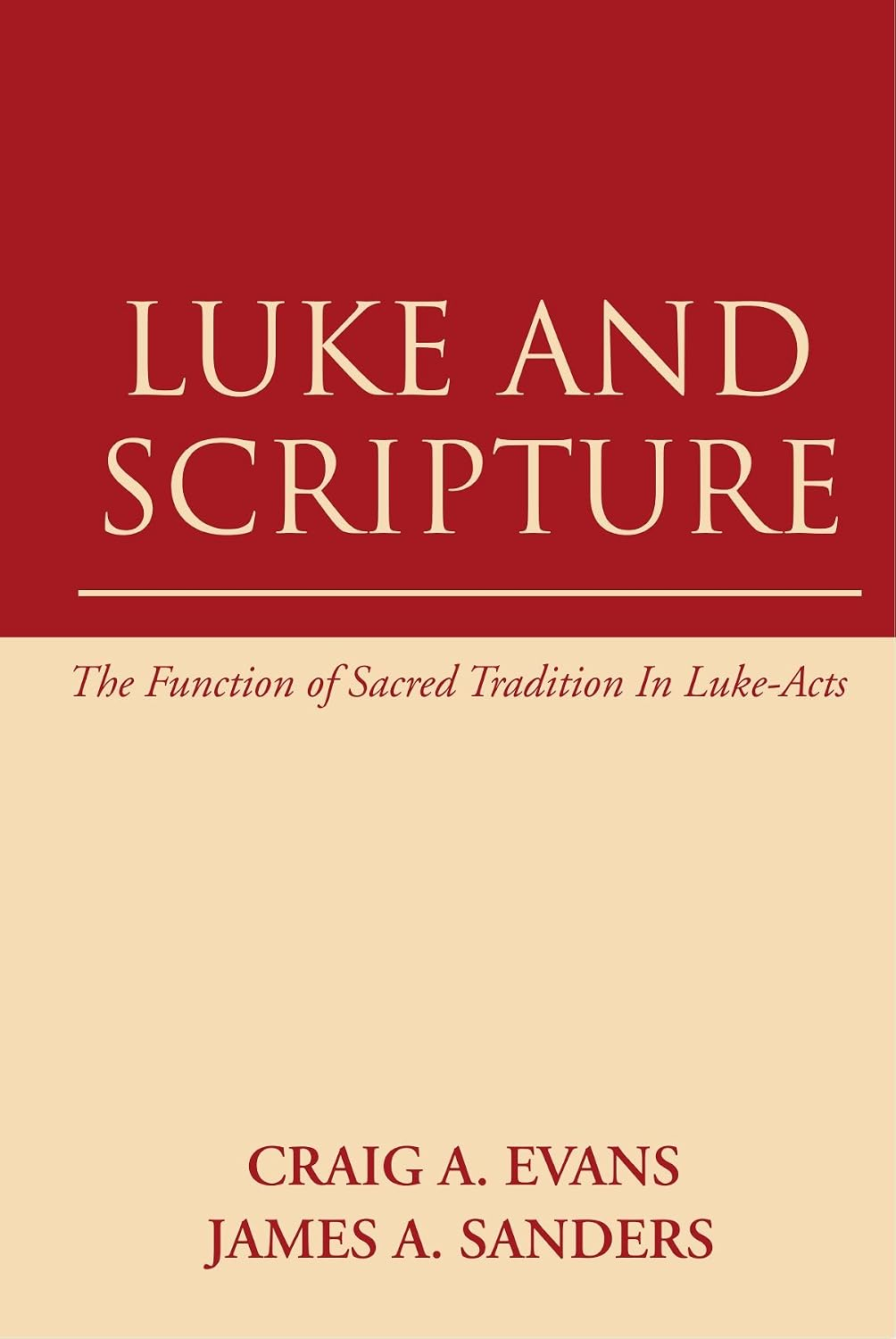
Evans, Craig A., and James A. Sanders. Luke and Scripture: The Function of Sacred Tradition in Luke-Acts. Eugene, OR: Wipf & Stock, 2001.
According to the Commentary on the New Testament Use of the Old Testament, although Luke only quotes the Old Testament some twenty-five times throughout his Gospel, he alludes to it possibly as many as 439 times. Thus, any perception that Luke is relatively uninterested in the Old Testament is largely mistaken. Luke makes extensive use of the Old Testament in his portrayal of Jesus and the fulfillment of Israel’s hopes and expectations. In Luke and Scripture: The Function of Sacred Tradition in Luke-Acts, Craig A. Evans and James A. Sanders take up Luke’s use of the Old Testament in a collection of essays that attempt to shed light on the topic through the method of comparative midrash. First published in 1993, the book has become a standard part of the discussion, and deservedly so. Luke and Scripture offers a valuable collection of studies demonstrating the pervasive importance of Israel’s sacred traditions for understanding Luke–Acts. At the same time, the diversity of the essays means that the volume is more successful in demonstrating the extent of Luke’s engagement with Scripture than in offering a unified account of how Scripture functions within Luke’s narrative.
The essays cover a wide range of topics, from Luke’s use of Isaiah, to the function of the Elijah/Elisha narratives, to the ethics of election in Luke’s great banquet parable, to the use of Psalm 118 in Luke’s entry narrative, to the portrayal of the Jews in Luke’s scriptural apologetic. The essays are nevertheless united by their general use of the method of comparative midrash, which simply means comparing Luke’s usage with contemporary uses of the same Scripture in Jewish literature. The underlying assumption of this approach is that Luke’s use of Scripture did not take place in isolation. The same texts and traditions upon which Luke draws were being interpreted and reapplied within the broader Jewish world, and these contemporary interpretations can therefore provide an important context for understanding Luke’s own hermeneutical activity. By comparing Luke’s use of a particular passage or tradition with its interpretation elsewhere in Jewish literature, Evans and Sanders attempt to identify both the interpretive conventions Luke shares with his contemporaries and the distinctive ways in which he adapts Israel’s Scriptures to the story of Jesus and the early church. Comparative midrash thus provides the methodological thread connecting what might otherwise appear to be a rather diverse collection of essays. Despite the variety of texts and questions addressed, comparative midrash thus provides a common methodological framework for the volume as a whole.
The value of this comparative approach becomes apparent in the exegetical insights it produces throughout the volume. Rather than simply identifying Old Testament quotations and allusions, the contributors frequently demonstrate how attention to the wider interpretive traditions surrounding a particular text can illuminate Luke’s own use of it. This is especially important because Luke often draws upon Scripture in ways that extend beyond explicit citation. Scriptural characters, narratives, themes, and expectations provide patterns through which Luke interprets Jesus and the events of the early church. Reading these passages alongside their interpretation elsewhere in early Judaism therefore helps recover dimensions of Luke’s scriptural world that might otherwise be overlooked. At its best, comparative midrash allows the reader to see not merely that Luke has used a particular passage, but why that passage could carry the theological significance that Luke assigns to it. The method consequently provides an important safeguard against treating Luke’s use of Scripture as a collection of isolated Christian proof texts disconnected from their larger Jewish interpretive context. Luke’s reading is unmistakably Christian and Christological, but the essays repeatedly demonstrate that it remains deeply rooted in Israel’s Scriptures and the interpretive traditions that had developed around them.
A second strength of Luke and Scripture is the sheer breadth of Luke’s engagement with Scripture that emerges from the essays taken together. The volume demonstrates that the Old Testament does far more in Luke–Acts than provide a collection of individual proof texts or explicit predictions that find their fulfillment in Jesus. Israel’s Scriptures supply characters, narratives, themes, patterns, and expectations that repeatedly shape the way Luke tells his story. This breadth is reflected in the diversity of the essays themselves. Isaiah, the Elijah and Elisha narratives, the Psalms, Israel’s election, and other scriptural traditions are all shown to contribute in various ways to Luke’s presentation of Jesus and the early church. For example, Evans’s essay “Prophecy and Polemic: Jews in Luke’s Scriptural Apologetic” is particularly compelling in the way it challenges the conclusion that Luke is anti-Semitic in his portrayal of the Jews. Evans argues that Luke’s polemic against Jewish unbelief should be understood within the scriptural and prophetic patterns through which Luke interprets both Jesus’s rejection and the opposition encountered by the early church. The point is that the cumulative effect of the essays is significant. Even where one might disagree with an individual interpretation, the volume makes it increasingly difficult to read Luke–Acts without recognizing how thoroughly Luke’s narrative has been shaped by Israel’s Scriptures. Taken together, the essays demonstrate that the Old Testament does not merely provide occasional support for Luke’s theology; Israel’s Scriptures supply much of the conceptual and narrative world within which Luke tells the story of Jesus and the early church.
Nevertheless, the diversity that gives Luke and Scripture much of its value also contributes to one of its principal weaknesses. Although the individual essays provide numerous illuminating examples of Luke’s engagement with Israel’s Scriptures, the volume does not always bring these individual studies together into a unified account of how Scripture functions within Luke–Acts as a whole. This is particularly noticeable given the book’s subtitle, The Function of Sacred Tradition in Luke-Acts. The essays demonstrate a variety of ways in which Luke draws upon Scripture, but the reader is often left to determine how these individual examples relate to one another and what they reveal collectively about Luke’s larger scriptural hermeneutic. Of course, some degree of diversity is unavoidable in a collection of essays addressing different texts and questions, and that diversity contributes to the breadth that makes the volume so useful. Nevertheless, a concluding chapter drawing together the results of the individual studies and articulating more explicitly what they reveal about the larger function of Scripture within Luke–Acts would have strengthened the volume considerably. As it stands, Luke and Scripture is more successful in demonstrating the pervasive extent of Luke’s engagement with Scripture than in providing a comprehensive account of how that engagement functions across his two-volume narrative.
A second limitation concerns the method of comparative midrash itself. As noted above, comparison with contemporary Jewish interpretations can provide invaluable context for understanding Luke’s use of Scripture. Nevertheless, identifying parallels between Luke and other Jewish interpreters does not by itself explain how a particular scriptural text or tradition functions within Luke’s own narrative. At times, the volume’s emphasis upon comparative material can therefore leave questions of literary and theological function somewhat underdeveloped. Luke is not merely preserving individual interpretations of Israel’s Scriptures but incorporating them into a carefully constructed narrative in which scriptural themes and expectations develop across Luke–Acts. Consequently, understanding Luke’s use of Scripture requires attention not only to how a particular text was interpreted within early Judaism but also to where Luke places that text, how it relates to other scriptural traditions within his narrative, and what role it plays in the larger theological argument of Luke–Acts. This does not diminish the value of comparative midrash; rather, it highlights the limits of what the method can accomplish on its own. Comparative midrash is therefore most illuminating when it provides the historical and interpretive context for Luke’s use of Scripture while remaining attentive to the distinctive narrative and theological purposes for which Luke employs it.
Despite these limitations, Luke and Scripture remains a valuable contribution to the study of Luke–Acts and its use of the Old Testament. The individual essays vary in their subjects and conclusions, but together they make a compelling case that Israel’s Scriptures and the interpretive traditions surrounding them are indispensable for understanding Luke’s narrative and theology. The volume is particularly valuable for students and scholars interested in Luke–Acts, the New Testament use of the Old Testament, and the relationship between early Christianity and Jewish scriptural interpretation. More than thirty years after its original publication, some aspects of the discussion have naturally been supplemented by subsequent scholarship, but the volume continues to provide important exegetical insights and a useful methodological reminder: Luke must be read within the scriptural world from which his Gospel and Acts emerged. Luke and Scripture may not provide a comprehensive or fully unified account of the function of sacred tradition in Luke–Acts, but it convincingly demonstrates that such a function cannot be treated as peripheral. Israel’s Scriptures belong near the center of any attempt to understand Luke’s presentation of Jesus, the early church, and the fulfillment of God’s purposes.


