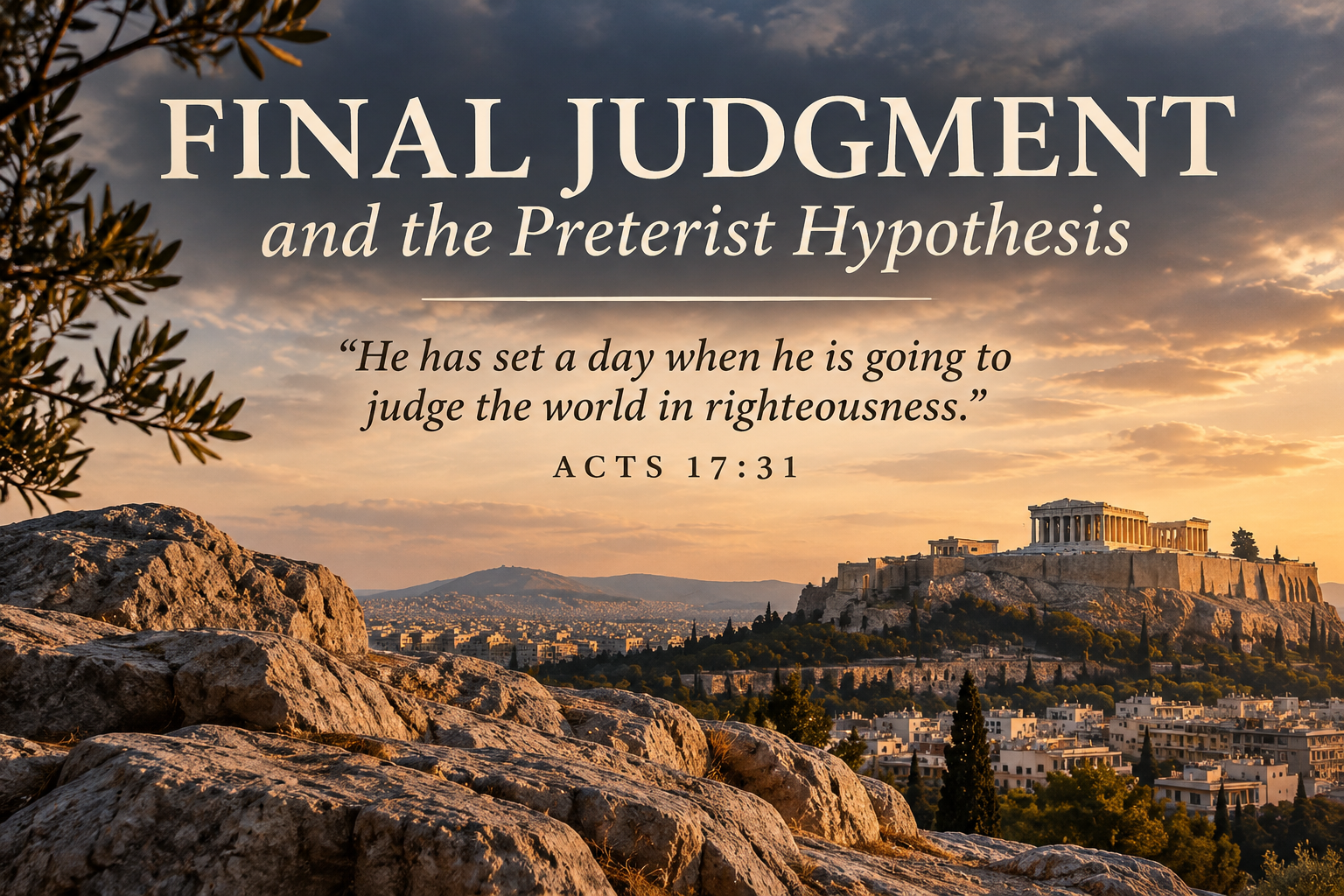
In last week’s post, I argued that biblical texts, particularly those containing predictive prophecy, must be interpreted within their original historical context. Preterist interpreters rightly insist on this axiom when reading Jesus’s predictions concerning Jerusalem. But the same hermeneutical principle must be applied consistently elsewhere. In the Book of Acts, as Paul addresses the Athenians on the Areopagus, he declares, “Therefore, having overlooked the times of ignorance, God now commands all people everywhere to repent, because he has set a day when he is going to judge the world in righteousness by the man he has appointed. He has provided proof of this to everyone by raising him from the dead” (Acts 17:30–31). What would Paul’s announcement of an appointed day on which God would judge the world through the resurrected Jesus have communicated to his Athenian hearers? After all, these are pagan Athenians, not inhabitants of Jerusalem awaiting the destruction of their city. It is my contention, then, that Paul’s proclamation presents final judgment as a universal and future event in which humanity is accountable to the risen Christ. Nothing within the immediate context naturally connects this judgment with the coming destruction of Jerusalem in AD 70. Rather, the universal summons to repentance, the judgment of the inhabited world, and especially the resurrection of Jesus as God’s guarantee point beyond a localized historical judgment toward the final judgment of humanity. If original-audience relevance matters for interpreting Jesus’s warnings concerning Jerusalem, it must also matter for interpreting Paul’s warning to Athens.
Now, by way of setting the scene, the Scriptures tell us that Paul was distressed when he saw that the city of Athens was full of idols. So he began to proclaim Christ and his resurrection in the synagogue and in the marketplace, where eventually he ran into some Epicurean and Stoic philosophers. They subsequently brought him to the Areopagus so that they could examine what he was saying more closely. This setting is important for understanding the argument that follows. Unlike Jesus’s warnings concerning Jerusalem, Paul’s speech does not arise from a discussion of the temple, Israel’s covenantal history, or the coming judgment upon Jerusalem. Instead, Paul begins with the Athenians’ idolatry and proceeds from the universal reality of God as Creator. The God whom they worship in ignorance is the God who “made the world and everything in it,” who is “Lord of heaven and earth,” and who “made from one man every nation of mankind to live on all the face of the earth” (Acts 17:24–26). The scope of Paul’s argument is therefore deliberately universal. He is addressing pagan Athenians as creatures who, together with the rest of humanity, are accountable to the God who created them. Consequently, when Paul moves from creation and idolatry to repentance and judgment, the natural horizon of his argument remains the same. The horizon of Paul’s speech is not Jerusalem and its covenantal crisis but humanity and its accountability to the Creator.
So, it makes sense then when we come to verses 30–31 that “God commands all people everywhere to repent.” The universal scope of this command follows naturally from everything Paul has already said. The God who created the world, who made every nation, and who gives life and breath to all people now summons all humanity to turn from its idolatry and ignorance. But equally important is the reason Paul gives for this universal summons. God commands all people everywhere to repent “because he has set a day when he is going to judge the world in righteousness.” In other words, the command to repent and the announcement of coming judgment belong together. All people everywhere must repent because God has appointed a day on which he will judge the inhabited world. The Greek term translated “world” here (oikoumenē) need not, by itself, carry the entire weight of the argument, since its precise scope can vary according to context. But within this particular speech, its universal sense fits the movement of Paul’s argument remarkably well: God made the world and everything in it, he made every nation from one man, he commands all people everywhere to repent, and he will judge the world in righteousness. The universal scope of Paul’s summons to repentance therefore supplies the natural horizon for the universal judgment by which he motivates it.
Of course, the (full) preterist hypothesis would suggest that this expectation was fulfilled in the destruction of Jerusalem in AD 70. But such an interpretation raises an important question within the context of Paul’s speech: what would the coming destruction of Jerusalem have to do with the repentance of these Athenian hearers? Paul has said nothing about Jerusalem, the temple, or Israel’s covenantal judgment. His concern throughout the speech has been the Athenians’ idolatry and the accountability of humanity to the God who created all things. Nor does Paul merely announce that judgment is coming; he presents that judgment as the reason why “all people everywhere” must repent. Certainly, Paul could warn his audience about an event whose precise historical circumstances they did not yet understand, and the destruction of Jerusalem would constitute a genuine act of divine judgment. The difficulty, however, is that nothing within the speech gives these Athenians any reason to understand the destruction of a city hundreds of miles away as the judgment for which their own repentance is required. The logic of Paul’s argument points in precisely the opposite direction: the Creator of all humanity commands all humanity to repent because he has appointed a day on which he will judge the world through his appointed man. The difficulty is not merely that the Athenians would have been unaware of AD 70; it is that nothing in Paul’s speech gives them reason to understand Jerusalem’s coming destruction as the judgment for which their own repentance is required.
Moreover, Paul grounds his expectation of this final judgment in the resurrection of Jesus, not in the coming destruction of Jerusalem. Acts 17:31 reads, “he has set a day when he is going to judge the world in righteousness by the man he has appointed. He has provided proof of this to everyone by raising him from the dead.” In other words, the guarantee that this judgment will occur is Jesus’s resurrection from the dead. The logic of Paul’s argument closely connects the identity of the coming Judge with his resurrection; God has appointed the man through whom he will judge the world, and by raising this same man from the dead, God has provided assurance that the appointed judgment will take place. This connection becomes even more significant when we consider the response of Paul’s Athenian audience. Luke tells us in the following verse that “when they heard about the resurrection of the dead, some began to ridicule him, but others said, ‘We’d like to hear from you again about this.’” The stumbling block for the Athenians was therefore not an announcement concerning the future destruction of Jerusalem but Paul’s proclamation of resurrection. This response fits naturally with the universal judgment Paul has just announced. The Jesus whom God raised from the dead is the same Jesus before whom humanity will ultimately be held accountable. The resurrection does not merely authenticate Jesus as a prophet announcing coming judgment; it identifies the risen Jesus as the appointed Judge before whom humanity must ultimately answer.
None of this requires us to deny that the destruction of Jerusalem in AD 70 constituted a genuine act of divine judgment. As I argued in the previous post, Jesus clearly warned of a coming judgment upon Jerusalem, and the destruction of the city and temple provides an important historical fulfillment of those warnings. The problem arises when this historical judgment is identified with the final judgment itself. Scripture repeatedly presents acts of divine judgment within history without thereby exhausting the expectation of an ultimate judgment still to come. God judged Egypt, Assyria, Babylon, and even Jerusalem, and each of these events demonstrated his righteousness and sovereignty within history. Yet none of them constituted the final judgment of humanity. Acts 17:30–31 gives us good reason to maintain the same distinction with respect to AD 70. Paul moves from the God who created the world and every nation, to the command that “all people everywhere” repent, to an appointed day on which God will judge the world through the man whom he raised from the dead. The cumulative movement of the speech points beyond a localized historical judgment toward the universal accountability of humanity before the risen Christ. AD 70 may therefore belong to the biblical pattern of divine judgment without becoming the final judgment toward which that pattern ultimately points.
Ultimately, Paul’s proclamation in Athens reminds us that the doctrine of final judgment is not merely an abstract component of Christian eschatology. It belongs to the gospel summons itself. God commands “all people everywhere” to repent because he has appointed a day when the world will be judged in righteousness. The Judge has already been identified, and his resurrection from the dead provides God’s assurance that this judgment will occur. Paul’s Athenian hearers therefore stood accountable before the same risen Christ whom Paul proclaimed to them, and nothing within the communicative context of the speech suggests that this accountability would be exhausted by the coming destruction of Jerusalem. To the contrary, the universal movement of Paul’s argument—from the Creator of all humanity, to the repentance of all people everywhere, to the judgment of the world—points toward a final reckoning before the risen Christ. Historical judgments such as the destruction of Jerusalem remain important precisely because they reveal the righteousness of the God who acts in history and anticipate the judgment still to come. But they must not be allowed to consume the future toward which they point. The Creator commands all people everywhere to repent because history is moving toward an appointed day when the world will be judged in righteousness through the risen Christ. Jerusalem would indeed face judgment within the first century, but Acts 17:31 directs our attention beyond Jerusalem to the final judgment of humanity before God’s appointed Judge.


