Tag Archives: Biblical Theology

On Christological Eschatology

If you have followed my blog for any amount of time or if you have perused through the topics and tags, then you have probably noticed that eschatology is a primary interest of mine, both academically and pastorally. However, this area of theological reflection often evokes a mixed bag of responses and reactions. Some are quick to debate the various questions and details related to timelines, rapture debates, and millennium questions, while others are prone to avoid the questions altogether. I would suggest that neither one of these responses to the doctrines of the last things is healthy. Moreover, when we are so focused on identifying our particular eschatological system, whether dispensational, premillennial, amillennial, or postmillennial, we run the risk of displacing Jesus from the center of the question. This is not to say that these systems are wrong per se, but it is to say that we are often in danger of missing the forest for the trees as it were. Our eschatology is only as sound as our Christology. Every question about the end ultimately reduces to the question: Who is Jesus, and what is he doing? In other words, our eschatological views must be inherently Christological before they are anything else.

Christological eschatology is the conviction that the person and work of Jesus Christ are not merely part of the end times—they are the interpretive center of all eschatology. Of course, this does not mean that it is unconcerned with the unfolding of future events like the final judgment or the general resurrection. Eschatological reflection will always entail some understanding of the events that are yet to unfold, as Scripture itself directs our attention to these realities. However, Christological eschatology asserts that these events derive their meaning and significance from Christ and his work. They are not self-interpreting realities, nor are they ultimate in themselves; rather, they are the outworking of what God has already accomplished in and through Jesus. In this way, Christological eschatology is not event-centered nor system-centered, but Christ-centered. It refuses to treat the end as a sequence to be mapped or a system to be mastered and instead understands it as the fulfillment of the redemptive work of Christ. It is simply the view that every eschatological question ultimately revolves around the person and work of Christ in bringing redemption to the world.

In many ways, viewing our eschatology as centered on the person and work of Christ is simply a way of embracing the interpretive horizon of the New Testament. The New Testament authors consistently orient their eschatological claims back to the person and work of Jesus. For example, in 1 Corinthians 15, when Paul is addressing the question of the resurrection, he grounds his argument in the fact that Christ has already been resurrected from the dead. He is the first fruits of our resurrection; because Christ has already been raised, we will be raised. (On the logic of the resurrection, see here.) Or again, when the Gospel authors talk about the nearness or the presence of the Kingdom, they speak of it in relation to the presence of Christ. Because Christ is King, his coming to earth marks the beginning of the Kingdom age. This is why we regularly speak of the already and the not yet. The Kingdom has already been inaugurated at Christ’s first coming, and it will be finally consummated at his second coming. In other words, the already/not yet framework is grounded in Jesus himself. Jesus is not just a participant in the end; he is the turning point of history. The end does not merely arrive with Jesus. In a real sense, it begins with him.

We miss this emphasis when we become too focused on other eschatological questions. Both at the popular and at the academic level, we are quick to obsess about timelines, to speculate about sequences, and to read Scripture backward through our preferred eschatological systems. Entire interpretive frameworks are often constructed around the ordering of events, the identification of signs, or the alignment of prophetic texts with contemporary developments. None of these questions are unimportant in themselves, but they can easily assume a controlling role that they were never meant to have. When this happens, the center of gravity in our eschatology subtly shifts. When eschatology becomes primarily about events, charts, and sequences, Christ becomes secondary. Jesus becomes just another piece in the system rather than the center of the system. He is treated as a necessary component within a larger structure, rather than the one in whom that structure finds its meaning and coherence. And when a system can be mapped without reference to the living Christ, then it has already gone off track. At that point, eschatology risks becoming an exercise in speculative reconstruction rather than a theological reflection on the redemptive work of Christ. The question is not whether we have constructed a coherent system, but whether our understanding of the end is actually centered on the person and work of Jesus.

Now, there are several aspects of Christ’s person and work that ground our eschatological reflections. First, as I’ve already noted, Jesus is the Risen Lord. In other words, if eschatology begins with resurrection (and it does), then because Jesus has already been raised from the dead, the future has already broken into the present. We have been spiritually raised with Christ to walk in newness of life, and one day, we will be raised physically to walk hand in hand with him in glory. Second, and this has already been noted as well, but Jesus is the Reigning King. After his resurrection, he ascended into heaven to be seated at the right hand of the Father where he is currently reigning in glory. In this sense, the Kingdom is not merely a future reality; it is present now as he reigns over his people by his Spirit through his Word. He is coming again to reign on earth, but his present enthronement should shape our expectations. Third, Jesus is the Coming Judge. In other words, the final judgment is not some abstract threat. No, it is a personal reality that is tied to Christ authority. As the ancient creeds confess, he is coming to judge the living and the dead. The judge is the crucified and risen Christ. And finally, Jesus is the Center of Restoration. Or to put it another way, the new creation is not a system reset, it is the union that we now have with Christ being finally fulfilled on earth as it is in heaven. My point is that every eschatological hope—resurrection, judgment, kingdom, restoration—finds its coherence in the person of Jesus.

So, rather than asking “when is the rapture?” or “what is the millennium?”, we should be asking questions like, “What does Jesus’s resurrection mean for the future?”, “What does his kingship imply about the present?”, and “What does his return reveal about judgment and restoration?” These are not different questions so much as they are better-ordered questions. They move us away from speculative sequencing and toward theological reflection on the person and work of Christ. In other words, the question is not first what happens next, but what does Jesus’ work mean for what happens next? This shift in emphasis reorients the entire task of eschatology. It forces us to begin not with a timeline but with an event—the death and resurrection of Jesus—and to interpret the future in light of that reality. It reminds us that the resurrection is not merely a past miracle, but the decisive intrusion of the future into the present, the beginning of the end itself. Likewise, the present reign of Christ is not an abstract theological claim, but the governing reality that shapes how we understand the present age. And his return is not simply the final item on a prophetic chart, but the personal culmination of God’s redemptive purposes in the world. When we ask our eschatological questions in this way, Christ is no longer assumed in the background—he stands at the center.

This is not just some theological word game; this change has direct pastoral and theological payoff. Most importantly, it grounds our hopes for the future in a person and not in a system. This is our “blessed hope, the appearing of the glory of our great God and Savior, Jesus Christ.” (Titus 2.13) We don’t have to have all the details figured out down to a T, so to speak; we simply have to trust in the one who has promised to make all things new. More than this, though, it produces stability in the midst of disagreement. The disagreements among eschatological systems are myriad, but in theory, we can all agree that Christ stands at the center of the eschatological program. I would go as far as to say that we must agree on this, as a matter of Christian orthodoxy. Our common hope in Christ should unify believers across all our eschatological differences. Our eschatology should bring us together not drive us apart. And finally, this reorientation in our eschatological reflection centers us on questions of discipleship rather than speculation. By focusing on Christ and his work, we are better able to wait patiently and faithfully as he has commanded us, instead of worrying about the details. The point is that the doctrines of eschatology are not meant to produce anxiety about the future, but confidence in the One who holds it.

Ultimately, the end times are all about Jesus. This may sound cliché, but it is the biblical emphasis. The New Testament does not give space to unnecessary speculations about the end times or invite us to lose ourselves in the details of timelines and sequences. Rather, every eschatological vision must revolve around the person and work of Jesus Christ. He is the one who is coming back to make all things new. He is the one who is coming back to receive us unto himself, that where he is there we may be also. He is the one who is coming back to set us free from the presence of sin once and for all and to bring God’s redemptive purposes to their final fulfillment. And so, the end of all things is not a timeline to decode, but a person to behold—the crucified, risen, and reigning Christ.


On the Narrative Logic of John 21

The twentieth chapter of John’s Gospel is full of climactic moments. Not only does it record the resurrection of Jesus and his interaction with Mary in the garden, but it also tells the story of Jesus’s appearance to his disciples in the upper room (On the Johannine Pentecost) and the climactic confession of Thomas a week later. The chapter ends with a clear purpose statement when John writes, “Jesus performed many other signs in the presence of his disciples that are not written in this book. But these are written so that you may believe that Jesus is the Messiah, the Son of God, and that by believing you may have life in his name.” (20.30-31) To many, these verses sound like an appropriate conclusion to John’s Gospel; for this reason, many scholars (and some readers) treat John 21 as a kind of appendix or addendum or afterthought. Although there is no manuscript evidence to support this claim, it is often argued that if chapter 20 brings the Gospel to its climactic conclusion, then why would John write chapter 21? It seems unnecessary. From a narrative perspective, John 21 is not an awkward appendix but the necessary completion of the Gospel’s story. It resolves tensions left intentionally open in chapter 20 and brings the Gospel’s themes — discipleship, love, witness, and mission — to their proper conclusion.

As I noted above, John 20 is the clear climax of John’s Gospel. Jesus is resurrected, the disciples are commissioned, and Thomas confesses Jesus as “My Lord and my God.” (20.28) This confession serves as a kind of bookend in the book that points the reader back to John’s opening where he affirms that Jesus is the Word that was with God and was God and was made flesh and dwelt among us. (1.1, 14) Following these climactic moments, it only makes sense that John’s purpose statement in verses 30-31 would bring the Gospel to its logical conclusion. This chapter proves that Jesus is the Christ of God, and that faith in Him as the resurrected one results in eternal life. The end. Or so one would think. Not only is there no manuscript evidence that John’s Gospel should end in chapter 20 (as there is with Mark’s ending, on which see here), but if John were to end his gospel with chapter 20, then there would be many narrative threads that would remain unresolved. What becomes of Peter after his denial? What becomes of the beloved disciple? What becomes of the disciples’ mission? Yes, chapter 20 concludes the narrative arc of Jesus’s identity, but chapter 21 goes on to explain what that revelation now means for the followers of Jesus.

John 21 returns the reader to the Sea of Tiberias, aka the Sea of Galilee. Narratively, this is a return to where it all began. Not only did Jesus begin his public ministry in Galilee, but he also called the first four disciples after a night of fishing on the Sea of Galilee. The scene intentionally echoes the earlier calling narrative familiar from Luke 5. After a night of fruitless labor, Jesus shows up and tells them to cast their nets on the other side of the boat. They haul in a catch that is nearly too large, and Jesus commissions them to discipleship and mission. Many interpret this scene as a regression for the disciples, a return to the life and vocation before Christ. However, in light of this parallel, this scene should be understood not as a regression, but as narrative symmetry. John intentionally returns his readers to the beginning to show that the resurrection does not erase vocation — it redefines it. Vocation that is engaged apart from radical dependence on the risen Christ is utterly futile, but when vocation is entered into from a position of dependence and obedience to the risen Christ, then it is abundantly fruitful. When we submit our vocation to the mission of Jesus, then we will reap abundant fruit and reward. Even so, the real center of John 21 is not fish, it is Peter.

Of course, all four Gospels record Peter’s three denials of Jesus on the night of Jesus’s arrest, but John is the only one who records Peter’s restoration. (Luke hints at the idea when Jesus tells him that after returning, he will encourage his brothers.) John deliberately connects the scene in John 21 back to the denial scene by noting that Jesus prepared a “charcoal fire” and the threefold repetition of the question “Peter, do you love me?” matching Peter’s three denials. Some tend to make a big deal out of the various words that are used for love in Peter’s answers, but this is overplayed. Not only were the words basically synonymous in the first century, but the idea that Peter’s love did not rise to some divine standard is wholly alien to the logic of the text. This is a threefold public restoration that corresponds to Peter’s threefold public failure. Moreover, it reveals the pastoral tenderness of Jesus. Jesus does not scold Peter; he does not call him out over his failures. He doesn’t berate or condemn him. He graciously restores Peter to ecclesial service. “Feed my lambs. Shepherd my sheep. Feed my sheep.” This commission is not merely personal therapy for Peter; it is an ecclesial necessity. John cannot end his Gospel with Peter in unresolved failure. The shepherd of the disciple group must be restored if the flock is to endure. But Peter is not the only disciple in view here either.

After his restoration, Peter noticed the disciple whom Jesus loved and he asks Jesus, “Lord, what about him?”, and Jesus responds, “What is that to you? As for you, follow me.” (21.20-22) Jesus’s point is that he has different callings for each of his followers, and that following Christ is more important than comparing callings. Peter’s calling was to shepherding and martyrdom; the beloved disciple’s calling was to abiding ministry and public/written testimony. As he writes in 21.24, “This is the disciple who testifies to these things and who wrote them down. We know that his testimony is true.” Not only is this important for establishing the credibility and reliability of John’s Gospel, but it is also a fundamental component of John’s understanding of what it means to be a disciple of Jesus. To put it another way, John 21 grounds the authority of the Gospel in eyewitness testimony while clarifying that discipleship does not look identical for all. We all serve the risen Christ, but we all serve him in different and varied ways. These verses are not just random narrative details added on to the end of the story; they are essential for completing John’s theology of discipleship.

In other words, for John, discipleship is a life that is characterized by following Jesus, loving Jesus, abiding in Jesus, and witnessing to the truth about Jesus. When we confess Christ (chapter 20), he commissions us to a life of embodied mission (chapter 21). If we truly believe that Jesus is the risen Christ (and he is), then we will follow him in whatever calling he has placed on our lives. Put differently, discipleship is the vocation of following Jesus. The risen Christ is not merely to be believed in — he is to be followed. If we say we love Christ, we will commit ourselves to and give ourselves for the care of his people. Moreover, John hints at the fact that discipleship can involve suffering. In 21.18, Jesus tells Peter, “when you grow old, you will stretch out your hands and someone else will tie you and carry you where you don’t want to go.”, and John explains that “He said this to indicate by what kind of death Peter would glorify God.” (21.19) This is part of the vocation of discipleship, too. We must be willing to follow Jesus wherever he leads; this is the kind of discipleship that Jesus is calling us all too.

However, returning to my thesis, without John 21, Peter’s denial remains unresolved, the beloved disciple’s authority is unexplained, and the future of the community of Jesus followers is unclear. In terms of John’s narrative, John ends his gospel not with spectacle but with discipleship as vocation. Chapter 20 concludes the revelation of Jesus’s identity, and chapter 21 concludes the formation of Jesus’s community. Or to put it another way, John 20 answers the question “Who is Jesus?”, and John 21 answers the question “What now?” Without this pastoral and ecclesial resolution, John’s Gospel would be incomplete. John does not end his Gospel in private mystical belief. He ends it with shepherding, witness, martyrdom, and mission. And he leaves the end of the story open when he writes, “And there are also many other things that Jesus did, which, if every one of them were written down, I suppose not even the world itself could contain the books that would be written.” In other words, the story is ongoing, and all the things that the risen Jesus will do have not yet been completed even two thousand years later. John 21 is not a loose epilogue. It brings the Gospel to its proper end — not merely with a confession of Christ, but with the commissioning of those who will testify to him. The risen Lord restores the fallen, distinguishes callings, anchors testimony, and sends his followers into a future shaped by love and sacrifice. That is not an afterthought. That is narrative completion. And it poses the question to the reader, “Will you follow Jesus?”


On Whispers of Revolution: A Book Review

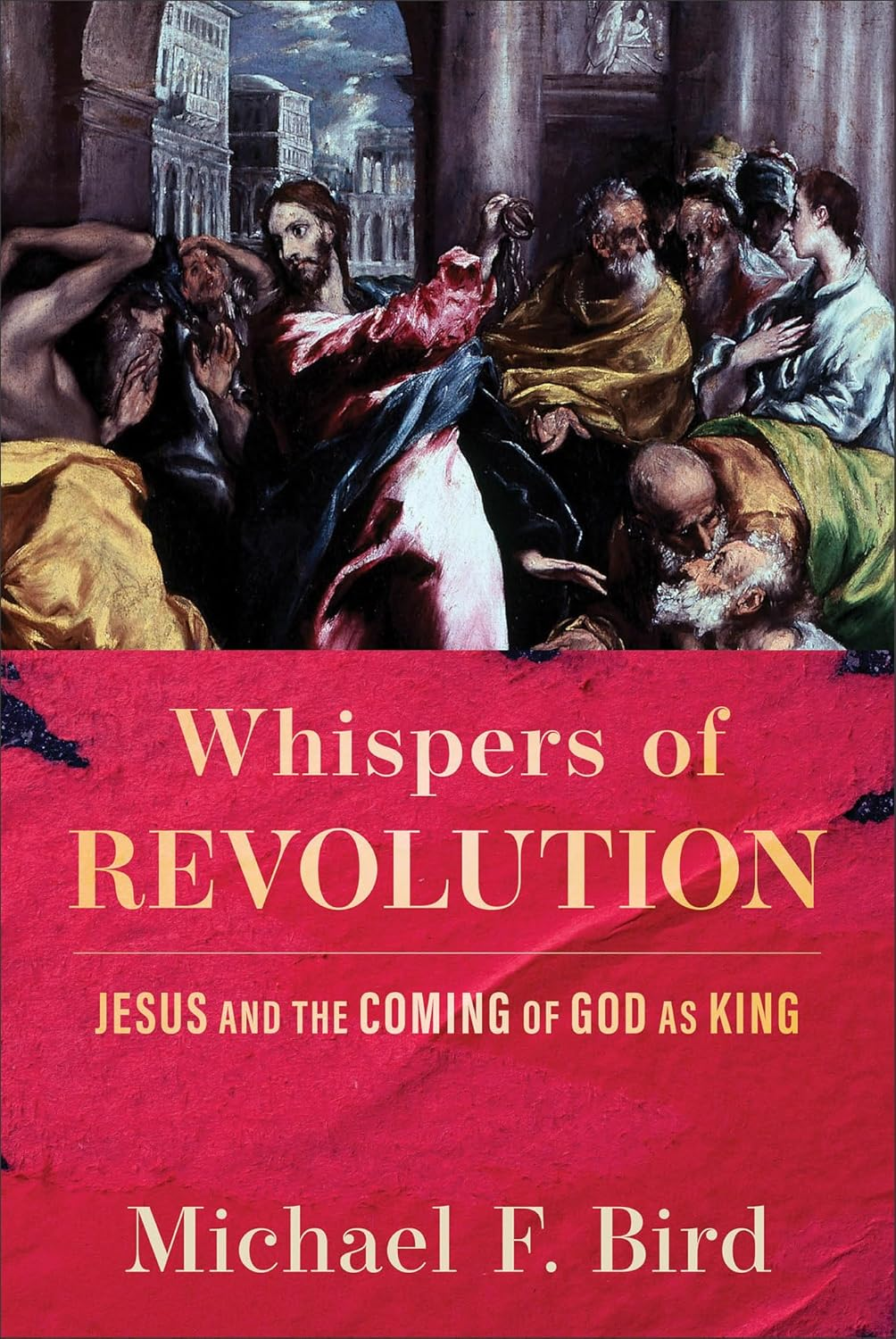
Bird, Michael F. Bird. Whispers of Revolution: Jesus and the Coming of God as King. Grand Rapids: Baker Academic, 2025.

When we confess that Christ is King, we are tapping into a longing that goes back to the very beginning of creation. Adam and Eve were placed in the garden of Eden to serve as God’s vice-regents, to rule and to establish his dominion in the world. Of course, our first parents failed when they succumbed to the deceptions of the serpent, and from that point on, the story of the Bible revolves around God’s plan to reestablish his dominion in the world. In a new book entitled Whispers of Revolution: Jesus and the Coming of God as King, Michael F. Bird applies this lens to the person and work of Jesus of Nazareth. Bird is Deputy Principle and Lecturer in Theology at Ridley College, Melbourne, and he is the author of over 30 books, including the award winning The Gospel of Lord: How the Early Church Wrote the Story of Jesus. In this book, Bird argues that Jesus was driven by the conviction that through his words and work, through his mission and message, God was unveiling his kingship in a way that would rescue Israel and eventually restore the whole world.

Bird’s essential thesis is that the life and ministry of Jesus is best understood within the context of Jewish restoration eschatology. Jewish restoration eschatology is simply the hope that one day God would bring an end to Israel’s exile, restore their national and spiritual life as his people, and through them bring the nations into submission under his rule. This hope is grounded in the visions of the canonical prophets, and it serves as the foundation for the theology and worldview of Second Temple Judaism. For Bird, this worldview “provides the key to understanding Jesus’ mission, aims, self-understanding and hope.” (56) With this lens in view, then, Bird goes on to walk through the Gospel accounts to show how the details of the Jesus earthly ministry fit within this framework. Along the way he discusses topics such as, the birth and early life of Jesus, Jesus’ self-understanding of himself as Messiah, his teaching about the Kingdom of God and other topics, his interactions with his contemporaries, his’ last days in Jerusalem, and his death and resurrection. In all of this, God is coming, coming as king. He concludes, “Jesus himself started the whisper of this revolution, one involving a reordering of power, Israel’s regathering, the redemption of the Jews, the defeat of Satan, and the renewal of creation.” (300) However, this good news could not remain a whisper; it had to be shared, repeated, declared, argued, and even shouted afar. And this is exactly what Jesus instructed his followers to do.

In terms of strengths, Bird is particularly helpful when he is discussing the place of historical Jesus studies in relation to New Testament Theology. After all, Jesus did not write any of the books that we have included in the NT canon. Technically, the NT Documents are written about him, but none of them were actually written by him. So, we may rightly speak of the theology of Matthew or Luke or Mark or John, but can we also speak of the theology of Jesus himself? Bird suggests that the study of the historical Jesus is a necessary prolegomena o our study of NT theology. Jesus is the church’s primal theologian, and it is his teaching, his ministry, his life and death that stands at the heart of the New Testament. Therefore, we cannot simply relegate historical Jesus studies to the domain of historians alone; no, the study of historical Jesus is a fundamental component of the theologians toolbox when it comes to understanding the theology of Paul or John or Matthew or Peter or James. Bird writes, “Jesus was the first theologian of the Jesus movement, and his is the creative mind behind so much of the church’s generative tradition.” (15-16) This means that the theology of the NT should find its impetus, not exclusively but at least initially, on the lips of Jesus of Nazareth. He goes on to write that, “the study of the historical Jesus is a reminder that the ‘word became flesh’.” (17). In other words, if we truly believe that our faith in grounded in the historical realities of Jesus life and ministry, death and resurrection, then we must give the study of the historical Jesus its proper place when it comes to understanding the New Testament.

One minor reservation that I have concerns Bird’s relatively frequent appeal to the Gospel of Thomas. Thomas is a mid-to-late second-century sayings collection comprising 114 logia attributed to Jesus, many of which exhibit clear literary and thematic dependence upon Synoptic tradition. While some scholars continue to argue that Thomas may preserve independent and possibly early Jesus traditions, the case for its independence remains highly contested. In numerous instances, the parallels suggest secondary development rather than primitive preservation, and several logia reflect theological trajectories consistent with the emerging Gnostic or proto-Gnostic tendencies. To be clear, Thomas is an important witness to the reception and reinterpretation of Jesus’ sayings in the second century. However, its value for reconstructing the historical Jesus is, in my view, extremely limited. For that reason, Bird’s approximately twenty-two references to Thomas—nearly half the number of his citations of the far more substantial and canonically received Gospel of John—feel somewhat disproportionate. While these references do not materially affect his overall thesis, a more restrained use of Thomas would have strengthened the historiographical clarity of the argument.

Whispers of Revolution is not a fifth gospel but at the same time it is not merely a gospel harmony. It is historically grounded, insightful, and clarifying reconstruction of Jesus within the context of first century Judaism and its hopes for restoration. And insofar as the historical study of Jesus of Nazareth is “indispensable for religious scholarship and the life of Christian faith” (14), Bird’s book is both accessible and academically rigorous. It will be a great benefit both to lay Christians who want to understand Jesus and the gospels better and to scholars who are looking for a clear and coherent understanding of Jesus to which they can correlate their own work. And so, I would gladly recommend this book, and if I were ever to teach a course on the life of Jesus or the Gospels, I would require it for my students. When Jesus was with his disciples at Caesarea Philippi, he asked them, “Who do people say that I am?”, and then, more importantly, he asked them, “Who do you say that I am?” This is the fundamental question we must all be able to answer. Bird has answered it: Jesus was a messianic prophet of Jewish restoration in fulfillment Old Testament hopes. While Jesus was certainly more than this, he was certainly not less, and Whispers of Revolution is a great book for those who want to understand the life and times, the ministry and message of Jesus as he himself might have understood it.


On Sola Scriptura and the Use of Bible Study Resources

Five hundred years ago, the leaders of the Protestant Reformation championed the refrain sola scriptura, that scripture alone is the ultimate and final authority for all questions pertaining to Christian faith and practice. It is a refrain that continues to ring out today in Bible believing churches all over the world. The perspicuity, sufficiency, and authority of the Bible are convictions that are foundational for the overall health and wellbeing of the church, and this is especially so when these truths are under the kind of direct attack that they have suffered in this current cultural climate. It is no understatement to say that the trends of the culture are moving against the authority and sufficiency of Holy Scripture. Therefore, it is imperative for every new generation of Christians to affirm, proclaim and defend these truths.

However, in my experience, there is widespread misunderstanding about what the doctrine of sola scriptura actually means. Many Christians commonly confuse the doctrine of sola scriptura, or “scripture alone”, with a position that might be called solo scriptura, or “scripture only”. Solo scriptura is the position that Holy Scripture is the only valid resource for matters of Christian faith and practice, and usually, it holds that other kinds of extra biblical resources are unnecessary, nay even inappropriate. According to this perspective, biblical commentaries, historical studies, biblical and systematic theologies are typically viewed as distractions or obstacles in the study of the Bible rather than as aids in the process. These resources are typically viewed as merely the opinions of men, and so they are deemed to be inappropriate for the Christian who truly wants to hear the voice God in His Word.

Now, I think that the believers who hold this kind opinion are genuine in their desire to know and obey the Word of God, and this should be applauded. But, to eschew all extra biblical resources out of some supposed devotion to the primacy of Holy Scripture is fundamentally short sighted and unwise. This is primarily because God has gifted his church with pastors and teachers (Ephesians 4.11), and these gifts have been preserved for us in the form of commentaries, theologies, and the like that have been passed down through the ages. Moreover, the Proverbs remind us that “A fool’s way is right in his own eyes, but whoever listens to counsel is wise” (Proverbs 12.15), and “Without guidance, a people will fall, but with many counselors there is deliverance” (Proverbs 11.14). In other words, it is in keeping with Biblical wisdom to listen to the counsel of those who have studied the Bible before us. Or to put it another way, “[Interpretations] fail when there is no counsel, but with many advisers they succeed” (Proverbs 15.22).

Of course, the doctrine of sola scriptura rightly affirms that these extra biblical resources do not stand above the Bible in any kind of authoritative or determinative way. The Bible is norma normans non normata; it is the norming norm that is itself not normed. On the other hand, biblical commentaries, systematic theologies, and the like are norma normata, or “normed norms”, in the process of biblical interpretation. They are the guard rails that keep us from falling into the canyon of interpretive subjectivism, but they are ultimately subservient to that final authority which is the inspired and inerrant Word of the one true and living God. This is the doctrine of sola scriptura rightly understood; it is the affirmation that scripture the final and highest authority on matters pertaining to Christian life and practice, but it is not the only authority on these matters.

So, when it comes to reading and studying the Bible, Christians are right to avail themselves of the plethora of resources both modern and ancient that are available today. This includes but is not limited to biblical commentaries, biblical, systematic, and historical theologies, socio-cultural background studies, linguistic and literary aids, and many others. These are valuable helps in the interpretive process. However, as helpful as these kinds of books are, we must remember that nothing can substitute for simply reading the Bible; this is the God-ordained means by which we are transformed into His image by the renewing of our minds. As Charles Spurgeon once said, “Visit many good books, but live in the Bible. ” Or as the Bible itself reminds us,

“But beyond these, my son, be warned: there is no end to the making of many books, and much study wearies the body. When all has been heard, the conclusion of the matter is this: fear God and keep his commands, because this is for all humanity.” 

~Ecclesiastes 12.12-13

For more on this topic, see also:
On the Use and Benefit of Tradition
On Hermeneutics & Interpreting the Bible


Slow To Write

"let every person be quick to hear, slow to speak, slow to anger."

lovegavehope

Just another WordPress.com site

Jared Cornutt

Pastor | Speaker | Writer

Denny Burk

A commentary on theology, politics, and culture

G3 Ministries

Events + Resources for the Local Church

Biblical Reasoning

Biblical and Systematic Theology According to the Scriptures

RetroChristianity

Reclaiming the Forgotten Faith

SBC Voices

Southern Baptist News & Opinion

Lucid Theology

Thoughts on words, books, theology, and life.

Baptist21

A pastor-led voice for Baptists in the 21st century

Center For Baptist Renewal

The Personal and Professional Blog of Phillip Powers

The Pastor's Well - Pastor Well

The Personal and Professional Blog of Phillip Powers

Articles - AlbertMohler.com

The Personal and Professional Blog of Phillip Powers

The Gospel Coalition

The Personal and Professional Blog of Phillip Powers