Tag Archives: Passion Week

On Christian Hope: Heaven or Resurrection

It is commonplace in American Christianity to hear people talk about going to heaven when they die. For most people, this is the promise of the Gospel, that if you believe in Jesus for the forgiveness of sin and live a morally good and ethical life for the most part, then you will get to go to heaven when you die. This is usually conceptualized as a kind of purely spiritual (nonmaterial, nonphysical) existence of some kind (think halos, harps, and clouds). However, this is a far cry from the biblical picture of eternal life. First, eternal life is not simply a limitless quantity of life that we experience when we die, though it certainly includes this; rather is a certain quality of life, i.e. the life of the messianic age, that we begin to experience even now in part on this side of glory. But, more importantly, the Christian vision for life after death is for a resurrected embodied life. This is a crucial aspect of the biblical understanding of salvation, but it is so often neglected, ignored, or outright denied. And so, since this is the week in which we celebrate the resurrection of our Lord Jesus, I would like to use the space that follows to explore the biblical foundation of the biblical hope for resurrection.

First, we must affirm that human beings were created as composite wholes, that is with a body and a soul. Some theologians would argue for a tripartite division, i.e. body, soul, and spirit, but the point remains the same, namely that the body is essential for what it means to be human. In Genesis, chapter 2, verse 7, we read, “Then the Lord God formed the man out of the dust from the ground and breathed the breath of life into his nostrils, and the man became a living being.” In other words, when the “spirit of life” (the Hebrew word for “breath” can also be translated as “spirit”) entered into the body made of dust, the first man became a living being. Both components were necessary to complete the first man; therefore, to exist as spirit only would be an incomplete, non-human existence. This is why the incarnation was necessary; as the author of Hebrews argues in chapter 10, verse 5 (quoting Psalm 40.6 LXX), “Therefore, as he was coming into the world, he said: You did not desire sacrifice and offering, but you prepared a body for me.” In order to redeem humanity, it was necessary that the Son of God should become fully human, body and soul, and if He was anything less than fully human, then the redemption He secured would be incomplete. Or to put it another way, that which He did not assume, He cannot redeem. And the only way that the body can be redeemed from death is through resurrection.

Of course, this leads right into the second biblical foundation of our resurrection, namely that Jesus Christ was resurrected bodily from the dead. A cursory reading of the Gospel accounts of our Lord’s passion leads to the inescapable conclusion that Jesus died bodily, He was raised bodily, He ascended bodily, and He will return bodily. He was no mere apparition or ghost; He was not some kind of spirit only being that appeared at random. In the Gospel of Luke, we read that Jesus ate with the disciples after His resurrection, both on the road to Emmaus and in the upper room, and in the Gospel of John, we read that He invited Thomas to touch the holes in His hands and in His side. So, while His resurrected body was different in many ways, there was still a corporeal continuity to His bodily existence both before and after His resurrection. Moreover, and perhaps more importantly, the Apostle Paul argues that the physical bodily resurrection of Jesus is the lynchpin of the Gospel. “And if Christ has not been raised, your faith is worthless; you are still in your sins.” (1 Corinthians 15.17) In other words, the bodily resurrection of Jesus was necessary for our salvation to be complete. It was not only necessary for Him to die physically for our sin, but it was also necessary for Him to be raised physically to new life. The bodily resurrection makes His work of redemption complete, and because He has been raised, He is able to offer resurrection life to those who trust in Him.

Consequently, this is the third biblical foundation for the Christian hope of resurrection, namely that the bodily resurrection of Jesus is the ground and promise for the bodily resurrection of those who have trusted in Him. Because He has been raised bodily, we who have trusted in Him will also be raised bodily. This is the inescapable logic of our union with Christ. As the Apostle Paul argues in the Letter to the Romans, chapter 6, verse 5, “For if we have been united with him in the likeness of his death, we will certainly also be in the likeness of his resurrection.” Or again, in 1 Corinthians, chapter 15, verse 20, “But as it is, Christ has been raised from the dead, the firstfruits of those who have fallen asleep.” The fact that He is the “first fruit” necessarily implies that there will be more fruit to come, and it is clear that the fruit Paul is envisioning in this context is the bodily resurrection of those who have been united with Jesus by faith. So, the promise of the Gospel, the Christian hope, is not merely going to heaven when we die; it is nothing less than resurrection from the dead. “For if we believe that Jesus died and rose again, in the same way, through Jesus, God will bring with him those who have fallen asleep.” (1 Thessalonians 4.14)

So, while the idea of going to heaven when we die sounds nice and comforting, the truth of the matter is that those who ignore or deny the future resurrection of the body really have no hope at all. All they really have is a vague notion of something resembling hope, which is really no better than an empty wish. It has no substance, no grounding in biblical realities at all. Disembodied existence as spirit only is not true life, at least not life the way that God intended it for humanity. God alone is spirit, and we are His creatures. The desire to shed the flesh and exist as pure spirit is a desire that comes from pagan philosophy and not from the Bible. The true biblical Christian hope is far better. It is nothing less than the fullness of embodied life that God always intended for humanity. It is eternal life, resurrected life, in the presence of God forever. In other words, the promise of the Gospel is not so much that we will get to go up to heaven when we die, but that heaven will come down to us when Jesus comes again to establish His kingdom on earth once and for all. This is the blessed hope, the Christian hope.

See also:
Chase, Mitchell L. Resurrection Hope and the Death of Death. Short Studies in Biblical Theology. Wheaton, IL: Crossway, 2022.
Wright, N.T. Surprised by Hope: Rethinking Heaven, the Resurrection, and the Mission of the Church. New York, NY: HarperOne, 2008.


On the Events of Holy Week

The events of Holy Week stand as the climax of the public ministry of Jesus in the Gospel accounts. All four of the Gospel writers devote almost half of their material to these events. Clearly, they intended for this story to stand at the center of our reflection on the person and work of Jesus. However, for most modern Christians, the events of Holy Week receive only a passing nod. Of course, we look forward to Easter and the cultural dressings that accompany it, and most churches emphasize the resurrection of Jesus on Easter Sunday, whether through song, sermon, or drama. But other than that, the final week of our Lord’s life mostly goes unacknowledged in the reflection and devotion of many people who call themselves His followers. As the Apostle James would say, “My brothers and sisters, these things should not be this way.” (James 3.10) The person and work of our Lord Jesus Christ should be the central focus of our reflection, not only during Holy Week, but every week of the year, because He is the never ending source of the sustaining grace that we need to live as His followers. So, in the space that follows, I would like to briefly sketch out the daily events of Holy week, so that we may grow in our understanding of what He accomplished on our behalf.

Palm Sunday
On Palm Sunday, Jesus made His triumphant entry into Jerusalem. This was His official presentation before the Jerusalem religious establishment as the long-awaited Messianic King. Matthew informs us that this event is the fulfillment of the prophecy of Zechariah 9.9 (Matthew 21.4-5), and we have this confirmed by the shouts of the Galilean pilgrims who sang “Hosanna” (Mark 11.9-10). However, as elated and joyous as the crowds were that day, we know that there is darkness on the horizon. Even as He was approaching the Holy City, He paused to weep over their lack of faith (Luke 19.41-44). It is likely that many of those who joined in the procession that day expected that this would be the day when Jesus would overthrow the Romans and establish Israel as an independent kingdom, and yet His disciples knew that He had already predicted three times that He would be crucified in Jerusalem. So, even as the disciples celebrated the arrival of Messiah, they waited with bated breath as His public ministry began to approach its primary purpose.

Monday
The last thing Jesus did on Sunday before retiring to Bethany for the night was to inspect the Temple (Mark 11.11), and in the subsequent scenes, the Gospel writers make it clear what He found there. On Monday, as they were heading back into the city, Jesus happened upon a fig tree that appeared to be fruitful, but finding it empty, He cursed it. It subsequently withered. In between these scenes, we have the familiar story of the temple cleansing. The implication is clear; the temple (and the Jerusalem religious establishment that it represents) was fruitless and empty. Though it had all the right external dressings, it was empty of any and all spiritual substance. And so, in what can only be described as a public act of prophetic judgment, Jesus clears the temple and begins to teach the people. This act was the final straw for the Jewish religious leaders, and from that point on, they began to look intently for a way to kill Him.

Tuesday, the “Day of Controversy”
On Tuesday of His passion, Jesus returned to the “scene of the crime”, so to speak, and as He was walking through the Temple, various factions representing the leadership of the Jewish religious establishment began to question him. The first question that they ask is the most telling and sets the tone for the rest of the day. “By what authority are you doing these things? Who gave you this authority to do these things?” they asked, in what was clearly an accusatory manor. It is obvious that their questions were not in earnest, and each successive interaction reveals their scheme with more clarity. But as the “Day of Controversy” unfolds, Jesus ably avoids their traps, and in the process, He exposes the true nature of their problem. Time and again, He brings the discussion back to the Scriptures, exposing the stubborn refusal of His opponents to submit to their authority. In other words, their problem is not with Him per se; rather, it is with the authority of God which He represents as Messiah. His is an authority that they all but refuse to submit to, and it is this refusal that ultimately provokes Jesus to condemn of the Temple and all that it represents in the Olivet Discourse. In this discourse, Jesus turns the attention of His disciples away from the religious, political, and nationalistic hopes of the Jewish religious establishment to a hope that culminates in His return in glory to establish the Kingdom of God once and for all.

“Silent” Wednesday
Wednesday of Holy Week is known as “Silent Wednesday”, because the Gospels are practically silent as to the activity of Jesus and the Disciples on that day. It is most likely that they spent the day in Bethany with Mary, Martha, and Lazarus enjoying the limited time that they had left to be together. It is also likely that it was on this Wednesday, as they were sharing a meal together in the home of Simon the Leper, that the woman with the alabaster jar came to anoint Jesus (Mark 14.3-10). Immediately, Judas raised the alarm that this valuable commodity had been wasted when it could have been sold and the profits given to the poor. But, when his concerns were seemingly dismissed by Jesus, it was the final straw.  Apparently, this event was the breaking point for Judas, and immediately, he went out to plot with the Jewish religious leaders to betray Jesus for 30 pieces of silver.  This is why this day is also known as “Spy” Wednesday.

Maundy Thursday (See also “On Maundy Thursday”)
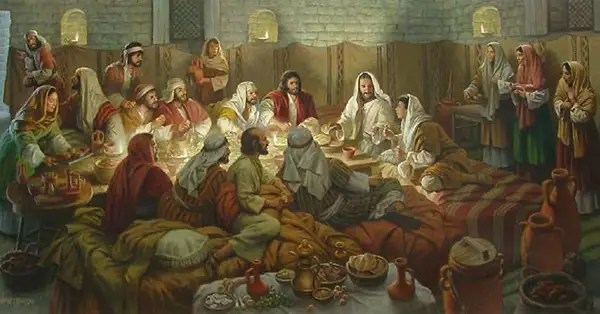
On Thursday morning, Jesus instructed His disciples on where they could prepare to celebrate the Passover, and later that evening, Jesus arrived at the location where He would celebrate His Last Supper with them. The evening began with Jesus donning the apparel of a servant and washing the disciples feet. Using this action as an object lesson, Jesus went on to teach them in the Upper Room Discourse (John 13-17) about a New Commandment, “that you should love one another.” This is why we call it “Maundy” Thursday; the name comes from the Latin mandatum which means command, “a new commandment.” During the course of the evening, Jesus predicted that the disciples would betray Him (even Peter would do so three times before the rooster crowed), and Judas left to prepare for his act of betrayal. The evening concluded with the sharing of the bread and cup as symbols of His body that was about to be broken and His blood that was about to be shed for the forgiveness of sins as the inauguration of the New Covenant. After their meal, they adjourned to the Garden of Gethsemane, and while the disciples slept, Jesus prayed three times that “this cup” (by which He meant His passion) would pass from Him. Shortly thereafter, the mob arrived, Judas completed his betrayal with a kiss, and Jesus was arrested.

Good Friday
After His arrest, Jesus was carried away to the house of the High Priest where He was subjected to a sham trial in the darkness of night. The fix was in, as they say, as one by one witnesses were brought in to make false accusations against Him, and yet, throughout it all, He remained quiet. At first light, they brought Him before the Roman authorities, because the Jewish religious leaders lacked the authority to put anyone to death, and after being examined and found innocent by both Pontius Pilate and Herod Antipas, the religious leaders stirred up the crowd to call for His death. So, Pilate offered them a choice; he would release Barabbas the murderer or Jesus, the so-called King of the Jews. Again, the religious leaders stirred up the crowd, and they called for the release of Barabbas and for the crucifixion of Jesus. Pilate gave them what they asked for; he turned Jesus over to the Romans soldiers to be mocked and beaten, and then they led him away to be crucified. At the top of Golgotha, they nailed him to a cross and crucified him between two criminals. The soldiers cast lots for His clothes, and the Jewish religious leaders mocked him. At about three in the afternoon, He cried out  with a loud voice “It is finished” and yielded up His Spirit to His Father. The Roman soldiers pierced His side with a spear to confirm that He was dead. Joseph of Arimathea requested His body and buried it in his own personal tomb before the start of the Sabbath at sundown.

Holy Saturday
The Gospels are mostly silent as to the details of Holy Saturday. Of course, it was the Jewish sabbath, a day dedicated to rest and to the worship of God, but for the followers of Jesus, this day was probably not very restful, to say the least. After all, they had just watched in horror as their beloved Master was wrongfully accused, unjustly convicted, and tragically executed. Jesus was dead, and it appeared that all their hopes had died with Him. He was supposed to be the Messiah, the prophesied and anointed King who would establish the Kingdom of God on earth, and He had been murdered, seemingly defeated by the worldly powers that be. Sure, he had predicted His own death and resurrection, but it is clear that they had no understanding of what that might mean until after all these things had taken place. On this Saturday, they were most likely overcome with grief and despair, and on top of that, there was the fear that what happened to Him might yet happen to them as well. And so, it is most likely that they spent the day locked behind closed doors cowering in terror. It was a dark day indeed, and yet, we know looking back that His death would not be the final word, that light and hope were still on the horizon. But this is the nature of Christian discipleship; sometimes we must endure the depths of the darkness before we ever begin to see the light of hope. 

Resurrection Sunday
On the first day of the week, Sunday morning, at daybreak, Mary Magdalene, Mary the mother of James, and Salome went to the tomb to anoint His body for burial; there hadn’t been time to do so on Friday due to the haste of getting Him buried before the start of the Sabbath. As they made their way to the tomb, they began to wonder how they might roll the stone away. However, when they arrived, they found the stone had already been rolled away, and when they looked inside the tomb, they were met by an angelic being who informed them of what had taken place. “Don’t be alarmed,” he told them. “You are looking for Jesus of Nazareth, who was crucified. He has risen! He is not here.” (Mark 16.6) Immediately, and with the angel’s express instruction, they returned to the city to inform the disciples of what they had seen. Of course, Peter, along with John ran off to see it for themselves, and finding it as the women had said, they were amazed at what this could mean. But Mary Magdalene stayed behind at the tomb, crying and confused. A man approached her, and at first, she did not recognize Him, assuming Him to be the gardener. “Sir, if you’ve carried him away, tell me where you’ve put him, and I will take him away.” (John 20.15) But when He called her by name, she immediately understood that this man was none other than her Lord and Savior. Later that day, He appeared to all of them in the upper room, even though the door was still locked, comforted them with the peace of His presence, and commissioned them to proclaim all that they had seen and heard.

If you are like me, and you have been raised in church, this may seem like the same ole’ story that has been told and retold too many times to count, but we must remember that this is the greatest story that has ever been told. These events are the pendulum upon which the course and destiny of human history hangs. The story of Jesus, especially His death and resurrection, are the foundation of God’s redemptive work in the world, and it is the very soul of our salvation. As followers of Jesus, we must never tire of hearing it, telling it, reading it, and singing it; we must never cease to be amazed at the wondrous work of Jesus on our behalf. And so this Holy week, let us echo the words of that great hymn writer, who wrote,

Tell me the story of Jesus
Write on my heart every word
Tell me the story most precious
Sweetest that ever was heard

~Fanny Crosby, “Tell Me the Story of Jesus”

For further study, see
On the Annual Celebration of Christmas and Easter
On the Crucifixion and Why It Matters at Christmas
On the How the Death of Jesus Changed Everything
On Why Christians Still Need the Gospel
On Remembering the Gospel
On Jesus’ Understanding of His Death
On the Season of Easter

See also:
Cook, William F., III. Jesus’s Final Week: From Triumphal Entry to Empty Tomb. Nashville, TN: B&H Academic, 2022.


On Maundy Thursday

A couple of weeks ago, Christians around the world celebrated the death and resurrection of our Lord Jesus Christ. It is a holiday that transcends all denominational lines, theological differences, national borders, language barriers, and time zones. Holy Week. Palm Sunday, Good Friday, Resurrection Sunday, these annual “holy-days” tell the story, that “old, old story, how a Savior came from glory, how He gave His life on Calvary, to save a wretch like me.” It is a time in which we pause to remember, when we focus our reflection, our worship on the good news that makes the Christian gospel unique, timeless, powerful, namely that Christ is risen. He is risen indeed. Each and every day of that week, from Palm Sunday through Resurrection Sunday, is absolutely rich, robust with significance for Christian faith and practice. However, there is one day of that week that is often neglected in the hustle and bustle that usually accompanies preparations for Easter Sunday.

On Thursday evening of our Lord’s Passion, Jesus gathered with His disciples in the upper room. The evening began with a beautiful act of loving service as Jesus washed the disciples feet. This seemingly simple moment subsequently shaped the entire evening as Jesus went on to teach them, saying, “I give you a new command: Love one another. Just as I have loved you, you are also to love one another.” (John 13.34). He then explained that this love would be the primary characteristic that would identify them as His disciples (verse 35). Of course, He would go on that evening to define this love by His own sacrificial death which would occur the following day on Good Friday (John 15.13). This is most likely why he referred to it as a “new command”. It wasn’t new in the sense that it had never been taught; in fact, the OT taught clearly that God’s people should “love your neighbor as yourself” (Lev 19.18). However, the love that Jesus was calling the disciples to that night was something more, something different, something new. This is why we traditionally refer to this day as Maundy, which comes from the Latin mandatum meaning command, “a new command.”

The evening continued around the table as they shared the Passover meal, and it concluded with the passing of the bread and cup, which Jesus reinterpreted as symbols of His body that would be broken and His blood that would be shed for the forgiveness of sins to inaugurate the New Covenant (Matthew 26.26-30). This Lord’s Supper subsequently became central to the worship of the early church. As Christians gathered each week for worship and Word, they would do so around the table; they would share a meal together which would of course include the breaking of bread and passing of the cup (c.f. Acts 2.46). This meal would eventually become known as the Agape Feast or “love feast”, so called after the new commandment that Jesus gave the disciples that Thursday night. It was a time when the followers of Christ could come together to experience the grace of fellowship that is available through the Holy Spirit.

In the modern church, this kind of observance is sadly lacking. Though a few traditions have revived the practice (for one example, click here), for the most part it is widely neglected. We are so caught up in the busyness of our own lives, that we fail to take the time to enjoy the fellowship that binds us together. Even immediate families today barely have the time to share an evening meal together, and when they do, they can hardly be bothered to look up from their screens to interact with one another. But for Jesus and His earliest followers, spending the time to share a meal together around the table was a precious gift of God. Unrushed fellowship over the course of a meal where mutual love to can be shared with one another was foundational in the weekly rhythms of the early church; it was paramount for their life together as disciples of Jesus.

We desperately need to recover this timeless grace, the age old spiritual discipline of table. Of course, this should begin with the weekly observance of the Lord’s Supper as a part of the church’s worship. This ordinance should stand at the center, alongside the preaching of the Word, as we gather together for mutual edification and encouragement every Sunday. It should not be relegated to the end of the service as an obligatory addendum. (For more on this, see my post here.) But it need not end there; it should extend from the weekly worship gathering to homes as brothers and sisters in Christ show each other the grace of hospitality, opening up their homes, sharing meals, loving one another, and doing life together. This is Jesus’ vision for Christian community, that we would love another, even as He loves us, and this is nowhere more on display than we we gather around the table.


On the Ending(s) of the Gospel of Mark

d38a6db3-bd4e-4462-b587-5e0764af14dd-mark-16

In the Sunday School class that I am a part of, we have recently been studying the history and meaning of the cross, and as a part of that study, I suggested that while the historical specifics and the theological significance of the cross are important, to truly understand the cross, we must understand it narratively as the climax of the Passion of our Lord and Savior Jesus Christ. This led the class’s facilitator to ask me to walk us through the Passion narrative, an invitation that I was more than willing to accept, and so, for more than two months, we followed in the steps of Jesus as He made his way toward the cross. And we did this by focusing specifically on Mark’s version of these events, which is recorded in chapters 11-16 of his Gospel.

It has been said that Mark’s Gospel is simply a “passion narrative with an extended introduction.” And whether that is an accurate description or not, Mark does allocate a disproportionate amount of space to the final week of Jesus’ life as compared with the first three plus years of His public ministry or, even, the thirty-some years that Jesus had lived beforehand. To be specific, Mark dedicates six entire chapters of his Gospel, some 38% if you are doing the math, to the events leading up and following Jesus’ death on the cross. Obviously, he thought that these events were of supreme significance. And so, typical of Mark’s style, these final six chapters tell the story of Jesus’ passion with such action and drama as to constantly leave the reader on the edge of their seat waiting to see what might happen next.

However, all throughout this study of Jesus’ passion week, I found myself feeling somewhat more afraid with every step we took as we moved closer and closer to the ending of Mark’s Gospel. You see, I already knew that there is a text critical question regarding Mark’s Ending, but the vast majority of the members of the class, being King James faithful, were very likely unaware of this issue. I was terrified of how they might react when I explained that Mark, chapter 16, verses 9-20, as they appear in their Bibles, are most likely secondary in nature. Well, I am glad to report that my brothers and sisters in Christ were more than gracious in accepting my explanation of the issue, which, as I had presumed, most of them had never been exposed to. But, the vast ignorance of this issue among so many Christians, especially down here in the Bible Belt, breaks my heart, so in the space that follows I would like to give a brief overview of the issues related to Mark’s ending(s).

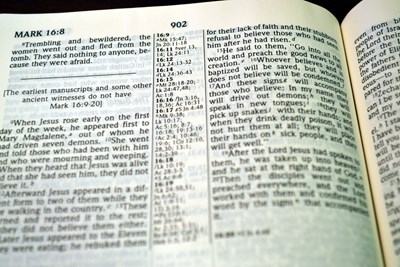
The fact of the matter is that there are actually four endings to the Gospel of Mark which are extant in the manuscript tradition. They are as follows:

  1. No ending, as is indicated in most modern translations, the earliest and most reliable manuscripts, particularly B and א, end the text of the second Gospel at verse 8.
  2. The Short Ending, immediately following 16:8, “But they reported briefly to Peter and those with him all that they had been told. And after these things Jesus himself sent out through them, from east to west, the sacred and imperishable proclamation of eternal salvation.”
  3. The Long ending (otherwise known as 16:9-20), which is included in all Bible translations that are available today, though usually with brackets, footnotes, and/or other indicators of its questionable authenticity.
  4. The Expanded ending, which expands the Long ending after verse 14, saying, “This age of lawlessness and unbelief is under Satan, who does not allow the truth and power of God to prevail over the unclean things of the spirits [or, does not allow what lies under the unclean spirits to understand the truth and power of God]. Therefore reveal your righteousness now’ – thus they spoke to Christ. And Christ replied to them, ‘The term of years of Satan’s power has been fulfilled, but other terrible things draw near. And for those who have sinned I was handed over to death, that they may return to the truth and sin no more, in order that they may inherit the spiritual and incorruptible glory of righteousness that is in heaven.”

Now, I am not here to argue the merits for or against any particular one of these four endings, but suffice it to say that the overwhelming consensus of New Testament textual scholarship has concluded that all of the endings that we have (numbers 2-4 above) are inherently secondary, and that, whether intentionally or unintentionally, the Gospel of Mark as we know it ends at 16:8. Based on both external and internal evidence considerations, this much seems reasonably certain.

However, what is important is not one’s conclusion regarding the original ending of the Gospel of Mark, but what conclusions should be drawn in light of the textual question. First, we must maintain our belief in the fundamental trustworthiness and historical reliability of the Bible in general, and of the Gospel accounts in particular. Just because the last twelve verses of the second Gospel as we know it are in question, this does not mean that the rest of the Gospel of Mark, or the other three Gospels for that matter, are inherently false. In fact, all of the events in the so-called Long Ending are attested in the other accounts, especially in Luke and Acts. Further, we must remember that we do not build theological conclusions based on the testimony of one verse in isolation. As important as scriptural citations are in establishing the Biblical basis for our theological conclusions, individual verses must be understood within the context of the whole of Holy Scripture.

Second, this does not mean that translations of the Bible which lack any indication of the textual issue, e.g. some editions of the King James Version, are fundamentally in error, or that the are trying to lead people astray. The history of the Bible in English is long and complex, and conclusions that are based on the presence and/or omission of this particular issue, or others like it, are simplistic and reductionistic. To the extent that any English translation of the Bible faithfully reflects the original text of the autographs, then it can be read with great spiritual benefit. As Jesus promised, the Spirit will lead us into all truth through His Holy Word. Ultimately, He is the one who inspired the original  biblical authors, He is the one who has providentially preserved the text, and He is the one who gives understanding of its truths and applies them to our hearts to make us more like Christ.


Slow To Write

"let every person be quick to hear, slow to speak, slow to anger."

lovegavehope

Just another WordPress.com site

Jared Cornutt

Pastor | Speaker | Writer

Denny Burk

A commentary on theology, politics, and culture

G3 Ministries

Events + Resources for the Local Church

Biblical Reasoning

Biblical and Systematic Theology According to the Scriptures

RetroChristianity

Reclaiming the Forgotten Faith

SBC Voices

Southern Baptist News & Opinion

Lucid Theology

Thoughts on words, books, theology, and life.

Baptist21

A pastor-led voice for Baptists in the 21st century

Center For Baptist Renewal

The Personal and Professional Blog of Phillip Powers

The Pastor's Well - Pastor Well

The Personal and Professional Blog of Phillip Powers

Articles - AlbertMohler.com

The Personal and Professional Blog of Phillip Powers

The Gospel Coalition

The Personal and Professional Blog of Phillip Powers